Premium Sliding Glass Patio Doors: Installation and Replacement
By Housey · Last reviewed 4th of May 2026
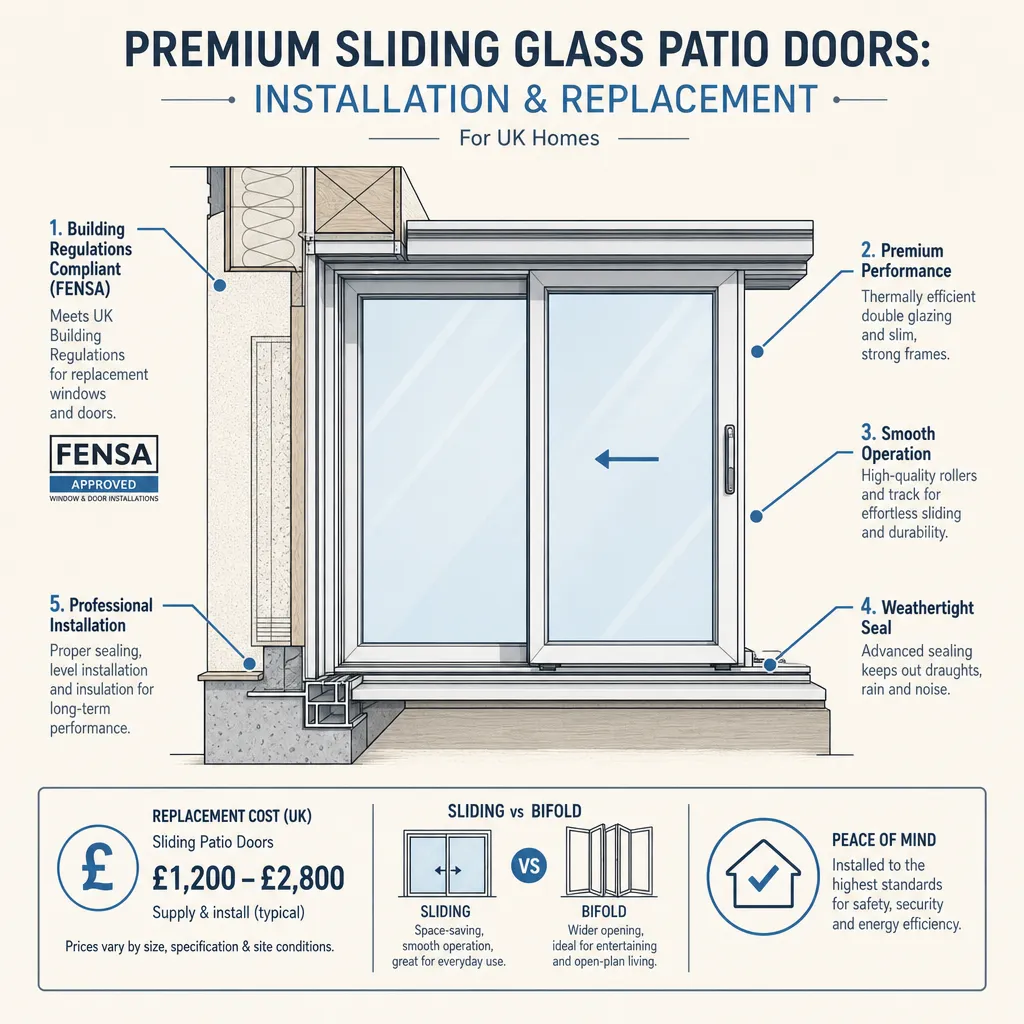
Premium Sliding Glass Patio Doors: Installation and Replacement
Sliding glass patio doors are one of the most popular ways to connect a rear-facing living space with a garden or terrace, and they appear in everything from ground-floor kitchen-diner refurbishments to single-storey extension completions. Whether you are replacing a dated set of 1980s aluminium sliders or specifying a new installation as part of a larger project, getting the glazing specification, thermal performance, and installer certification right matters both for the finished result and for your compliance with Building Regulations — and for the documentation pack you will need when you come to sell.
Key points
- Replacement sliding patio doors with more than 60% glazed area must achieve a maximum whole-unit U-value of 1.4 W/m²K under Approved Document L1B (Conservation of fuel and power: existing dwellings, 2022 edition).
- Installation by a FENSA- or CERTASS-registered company allows the work to be self-certified under Building Regulations, bypassing a separate local authority Building Control application.
- Replacing rear patio doors with a new set of similar dimensions is generally permitted development in England — planning permission is not usually required unless the property is listed, in a conservation area with an Article 4 Direction, or a flat.
- Sliding doors require a continuous, level threshold and an unobstructed floor track; structural preparatory work — including a new lintel — is likely if the opening width is being altered.
- Fitted costs for premium aluminium double-glazed sliding patio doors typically range from approximately £1,500 to over £5,000, depending on width, frame material, glazing specification, and configuration. Indicative UK costs, last reviewed 2026-05-04.
Types of sliding patio door
Sliding patio doors travel horizontally on tracks rather than swinging outward. The most common configurations in UK residential use are:
- Two-panel (OX or XO): one fixed panel, one sliding panel — practical for standard rear openings of 1.6 m–2.4 m wide.
- Three-panel (OXO): central sliding panel flanked by two fixed lights — suited to wider openings of 2.4 m–3.6 m.
- Four-panel (OXXO): two sliding panels that meet in the centre — useful for wide openings up to 4.8 m without the folding mechanism required by bifold doors.
- Inline sliding systems: premium multi-panel arrangements where all panels slide — common in architectural new-build and high-specification renovations.
Frame materials compared
Frame material | Typical whole-unit U-value | Maintenance | Typical lifespan | Notes |
|---|---|---|---|---|
Aluminium (warm-edge thermal break) | 1.0–1.6 W/m²K | Low — wipe clean | 30–50 years | Slim sightlines, premium look |
uPVC | 1.2–1.6 W/m²K | Low | 20–35 years | Lower cost, wider profiles |
Timber | 1.2–1.8 W/m²K | Moderate — periodic redecoration | 30–50+ years | Suits heritage or period contexts |
Timber-aluminium composite | 0.9–1.4 W/m²K | Low externally | 30–50 years | Timber interior, aluminium exterior cladding |
U-values are indicative whole-unit figures; always confirm actual product performance data with the manufacturer or installer before specifying.
Do sliding patio doors need planning permission?
In most cases, replacing existing patio doors with a new set of similar dimensions does not require planning permission in England under the Town and Country Planning (General Permitted Development) (England) Order 2015.
Planning permission may be required if:
- The property is a listed building — Listed Building Consent is needed for any replacement that affects the character of the building.
- The property is in a conservation area where an Article 4 Direction has removed permitted development rights for door and window changes.
- You are increasing the size of the opening — structural changes to an external wall may require a planning application or at minimum Building Control sign-off for structural alterations.
- The property is a flat or maisonette — permitted development rights differ significantly from those for houses.
Always check with your local planning authority (LPA) before starting work if any of these circumstances apply. The Planning Portal guidance on windows and doors provides an interactive overview of when permission is and is not required.
Building Regulations and thermal performance
All replacement glazed doors in England must comply with Approved Document L1B (Conservation of fuel and power: existing dwellings). The 2022 edition sets the following minimum standards for replacement doors:
- Doors with more than 60% glazed area: maximum whole-unit U-value of 1.4 W/m²K.
- Doors with 60% or less glazed area: maximum U-value of 1.6 W/m²K.
Most FENSA- or CERTASS-registered installers will confirm compliance as part of their service and issue a certificate on completion. If your installer is not registered with a competent person scheme, you must apply to your local authority Building Control department before work begins. The completion certificate should be retained with your property records — it is routinely requested during conveyancing.
FENSA (Fenestration Self-Assessment Scheme) and CERTASS are the two main competent person schemes for window and door installation in England and Wales. Absence of a certificate — from either scheme or from Building Control — can complicate a future sale.
Glazing and security specification
Most premium sliding doors are supplied with double-glazed units as standard, with triple glazing available as an upgrade. For a rear-facing door in a well-heated UK home, double glazing with a low-emissivity (low-e) coating and argon gas fill is usually sufficient to meet Part L.
Additional glass options to consider:
- Solar control glass (e.g., coating types such as SGG Cool-Lite): reduces summer overheating in south- or west-facing openings.
- Acoustic glass: relevant for urban properties or those near busy roads.
- Laminated inner pane: improves security and reduces injury risk from glass breakage.
For security, look for:
- Multi-point locking mechanisms.
- Anti-lift devices on the sliding panels.
- Toughened or laminated safety glass to BS EN 12150 or equivalent.
- PAS 24:2016 accreditation — the enhanced security performance standard for doors and windows, which underpins Secured by Design certification.
Sliding vs bifold vs French doors: which is right for you?
Door type | Best for | Not ideal for | Typical clear opening | Main consideration |
|---|---|---|---|---|
Sliding (2-panel) | Moderate openings, low maintenance, slimline appearance | Maximum clear opening width | ~50% of total frame width | Track must be kept clean and unobstructed |
Sliding (multi-panel) | Wide openings, architectural aesthetic | Budget-conscious projects | Up to 75% of total frame width | Higher cost than bifold at comparable widths |
Bifold | Maximum clear opening, indoor-outdoor flow | Tight spaces (panels fold inward or outward) | Up to 90% of total frame width | Hinges and compression seals need periodic maintenance |
French doors (outswing) | Traditional aesthetic, lower cost | Wide openings, step-free threshold access | Full width of two panels | Requires external clearance for outward swing |
French doors (inswing) | Period properties, conservation area contexts | Internal furniture clearance required | Full width of two panels | Less common in UK residential use |
What to ask before accepting a quote
Use this checklist when comparing quotes from installers:
- What is the whole-unit U-value of the specific door system being quoted?
- Is the installer FENSA- or CERTASS-registered? Who will issue the compliance certificate?
- Does the quote include VAT, waste removal, making good around the frame, and any threshold or drainage work?
- What glass specification is included — standard clear, low-e, solar control, acoustic?
- Does the locking system meet PAS 24:2016 or Secured by Design requirements?
- What is the lead time from order to installation?
- Does the quote cover structural lintels or associated works if the opening is being altered?
- What are the warranties on the frame, glass unit, and hardware respectively?
- What happens if access issues or hidden structural problems are discovered on installation day?
When to get professional help
Most sliding patio door installations require a qualified, FENSA- or CERTASS-registered installer — this is not a straightforward DIY project for most homeowners. Seek additional professional advice when:
- The opening width is being changed — new lintels and structural making good are almost certainly required; appoint a structural engineer or experienced contractor.
- The property is listed or in a conservation area — check planning obligations with the LPA before ordering anything.
- The existing threshold or floor is uneven — levelling work and drainage detailing may be required to achieve a compliant weatherseal.
- The installation is part of a wider extension or renovation — the door specification should be coordinated with the structural frame, insulation strategy, and airtightness layer.
- Automated sliding systems or threshold heating are specified — any electrical work must be carried out by a qualified electrician under Part P of Building Regulations.
How Housey can help
Housey can help you compare proposals from vetted window and door installers across the UK. Submit a quote request to receive responses from local, certificated installers who can advise on specification, planning considerations, Building Regulations compliance, and security standards.
Frequently asked questions
Do I need planning permission to replace my sliding patio doors?
In most cases, replacing existing patio doors with a new set of similar dimensions does not require planning permission under permitted development rights in England. Exceptions include listed buildings, which require Listed Building Consent, conservation areas where an Article 4 Direction applies, and flats. Always check with your local planning authority if any of these circumstances apply to your property.
What does FENSA certification mean for patio door installation?
FENSA is a UK competent person scheme allowing registered window and door installers to self-certify that their work complies with Building Regulations without a separate local authority Building Control application. A FENSA certificate is issued on completion and should be kept with your property documents. Absence of a certificate can delay conveyancing when you come to sell.
How long does it take to install sliding patio doors?
A like-for-like replacement in an existing opening typically takes one to two days. If the opening is being enlarged and structural work such as a new lintel is required, allow an additional one to three days for structural making good before the door system is fitted.
What U-value should sliding patio doors have?
Under Approved Document L1B (2022, existing dwellings in England), sliding doors with more than 60% glazed area must achieve a whole-unit U-value of 1.4 W/m²K or better. Most modern double-glazed aluminium and uPVC systems meet this threshold. Triple-glazed units typically achieve 0.8–1.0 W/m²K.
Can I install sliding patio doors myself?
DIY installation is physically possible, but replacement glazed doors are subject to Building Regulations. Unless you notify your local authority Building Control and demonstrate compliance yourself, the practical route is a FENSA- or CERTASS-registered installer who self-certifies the work. Uncertified installation without a compliance certificate can complicate a future property sale.
Sources and further reading
- Building Regulations Approved Document L1B — GOV.UK / DLUHC
- FENSA: homeowner guidance — FENSA
- CERTASS: homeowner information — CERTASS
- Planning Portal: windows and doors — Planning Portal
- Secured by Design: residential guidelines — Secured by Design (Police Crime Prevention Initiatives)
Useful next reads
 Improvement & Build
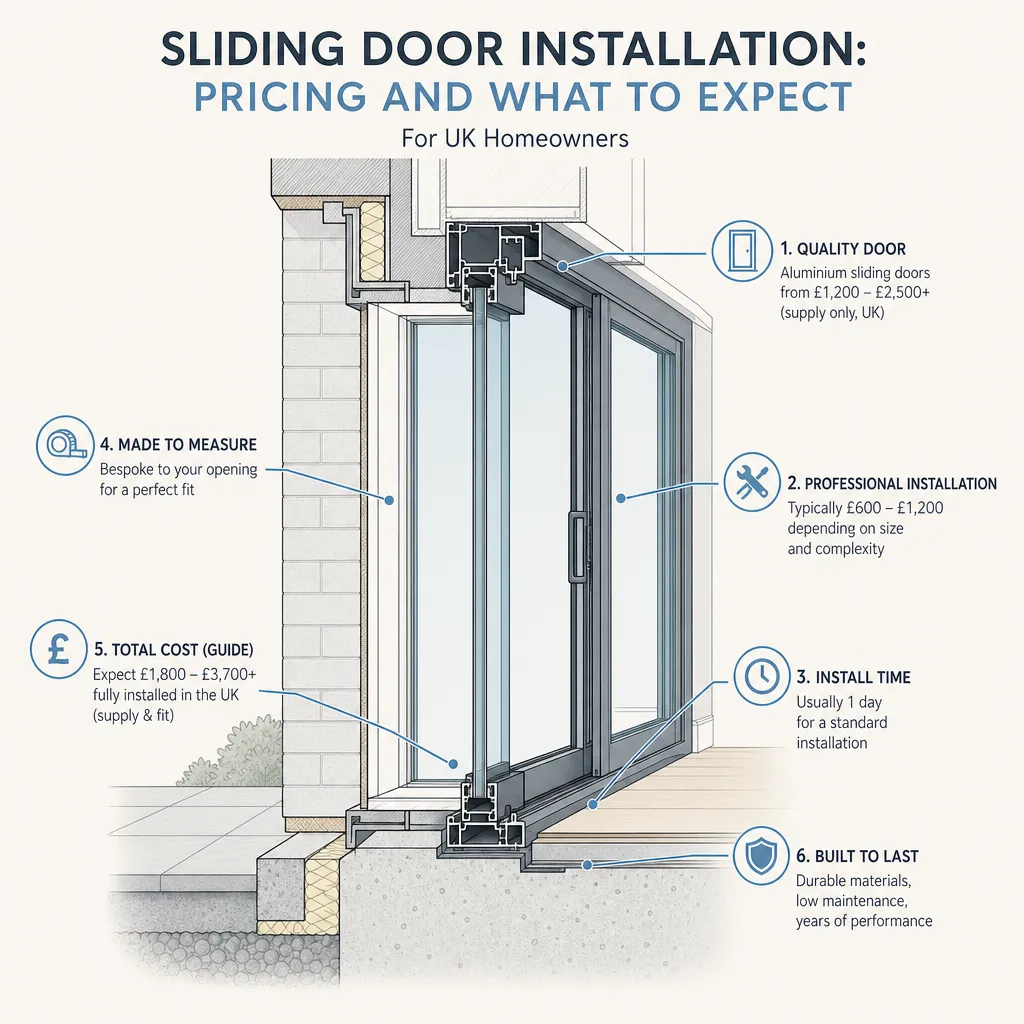
Sliding door installation: pricing and what to expect
A new sliding patio door in the UK typically costs £800–£3,000 fully installed, depending on size, material, and glazing specification.
 Improvement & Build
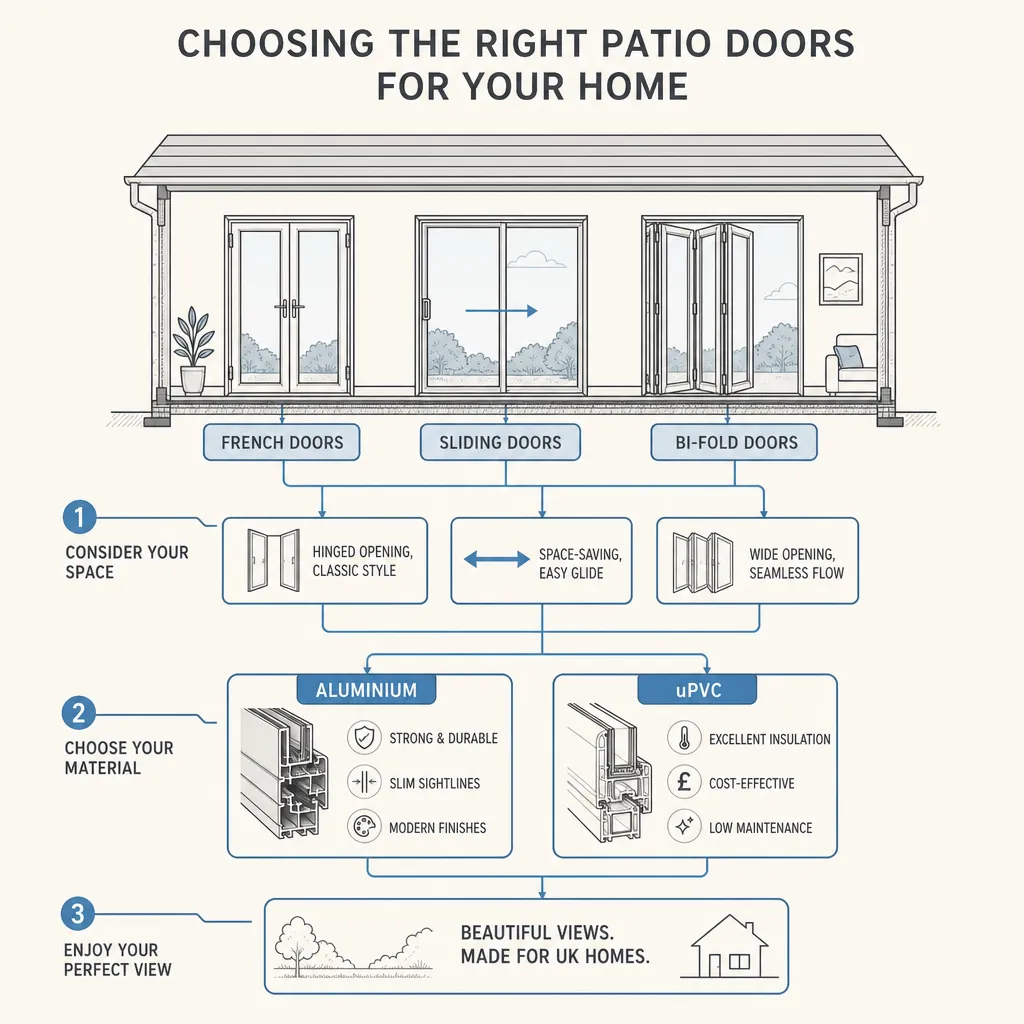
Choosing the Right Patio Doors for Your Home
The right patio doors depend on your opening width, available swing space, home style, and budget.
 Improvement & Build
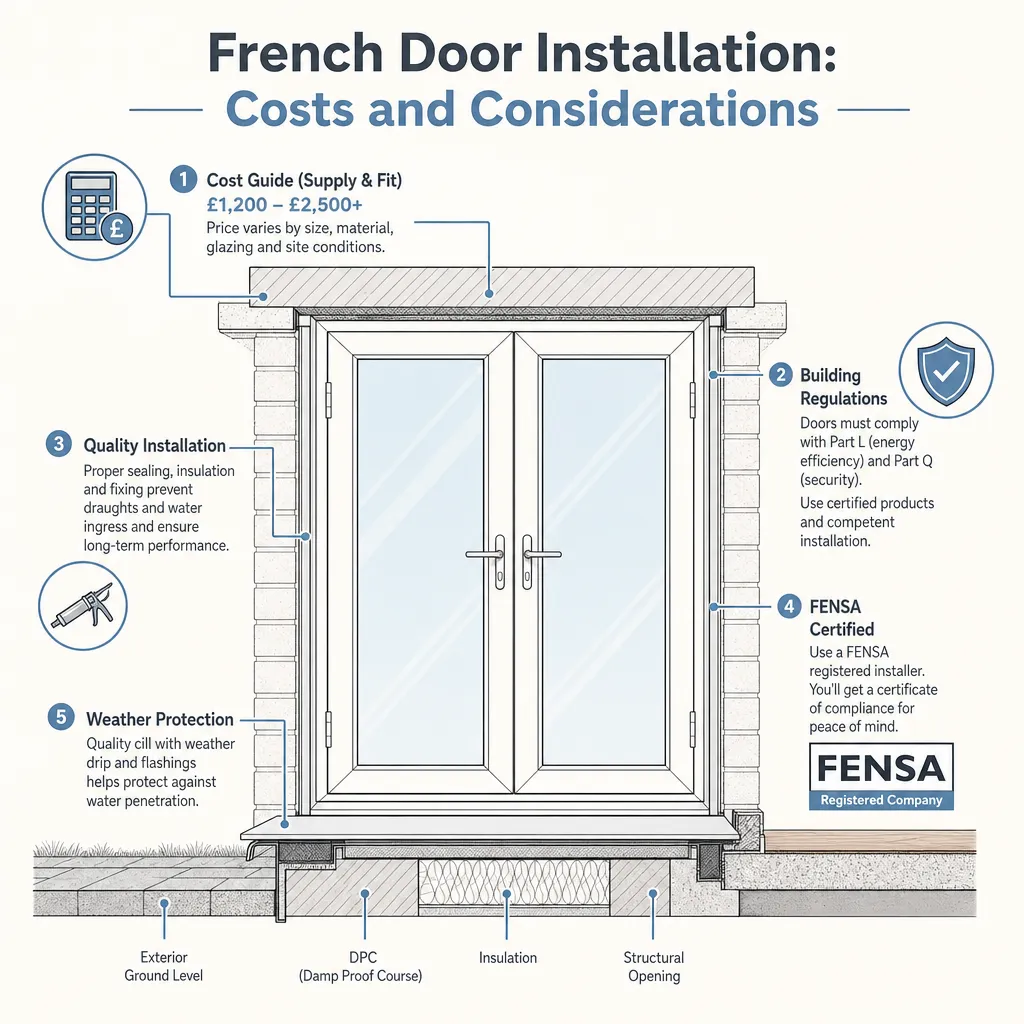
French Door Installation: Costs and Considerations
External French door installation typically costs £1,500–£4,000 in the UK, including supply and fitting, depending on material, glazing specification, and whether structural alterations are needed.
 Improvement & Build
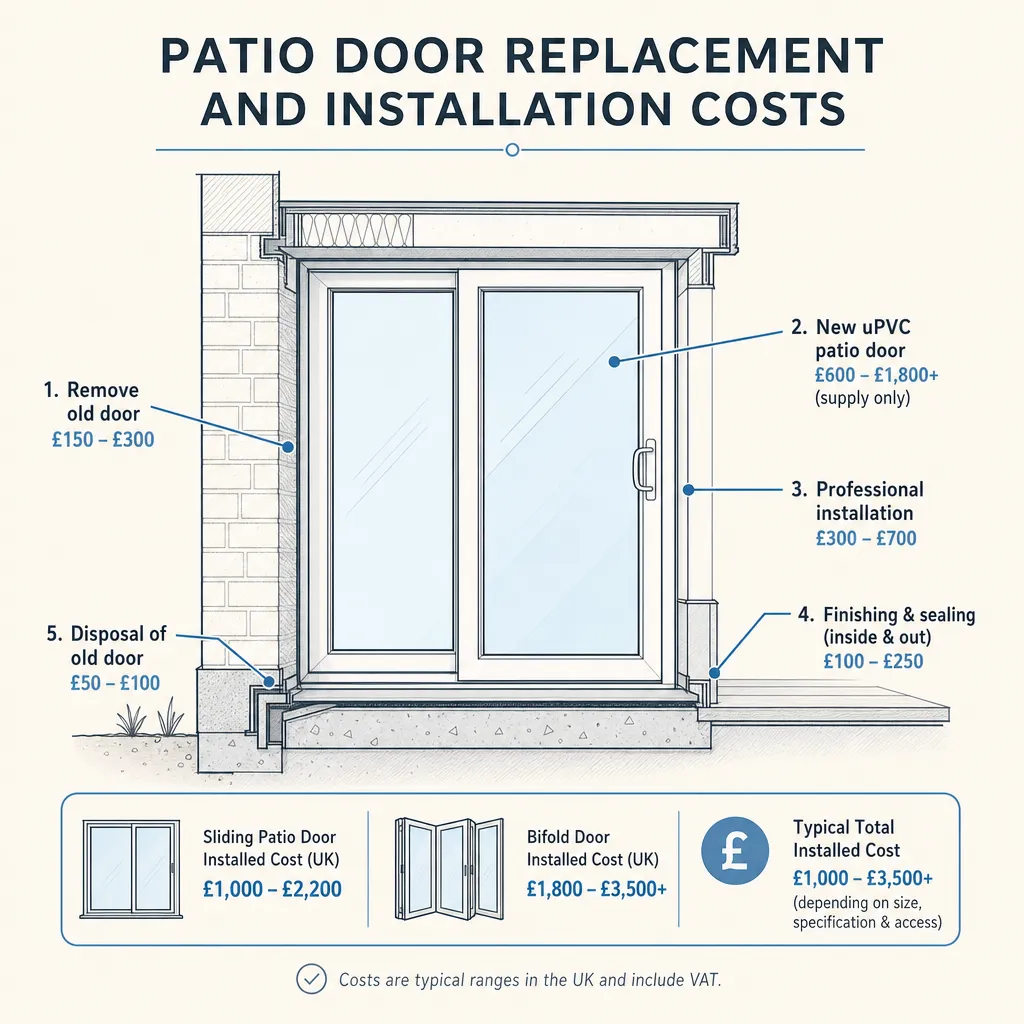
Patio Door Replacement and Installation Costs
Replacing patio doors in the UK typically costs £800–£2,000 installed for a standard uPVC sliding unit, rising to £3,000–£8,000 or more for aluminium bifold doors.
 Improvement & Build
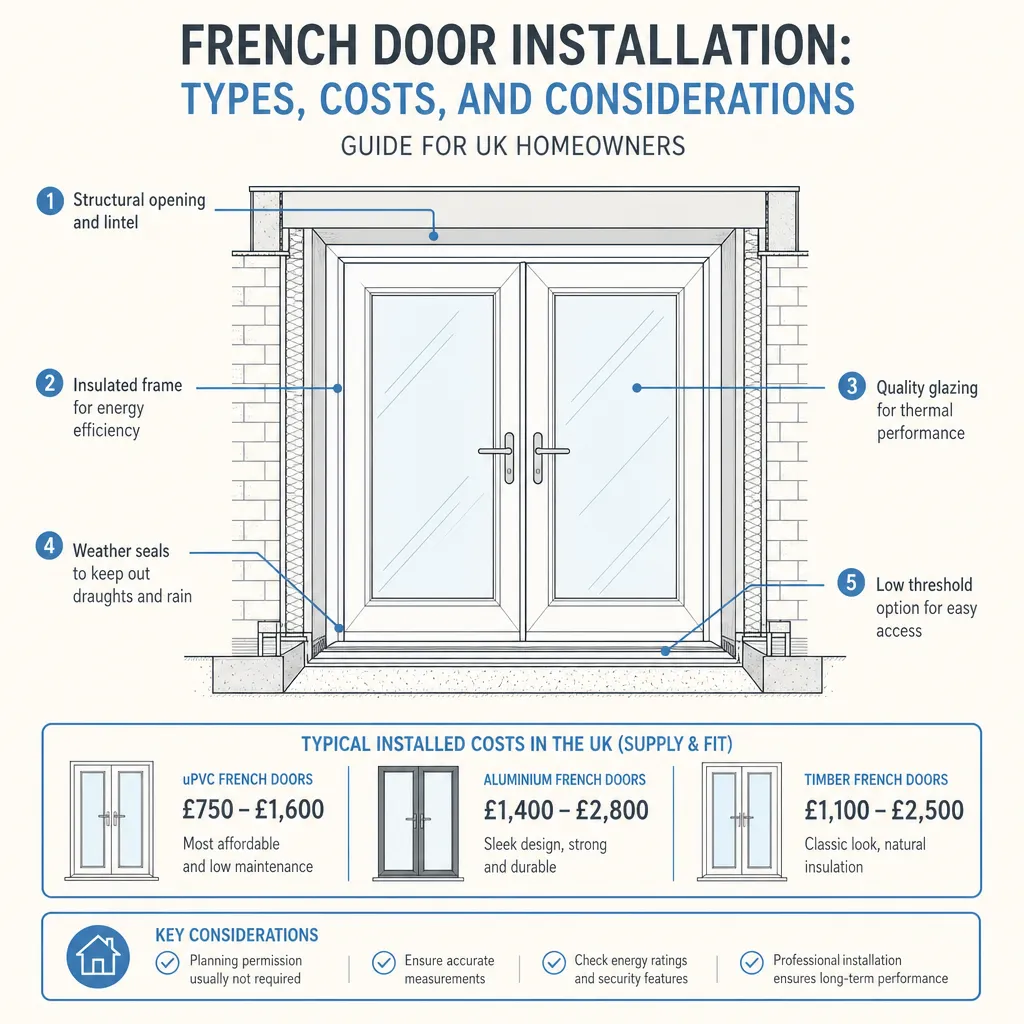
French Door Installation: Types, Costs, and Considerations
French doors in the UK cost roughly £1,500–£3,000 for uPVC and £2,500–£6,000 or more for aluminium or timber, installed.