Replacing or Upgrading Old Building Insulation: What You Need to Know
By Housey · Last reviewed 1st of June 2026
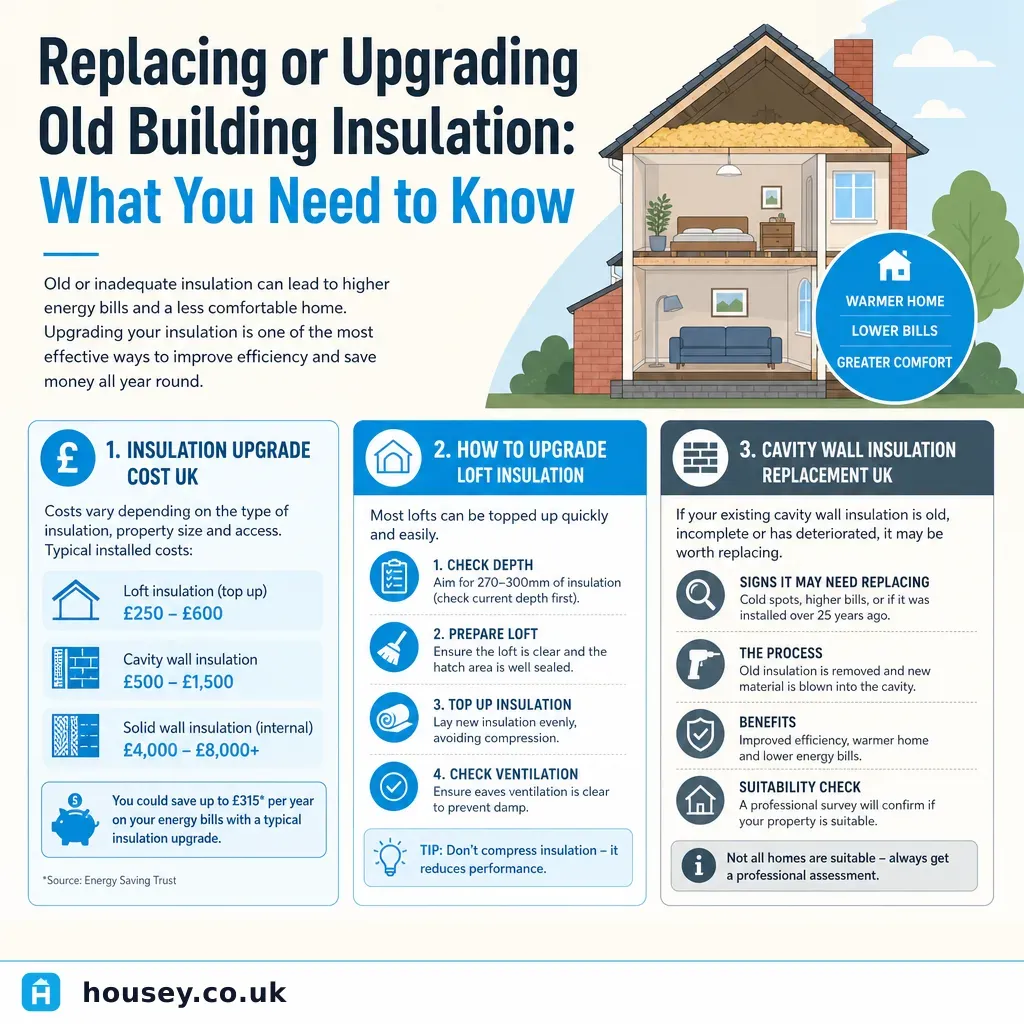
Replacing or Upgrading Old Building Insulation: What You Need to Know
Millions of UK homes still have insulation that was installed to standards set 20, 30, or even 40 years ago — or that has since settled, degraded, or been disturbed by subsequent building work. For homeowners weighing up whether to top up, replace, or commission a coordinated retrofit, the decision involves more than simply adding more material: construction type, moisture behaviour, ventilation, and the regulatory framework that governs any grant-funded work all play a significant role.
Key points
- Building Regulations Approved Document L (Conservation of Fuel and Power, 2021 edition) sets threshold U-values for insulation upgrades in existing dwellings: 0.16 W/m²K for roofs and 0.18 W/m²K for cavity walls.
- The Energy Saving Trust recommends a minimum of 270mm of glass mineral wool in an accessible pitched-roof loft; anything below 100mm is considered significantly below current best practice.
- Any work funded through ECO4 or the Great British Insulation Scheme (GBIS) must comply with PAS 2035:2023 and requires a qualified Retrofit Assessor and Retrofit Coordinator.
- Cavity wall insulation installed before 1995 may contain urea-formaldehyde (UF) foam, which can degrade over time and is associated with moisture ingress; specialist assessment is needed before adding new insulation.
- Solid-wall insulation (internal or external) can alter the thermal and moisture balance of a building envelope; a pre-works moisture risk assessment is a core requirement under PAS 2035.
How to tell whether your insulation needs replacing or upgrading
Several signs point to inadequate or degraded insulation in a UK property:
- Loft insulation below 100mm — visible when you open the hatch. Current best practice is 270mm of mineral wool laid in two layers at right angles.
- Cold spots on internal walls — particularly in pre-1920s solid-wall properties with no existing internal or external insulation.
- High heating bills despite a modern boiler — an EPC assessment can help pinpoint where heat loss is greatest.
- Visible gaps, slumping, or rodent damage in loft insulation, especially loose-fill vermiculite or older glass wool that has compressed over decades.
- Damp patches following cavity wall insulation — a recognised risk with older UF foam installations or where cavities were not inspected by borescope before injection.
- A borderline EPC rating — homes targeting Band C or above for a sale, new tenancy, or retrofit scheme will often require insulation upgrades.
An EPC prepared by an accredited Domestic Energy Assessor (DEA) will identify current insulation levels and recommend specific upgrades. You can check your property's current EPC rating on the GOV.UK energy certificate register.
Which insulation upgrade applies to your home
The right approach depends on your home's age, wall construction, and whether existing insulation can be retained or must be removed first.
Property type | Typical existing insulation | Upgrade options | Key risk |
|---|---|---|---|
Pre-1920s solid brick or stone | None, or thin internal board | External wall insulation (EWI) or internal wall insulation (IWI) | Moisture entrapment, interstitial condensation |
1930s–1970s unfilled cavity wall | None, or aged blown fibre | Cavity wall insulation (CWI) fill or top-up | Bridged cavity, water ingress if cavity has rubble debris |
1970s–1990s cavity wall with UF foam | Degraded UF foam | UF foam removal or encapsulation, then re-fill | Residual damp, specialist extraction required |
Post-1990 cavity wall | Partial insulation (early Part L) | CWI top-up or full re-fill | Generally lower risk; check original installation record |
Timber-frame home | Batts between studs (if filled at all) | Internal board upgrade or breathable membrane addition | Vapour control layer critical; risk of trapped moisture |
Accessible pitched-roof loft | Thin or compressed mineral wool | Top-up to 270mm, or rigid boards if converting to habitable use | Generally straightforward; maintain 50mm ventilation gap at eaves |
Indicative UK property types only. Always confirm construction type with a surveyor or Retrofit Assessor before specifying works.
PAS 2035: the retrofit standard that governs funded work
PAS 2035:2023 is the publicly available specification for whole-house retrofit in the UK, published by BSI. It is mandatory for any work funded through ECO4 and GBIS, and it sets out a coordinated approach to improving a home's energy performance while managing fabric and moisture risks.
Under PAS 2035:
- A Retrofit Assessor surveys the property and produces a Retrofit Assessment covering the building fabric, heating services, and occupancy conditions.
- A Retrofit Coordinator (holding a qualification such as Elmhurst, ABBE Level 5, or equivalent) oversees the design and delivery of improvement measures.
- Medium and high-risk measures — including solid wall insulation and some floor insulation types — require a full Retrofit Assessment and a Medium or High Risk Retrofit Design before installation proceeds.
Even where works are not grant-funded, following PAS 2035 principles is strongly advisable for solid-wall or moisture-sensitive upgrades in older UK properties. The standard is published by BSI and its requirements are referenced in ECO4 and GBIS guidance from Ofgem.
Moisture and ventilation: the risk you cannot ignore
Insulation upgrades in older UK properties carry a real risk of altering the moisture balance of the building envelope. The most common problems are:
- Interstitial condensation — warm moist air migrates through the structure and condenses at a cool interface within the wall. Adding insulation changes the position of that dew point interface, which can cause concealed dampness if not correctly managed.
- Persistent cold bridges — at window reveals, floor-wall junctions, and lintels — can remain or worsen if the insulation specification does not adequately address them.
- Reduced background ventilation — a tighter building envelope can cause surface condensation and mould growth unless ventilation is also improved, typically via trickle vents, mechanical extract ventilation (MEV), or mechanical ventilation with heat recovery (MVHR).
PAS 2035 requires that moisture risk is formally assessed before specifying wall insulation in at-risk properties. Do not rely on a contractor's verbal assurance; ask for a written moisture risk assessment as part of the Retrofit Assessment documentation.
Grants and funding available in England in 2026
Several schemes may reduce the cost of insulation upgrades, depending on household income, property type, and EPC rating:
- ECO4 (Energy Company Obligation 4): Targets low-income and fuel-poor households in properties rated EPC Band D–G. Insulation is a primary eligible measure. Contact your energy supplier or check eligibility via GOV.UK.
- Great British Insulation Scheme (GBIS): Targets homes in Council Tax Bands A–D (or A–E for lower-income households). Administered through Ofgem. Focuses on a single poorly insulated element rather than a whole-house approach.
- Local authority schemes: Some councils operate Warmer Homes or Home Upgrade Grant (HUG2) programmes for fuel-poor households. Check your local authority's website.
All ECO4 and GBIS installations must be carried out by TrustMark-registered contractors. Approved Document L applies regardless of whether funding is used.
Important limitations
This article provides general information about insulation upgrade options and the regulatory framework in England. Grant eligibility, U-value thresholds, and approved methods may differ in Scotland (where the Scottish Government operates its own energy efficiency programmes), Wales (Warm Homes Wales), and Northern Ireland.
Insulation specifications vary significantly by property age, construction method, and condition. This guide does not constitute a Retrofit Assessment and should not be used as the basis for specifying insulation works. A qualified Retrofit Assessor or energy surveyor should inspect the property before any substantive upgrade is commissioned.
When this becomes urgent
Seek professional advice promptly if:
- Damp patches have appeared on internal walls following previous cavity wall insulation work.
- You can see or smell mould in rooms that were not previously affected.
- Your EPC certificate notes that existing insulation is defective or was incorrectly installed.
- You are planning to sell, let, or remortgage and the property is rated EPC Band F or G — minimum energy efficiency standards apply to rental properties in England and Wales.
- The property is listed or in a conservation area, where acceptable materials and approved methods are restricted by planning law.
What to ask a qualified professional
Before instructing a Retrofit Assessor or insulation installer, ask the following:
- Is the contractor TrustMark-registered and familiar with PAS 2035 requirements for this specific construction type?
- Will a full Retrofit Assessment be carried out before any works are specified?
- How will moisture and ventilation risks be formally assessed and managed?
- For cavity wall properties: will a borescope inspection be carried out before injection to check cavity condition, debris, and wall tie state?
- What U-value will the completed installation achieve, and how will this be verified on site?
- Is the existing insulation being removed, encapsulated, or retained — and what is the stated rationale?
- Which grant schemes, if any, apply to this property, and what documentation will be needed to apply?
When to get professional help
If you are unsure whether your existing insulation needs replacing or topping up, an EPC from an accredited DEA is a low-cost starting point. For solid-wall properties, older cavity walls, or any funded works under ECO4 or GBIS, a Retrofit Assessor qualified under PAS 2035 is the appropriate professional.
Red flags that require immediate professional involvement:
- Damp staining or efflorescence on internal walls following previous insulation works
- Mould or condensation that has noticeably worsened since works were carried out
- Bulging, spalling, or cracking of external render on a property with existing external wall insulation
- Any suspicion that the existing insulation contains asbestos — possible in some pre-1985 loose-fill installations. Do not disturb the material; contact a licensed asbestos surveyor.
How Housey can help
Housey connects homeowners with qualified insulation installers and accredited professionals for retrofit assessments, who can survey your property, advise on the most appropriate upgrade for your construction type, and manage the grant application process where applicable.
Frequently asked questions
Does replacing loft insulation require planning permission?
In most cases, no. Topping up or replacing loft insulation is not notifiable under planning rules and does not require building regulations approval for a like-for-like upgrade in an existing loft. However, if the loft is being converted to a habitable room, a full building regulations application is required, covering insulation, fire safety, structural elements, and means of escape.
Can cavity wall insulation be removed if it has caused damp problems?
Yes. UF foam or poorly installed blown-fibre insulation can sometimes be extracted or encapsulated, though extraction is a specialist process. A surveyor or damp specialist should assess the severity of the problem before removal is specified, and the underlying cause of damp must be identified and addressed before any new insulation is installed.
Is solid wall insulation worth it for a Victorian terrace?
Solid wall insulation can significantly improve thermal comfort and reduce heating bills in pre-1920s solid-brick homes, which typically have uninsulated U-values of around 2.1 W/m²K. It is among the more expensive and complex retrofit measures, however, and a moisture risk assessment under PAS 2035 is essential before any works proceed.
Does external wall insulation require planning permission?
EWI changes the external appearance of a property and may affect permitted development rights, particularly on detached homes or where the installation takes the wall beyond the permitted boundary. Check with your local planning authority before commissioning works, and always seek listed building consent if the property is listed or in a conservation area.
Sources and further reading
- Building Regulations Approved Document L (2021) — GOV.UK / DLUHC
- PAS 2035:2023 — Retrofitting dwellings for improved energy efficiency — BSI
- Loft insulation guidance — Energy Saving Trust
- ECO4 scheme guidance — Ofgem
- Great British Insulation Scheme — Ofgem
- Find an energy performance certificate — GOV.UK
Useful next reads
 Energy & Retrofit
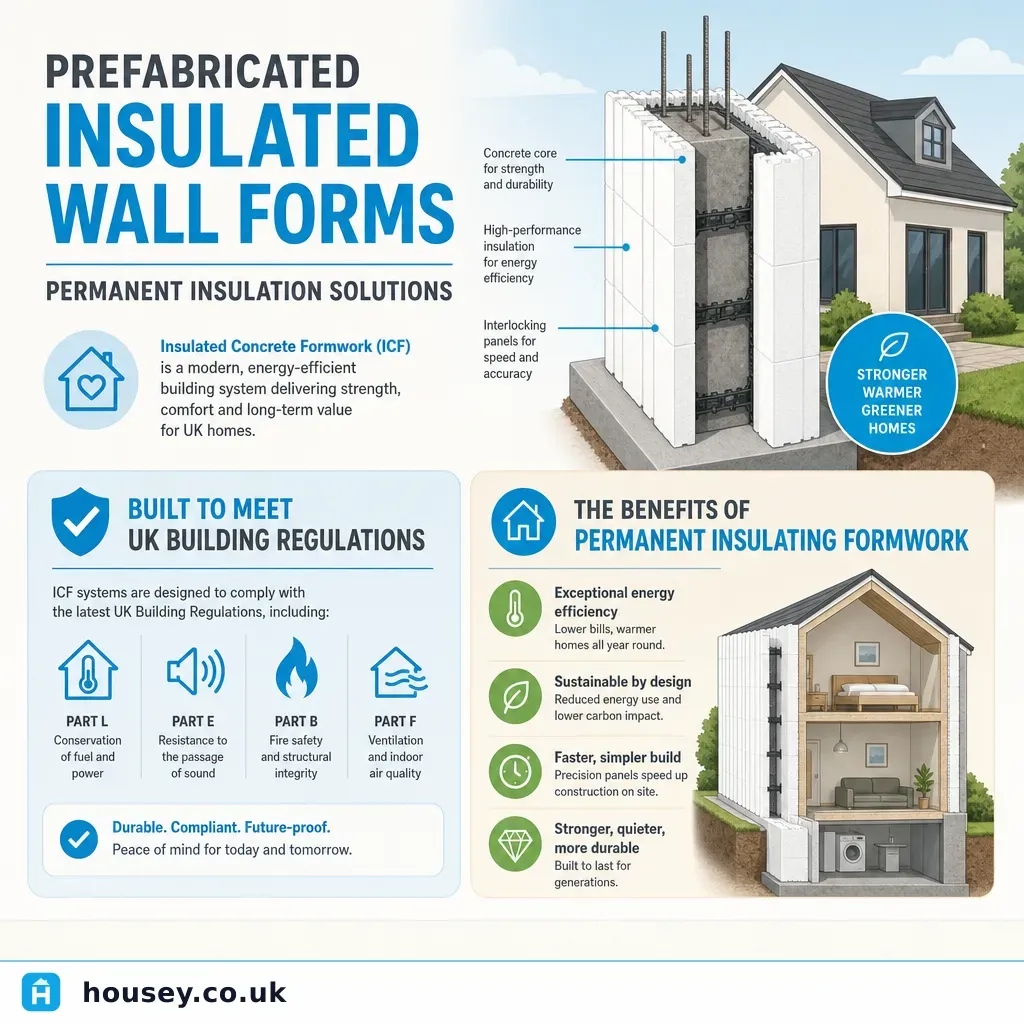
Prefabricated Insulated Wall Forms: Permanent Insulation Solutions
Prefabricated insulated wall forms — including ICF and SIPs systems — deliver high thermal performance by combining permanent insulation with structural concrete or timber in a single wall assembly.
 Energy & Retrofit
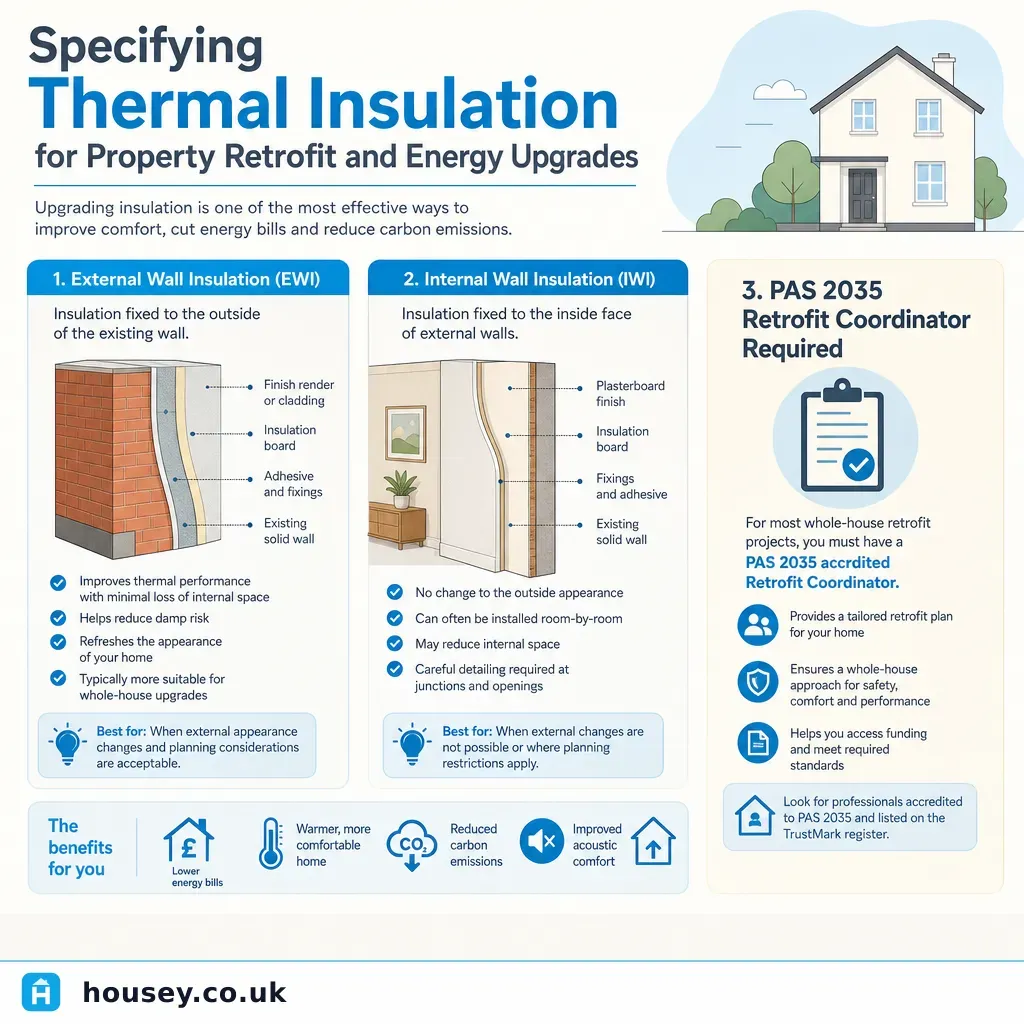
Specifying Thermal Insulation for Property Retrofit and Energy Upgrades
Specifying thermal insulation for UK retrofit requires matching the product to your property's construction, moisture conditions, and heating system.
 Energy & Retrofit
Improving Home Energy Efficiency through Secondary Glazing Solutions
Secondary glazing fits an additional pane inside your existing window reveal, reducing heat loss and noise without replacing the original frame.
 Energy & Retrofit
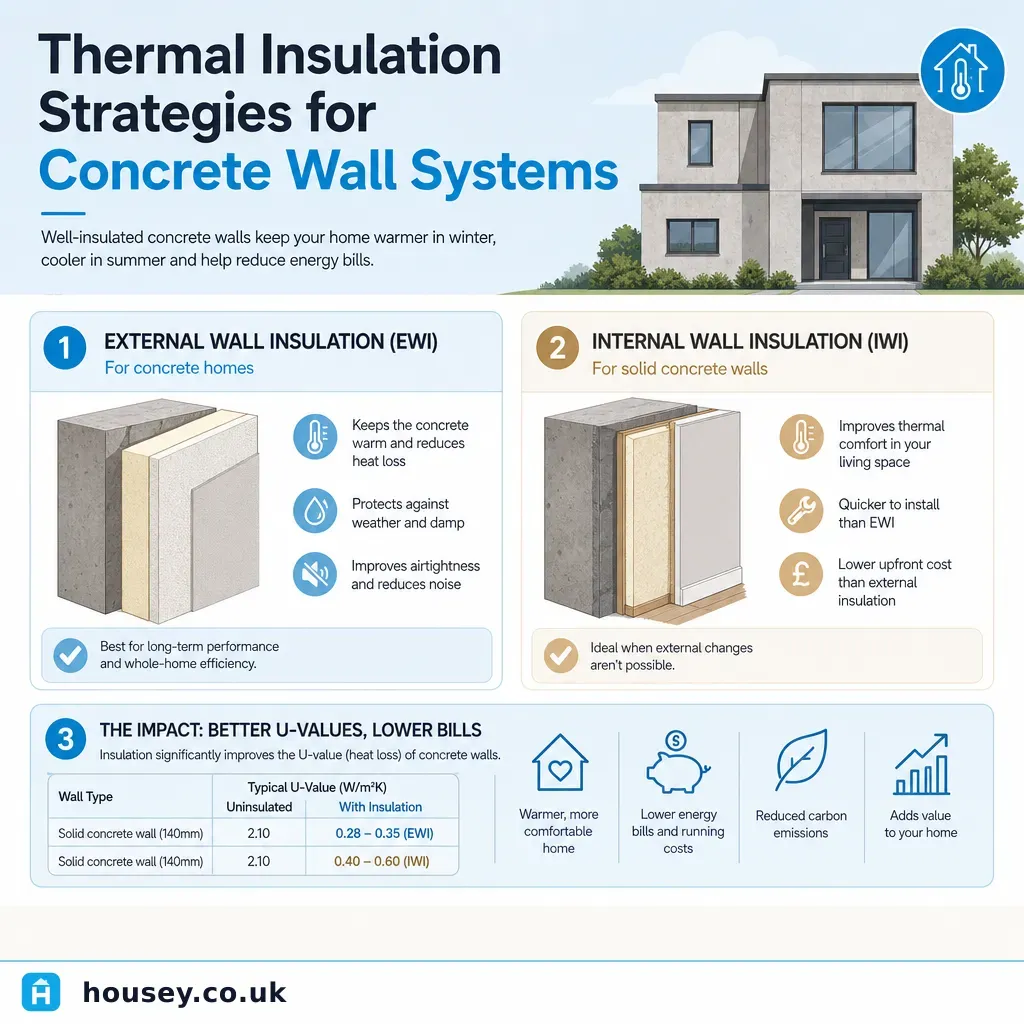
Thermal Insulation Strategies for Concrete Wall Systems
Concrete walls can be insulated using three main approaches: external wall insulation (EWI), internal wall insulation (IWI), or — where a cavity exists — cavity fill.
 Energy & Retrofit
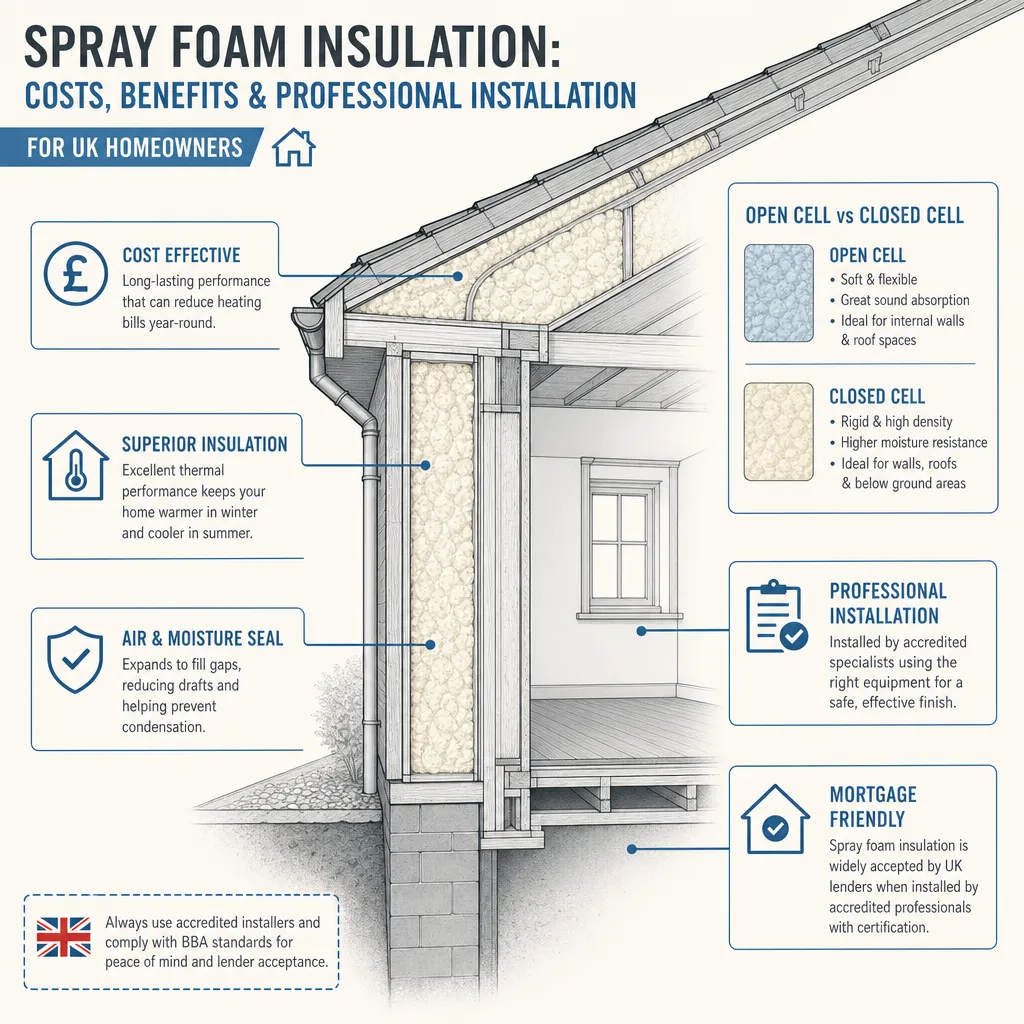
Spray foam insulation: costs, benefits and professional installation
Spray foam insulation costs between £15 and £60 per square metre installed in the UK, depending on whether open-cell or closed-cell foam is used.