Stone Wall Construction: Garden Boundaries, Retaining Walls and Costs
By Housey · Last reviewed 24th of May 2026
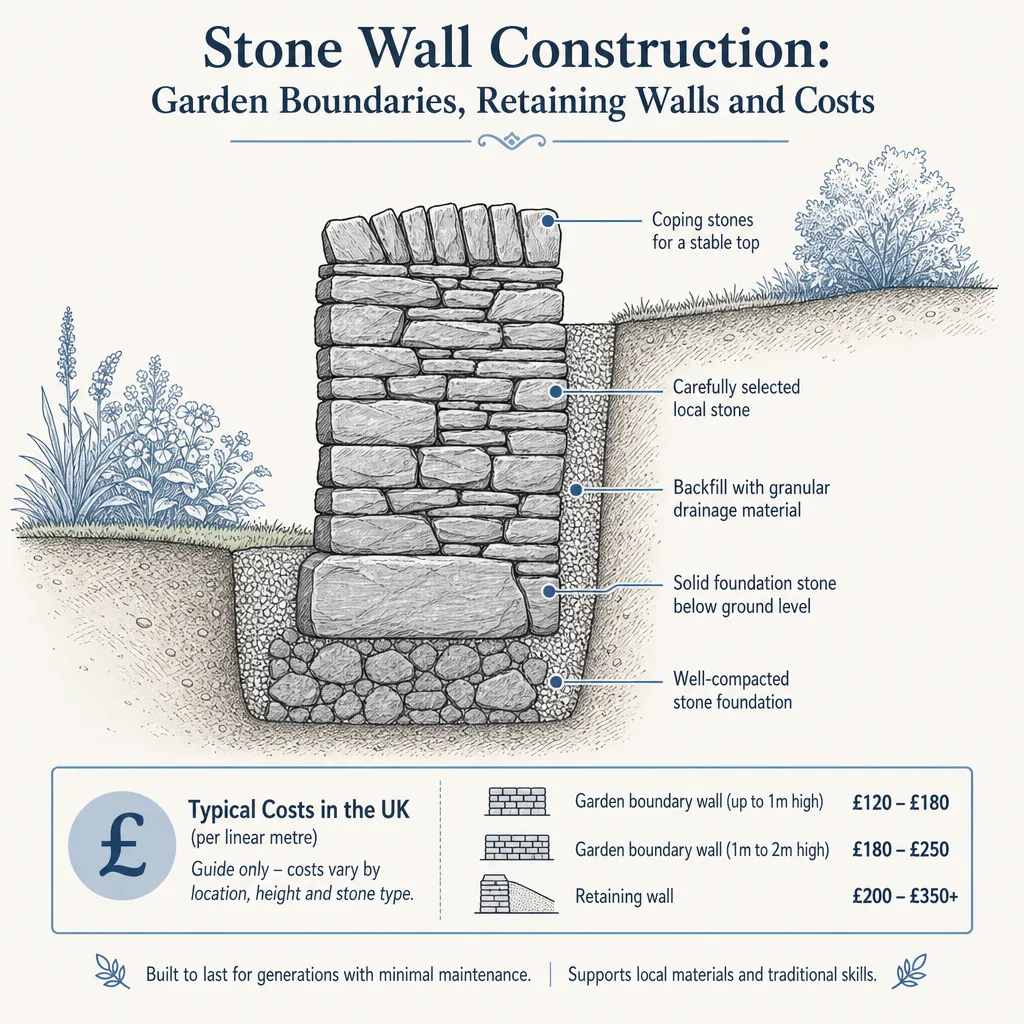
Stone Wall Construction: Garden Boundaries, Retaining Walls and Costs
Stone walls have defined the British landscape for centuries, from dry stone field boundaries in the Yorkshire Dales to mortared garden walls in suburban terraces. Whether you are marking a property boundary, managing a slope with a retaining wall, or adding a traditional feature to your garden, the choice of wall type, materials, and construction method has planning, legal, and cost implications that are worth understanding before work begins.
Key points
- Walls over 1 metre high on a boundary adjacent to a highway, or over 2 metres elsewhere, generally require planning permission under Schedule 2, Part 2, Class A of the Town and Country Planning (General Permitted Development) (England) Order 2015.
- Retaining walls holding back more than 600 mm of soil should be treated as structural elements and designed by a qualified professional.
- The Party Wall etc. Act 1996 may require written notice to adjoining owners before you build a new wall on or close to a shared boundary.
- Conservation area or listed building status can impose tighter height limits and material controls on boundary walls, even for low structures.
- Indicative UK costs for mortared stone garden walls range from £150–£350 per metre run depending on stone type, height, and region (Indicative UK costs, last reviewed 2026-05-24).
Dry stone walls vs mortared walls
The two main construction types serve different purposes and suit different settings.
Feature | Dry Stone Wall | Mortared Stone Wall |
|---|---|---|
Mortar used | No — interlocking stone only | Yes — lime or cement mortar |
Best for | Rural boundaries, field divisions, heritage settings | Garden boundaries, raised beds, suburban settings |
Durability | Very long-lasting if well-built; self-draining | Durable but mortar erodes over time; periodic repointing needed |
Heritage notes | Traditional character; may require consent in conservation areas | Standard boundary wall planning rules apply |
Typical cost per metre run | £80–£200 (labour-intensive) | £150–£350+ depending on stone type and wall height |
Indicative UK costs, last reviewed 2026-05-24. Quotes vary significantly by stone type, locality, and contractor.
When do you need planning permission?
Planning rules for garden walls in England are set out in the Town and Country Planning (General Permitted Development) (England) Order 2015 (Schedule 2, Part 2, Class A). The key thresholds are:
- Up to 1 metre on a boundary adjoining a highway, footpath, or bridleway: no planning permission needed.
- Up to 2 metres on all other boundaries: no planning permission needed.
- Above these heights, a planning application to your local planning authority (LPA) is usually required.
Additional restrictions apply if:
- The property is in a conservation area — lower height thresholds and material controls often apply.
- The building is listed — listed building consent may be needed even for minor boundary works.
- An Article 4 Direction has removed permitted development rights in your area.
Always check with your local planning authority before starting work if you are in any doubt.
Retaining walls: structural considerations
A retaining wall holds back soil at a change in ground level. When retained earth exceeds approximately 600 mm, the loads involved are significant enough to treat the wall as a structural element rather than a garden feature.
For retaining walls, you should:
- Engage a structural engineer or experienced landscaper to calculate loads and specify the construction.
- Include adequate drainage — weep holes or a land drain at the base prevent hydrostatic pressure building behind the wall and are essential for longevity.
- Consider whether Building Regulations notification is needed — walls over 1 metre adjacent to a highway may be notifiable.
- Check whether the Party Wall etc. Act 1996 applies if the wall runs close to a shared boundary.
Do not simply extend a garden wall downward without calculating the retaining load. A failed retaining wall can cause significant earth movement, structural damage, and injury.
Party Wall Act considerations
The Party Wall etc. Act 1996 requires written notice to adjoining owners before:
- Building a new wall on or astride the line of junction (shared boundary) — a Section 1 notice.
- Carrying out works to an existing party wall or party fence wall — a Section 3 notice.
Failure to serve notice removes your legal protections and can result in a costly dispute. A boundary surveyor can advise whether the Act applies and draft the required notices before any work starts.
Common stone types used in UK gardens
- Sandstone: warm buff and brown tones; widely used in the Midlands, northern England, and Scotland.
- Limestone: pale greys and creams; common in the Cotswolds, Yorkshire, and Somerset; some varieties are susceptible to weathering.
- Granite: very hard-wearing; common in Cornwall, Devon, and Scotland; heavier and more demanding to cut.
- Reclaimed stone: often the most cost-effective way to match local character; sourcing and quality vary by region.
- Reconstituted stone: factory-produced blocks with a more uniform appearance; lower cost than natural stone.
Homeowner checklist before building a stone wall
When to get professional help
Most stone garden walls are within the competence of an experienced landscaper or dry stone waller. Professional input is advisable — or essential — when:
- The wall will retain more than 600 mm of soil.
- The wall adjoins a public highway or footpath.
- The property is listed or in a conservation area.
- There is any uncertainty about the legal boundary position.
- Ground conditions are poor (filled ground, high water table, or expansive clay).
- The proposed wall is over 1.5 metres high.
How Housey can help
Housey connects you with vetted landscapers specialising in stone walls — from dry stone and mortared garden walls to structural retaining walls. If there is any uncertainty about where the legal boundary runs, a boundary surveyor can review your title deeds and confirm the correct line before work begins.
Frequently asked questions
Do I need planning permission to build a stone garden wall?
In England, walls up to 1 metre on a highway boundary and up to 2 metres on other boundaries are usually permitted development under the GPDO 2015. Higher walls, walls in conservation areas, or works to listed buildings typically require planning consent. Permitted development rights can be restricted locally via Article 4 Directions, so always check with your local planning authority before starting.
How long does a stone garden wall last?
A well-built dry stone wall can last a century or more with periodic maintenance. Mortared stone walls with lime mortar typically last 50–100 years before significant repointing is needed; cement mortar walls can suffer spalling in freeze–thaw cycles and may need earlier attention. Foundation depth, drainage, and stone quality are the primary factors affecting longevity.
What is the difference between a dry stone wall and a mortared wall?
A dry stone wall is built from carefully interlocking stones without mortar; stability comes entirely from the weight and fit of the stones. A mortared wall uses lime or cement mortar to bind stones together, offering greater resistance to lateral loads but dependent on mortar quality over time. Dry stone walls are traditional in upland and rural areas; mortared walls are more common in suburban gardens.
How much does a stone garden wall cost?
Indicative UK costs, last reviewed 2026-05-24: mortared stone walls typically cost £150–£350 per metre run for a wall up to 1 metre high, depending on stone type and region. Dry stone walling costs around £80–£200 per metre run but is highly labour-intensive. Retaining walls with drainage and deeper foundations cost more. Obtain at least three itemised quotes before committing to a contractor.
Sources and further reading
- Planning Portal — Fences, gates and garden walls — Planning Portal
- Town and Country Planning (GPDO) (England) Order 2015, Schedule 2 Part 2 — legislation.gov.uk
- GOV.UK — Party Wall etc. Act 1996 explanatory booklet — GOV.UK
- Dry Stone Walling Association of Great Britain — DSWA
Useful next reads
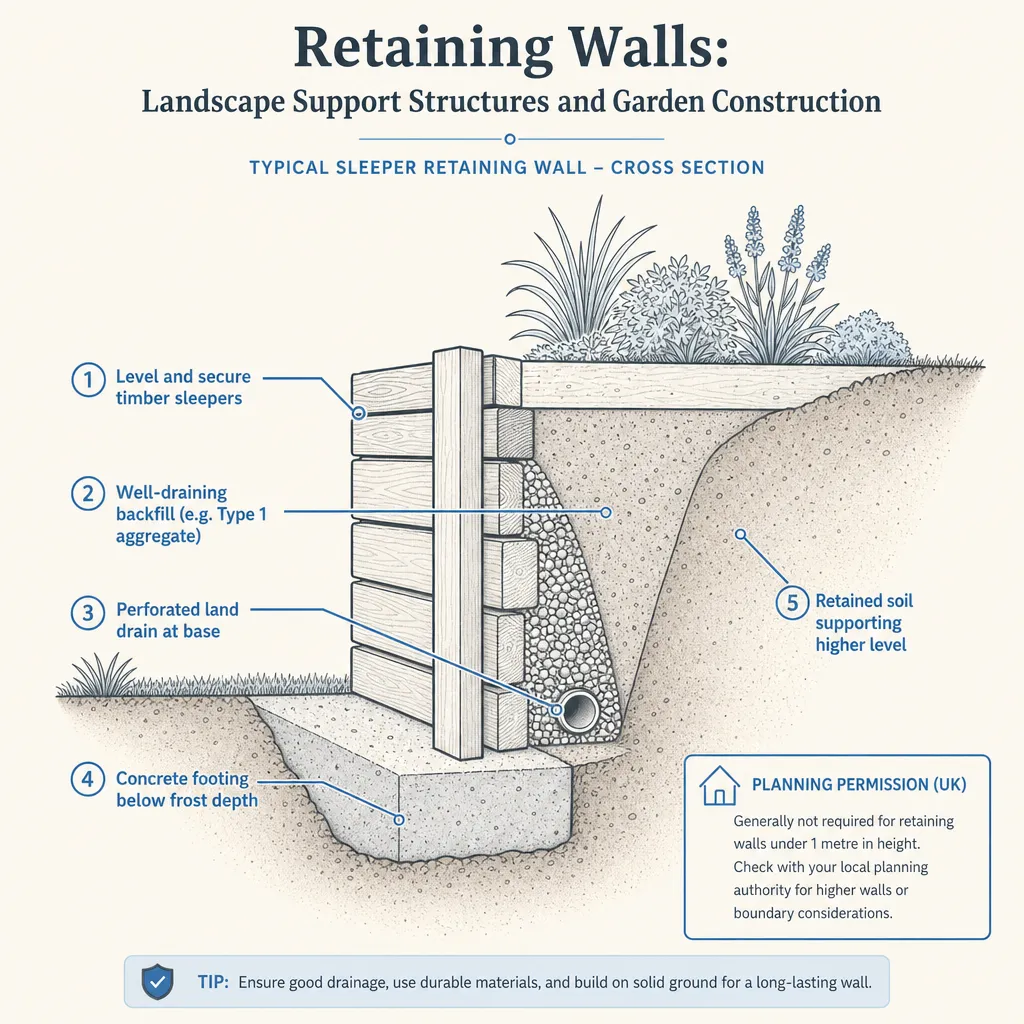 Improvement & Build
Retaining Walls: Landscape Support Structures and Garden Construction
A domestic retaining wall under 1 metre in height, away from buildings and boundaries, can usually be built by a landscaper or groundworker without structural calculations.
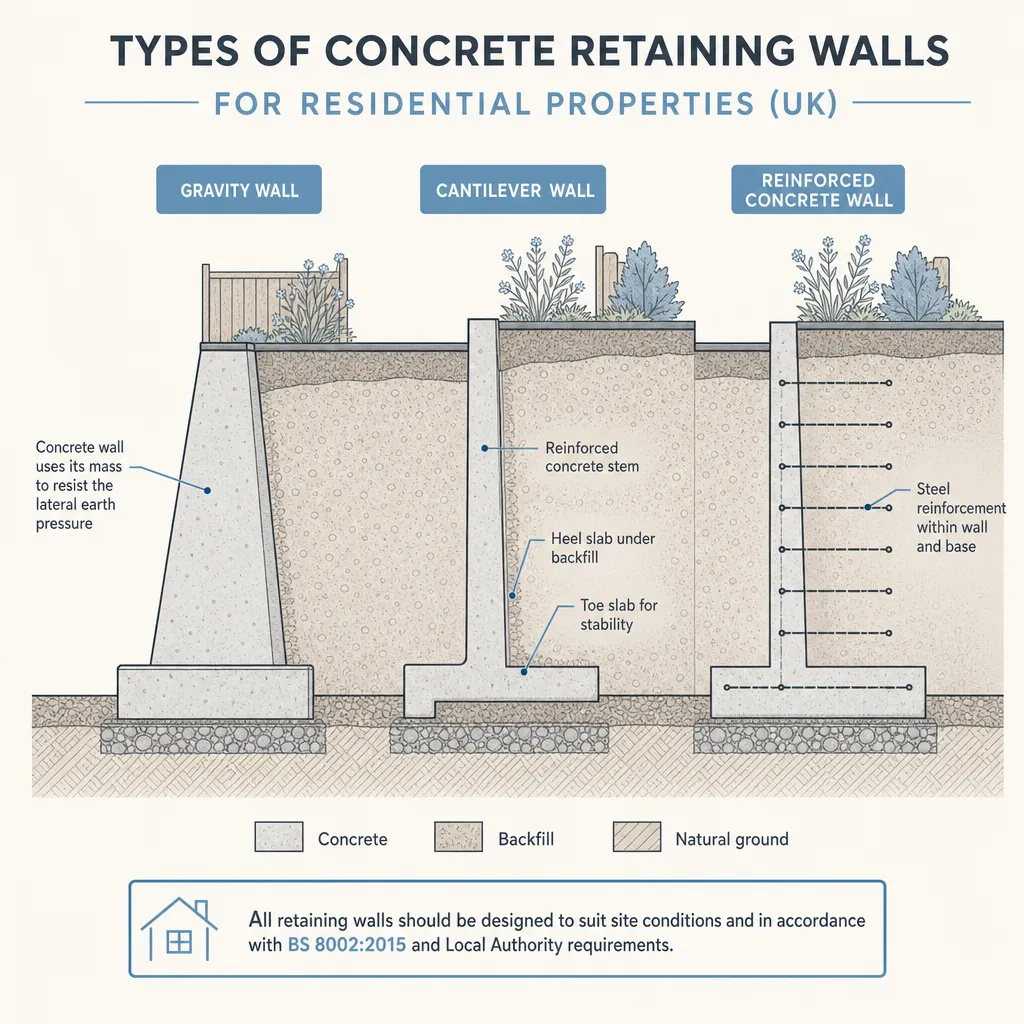 Improvement & Build
Types of Concrete Retaining Walls for Residential Properties
The four main concrete retaining wall types for UK residential use are gravity walls, cantilever walls, segmental block (SRW) systems, and sheet-pile walls.
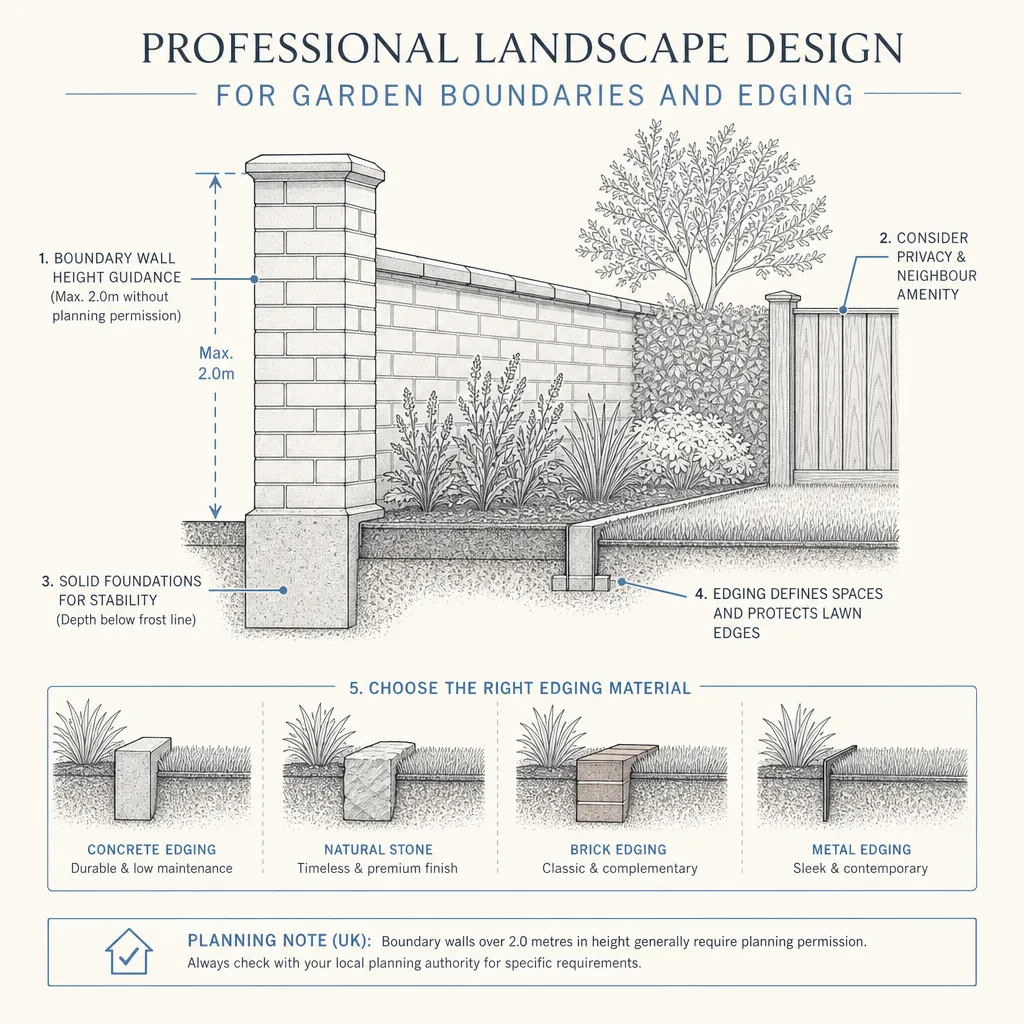 Improvement & Build
Professional Landscape Design for Garden Boundaries and Edging
Garden boundaries and edging define structure, manage drainage, and mark the legal interface between properties.
 Improvement & Build
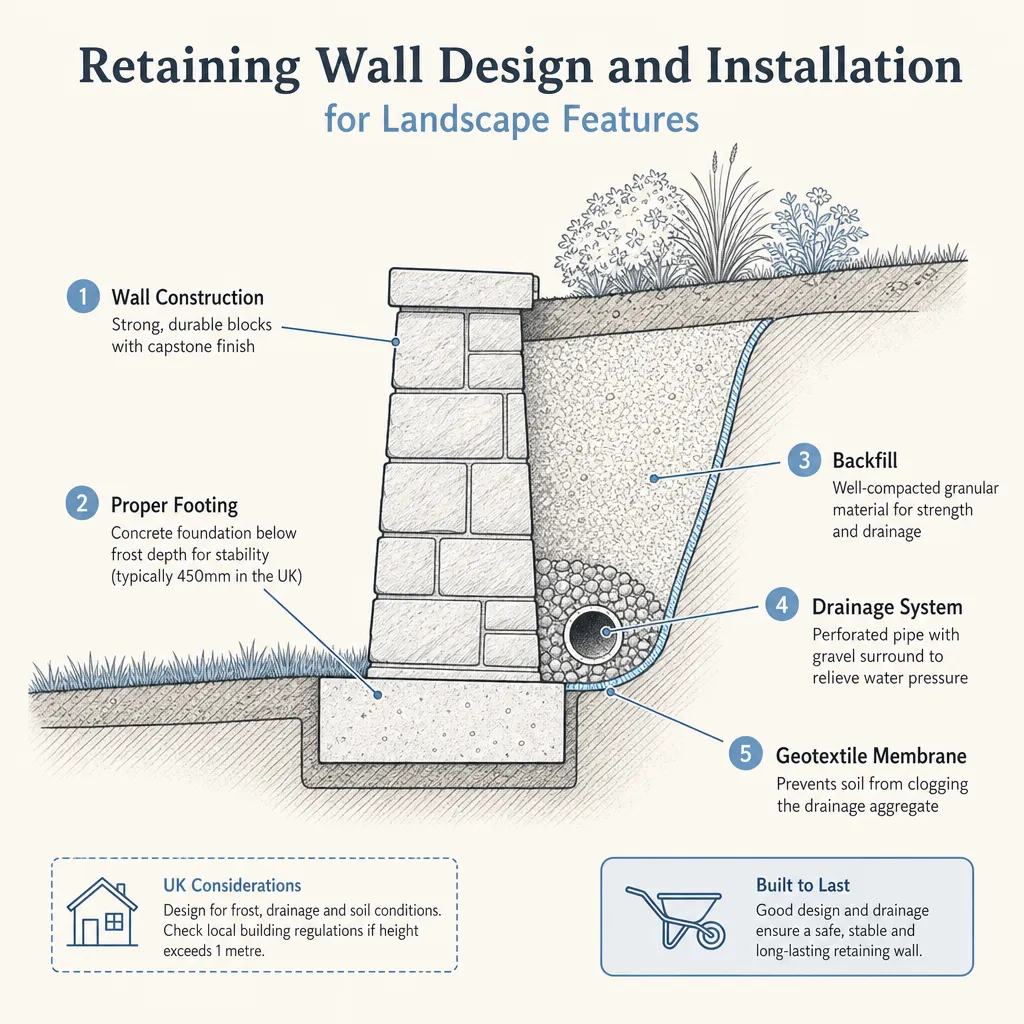
Retaining Wall Design and Installation for Landscape Features
A garden retaining wall holds back soil on a sloped plot using concrete blocks, stone, or timber.
 Improvement & Build
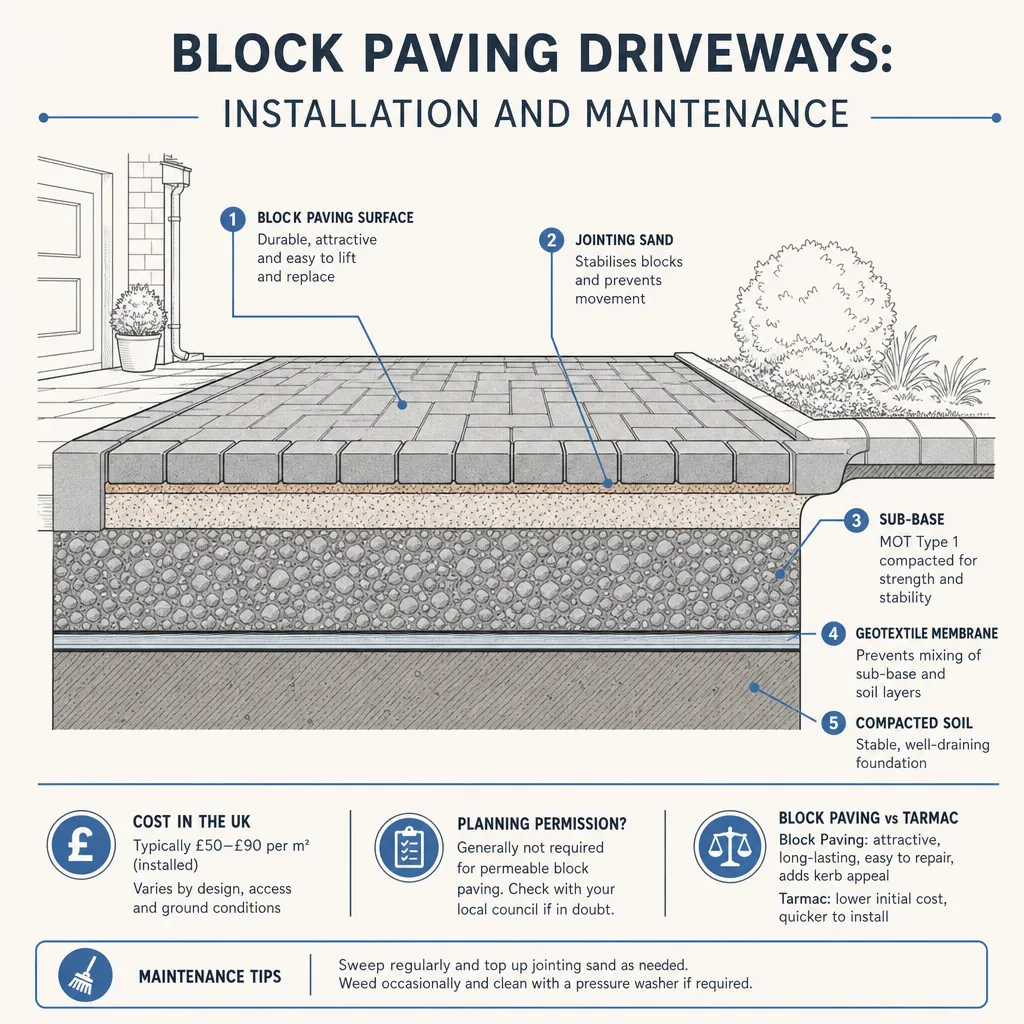
Block Paving Driveways: Installation and Maintenance
Block paving driveways typically cost £50–£120 per m² installed and last 20–30 years with good maintenance.