Retrofit Energy Assessment Costs and Process
By Housey · Last reviewed 10th of May 2026
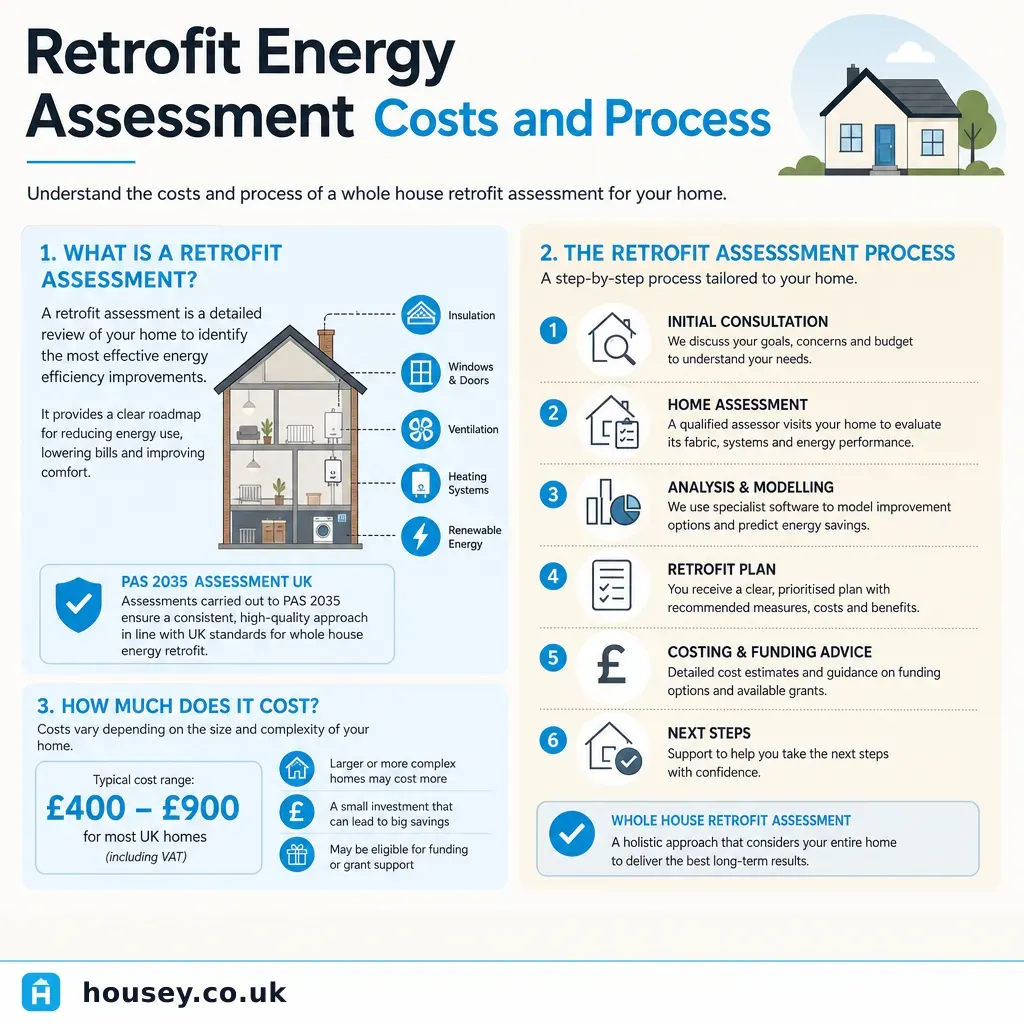
Retrofit Energy Assessment Costs and Process
A retrofit assessment is the formal starting point for almost any whole-house energy-improvement project in the UK. It typically arises when homeowners are planning insulation upgrades, a new heating system, or an application for ECO4 or Great British Insulation Scheme funding — and it matters because the wrong improvement, applied in the wrong sequence without prior assessment, can create condensation, interstitial moisture, and ventilation problems that cost considerably more to remedy than the original inefficiency.
Key points
- PAS 2035:2023 is the UK standard governing domestic retrofit; it mandates a Retrofit Assessment Document (RAD) before any funded or coordinated works begin.
- A retrofit assessor must hold at minimum a Level 5 Diploma in Domestic Retrofit Assessment and be registered with TrustMark to work on ECO4 or Great British Insulation Scheme projects.
- Whole-house retrofit assessments typically cost £300–£800; a basic assessment covering fabric and heating data alone may be lower. (Indicative UK costs, last reviewed 2026-05-10.)
- The RAD feeds into a Medium Term Improvement Plan (MTIP) — a sequenced schedule of recommended measures, usually covering a 5–25 year horizon.
- An Energy Performance Certificate (EPC) and a PAS 2035 retrofit assessment are distinct documents produced by different qualified professionals; an EPC alone does not satisfy PAS 2035 requirements.
What a retrofit assessment involves
A domestic retrofit assessment goes considerably further than a standard EPC. The assessor visits the property and collects data across several areas:
- Building fabric — wall construction (cavity, solid, timber frame), loft and floor types, window specifications, and existing insulation levels.
- Heating, ventilation, and hot water — current system age, controls, efficiency ratings, and ventilation provision including trickle vents, extractor fans, and any mechanical heat recovery units.
- Moisture and airtightness — signs of existing damp, condensation risk zones, or inadequate ventilation that must be resolved before insulation is added to the fabric.
- Occupancy and health factors — household size and any health conditions that affect appropriate heating or ventilation thresholds.
- Energy use data — actual bills or smart meter readings alongside modelled performance using RdSAP or equivalent software.
The assessor then produces the RAD, which is passed to a Retrofit Coordinator who develops the MTIP and manages delivery of works.
Important note: A retrofit assessment is not a structural survey and does not replace a RICS inspection. If there is any evidence of damp, cracking, or structural movement, those issues should be investigated separately before retrofit works begin.
How much does a retrofit assessment cost?
Assessment type | Typical scope | Indicative cost (UK, 2026) |
|---|---|---|
EPC only | SAP/RdSAP calculation, A–G rating, basic recommendations | £60–£120 |
Basic retrofit assessment | Fabric, heating, ventilation data; RAD produced | £250–£500 |
Whole-house retrofit assessment | Full RAD including moisture risk, occupancy, health factors | £400–£800 |
Assessment and coordination (combined) | RAD, MTIP, and coordination through to works completion | £800–£2,500+ |
Indicative UK costs, last reviewed 2026-05-10. Prices vary by region, property size, and complexity. Obtain at least two quotes before proceeding.
Key cost drivers include property size, construction complexity (solid-wall or listed buildings require more detailed analysis), whether a full moisture-risk investigation is included, and whether grant eligibility means the assessment fee is met by the scheme itself.
Which type of assessment do you need?
- Choose an EPC only if you need to comply with rental regulations, sell a property, or establish a baseline energy rating before planning further work.
- Choose a basic retrofit assessment if you are planning one or two specific improvements and want professional guidance on sequencing and moisture risk.
- Choose a whole-house retrofit assessment if you are planning multiple measures, applying for grant funding, or your property is pre-1919, solid-wall, or has existing damp or condensation problems.
- Ask a TrustMark-registered retrofit assessor or coordinator if you are unsure — some properties also require a Retrofit Designer for complex or multi-phase proposals.
- Check GOV.UK guidance on ECO4 and the Great British Insulation Scheme if your household income is below a certain threshold or your EPC rating is D or below — the assessment cost may be funded by the scheme.
PAS 2035: why the standard matters
PAS 2035 (published by BSI, updated in 2023) was introduced because earlier grant schemes funded insulation that created moisture problems — particularly external wall insulation on solid-brick Victorian and Edwardian houses where vapour could not escape through the new cladding system. The standard establishes:
- Defined professional roles — Retrofit Assessor, Retrofit Coordinator, Retrofit Designer, and PAS 2030-certified installer.
- Sequenced improvement — higher-risk measures such as airtightness and insulation must follow, not precede, adequate ventilation provision.
- Mandatory moisture risk assessment — required for all solid-wall and most cavity-wall properties.
- Handover documentation — an Occupier Instruction Document must be provided to the homeowner on completion of works.
All works funded under ECO4 or the Great British Insulation Scheme must comply with PAS 2035. Private retrofit without grant funding does not always legally require compliance, though many insurers and lenders are beginning to ask for evidence of PAS 2035-compliant specification for insulated solid-wall properties.
Important limitations
This article provides general information about retrofit assessment processes and typical costs as they apply in England and Wales. Conditions vary significantly between properties — moisture risk, construction type, occupancy, and grant eligibility all affect what is appropriate for any individual home. A qualified retrofit assessor must inspect your property before any improvement measures are recommended or specified. Rules in Scotland and Northern Ireland may differ in some respects. Nothing in this guide constitutes a recommendation that any specific measure is appropriate for your property.
When to get professional help
Seek a TrustMark-registered retrofit assessor or coordinator before starting any insulation or airtightness work if:
- Your property was built before 1919 (likely solid-wall construction with moisture-sensitive behaviour).
- There are existing damp patches, condensation on internal walls, or mould growth.
- A previous scheme-funded measure has caused or is suspected to have caused problems.
- You are planning to combine multiple measures — for example, adding insulation alongside a heat pump upgrade.
- A grant scheme has confirmed that a PAS 2035-compliant assessment is required before funding is approved.
- A building survey has flagged unresolved structural or moisture defects.
What to ask a qualified professional
Before instructing a retrofit assessor, ask:
- Are you registered with TrustMark, and can you provide your registration number?
- What qualifications do you hold — specifically the Level 5 Diploma in Domestic Retrofit Assessment?
- Will the assessment produce a full PAS 2035-compliant Retrofit Assessment Document, or an advisory report only?
- Does the quoted fee include a moisture risk assessment?
- Will you also act as Retrofit Coordinator, or will I need to appoint a separate professional for that role?
- How many properties of this age and construction type have you assessed?
- What happens if the assessment concludes that insulation is not currently appropriate for this property?
How Housey can help
Housey connects homeowners with TrustMark-registered professionals who carry out retrofit assessments across England, Scotland, and Wales. You can also find energy-efficiency consultants to advise on sequencing improvements and grant eligibility before committing to a full assessment programme. For properties where a specific measure is already under consideration, insulation assessments can confirm whether the approach is technically appropriate before works are commissioned.
Frequently asked questions
Is a retrofit assessment the same as an EPC?
No. An EPC is a standardised A–G rating produced under RdSAP methodology with basic improvement recommendations. A retrofit assessment under PAS 2035 is a far more detailed investigation covering building fabric, moisture risk, ventilation, heating, and occupancy. It produces a Retrofit Assessment Document that informs a sequenced improvement plan. Different qualifications are required to produce each document.
Do I need a retrofit assessment to apply for ECO4?
Yes. All measures installed under ECO4 must comply with PAS 2035, which requires a formal retrofit assessment, a TrustMark-registered coordinator, and PAS 2030-certified installers. Your energy supplier or local authority can connect you with a registered assessor as part of the scheme process. The assessment cost is often covered by the grant scheme.
Can the same person act as both assessor and coordinator?
In some cases yes. PAS 2035 defines separate roles but a single qualified professional may hold accreditations for more than one of them. For larger or more complex projects a Retrofit Designer may also be needed. Always confirm which roles the professional is authorised to carry out before instructing them, and whether a separate coordinator will be required.
How long does a retrofit assessment take?
The on-site visit typically takes two to four hours for a standard semi-detached or terraced house; larger or more complex properties may take longer. The Retrofit Assessment Document is usually delivered within one to two weeks of the visit, though turnaround varies by assessor workload and property complexity.
Sources and further reading
- PAS 2035:2023 — Retrofitting dwellings for improved energy efficiency — BSI Group
- ECO4 scheme guidance for households — GOV.UK
- Great British Insulation Scheme — GOV.UK
- TrustMark — find a registered retrofit professional — TrustMark
- Retrofit and energy efficiency in older buildings — Historic England
Useful next reads
 Energy & Retrofit
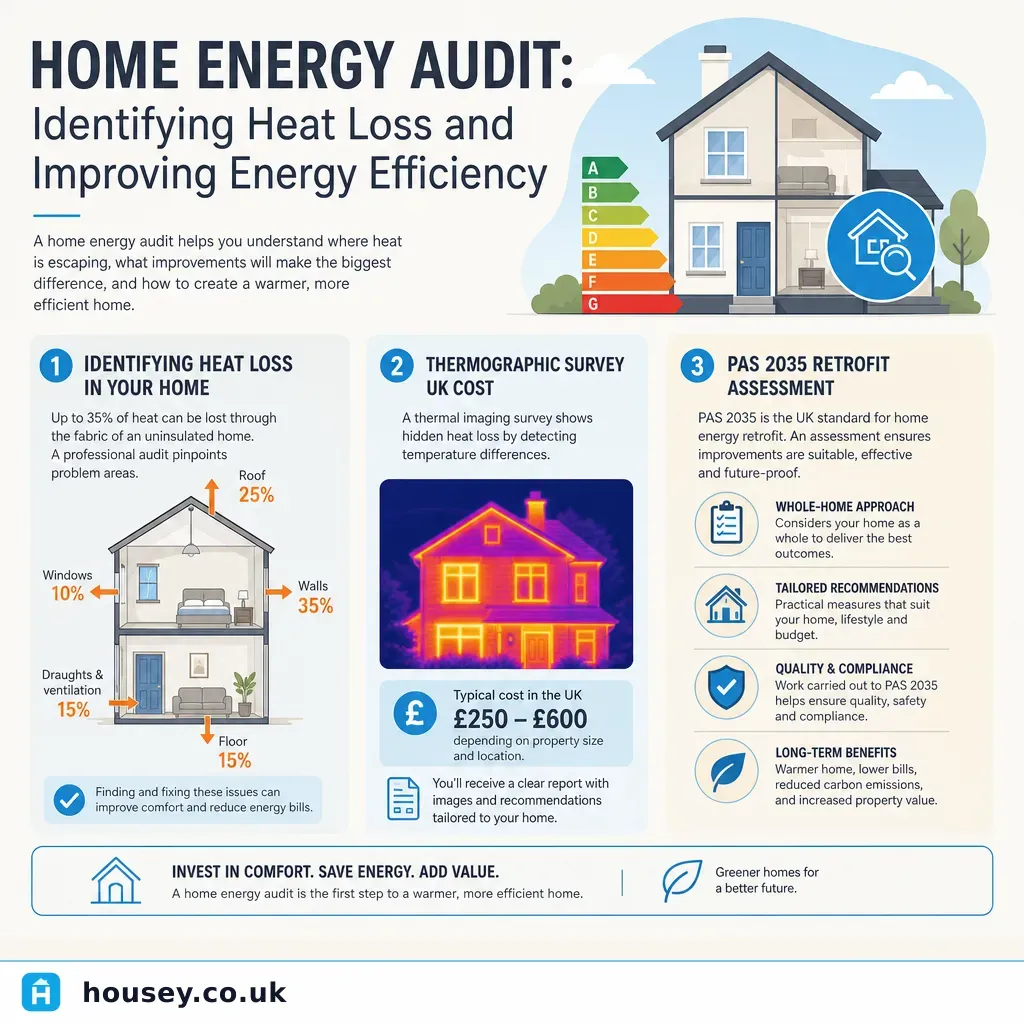
Home Energy Audit: Identifying Heat Loss and Improving Energy Efficiency
A home energy audit is a structured assessment of where your property loses heat and how efficiently it uses energy.
 Energy & Retrofit
The Value of an Energy Performance Audit for Your Home
A home energy performance audit is a detailed, site-specific assessment of a property's fabric, heating, ventilation, and controls.
 Energy & Retrofit
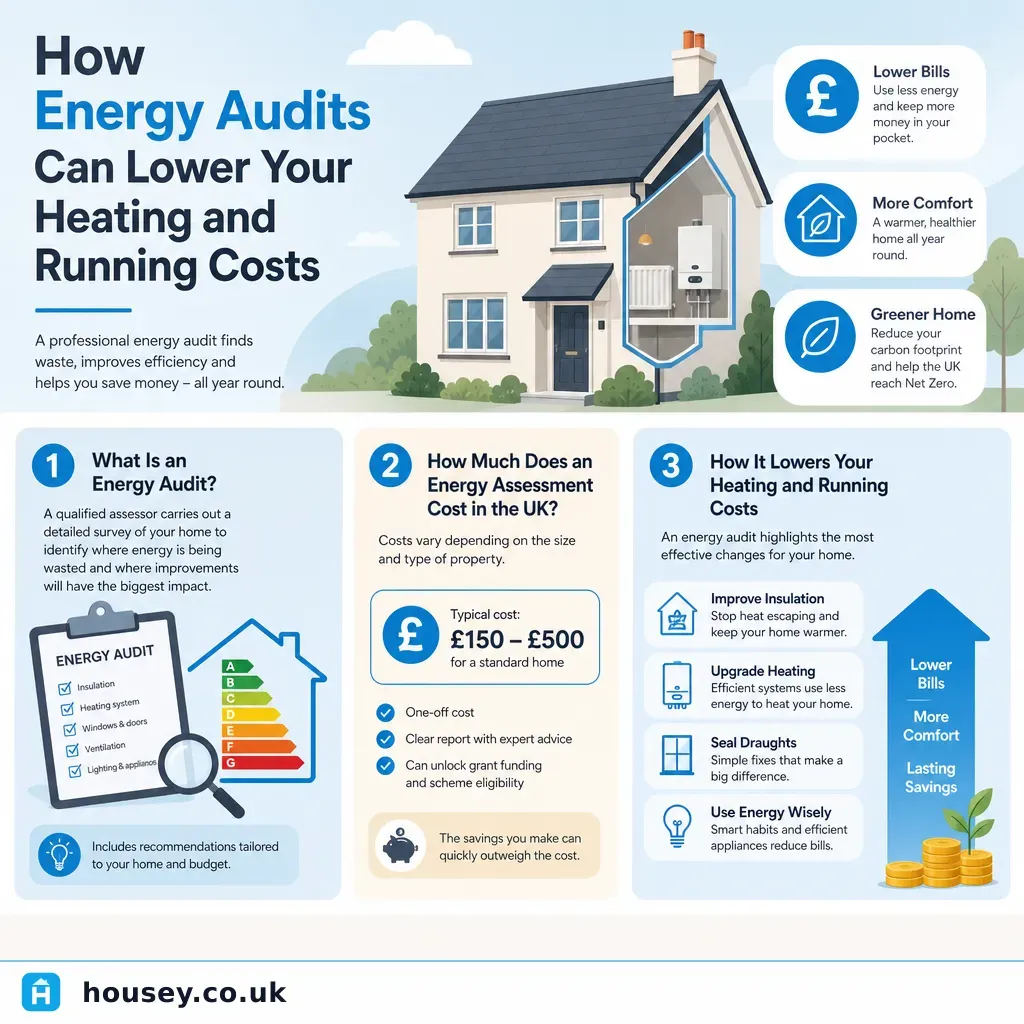
How Energy Audits Can Lower Your Heating and Running Costs
A home energy audit is a detailed inspection of your property's insulation, heating system, glazing, and ventilation to identify where energy is lost and recommend improvements.
 Energy & Retrofit
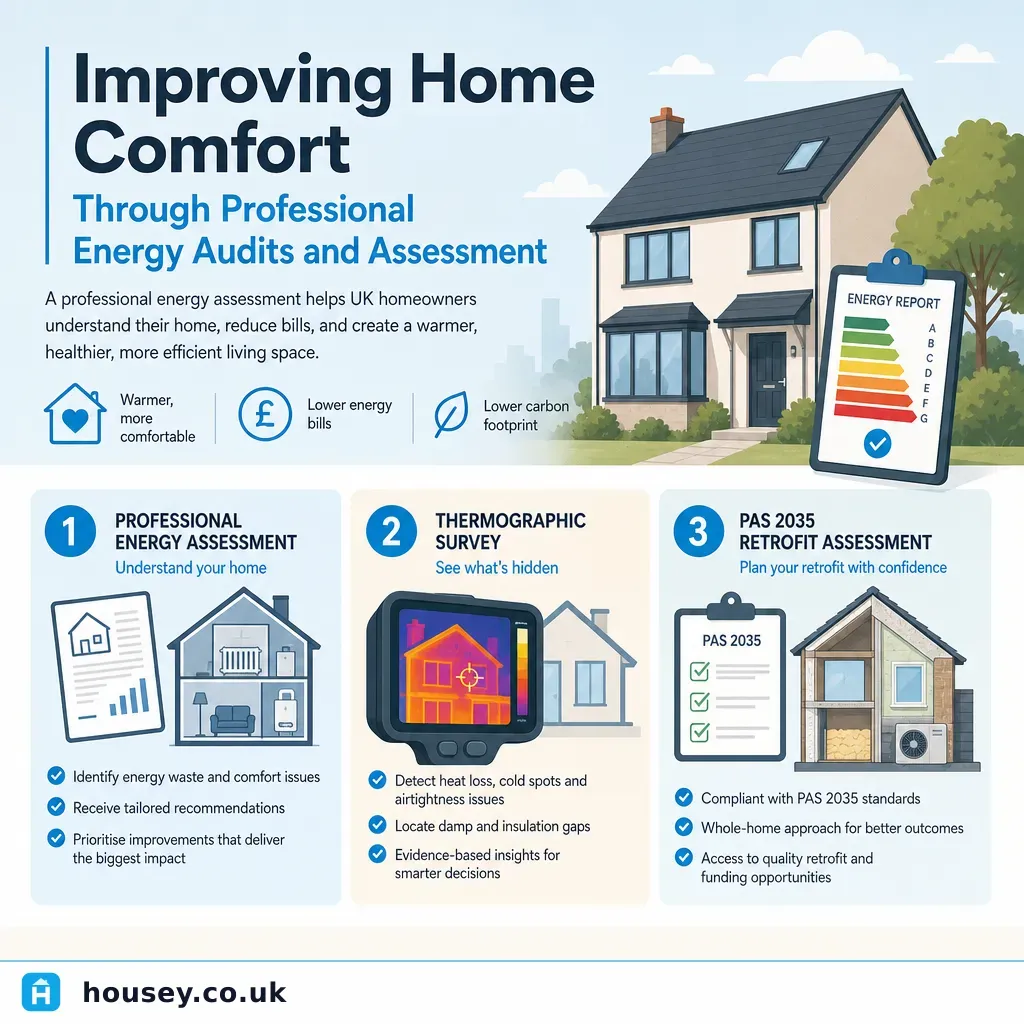
Improving Home Comfort Through Professional Energy Audits and Assessment
A professional home energy audit assesses your property's actual thermal performance — insulation, heating, ventilation, air leakage, and moisture — and produces a prioritised action plan.
 Energy & Retrofit
Insulating Solid Masonry Walls Under Bay Windows: Technical Guidance
Insulating solid masonry walls under bay windows requires specialist detailing at angled wall faces, window reveals, and the bay floor and ceiling junctions.