Retrofit Project Coordination: Planning and Budget
By Housey · Last reviewed 10th of May 2026
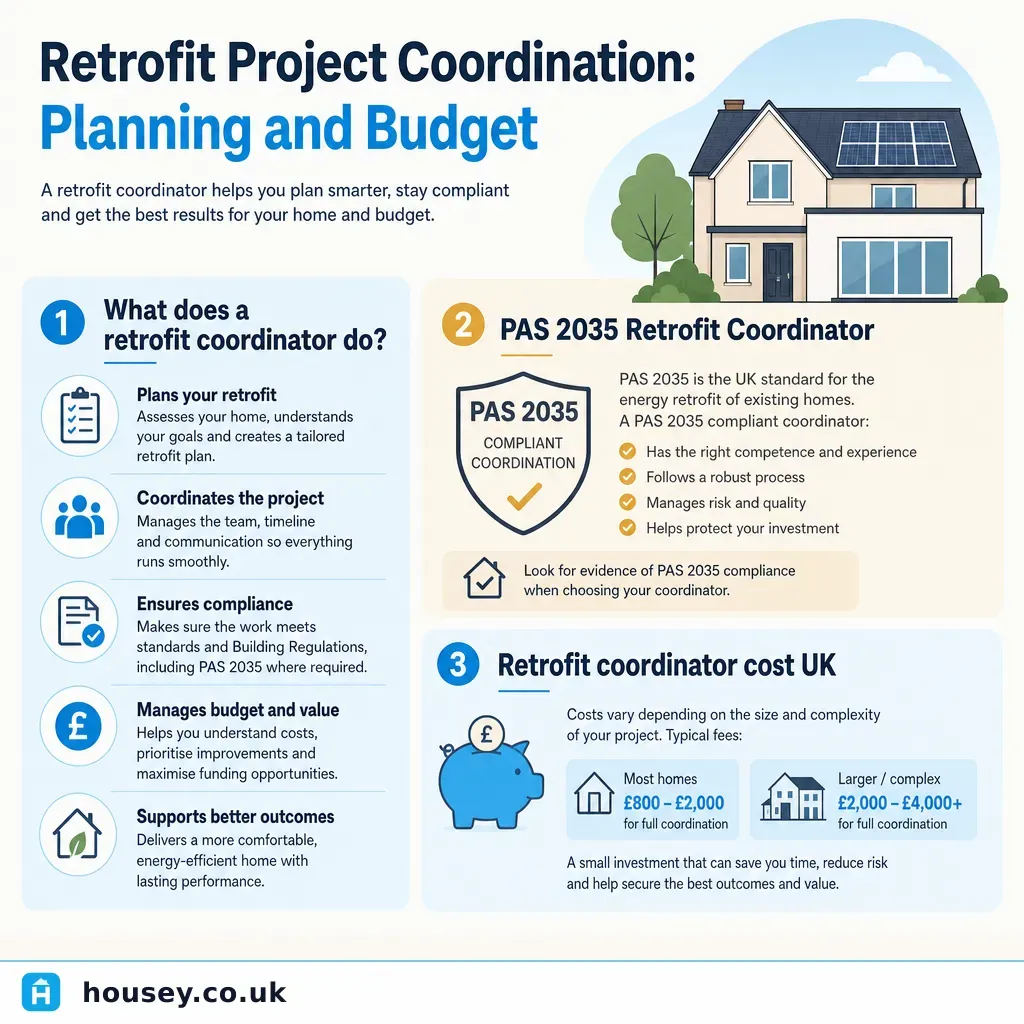
Retrofit Project Coordination: Planning and Budget
Once a retrofit assessment is complete, the work of planning and delivering improvements falls to a Retrofit Coordinator — a role that many UK homeowners encounter for the first time when applying for ECO4 or Great British Insulation Scheme funding. Coordination matters most when multiple measures are involved, when a property requires careful sequencing because of its age or construction, or when a grant scheme requires formal PAS 2035 compliance from assessment through to completion.
Key points
- A Retrofit Coordinator (RC) is a distinct, qualified role under PAS 2035:2023, responsible for developing the Medium Term Improvement Plan (MTIP) and overseeing the delivery of energy improvement works.
- RCs must hold a Level 5 Certificate in Retrofit Coordination and Advice and be registered with TrustMark to work on ECO4 or Great British Insulation Scheme-funded projects.
- The RC's central output is the MTIP: a sequenced schedule of energy improvements typically covering a 5–25 year horizon, based on the property's Retrofit Assessment Document.
- Retrofit coordination fees typically range from £500–£2,500 depending on project complexity and scope; combined assessment-and-coordination services may offer better value. (Indicative UK costs, last reviewed 2026-05-10.)
- Incorrect sequencing — for example, installing airtightness measures before adequate ventilation is in place — is one of the most common causes of moisture and air-quality problems in retrofit projects.
What a Retrofit Coordinator does
A Retrofit Coordinator is not a general project manager, though there is some overlap in their day-to-day work. Their specific responsibilities under PAS 2035 include:
- Reviewing and interpreting the Retrofit Assessment Document (RAD).
- Developing the Medium Term Improvement Plan (MTIP) for the property.
- Specifying individual improvement measures to the correct PAS 2030 installation standard.
- Engaging and coordinating TrustMark-registered and PAS 2030-certified installers.
- Monitoring key stages of works on site — or arranging independent inspection — to confirm measures are installed as specified.
- Managing the occupancy assessment and confirming that adequate ventilation is in place before and after any airtightness improvements.
- Completing and issuing the Retrofit Completion Document and Occupier Instruction Document.
For ECO4-funded projects, the RC also holds formal accountability — they sign off that works comply with PAS 2035 and that measures have been installed in the correct sequence.
Retrofit Coordinator vs general project manager
Feature | Retrofit Coordinator (PAS 2035) | General project manager |
|---|---|---|
Regulated qualification | Level 5 Certificate in Retrofit Coordination and Advice | No regulated standard |
TrustMark registration | Required for ECO4 and GBIS projects | Not applicable |
Moisture and ventilation expertise | Core competency under PAS 2035 | Not typically included |
Responsible for PAS 2035 compliance | Yes | No |
Can sign off ECO4 or GBIS works | Yes | No |
Suitable for multi-measure retrofit | Yes | Risk of incorrect sequencing |
Suitable for general building works | Limited | Yes |
For any project involving insulation, airtightness, or ventilation changes funded by ECO4 or GBIS, a TrustMark-registered Retrofit Coordinator is required. A general project manager may be appropriate for building works outside the retrofit scope — for example, managing a bathroom renovation running in parallel with an energy upgrade.
Planning your retrofit: a worked UK scenario
Property: 1930s semi-detached house, solid external walls to front and rear, unfilled cavity party walls, ageing gas boiler (15 years old), no loft insulation, single-glazed windows to the rear. EPC rating: E.
Step 1 — Assessment: A TrustMark-registered retrofit assessor visits and produces a RAD. The report identifies solid walls to front and rear (not suitable for CWI); infillable cavity party walls; absent loft insulation; condensation risk on north-facing internal walls; and the boiler approaching end of useful life.
Step 2 — MTIP development: The Retrofit Coordinator reviews the RAD and develops a phased MTIP: (1) loft insulation first — quick, low-risk, high-impact; (2) improved background ventilation throughout the property; (3) internal wall insulation to the worst-performing walls, with correct vapour control; (4) heat pump installation in years 4–6 once the fabric is improved and the heating load reduced; (5) remaining window upgrades.
Step 3 — Works delivery: The RC engages a PAS 2030-certified insulation installer and a ventilation specialist. Both are TrustMark-registered. The RC reviews specifications and inspects key installation stages before signing off compliance.
Step 4 — Completion: The RC issues the Retrofit Completion Document. The homeowner receives an Occupier Instruction Document explaining ventilation controls, heating settings, and moisture management.
Why sequencing mattered here: Installing internal wall insulation before improving background ventilation would have increased condensation risk on the north-facing walls. The RC's role was to identify and prevent that outcome from occurring.
How to budget for retrofit coordination
As a rough guide (indicative UK costs, last reviewed 2026-05-10):
Project scope | Typical RC fee |
|---|---|
Single measure, straightforward property | £300–£600 |
Two to three measures, standard property | £600–£1,200 |
Multi-measure, complex or older property | £1,200–£2,500+ |
Assessment and coordination (combined service) | £800–£2,500+ |
Always clarify what is included: some quotes cover specification only; others include on-site inspection at key stages, completion documentation, and occupier handover. For ECO4 or GBIS-funded projects, the coordination fee may be included in the funded package — confirm with your grant scheme administrator before appointing a coordinator independently.
Important limitations
This article describes the Retrofit Coordinator role and planning process under PAS 2035 as it applies in England and Wales. Grant scheme rules, eligibility, and qualification requirements may change. For properties in conservation areas, listed buildings, or with unusual construction, additional input from a Retrofit Designer may also be needed. Requirements differ in some respects in Scotland and Northern Ireland. Always verify current requirements with TrustMark or your grant scheme administrator before appointing professionals.
When to get professional help
Engage a TrustMark-registered Retrofit Coordinator before works begin if:
- More than one energy improvement measure is planned for the same property.
- The property is pre-1919, solid-wall, timber-frame, or has existing damp or condensation.
- You are applying for ECO4, GBIS, or any other PAS 2035-compliant grant funding.
- A retrofit assessment has recommended complex, phased, or higher-risk measures.
- An installer or builder has suggested that formal coordination is unnecessary for your project.
What to ask a qualified professional
Before appointing a Retrofit Coordinator, ask:
- Are you registered with TrustMark, and can you provide your registration number?
- Do you hold a Level 5 Certificate in Retrofit Coordination and Advice?
- Have you coordinated retrofit projects on properties of this age and construction type before?
- Will you be present on site at key inspection stages, or is this desk-based coordination only?
- What quality-assurance checks do you carry out during and after installation?
- Does your fee include the Retrofit Completion Document and Occupier Instruction Document?
- What happens if a problem is found mid-works that changes the scope or required sequence?
How Housey can help
Housey connects homeowners with qualified professionals at every stage. Find a retrofit assessor to start with a PAS 2035-compliant assessment, search for project managers to advise on managing wider building works alongside an energy upgrade, or speak to an energy-efficiency consultant to map out the scope and sequencing of your improvements before committing to a coordinator or installer.
Frequently asked questions
Is a Retrofit Coordinator required by law?
Not for privately funded works. However, for projects receiving ECO4 or Great British Insulation Scheme funding, PAS 2035 compliance — including a qualified Retrofit Coordinator — is a mandatory condition of the scheme. Some insurers and mortgage lenders are also beginning to require evidence of coordinated retrofit specification for insulated solid-wall properties.
Can my insulation installer act as Retrofit Coordinator?
Under PAS 2035, the installer and the Retrofit Coordinator must be independent — the same individual or company cannot fill both roles on the same project. This separation prevents conflicts of interest where an installer might specify measures that suit their business rather than what the property genuinely needs. Check TrustMark registration for each professional separately.
What is the Medium Term Improvement Plan (MTIP)?
The MTIP is a sequenced plan of energy improvements for your property, developed by the Retrofit Coordinator from the Retrofit Assessment Document. It typically covers a 5–25 year horizon, prioritises fabric improvements first, and ensures that later measures such as heat pump installation are only introduced once the building is prepared to support them efficiently.
How long does the retrofit coordination process take?
Timescales depend on project scope. A single-measure project may be coordinated in a few weeks. A phased multi-measure programme — for example, insulation in year one and a heat pump in year three — involves an ongoing coordination relationship. Agree the coordinator's inspection schedule, response times, and handover process before signing any agreement.
Sources and further reading
- PAS 2035:2023 — Retrofitting dwellings for improved energy efficiency — BSI Group
- TrustMark — Retrofit Coordinator register — TrustMark
- ECO4 scheme guidance for households — GOV.UK
- Energy Saving Trust — home energy advice — Energy Saving Trust
- CIBSE guidance on retrofit for climate change — CIBSE
Useful next reads
 Energy & Retrofit
The Value of an Energy Performance Audit for Your Home
A home energy performance audit is a detailed, site-specific assessment of a property's fabric, heating, ventilation, and controls.
 Energy & Retrofit
Garage Insulation and Thermal Upgrade Costs
Insulating a garage in the UK typically costs £600–£1,800 for walls, £400–£900 for the ceiling, and £800–£2,500 for a new insulated door.
 Energy & Retrofit
Wall Insulation, Replastering, and Panelling: Coordinating Multiple Trades
Coordinating wall insulation with replastering and panelling requires a strict trade sequence: damp assessment first, then first-fix electrical, insulation, boarding, wet plaster, and second-fix.
 Energy & Retrofit
Government Warm Homes Scheme: Energy Upgrades and Support for UK Homeowners
The Warm Homes Plan coordinates several UK government energy upgrade schemes.
 Energy & Retrofit
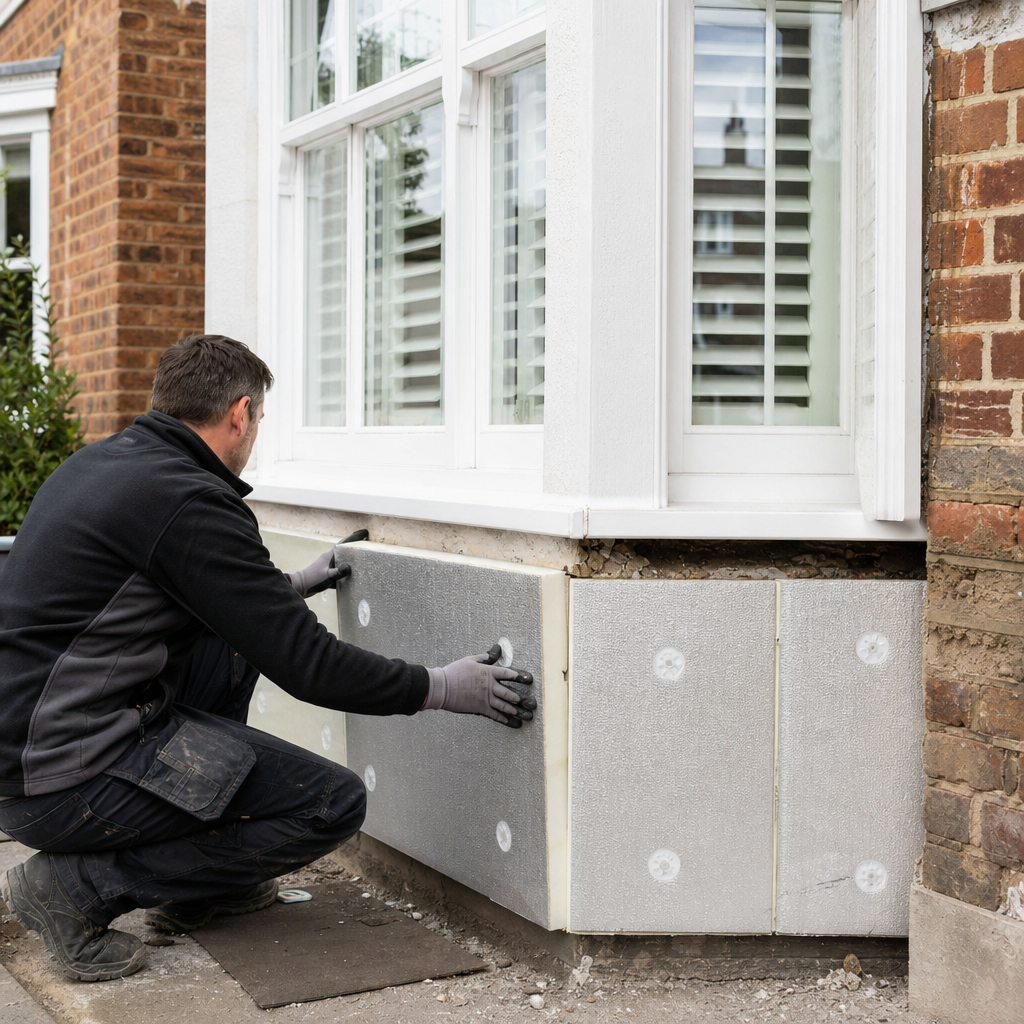
Insulating Solid Masonry Walls Under Bay Windows: Technical Guidance
Insulating solid masonry walls under bay windows requires specialist detailing at angled wall faces, window reveals, and the bay floor and ceiling junctions.