Rippling and Bumping on Roof Shingles: Causes and Warranty Implications
By Housey · Last reviewed 11th of May 2026
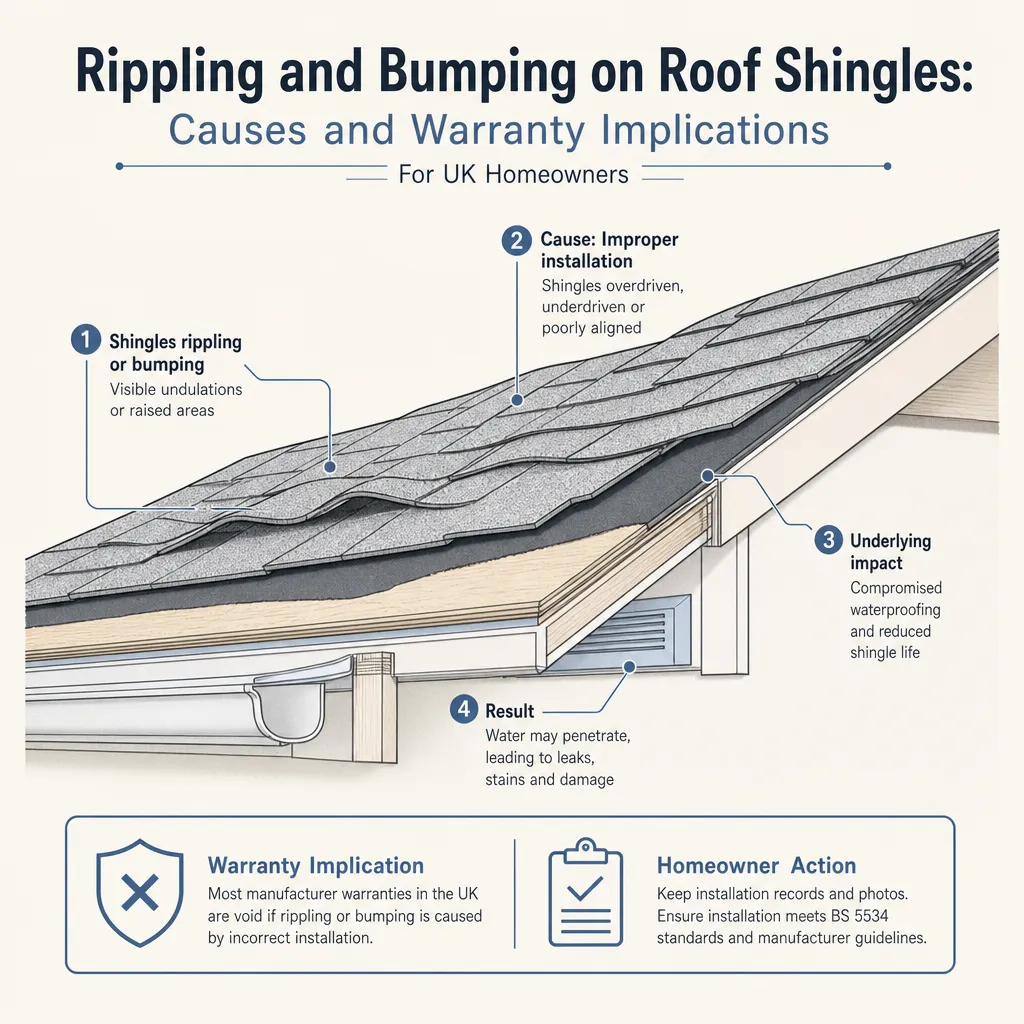
Rippling and Bumping on Roof Shingles: Causes and Warranty Implications
Visible rippling, buckling, or bumping across a shingle roof is one of the more unsettling defects a homeowner or surveyor can spot, particularly when the work is recent or the roof is still within its warranty period. While clay and concrete tiles are more prevalent on UK homes, asphalt shingles and timber shingles are used on extensions, dormers, flat-to-pitch conversions, and some residential properties — especially where a lower loading or a particular aesthetic is needed. Understanding why shingles deform, and what that means for your warranty position, is essential before instructing repairs or pursuing a claim against either the installer or the manufacturer.
Key points
- Rippling and buckling in shingles is almost always caused by installation error or substrate moisture, not a product defect — though a genuine product fault can also be grounds for a warranty claim.
- BS EN 544 is the European standard governing the dimensional stability and weather resistance of bitumen-based roofing shingles; products meeting this standard should not deform under normal UK temperature ranges.
- NFRC (National Federation of Roofing Contractors) member companies are bound by federation workmanship standards and offer access to the NFRC guarantee scheme.
- Shingle manufacturer warranties typically exclude defects caused by improper installation, inadequate ventilation, or incompatible underlay.
- An independent roof survey is the standard evidence-gathering step before making any warranty claim or starting a dispute with a contractor.
Why shingles ripple and buckle
Shingle deformation falls into three broad categories: installation problems, substrate problems, and — more rarely — product issues.
Installation-related causes
Inadequate fastening is a frequent culprit. Shingles require a defined number of nails per course, placed within specific zones set out in the manufacturer's installation guide. Too few nails, nails placed too high or too low, or nails driven at the wrong angle allow shingle tabs to lift and distort under thermal movement and wind.
Shingles laid in cold weather before relaxing from packaging compression can buckle once they warm up. Quality installers allow shingles to acclimatise or account for this in their nailing pattern.
No starter strip at the eaves, or an incorrectly positioned starter, allows the first course to lift from the bottom, creating a visible roll at the lowest point.
Re-roofing over existing shingles without proper deck preparation introduces an uneven substrate that telegraphs through to the new surface.
Substrate and underlay problems
Damp or inadequately dried decking is a leading cause of undulating shingle surfaces. When OSB or plywood decking absorbs moisture, it swells and can push shingles upward in a wave or ridge pattern that closely follows the board layout below.
Boards with gaps, raised edges, or protruding fixings create an uneven nailing surface that shows through to the finished surface.
Incompatible, damaged, or bridging underlay — torn, improperly overlapped, or installed without adequate tension — can bunch beneath shingles and create localised bumps.
Product issues
Genuine manufacturing defects in shingles conforming to BS EN 544 are uncommon, but can include inconsistent mat thickness, poor bonding, or granule loss. If every affected shingle shows identical deformation regardless of its position on the roof, and the installation appears otherwise correct, a product defect claim against the manufacturer may be worth pursuing.
Comparison: identifying the cause of shingle deformation
Cause type | Typical appearance | Typical location | Key evidence needed |
|---|---|---|---|
Inadequate fastening | Lifted or curling tabs, irregular pattern | Scattered, often at edges or lower courses | Nail count and placement from a removed sample shingle |
Substrate moisture | Regular undulating waves following board lines | Follows decking board pattern below | Moisture meter readings in deck; inspection from inside |
Underlay bunching | Localised bumps, often at sheet laps | Where underlay sheets overlap | Visual inspection under lifted shingles |
Product defect | Consistent deformation across all shingles | Widespread, unrelated to fastening zones | Manufacturer batch records; independent laboratory testing |
Warranty implications in the UK
Shingle installations typically carry two separate warranties: a manufacturer's product warranty (covering the shingle material, often 15–30 years for quality products) and a contractor's workmanship warranty (covering installation, typically 1–10 years depending on the contractor and any scheme membership).
Manufacturer warranties for shingles generally exclude:
- Defects caused by improper installation or deviation from the published installation guide
- Damage from inadequate ventilation causing condensation on the underside of shingles
- Use with incompatible underlays or adhesives
- Weather events beyond the stated design wind speed
This means that if rippling is caused by installation error, the manufacturer may legitimately decline a product warranty claim even if the shingles themselves are undamaged.
NFRC member contractors are bound by the federation's published workmanship standards. If your contractor is an NFRC member and refuses to address a valid defect, the NFRC's dispute process provides a structured route to resolution.
Non-NFRC installers are bound only by the terms of their contract. If the workmanship warranty is limited or the contractor is unresponsive, resolution may require the small claims court (for lower-value disputes) or formal Construction Act adjudication.
What to ask before making a warranty claim
- What are the exact warranty coverage periods for both materials and workmanship?
- Does the manufacturer's warranty require installation by an accredited or trained installer?
- Has an independent surveyor documented the defect, its extent, and the likely cause in writing?
- Does the contractor's warranty explicitly exclude this type of defect?
- Is your claim within the notification period stated in the warranty documentation?
- Do you have the original installation invoice, warranty certificate, and product batch information?
- Are you confident of the cause — or do you need an independent report to establish liability before making contact?
Getting an independent roof survey
Before making any warranty claim, commission an independent roof survey from a qualified surveyor or experienced roofing professional. A professional assessment documents the defect type, probable cause, extent, and recommended remediation — all of which are required to support a claim.
If the survey identifies installation error, ask the surveyor to cite the specific deviation from the manufacturer's installation guide. This provides a clear basis for a workmanship claim against the contractor and makes it harder for the manufacturer to deflect the issue as a product failure.
When to get professional help
Arrange a professional inspection without delay if:
- Rippling or buckling appears within the first two years of installation — this is almost certainly within the workmanship warranty period.
- You see water ingress, damp patches on ceilings, or visible daylight through the roof structure.
- Shingles are lifting at edges or corners in normal wind conditions.
- The defect is worsening or spreading across the roof.
- The contractor has become unresponsive to your concerns.
Do not attempt to inspect the roof surface yourself. Working at height carries a serious risk of injury; use only a qualified roofer or surveyor with appropriate access equipment and insurance.
How Housey can help
A professional roof survey provides the independent evidence needed to determine the cause of shingle rippling, support a warranty claim, and specify the correct remediation. If repairs are needed, connecting with a qualified roofer who can work to a surveyor's specification is the most reliable route to a lasting fix.
Frequently asked questions
Is shingle rippling always a sign of a serious problem?
Not always. Minor buckling in asphalt shingles laid in cold conditions can resolve as the material warms and relaxes in the first season. However, persistent or worsening rippling, waves that follow the pattern of decking boards below, or any accompanying water ingress should be assessed by a professional. Deformed shingles are more vulnerable to wind lift and water penetration over time.
Can I claim on the manufacturer's warranty if the installer caused the problem?
It depends on the warranty terms. Most manufacturer warranties explicitly exclude installation defects and require installation to have followed the published guide. If the installer is at fault, your claim is more likely to succeed against the contractor's workmanship warranty. If the contractor is unresponsive or the warranty has expired, adjudication or the small claims court may be the appropriate next step.
How long should a properly installed shingle roof last in the UK?
Quality asphalt shingles installed to manufacturer guidance should last 20–30 years under typical UK conditions. Western red cedar timber shingles, if properly installed and ventilated, can last 25–40 years. Factors that reduce lifespan include coastal salt air, persistent moss growth in damp locations, and inadequate roof ventilation. Verify current expectations with your chosen contractor or manufacturer.
Does BS 5534 apply to shingles?
BS 5534 is the code of practice for slating and tiling and applies primarily to clay, concrete, and natural slate products. Bitumen-based shingles are more directly governed by BS EN 544, which sets performance requirements for dimensional stability, weather resistance, and flexibility. Manufacturer installation guides should be followed alongside the relevant standard.
Sources and further reading
- BS EN 544: Bitumen shingles — specification — BSI Group
- NFRC: workmanship standards and guarantee scheme — National Federation of Roofing Contractors
- BS 5534: Code of practice for slating and tiling — BSI Group
- Working at height: the law — Health and Safety Executive
Useful next reads
 Surveys & Inspections
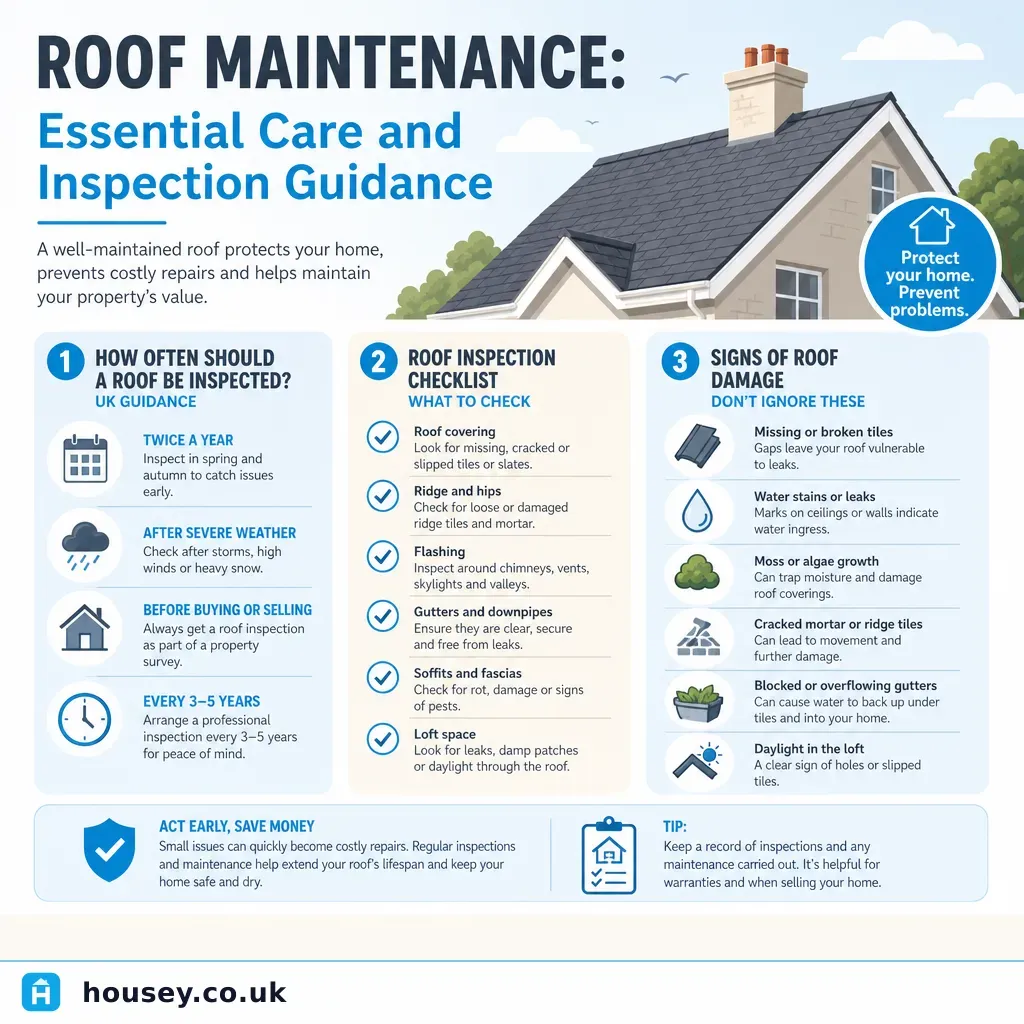
Roof Maintenance: Essential Care and Inspection Guidance
UK roofs should be visually inspected at least once a year — ideally in autumn before winter — and after any significant storm.
 Surveys & Inspections
Can a New Roof Reduce Your Home Insurance Costs?
A new roof can improve your home insurance position in the UK, particularly if you replace an aged flat roof or a deteriorating pitched roof.
 Surveys & Inspections
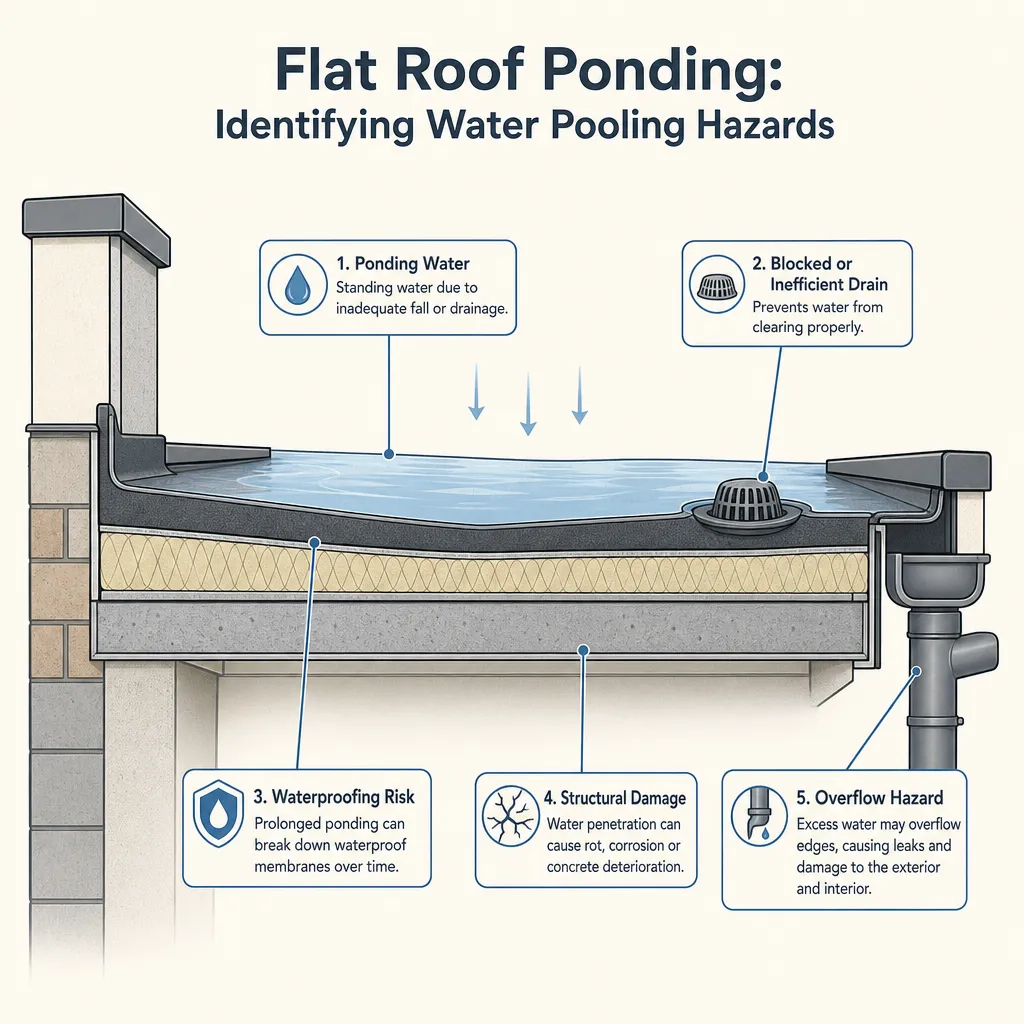
Flat Roof Ponding: Identifying Water Pooling Hazards
Flat roof ponding lasting more than 24–48 hours after rainfall warrants investigation.
 Surveys & Inspections
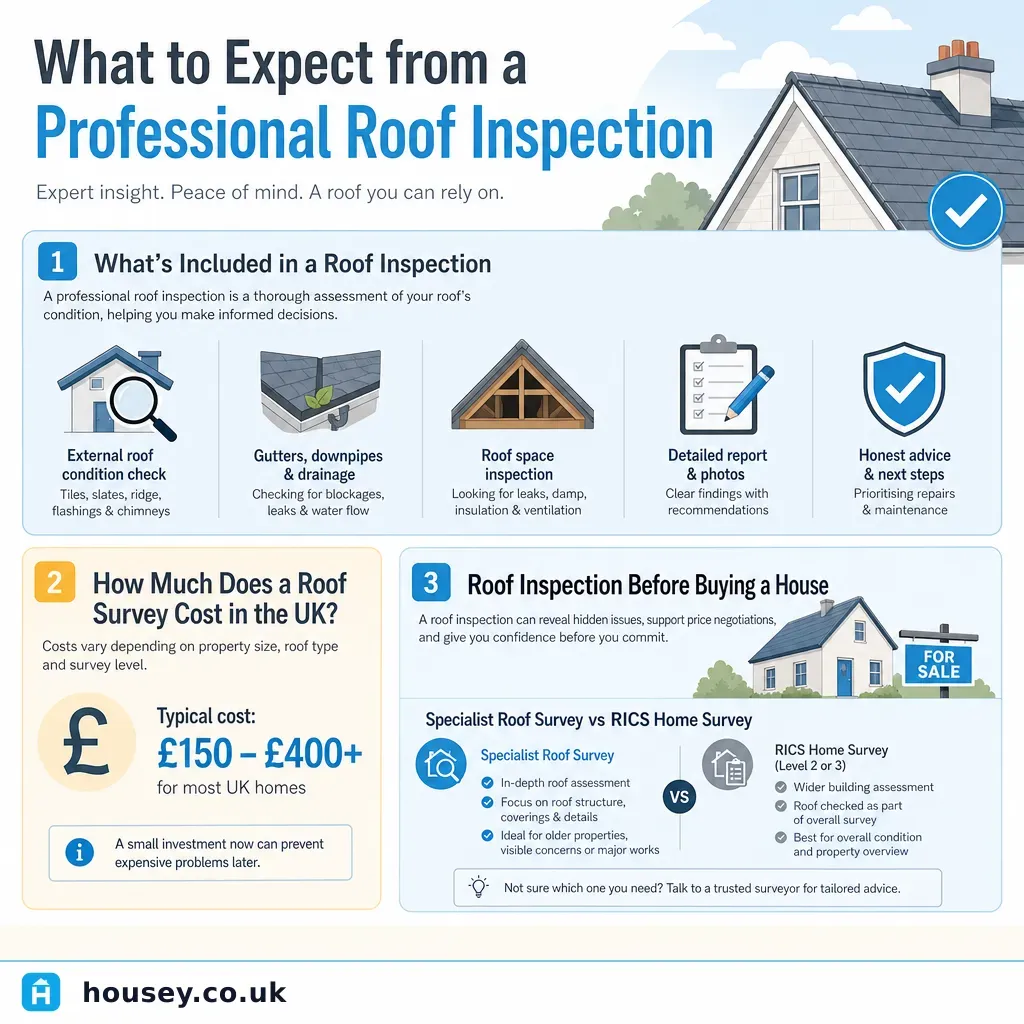
What to Expect from a Professional Roof Inspection
A professional roof inspection involves a qualified specialist examining your roof coverings, flashings, mortar, gutters, and structure.
 Surveys & Inspections
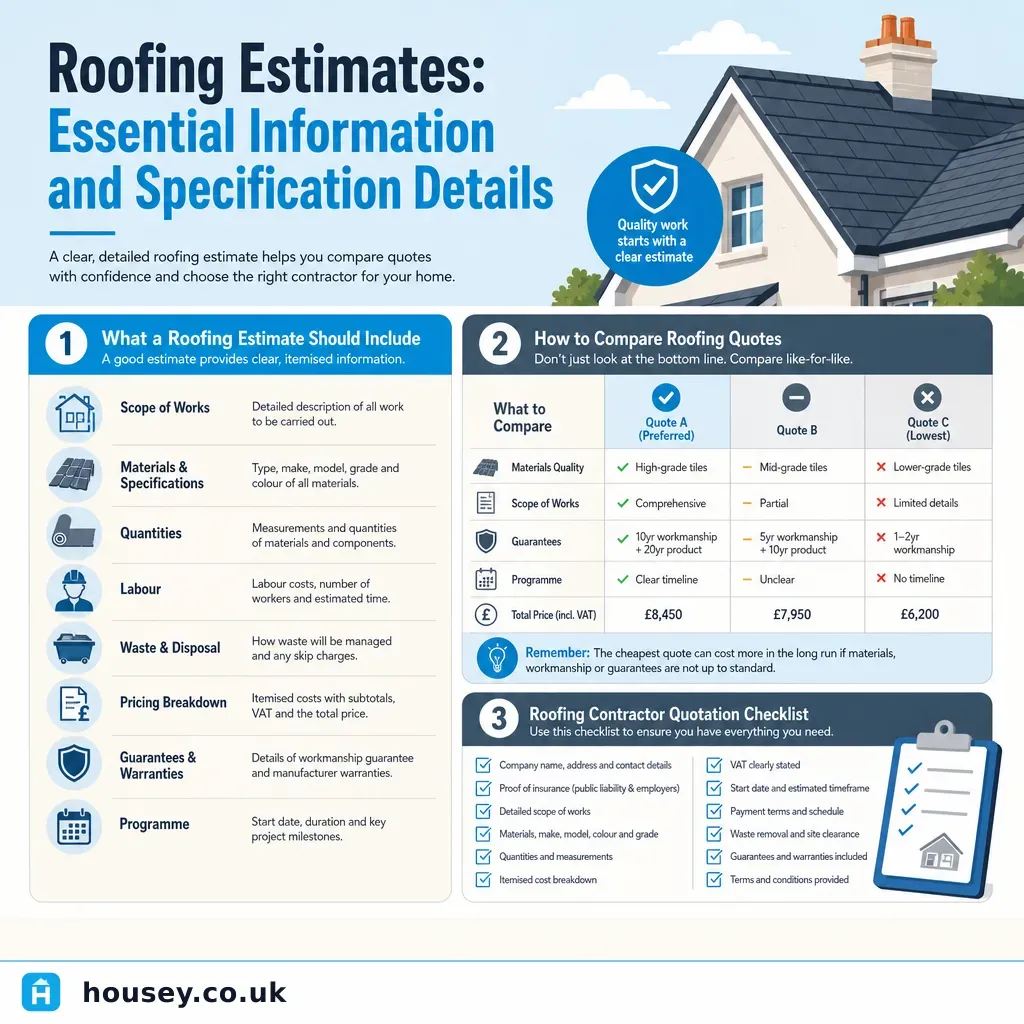
Roofing Estimates: Essential Information and Specification Details
A robust UK roofing estimate should specify materials by manufacturer and product code, reference BS 5534 for pitched roofs or the relevant system standard for flat roofs, state the workmanship and manufacturer warranty terms, itemise scaffolding and waste disposal, and set out a stage payment schedule.