Roof Maintenance: Essential Care and Inspection Guidance
By Housey · Last reviewed 11th of May 2026
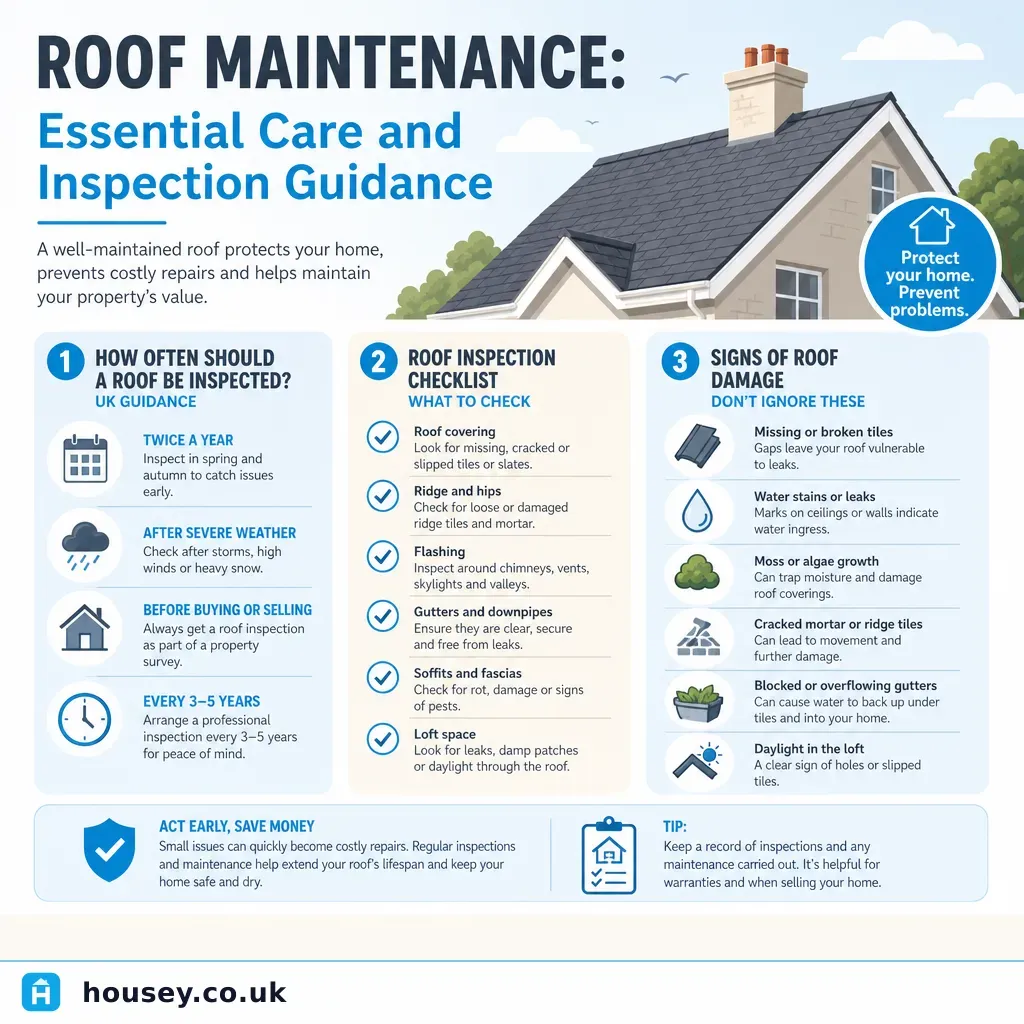
Roof Maintenance: Essential Care and Inspection Guidance
A UK roof is the building's primary defence against rain, wind, and cold, and minor problems left unaddressed can escalate rapidly into costly repairs or sustained internal water damage. Most homeowners rarely see their roof up close, which means defects can go unnoticed for years. Understanding what a basic maintenance regime involves — and knowing when to call a qualified professional — helps protect one of the most expensive elements of any UK home.
Key points
- The Building Research Establishment (BRE) notes that most UK pitched roofs are designed for a service life of 60 years or more, but individual components — underlays, flashings, and ridge mortar — can fail within 20–30 years without routine maintenance.
- Gutters blocked by leaf debris cause water to overflow against fascias and soffits, leading to timber rot, damp penetration at wall heads, and potential foundation saturation; gutters should be cleared at least once a year.
- Flashings — lead, aluminium, or mortar fillets — around chimney stacks, dormer cheeks, and wall abutments are the most common site of roof leaks in UK residential properties.
- Flat roofs have a shorter typical lifespan than pitched roofs: roughly 20–25 years for EPDM rubber membrane, 25 or more years for GRP (fibreglass), and 15–25 years for traditional built-up felt.
- The Work at Height Regulations 2005 apply to anyone carrying out work above ground level; for homeowners, any roof access beyond single-storey height should be carried out by a professional roofer with appropriate equipment, training, and insurance.
How often should a UK roof be inspected?
A general visual inspection from ground level — using binoculars if needed — should be carried out at least once a year. The most productive times are:
- Autumn (September–November): Before winter weather arrives. Clear gutters, check for loose or slipped tiles, and attend to any repairs before the first sustained rainfall and frost.
- After a significant storm: High winds can dislodge ridge tiles, unseat slates, and damage flashings. A post-storm check should be standard practice.
- Before and after major works: If scaffolding is being erected for adjacent works, it provides a logical opportunity to arrange a roof inspection at minimal additional cost.
Professional inspections using scaffolding, a cherry picker, or a drone survey are advisable every 5–10 years for older properties, or whenever internal damp stains, mould, or unexplained moisture appears after wet weather.
Pitched roof maintenance: what to check
UK pitched roofs are most commonly covered in clay or concrete tiles, natural slate (Welsh slate being the most widely used native variety), or synthetic slate. Inspection principles are consistent across materials:
Tiles and slates
- Look from ground level for slipped, cracked, or missing tiles or slates.
- Check that ridge tiles and hip tiles appear firmly bedded — loose ridge mortar is one of the most common sources of wind damage and water ingress.
- On older properties, check verge mortar (the mortar fillet at the roof edges) for cracking and loss.
Flashings
- Lead flashings at chimney bases, around dormer windows, and at wall abutments should lie flat and be fully sealed. Lifted or cracked flashing allows water behind the roof covering.
- Mortar fillets used instead of lead on some older properties can harden and crack over time; check for gaps or separation.
Gutters and downpipes
- Remove leaf debris, moss, and silt accumulation at least annually — ideally in late autumn after leaf fall.
- Check that brackets are secure and gutters fall correctly toward downpipes without sagging.
- Downpipes should discharge freely to a drain; blockages can cause water to overflow at the wall head and saturate pointing and brickwork.
Chimney stacks
- Chimney pots and the surrounding haunching (the mortar mound around the pot base) can loosen over time, particularly on Victorian and Edwardian stacks.
- Disused chimney flues should be capped or ventilated to prevent damp accumulation inside the stack.
Flat roof maintenance: what to check
Flat roofs — common on extensions, garages, and many 1960s–80s properties — require specific checks:
- Surface condition: Look for blistering, splits, lifting membrane seams, or ponding water (standing water remaining more than 48 hours after rain).
- Upstands and edge trims: The junction between the roof covering and the wall or parapet is the most vulnerable area; check for lifting or gaps.
- Outlets and drains: Keep flat roof drains clear of debris; a blocked outlet can cause rapid water accumulation and structural overload.
- Membrane integrity: EPDM and GRP roofs should be checked for UV degradation, puncture damage, or joint failure.
Seasonal roof maintenance checklist
Autumn (September–November)
Spring (March–May)
After a significant storm
Flat roof vs pitched roof: maintenance comparison
Feature | Pitched roof (tile or slate) | Flat roof (EPDM, GRP, or felt) |
|---|---|---|
Typical covering lifespan | 60+ years (clay tile); 30–50 years (concrete tile); 100+ years (natural slate) | 20–25 years (EPDM); 25+ years (GRP); 15–25 years (built-up felt) |
Main failure points | Slipped tiles, flashing failure, ridge and verge mortar | Ponding water, membrane splits, upstand lifting |
Inspection frequency | Annual visual; professional every 5–10 years | Annual visual; professional every 3–5 years |
Moss and algae risk | High on north-facing slopes | Low |
DIY access risk | Not recommended above single-storey height | Not recommended — membrane can be punctured by foot traffic |
Storm vulnerability | Ridge and hip tile displacement | Standing water accumulation; edge trim lifting |
Red flags: when a roof needs urgent professional attention
Contact a qualified roofer promptly if you notice any of the following:
- Damp stains appearing on upstairs ceilings after rainfall, or visible water entry when inspecting the loft space.
- Sagging or deflection in the roofline when viewed from street level.
- Daylight visible through the roof structure from inside the loft.
- More than two or three slipped or missing slates or tiles.
- A ridge tile or hip tile that is visibly displaced or absent.
- Blistering or splitting across a significant area of flat roof membrane.
- Persistent gutter overflow despite recent clearance, which may indicate a structural alignment problem or hidden blockage.
These are signs that a professional repair assessment is required promptly — not items to defer to a future list.
When to get professional help
Working on or near a roof is hazardous. The Health and Safety Executive (HSE) consistently identifies falls from height as one of the principal causes of fatal accidents in construction. Homeowners should not attempt any roof work beyond ground-level gutter clearance without appropriate training, access equipment, and safety provisions.
Engage a qualified professional roofer for:
- Any repair or replacement work involving tiles, slates, flashings, ridge mortar, or lead work.
- Access for inspection where you cannot see the full roof from ground level or a first-floor window.
- Any work involving a chimney stack.
- Flat roof repair or full replacement.
- Any inspection prompted by internal damp staining or visible structural concern.
A qualified roofer should hold public liability insurance. For notifiable work under Building Regulations — such as certain re-roofing projects — they should be registered with a Competent Person Scheme or the work should be subject to local authority building control sign-off.
How Housey can help
Housey connects homeowners with vetted local qualified local roofers and specialists who can carry out a professional roof survey — from annual condition checks through to full drone inspections and pre-purchase reports. Getting two or three quotes before committing to significant roof work is always advisable.
Frequently asked questions
How much does a professional roof inspection cost in the UK?
Costs vary by roof size, access method, and region. A basic inspection by a roofer using a ladder may cost £75–£200, while a full inspection using scaffolding or a drone survey typically ranges from £200–£500 or more. Indicative UK costs, last reviewed 2026-05-11. Always obtain at least two quotes and confirm what the inspection includes.
How long does a UK roof last?
Natural slate can last 100 years or more if well laid and maintained. Clay tiles typically last 60–100 years; concrete tiles 30–50 years. EPDM flat roofing lasts around 20–25 years; GRP (fibreglass) flat roofing 25 years or more. Individual components — flashings, underlay, ridge mortar — often need attention well before the covering itself fails.
Does roof maintenance affect my home insurance?
Most UK home insurance policies require the property to be kept in reasonable repair. Damage arising from neglected maintenance — such as a deteriorated flashing or a long-blocked gutter — may not be covered under a standard policy. Check your policy wording and arrange repairs promptly when defects are identified during inspections.
Do I need planning permission for roof repairs in the UK?
Like-for-like repairs do not normally require planning permission. However, changing the roof covering to a different material, adding a roof light, or altering the roof slope or external form may require permission — particularly in a Conservation Area. Check with your local planning authority before any works that change the external appearance of the roof.
Sources and further reading
- Work at Height Regulations 2005 — legislation.gov.uk
- Working at height: a brief guide (INDG401) — Health and Safety Executive
- Competent person schemes — GOV.UK
- Conservation areas: designation, appraisals and management — GOV.UK
Useful next reads
 Surveys & Inspections
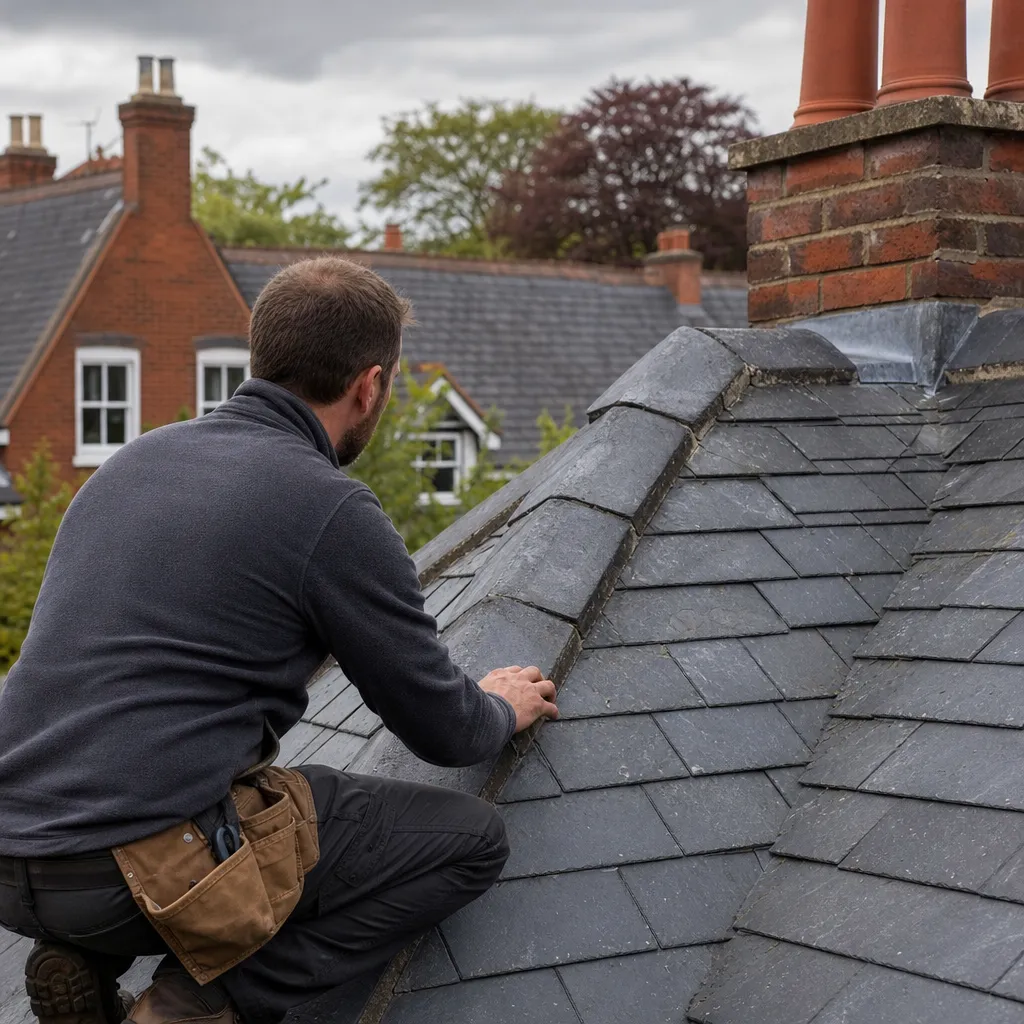
Maintaining slate roofs: essential care and upkeep guidance
A well-maintained natural slate roof can last 80–150 years, but it relies on regular inspections, prompt replacement of slipped or cracked slates, clear gutters, and sound lead flashings.
 Surveys & Inspections
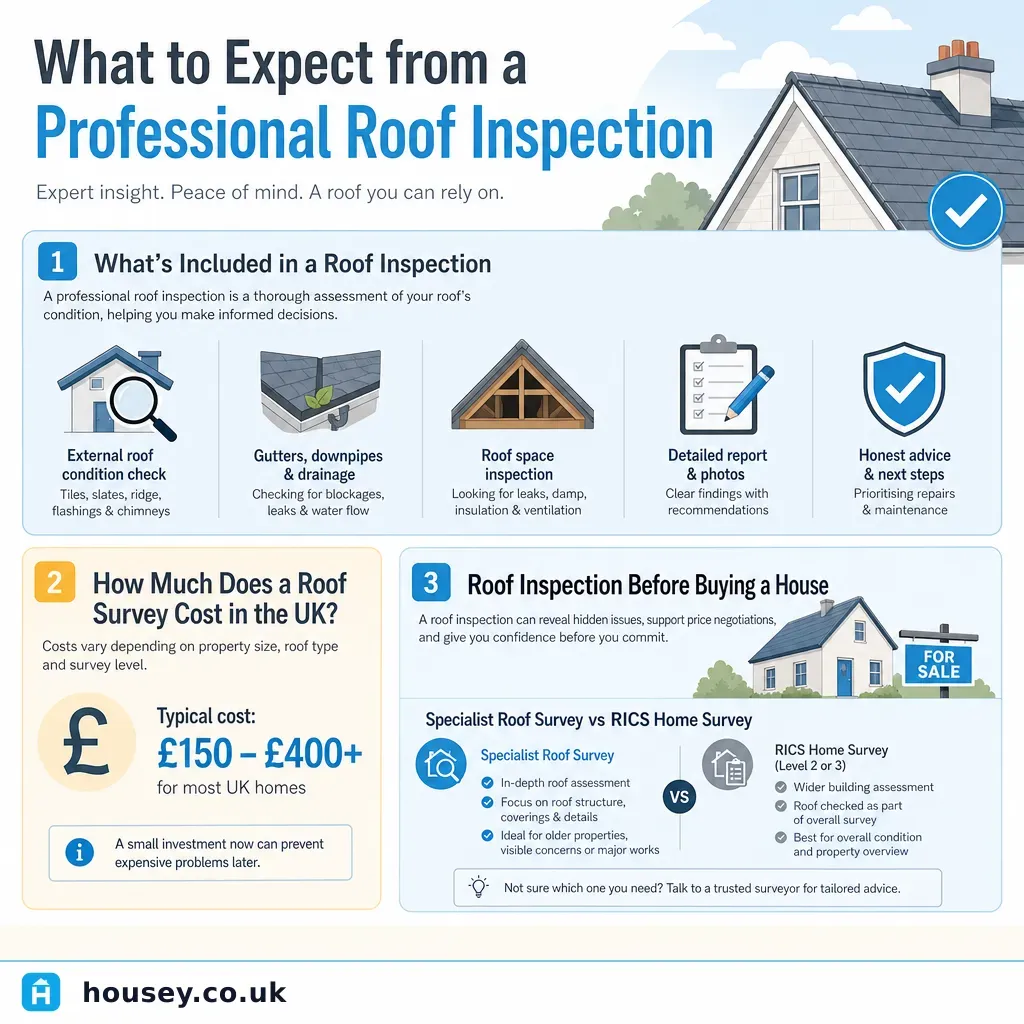
What to Expect from a Professional Roof Inspection
A professional roof inspection involves a qualified specialist examining your roof coverings, flashings, mortar, gutters, and structure.
 Surveys & Inspections
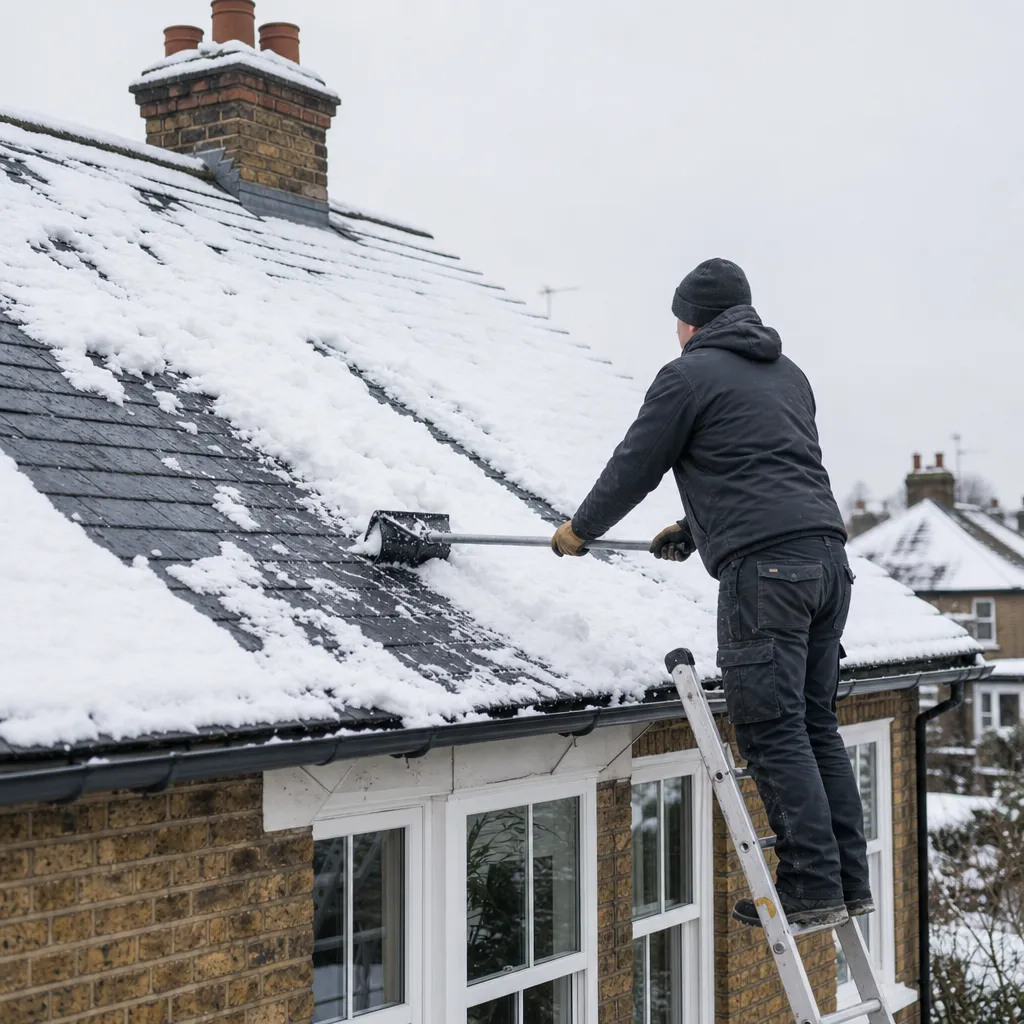
Roof Snow Removal: Safety and Structural Considerations
In the UK, most pitched roofs in good condition can tolerate typical snowfall without intervention.
 Surveys & Inspections
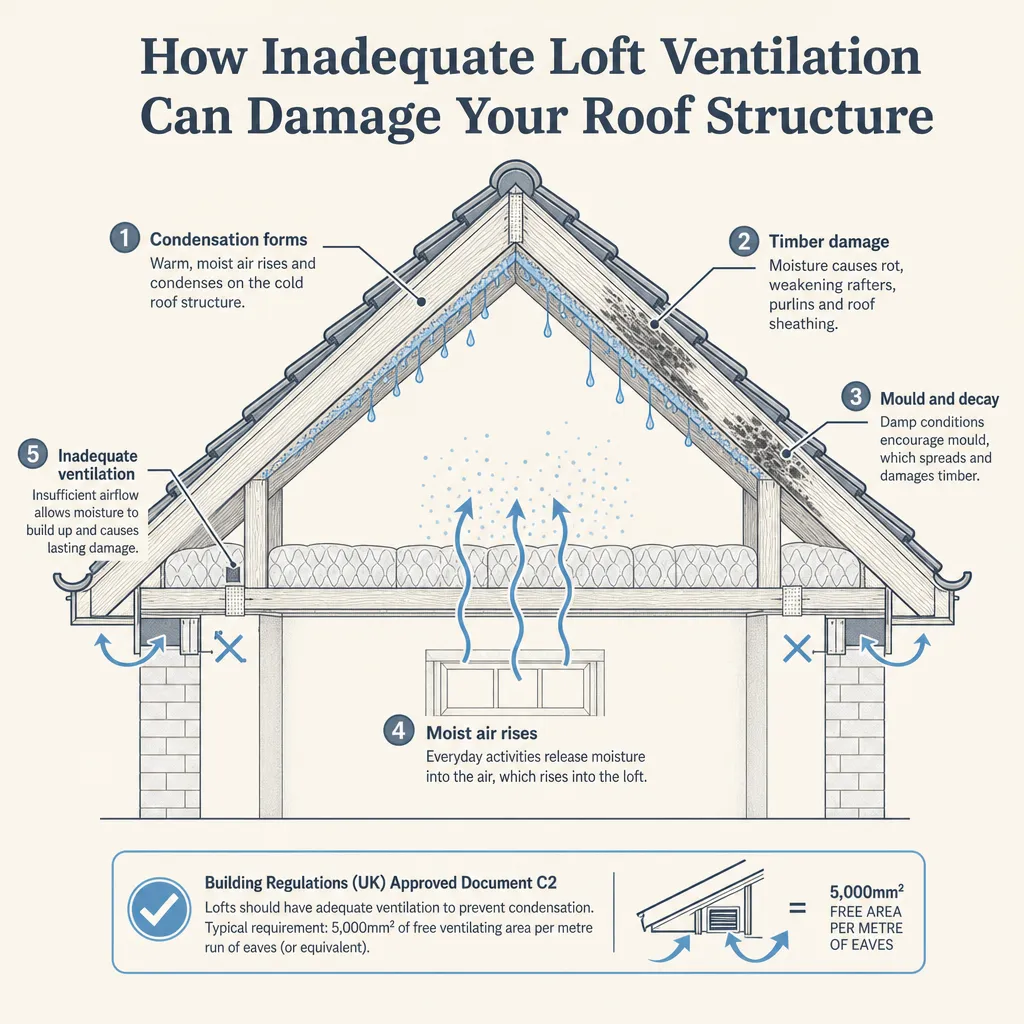
How Inadequate Loft Ventilation Can Damage Your Roof Structure
Inadequate loft ventilation allows warm, moist air to condense on cold roof timbers.
 Surveys & Inspections
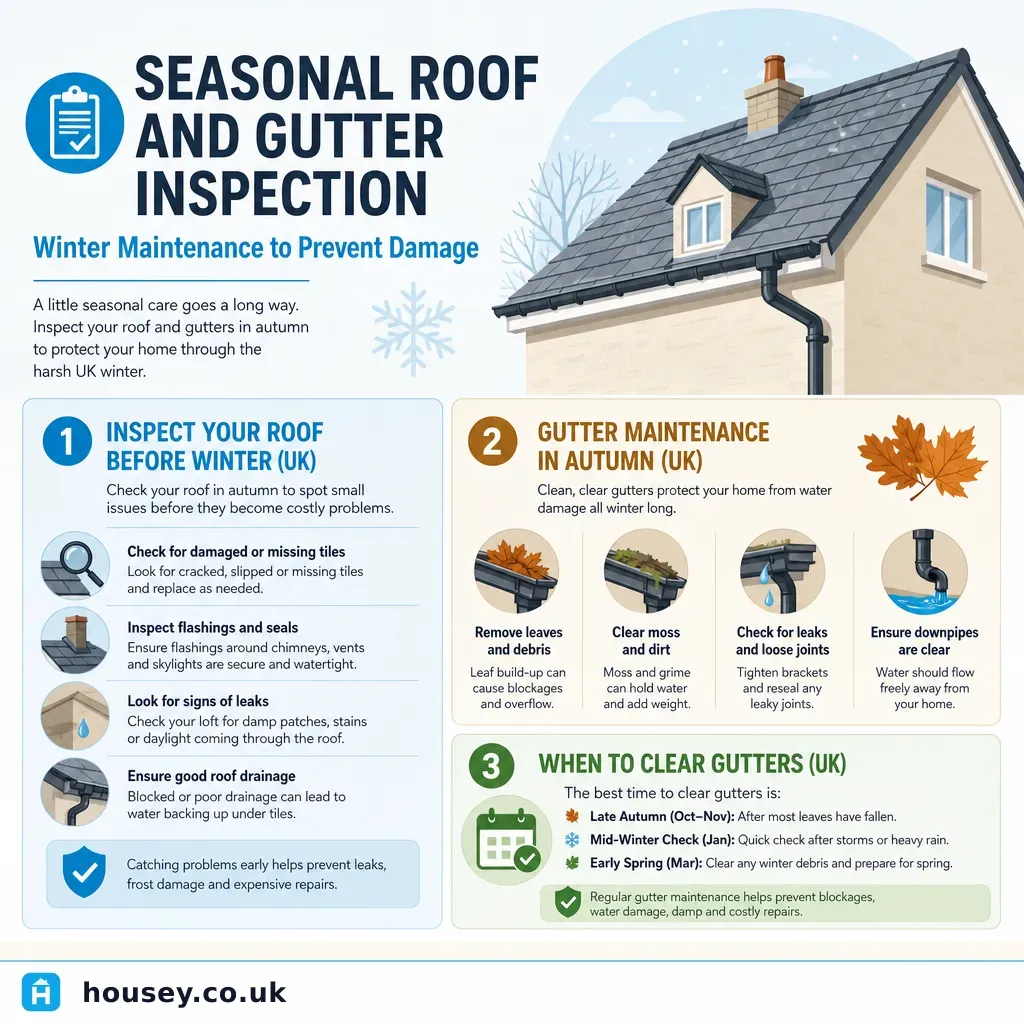
Seasonal Roof and Gutter Inspection: Winter Maintenance to Prevent Damage
UK roofs and gutters need inspection before and after winter to catch loose tiles, blocked gutters, and failed flashings before they cause water ingress.