Roofing Estimates: Essential Information and Specification Details
By Housey · Last reviewed 31st of May 2026
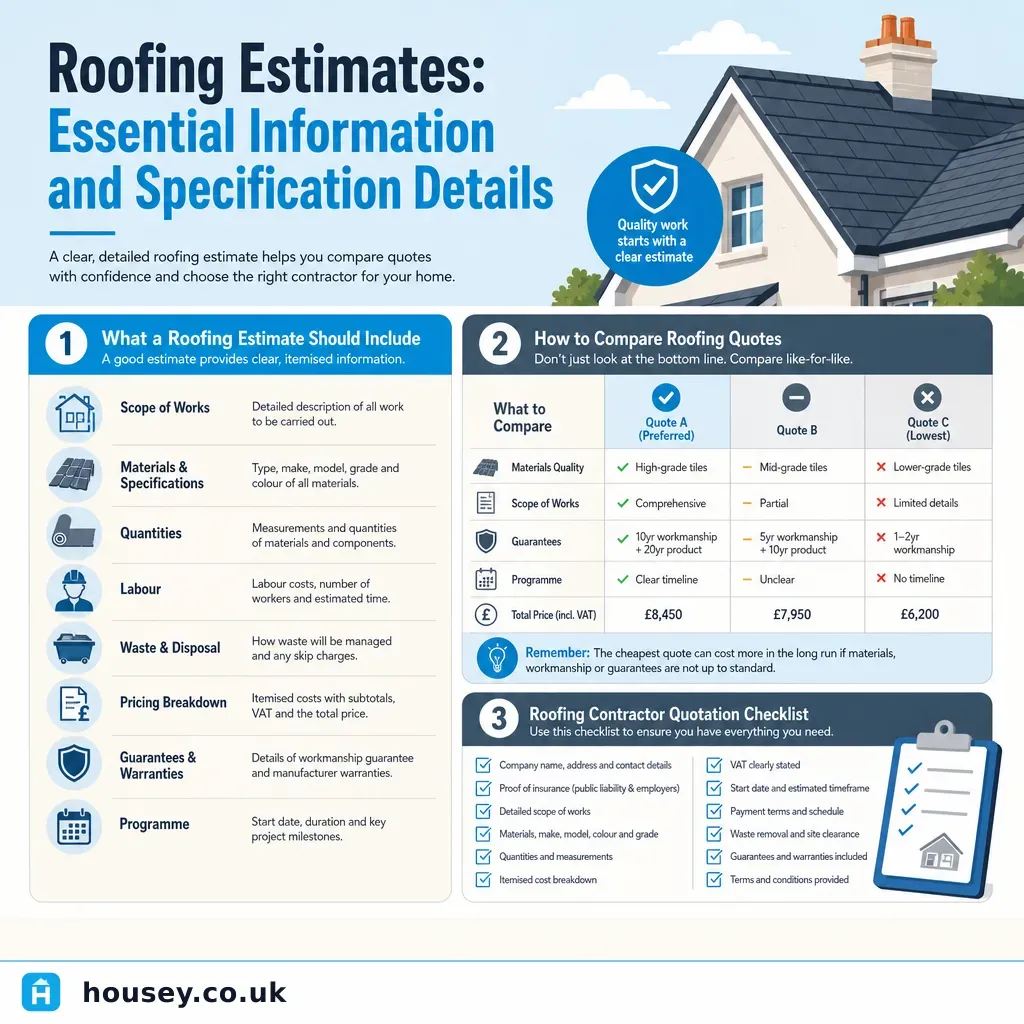
Roofing Estimates: Essential Information and Specification Details
Getting quotes for roof work is one of the more testing tasks a UK homeowner faces — partly because the work is expensive and disruptive, and partly because the quality of what you are buying is difficult to judge from a written estimate alone. Whether you need a full re-roof, a flat roof replacement, or a localised repair, understanding what a proper roofing estimate should contain puts you in a much stronger position to compare contractors and avoid costly disputes after the work is done.
Key points
- Pitched roof slating and tiling work in the UK should reference BS 5534:2014+A2:2018, the British Standard that specifies minimum requirements for battens, underlay, tile fixing, and dry-fix ridge systems.
- Flat roof systems — felt, GRP fibreglass, EPDM rubber, and single-ply membrane — have materially different lifespans and warranty terms; the specific system must be named explicitly in any estimate.
- Scaffolding is required for most pitched roof work on a two-storey house under the Work at Height Regulations 2005; an estimate that makes no provision for access is incomplete.
- The National Federation of Roofing Contractors (NFRC) and the Competent Roofer scheme are the main industry bodies; membership provides access to workmanship guarantee schemes and a formal complaints process.
- VAT on residential roofing repairs is charged at 20% for most homeowners; always confirm whether a quoted price is VAT-inclusive or exclusive before accepting.
Types of roofing work and what to expect
Type of work | Typical scope | Approximate lifespan | Specification level needed |
|---|---|---|---|
Tile or slate re-roof (pitched) | Strip existing covering, batten, underlay, and relay | 30–60+ years (varies by material) | Full written spec: materials, BS reference, warranty |
Flat roof replacement | Strip and relay felt, GRP, EPDM, or single-ply | 10–25 years (felt); 25–50 years (GRP/EPDM/single-ply) | Full system spec plus manufacturer warranty details |
Ridge and hip re-bedding or dry-fixing | Re-bed mortar or install dry-fix ridge and hip system | 10–20 years (mortar); 30+ years (dry-fix) | Written scope: dry-fix vs mortar decision documented |
Flashing repair or replacement | Lead, aluminium, or zinc at chimney, valleys, abutments | 25–50+ years (lead to BS EN 12588) | Material type and code number specified |
Partial repair or patch | Address specific slipped tiles or isolated leaks | Variable | Scope of work, materials, access method |
Chimney repointing or removal | Repoint stack or take down to below roof level | 15–25 years (repointing) | Written scope, structural implications if removal |
Indicative lifespans only — actual performance depends on installation quality, material grade, maintenance regime, and exposure. Indicative UK costs last reviewed 2026-05-31; obtain written quotes from NFRC-member contractors for current pricing.
What a proper roofing estimate must include
Scope of works
The estimate should state clearly which roof areas are included, what is being stripped and what is being retained, and how the contractor will access the roof — scaffolding, a cherry picker, or a combination.
Materials specification
Every material component should be named:
- Tile or slate: manufacturer, product name, and product code (for example: Marley Mellor concrete interlocking tile, or Tegral Bangor Blue natural slate)
- Underlay: type (breathable or non-breathable) and BS reference — BS 5534 effectively requires a breathable underlay for most new and replacement pitched roof work
- Battens: treated or untreated; BS 5534 requires treated battens sized to suit rafter centres and tile type
- Ridge and hip system: mortar bedded or dry-fix — dry-fix is now strongly recommended under BS 5534 and required by many manufacturers to validate the tile warranty
- Valley type: open metal valley, closed mortar valley, or a pre-formed GRP valley trough
- Flashings: material (lead, aluminium, or zinc) and standard — lead flashings should reference BS EN 12588 and specify the code number, which indicates sheet thickness
Workmanship warranty
The estimate should state the duration (typically 5–10 years for workmanship), who backs it (the contractor, an NFRC Guarantee scheme, or an insurance-backed guarantee provider), and what it covers and excludes.
System or manufacturer warranty
For flat roof systems — GRP, EPDM, or single-ply — the manufacturer's system warranty is separate from the workmanship guarantee and typically requires installation by an approved applicator. The duration and any conditions should be named in the estimate.
Scaffolding and access
The estimate should confirm whether scaffolding is included or is a separate contractor cost, the expected duration of hire, and who is responsible for overage charges if the project overruns.
Waste disposal and old material removal
Removal and disposal of existing tiles, felt, battens, and old lead should be itemised. Note that old lead has scrap value and some contractors factor this into their pricing.
VAT and payment schedule
Confirm whether the price is VAT-inclusive or exclusive — for most domestic roofing 20% VAT applies. Stage payments tied to progress milestones are standard practice; avoid paying more than 10–20% upfront.
Quote comparison template
When you have received two or more estimates, use this framework to compare like for like:
Item | Contractor A | Contractor B | Contractor C |
|---|---|---|---|
Tile or slate — manufacturer and product name |
|
|
|
Underlay — type and BS reference |
|
|
|
Battens — treated, BS 5534 compliant? |
|
|
|
Ridge system — mortar or dry-fix? |
|
|
|
Flashing — lead code or alternative material |
|
|
|
Workmanship warranty — duration and backer |
|
|
|
System or manufacturer warranty (flat roofs) |
|
|
|
Scaffolding — included or separate cost |
|
|
|
Waste disposal — included? |
|
|
|
VAT — included in quoted price? |
|
|
|
Stage payment schedule |
|
|
|
Estimated start date and project duration |
|
|
|
NFRC or Competent Roofer membership |
|
|
|
Public liability insurance confirmed |
|
|
|
Total price (VAT inclusive) |
|
|
|
Red flags in a roofing estimate
Watch for these warning signs before accepting a quote:
- No written specification — a one-line price with no material detail offers no recourse if workmanship or materials fall short.
- Unverifiable materials — phrases such as "good quality tiles" or "standard underlay" without named products mean you cannot hold the contractor to a specific standard.
- No scaffolding provision — most pitched roof work legally requires scaffolding under the Work at Height Regulations 2005; a contractor working from ladders alone on a full re-roof is a safety concern worth querying directly.
- Pressure to pay in full upfront or cash only — this removes your consumer rights and paper trail for any dispute.
- No insurance details available — public liability insurance (minimum £2 million, preferably £5 million) should be available on request before you sign anything.
- No workmanship guarantee — even a brief one-page guarantee document is standard practice among reputable contractors.
- Price dramatically below comparable quotes — if one estimate is 40% or more below the others, scrutinise the specification carefully; the shortfall is usually in materials grade, omitted scaffolding, or excluded waste disposal.
Homeowner checklist: before work starts
When to get professional help
For significant roofing projects, consider commissioning a roof survey before inviting contractors to quote. An independent survey establishes the scope of work objectively, gives you a specification to issue to all contractors — ensuring genuine like-for-like comparison — and reduces the risk of unexpected additional work arising mid-project.
Seek professional advice if:
- You are unsure whether you need a repair, a partial re-roof, or a full replacement
- The roof shows signs of structural sagging, rafter failure, or visible spread at the eaves
- The property is listed or in a conservation area, where planning consent may be needed to change tile type or material
- The work involves a shared or party roof with a neighbouring property
How Housey can help
Housey helps you find and compare qualified local roofers and book an independent roof survey before inviting tenders. Review NFRC membership, insurance status, and verified homeowner feedback before instructing a contractor to start.
Frequently asked questions
How many roofing quotes should I get?
Get at least three written quotes for any significant roofing work. This is standard guidance from Citizens Advice and consumer protection bodies. Three quotes give you a meaningful price range and let you assess differences in specification and approach. For emergency repairs where time is limited, at least two written quotes remain advisable.
Should a roofing estimate include scaffolding?
For most pitched roof work on a two-storey house, scaffolding is required under the Work at Height Regulations 2005. It should either be included in the estimate or provided as a separately itemised cost. Be cautious of estimates for steep or high roofs that make no mention of access arrangements at all.
What is an insurance-backed guarantee for roofing work?
An insurance-backed guarantee (IBG) is a policy taken out by the contractor that protects your workmanship warranty if the contractor ceases trading before the guarantee period expires. IBGs are available through providers such as the NFRC Guarantee scheme. They are separate from the contractor's own workmanship warranty and provide additional protection for larger projects.
Does roofing work need planning permission?
Most like-for-like roof repairs and replacements are permitted development in England and do not require planning permission. However, if your property is listed, in a conservation area, or you plan to change the roof material or profile, check with your local planning authority before work begins. GOV.UK's permitted development guidance for householders provides further detail.
What is BS 5534 and why does it matter?
BS 5534:2014+A2:2018 is the British Standard for slating and tiling for pitched roofs and vertical cladding. It specifies minimum requirements for battens, underlay, fixing methods, and dry-fix ridge systems. Contractors working to BS 5534 are installing a roof to a recognised quality benchmark, and NFRC member warranties typically require compliance with this standard.
Sources and further reading
- BS 5534:2014+A2:2018 Code of practice for slating and tiling — BSI
- National Federation of Roofing Contractors (NFRC) — NFRC
- Work at Height Regulations 2005 — legislation.gov.uk / HSE
- Consumer Rights Act 2015 — legislation.gov.uk
- Permitted development rights for householders: technical guidance — GOV.UK
Useful next reads
 Surveys & Inspections
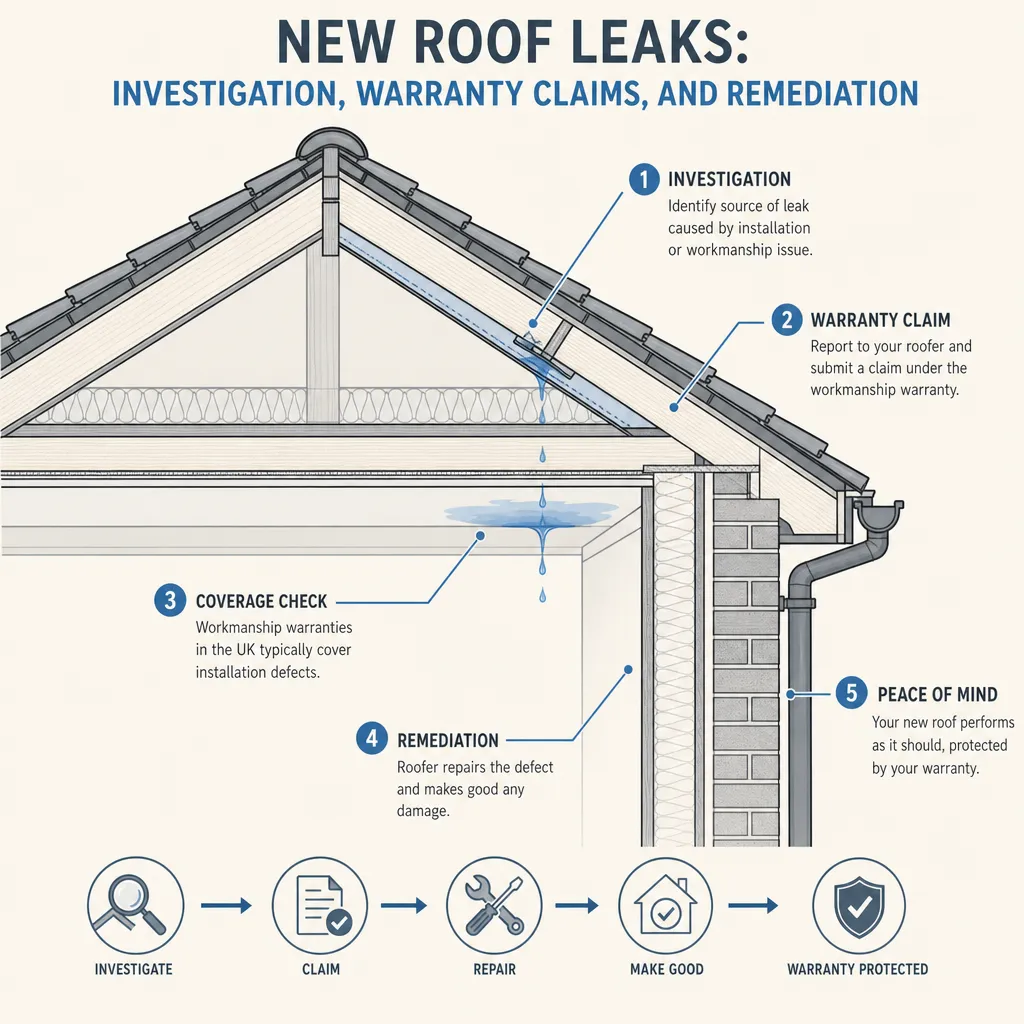
New Roof Leaks: Investigation, Warranty Claims, and Remediation
A leak on a new roof usually indicates a workmanship or materials fault.
 Surveys & Inspections
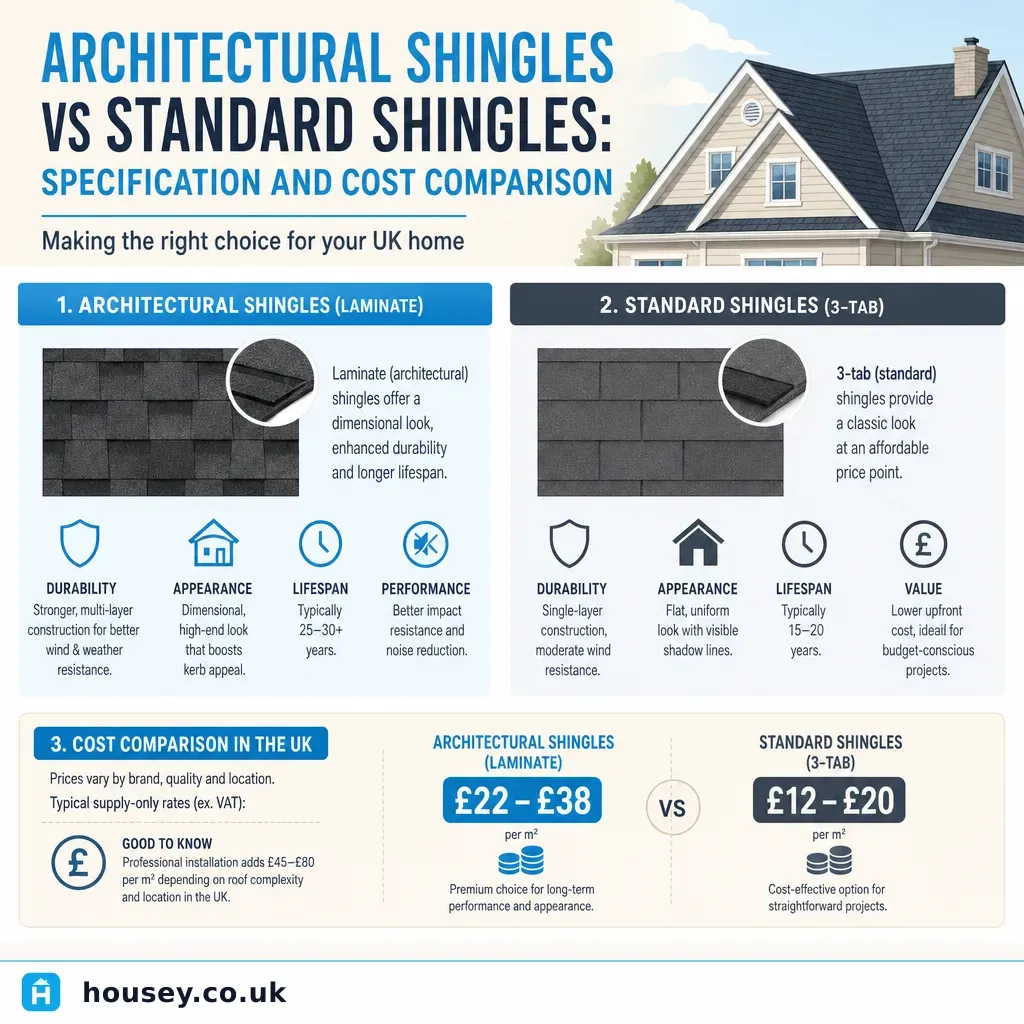
Architectural Shingles vs Standard Shingles: Specification and Cost Comparison
Architectural (laminate) shingles use a multi-layer construction, typically 3–5 mm thick, with better wind resistance and longer warranties than standard three-tab shingles at 2–3 mm.
 Surveys & Inspections
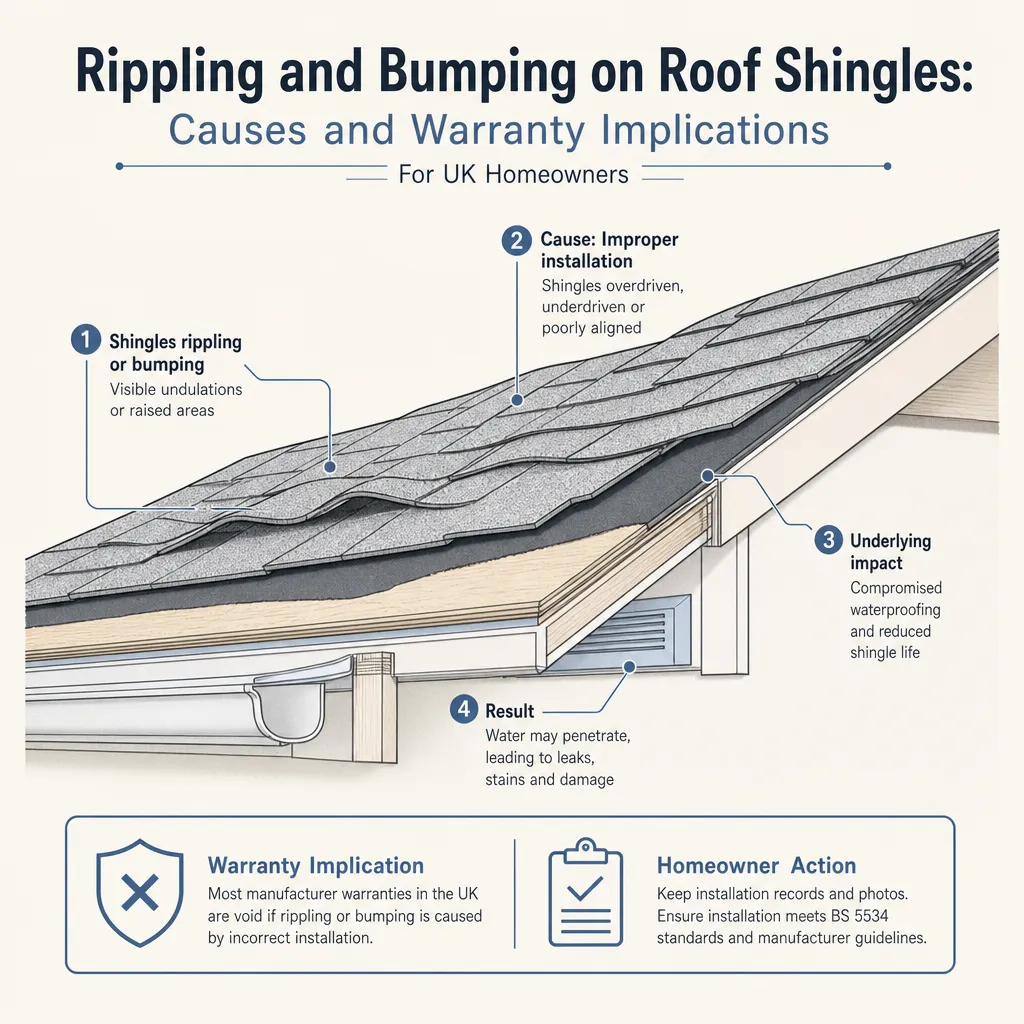
Rippling and Bumping on Roof Shingles: Causes and Warranty Implications
Rippling or bumping on roof shingles is almost always caused by installation error — typically inadequate fastening or a damp, uneven substrate — rather than a product defect.
 Surveys & Inspections
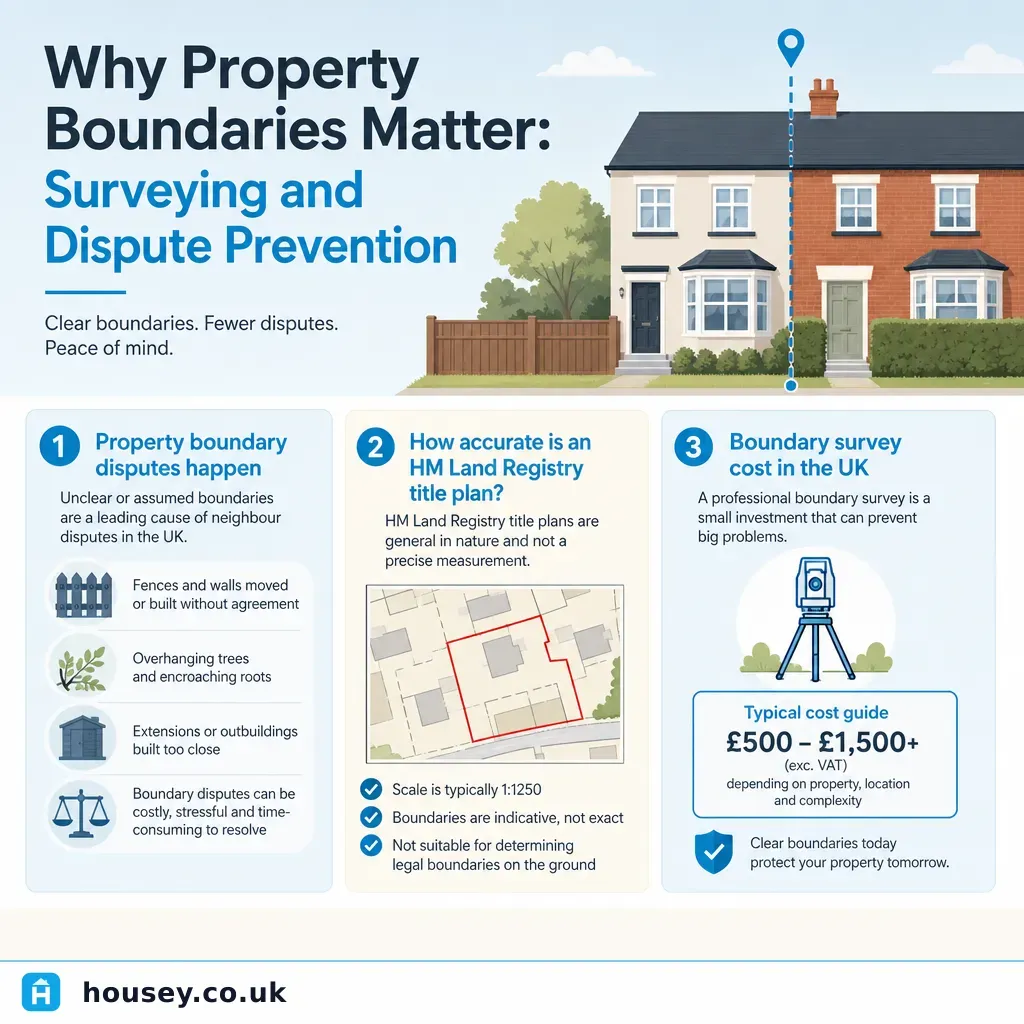
Why Property Boundaries Matter: Surveying and Dispute Prevention
Property boundaries in England and Wales are recorded as general boundaries by HM Land Registry — not precise measurements.
 Surveys & Inspections
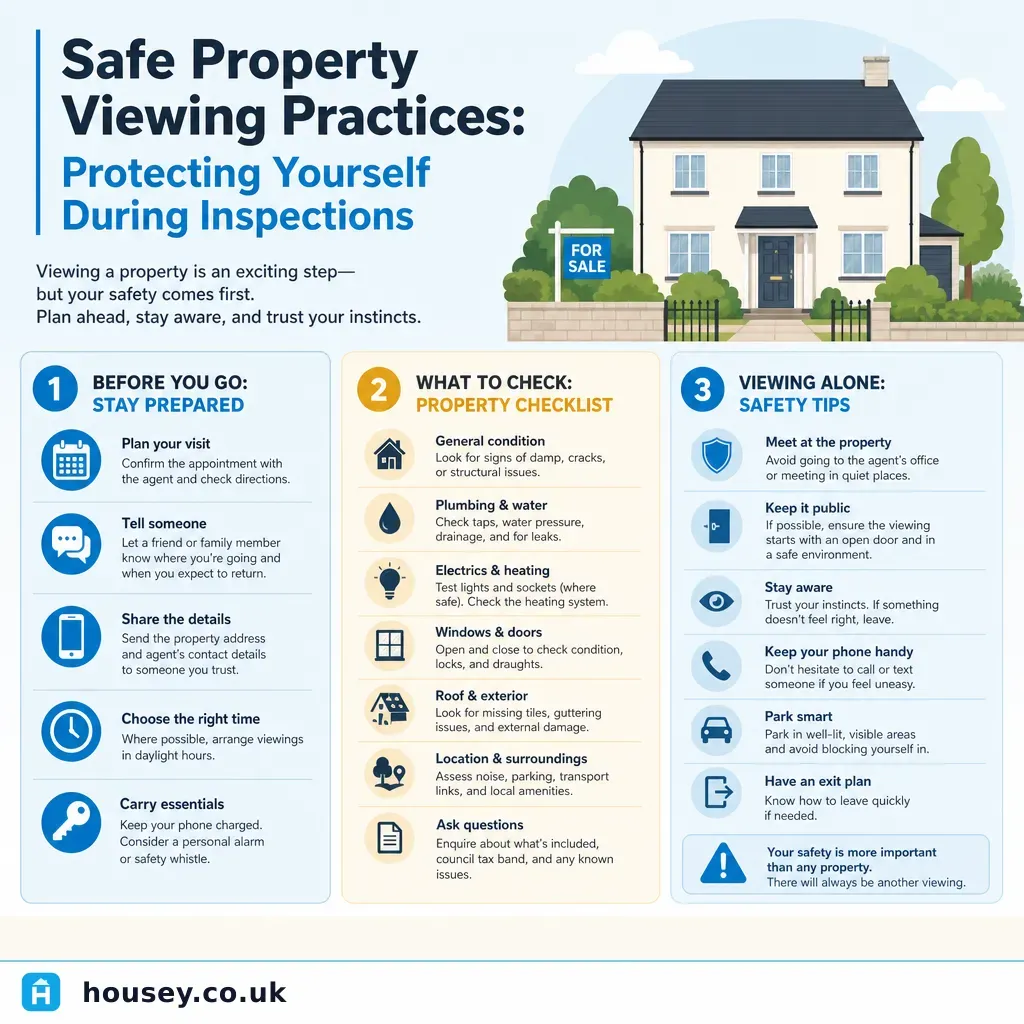
Safe Property Viewing Practices: Protecting Yourself During Inspections
When viewing a property in the UK, always tell someone where you are going and share the full address before you leave.