Roof Discolouration and Algae Growth: Prevention and Treatment Options
By Housey · Last reviewed 1st of June 2026
Roof Discolouration and Algae Growth: Prevention and Treatment Options
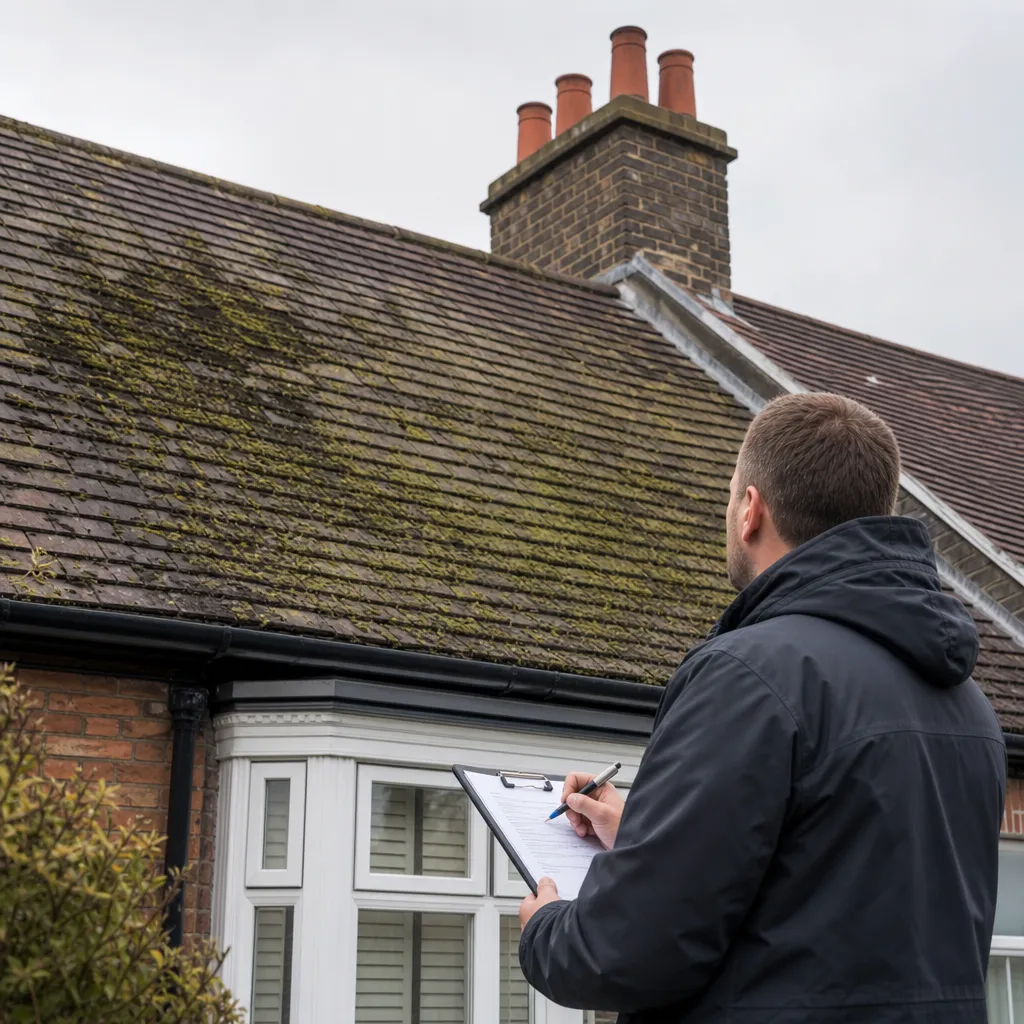
Black streaks, green patches, and the creeping flat crust of lichen are among the most visible signs of biological growth on UK roof coverings. For most homeowners, the first question is aesthetic — but the longer-term issue is whether growth is accelerating tile degradation, and what action, if any, should be taken before minor colonisation becomes a costly repair. The right answer depends significantly on roof material, the age of the covering, local climate, and the specific organism involved.
Key points
- Four main organisms colonise UK roofs: algae (most commonly Gloeocapsa magma, responsible for dark streaking), moss, lichen, and liverworts — each requires a different treatment approach, and lichen is both the hardest to remove and the most damaging over the long term.
- High-pressure washing of concrete or clay tiles can strip surface granules and shorten remaining service life, particularly on tiles more than 20 years old or showing frost damage — it is not appropriate for all roof types.
- Biocide treatments used for roof cleaning must comply with the Biocidal Products Regulation (BPR) — always verify that a product is approved for the intended application and obtain a COSHH assessment from any contractor you appoint.
- Some roofing manufacturers' guarantees are voided by incompatible chemical treatments — check tile-specific guidance before any product is applied to a warranted covering.
- Many cases of roof discolouration on modern concrete or clay tiles are cosmetic and do not indicate waterproofing failure — a roof survey can confirm the actual condition of the covering.
What causes roof discolouration
Roof discolouration in the UK is almost always biological in origin. Four main colonisers are responsible:
Algae cause dark brown or black staining, most visible as streaks running downslope from ridges, beneath overhanging branches, or around roof fittings. Algae spread readily in the UK's moist climate and are typically the first coloniser on a recently cleaned or new roof surface.
Moss creates thick green or brown cushion growth, predominantly in sheltered, north-facing, or heavily shaded areas. Moss retains moisture against the tile surface, which can promote freeze-thaw cycling on older, more porous tiles. It can also work under tile laps and disrupt water shedding if allowed to accumulate over several seasons.
Lichen forms a tight, flat crust of grey, yellow, or orange growth and is the hardest to remove. Unlike algae and moss, lichen has root-like structures (rhizines) that penetrate the surface of softer tiles, natural slate, and plain clay tiles, causing gradual surface erosion. It typically indicates a roof that has been undisturbed for many years.
Liverworts are less common but similar to moss in effect — flat green patches that appear on pitched or low-pitched roofs, particularly in wetter western areas of the UK.
The rate of growth depends on local rainfall, roof pitch, tree cover, aspect, and tile material. Properties in wetter western regions and those surrounded by mature trees are more susceptible. North-facing roof slopes, receiving less sunlight and drying more slowly, are consistently higher-risk.
Treatment options compared
Treatment method | Best for | Not ideal for | Typical frequency | Key risk |
|---|---|---|---|---|
Biocide soft wash | Algae and light moss on tiles in sound condition | Heavy moss; lichen; fragile surfaces | Every 3–5 years | Chemical runoff to drains and planting; BPR compliance required |
Manual soft brushing | Moss on concrete or clay tiles in sound condition | Natural slate; fragile plain clay; lichen | Annual or as needed | Surface damage if brushed aggressively; disturbing ridge pointing |
High-pressure washing | Heavy moss on robust modern concrete tiles only | Tiles over 20 years old; natural slate; any frost-damaged tile | Not routinely recommended | Surface granule loss; forcing water under tile laps |
Biocide treatment plus anti-algae coating | Recently cleaned or new roof surfaces for long-term prevention | Surfaces with active heavy growth; established lichen | Single application at time of cleaning | Tile manufacturer warranty compatibility |
Specialist lichen removal | Lichen-affected natural slate or plain clay | Standard modern concrete tiles | As required | Surface penetration worsens if lichen is left long-term |
Indicative UK costs, last reviewed 2026-06-01. Roof cleaning costs vary by roof area, access method, and treatment chosen. Obtain itemised quotes from at least two qualified roofers before instructing any work.
Does biological growth actually damage your roof?
The practical impact depends on the organism, the roof material, and how long growth has been established.
Algae — primarily cosmetic in early stages. Long-term algae cover creates a consistently moist surface that can marginally increase freeze-thaw cycling on older, more porous tiles, but is rarely a cause of structural failure on its own.
Moss — a more practical concern. Thick accumulations hold significant moisture against tile surfaces and, over several years, can contribute to accelerated frost spalling on older tiles. Moss can also work under tile laps, particularly where tiles are already slightly lifted or where mortar pointing at verge and ridge level has deteriorated. On flat and low-pitched roofs, heavy moss regularly blocks gutters and drainage outlets.
Lichen — the most damaging over long periods. Lichen's root structures penetrate the surface pores of natural slate, sandstone, and some clay tiles, chemically and mechanically altering the surface over decades. Removal of established lichen requires specialist attention and may cause some surface disruption.
For most modern concrete or clay-tiled roofs in sound structural condition, biological growth is primarily cosmetic. However, it can obscure other defects — cracked tiles, failed pointing, displaced ridge caps — that warrant attention. A roof survey before any treatment decision confirms whether underlying issues are present.
Prevention: a homeowner checklist
Reducing the conditions that favour biological growth is more cost-effective than repeated treatment:
What not to assume
Several common assumptions lead homeowners to make unnecessary or counterproductive decisions about roof cleaning:
- Do not assume pressure washing is always the safest or best method — it is the most aggressive treatment and is inappropriate for many UK roof types. A professional condition assessment should precede any decision.
- Do not assume all discolouration means a failing roof — on many properties, biological growth is wholly cosmetic and the tile and waterproofing are in sound condition.
- Do not assume a biocide application alone removes established moss — biocide kills the growth but does not remove dead material; some follow-up manual clearing is usually needed.
- Do not assume any contractor can treat any roof — cleaning methods must be matched to the specific tile type, age, and condition. Ask your contractor to justify the method they propose.
- Do not assume treatments are safe on a warranted roof covering — check with your tile manufacturer before any product is applied if a live warranty is in place.
When to get professional help
In most cases, biological growth on a well-maintained roof is a routine maintenance matter rather than an emergency. However, seek professional advice if:
- Moss accumulation is present at valley, ridge, or verge junctions — these are the points where ingress can lead to water penetration.
- The roof is more than 20 years old and has not been professionally inspected recently — treatment decisions should follow a condition assessment.
- You are considering a DIY high-pressure clean on an older or unfamiliar roof covering — incorrect technique carries a real risk of tile damage.
- Green or black staining is accompanied by damp patches on internal ceilings — this warrants a full inspection rather than surface treatment alone.
- You have natural slate, plain clay tiles, or a heritage roof covering — treatment choices for these materials require specialist knowledge.
How Housey can help
Before committing to a roof-cleaning treatment, a professional roof survey will confirm the condition of your roof covering, identify any defects that should be addressed first, and help you make an informed decision about whether cleaning adds value. Housey connects you with qualified local roofers who can assess your specific tile type, advise on the most appropriate treatment method, and carry out works safely with the correct access equipment.
Frequently asked questions
Is roof algae harmful to the roof structure?
Algae growth is primarily cosmetic in early stages and does not typically compromise the waterproofing of a sound roof. However, long-term biological colonisation — particularly established moss and lichen — can accelerate surface wear on older or more porous tiles, contribute to gutter blockages, and obscure other defects. Regular inspection from ground level allows early intervention before growth causes practical problems.
How often should I clean my roof?
There is no single correct answer — it depends on local climate, shading from trees, roof material, and the type and extent of growth present. On a typical suburban property with concrete tiles in a moist climate, a soft-wash biocide treatment every three to five years may be appropriate. Natural slate, plain clay, and heritage materials warrant more careful assessment. An annual visual check from ground level is good practice for all roof types.
Will roof cleaning increase my home's value?
Roof cleaning can improve kerb appeal and demonstrate maintenance to prospective buyers, but its effect on formal valuation is limited. A RICS surveyor notes the structural condition of the roof covering rather than its cosmetic appearance. If preparing a property for sale, a roof survey and any recommended repairs will carry more weight with a surveyor than cosmetic cleaning alone.
Can I clean my own roof safely?
Manual soft-brushing of accessible sections from a safely positioned ladder is feasible for light moss, provided work stays within 2 m of ground level. Any work above 2 m carries a significant fall risk and should be carried out by a professional with appropriate access equipment and public liability insurance. High-pressure washing from a ladder is best avoided — incorrect technique can dislodge tiles or force water under laps. The HSE provides guidance on the risks of working at height.
Sources and further reading
- Working at Height Regulations 2005 — Health and Safety Executive
- Control of Substances Hazardous to Health (COSHH) — Health and Safety Executive
- Biocidal Products Regulation (BPR) — Health and Safety Executive
- Good Practice in Roofing — National Federation of Roofing Contractors
Useful next reads
 Improvement & Build
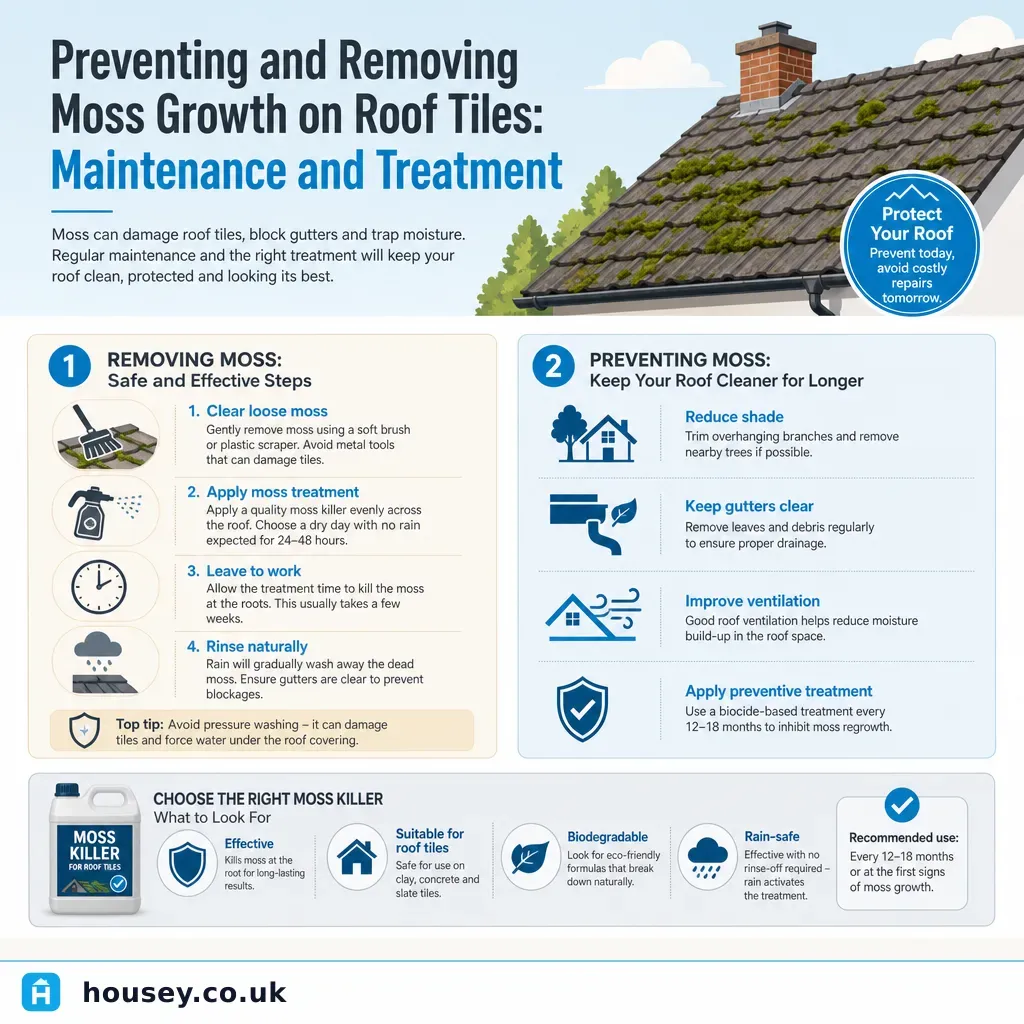
Preventing and Removing Moss Growth on Roof Tiles: Maintenance and Treatment
Moss on roof tiles is best treated with a proprietary biocide spray, left to die back over several weeks, then carefully cleared.
 Improvement & Build
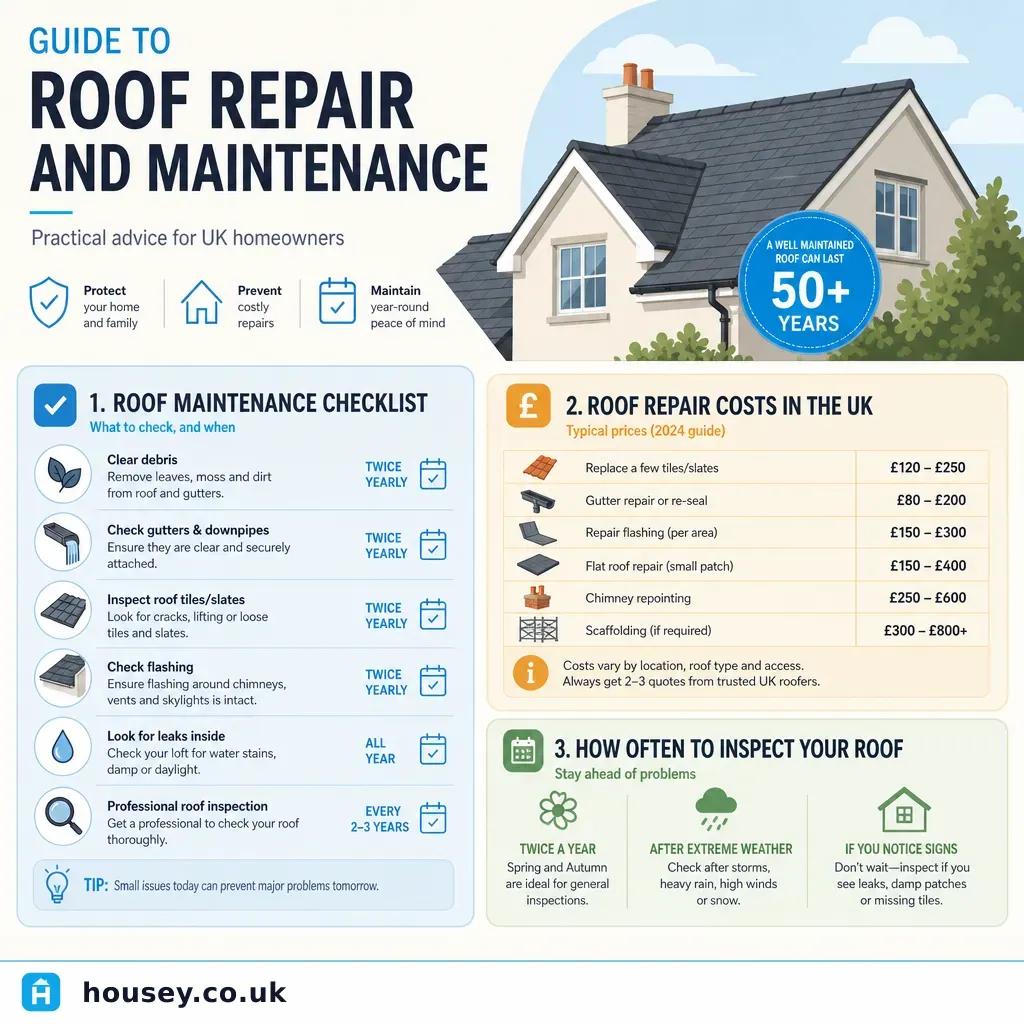
Guide to Roof Repair and Maintenance
Regular roof inspections every 3–5 years, prompt repair of damaged tiles and failed flashings, and annual gutter clearance are the core of effective UK roof maintenance.
 Improvement & Build
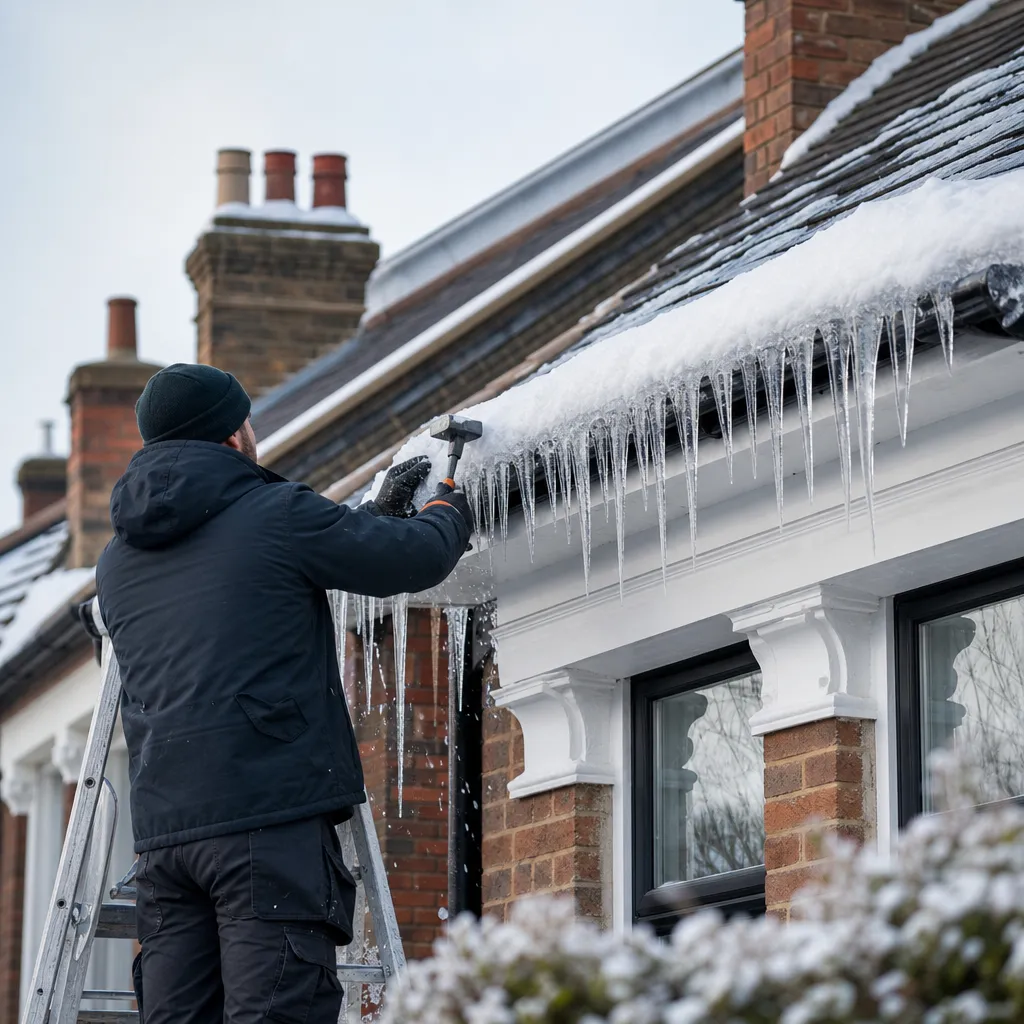
Ice Dam Removal and Roof Protection Services
Ice dams form when heat escaping through a poorly insulated roof melts snow, which refreezes at the colder eaves.
 Improvement & Build
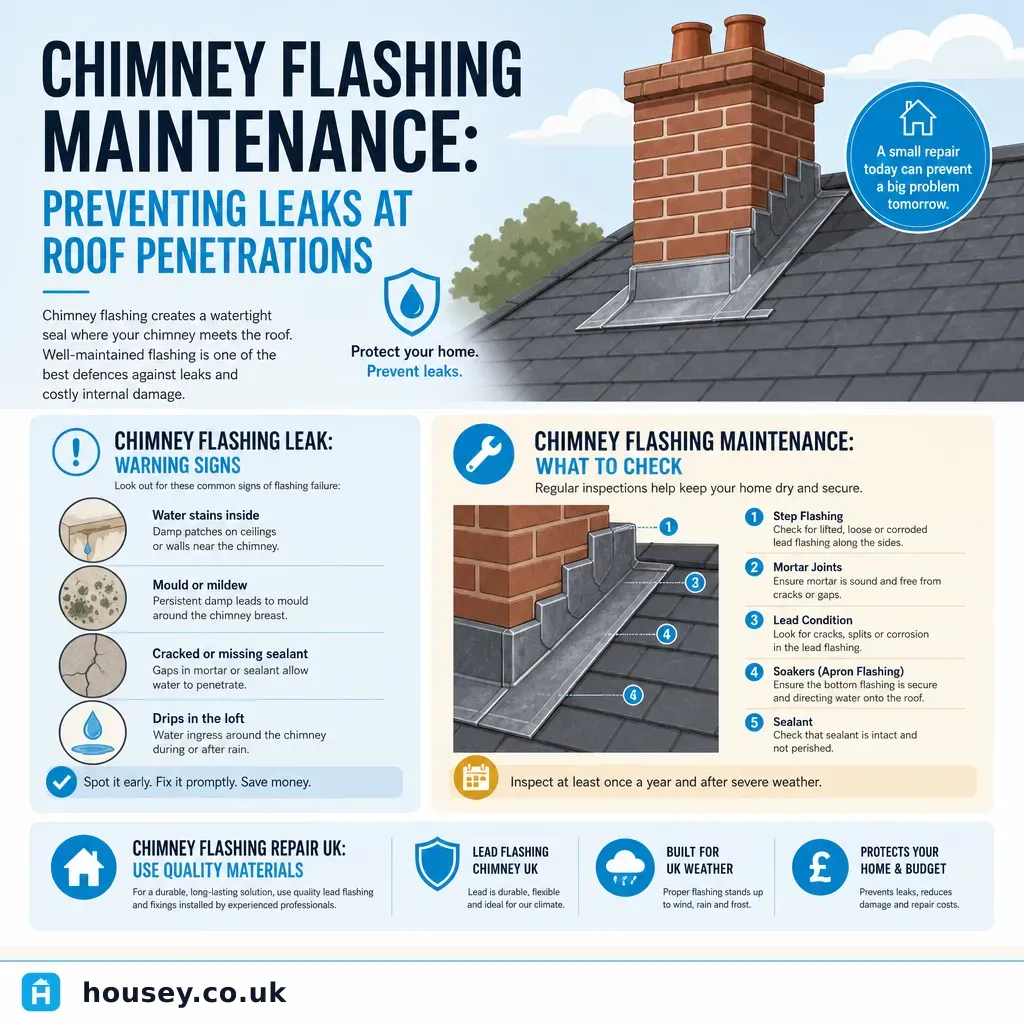
Chimney Flashing Maintenance: Preventing Leaks at Roof Penetrations
Chimney flashings most commonly fail at the raggle joint — where the mortar holding the counter flashing cracks — rather than through lead deterioration.
 Improvement & Build
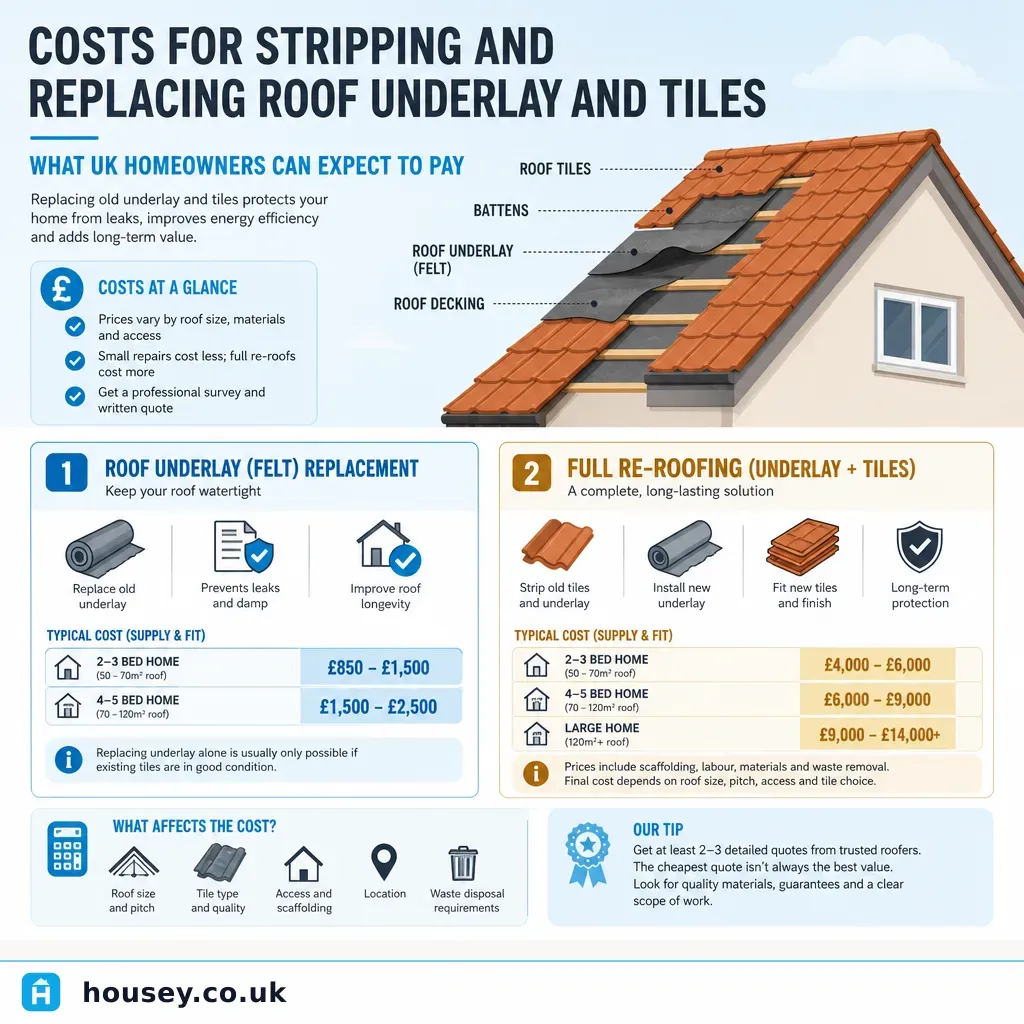
Costs for Stripping and Replacing Roof Underlay and Tiles
Stripping and replacing roof underlay and tiles on a typical UK semi-detached house costs £5,000–£12,000, depending on roof size, tile type, and access.