Roof Felt Repair from Inside: Internal Access and Temporary Solutions
By Housey · Last reviewed 3rd of May 2026
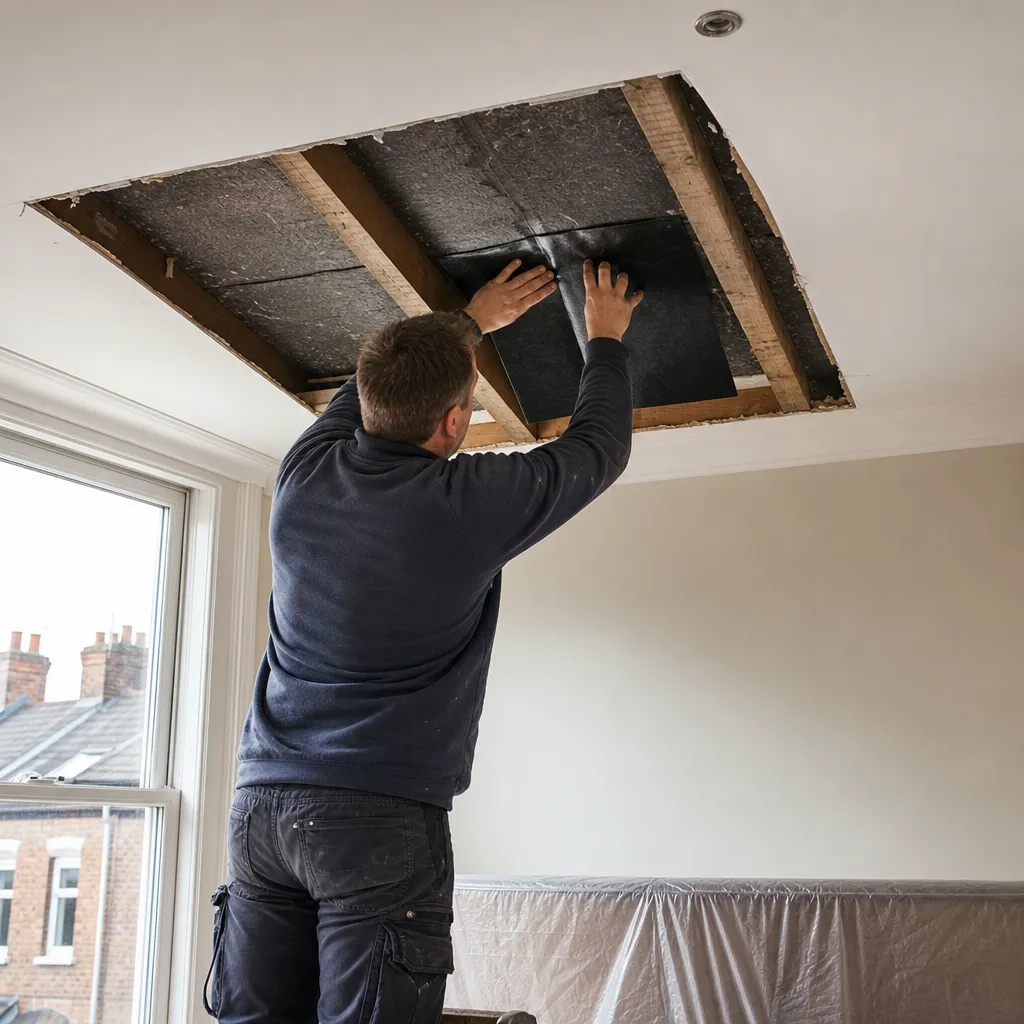
Roof Felt Repair from Inside: Internal Access and Temporary Solutions
Damaged roofing felt — the secondary waterproofing membrane that sits directly beneath tiles or slates — tends to announce itself through damp patches on ceilings, sagging sections visible in the loft, or daylight showing between rafters. Many homeowners notice the problem from inside the roof space before they can get a roofer on site, particularly during bad weather or winter months. Understanding what internal repairs can and cannot achieve helps you manage the situation safely and realistically until professional work takes place.
Key points
- Roofing felt (also called sarking felt or underlay) acts as the secondary line of defence against wind-driven rain — it is not the primary weatherproofing layer, which is provided by tiles or slates.
- BS 5534:2014+A2:2018 is the British Standard covering slating and tiling for pitched roofs, including underlay specification and installation requirements.
- Traditional bitumen felt has a practical lifespan of approximately 15–25 years; modern breathable membranes typically last considerably longer — 40+ years in many cases.
- Self-adhesive butyl or bitumen flashing tape is the most practical material for a temporary internal repair to a localised tear or puncture.
- Any internal repair is temporary only — full felt replacement requires tiles and battens to be lifted from the outside and cannot be achieved from within the loft.
Why roofing felt fails — and why it matters
Felt can deteriorate in several distinct ways:
- Perishing and embrittlement: Traditional bitumen felt becomes brittle with age, typically cracking and crumbling — most visibly where it sags between rafters under its own weight over many years.
- Physical tears: Caused by tile or slate movement, foot traffic during previous repair work, or impact from debris.
- Condensation-related failure: Non-breathable felt in poorly ventilated lofts is susceptible to moisture degradation from within the building, particularly in well-insulated modern homes.
- Poor original installation: Felt laid without adequate laps at joints, or without sufficient drape between rafters, is more likely to split or pool water rather than drain it to the gutter.
When felt fails, rainwater that penetrates beneath tiles — which is normal in high wind and driving rain — can enter the roof space rather than being directed safely to the eaves and gutter. Over time, this causes roof timber rot, ceiling staining, insulation damage, and potentially serious structural timber decay.
What internal repairs can and cannot do
Repair type | What it achieves | What it does not achieve | Suitable for |
|---|---|---|---|
Self-adhesive flashing tape (butyl or bitumen) | Bridges a localised tear or small hole; stops drips temporarily | Does not address perished or degraded felt across a wider area | Single tear or puncture while awaiting a roofer |
Foil-backed roofing repair tape | Similar to above; some additional moisture resistance | Not suitable for large areas or ongoing water pressure from above | Small emergency patches |
Bitumen lap sealant / mastic | Can seal opened lapping joints or small gaps between sheets | Brittle when cured; not durable long-term; temporary only | Lapped joints that have opened |
Tarpaulin cover (external, by roofer) | Prevents further ingress from above while permanent repair is arranged | Not a repair — purely protective until roofer attends | Emergency cover after storm damage displacing tiles |
Full felt replacement (external) | Permanent solution; restores complete secondary weatherproofing | Requires tiles and battens to be stripped — cannot be done from inside | When felt is perished or beyond localised patch |
Which option should you choose?
Use this decision tree to assess your situation:
- Apply internal flashing tape if: you have identified a single tear or small hole in otherwise intact felt, the damaged area is accessible from within the loft without risk of falls, and you are waiting for a roofer to attend.
- Request an urgent roofer inspection if: felt is visibly sagging across multiple bays, you can see daylight through the covering in more than one location, or water is entering persistently despite an internal patch.
- Seek emergency tarpaulin cover if: storm damage has displaced tiles and water is entering in volume — contact qualified local roofers who offer emergency call-out.
- Commission a professional roof survey if: you are unsure of the extent of the damage, have recently bought the property, or suspect multiple areas of failing felt — a professional roof survey can assess condition across the whole roof plane before you commit to repair costs.
- Consult a structural engineer if: you notice any sagging in the roof line visible from outside, movement at the ridge, or distortion of rafters visible in the loft — a structural engineering assessment should precede significant roofing work on a roof showing signs of structural change.
Applying a temporary internal repair safely
If you have safe loft access and the damaged area is within arm's reach without crawling across unsupported plasterboard, a temporary patch is straightforward:
- Trace the entry point carefully — water often travels along timbers before dripping, so the actual entry point may be upslope from where you first see the drip.
- Dry the area as well as you can — adhesive tape bonds poorly to wet or dirty surfaces; use an absorbent cloth and allow the felt to dry if at all possible.
- Cut a patch of self-adhesive butyl flashing tape at least 150mm larger than the damaged area on all sides.
- Apply firmly, pressing out air bubbles and ensuring the edges make full contact with the felt.
- Step on joists only — never stand on the loft insulation or on unsupported plasterboard between joists; use a crawl board (a plank placed across joists) to distribute your weight safely.
- Note the patched location for the roofer and describe the full extent of visible damage when you arrange an inspection.
What not to assume
- "The tiles look intact, so the felt must be fine" — tiles and slates can appear undamaged externally while the underlay beneath has perished or torn across a wide area. Felt condition is not visible from outside without lifting tiles.
- "An internal patch will see me through until I sell" — temporary internal repairs are not a permanent fix and should not be misrepresented in a property transaction. Buyers' surveyors commonly flag visible felt deterioration during a loft inspection, and it can become a point of renegotiation at survey stage.
- "Any waterproof tape will work" — standard household adhesive tapes, gaffer tape, and general-purpose foil tape are not suitable for roofing applications; use a dedicated butyl-based or bitumen-based flashing tape rated for roofing.
- "The loft is safe to move around in" — many UK loft spaces are not boarded, and stepping between joists directly onto plasterboard risks a fall through the ceiling. Always assess access and use a crawl board.
- "Felt replacement is a minor job" — full replacement of roofing felt involves stripping all tiles from the affected roof plane, removing and replacing the underlay, and re-tiling to current standards under BS 5534. For a typical semi-detached roof, this is a significant project requiring qualified local roofers with appropriate insurance and competence.
When to get professional help
Contact a qualified roofer promptly if:
- Felt is perished, crumbling, or degraded across a large area — internal patches cannot address widespread failure.
- Water is entering the roof space during light or moderate rain without high winds — this suggests the primary weatherproofing (tiles or slates) is also compromised.
- You can see daylight through the roof covering from inside the loft.
- There is evidence of rot in roof timbers — softness when pressed, discolouration, or visible fungal growth.
- The roof is over 15–20 years old and has not been recently inspected — a professional roof survey can identify developing issues before they become urgent.
- The property is in a conservation area or is listed — any roofing work may require prior consent from the local planning authority.
Do not attempt to access the roof externally unless you are a trained roofing professional with appropriate fall-arrest equipment and safety measures in place. The HSE consistently identifies falls from roofs as among the most frequent causes of fatal accidents in the construction sector.
How Housey can help
Housey can help you find qualified local roofers for everything from emergency call-outs to full felt replacement and re-roofing projects. If you are uncertain about the true extent of the problem, starting with a professional roof survey gives you an accurate picture of the roof's condition and the scope of work needed before you commit to repair costs.
Frequently asked questions
Can roofing felt be repaired without removing tiles?
A temporary internal repair using self-adhesive flashing tape is possible without touching the tiles. However, a full and permanent repair or replacement of roofing felt requires tiles and battens to be lifted from outside — there is no way to replace an underlay sheet from inside the loft. Internal patches are a short-term measure only while a roofer is arranged.
How long will a temporary internal roof felt repair last?
A well-applied butyl flashing tape patch can provide a temporary seal for several weeks to a few months in mild conditions. It should not be relied upon through a period of heavy rain or frost, as adhesion can degrade. Arrange a professional roofer inspection as soon as practicable after applying any internal repair to assess the full extent of felt condition.
How much does roof felt replacement cost in the UK?
Full felt replacement for a typical semi-detached house — stripping tiles from one roof plane, replacing the underlay, and re-tiling — typically costs £2,500–£6,000 or more depending on roof area, tile type, and contractor. Localised repair where a small area of tiles is temporarily removed may cost £300–£800. Indicative UK costs, last reviewed 2026-05-03. Always obtain multiple written quotes.
Is damaged roof felt covered by home insurance?
Cover depends on your individual policy. Most home insurance policies cover sudden and accidental damage — such as storm damage causing a tear in the felt or displacing tiles. Gradual deterioration due to age is generally excluded. Check your policy wording carefully and contact your insurer before making any repairs if you intend to make a claim, as unauthorised repairs can sometimes affect a claim.
Does replacement roofing felt need to be breathable?
Modern guidance under BS 5534 and associated Building Regulations practice favours breathable (vapour-permeable) underlays in most new and replacement roofing applications. They allow moisture vapour to escape without condensing, reducing the risk of timber decay. Traditional bitumen felt is non-breathable and can contribute to condensation in poorly ventilated loft spaces. Discuss the appropriate specification with your roofer.
Sources and further reading
- Working at height: a brief guide — Health and Safety Executive
- BS 5534:2014+A2:2018 — Slating and tiling for pitched roofs and vertical cladding — BSI Group
- Approved Document C: Site preparation and resistance to contaminants and moisture — UK Government / MHCLG
- Homeowner guidance on roofing work — National Federation of Roofing Contractors (NFRC)
Useful next reads
 Improvement & Build
Why Double-Glazed Windows Become Misty or Foggy
Misting between double-glazed panes means the hermetic seal of the insulated glazing unit (IGU) has failed, allowing humid air into the cavity.
 Improvement & Build
Split Roof Underlayment: Repair Approaches and Replacement Decisions
Split roof underlayment should be patched when damage is isolated and the surrounding membrane is still sound.
 Improvement & Build
Liniar uPVC Windows: Performance, Durability, and Quality Assessment
Liniar uPVC window profiles are manufactured in the UK using multi-chambered, foamed frames.
 Improvement & Build
Garden Tap Installation with Hot and Cold Water: Plumbing Options
Adding a cold garden tap is a common DIY project, but routing hot water outdoors requires a plumber to connect to your domestic hot water system and comply with the Water Supply (Water Fittings) Regulations 1999.
 Improvement & Build
Sealing and Maintaining Historic Leaded Glass Windows: Preservation and Performance
Leaded glass windows are maintained using traditional linseed oil cement — not silicone or modern sealants, which prevent natural movement in the lead came.