Roof Shingling Methods and Installation Costs
By Housey · Last reviewed 10th of May 2026
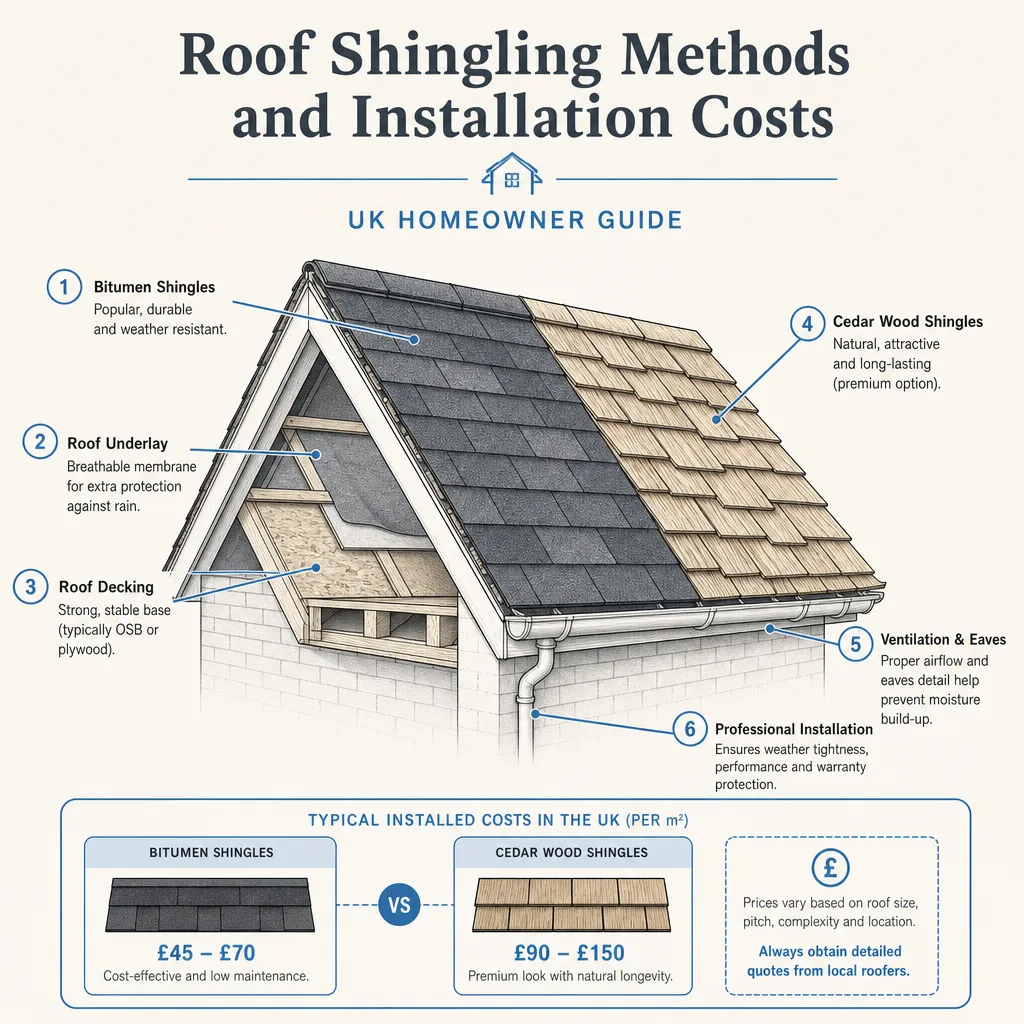
Roof Shingling Methods and Installation Costs
Whether you are replacing a worn covering on a garden outbuilding or exploring decorative shingle finishes for a home extension, understanding the options and costs helps you brief contractors confidently. Bitumen strip shingles and cedar wood shingles appear on a range of domestic buildings across the UK — from Victorian garden rooms to contemporary self-builds. Getting the specification right at the outset avoids expensive remedial work later, particularly where deck condition and pitch requirements are overlooked during the planning stage.
Key points
- Bitumen/asphalt strip shingles are the most common shingle type in UK residential use, with a manufacturer-specified minimum pitch of typically 17.5°.
- Cedar wood shingles require preservative treatment and are not permitted in some conservation areas or on listed buildings without prior listed building consent.
- Building Regulations Approved Document C (Site Preparation and Resistance to Contaminants and Moisture) covers weathertightness requirements for roof coverings, including shingle systems.
- Indicative costs for bitumen strip shingle installation range from £40–£80 per m² for supply and fit (Indicative UK costs, last reviewed 2026-05-10).
- Any roof replacement on a property with a shared wall may trigger obligations under the Party Wall etc. Act 1996 if the work involves structural interference.
What is roof shingling?
In the UK context, roof shingling refers to the installation of overlapping flat elements — most commonly bitumen (asphalt) strip shingles or cedar/hardwood wood shingles — rather than clay or concrete tiles. Bitumen shingles are manufactured in strips of three or more tabs and are widely used on low-pitch domestic extensions, garden rooms, home offices, and outbuildings. Cedar shingles and shakes are a premium alternative favoured for their natural appearance and longevity when correctly maintained.
Shingles differ from roof tiles in their method of fixing: they are nailed directly to a boarded or sheet decking rather than hung from battens, making the quality of the underlying deck critical to the finished roof's performance and longevity.
Shingle types available in the UK
Shingle type | Typical pitch range | Approximate lifespan | Best for | Not ideal for |
|---|---|---|---|---|
Bitumen/asphalt strip | 17.5° and above | 20–30 years | Garden buildings, annexes, low-pitch extensions | Listed buildings, most conservation areas |
Cedar wood shingles | 18° and above | 25–40 years (treated) | Visible pitched roofs, traditional aesthetics | High-maintenance aversion, restricted areas |
Fibre cement shingles | 20° and above | 25–40 years | Contemporary and heritage designs | Not always accepted by planners as like-for-like |
Synthetic composite shingles | Varies by product | 30–50 years | Modern self-builds, long-term performance | Budget projects |
Always confirm pitch compatibility with the manufacturer's technical data sheet before specifying any shingle product. Fitting a shingle below its rated minimum pitch is a common cause of premature failure.
Installation stages
Roof shingle installation broadly follows these stages:
- Decking preparation — existing materials stripped back; decking boards or OSB/plywood sheet inspected for rot, delamination, or movement; defective sections replaced before any new material is fixed.
- Underlay — a breather membrane or felt underlay is fixed over the deck in horizontal courses, lapped at joints per manufacturer guidance.
- Starter course — a special starter strip or inverted shingle course is fixed along the eaves to provide a solid base and prevent wind uplift of the first course.
- Field courses — shingles laid in overlapping courses from eaves to ridge, each row offset from the last so vertical joints do not align; nailed per the manufacturer's fixing pattern.
- Ridges and hips — cut or purpose-made ridge and hip pieces are fixed with increased nail coverage and sealed at junctions.
- Flashings — Code 3 or Code 4 lead-flashing details formed at abutments, penetrations, and valleys; these are critical for long-term weathertightness.
Because all meaningful stages involve working at height, this work should be carried out by a professional roofer with appropriate equipment and public liability insurance.
Costs of roof shingle installation
Indicative UK costs, last reviewed 2026-05-10. Quotes vary significantly by region, roof complexity, access requirements, and material choice.
Item | Indicative cost range |
|---|---|
Bitumen strip shingles — supply and fit | £40–£80 per m² |
Cedar wood shingles — supply and fit | £80–£160 per m² |
Synthetic composite shingles — supply and fit | £90–£170 per m² |
Replacement of decking boards (if required) | £20–£40 per m² additional |
Lead flashings | £30–£70 per linear metre |
Scaffold access (typical small roof) | £400–£900 |
Cost drivers include roof area, pitch, access difficulty, the need for scaffold, extent of decking repairs, and local labour rates. Always obtain at least three written quotes and ask contractors to itemise materials, labour, scaffold, and waste disposal separately.
Planning permission and building control
For most like-for-like shingle replacements on an existing domestic roof, planning permission is not required under permitted development rights. However, consent may be needed if:
- the property is in a conservation area and the work is visible from a highway and affects the character of the area,
- the building is listed — any change to the exterior requires listed building consent from the local authority,
- the work materially alters the shape or pitch of the roof.
Building Regulations approval under Approved Document C is typically required for roof re-covering work, even where permitted development means planning permission is not needed. A building control application — either via your local authority building control or a registered Approved Inspector — ensures the completed roof meets weathertightness and structural standards. A building control consultant can advise on the correct notification route for your project.
What to ask before accepting a quote
- Which shingle product is specified, and what is its manufacturer-rated minimum pitch and warranty period?
- Is scaffolding, decking repair, and waste removal included in the quoted price?
- What is the contractor's process if additional rot or damage is found once stripping begins — and how are variations priced?
- Are lead flashings included, or quoted as a provisional sum?
- Can the contractor provide evidence of public liability insurance?
- Will a building control notification be submitted, and who is responsible for making the application?
- Is VAT included in the quoted price?
When to get professional help
Roof shingling always requires a qualified roofing contractor; it is not suitable for DIY work above 2 m. Seek professional advice if:
- you notice sagging decking, soft spots underfoot, or visible signs of structural movement in the existing roof,
- the property is listed or in a conservation area and material changes are planned,
- the roof has existing solar panels, skylights, or complex junction details requiring specialist attention,
- there is evidence of asbestos-containing materials in the existing roof build-up — particularly in pre-2000 flat roofs that may incorporate asbestos-reinforced felt or boarding. Do not disturb; arrange an asbestos survey before any stripping work begins.
How Housey can help
Housey connects you with vetted roofers in your area who can assess your existing roof, specify the correct shingle system for your pitch and property type, and provide fully itemised quotes. For projects requiring building control sign-off, our building control consultants can guide you through the notification process from start to completion.
Frequently asked questions
Are bitumen shingles suitable for UK weather?
Yes — bitumen strip shingles are designed to withstand the wet and windy conditions common across the UK, provided they are installed at the correct minimum pitch (typically 17.5°) with appropriate underlay and flashings. Their typical lifespan is 20–30 years, making them a practical, cost-effective option for garden buildings, annexes, and low-pitch extensions.
Can I install roof shingles over existing felt?
Most installers recommend stripping back to bare deck before re-shingling. Laying new shingles over existing material can trap moisture, hide decking damage, and add structural load. It may also invalidate the product warranty. Your contractor should inspect deck condition and report any defects before finalising the quote.
Do roof shingles need maintenance?
Cedar and wood shingles benefit from periodic re-treatment with a preservative or biocide to prevent moss, lichen, and fungal growth. Bitumen shingles generally need only visual inspection after storms — checking for lifted tabs, exposed nails, or damaged flashings. Any defects found should be repaired promptly to prevent water ingress and timber damage beneath.
Is planning permission needed to shingle a roof?
For most like-for-like replacements on an existing domestic roof, planning permission is not required. However, properties in conservation areas or those that are listed may need consent before changing roofing materials. A change to the roof's shape or pitch also typically requires planning permission. Always check with your local planning authority before starting work.
Sources and further reading
- Building Regulations Approved Document C — GOV.UK
- Planning Permission for Houses — GOV.UK
- Party Wall etc. Act 1996 guidance — GOV.UK
- Advice for Owners of Listed Buildings — Historic England
Useful next reads
 Improvement & Build
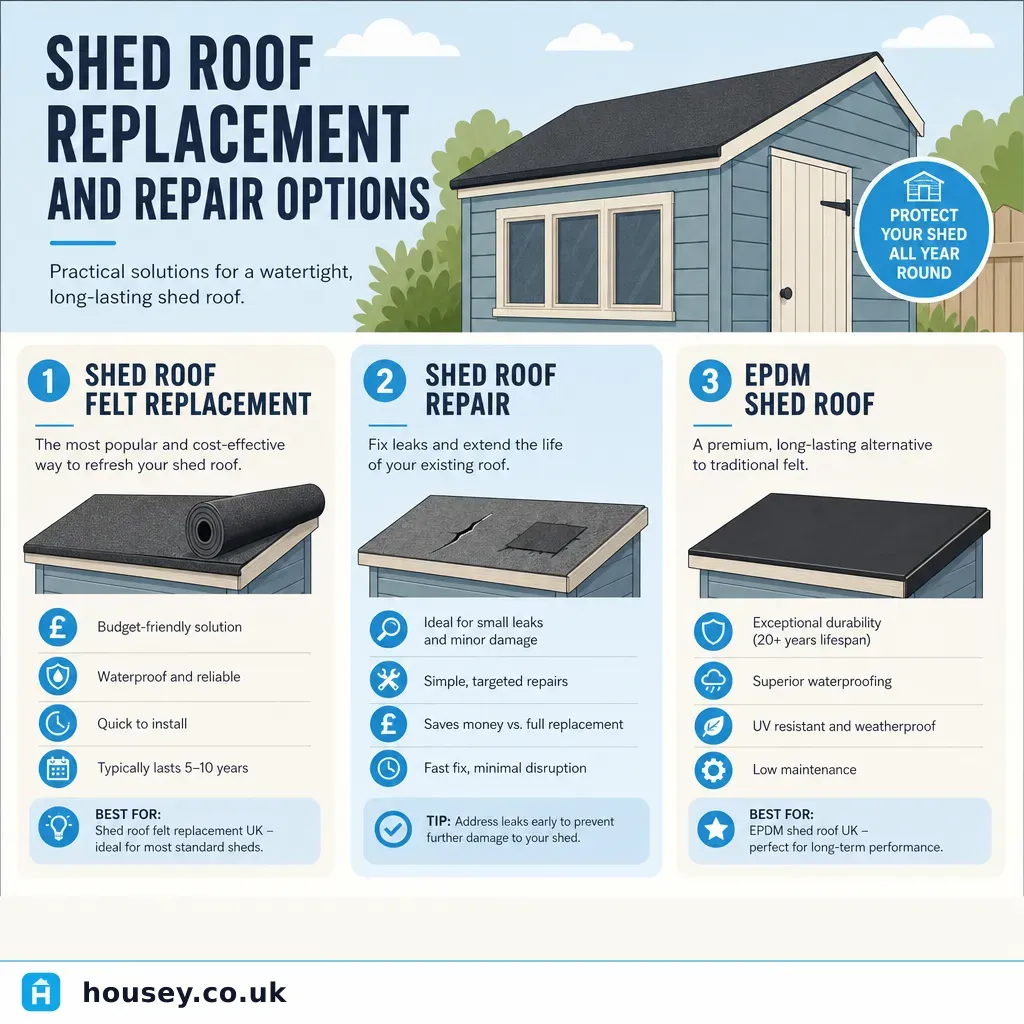
Shed Roof Replacement and Repair Options
Shed roofs in the UK are most commonly covered with mineral felt (lasting 5–15 years), EPDM rubber membrane (20–30 years), or corrugated bitumen sheets.
 Improvement & Build
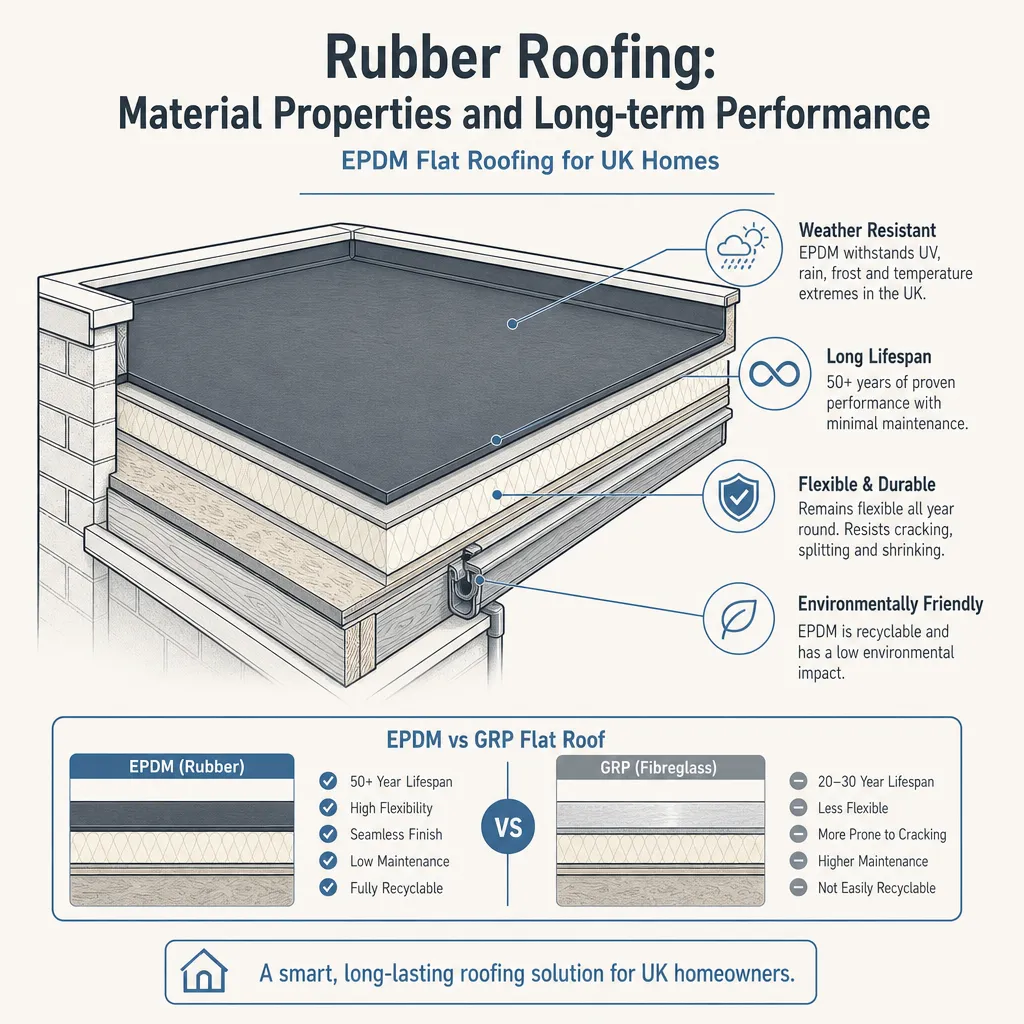
Rubber Roofing: Material Properties and Long-term Performance
EPDM rubber roofing is a synthetic rubber membrane used on UK flat roofs, available in large sheets that minimise seams.
 Improvement & Build
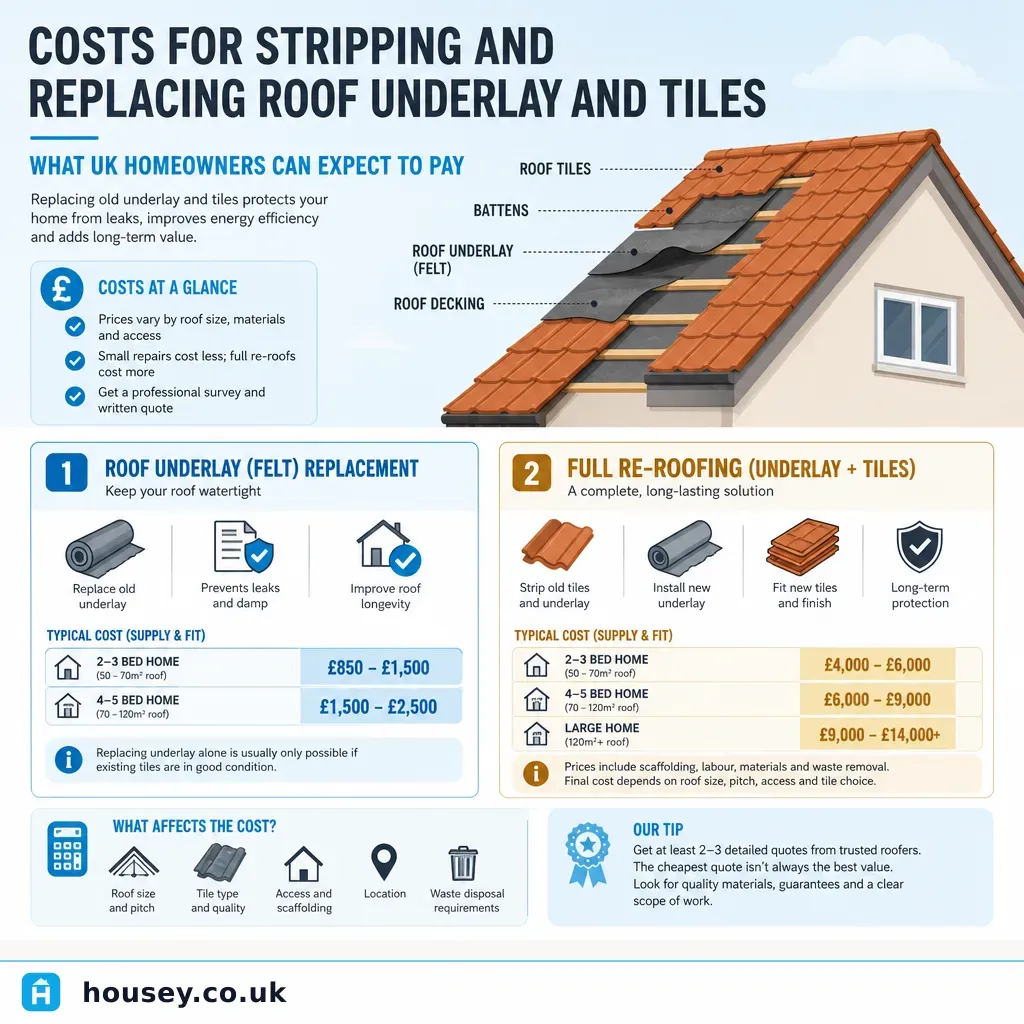
Costs for Stripping and Replacing Roof Underlay and Tiles
Stripping and replacing roof underlay and tiles on a typical UK semi-detached house costs £5,000–£12,000, depending on roof size, tile type, and access.
 Improvement & Build
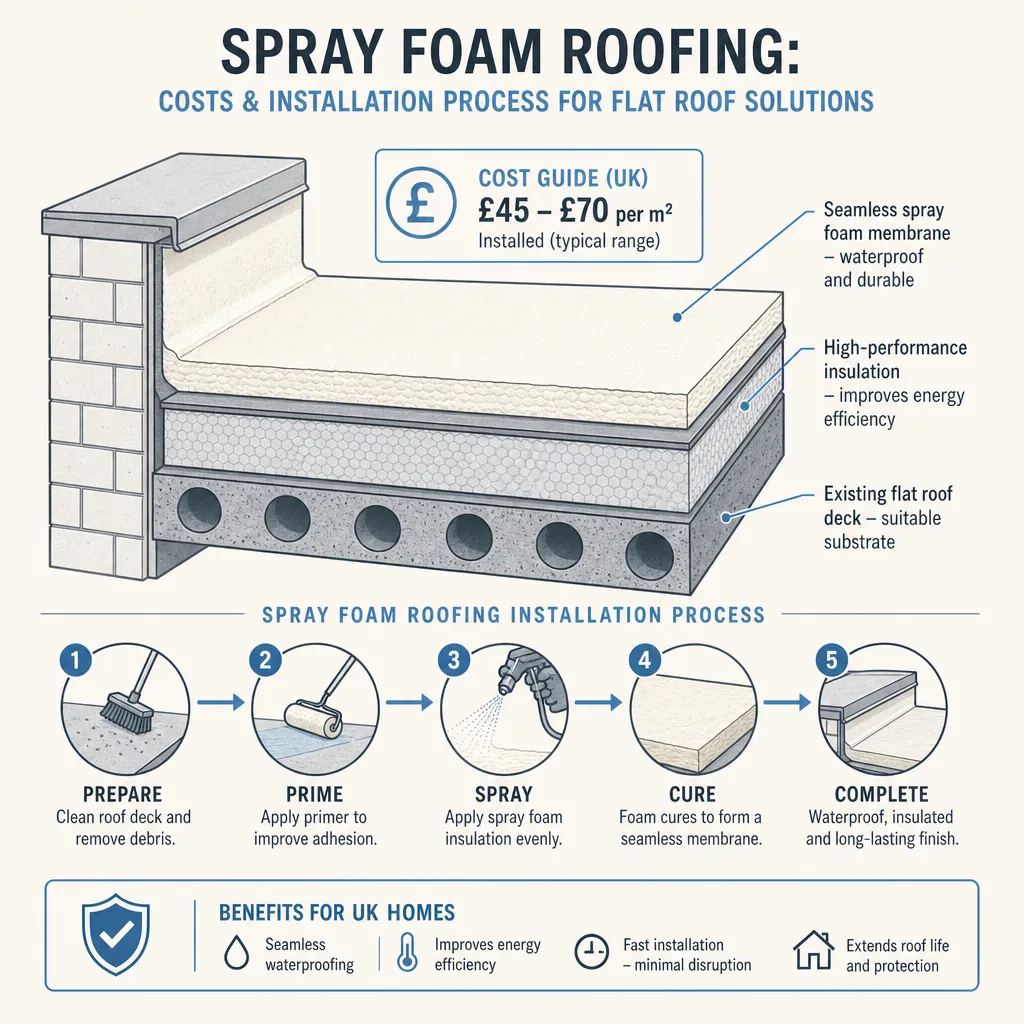
Spray foam roofing: costs and installation process for flat roof solutions
Spray foam roofing for a domestic flat roof in the UK typically costs between £70 and £120 per square metre including preparation, foam application, and UV-protective topcoat, though prices vary with roof size, access, existing substrate condition, and region.
 Improvement & Build
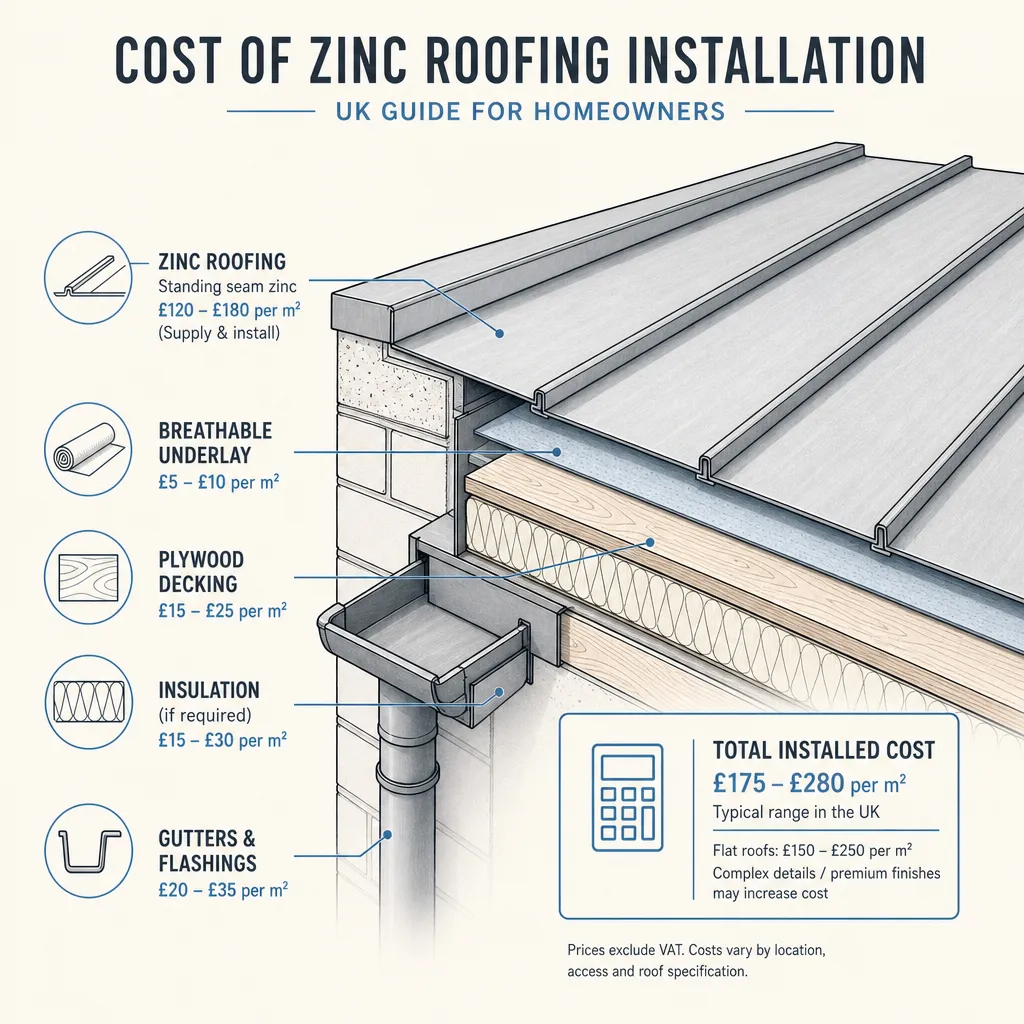
Cost of Zinc Roofing Installation
Zinc roofing typically costs £100–£200 per m² installed in the UK for standing seam systems, with flat roof applications ranging from £80–£160 per m².