Thin-Shell Concrete Residential Architecture and Design in the UK
By Housey · Last reviewed 25th of May 2026
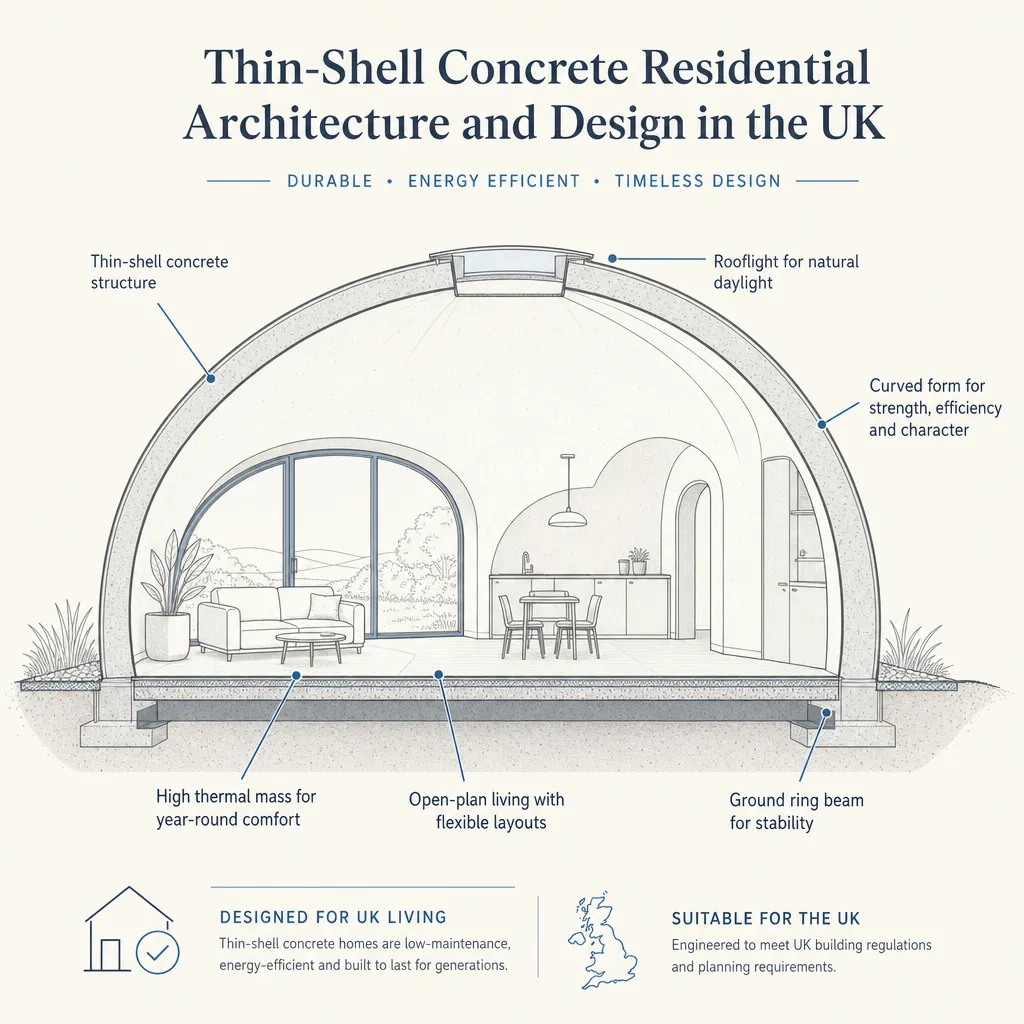
Thin-Shell Concrete Residential Architecture and Design in the UK
Thin-shell concrete structures — domes, barrel vaults, hyperbolic paraboloids, and folded-plate forms — carry a distinguished mid-20th-century engineering heritage, but remain an unusual and highly specialist choice for residential construction in the UK. The question typically arises during the early stages of a bespoke self-build or experimental new-build project where a homeowner or developer is deliberately moving away from conventional timber frame or masonry blockwork in pursuit of architectural form and structural innovation. Because shell structures achieve their load-carrying capacity through curvature rather than material mass, the geometry and the structure are inseparable — meaning the right professional team must be in place from the very first design decisions.
Key points
- Thin-shell concrete structures achieve efficiency through double curvature: a concrete dome spanning 8 m may require a shell only 40–80 mm thick, compared with a flat slab of far greater depth for the same span.
- All thin-shell concrete dwellings require full planning permission; the non-conventional external form and material will not satisfy permitted development rules.
- Building Regulations Part A (Structure) requires structural calculations by a chartered structural engineer; shell geometries typically require finite element analysis (FEA) rather than simple hand calculations.
- Gunite (sprayed concrete) is commonly used for complex curved shell forms in the UK where traditional formwork would be disproportionately expensive or technically impractical.
- A realistic programme from architect appointment to practical completion for a bespoke concrete shell dwelling is 18–36 months, reflecting specialist procurement, complex building control, and on-site programme.
What is a thin-shell concrete structure?
A thin-shell structure is defined by a thickness-to-span ratio typically between 1:200 and 1:500 — structural efficiency derives from double curvature, which allows compressive forces to be resolved in-plane rather than through bending. This is fundamentally different from a flat slab or conventional beam-and-column frame.
Common shell geometries encountered in residential architecture include:
- Dome — spherical or elliptical; commonly used for single-room structures, garden studios, or as a signature volume within a larger composition.
- Barrel vault — a cylindrical surface; often used to roof a long-span studio, living hall, or corridor.
- Hyperbolic paraboloid (hypar) — a saddle-shaped, doubly-curved surface that can be formed using straight formwork, making it more buildable than a dome.
- Folded plate — a series of flat concrete planes inclined to each other, achieving structural depth through geometry rather than curvature.
In UK residential use, shells are most often employed as a primary structure for a single dwelling, as a feature volume within a larger house, or as a standalone outbuilding or studio.
Planning permission and design considerations
Planning permission
Thin-shell concrete homes will not fall within permitted development. Any new dwelling or substantial extension in this form requires full planning permission. Key considerations at the pre-application stage:
- Visual amenity: Local planning authorities (LPAs) assess whether the form and material are compatible with the character of the surrounding area. Non-conventional shell structures can attract significant scrutiny in areas of conventional townscape.
- Conservation areas and listed building settings: If the site is within or adjoining a conservation area, or within the setting of a listed building, a heritage impact assessment and pre-application meeting are strongly advisable before preparing drawings.
- Design and Access Statement: Required for most new dwelling applications; should explain clearly how the form responds to site context, scale, and materiality.
- Structural information at planning stage: Some LPAs request indicative structural information for unusual construction methods; early engagement with your structural engineer is therefore advisable before the planning application is submitted.
Which professionals do you need?
Stage | Professional | Key role |
|---|---|---|
Concept and planning | RIBA-registered architect with shell or concrete structure experience | Design development, planning application, Design and Access Statement |
Structural design | Chartered structural engineer (MIStructE or CEng) | Shell geometry analysis, finite element modelling, reinforcement specification, Part A compliance |
Building regulations | Approved inspector or local authority building control | Compliance checking across Parts A, B, C, L, and M |
Site construction | Specialist concrete contractor or gunite/shotcrete applicator | Formwork design or sprayed concrete application, RC placement, surface finishing |
Cost management | Quantity surveyor | Cost plan, tender documents, contract administration |
Building Regulations
A thin-shell concrete dwelling must comply with all relevant Approved Documents. The most critical for shell construction are:
- Part A (Structure): Requires calculations demonstrating stability under dead, imposed, wind, and snow loads. Shell structures typically require finite element analysis.
- Part B (Fire Safety): Concrete is non-combustible (reaction-to-fire Class A1) but escape routes, travel distances, and compartmentation must still be fully addressed.
- Part C (Moisture): The shell must resist rain penetration and rising damp. Concrete shells are vulnerable to cracking, which can allow water ingress; a waterproofing strategy — applied membrane, integral crystalline additive, or external cladding system — is needed.
- Part L (Energy): The shell must meet fabric energy efficiency targets. Insulating a curved concrete surface requires careful detailing; spray-applied rigid foam or external insulation systems are commonly used.
- Part M (Accessibility): Standard accessibility requirements apply to all new dwellings.
Worked UK scenario: a bespoke dome dwelling in rural Wiltshire
A self-builder in rural Wiltshire proposes a three-bedroom dwelling based on an interconnected cluster of concrete domes with an overall footprint of 180 m². The typical process for such a project would proceed as follows:
- Pre-application discussion with the local planning authority to gauge receptiveness to the non-conventional form on a rural site. A landscape and visual impact assessment is very likely to be requested.
- Architect appointment: an RIBA-registered architect with demonstrated experience of shell or monolithic concrete structures is appointed. Concept designs and a Design and Access Statement are prepared.
- Structural engineer appointment: the structural engineer develops a finite element model of the shell geometry to determine reinforcement requirements, deflection behaviour, and foundation loads.
- Planning application: full planning permission is sought. Standard determination is 8 weeks but may extend to 13 weeks where specialist consultees — Historic England, a local ecology officer — are involved.
- Building regulations: full plans submission to building control, including structural calculations, energy compliance via a SAP calculation, and a waterproofing strategy.
- Contractor procurement: specialist concrete contractors — including a gunite or shotcrete applicator — are tendered. A quantity surveyor prepares a cost plan; bespoke shell construction typically costs 20–40% more per m² than conventional construction (indicative; last reviewed 2026-05-25; final costs are highly project-specific and should be established through competitive tender).
- Construction: on-site programme typically 12–18 months for a shell of this scale, depending on form complexity, subcontractor availability, and weather.
What to ask before appointing an architect or engineer
- Can you show examples of thin-shell or monolithic concrete residential projects you have completed in the UK?
- Have you worked previously with a gunite or shotcrete contractor on a residential shell structure?
- What finite element software will you use for the structural analysis, and will the output be accepted by building control?
- Have you obtained pre-application feedback from a local planning authority on a project of this type?
- How will you achieve the Building Regulations Part L fabric energy efficiency target with this construction?
- What waterproofing strategy do you recommend for the concrete shell, and how will it be maintained?
- What is a realistic overall programme from appointment to practical completion?
When to get professional help
Thin-shell concrete construction is not suited to a design-and-build procurement route using a general contractor without specialist experience. An architect and a structural engineer should be appointed simultaneously from the outset — the geometry cannot be separated from the structural design, and decisions made at concept stage directly affect buildability, cost, and Building Regulations compliance. Do not submit a planning application without at least outline structural input confirming that your proposed geometry is structurally and technically feasible.
How Housey can help
Housey connects homeowners and self-builders with RIBA-registered architects experienced in innovative residential design, and with structural engineers who can assess and specify complex concrete structures. For a bespoke project of this type, engaging both disciplines before any planning application is submitted is strongly recommended.
Frequently asked questions
Is thin-shell concrete construction legal in the UK?
Yes. Thin-shell concrete structures can fully satisfy all relevant Building Regulations — Parts A, B, C, L, and M — provided they are correctly designed and specified by qualified professionals. There are no specific prohibitions on shell concrete in UK residential construction, though specialist design and building control input is essential throughout.
How much does a thin-shell concrete house cost to build?
Costs are highly project-specific. Bespoke concrete shell construction in the UK is likely to cost 20–50% more per square metre than equivalent conventional construction, reflecting specialist formwork, contractor expertise, and extended programme. A quantity surveyor should prepare a project-specific cost plan before committing to the approach. Indicative only, last reviewed 2026-05-25; obtain competitive tenders.
Can I build a thin-shell concrete home under permitted development?
No. New dwellings do not fall within permitted development rights regardless of construction method. Full planning permission is required for any new home. Extensions may benefit from permitted development for some forms, but a thin-shell concrete addition is unlikely to satisfy the similar-appearance requirement without express planning consent.
Are there UK architects who specialise in concrete shell design?
Yes, though the field is specialist. Architects with a track record in monolithic concrete, earth-sheltered housing, or shell structures are best found through RIBA's Find an Architect service, which allows filtering by specialism and location. Always ask to see completed UK examples before appointing.
Sources and further reading
- Building Regulations Approved Document A (Structure) — GOV.UK
- Building Regulations Approved Document L (Energy) — GOV.UK
- Find an Architect — RIBA
- Structural concrete in residential design — The Concrete Centre
- Planning Practice Guidance: Design — GOV.UK
Useful next reads
 Planning & Pre-Build
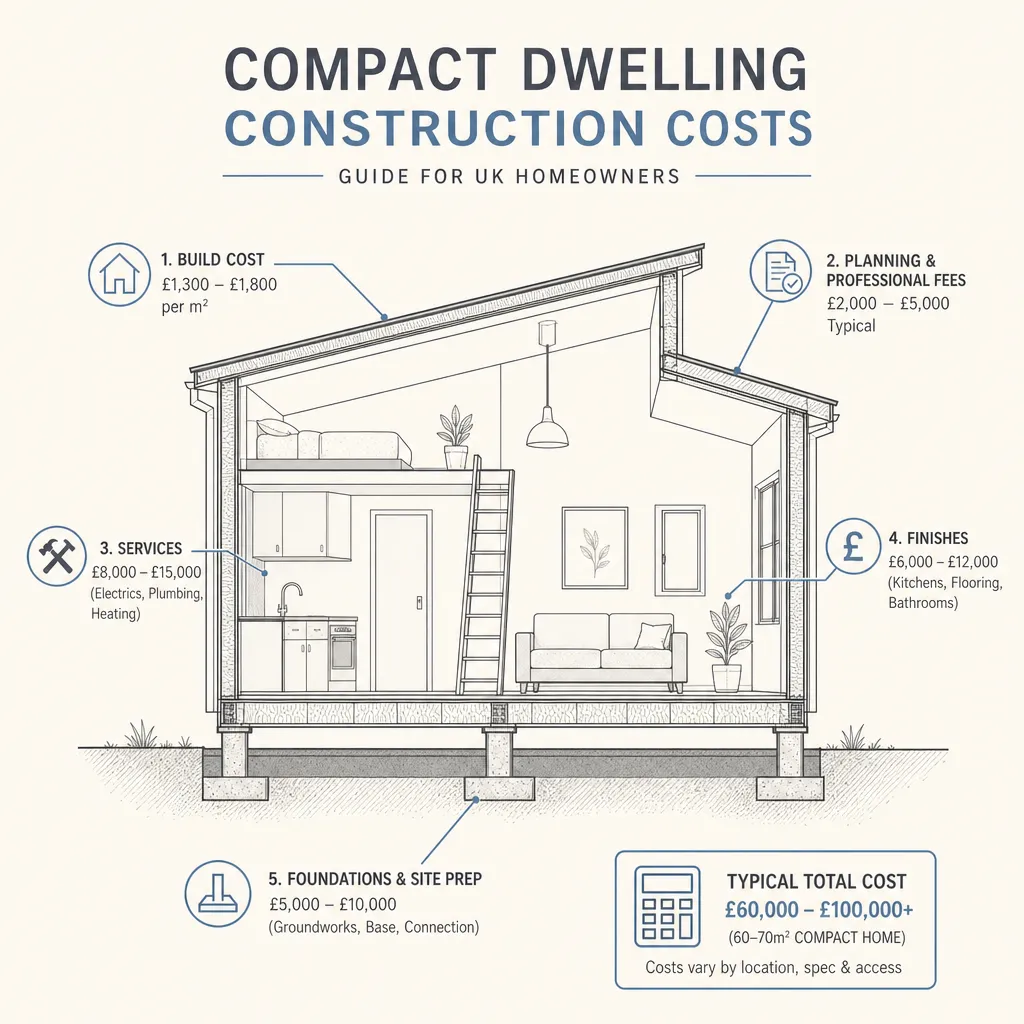
Compact Dwelling Construction Costs
A compact dwelling in the UK costs roughly £50,000–£200,000 or more to build, depending on design, build route, and specification.
 Planning & Pre-Build
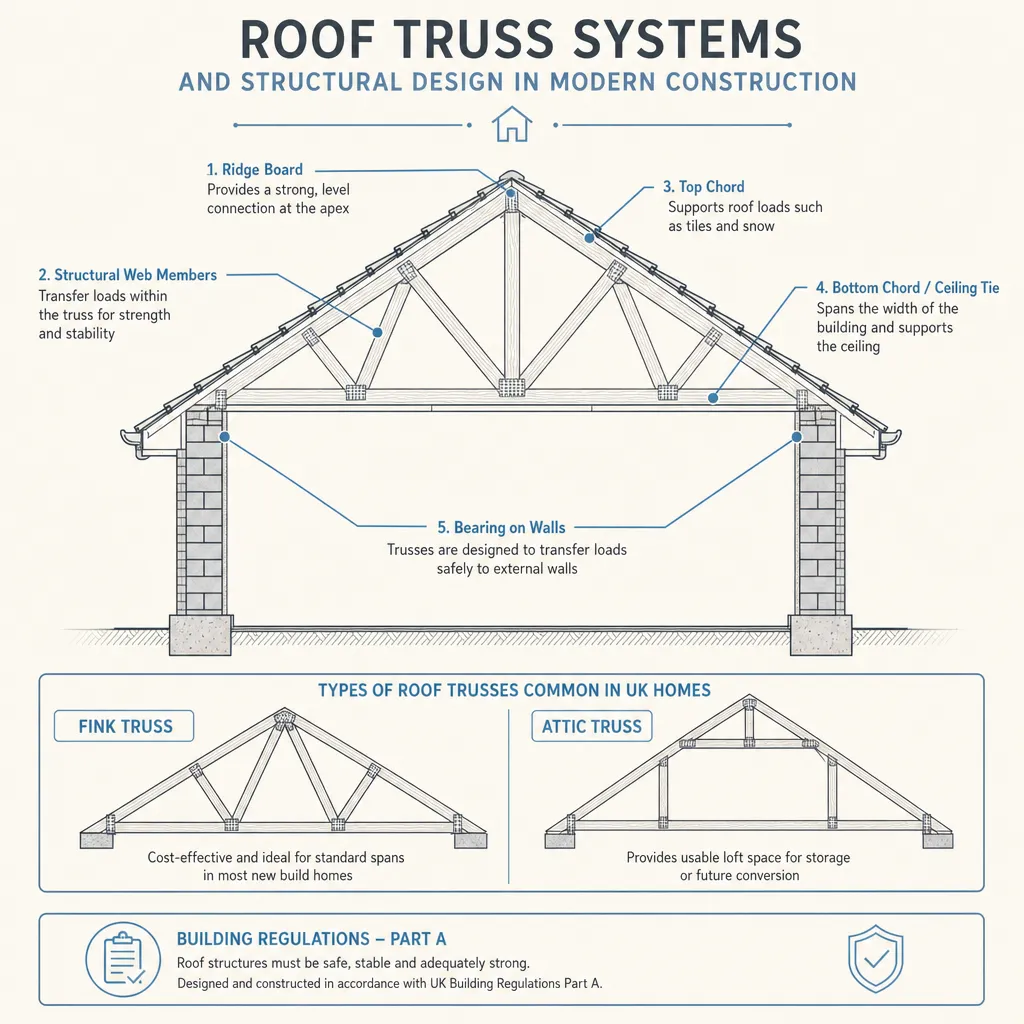
Roof Truss Systems and Structural Design in Modern Construction
Roof trusses are factory-engineered frames that carry roof loads to load-bearing walls.
 Planning & Pre-Build
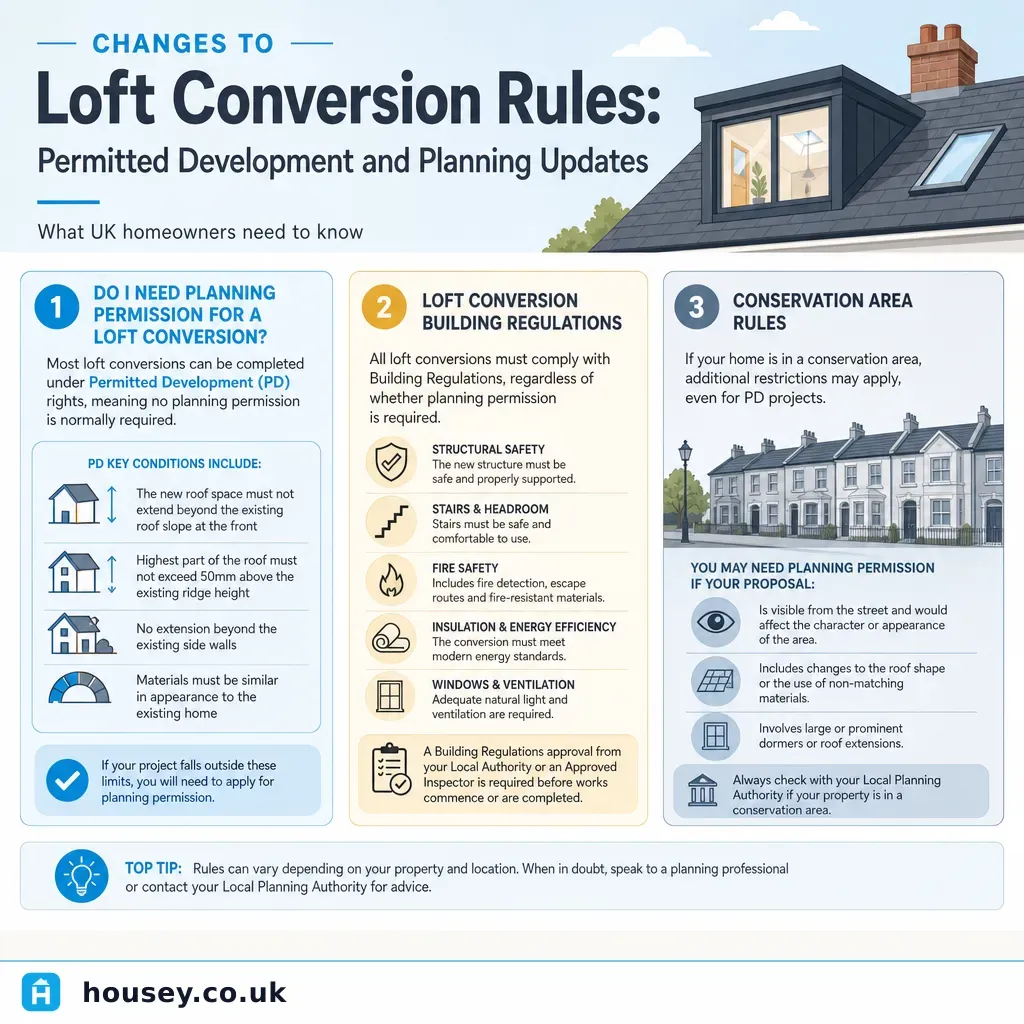
Changes to Loft Conversion Rules: Permitted Development and Planning Updates
In England, most loft conversions on standard houses qualify as Permitted Development under Class B of the GPDO 2015, allowing up to 40 cubic metres (terraced) or 50 cubic metres (detached or semi-detached) without a planning application — if conditions are met.
 Planning & Pre-Build
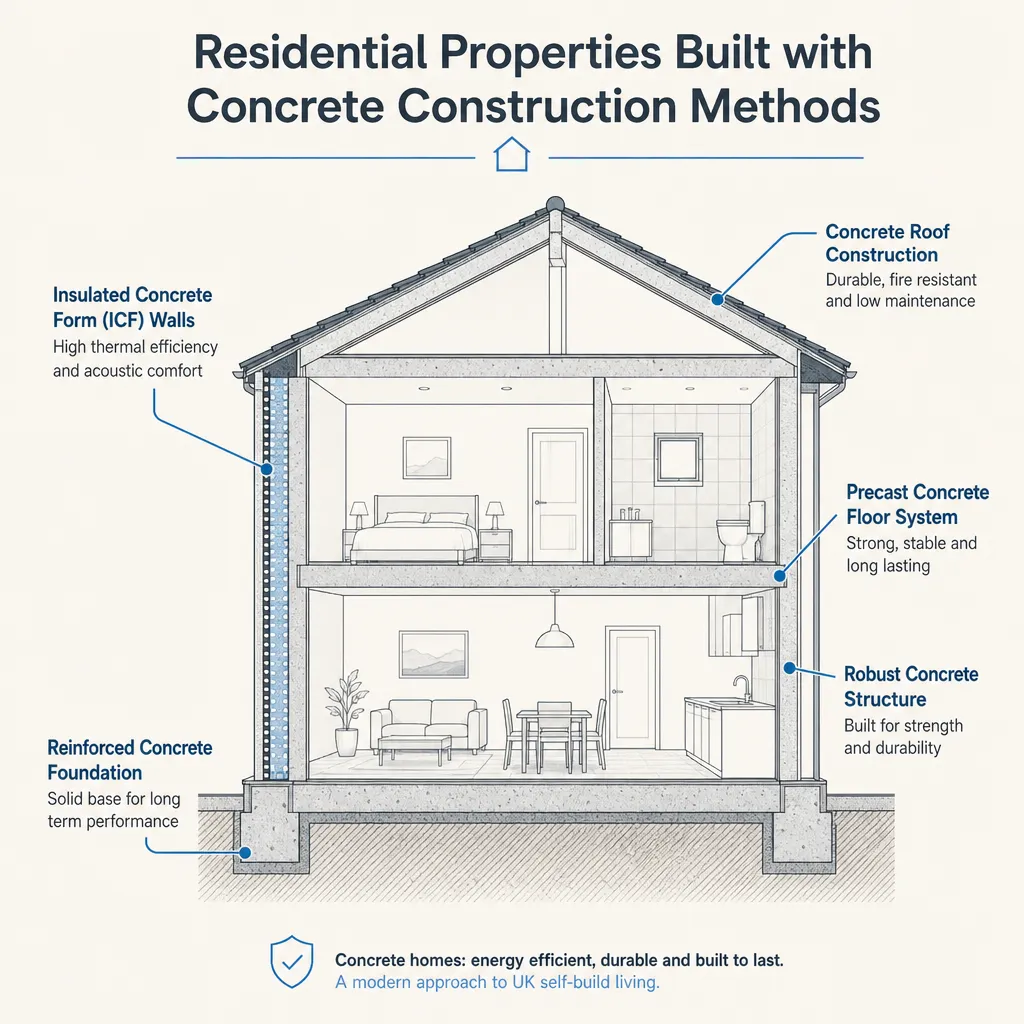
Residential Properties Built with Concrete Construction Methods
UK homes are built using several concrete methods: in-situ cast concrete, precast panel systems, insulating concrete formwork (ICF), and older non-traditional types such as Wimpey No-Fines and Laing Easiform.
 Planning & Pre-Build
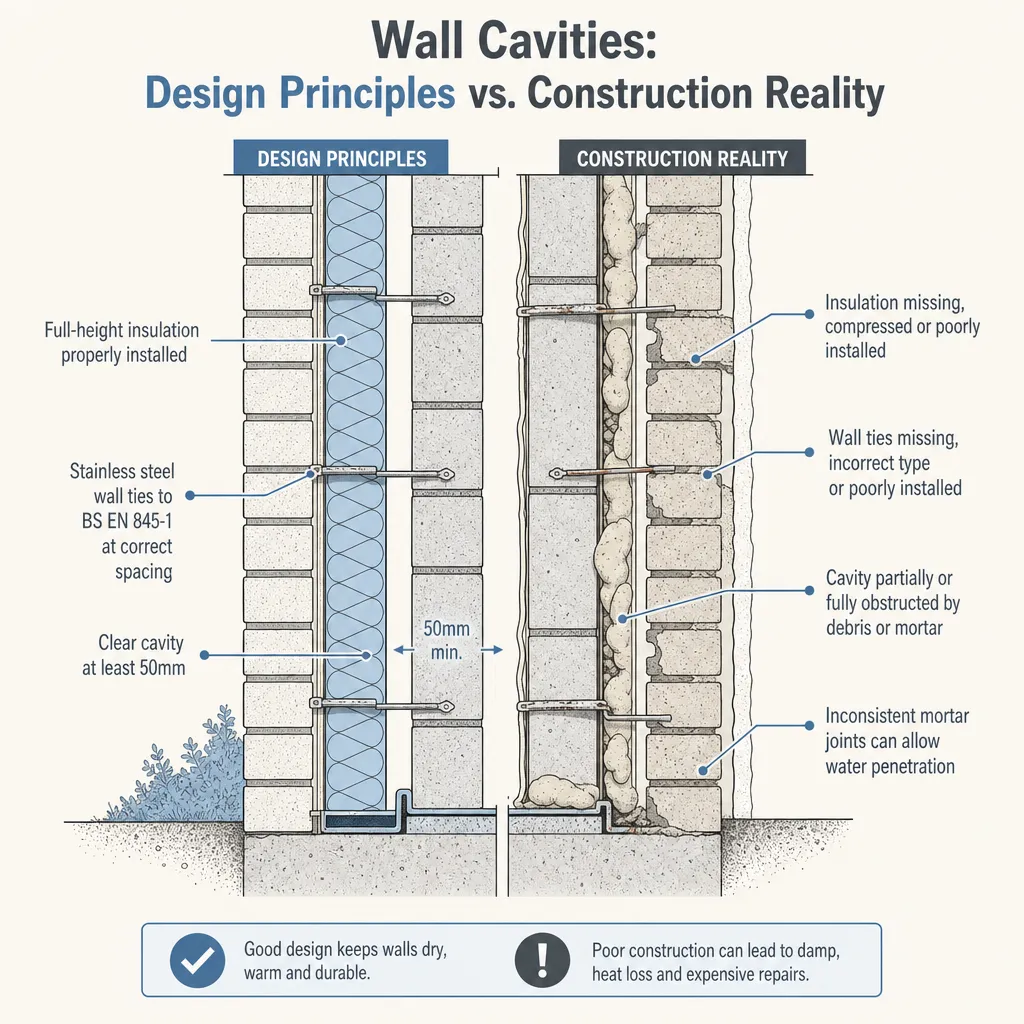
Wall Cavities: Design Principles vs. Construction Reality
A UK cavity wall is designed to resist weather, control heat loss, and structurally link two masonry leaves.