Roof Ventilation: Why It Matters for Your Roof's Lifespan
By Housey · Last reviewed 1st of June 2026
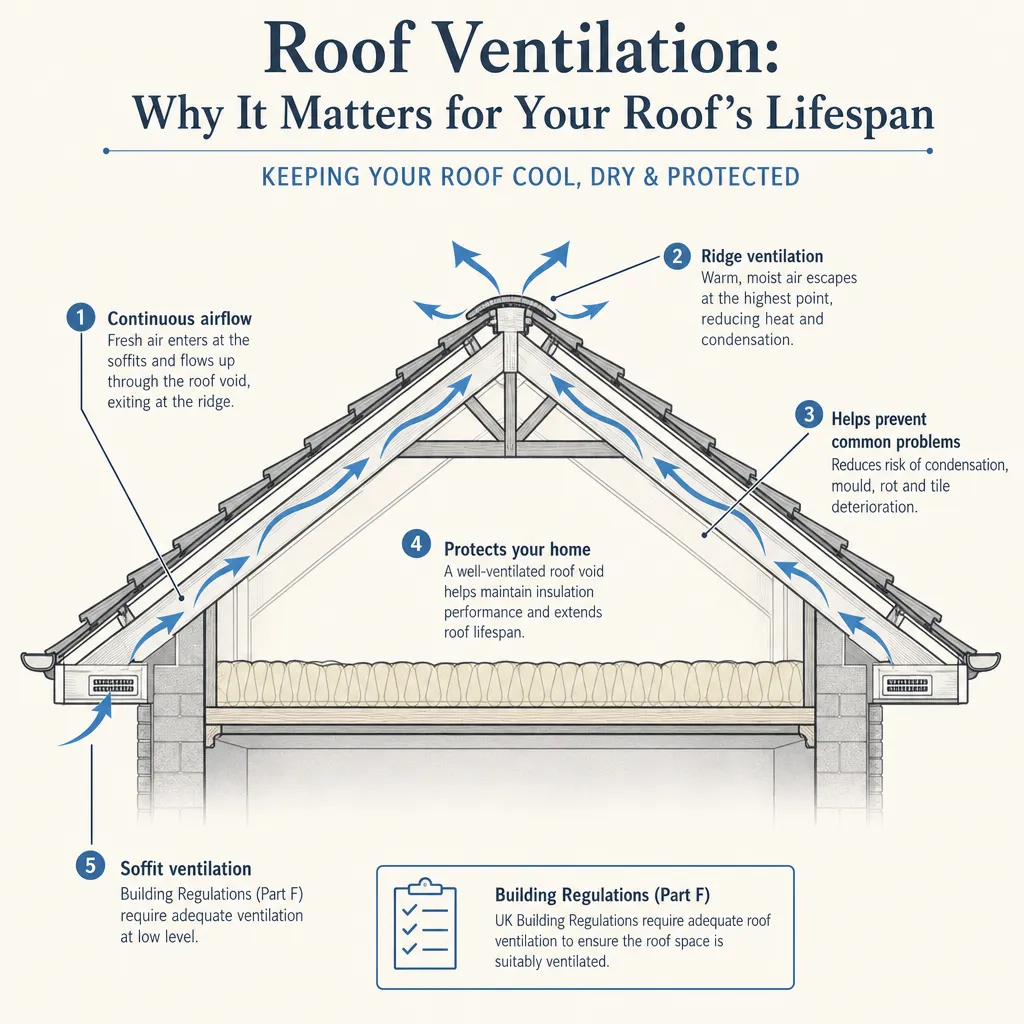
Roof Ventilation: Why It Matters for Your Roof's Lifespan
Moisture is among the most destructive forces a roof faces, and it does not always arrive through a missing tile. In UK homes — from Victorian terraces to 1990s estate houses — condensation forming within the roof void accounts for a significant proportion of premature timber decay and roofing material failures that owners never trace back to inadequate ventilation. A roof with proper ventilation can last 40–80 years depending on the covering material; one with chronically poor ventilation may fail in half that time.
Key points
- BS 5250:2021 (Code of Practice for Control of Condensation in Buildings) is the primary UK design standard for roof ventilation in residential construction.
- Cold pitched roofs with insulation at ceiling level require a continuous 25 mm ventilation gap at the eaves for pitches above 15°, plus cross-ventilation near the ridge — requirements referenced in Building Regulations Approved Document C.
- Warm roofs — where insulation fills the full rafter depth — must either be fully sealed with a vapour control layer or counter-battened to create a 50 mm air gap above the insulation.
- Interstitial condensation in a poorly ventilated roof void can reduce mineral wool insulation thermal resistance by 30–50%, compounding energy loss alongside structural damage.
- Blocked soffit vents are the most common cause of inadequate ventilation identified during roof surveys of pre-2000 UK housing stock.
How roof ventilation works
Roof ventilation relies on a continuous air pathway through the roof void to carry moisture-laden air away before it condenses on cold surfaces. In a typical cold pitched roof, outside air enters at the eaves through soffit vents or a continuous ventilated fascia, travels across the top of the ceiling insulation, and exits near the apex through a ventilated ridge, high-level tile vents, or gable openings.
Two forces drive this movement: the stack effect, where warm air rising draws cooler air in at the eaves, and wind pressure across the roof slope. Both depend on unobstructed pathways. If insulation is pushed tight against the eaves, or soffit vents are blocked by paint, debris, or birds' nests, air movement stalls and relative humidity in the void rises — often to the point where condensation forms on cold timber and felt surfaces overnight.
Which roof construction type do you have?
Decision tree: identifying your roof ventilation type
- Choose cold roof management if insulation is laid flat on the loft floor and you can access the roof void as a clear space. Check for soffit vents and a ventilated ridge. A 50 mm clear airway must be maintained between the insulation surface and the underside of the roof deck at the eaves.
- Choose warm roof assessment if insulation is fitted between or below the rafters — common after a loft conversion or ECO-funded insulation upgrade. Ask the installer for the specification confirming whether a vapour control layer was installed and whether a ventilated counter-batten zone was provided above the insulation.
- Ask a professional if you have a flat roof section, a roof altered under a grant scheme, or any construction type you cannot confidently identify from a loft inspection.
- Commission a ventilation and condensation assessment if you find any of the red flags listed in the section below.
What building regulations require
Building Regulations Approved Document C (England and Wales) and BS 5250:2021 set the primary requirements for residential roof ventilation. Scotland's Technical Handbook Section 3 and Northern Ireland's Technical Booklet C follow broadly equivalent principles.
Key benchmarks for cold pitched roofs:
- Pitch above 15°: Equivalent of a continuous 25 mm eaves-level opening on two opposing sides, plus cross-ventilation to prevent stagnant air zones.
- Pitch 15° or below, or complex plan shapes: Equivalent of a 35 mm gap, with additional high-level openings to ensure air movement.
- Cathedral ceilings or room-in-the-roof constructions: Minimum 50 mm ventilated air gap above the insulation layer throughout the rafter depth.
- Cold flat roofs: Ventilation openings on opposing sides equal to at least 1/300 of the plan area, with a 50 mm air space between insulation and deck.
These requirements apply when work triggers building control — a full re-roof, loft conversion, or insulation installation. Routine repairs such as replacing individual tiles or repointing flashings do not typically require a building regulations application, but should not disturb existing ventilation provision as part of the repair.
How poor ventilation damages a roof
Interstitial condensation — moisture condensing within the structure rather than on a visible surface — is the key damage mechanism. When warm, moist air from the living space migrates into a cold roof void and meets cold timber or sarking felt, it deposits moisture. Over time:
- Timber decay: Rafters, purlins, and ridge boards absorb moisture and become vulnerable to wet rot and fungal attack. Structural strength reduces well before visible deterioration appears.
- Felt degradation: Traditional bitumen sarking felt is not vapour-open. Moisture accumulating above it accelerates deterioration and can cause tile-to-batten fixing problems.
- Mould growth: Airborne spores thrive in high-humidity voids and can spread to insulation and plasterboard ceilings below.
- Tile and slate deterioration: Freeze-thaw cycles in a damp void accelerate cracking and delamination of both concrete tiles and natural slate.
A clay plain tile roof rated for 40–60 years, or Welsh slate rated for 60–80 years, may need replacing in 20–30 years if ventilation is chronically inadequate. Replacement costs for a typical semi-detached house typically range from £8,000 to £18,000 or more depending on material and roof area (indicative UK costs, last reviewed 2026-06-01; obtain quotes for your specific property).
Red flags: signs of poor roof ventilation
Inspect your loft at least once a year. Seek professional advice promptly if you observe any of the following:
- Damp patches or water staining on loft insulation, rafters, or ceiling joists that do not correspond to a known tile or flashing fault.
- Condensation on cold water tanks, pipes, or the underside of the roof deck in winter.
- Soft, discoloured, or spongy timber at rafter ends near the eaves — the most common location for moisture-driven decay in UK housing.
- Mould growth on the underside of sarking felt or on the back faces of tiles or slates.
- Sagging or bubbling plasterboard on upstairs ceilings without any traceable tile leak above.
- A persistent musty odour in the loft, particularly after cold spells or prolonged wet weather.
- Blocked, painted-over, or missing soffit vents — check from ground level along the eaves line.
Homeowner ventilation checklist
Use this before commissioning work or booking a survey:
When to get professional help
A professional assessment is advisable if you identify any red flags above, or in any of these situations:
- You are planning a loft conversion and need to confirm existing ventilation before insulating the rafters.
- You have unexplained damp patches on upstairs ceilings not linked to a known tile or flashing fault.
- Loft insulation was installed under an ECO3, ECO4, or local authority scheme and you are unsure whether ventilation baffles were fitted.
- You are purchasing a property and want assurance about roof void condition and moisture risk before exchange.
A roof survey will assess accessible timber condition and identify blocked or absent ventilation. A ventilation and condensation assessment will measure relative humidity, identify condensation risk zones, and recommend specific remedial measures.
How Housey can help
Housey connects homeowners with vetted local specialists who carry out roof surveys and ventilation and condensation assessments. Describe your situation, receive quotes from local professionals, and compare them in one place — without cold-calling multiple firms individually.
Frequently asked questions
Does better roof ventilation reduce my energy bills?
Not directly — ventilation allows air movement rather than adding insulation. However, damp insulation loses 30–50% of its thermal resistance, so maintaining ventilation protects the performance of any loft insulation you have installed. Good insulation without good ventilation can accelerate moisture problems rather than resolve them.
Can roof ventilation be improved without a full re-roof?
Usually yes. Contractors can retrofit over-fascia ventilators, individual tile ventilators, or a dry-fix ventilated ridge without removing all tiles. A loft inspection is needed first to confirm whether insulation baffles are in place at the eaves, as adding vents without clearing the airway there may not resolve the problem.
Do I need building control approval for ventilation repairs?
Routine repairs generally do not require a building regulations application. However, re-roofing more than 25% of the total roof area, converting the loft, or installing insulation will normally trigger building control notification. Check with your local building control body or an approved inspector before starting any work of this scale.
What is a vapour control layer and when is it needed?
A vapour control layer (VCL) is a foil-faced membrane installed on the warm side of insulation to limit moisture diffusion into the roof structure. It is essential in warm roof construction where no ventilated air gap exists above the insulation. It does not replace ventilation in a cold roof construction, where an open airway from eaves to ridge remains necessary.
Sources and further reading
- Building Regulations Approved Document C: Site Preparation and Resistance to Moisture — GOV.UK
- BS 5250:2021 Code of Practice for Control of Condensation in Buildings — BSI
- NHBC Technical Standards: Roofing — NHBC
- Loft Insulation — Energy Saving Trust
- Roofs: Maintenance and Repair — Historic England
Useful next reads
 Surveys & Inspections
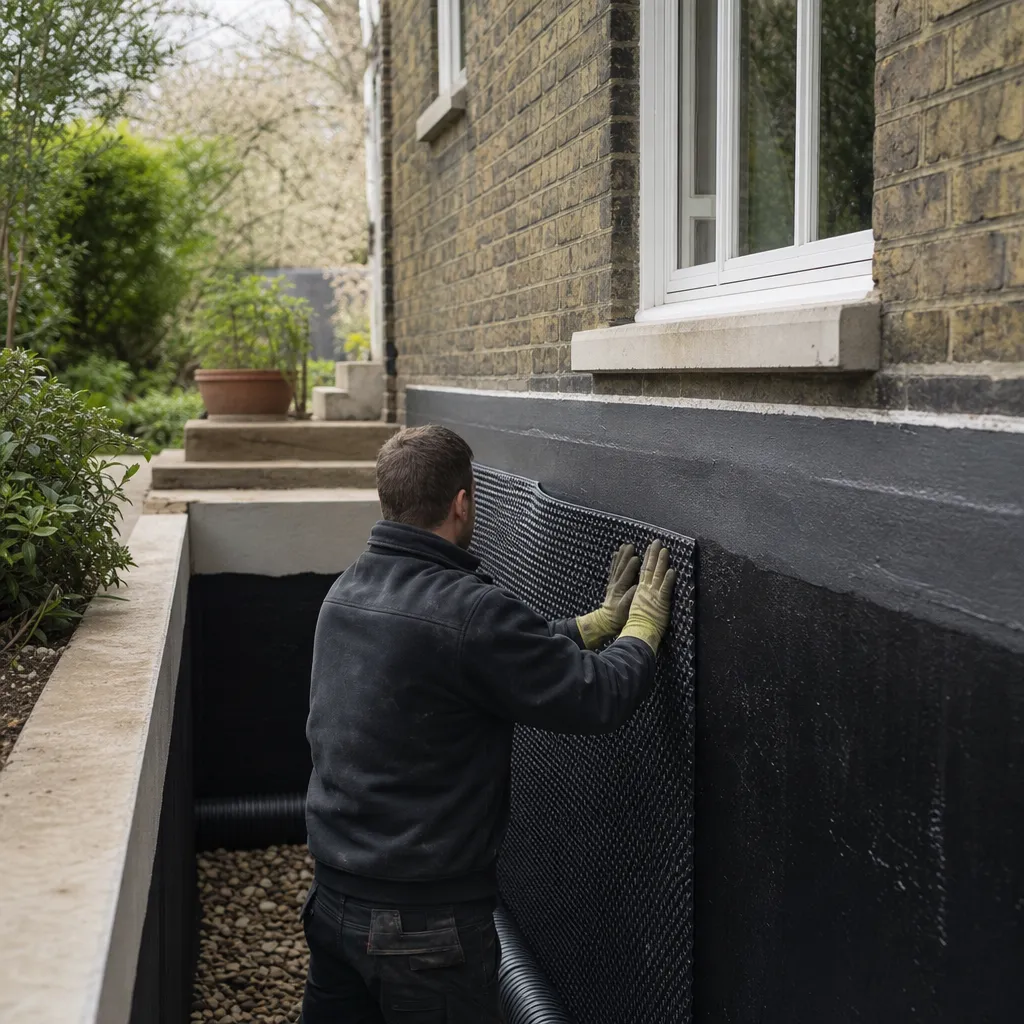
Basement Waterproofing Solutions for Damp Prevention
Basement waterproofing in the UK is governed by BS 8102:2022, which defines three system types: Type A (barrier coatings), Type B (structurally integral concrete), and Type C (cavity drain membrane with sump pump).
 Surveys & Inspections
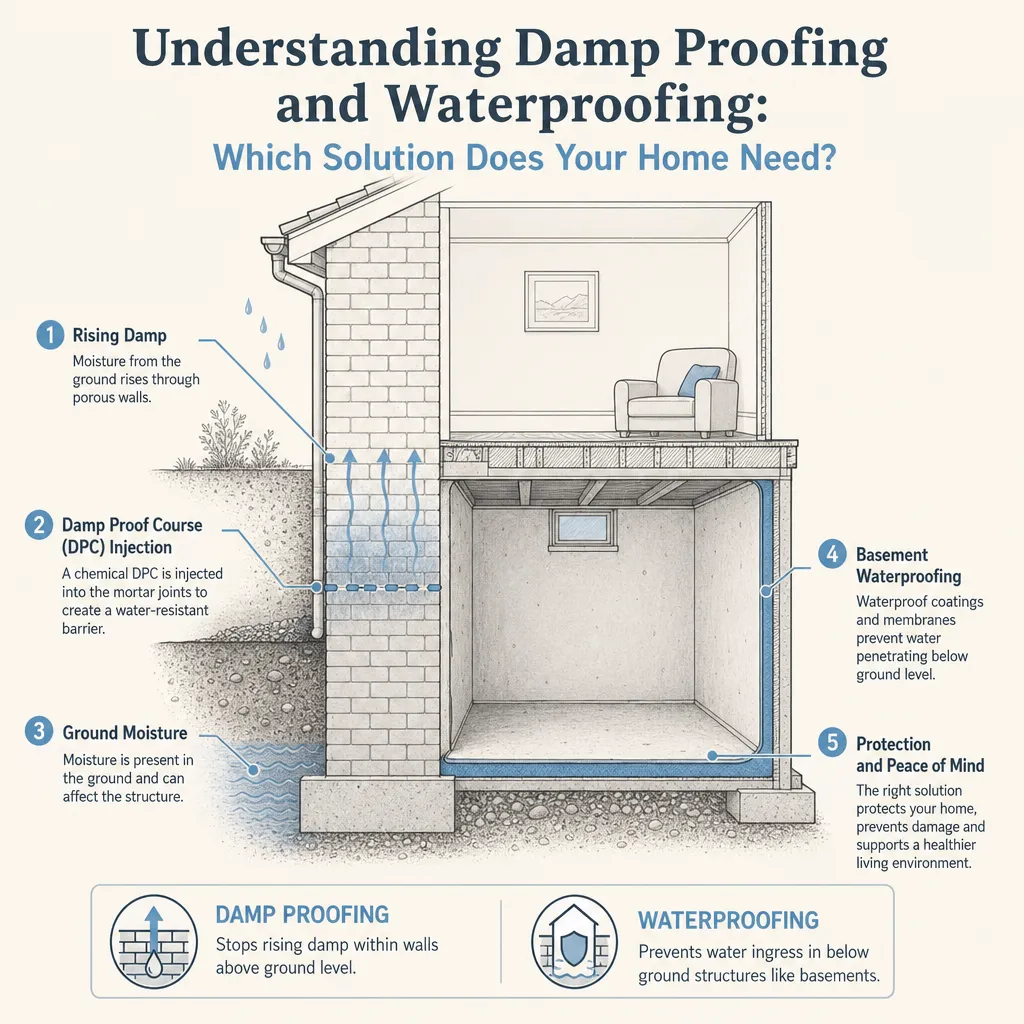
Understanding Damp Proofing and Waterproofing: Which Solution Does Your Home Need?
Damp proofing controls moisture movement through above-ground walls, while waterproofing excludes groundwater from below-ground structures.
 Surveys & Inspections
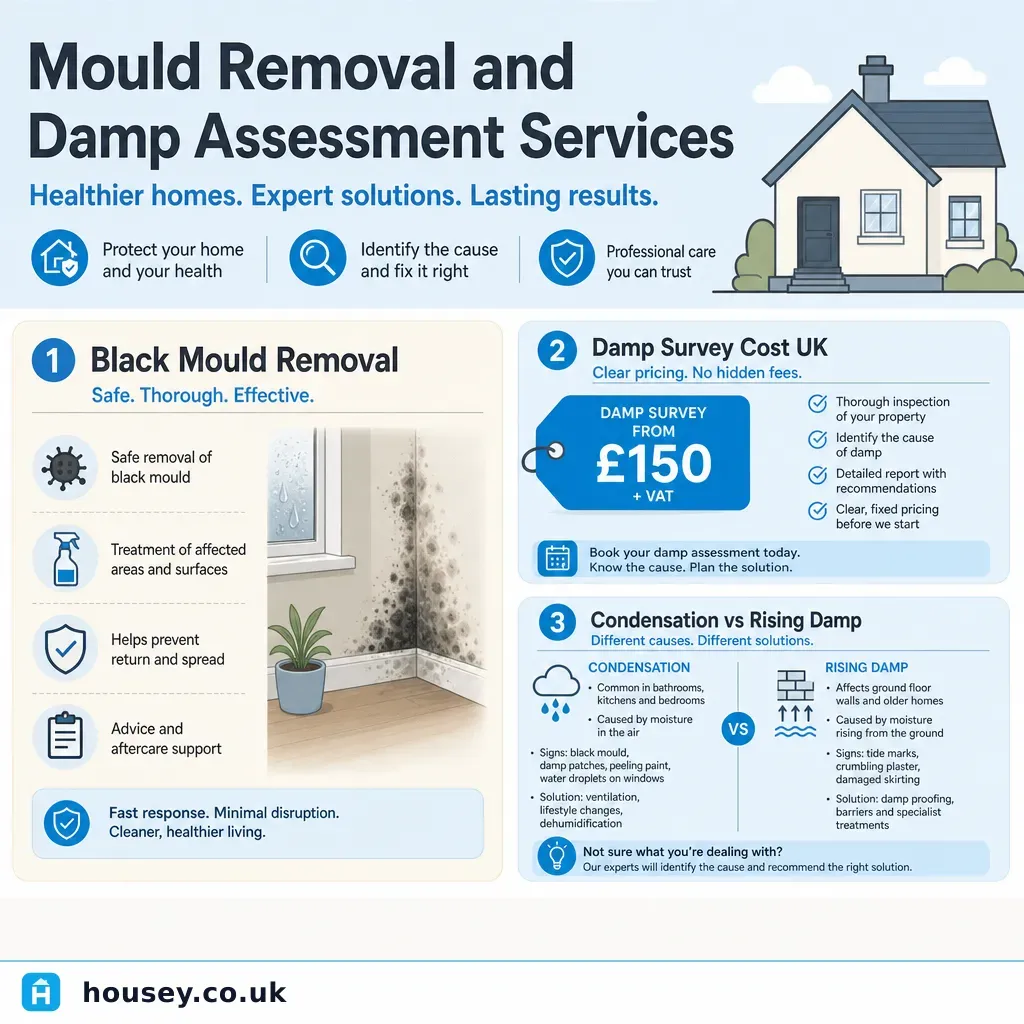
Mould Removal and Damp Assessment Services
Professional mould removal and damp assessment starts with identifying the moisture source—condensation, rising damp, or penetrating damp—before any treatment begins.
 Surveys & Inspections
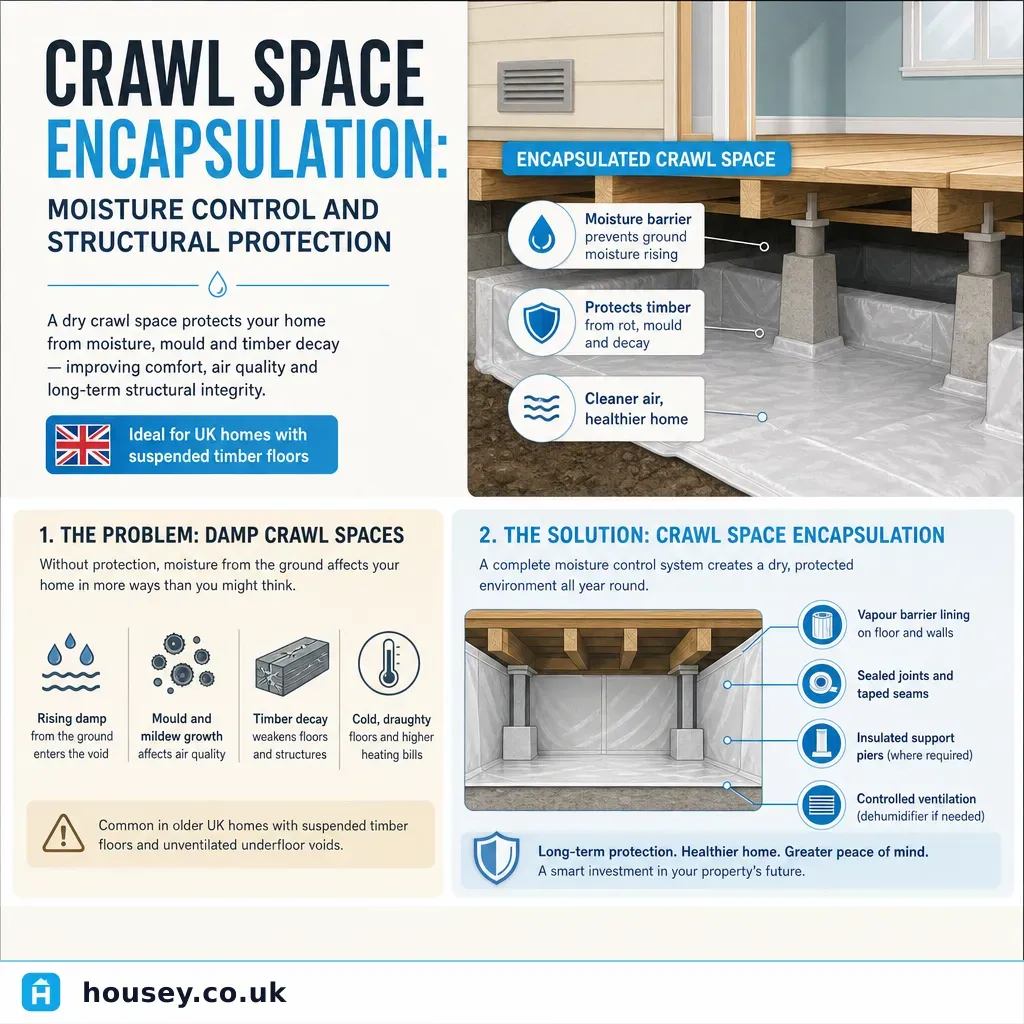
Crawl Space Encapsulation: Moisture Control and Structural Protection
Crawl space encapsulation seals the subfloor void beneath suspended timber floors with a vapour control layer and improved ventilation to prevent rising damp, condensation, timber rot and structural damage.
 Surveys & Inspections
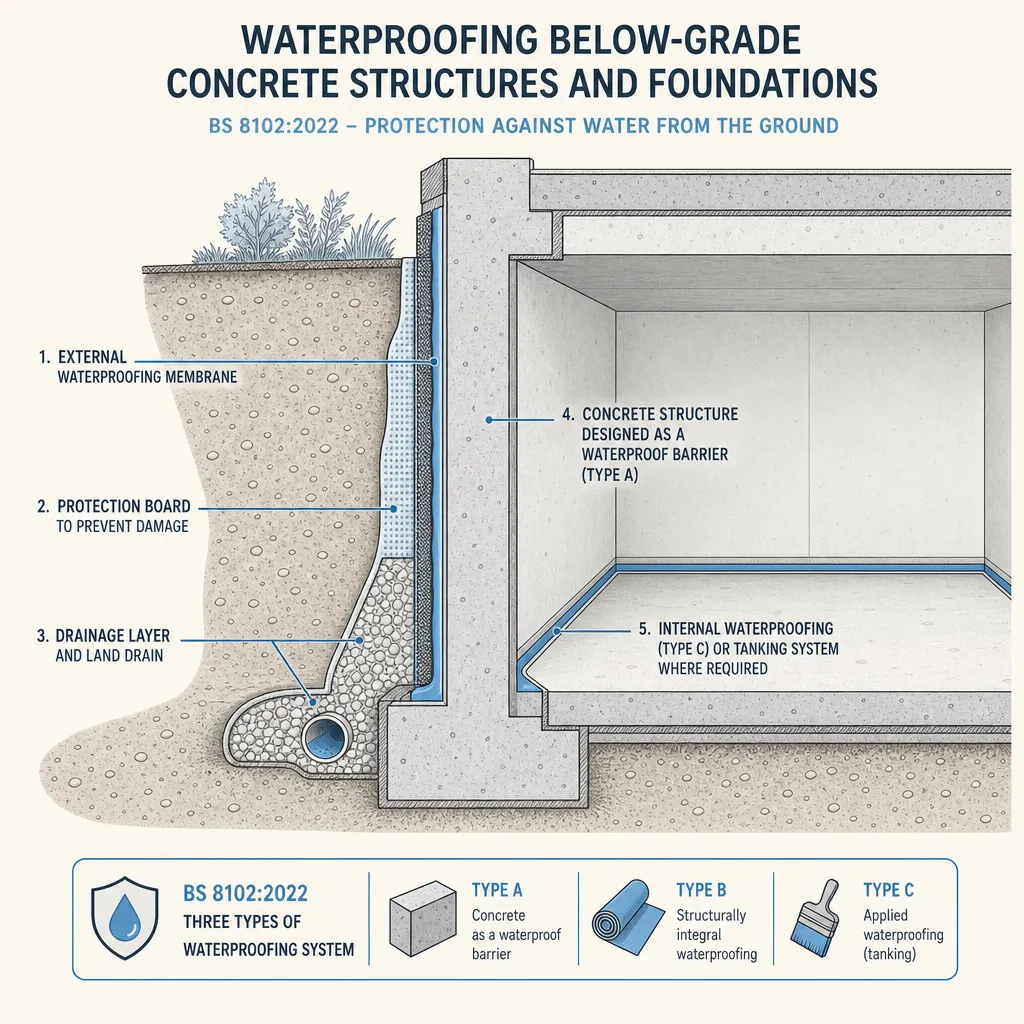
Waterproofing Below-Grade Concrete Structures and Foundations
Below-grade waterproofing in the UK should be designed to the grade of protection required under BS 8102:2022.