Roofing Nail Penetration Through Soffit: Installation Standards
By Housey · Last reviewed 1st of June 2026
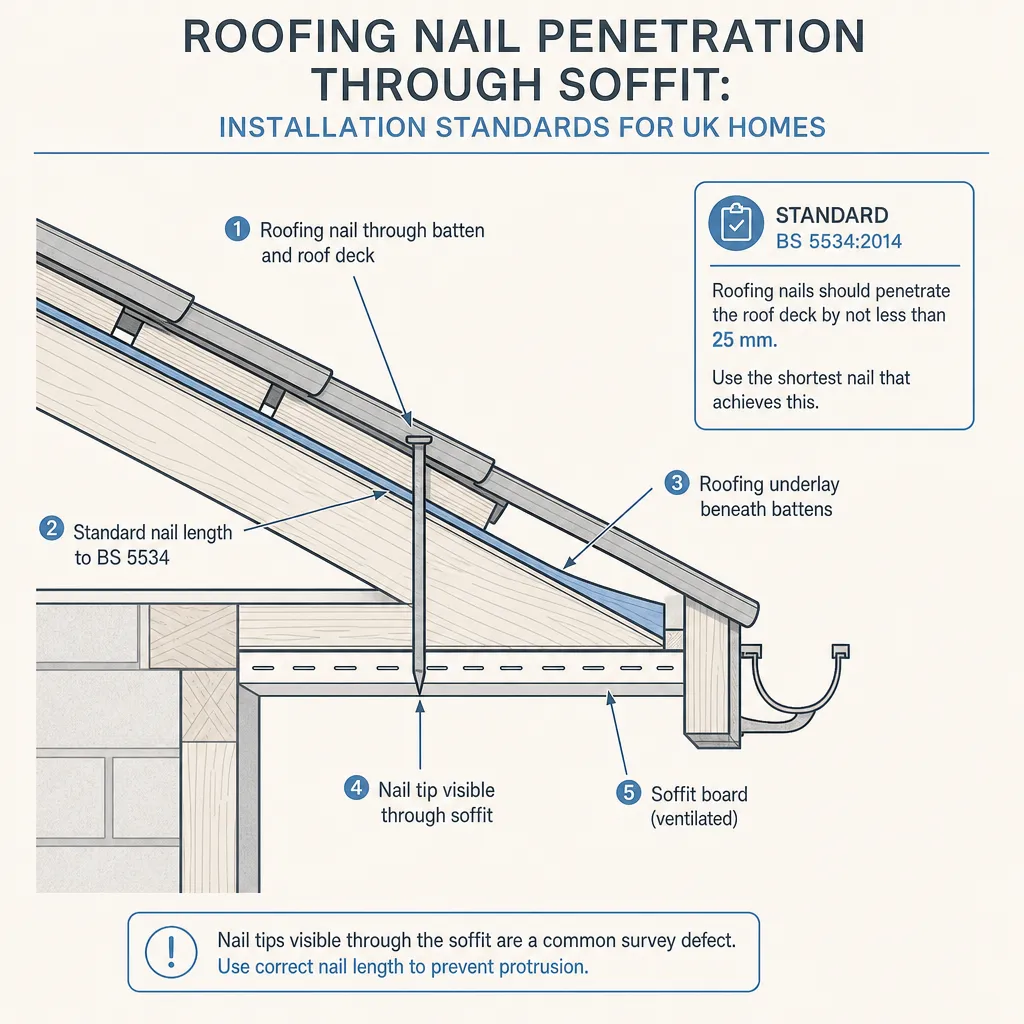
Roofing Nail Penetration Through Soffit: Installation Standards
Roofing nail penetration through the soffit board is a defect that surfaces in survey reports more often than many buyers expect, particularly when inspecting post-war semis, Victorian terraces, or any property that has had roof work carried out without close attention to fixing specification. It typically comes to light during a RICS Level 2 or Level 3 Home Survey when the surveyor examines the eaves from ground level or from within an accessible loft space. Understanding what the standard requires, how surveyors grade this type of defect, and what remediation involves will help you respond to a survey report with confidence.
Key points
- BS 5534:2014+A2:2018 is the principal UK standard for slating and tiling on pitched roofs, specifying minimum nail penetration depths into battens and structural timbers.
- Visible nail tips on the underside of the soffit board indicate that over-length nails were used, the battens are shallower than the fixing specification required, or the rafter depth at the eaves was insufficient.
- RICS surveyors typically grade this as Condition 2 (repair required in the medium term) or Condition 3 (urgent attention needed), depending on extent and associated moisture evidence.
- Moisture can track through nail puncture points into the roof void, risking decay of rafter tails, fascia boards, and wall plates if the issue is widespread and left unaddressed.
- Under the Work at Height Regulations 2005, all remedial roofing work must be carried out by a competent person; scaffolding should be erected by a CISRS-registered contractor for anything beyond a single ladder lift.
What do UK roofing nail installation standards require?
The principal standard for pitched roof covering in the UK is BS 5534:2014+A2:2018 — Slating and tiling for pitched roofs and vertical cladding. It sets out:
- Minimum batten thickness and depth to provide adequate nail-holding capacity
- Nail length selection relative to batten depth and the required penetration into the rafter — a minimum 25mm penetration into structural timber is required
- Minimum fixings per tile or slate, including double-fixing requirements in higher wind-exposure zones as defined by BS EN 1991-1-4
- Eaves and verge detailing where fixings are critical and where nail angles can cause penetration of thinner boards beneath the tile course
The NHBC Standards (Chapter 7.2) reference BS 5534 for new-build pitched roofs. For older properties, the question is often whether the original installation met the standards in force at the time — pre-2015 requirements were less prescriptive, making this defect more common on homes re-roofed before the current standard came into force.
Why do nails penetrate through the soffit?
Cause | Description | Typical occurrence |
|---|---|---|
Over-length nails | Nails substantially longer than the batten depth | Very common on re-roofs |
Shallow battens | 25mm × 50mm battens used where a deeper section was required | Common on budget re-roofs |
No rafter tail at eaves | Nails fired where only a fascia-supporting batten is present | Occasional |
Nail gun without depth control | Nails over-driven at the eaves zone | Less common but increasing |
Soffit added retrospectively | Open eaves boarded over after the roof was originally laid | Occasional on Victorian and Edwardian stock |
In most cases, the issue is most visible at the lowest tile course, where battens are narrowest and nails fired at even a slight angle are most likely to pass below the soffit line.
How serious is the defect?
Severity depends on extent and any associated moisture or timber damage.
Low concern: One or two nail tips visible, isolated to a small area, no moisture staining, no soft timber on probing. A workmanship defect to be noted and corrected, but unlikely to cause structural problems in the short term.
Moderate concern: Multiple nail tips across several rafter bays, light staining on the soffit board, no active decay detected. Repair should be scheduled before winter.
High concern: Widespread nail penetration combined with wet or stained soffit boards, dark discolouration on rafter tails, soft timber on probing, or evidence of rot at the wall plate. A close-access inspection by a qualified roofer is warranted before purchase or exchange of contracts.
A surveyor inspecting from ground level or an accessible loft hatch cannot always probe the full depth of timbers at the eaves; they will record what is observable and recommend specialist investigation where moisture or decay is indicated.
What surveyors look for — and how defects are graded
During a RICS Level 2 Home Survey or RICS Level 3 Home Survey, the surveyor inspects the roof covering, eaves detail, and soffit and fascia boards from ground level with binoculars and from any accessible roof void.
Nail penetration through soffits is typically reported as:
- Condition 2 — defects requiring repair or replacement in the medium term, often worded as: 'Nail tips are visible through the soffit board at the eaves, consistent with over-length fixings used during re-roofing. A qualified roofer should inspect and carry out any necessary remedial work.'
- Condition 3 — where moisture staining, soft timber, or active decay is also present and more urgent action is required.
If a Level 2 survey raises this defect, buyers may wish to commission a Level 3 survey or an independent roofer's report before proceeding to exchange of contracts.
Remediation options
The appropriate fix depends on the cause and extent of the defect:
- Selective nail removal and re-fixing — where individual nails can be withdrawn and replaced with correctly-sized fixings without disturbing the tile course. Suited to isolated occurrences.
- Tile strip, batten check, and re-lay — where the batten depth is the root cause, the affected tile courses are lifted, battens are checked or replaced to the correct section, and tiles re-fixed with appropriate nails. More disruptive but addresses the underlying issue.
- Soffit board replacement — where the board is damaged by moisture or decay, replacement of the soffit section is included in the remediation package.
Indicative UK costs, last reviewed 2026-06-01. Roofer call-out and selective repair: £150–£500+ depending on extent and access. Partial tile-course strip and re-lay: £500–£2,000+. Costs vary significantly by region, roof pitch, access difficulty, and whether scaffolding is required. Always obtain at least three written quotes with a clear schedule of work.
What to ask a roofer before accepting a quote
- What is causing the nail penetration in your assessment — nail length, batten depth, or rafter tail detail?
- Will you need to strip the tile course, or can nails be removed and replaced in situ?
- Is there any moisture damage to rafter tails or soffit boards that should be addressed at the same time?
- What fixings will you use, and do they comply with BS 5534:2014+A2:2018?
- What scaffold or access equipment do you plan to use, and who will erect it?
- Is VAT included in the quote?
- Will you provide a written report and schedule of work on completion?
Red flags — when this may be more serious
Watch for these signs that the defect warrants closer investigation before committing to purchase or repair:
- Widespread nail tips across more than two roof slopes — suggests a systemic fixing problem rather than isolated poor workmanship
- Soft or darkened timber on soffit boards or rafter tails beneath the penetration points — potential early-stage decay
- Gaps between soffit boards combined with nail penetration — may have allowed birds or moisture into the roof void over a prolonged period
- Recent re-roofing documented by the seller with no building control completion certificate, particularly where batten replacement was involved
- Staining on ceilings beneath the eaves inside the property — may indicate moisture has tracked from the roof void into the structure
When to get professional help
If a survey report flags soffit nail penetration, the recommended next step is a close-access inspection by a qualified roofer — typically from scaffolding — to assess the extent, probe any stained timber, and confirm whether decay is present. Do not delay if moisture staining is noted.
Ensure any contractor holds current public liability insurance and complies with the Work at Height Regulations 2005. If the survey also flags damp in the roof void or deterioration at the wall plates, a damp and timber specialist may need to assess the structure before remedial work is specified and priced.
How Housey can help
Housey connects you with vetted local professionals who can help you understand and resolve roofing defects found in survey reports. Request a roof survey for a close-access inspection and written report, or find qualified roofers to carry out remedial work and provide a BS 5534-compliant specification and completion certificate.
Frequently asked questions
Is nail penetration through the soffit covered by buildings insurance?
Generally not as a standalone workmanship defect — buildings insurance typically covers sudden and unforeseen damage rather than gradual installation failures. However, if moisture ingress caused by the penetration has led to rot in structural timbers, there may be a consequential damage claim element. Check your policy wording and speak to your insurer directly.
Can I just seal around the nail tips from below?
Sealing nail tips treats the visible symptom rather than the underlying cause. The incorrect fixing remains in place, and the sealant may mask moisture evidence from future surveys and inspections. A qualified roofer should assess whether the tile course needs stripping and re-fixing with correctly-sized nails.
Does nail penetration through the soffit affect a mortgage valuation?
A standard mortgage valuation does not inspect individual fixing defects at this level of detail. However, if the valuing surveyor has broader concerns about overall roof condition, they may impose a retention or request a specialist roofer's report before mortgage funds are released.
How do I find a qualified roofer to inspect this defect?
Ask for evidence of current public liability insurance and check whether the contractor is a member of the National Federation of Roofing Contractors (NFRC) or the Confederation of Roofing Contractors (CORC). Request a written inspection report and specification — not just a verbal quote — particularly when the defect was flagged in a formal building survey.
Sources and further reading
- BS 5534:2014+A2:2018 — Slating and tiling for pitched roofs and vertical cladding — British Standards Institution
- NHBC Standards Chapter 7.2 — Pitched roofs — NHBC
- Work at Height Regulations 2005 — legislation.gov.uk
- RICS Home Survey Standard — RICS
- National Federation of Roofing Contractors — find a member — NFRC
Useful next reads
 Surveys & Inspections
Professional Electrical Services: Quality Installations and Compliance
Professional electrical services in UK homes are governed by Part P of the Building Regulations and BS 7671 (18th Edition).
 Surveys & Inspections
Why Property Boundaries Matter: Surveying and Dispute Prevention
Property boundaries in England and Wales are recorded as general boundaries by HM Land Registry — not precise measurements.
 Surveys & Inspections
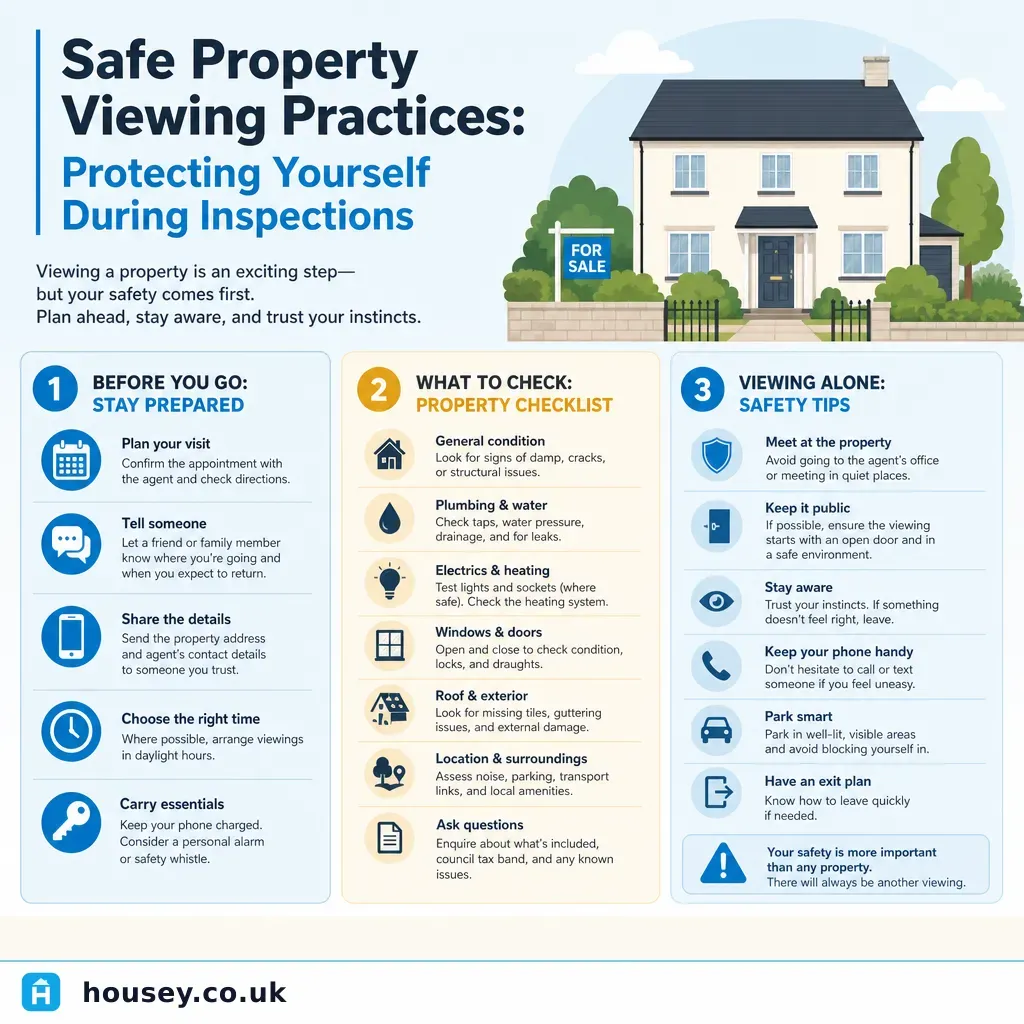
Safe Property Viewing Practices: Protecting Yourself During Inspections
When viewing a property in the UK, always tell someone where you are going and share the full address before you leave.
 Surveys & Inspections
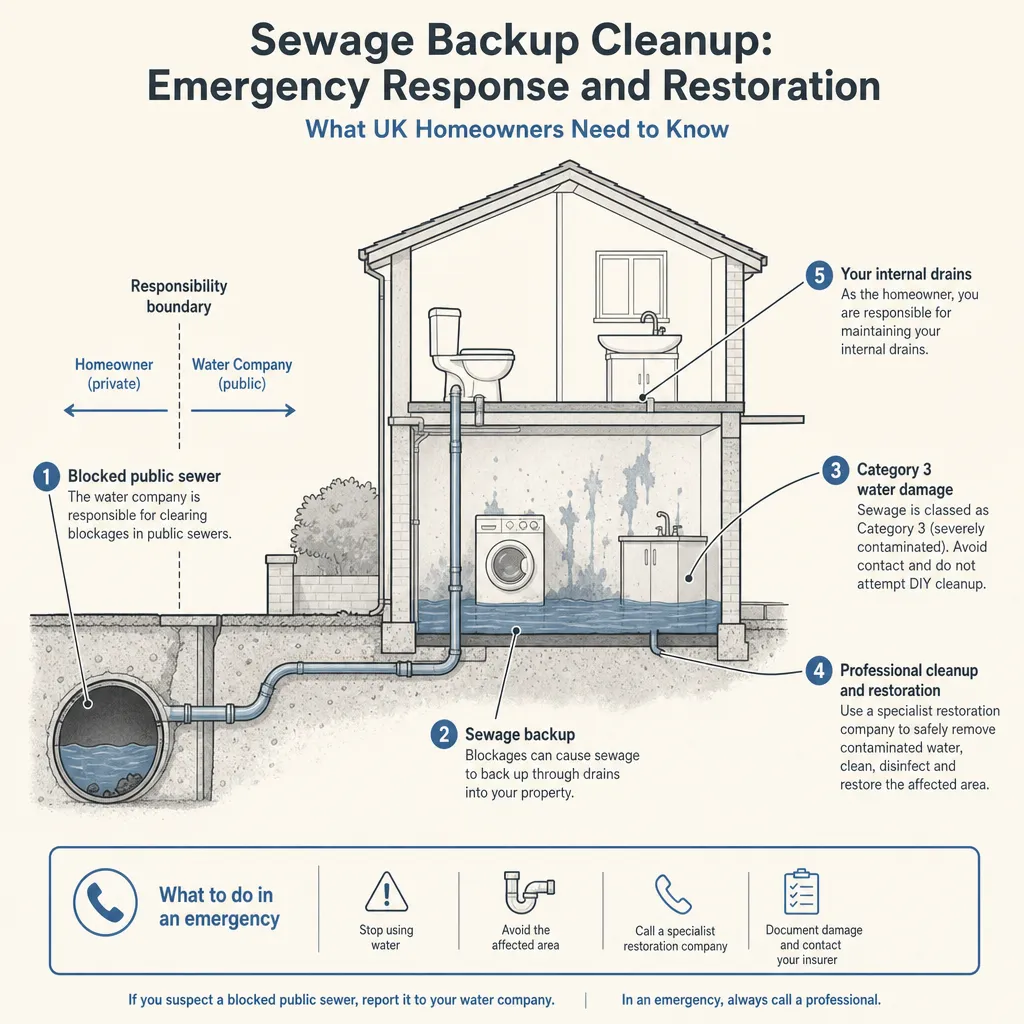
Sewage Backup Cleanup: Emergency Response and Restoration
A sewage backup should be treated as a Category 3 contamination event.
 Surveys & Inspections
Identifying Asbestos Insulation: What You Need to Know for Your Property
Asbestos insulation was widely used in UK properties built before 2000, commonly found in pipe lagging, ceiling tiles, loose-fill loft insulation, and around boilers.