Rooftop Air Conditioning Units: Installation and Structural Considerations
By Housey · Last reviewed 1st of June 2026
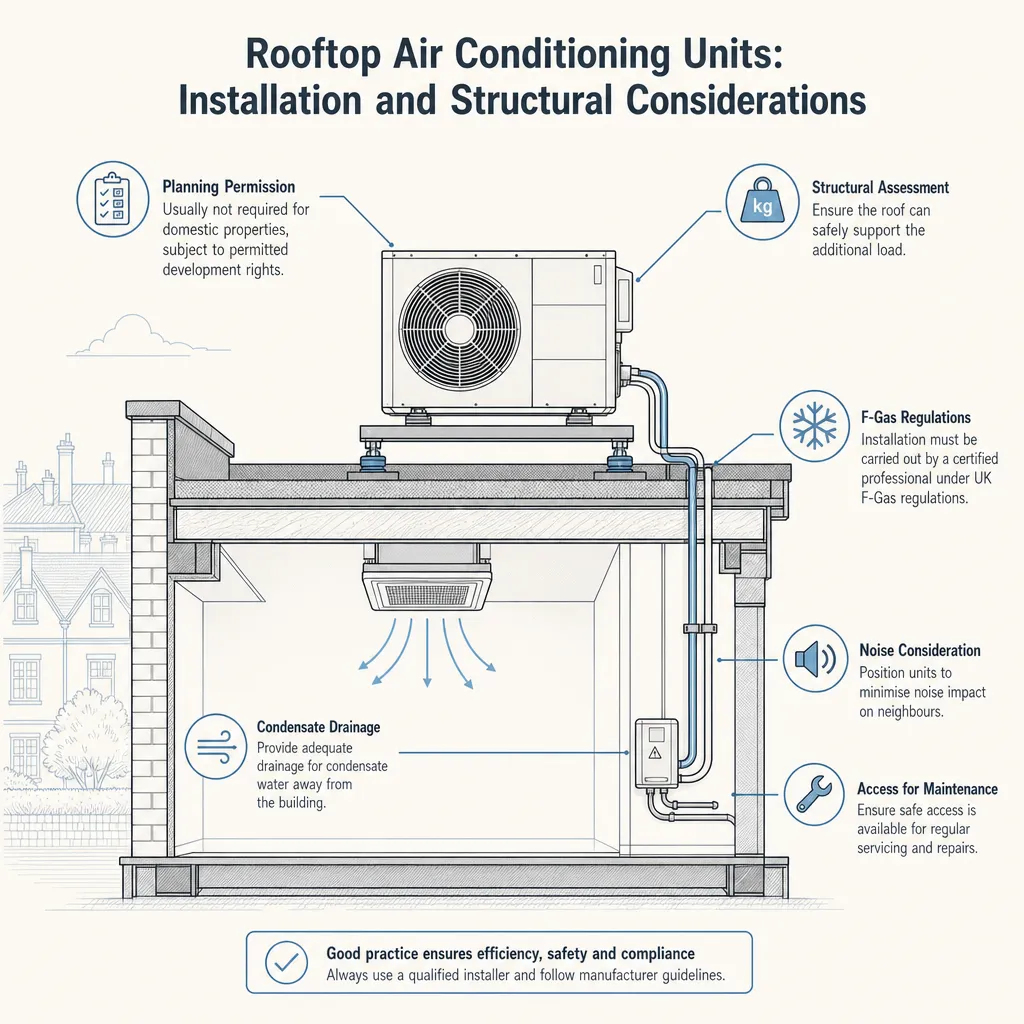
Rooftop Air Conditioning Units: Installation and Structural Considerations
Rooftop air conditioning installations are becoming more common in UK homes and smaller commercial premises, particularly as summers grow warmer and urban heat islands intensify. The decision typically arises during a renovation, an office conversion, or when a conventional wall-mounted split system is not feasible. Getting the installation wrong — structurally, legally, or technically — can be costly to correct and may create safety or compliance issues that affect insurance and resale.
Key points
- In England, domestic air conditioning units may fall under permitted development rights under Schedule 2, Part 1, Class G of the Town and Country Planning (General Permitted Development) (England) Order 2015, but conditions apply including a daytime noise limit of 42 dB(A) at one metre from any neighbouring window or door.
- Approved Document A (Structure) of the Building Regulations requires structural assessment before adding new imposed loads to an existing roof — a requirement that applies regardless of unit size.
- UK F-Gas Regulations require that only engineers holding a valid F-Gas Certificate of Competency install, service, or decommission equipment containing hydrofluorocarbon (HFC) refrigerants.
- Listed buildings and properties in conservation areas generally cannot benefit from permitted development for external air conditioning units; full planning permission is usually required.
- Approved Document L (Conservation of Fuel and Power) sets minimum energy efficiency requirements, including seasonal energy efficiency ratio (SEER) thresholds, for new cooling installations in England.
Do rooftop AC units need planning permission in the UK?
For residential properties in England, permitted development rights under Schedule 2, Part 1, Class G of the Town and Country Planning (General Permitted Development) (England) Order 2015 allow the installation of air conditioning units without a formal planning application, provided several conditions are met:
- The unit is not installed on a wall, roof slope, or other surface that fronts a highway.
- The unit produces no more than 42 dB(A) during the daytime at one metre from any window or door of a neighbouring property.
- The property is not a listed building.
- The property does not sit within a World Heritage Site or the curtilage of a listed building.
- No more than one unit is installed on the same dwelling at any one time.
In Scotland, Wales, and Northern Ireland, the planning rules differ and may be more restrictive — check with the relevant local planning authority (LPA) before proceeding.
Conservation areas and Article 4 Directions: In a conservation area, permitted development rights for air conditioning units are often withdrawn, either through conservation area designation or an Article 4 Direction issued by the LPA. Always check with your LPA before assuming permitted development applies to your property.
Decision tree: do you need planning permission?
- Choose permitted development if: the property is a standard residential dwelling in England, the unit will not be visible from a highway, the 42 dB(A) noise limit can be met, and no Article 4 Direction or other restriction applies.
- Apply for full planning permission if: the property is listed, in a World Heritage Site, in a conservation area with withdrawn permitted development rights, or in Scotland, Wales, or Northern Ireland where separate rules apply.
- Check with your LPA if: you are unsure whether an Article 4 Direction applies, the property has a complex planning history, or you are converting a commercial building to residential use.
- Consult a chartered town planner if: the application is contentious, the site has a complex history, or you have received informal objections from neighbours.
Structural considerations before installation
A rooftop air conditioning unit — particularly a packaged rooftop unit (RTU) used in commercial or larger residential applications — can weigh anywhere from 200 kg to over 1,500 kg depending on cooling capacity. Even a modest residential split-system outdoor unit installed on a flat roof may weigh 50–150 kg. Adding that load to a structure not designed for it can cause deflection, cracking, or in severe cases structural failure.
Approved Document A (Structure) of the Building Regulations requires that any new load-bearing intervention be assessed to ensure the existing structure can safely accommodate it. This typically means:
- Commissioning a structural engineer's assessment of the roof, including beams, joists, deck, and any existing imposed loads.
- Reviewing original structural drawings if available, or undertaking an intrusive survey if they are not.
- Confirming the proposed mounting arrangement distributes load adequately and avoids point-loading problems.
- Checking that roof waterproofing and drainage will not be compromised by support penetrations or new steelwork.
Older timber flat roofs — common on 1930s semis and post-war builds — are often not designed to carry significant additional point loads without remedial strengthening. Do not assume that an existing roof can take the weight until a structural engineer has confirmed it.
Building Regulations compliance
Beyond planning, a rooftop AC installation in a domestic or commercial building may need to comply with several Approved Documents:
Approved Document | What it covers | Relevance to rooftop AC |
|---|---|---|
Part A (Structure) | Structural stability and loads | Roof structural assessment required |
Part F (Ventilation) | Ventilation standards | Ensures installation does not compromise building ventilation |
Part L (Conservation of Fuel and Power) | Energy efficiency | Minimum SEER/EER thresholds for new cooling systems |
Part P (Electrical safety — domestic) | Fixed electrical installations in dwellings | Wiring and controls must comply; BCB notification or self-certification required |
Building control notification may be required for certain installation types, particularly where structural work is involved or the installation is in a commercial premises. Check with your local building control body (BCB) or an approved inspector before committing to a contractor.
F-Gas and refrigerant compliance
The UK F-Gas Regulations (derived from EU Regulation 517/2014 and retained in UK law) impose strict requirements on the handling of fluorinated greenhouse gases, which are used as refrigerants in most modern AC systems — commonly R-410A or R-32. Key rules:
- Only engineers holding a valid F-Gas Certificate of Competency — issued by a body recognised under the UK F-Gas scheme, such as REFCOM — may install, service, recover, or decommission equipment containing F-Gas refrigerants.
- Leak checks are required at defined intervals for systems above certain refrigerant charge weights.
- Records of refrigerant charges, leak checks, and all servicing activity must be maintained by the equipment operator.
- From 2025, certain high-global-warming-potential (GWP) refrigerants face supply restrictions under the UK F-Gas phase-down schedule.
Always ask a prospective installer for their F-Gas certificate number and verify it is current before instructing any work. REFCOM maintains a public register of certified engineers.
Comparison: domestic split system vs commercial rooftop packaged unit
Feature | Domestic split system (outdoor unit on roof) | Commercial rooftop packaged unit (RTU) |
|---|---|---|
Typical weight | 50–150 kg | 300–1,500+ kg |
Structural risk | Lower, but still requires assessment on old or flat roofs | High; always requires structural engineer sign-off |
Planning complexity | Usually permitted development for residential | Often requires planning permission for commercial premises |
F-Gas requirements | Yes — F-Gas certified engineer required | Yes — F-Gas certified engineer required |
Noise considerations | Check 42 dB(A) permitted development limit | May require BS 4142:2014+A1:2019 commercial noise assessment |
Typical use case | 1930s semi, Victorian terrace, modern flat | Office conversion, retail unit, school building |
Building control involvement | Sometimes (structural work, Part P wiring) | Usually required |
Important limitations
This article provides general guidance only. Planning rules, building regulations, and structural requirements vary significantly by property type, location, construction, age, and local authority. Nothing in this article constitutes planning advice, structural engineering advice, or legal advice. A qualified structural engineer should assess any proposed rooftop loading, and a planning consultant or your local planning authority should be consulted before assuming permitted development rights apply to your specific property and installation.
What to ask a qualified professional
Before instructing any contractor to install a rooftop air conditioning system, ask:
- Do you hold a current F-Gas Certificate of Competency, and what is your certificate number?
- Has a structural engineer assessed this roof for the proposed unit weight and mounting arrangement, and can I see the report?
- Does this installation qualify as permitted development for my property, or does it require a planning application?
- Will building control be notified, and if so, will you manage that process on my behalf?
- What refrigerant does the unit use, and how does it align with the UK F-Gas phase-down schedule?
- What noise level will the unit produce at one metre from any neighbouring windows, and how was this figure calculated?
- What warranty is provided on the equipment, and who carries out future F-Gas leak checks and servicing?
When to get professional help
Always instruct a qualified structural engineer before proceeding if:
- The roof is a timber flat roof more than 20 years old.
- The unit weighs more than 100 kg and the roof was not designed for imposed loads.
- There are existing visible signs of roof movement, deflection, or cracking.
- The building is listed or in a conservation area.
- The installation requires cutting through the roof deck or installing new structural steelwork.
For planning queries, speak to your local planning authority's duty planning officer or instruct a chartered town planner before committing to equipment purchases. For F-Gas certificate verification, REFCOM maintains a public register at refcom.org.uk.
How Housey can help
Housey connects UK homeowners and commercial property owners with vetted local professionals, including structural engineers, building surveyors, and planning consultants. If you are considering a rooftop AC installation, Housey can help you find qualified specialists to assess your property's structural capacity, advise on permitted development, and confirm that your proposed installation meets Building Regulations before any work begins.
Frequently asked questions
Does a rooftop air conditioning unit always need planning permission?
Not always. In England, residential installations may qualify as permitted development under Schedule 2, Part 1, Class G of the GPDO 2015, provided the unit does not face a highway, meets the 42 dB(A) daytime noise limit, and the property is not listed or in a designated area. Rules differ in Scotland, Wales, and Northern Ireland. Always verify with your local planning authority before relying on permitted development rights.
Can I install a rooftop AC unit myself?
No. Equipment containing F-Gas refrigerants must be installed, serviced, and decommissioned only by F-Gas certified engineers under UK F-Gas Regulations. Attempting to handle refrigerants without certification is illegal. Structural, electrical, and potentially building control requirements also mean professional involvement is necessary for any rooftop installation.
What happens if my rooftop AC unit causes noise complaints?
Noise from air conditioning units is subject to permitted development limits of 42 dB(A) at one metre from a neighbouring window or door, and may constitute a statutory nuisance under the Environmental Protection Act 1990 if excessive. If a local authority upholds a complaint, you may be required to reduce noise levels or remove the unit. A noise impact assessment before installation reduces this risk.
Do I need building control approval for a rooftop AC installation?
It depends on the scope. If structural alterations are required, or the installation involves new fixed electrical work in a domestic property, building control notification is likely required. Your local building control body or an approved inspector can advise whether a full application or a competent person scheme self-certification route applies to your installation.
Sources and further reading
- Town and Country Planning (General Permitted Development) (England) Order 2015, Schedule 2, Part 1, Class G — legislation.gov.uk
- Approved Document A: Structure — GOV.UK
- Approved Document L: Conservation of Fuel and Power — GOV.UK
- UK F-Gas Regulations guidance for users, producers and traders — GOV.UK
- REFCOM: F-Gas certification and registered engineers — REFCOM
Useful next reads
 Energy & Retrofit
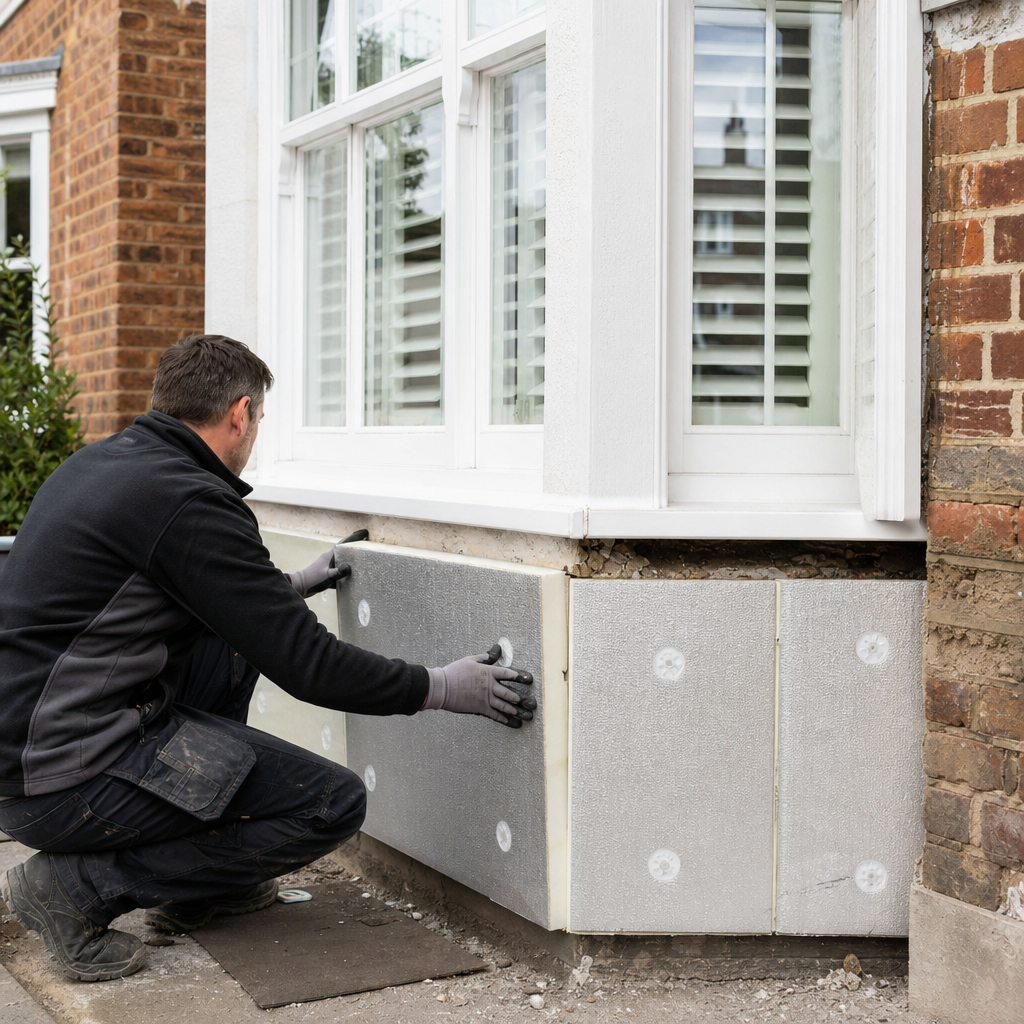
Insulating Solid Masonry Walls Under Bay Windows: Technical Guidance
Insulating solid masonry walls under bay windows requires specialist detailing at angled wall faces, window reveals, and the bay floor and ceiling junctions.
 Energy & Retrofit
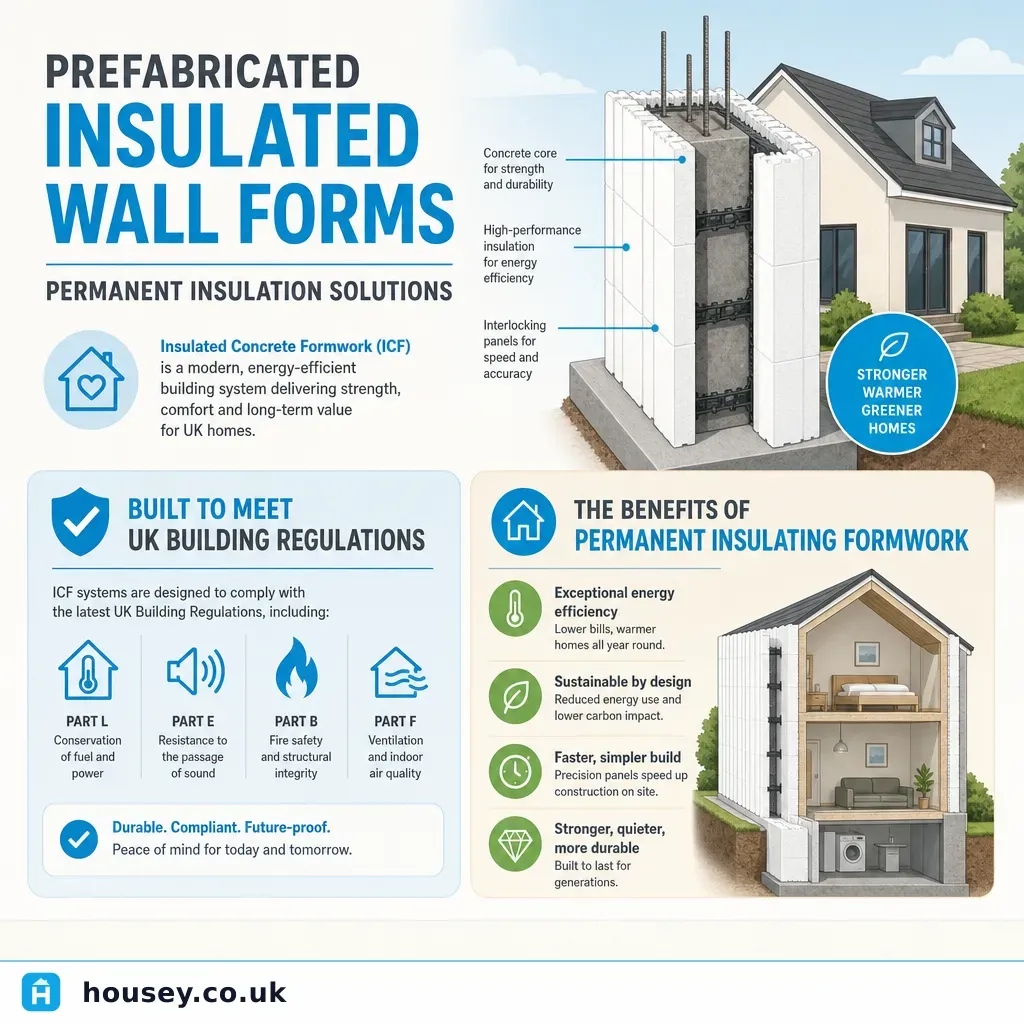
Prefabricated Insulated Wall Forms: Permanent Insulation Solutions
Prefabricated insulated wall forms — including ICF and SIPs systems — deliver high thermal performance by combining permanent insulation with structural concrete or timber in a single wall assembly.
 Energy & Retrofit
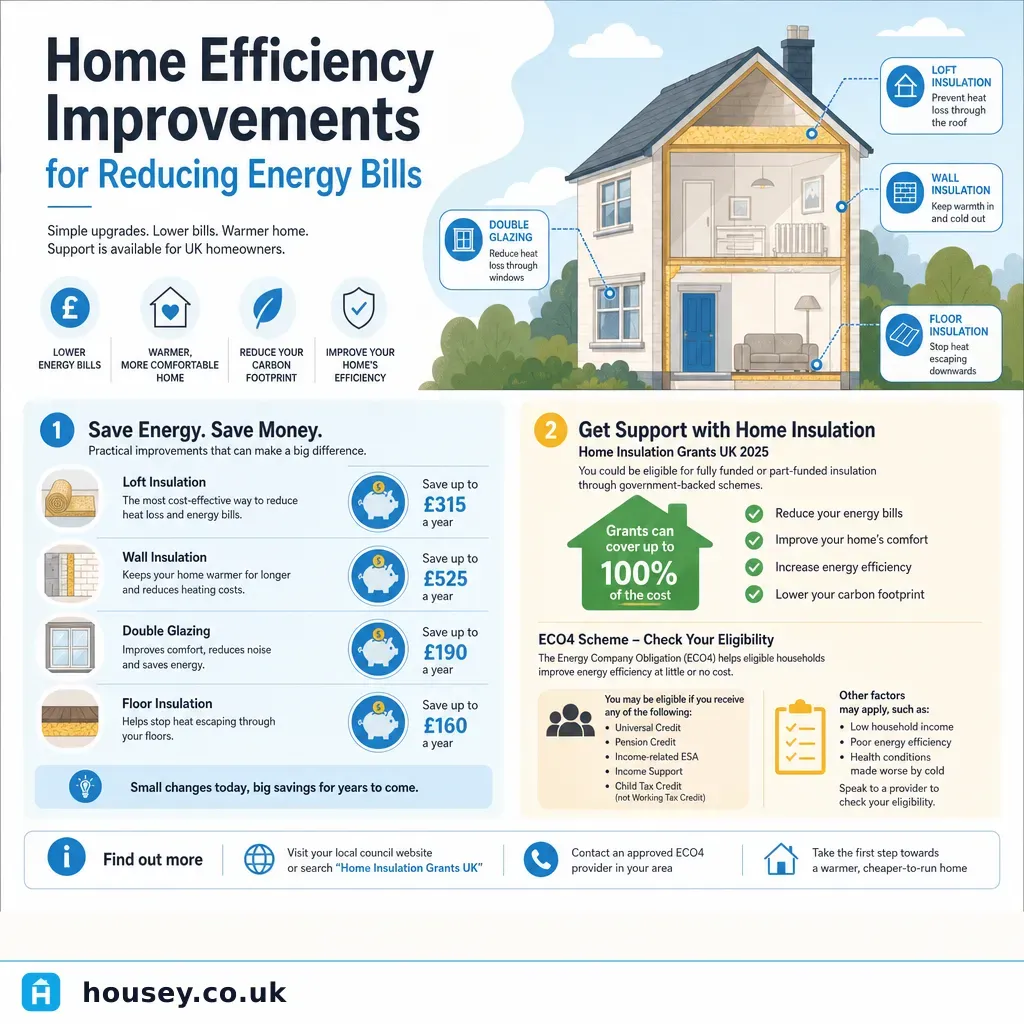
Home Efficiency Improvements for Reducing Energy Bills
The most cost-effective UK home efficiency improvements are usually loft insulation, cavity wall insulation, draught-proofing, and upgrading heating controls.
 Energy & Retrofit
Solar Energy Integration in Below-Ground Structures: Design and Feasibility
Below-ground structures cannot host solar panels on their own roofs but can use surface-mounted panels connected via cable runs, solar light tubes for daylighting, and battery storage.
 Energy & Retrofit
Climate-Ready Home Improvements for the Future
Climate-ready home improvements tackle four main risks for UK properties: overheating, increased rainfall and flooding, storm damage, and energy cost volatility.