Safe Tree Trimming Near Overhead Power Lines
By Housey · Last reviewed 11th of May 2026
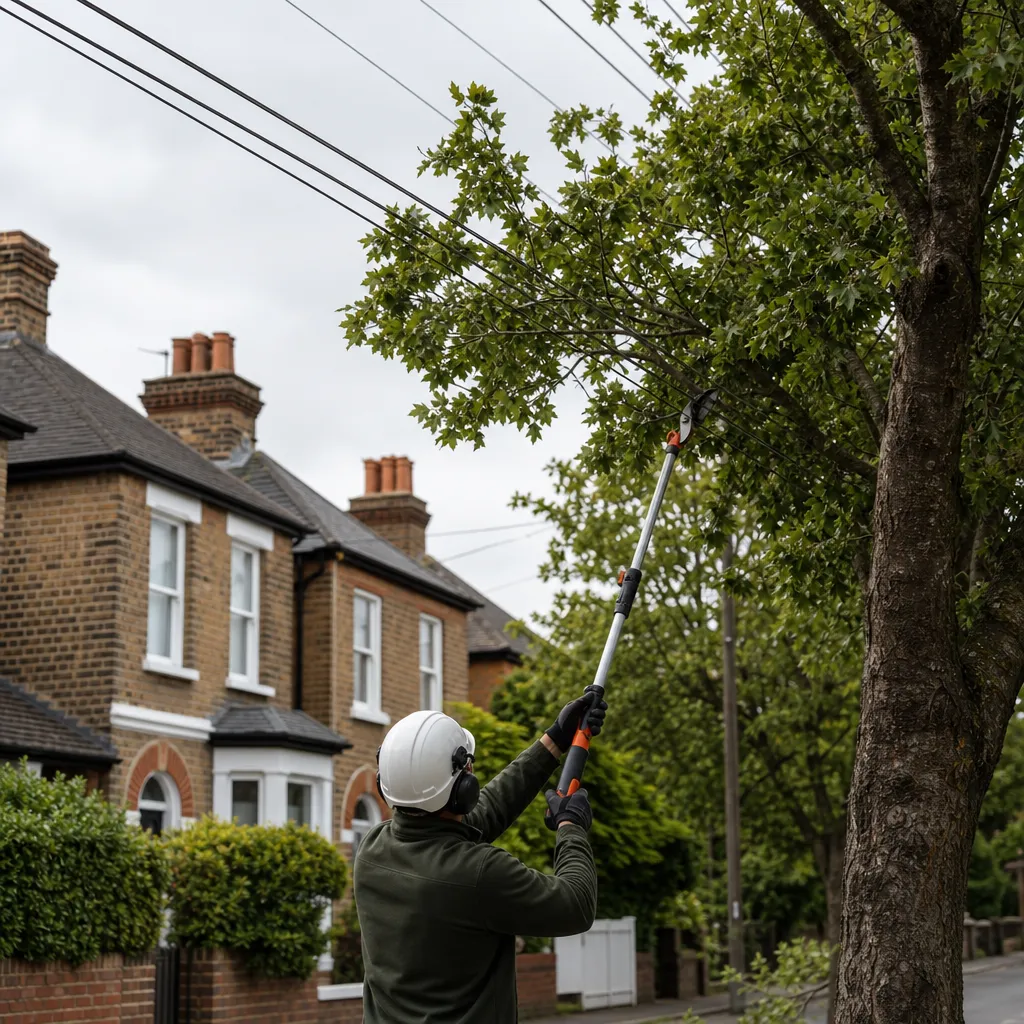
Safe Tree Trimming Near Overhead Power Lines
For many UK homeowners, the discovery that a garden tree has grown close to — or is brushing against — an overhead power line often arrives without warning: during a storm, a routine garden tidy, or a surveyor's visit. The combination of live electrical infrastructure and unmanaged vegetation creates risks that are not visible at a glance and cannot be managed with domestic tools or standard gardening knowledge. Understanding who bears legal responsibility, when to contact your Distribution Network Operator (DNO), and why this must always involve specialist contractors is essential before any trimming begins.
Key points
- Overhead distribution lines in the UK are owned and maintained by regional Distribution Network Operators (DNOs) such as UK Power Networks, Northern Powergrid, SP Energy Networks, and National Grid Electricity Distribution — find your DNO via the Energy Networks Association using your postcode.
- Landowners have a legal duty under the Electricity Act 1989 to notify their DNO if trees on their land threaten to interfere with overhead lines.
- HSE guidance (GS6) states that unqualified persons must not approach within 3 metres of a low-voltage overhead line or within 9 metres of a high-voltage line.
- Many DNOs operate vegetation management programmes and will carry out or fund clearance near their lines — always contact your DNO before paying a contractor.
- Calling 105 connects you to the UK-wide power emergency line, available 24 hours a day, for urgent situations including trees touching or bringing down lines.
Who is responsible for trees near power lines?
UK overhead power lines fall into two broad categories:
- Low-voltage distribution lines (up to 11 kV) — the lines most commonly found in domestic gardens, running between wooden poles along rear boundaries or across fields. Operated by the regional DNO.
- High-voltage distribution and sub-transmission lines (33 kV and above) — larger lines on taller poles or steel pylons. Domestic garden proximity is less common, but the risk is substantially higher.
The DNO owns and maintains the lines. The landowner is responsible for trees on their land and must prevent those trees from interfering with lines under the Electricity Act 1989. In practice, many DNOs inspect their networks proactively and contact homeowners when vegetation poses a risk. You can also contact your DNO pre-emptively — this is usually the simplest and potentially cheapest first step.
Where a tree on a neighbouring property is the source of encroachment, the DNO retains statutory powers under the Electricity Act 1989 to arrange clearance regardless of land ownership. Contact your DNO to report the situation.
Why this work must never be DIY
Many distribution lines in the UK are not fully insulated. The outer covering on distribution conductors is a weather-resistant coating, not true electrical insulation. A wet branch, a rope, a ladder, or a chainsaw bar making contact with a conductor can complete a circuit with potentially fatal consequences — even at low voltage.
Specific dangers include:
- Flashover: high-voltage conductors can arc electricity through air without direct contact, particularly in wet or humid conditions.
- Step potential: if a line faults and current enters the ground, a person standing nearby can become part of the circuit without touching the cable directly.
- Hidden conductors: dense growth can completely obscure lines within a canopy. Never assume a line is absent without professional verification.
- Rope and pole contact: attempting to guide a falling branch with a rope or pole is a common instinct that is extremely dangerous near live lines.
HSE guidance (GS6: Avoidance of danger from overhead electric lines) is explicit: no unqualified person should work within the stated distances. Consumer-grade rubber gloves and non-conductive tools do not provide adequate protection at distribution voltages.
Red flags: situations requiring immediate action
Do not approach the tree, and keep all others away from the area, if you observe any of the following:
- A branch or trunk is in direct contact with an overhead line.
- An overhead line appears to be sagging lower than normal due to branch weight.
- You can hear buzzing, crackling, or popping near a line.
- You can see scorch marks, blackening, or charring on bark adjacent to a line.
- A line has fallen or appears to have moved into the canopy after a storm.
- There is smoke, sparking, or visible damage to the conductor near the tree.
In any of these situations: call 105 (UK power emergency line) or your DNO's 24-hour emergency number immediately. Do not attempt to cut the tree, use any tool near the line, or allow anyone to stand beneath or near the contact point.
Choosing the right contractor
Not all tree surgeons are qualified or insured for work near live overhead lines. Key qualifications and accreditations to look for:
Qualification / accreditation | What it indicates |
|---|---|
NPTC / City & Guilds CS30, CS31 (chainsaw units) | Basic arboricultural competence; required for chainsaw use |
NPTC / City & Guilds PA6 (aerial tree work) | Qualified for climbing and working at height in trees |
IPAF licence (category 3a/3b) | Authorised for mobile elevated work platforms |
Utility-proximity safety training (HSE GS6 compliant) | Specific to working near live overhead electric lines |
Arboricultural Association Approved Contractor | Assessed for quality, insurance, and standards; useful baseline |
Public liability insurance covering utility-proximity work | Essential — verify the policy explicitly covers live infrastructure |
Some DNOs maintain approved or preferred contractor lists for vegetation management near their networks. Ask your DNO whether they can recommend a vetted contractor, particularly if the situation may require temporary line isolation before work can proceed.
Important limitations
This article provides general guidance on the hazards and responsibilities associated with trees near overhead power lines in England, Scotland, and Wales. Specific network configurations, voltages, ownership arrangements, and DNO vegetation management policies vary by region and operator. The safe approach distances quoted reflect HSE GS6 guidance for typical distribution scenarios and are not a substitute for a site-specific risk assessment by a qualified professional. Northern Ireland is served by NIE Networks under separate regulatory arrangements. Do not rely solely on this guide when planning or assessing work — always contact your DNO and instruct a qualified arborist to inspect the site in person.
When this becomes urgent
Treat the situation as a power emergency requiring immediate action if:
- Any part of a tree is already touching a live overhead line.
- A line has come down or appears physically damaged.
- There is any risk of imminent contact — for example, high winds forecast, visible lean towards a line, or recent ice or snow loading.
- You can see sparks, smoke, or fire anywhere near the line.
Call 105 or your DNO's 24-hour emergency number. Do not enter the area around the tree. Keep children and animals well away until the DNO confirms the situation is safe.
What to ask a qualified professional
Before instructing a tree surgeon for work near overhead lines:
- Have you carried out tree work near live overhead distribution lines, and how recently?
- What utility-proximity safety training do you hold — is it current and HSE GS6 compliant?
- Will you conduct a formal written risk assessment and method statement before work starts?
- Will you contact the DNO to discuss safe working distances or any requirement for line isolation?
- What is the procedure if the line needs to be de-energised — can you manage that liaison, and what is the likely timescale?
- Does your public liability insurance specifically cover work near live overhead electrical infrastructure?
- Will I receive a written record or completion certificate for the work carried out?
- Is the tree subject to a Tree Preservation Order (TPO) or in a conservation area — and if so, have you submitted the required local planning authority notification?
When to get professional help
Always instruct a qualified arborist before any cutting begins near an overhead line — including simply to assess the situation and confirm what lines are present. Additional reasons to involve a professional promptly:
- The tree has a Tree Preservation Order (TPO) or is in a conservation area, requiring local planning authority notification or consent before works.
- The tree sits on a boundary where ownership or permitted cutting extent is unclear.
- Root systems may affect buried cables or drainage.
- A surveyor or mortgage lender has flagged the tree as a concern on a property transaction.
How Housey can help
Housey connects homeowners with qualified tree surgeons experienced in managing vegetation close to overhead infrastructure. Submit a job request and receive quotes from vetted local arborists who can carry out a safe site assessment, manage DNO liaison, and hold the appropriate insurance for this specialist work.
Frequently asked questions
Who do I call if a tree is touching a power line in the UK?
Call 105 — the UK-wide electricity emergency number — or contact your regional DNO directly. Do not approach the tree or attempt to remove the branch yourself. The DNO can make the situation safe and advise on next steps, including any required vegetation management.
Can I trim a tree near a power line myself?
No. HSE guidance (GS6) states that unqualified persons should not work within 3 metres of low-voltage overhead lines or 9 metres of high-voltage lines. This applies regardless of the tools used. Always instruct a qualified arborist with specific utility-proximity safety training and appropriate public liability insurance.
Is the homeowner responsible for trees near power lines?
Yes, in general. Landowners have a duty under the Electricity Act 1989 to prevent trees on their land from interfering with overhead power lines. However, many DNOs proactively manage vegetation near their networks and may carry out or fund clearance — contact your local DNO before instructing a contractor.
Will my DNO pay for tree trimming near their power lines?
Some DNOs will carry out vegetation clearance near their infrastructure at their own expense where the risk to the network is significant. Contact your regional DNO's vegetation management team to discuss your specific situation. This varies by operator and the immediacy of the risk to the network.
Do I need planning permission to trim a tree near a power line?
If the tree has a Tree Preservation Order (TPO) or is in a conservation area, you must notify your local planning authority before works proceed — emergency works may be an exception in some circumstances. Your tree surgeon should check TPO status as part of their site assessment before any cutting begins.
Sources and further reading
- HSE GS6: Avoidance of danger from overhead electric power lines — Health and Safety Executive
- Electricity Act 1989 — legislation.gov.uk
- Electricity at Work Regulations 1989 — legislation.gov.uk
- Energy Networks Association: find your network operator — Energy Networks Association
- Arboricultural Association: find a tree surgeon — Arboricultural Association
Useful next reads
 Improvement & Build
Watering Large Trees: Techniques and Frequency for Establishment
Newly planted large trees typically need 50–90 litres of water per week during the growing season for the first two to three years.
 Improvement & Build
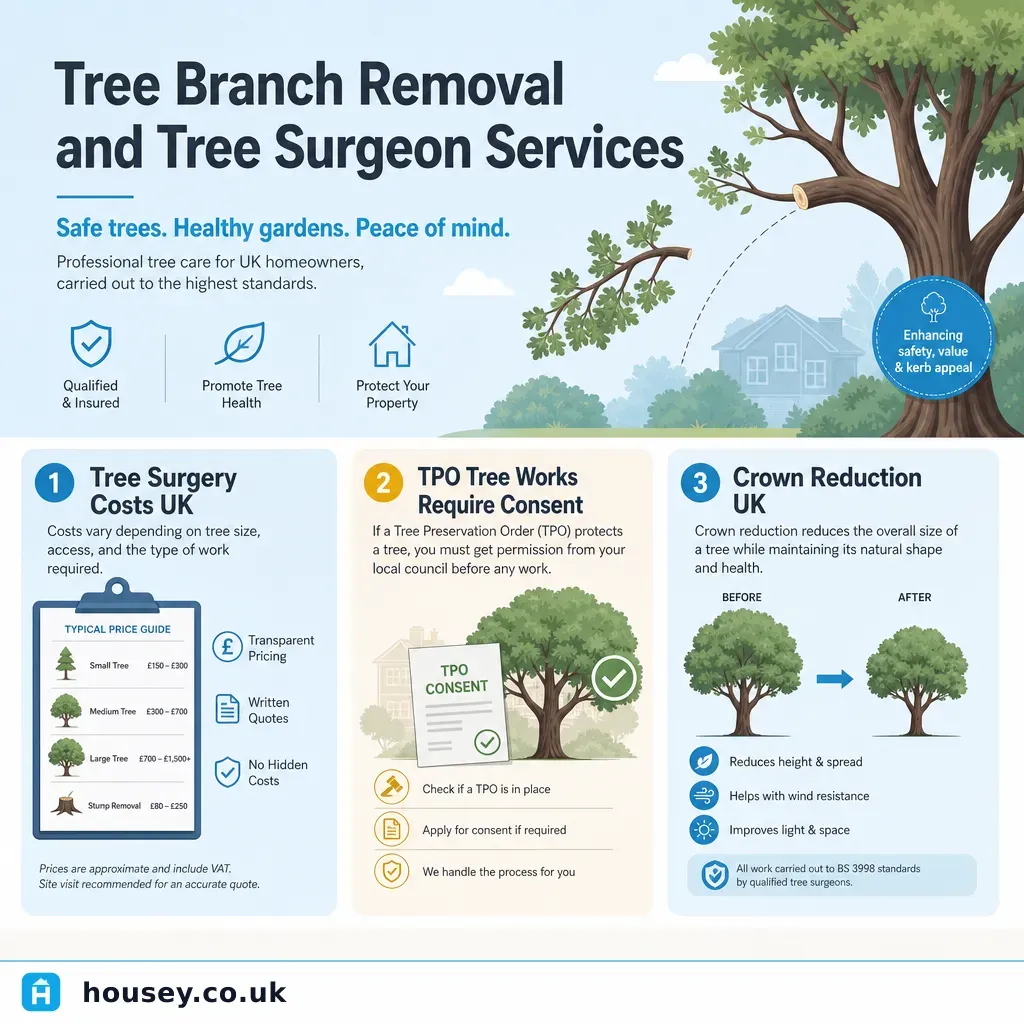
Tree Branch Removal and Tree Surgeon Services
Tree surgery — from deadwooding and crown reduction to branch removal and felling — must be carried out by qualified, insured contractors in the UK.
 Improvement & Build
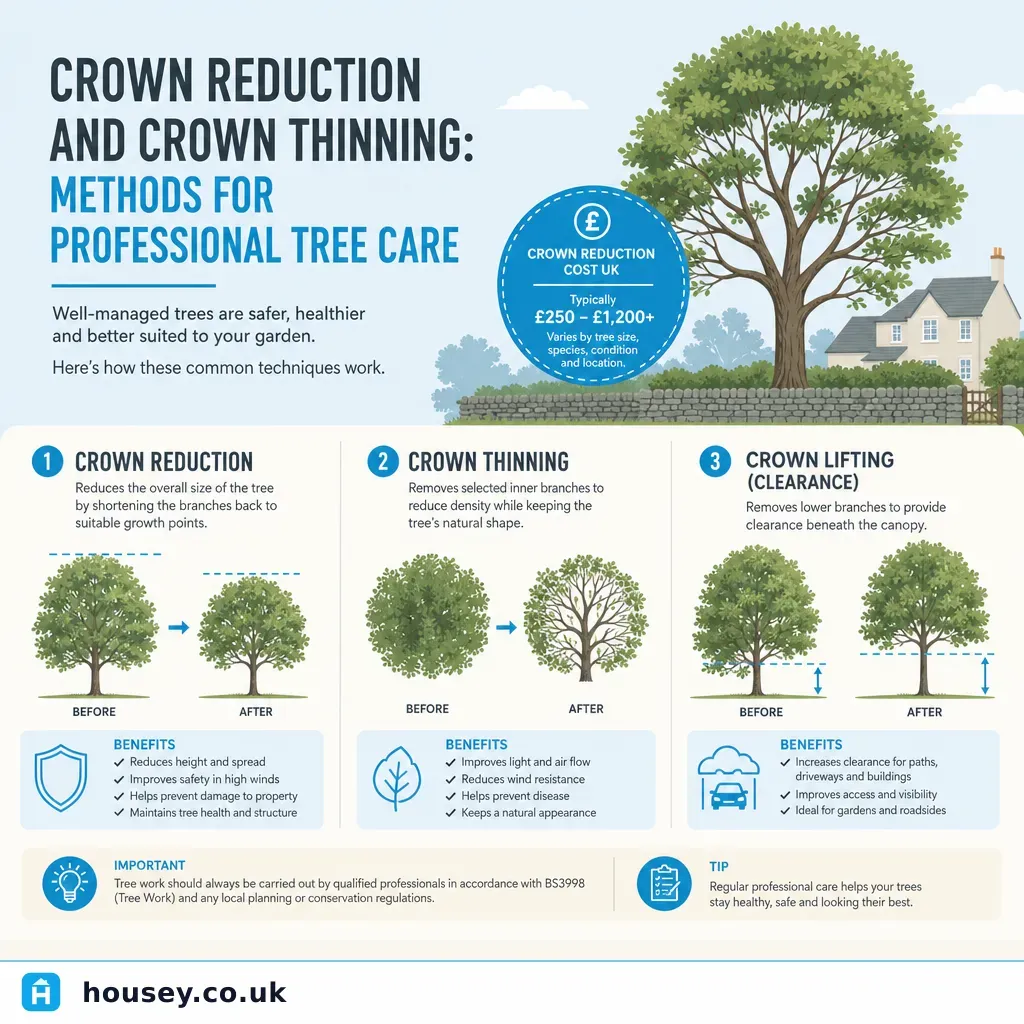
Crown Reduction and Crown Thinning: Methods for Professional Tree Care
Crown reduction cuts the canopy back to lateral growth points, reducing overall height or spread.
 Improvement & Build
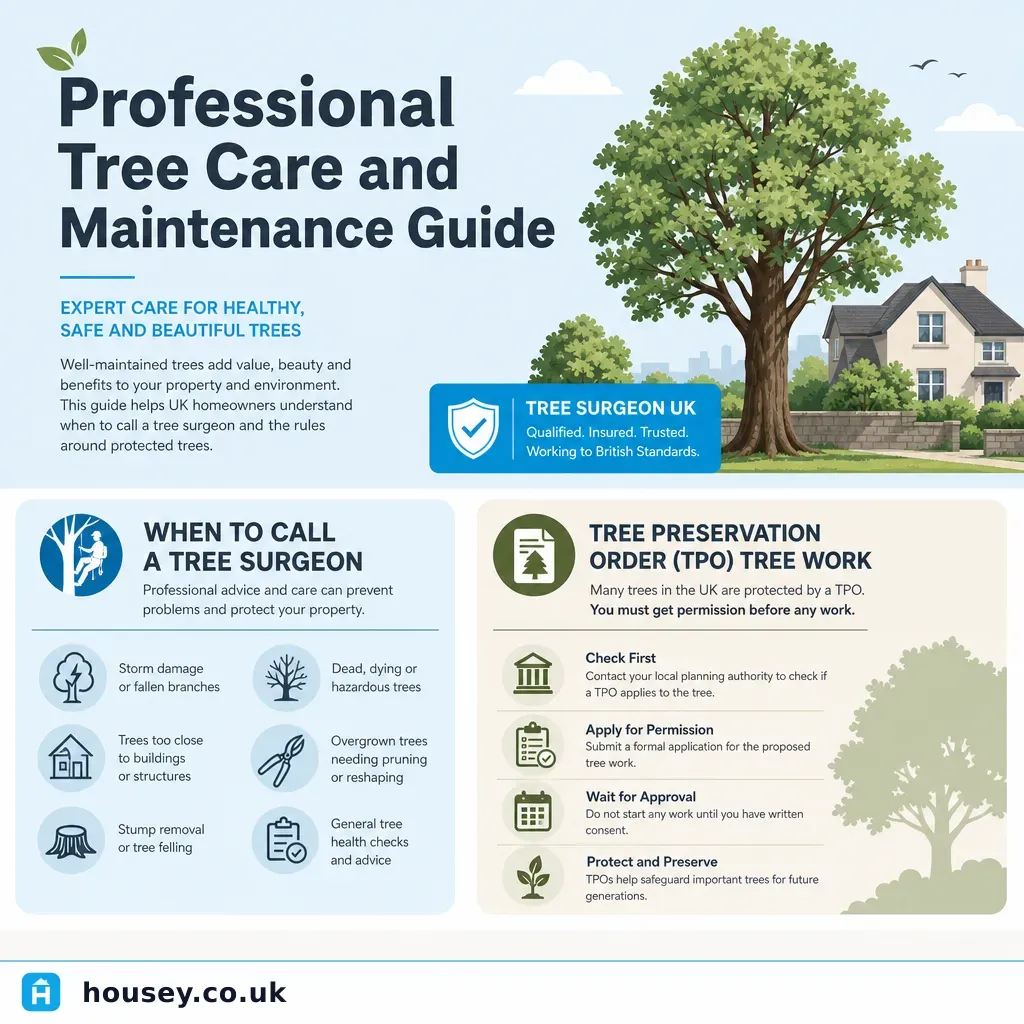
Professional Tree Care and Maintenance Guide
Professional tree care covers pruning, crown reduction, felling, and health assessments carried out by qualified arborists.
 Improvement & Build
Removing Bird Nests Safely: Professional and Humane Approaches
In the UK, removing a bird nest while it is in use or being built is a criminal offence under Section 1 of the Wildlife and Countryside Act 1981.