Safety During Home Repairs: Best Practices and Precautions
By Housey · Last reviewed 19th of May 2026
Safety During Home Repairs: Best Practices and Precautions
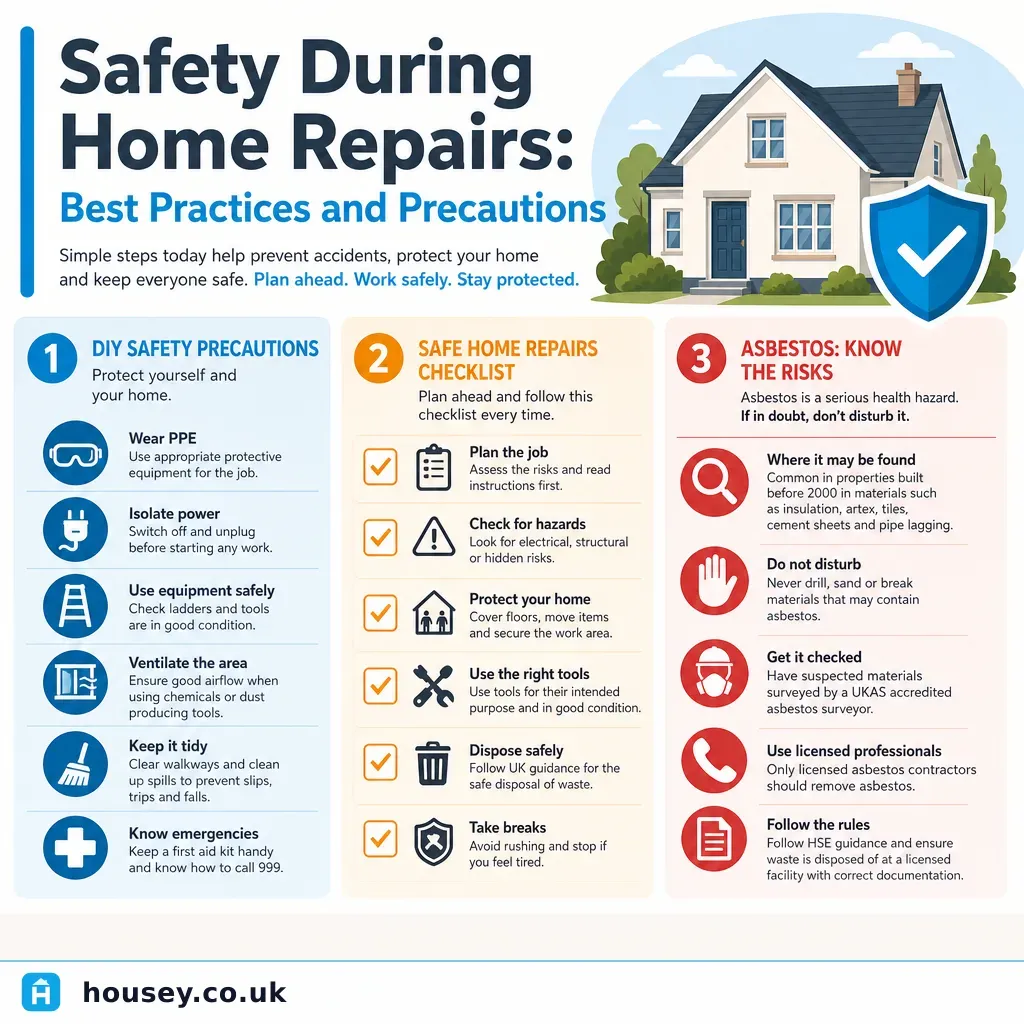
Home repair work in the UK — from fixing a leaking tap to replastering a ceiling or replacing floorboards — spans a wide spectrum of risk. Most tasks are manageable with the right approach, but a significant number involve hidden hazards that cause thousands of serious injuries each year. The Health and Safety Executive (HSE) identifies falls from height as the leading cause of serious DIY injury, while undetected asbestos, exposed electrical wiring, and gas incidents account for the most severe outcomes. Knowing which precautions apply — and when to stop and call a qualified professional — is the most practical knowledge a homeowner can have before starting any repair.
Key points
- Falls from height are the most common cause of serious DIY injury in the UK; the HSE advises that work above 2 m requires proper scaffold or access equipment, not a domestic ladder alone.
- Asbestos-containing materials (ACMs) were widely used in UK buildings constructed or refurbished before 2000; disturbing them without appropriate controls is a criminal offence under the Control of Asbestos Regulations 2012.
- Gas work must only be carried out by a Gas Safe Register-registered engineer; carrying out work on gas fittings without registration is illegal under the Gas Safety (Installation and Use) Regulations 1998.
- Electrical work affecting the fabric of a property — new circuits, consumer unit work, work in kitchens or bathrooms — must be notified under Part P of the Building Regulations and carried out by a registered competent person.
- Building control notification is required for structural alterations, loft conversions, and extensions; skipping this creates complications when selling or remortgaging.
Which repairs require a professional?
Not all home repairs carry the same risk profile. Some work is suitable for a careful homeowner; a significant amount is restricted by law or carries hazards that make professional involvement the only appropriate course.
Repair type | DIY permissible? | Regulatory requirement | Professional to use |
|---|---|---|---|
Painting and decorating | Yes | None | None required |
Minor plumbing (tap washers, like-for-like fixtures outside kitchens and bathrooms) | Usually | None for like-for-like | Plumber for complex work |
Electrical (replacing like-for-like accessories in dry rooms) | Limited | Part P notification for new circuits and kitchen/bathroom work | NICEIC or NAPIT-registered electrician |
Gas appliance work (boilers, gas fires, gas hobs) | No — illegal | Gas Safety (Installation and Use) Regulations 1998 | Gas Safe Register-registered engineer |
Structural alterations (removing walls, inserting beams) | Not without professional design | Building Regulations approval required | Structural engineer + building control |
Roof repairs above 2 m | Not without proper access equipment | Working at Height Regulations 2005 | NFRC-registered roofer |
Intrusive work in pre-2000 properties (drilling, cutting, removing boards or ceiling tiles) | Not without asbestos survey first | Control of Asbestos Regulations 2012 | UKAS-accredited asbestos surveyor or licensed contractor |
Working at height: what the regulations say
The Working at Height Regulations 2005 apply wherever a person could be injured from a fall, including domestic settings when tradespeople are at work. For homeowners carrying out DIY above 2 m, the HSE advises:
- Use scaffold towers, hop-up platforms, or hired scaffolding rather than a household ladder for anything more than brief, stable work.
- A ladder is only appropriate for short-duration tasks where both hands are not needed continuously.
- Never work on a pitched roof surface without fall-arrest equipment or edge protection.
- Overreaching, working on wet or icy surfaces, and using improvised platforms cause the majority of at-height incidents.
If you are hiring a tradesperson for roof, gutter, or chimney work, ask specifically what access equipment they will use and how they will provide edge protection before work starts.
Asbestos: the hidden risk in pre-2000 homes
Asbestos was widely used in UK buildings until its full ban in 1999. It is commonly found in: artex and textured coatings, vinyl floor tiles, ceiling tiles, pipe lagging, soffit boards, corrugated garage roofs, and certain composite board products. Inhaled asbestos fibres cause mesothelioma and asbestosis — serious diseases with no cure.
If your property was built or refurbished before 2000 and you are planning to drill, cut, sand, or remove materials that could contain asbestos:
- Stop work.
- Arrange an asbestos survey by a UKAS (United Kingdom Accreditation Service)-accredited surveyor — a management survey to identify materials in situ, or a refurbishment/demolition survey before intrusive work begins.
- If ACMs are confirmed and need removal, a licensed contractor must carry out the work under the Control of Asbestos Regulations 2012.
Do not rely on visual identification alone. Artex looks identical whether or not it contains chrysotile asbestos fibres. Only laboratory analysis of a sample taken by a competent person can confirm the presence or absence of ACMs.
Electrical safety: what you can and cannot do yourself
Part P of the Building Regulations 2010 defines the boundary for DIY electrical work in UK homes:
- Generally permitted without notification: replacing like-for-like accessories (sockets, switches) outside kitchens and bathrooms.
- Must be notified to building control or carried out by a registered competent person: any work in kitchens or bathrooms, installing new circuits, work near a swimming pool, altering or replacing a consumer unit.
The practical guidance: unless you hold a relevant electrical qualification, limit DIY to replacing like-for-like fittings in dry rooms only. For anything more complex, use an NICEIC or NAPIT-registered electrician who can self-certify the work and issue a completion certificate. Always isolate the circuit at the consumer unit and confirm isolation with a voltage tester before touching any electrical fitting.
Important limitations
This article provides general information on home repair safety in the UK. Rules, regulations, and risk levels vary significantly depending on property type, age, construction method, and local authority requirements. Nothing in this article constitutes professional safety, legal, or engineering advice. A qualified professional should assess your specific situation before any work involving gas, electrical systems, structural elements, asbestos, or working at height. Regulations are updated periodically — always check GOV.UK and the relevant professional body for current requirements.
When this becomes urgent
Stop work and seek immediate professional advice if:
- You have found or disturbed a material you suspect may contain asbestos.
- You can smell gas or suspect a gas leak — leave the building immediately, do not operate any switches, and call the National Gas Emergency Service on 0800 111 999.
- You have exposed live electrical wiring or an RCD (residual current device) has tripped and will not reset.
- A structural element has moved, cracked, or made unexpected sounds during work.
- Water is actively entering the building through a roof or external wall breach following a repair.
- Any person has been injured or is at immediate risk of falling.
What to ask a qualified professional
Before instructing any professional for hazardous repair work:
- Are you registered with the relevant professional body? (Gas Safe for gas work; NICEIC or NAPIT for electrical; UKAS-accredited for asbestos surveying; NFRC for roofing.)
- What qualifications do your operatives hold, and can you provide documentary evidence?
- Will you issue a completion certificate or test certificate on completion of the work?
- Do you carry public liability insurance, and what is the coverage limit?
- Will building control notification be required for this work, and will you handle the submission?
- What is your process if you discover additional hazards — such as asbestos — once work has started?
- What does your quote explicitly include and exclude?
When to get professional help
Beyond regulated work categories, consider calling a professional when:
- You are uncertain what a material is made of in a pre-2000 property.
- The repair requires sustained work at height beyond a brief, stable ladder task.
- The scope of a repair appears to be growing — a damp patch that has spread, or a crack that is widening.
- You do not have appropriate PPE (personal protective equipment) or specialist tools for the job.
- A previous DIY attempt has made the situation worse or revealed a larger underlying problem.
How Housey can help
If your repair work requires Building Regulations approval or building control notification, building control consultants on the Housey platform can advise on what submissions are required and manage the process on your behalf — helping ensure your works are compliant from the outset and avoiding complications when you come to sell or remortgage.
Frequently asked questions
What home repairs can I legally carry out myself in the UK?
Decorating, minor plumbing (like-for-like fixtures outside kitchens and bathrooms), and replacing like-for-like electrical accessories in dry rooms are generally permissible. Gas work, structural alterations, work in asbestos-risk areas, and most electrical work in kitchens and bathrooms must be carried out by registered professionals under the relevant regulations.
What happens if I carry out electrical work without notifying building control?
Unnotified electrical work will not have a completion certificate. This creates problems when selling — solicitors will ask for certificates, and mortgage lenders may require the work to be inspected or redone at your cost. In serious cases, unnotified work can also affect home insurance validity.
How do I know if my home contains asbestos?
Any property built or refurbished before 2000 may contain asbestos-containing materials. The only reliable method to confirm or rule this out is an asbestos survey by a UKAS-accredited surveyor. Visual inspection alone is insufficient — the same material can look identical with or without asbestos content.
Is a domestic ladder safe for roof repairs?
For very brief, stable tasks such as clearing a gutter from a properly footed ladder, a ladder may be acceptable. For any work requiring movement on or near a roof pitch, sustained periods above 2 m, or tasks where both hands are needed, proper scaffolding or access equipment is required under the Working at Height Regulations 2005.
Sources and further reading
- Working at Height Regulations 2005 — Health and Safety Executive
- Control of Asbestos Regulations 2012 — Health and Safety Executive
- Gas Safety (Installation and Use) Regulations 1998 — Gas Safe Register
- Part P: Electrical Safety in Dwellings — GOV.UK
- DIY electrical work guidance for homeowners — Electrical Safety First
Useful next reads
 Improvement & Build
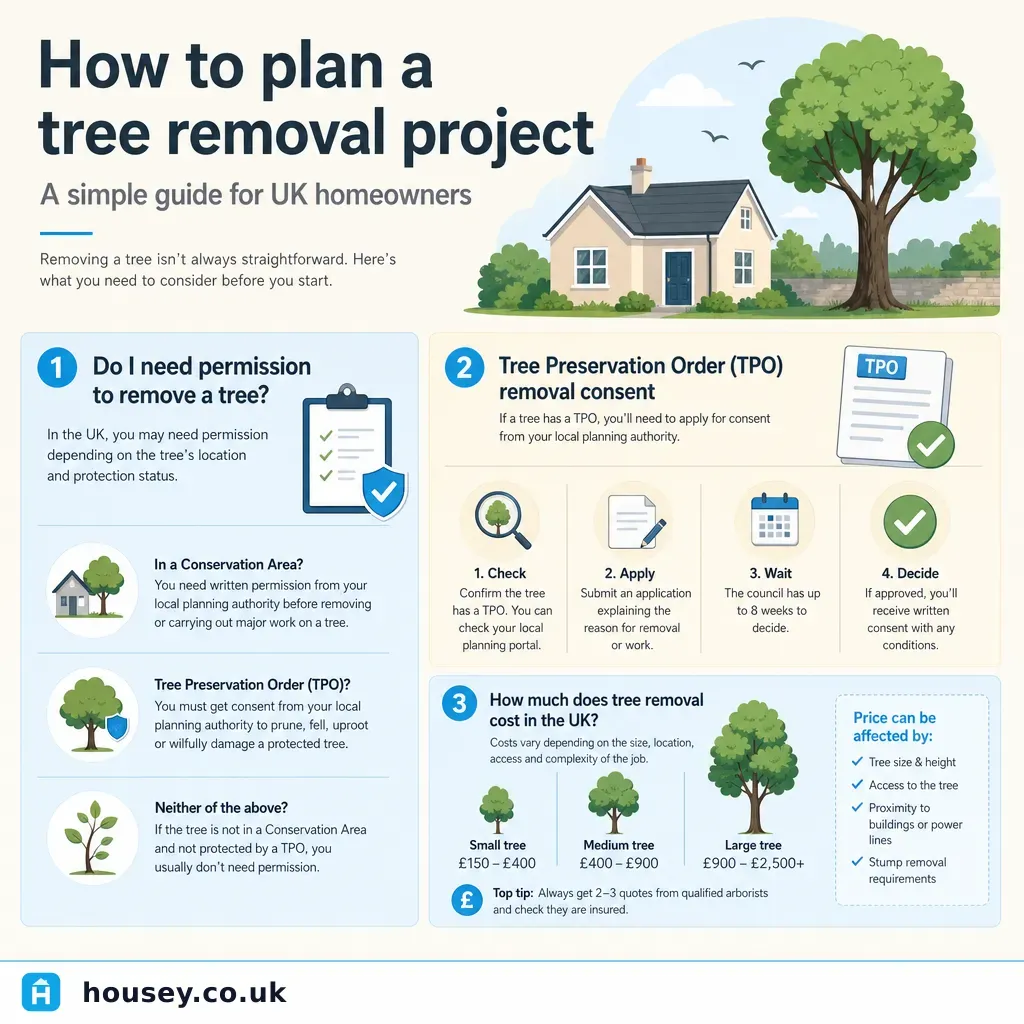
How to plan a tree removal project
Planning a tree removal project starts with checking whether the tree is protected by a Tree Preservation Order or sits in a conservation area, as both require council consent before any work begins.
 Improvement & Build
Cost of Installing Security Film on Windows
Security film for windows in the UK typically costs £25–£60 per m² for supply and professional installation, depending on film specification and window count.
 Improvement & Build
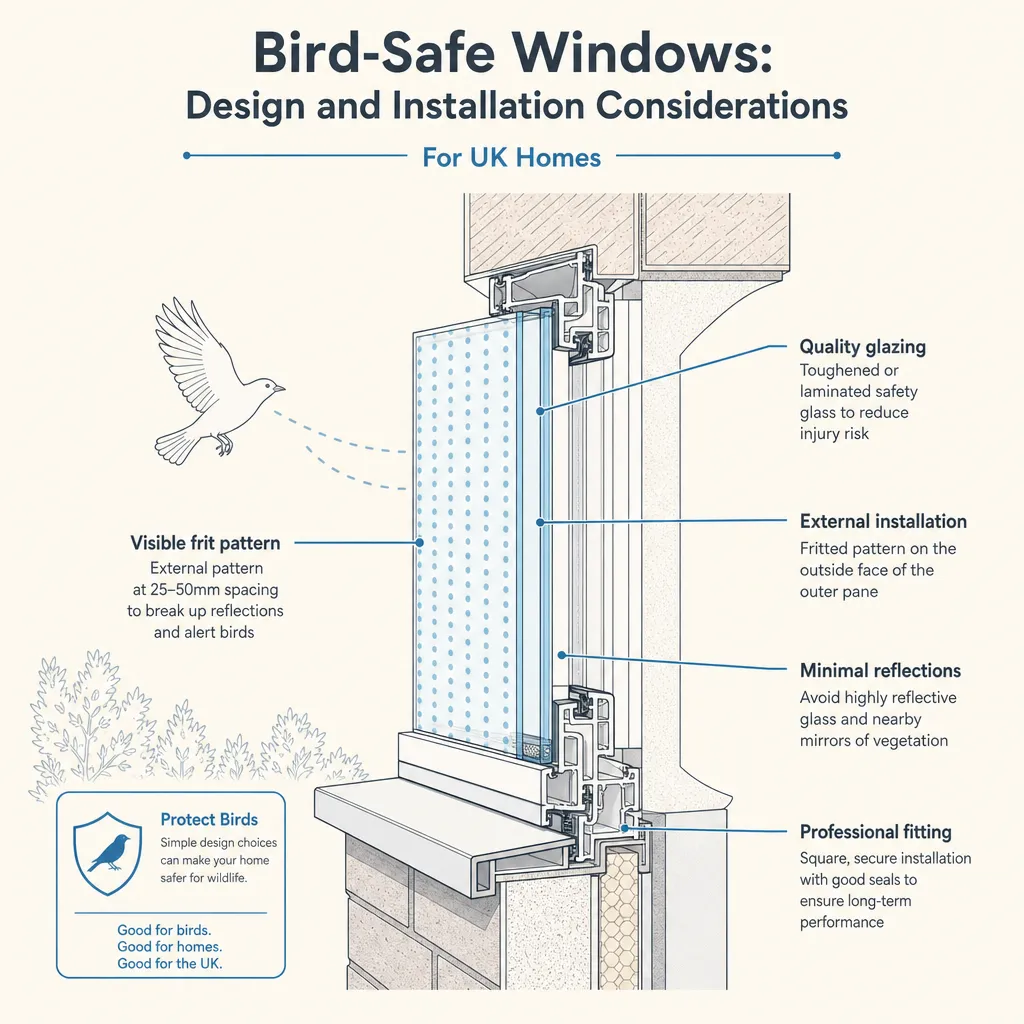
Bird-Safe Windows: Design and Installation Considerations
Bird-safe windows use patterns, coatings, or films on the exterior glazing surface to make glass visible to birds in flight.
 Improvement & Build
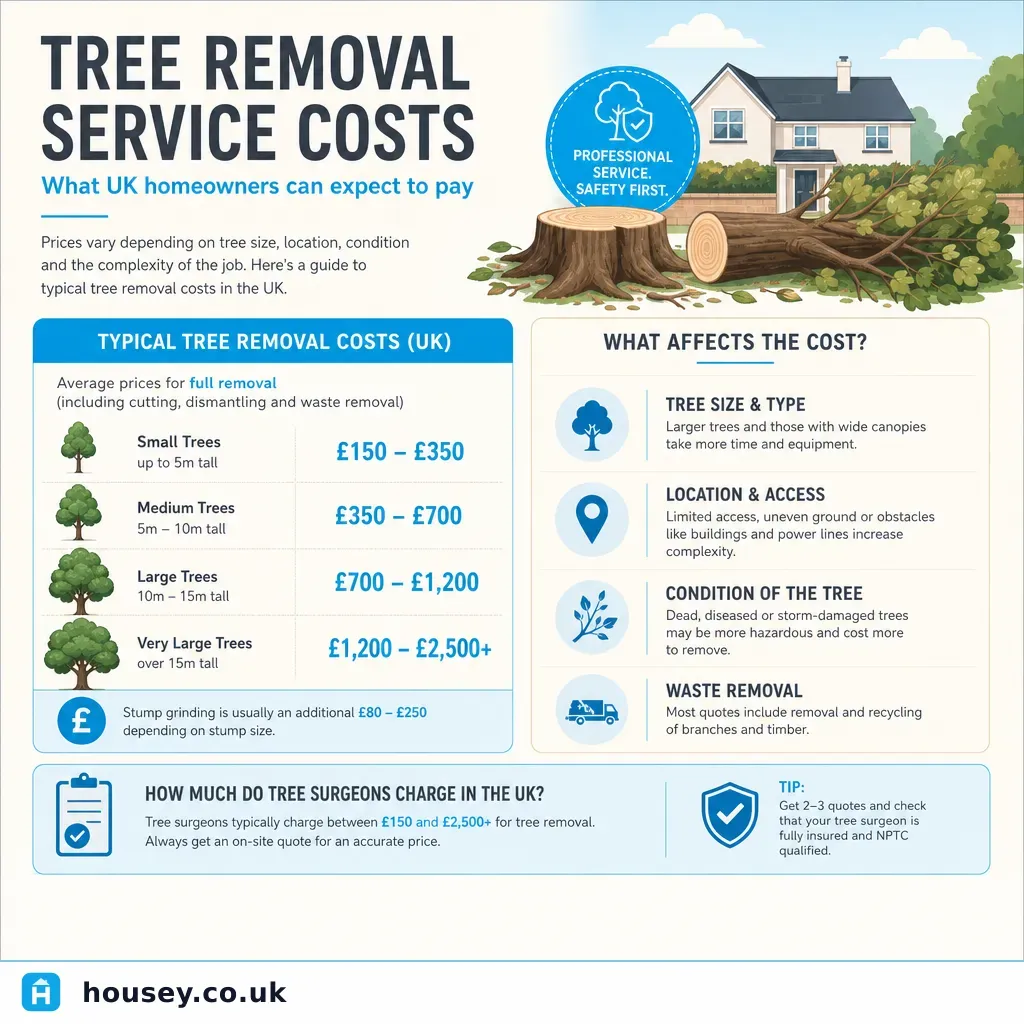
Tree Removal Service Costs
Professional tree removal costs in the UK depend on tree height, access, species, and the scope of work included.
 Improvement & Build
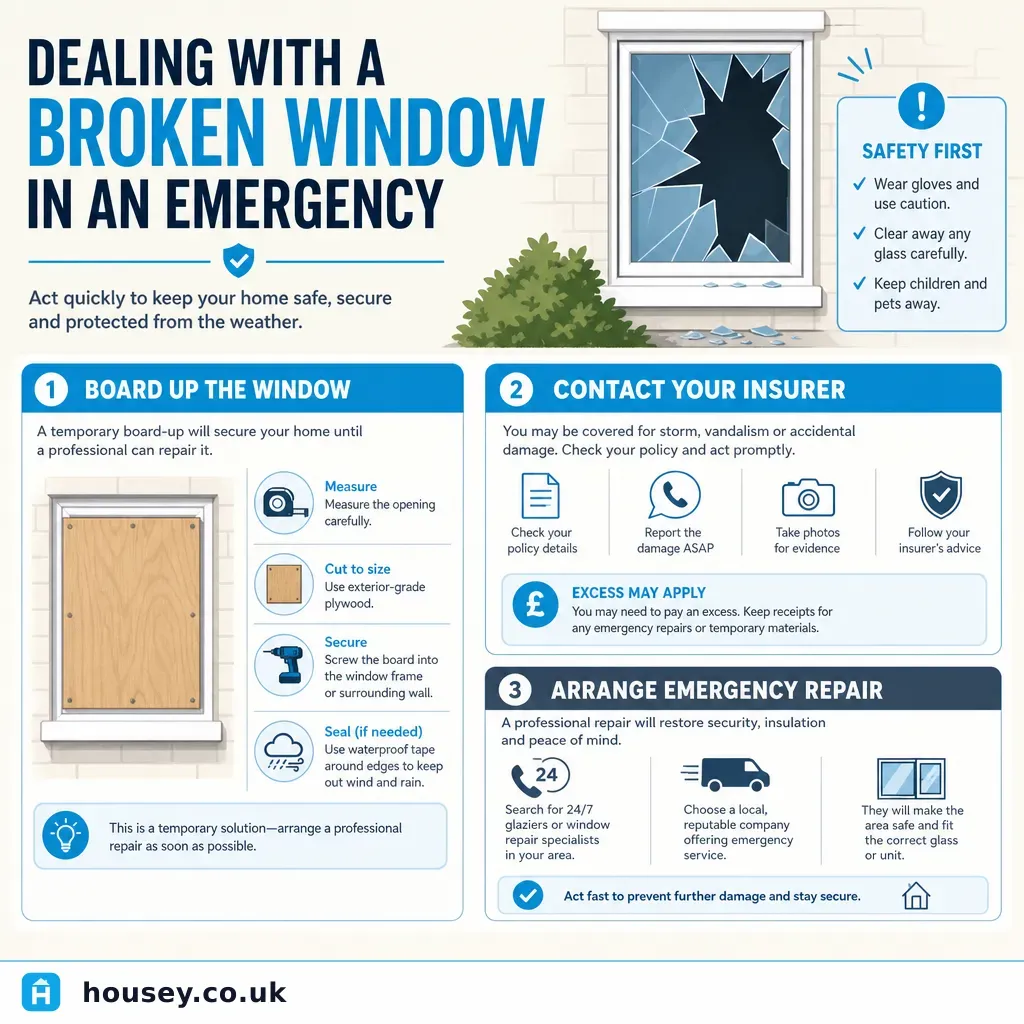
Dealing with a broken window in an emergency
If a window breaks, your priority is clearing loose glass safely while wearing thick gloves, then sealing the opening with heavy-duty polythene or plywood before contacting your insurer.