Sectional Garage Door Installation and Replacement
By Housey · Last reviewed 10th of May 2026
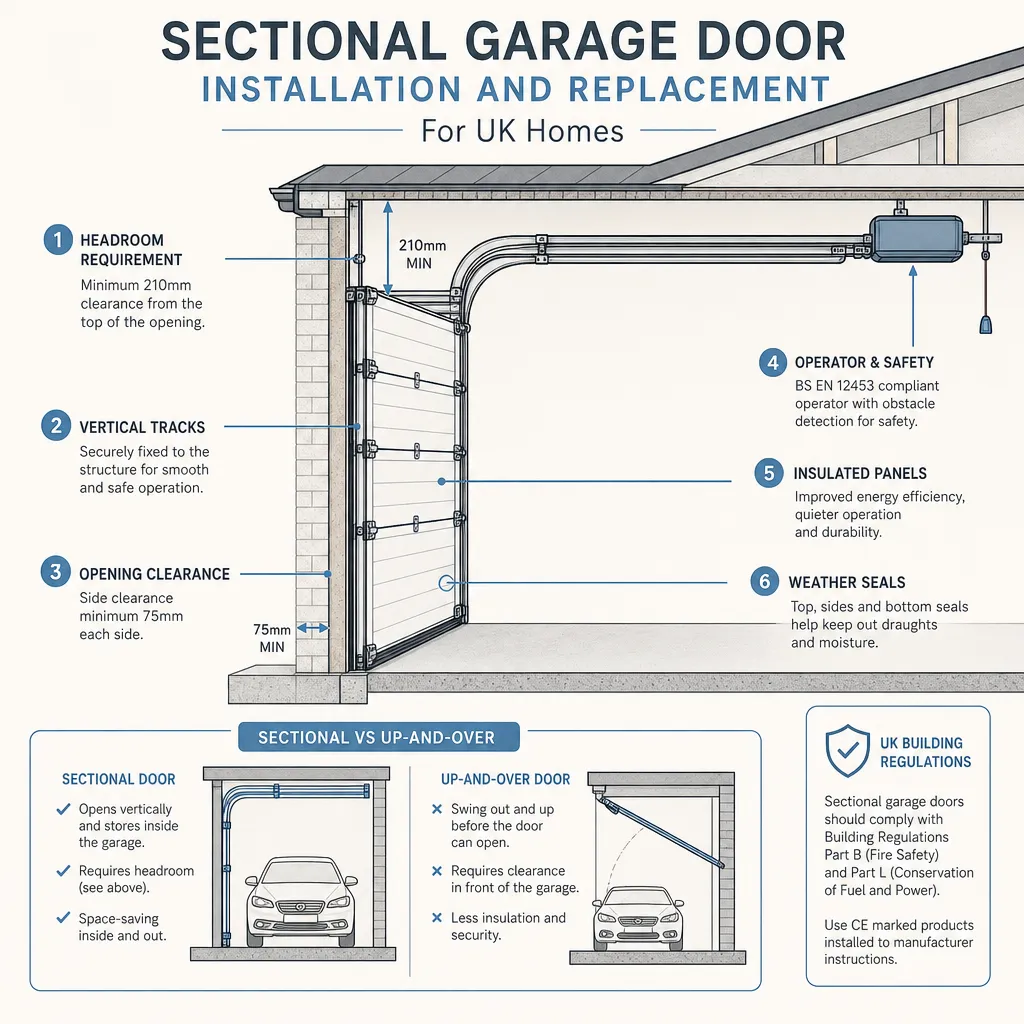
Sectional Garage Door Installation and Replacement
Sectional garage doors tend to come up when a homeowner is replacing an ageing up-and-over panel that jams in cold weather, building a new garage alongside an extension, or converting a double garage where the available forecourt depth is limited. The choice of door system affects how much driveway space is needed to operate it, how well the garage can be insulated, and whether automation is practical — decisions that are worth getting right before a door is ordered.
Key points
- Sectional doors require a headroom clearance of 220–300 mm above the door opening to accommodate the overhead tracking; confirm available headroom before specifying.
- Building Regulations Part L applies to garage doors where the garage is attached to and thermally connected to the dwelling — the door assembly must typically achieve a U-value of 1.6 W/m²K or better.
- Planning permission is generally not required to replace a garage door like-for-like, but a materially different appearance in a conservation area or a listed building may require consent.
- Automated sectional doors must include a safety reversal mechanism and a manual override as required under the Supply of Machinery (Safety) Regulations 2008, which retained EU Machinery Directive requirements in UK law.
- Spring mechanism warranties typically cover 10,000–25,000 cycles and are a key differentiator between budget and quality installations.
How sectional garage doors work
A sectional door is made up of horizontal panels — usually four or five — joined by hinges and fitted with rollers that run in vertical tracks on either side of the opening before curving back onto horizontal ceiling tracks. When opening, the door rises vertically without swinging outward, so no forecourt space is required in front of it. This makes sectional doors particularly practical for garages set close to a boundary, road, or gate.
The door is balanced by torsion springs mounted above the opening or by extension springs running along the ceiling tracks. These springs are under significant mechanical tension and should only be adjusted or replaced by a competent installer — spring failure is one of the most common causes of mechanism damage and sudden door drop.
Garage door types compared
Door type | Opening mechanism | Forecourt space needed | Insulation potential | Automation | Best for |
|---|---|---|---|---|---|
Sectional (overhead) | Rises vertically on overhead tracks | None required | High — foam-filled panels typically 40–45 mm | Easy; motor mounts to ceiling | Limited driveways; insulated garages; new builds |
Up-and-over (canopy) | Panel swings out then rises | Up to 1.2 m in front | Moderate — single panel, limited frame seal | Can be motorised; bulkier mechanism | Simple replacement; cost-sensitive projects |
Roller (coiling) | Panel coils into drum above opening | None required | Moderate — foam-filled slats | Motor built into drum | Very limited headroom; garages not thermally connected to house |
Side-hinged | Two leaves swing outward | Requires clear side approach | Moderate | Limited automation options | Converting garage to workshop; aesthetic preference |
Indicative comparison only. Specifications and costs vary by manufacturer. Indicative UK costs, last reviewed 2026-05-10.
Which door should you choose?
- Choose a sectional door if you have at least 220 mm of headroom above the opening, want maximum insulation, and have limited forecourt depth.
- Choose a roller door if available headroom is under 220 mm and the garage is not thermally connected to the main house.
- Choose an up-and-over if budget is the primary consideration and there is adequate clear space in front of the garage.
- Choose side-hinged doors if you primarily use the garage as a workshop or store and pedestrian access is more important than vehicle access.
- Check with your local planning authority if the garage is in a conservation area, the property is listed, or the new door will materially alter the building's appearance.
- Ask a building control consultant if the garage is an integral part of a heated dwelling — thermal and fire separation requirements will apply.
Planning permission and Building Regulations
Planning permission is generally not required to replace an existing garage door with a new one of similar appearance and materials. However:
- In a conservation area, a significantly different style, colour, or material may need planning consent.
- In a listed building, listed building consent may be required for any alteration, including a new door.
- If you are building a new garage rather than replacing a door, permitted development rules apply based on size, location, and whether the property has existing extensions.
Building Regulations are more frequently relevant. If the garage is attached to the house and forms part of the heated envelope — for example, it has a connecting door into the hallway or kitchen — the new garage door must meet the thermal performance requirements of Approved Document L. The typical threshold is a U-value of 1.6 W/m²K for the door assembly; confirm against the current edition of the Approved Document and your specific situation.
Fire separation between an integral garage and the living accommodation is governed by Approved Document B. The door between the garage and the house must meet fire resistance requirements and be self-closing — replacing the external garage door does not remove this obligation, but it is worth checking the whole fire separation is in order while work is underway.
Automation and safety
Most sectional doors can be automated at the time of installation or retrofitted later with a ceiling-mounted motor unit. Key requirements for compliant automation:
- The operator must include a safety reversal mechanism that stops and reverses the door if it meets an obstruction during closing.
- A manual override is required to operate the door by hand in the event of a power failure.
- Photocell safety beams are standard on quality systems and prevent the door closing if the beam is broken by a vehicle or person.
- Operators must comply with the Supply of Machinery (Safety) Regulations 2008 (which retained the EU Machinery Directive in UK law post-Brexit).
- Smart connectivity (Wi-Fi modules for smartphone control) is widely available but adds complexity — confirm that any smart module maintains compliance with the required safety functions.
What to ask before accepting a quote
- What is the panel thickness and insulation specification — foam fill type and declared U-value?
- Will the door assembly meet Building Regulations if required for a thermally connected garage?
- What headroom is needed, and have you confirmed the available clearance on site?
- What is the warranty on the panels, the springs, and the mechanism separately?
- If automated, which operator is proposed and what safety certifications does it carry?
- Does the quote include remedial work to the frame, lintel, or track surrounds if needed?
- Is VAT included?
- Are the installers members of a relevant trade body such as the Door and Hardware Federation?
When to get professional help
Sectional door installation involves handling components under spring tension and, if automated, connection of a mains-powered operator. Both aspects should be carried out by a competent, experienced installer — not attempted as a DIY project.
If the project also involves structural work alongside the door installation, extension builders with garage experience should be engaged. Where Building Regulations apply, building control consultants can advise on what notifications and inspections are required before and during the work.
Red flags that mean get professional advice before proceeding:
- The existing lintel above the opening shows cracking, bowing, or deflection.
- You plan to widen the garage opening as part of the project — this is structural work.
- The garage is integral to the house and you are unsure whether thermal or fire separation requirements apply.
- The existing mechanism is failing repeatedly, suggesting the spring balance is incorrect for the door weight.
- The garage is in a listed building or conservation area and you have not confirmed consent requirements.
How Housey can help
Housey connects you with experienced extension builders for garage construction and structural work around openings, and with building control consultants for compliance advice on thermally connected garages and new builds. Request quotes from vetted local professionals through Housey.
Frequently asked questions
Do I need planning permission to replace a garage door?
In most cases, no. Replacing a garage door like-for-like is generally permitted development. However, a significantly different appearance — particularly in a conservation area or a listed building — may require planning permission or listed building consent. Always check with your local planning authority if the property is in a sensitive location or if the replacement materially changes the building's appearance.
What headroom do I need for a sectional garage door?
Most sectional door systems require 220–300 mm of clearance above the opening to accommodate horizontal ceiling tracks and the door panels in the raised position. Some manufacturers offer low-headroom kits that reduce this to around 120–150 mm. Measure the available headroom carefully before specifying a door, and confirm the requirement with the installer.
Are sectional garage doors more secure than up-and-over doors?
Sectional doors are generally considered more secure than canopy-style up-and-over doors. The frame-to-door seal is tighter, there is no single central catch mechanism to attack from outside, and modern locking systems engage at multiple points around the perimeter. The main vulnerability for any garage door remains the quality of installation and the strength of the surrounding frame.
How long do sectional garage door springs last?
Spring lifespan is usually quoted in cycles — one open plus one close equals one cycle. Quality torsion springs are typically rated for 10,000–25,000 cycles. At two uses per day, 10,000 cycles is roughly 14 years. Spring life can be shortened by incorrect balance adjustment or lack of lubrication. Ask your installer what cycle rating the springs are fitted with.
Sources and further reading
Useful next reads
 Improvement & Build
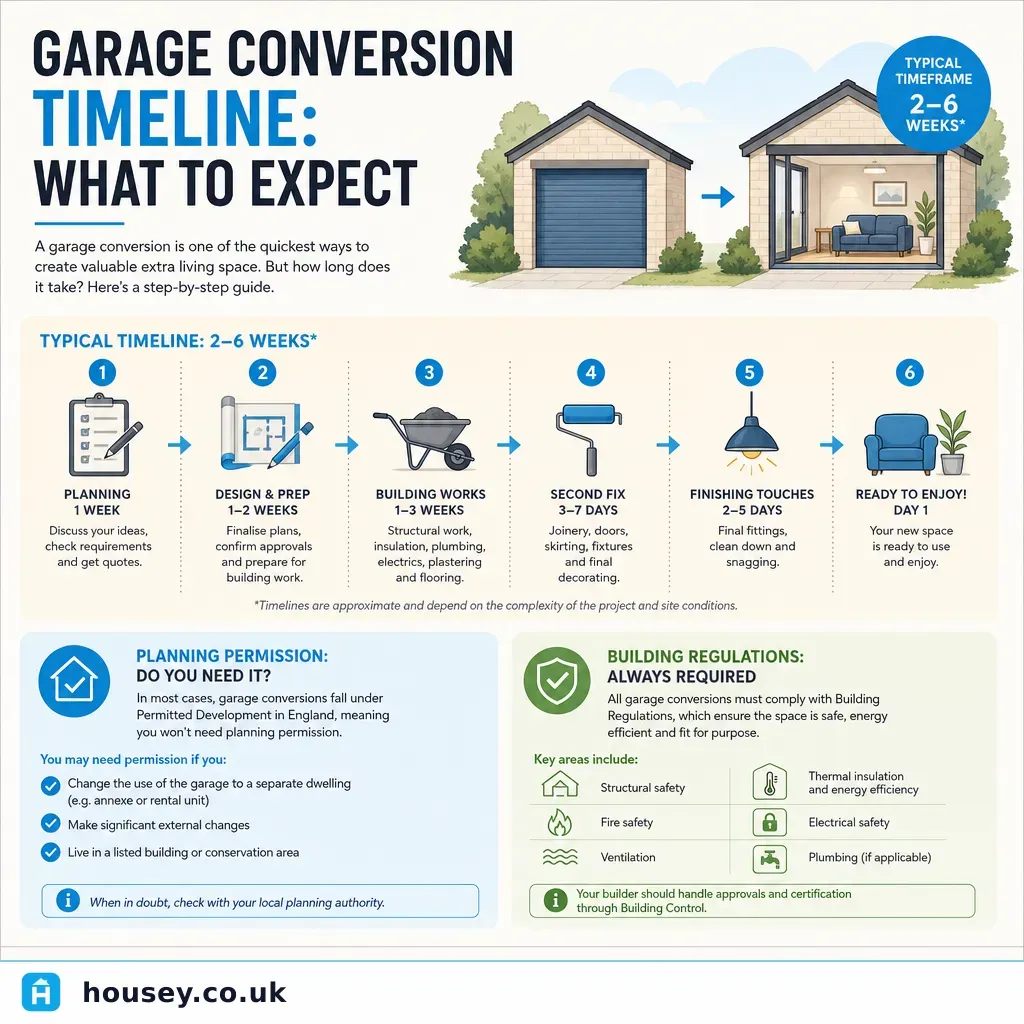
Garage Conversion Timeline: What to Expect
A straightforward attached garage conversion in England usually takes 4–8 weeks of construction, plus pre-start time for building control approval (5 working days for Full Plans).
 Improvement & Build
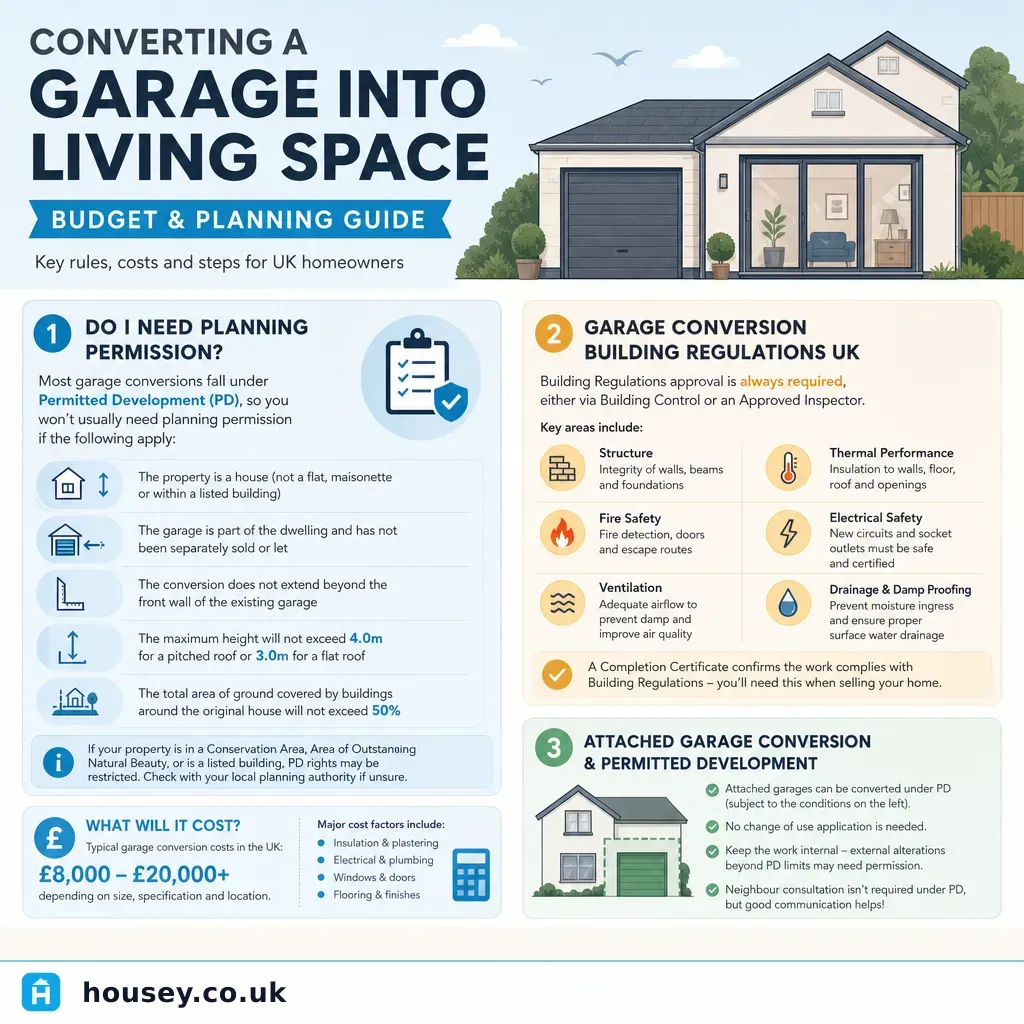
Converting a Garage into Living Space: Budget and Planning Guide
A single-garage conversion typically costs £8,000–£20,000 in the UK.
 Improvement & Build
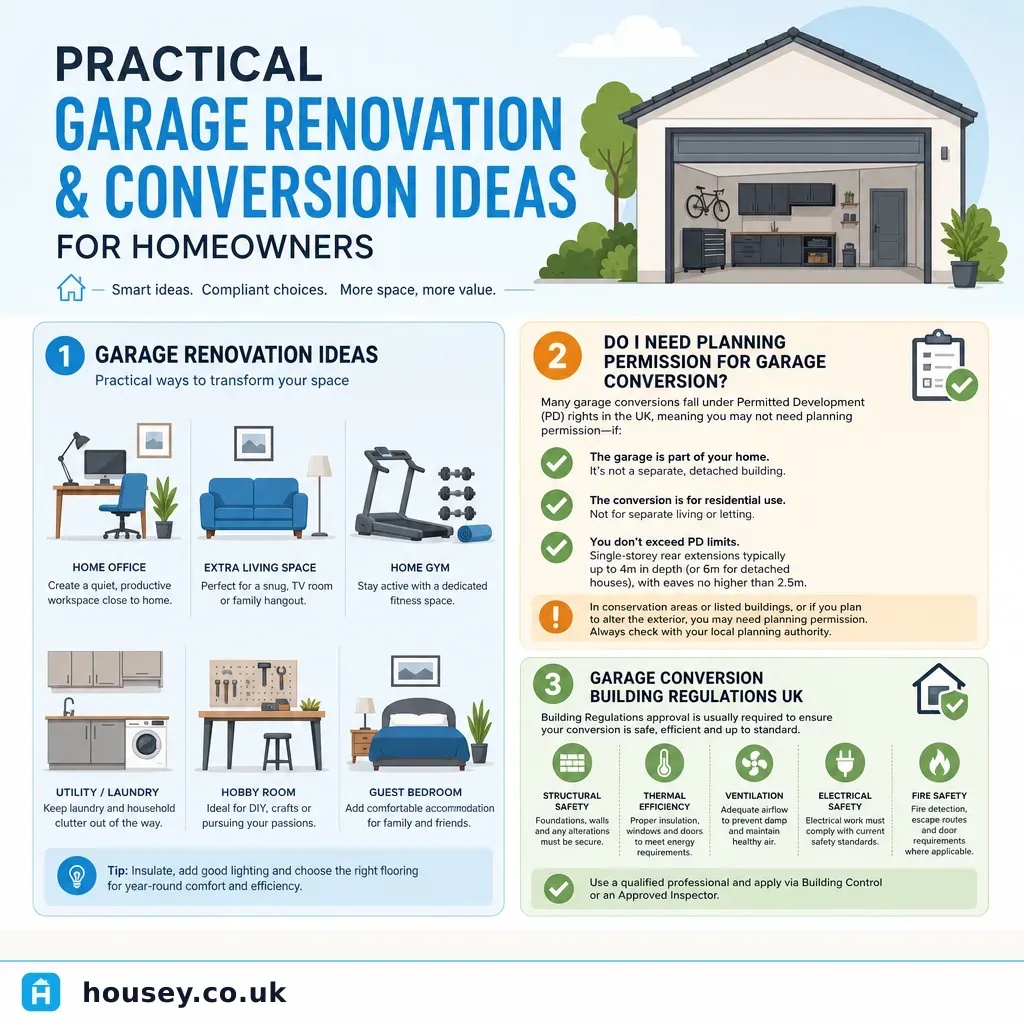
Practical Garage Renovation and Conversion Ideas for Homeowners
A full garage conversion to habitable use almost always requires Building Regulations approval in the UK, even if planning permission is not needed.
 Improvement & Build
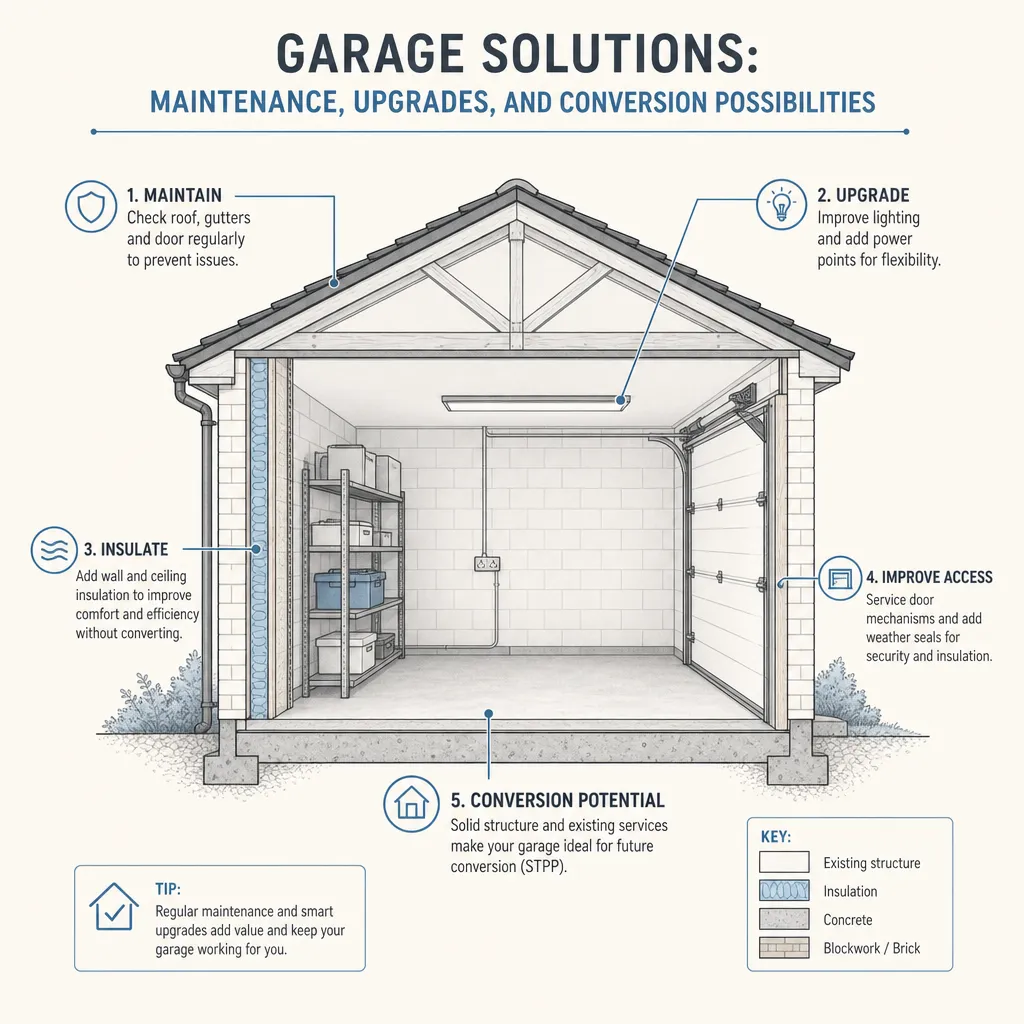
Garage Solutions: Maintenance, Upgrades, and Conversion Possibilities
Your garage can serve many functions — storage, workshop, hobby space, or a full habitable room conversion.
 Improvement & Build
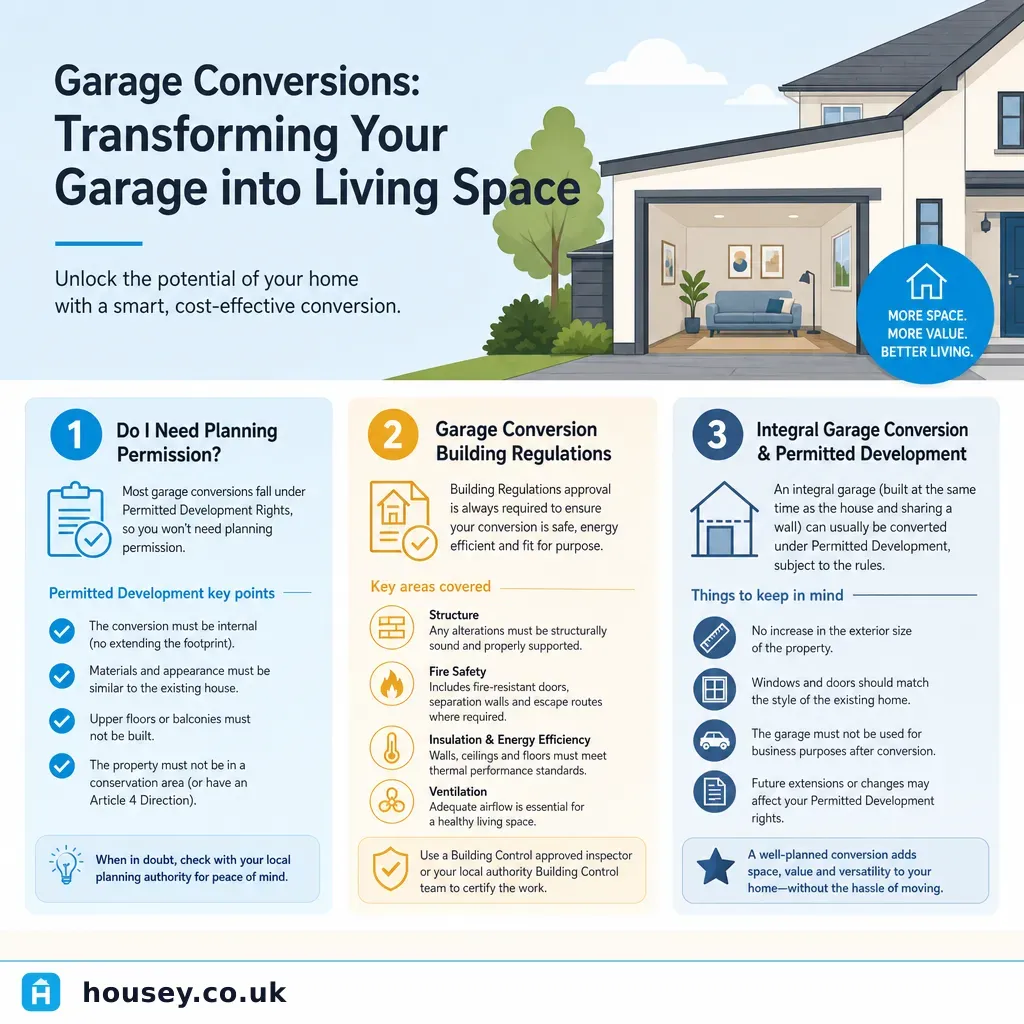
Garage Conversions: Transforming Your Garage into Living Space
Most integral garage conversions in England fall within permitted development and do not require a planning application, but Building Regulations approval is required in virtually all cases.