Selecting the Right Insulation for Your Home: Types and Benefits
By Housey · Last reviewed 7th of May 2026
Selecting the Right Insulation for Your Home: Types and Benefits
Most UK homes lose significant heat through uninsulated roofs, walls, and floors — but the right fix depends on your property's age and construction. Victorian terraces, 1930s semis, and post-war cavity-wall houses each require a different approach, and choosing the wrong type wastes money or, in older buildings, risks moisture damage.
Key points
- Loft insulation should be at least 270mm deep (mineral wool); the Energy Saving Trust estimates an uninsulated roof accounts for around 25% of a home's heat loss.
- Cavity walls (most homes built after approximately 1920) can be filled with mineral wool, EPS beads, or injected foam — usually permitted development with no planning permission needed.
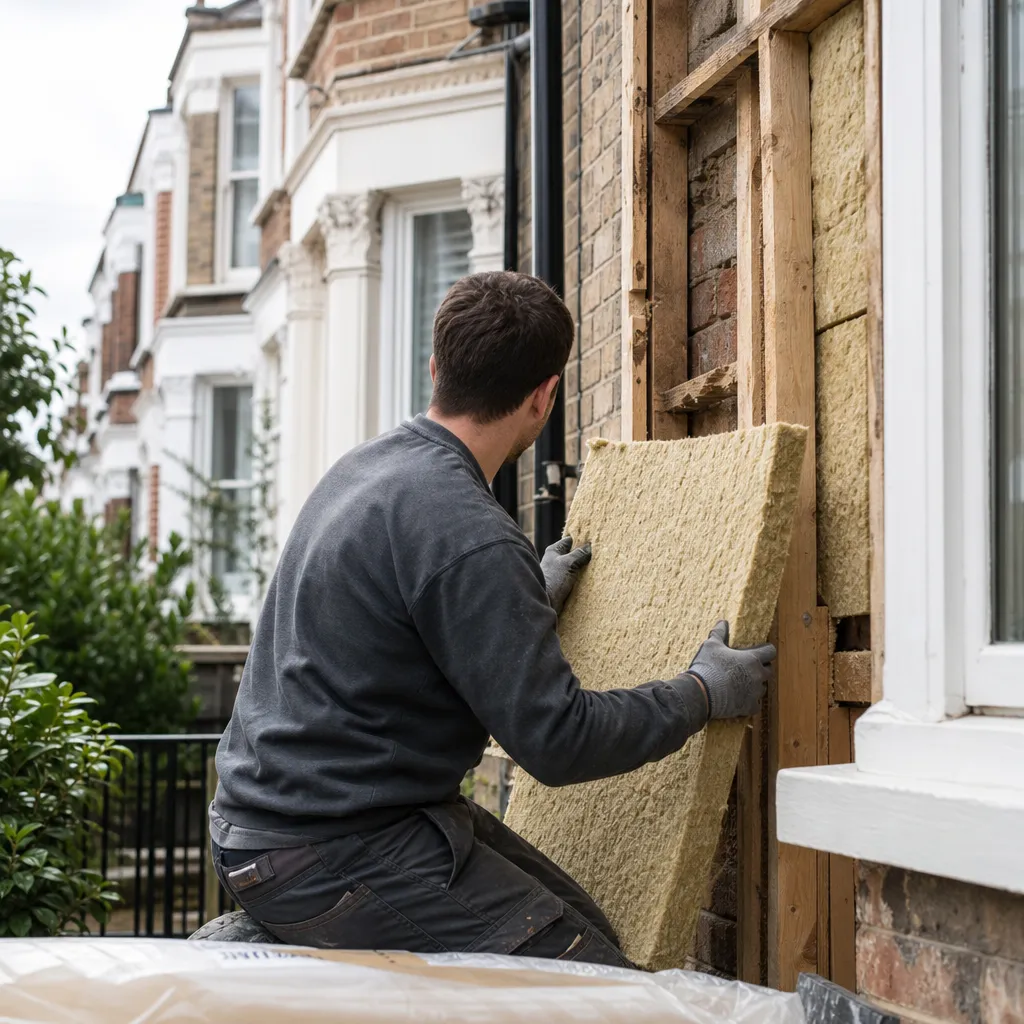
- Solid-wall homes (pre-1920 Victorian and Edwardian stock) require external wall insulation (EWI) or internal wall insulation (IWI); both are more disruptive and costly than cavity fill.
- PAS 2035:2023 is the quality standard for retrofit insulation in Great Britain; TrustMark-registered installers working to PAS 2035 and PAS 2030 are required for ECO4 and GBIS funding.
- Adding insulation to older solid-wall homes without a ventilation and condensation assessment risks interstitial condensation and structural damage.
Main insulation types for UK homes
Loft insulation
Mineral wool rolls laid to 270mm between and over joists is the standard for accessible cold lofts. For occupied loft conversions (warm roofs), rigid PIR or phenolic boards between and below rafters are used — they achieve better U-values at thinner depths.
Cavity wall insulation
Post-1920 homes with an unfilled cavity can be treated with mineral wool (loose fill injection), EPS beads, or polyurethane foam. Mineral wool and EPS are generally preferred; spray foam can complicate mortgage applications and resale — see below.
Solid wall insulation
Pre-1920 homes with no cavity need either:
- EWI (external wall insulation): boards fixed outside, clad with render. More effective thermally; may need planning permission in conservation areas or for listed buildings.
- IWI (internal wall insulation): boards fixed inside. No external change, but reduces floor area and needs careful detailing to avoid cold bridges and moisture problems.
Floor insulation
Suspended timber floors can be insulated from below (mineral wool batts between joists). Solid floors take rigid boards under screed, which raises floor levels and affects doors, skirting boards, and fitted units.
Insulation materials: a comparison
Material | Common use | Typical lambda (W/mK) | Best for | Watch out for |
|---|---|---|---|---|
Mineral wool (glass/rock) | Loft rolls, cavity fill | 0.033–0.044 | Most standard UK homes | Unsuitable for exposed or persistently wet walls |
EPS beads | Cavity fill | 0.032–0.040 | Irregular cavities | Specialist injection installer required |
PIR boards (e.g. Celotex, Kingspan) | Roofs, floors, IWI | 0.022–0.028 | Space-constrained retrofits | Higher cost; fire performance varies by product |
Phenolic foam boards | Roofs, IWI | 0.018–0.023 | Minimum thickness situations | Most expensive rigid board option |
Wood fibre boards/batts | IWI, EWI backing | 0.038–0.050 | Breathable retrofit on older masonry | Greater thickness required |
Spray polyurethane foam | Loft underside, cavity | 0.025–0.040 | Hard-to-access roof spaces | Can affect mortgage eligibility; RICS advises caution |
Lambda values are indicative; consult BBA-certified product data sheets for your specific project.
Which insulation is right for your home?
- Choose loft mineral wool rolls if you have an accessible cold loft with little or no existing insulation.
- Choose cavity wall fill (mineral wool or EPS) if your home was built between roughly 1920 and 1995, has an unfilled cavity, and walls are not in an exposed or persistently wet location.
- Choose EWI if you have solid walls and are carrying out external works anyway — check planning constraints first.
- Choose IWI if you have solid walls and cannot change the external appearance (conservation area, listed building).
- Choose floor insulation if you have a suspended timber floor with noticeable cold draughts.
- Ask a retrofit assessor first if your home has non-standard construction, has been significantly extended, or you want to access ECO4, GBIS, or HUG2 funding — PAS 2035 requires a whole-house assessment before funded measures are installed.
- Check with your local planning authority before installing EWI in a conservation area or on a listed building, as permitted development rights do not apply.
Grant funding overview
- ECO4: Targets fuel-poor and lower-income households; requires a TrustMark-registered installer working to PAS 2030 and PAS 2035.
- Great British Insulation Scheme (GBIS): Single-measure insulation for EPC D–G homes; regulated by Ofgem.
- Home Upgrade Grant (HUG2): England off-gas-grid homes rated E, F, or G; administered via local authorities.
Check eligibility via GOV.UK or the Energy Saving Trust before commissioning any work.
A note on spray foam
RICS has published guidance warning that spray foam bonded to roof timbers can impede structural inspection, affect mortgage applications, and reduce saleability. Always seek independent advice before choosing spray foam over standard alternatives.
When to get professional help
- Pre-1919 solid-wall home with damp, poor ventilation, or a condensation history — insulation without a moisture assessment risks structural damage.
- Flat, mixed, or non-standard roof construction.
- ECO4, GBIS, or HUG2 funding required — a PAS 2035 retrofit assessor must specify measures.
- Conservation area or listed building — EWI may require listed building consent or planning permission.
- Spray foam already present — commission a structural inspection before further insulation work.
- Visible black mould or persistent condensation — address the root cause before adding insulation.
How Housey can help
Housey connects UK homeowners with qualified professionals across the insulation journey. Start with an insulation assessment to identify what your property needs, then find rated insulation installers for the work itself. For funded schemes, retrofit assessments provide the PAS 2035-compliant whole-home view required for ECO4 and GBIS, and a ventilation and condensation assessment ensures moisture risk is managed throughout.
Frequently asked questions
How much loft insulation do I need?
The recommended depth is 270mm of mineral wool. Many UK homes still have 100mm or less. Increasing to 270mm can deliver typical annual savings of around £150–£300 for a semi-detached house according to the Energy Saving Trust, though savings depend on property size, heating system, and tariff.
Can I get cavity wall insulation for free?
Some households qualify for free or subsidised cavity wall insulation through ECO4 or GBIS, subject to income, benefits, and EPC rating. Contact your energy supplier or check via the GOV.UK energy bills support pages.
Does insulation need planning permission?
Most cavity fill and loft insulation is permitted development. EWI may need permission in conservation areas, on listed buildings, or where Article 4 directions apply. Always check with your local planning authority before external works.
What is spray foam insulation and should I use it?
SPF expands and sets hard, filling gaps effectively. However, RICS guidance warns it can bond to roof timbers, complicating inspection and repair, and may affect mortgage eligibility. Seek independent advice before choosing it over standard alternatives.
Is insulation VAT-free?
Qualifying insulation materials and installation in residential properties currently attract 0% VAT under HMRC's energy-saving materials relief. Check current HMRC guidance for qualifying criteria.
Sources and further reading
- Loft and roof insulation — Energy Saving Trust
- Cavity wall insulation — Energy Saving Trust
- Solid wall insulation — Energy Saving Trust
- PAS 2035 retrofit standard — TrustMark
- ECO4 scheme — GOV.UK
- RICS spray foam guidance — RICS
- Great British Insulation Scheme — Ofgem
Useful next reads
 Energy & Retrofit
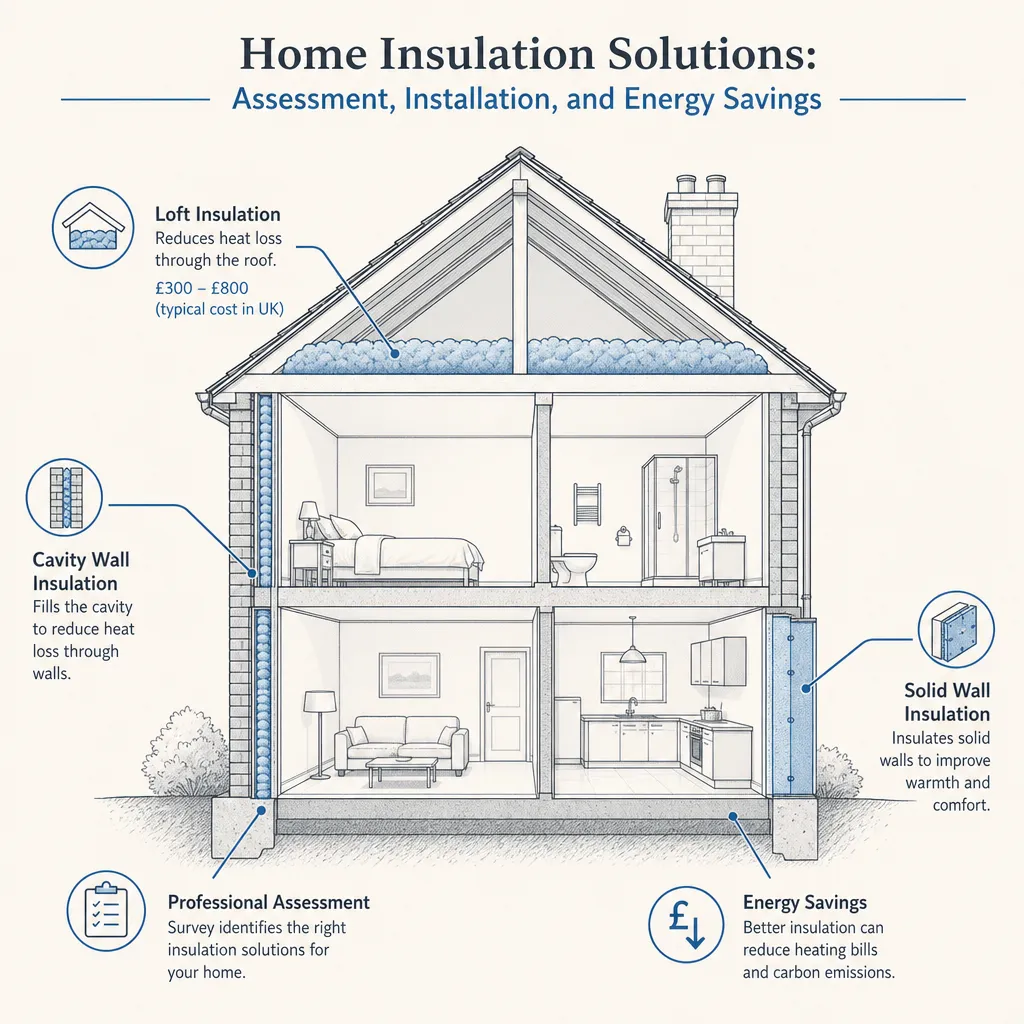
Home Insulation Solutions: Assessment, Installation, and Energy Savings
Home insulation in the UK covers loft, cavity wall, solid wall, and floor insulation.
 Energy & Retrofit
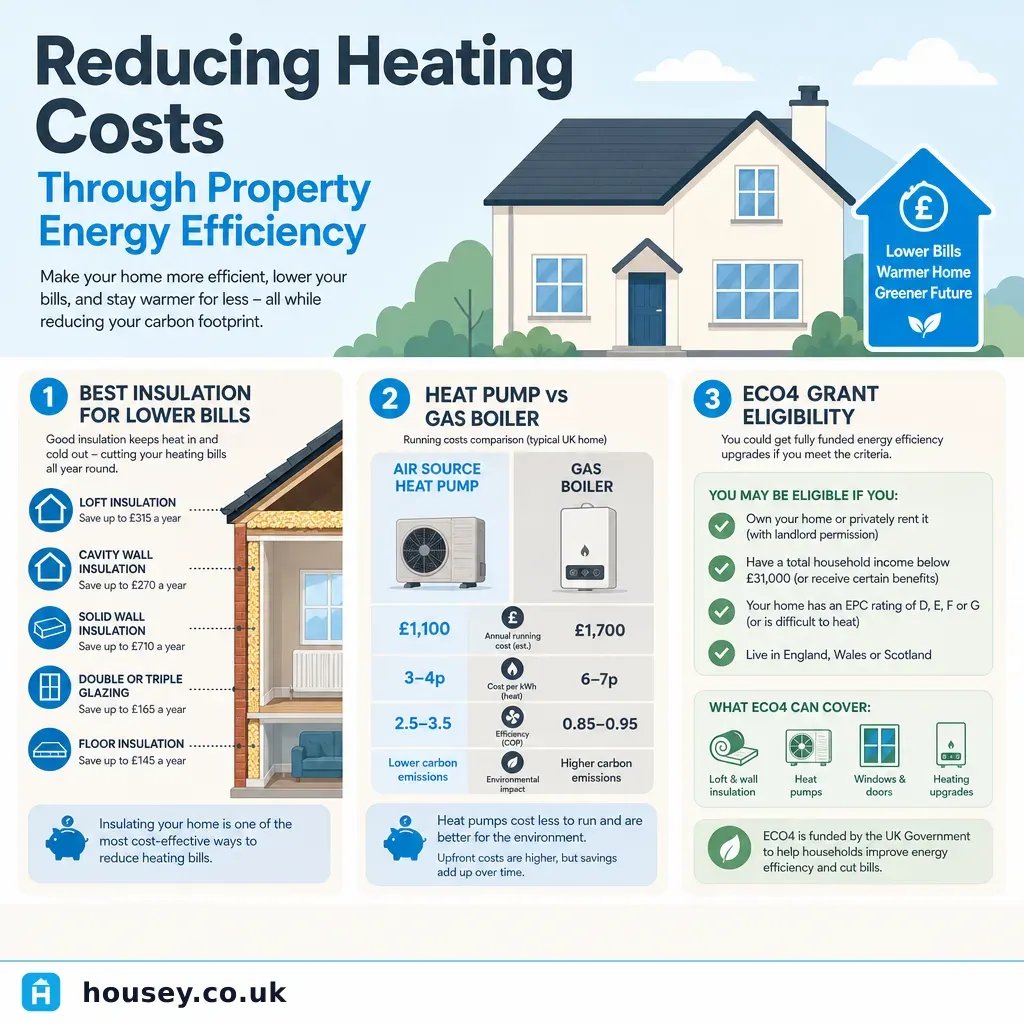
Reducing Heating Costs Through Property Energy Efficiency
Reducing heating costs starts with identifying where heat is lost — typically walls (30–35%), roof (20–25%), and windows.
 Energy & Retrofit
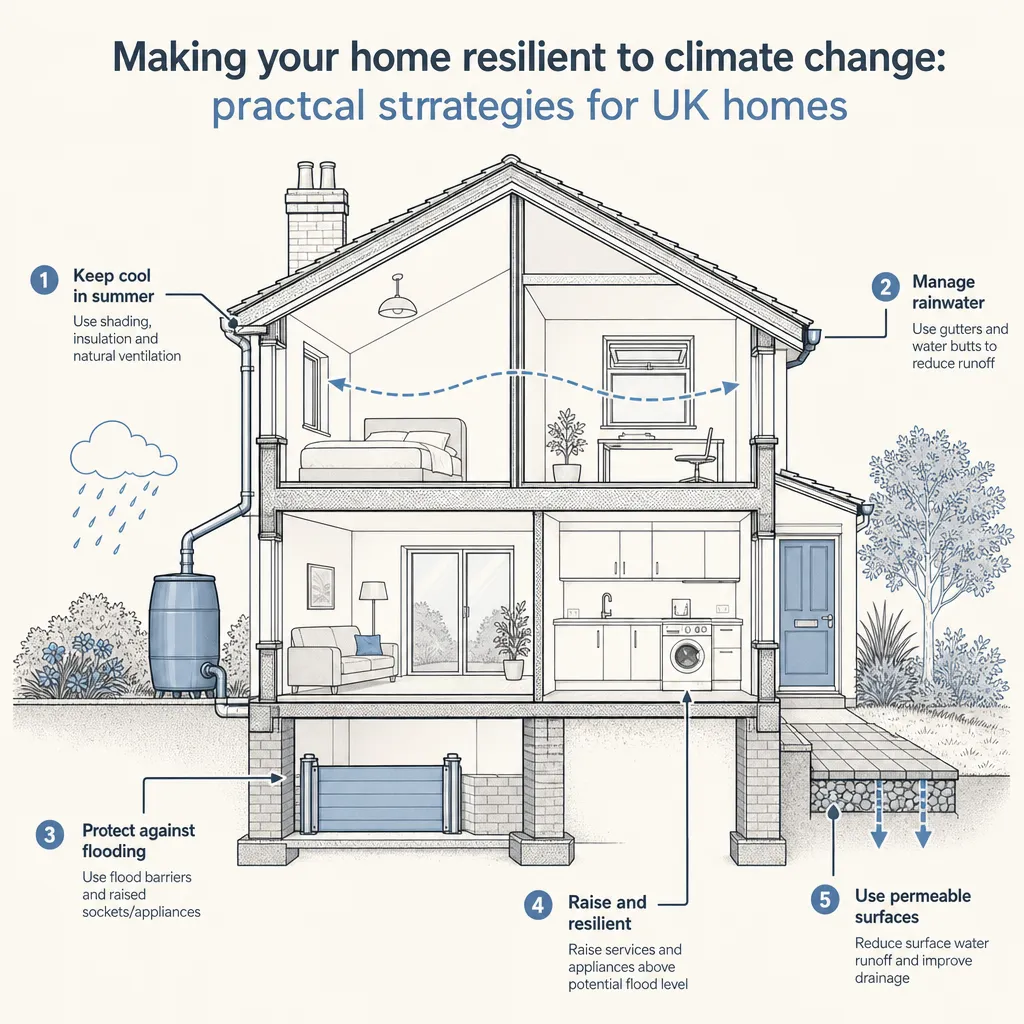
Making your home resilient to climate change: practical strategies
UK homeowners can improve climate resilience by addressing flood risk, overheating, and energy efficiency together.
 Energy & Retrofit
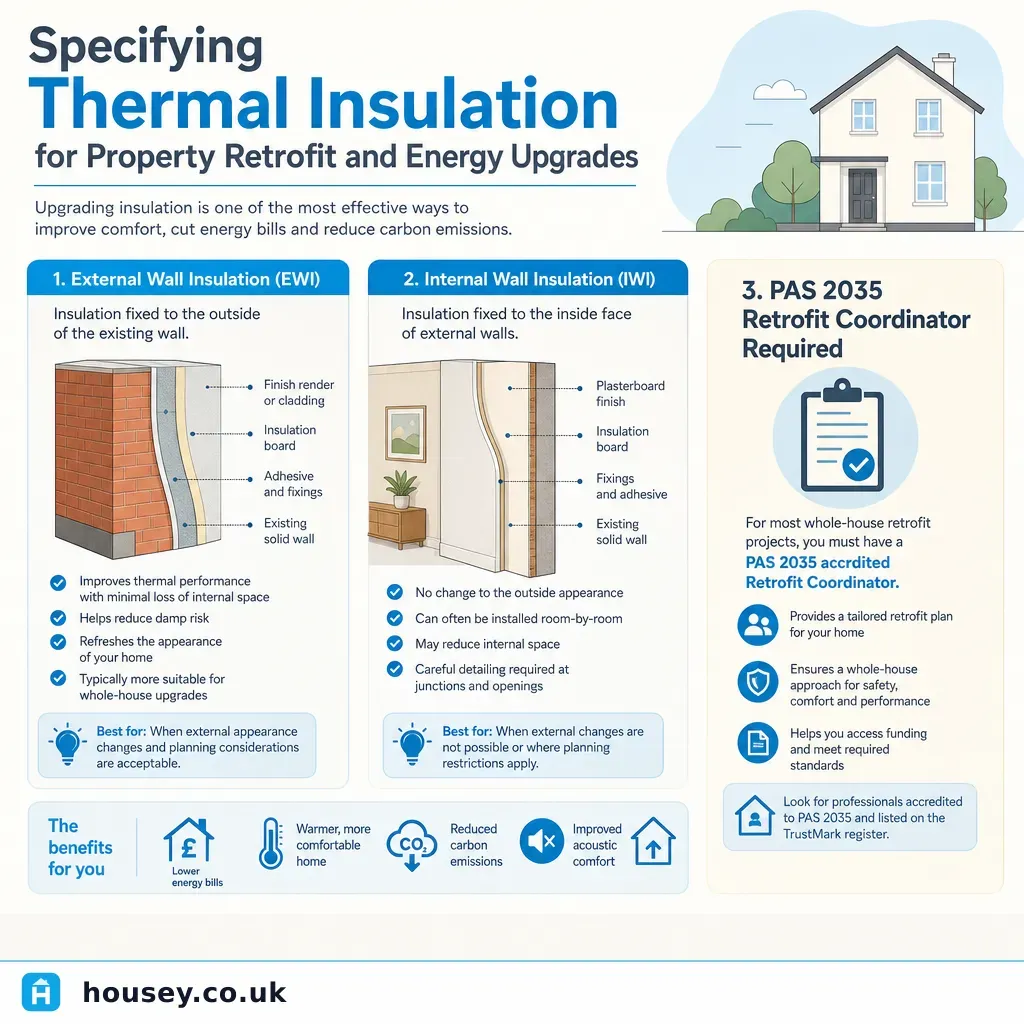
Specifying Thermal Insulation for Property Retrofit and Energy Upgrades
Specifying thermal insulation for UK retrofit requires matching the product to your property's construction, moisture conditions, and heating system.
 Energy & Retrofit
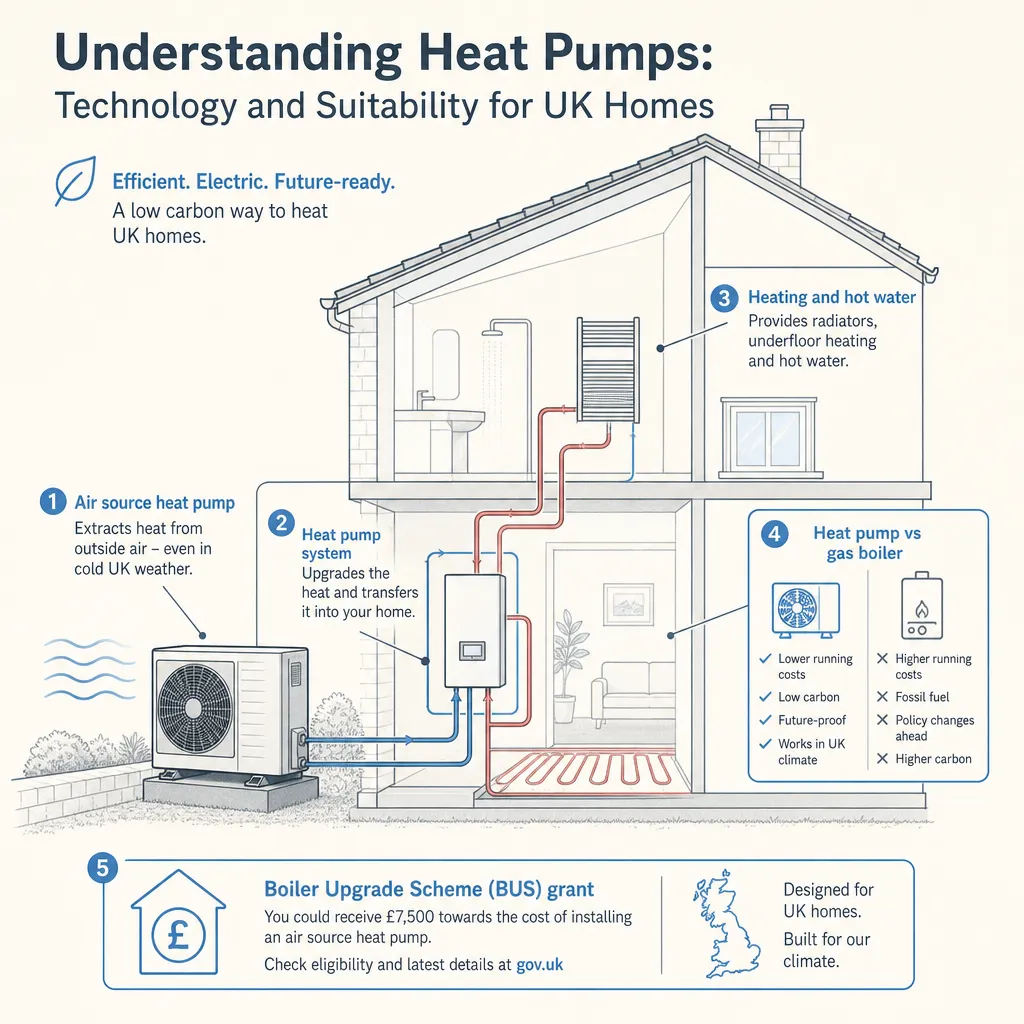
Understanding Heat Pumps: Technology and Suitability for UK Homes
Heat pumps extract heat from the air or ground and transfer it indoors, typically achieving efficiencies of 250–400% compared to a conventional boiler's near 100%.