Septic System Installation and Replacement Costs
By Housey · Last reviewed 30th of May 2026
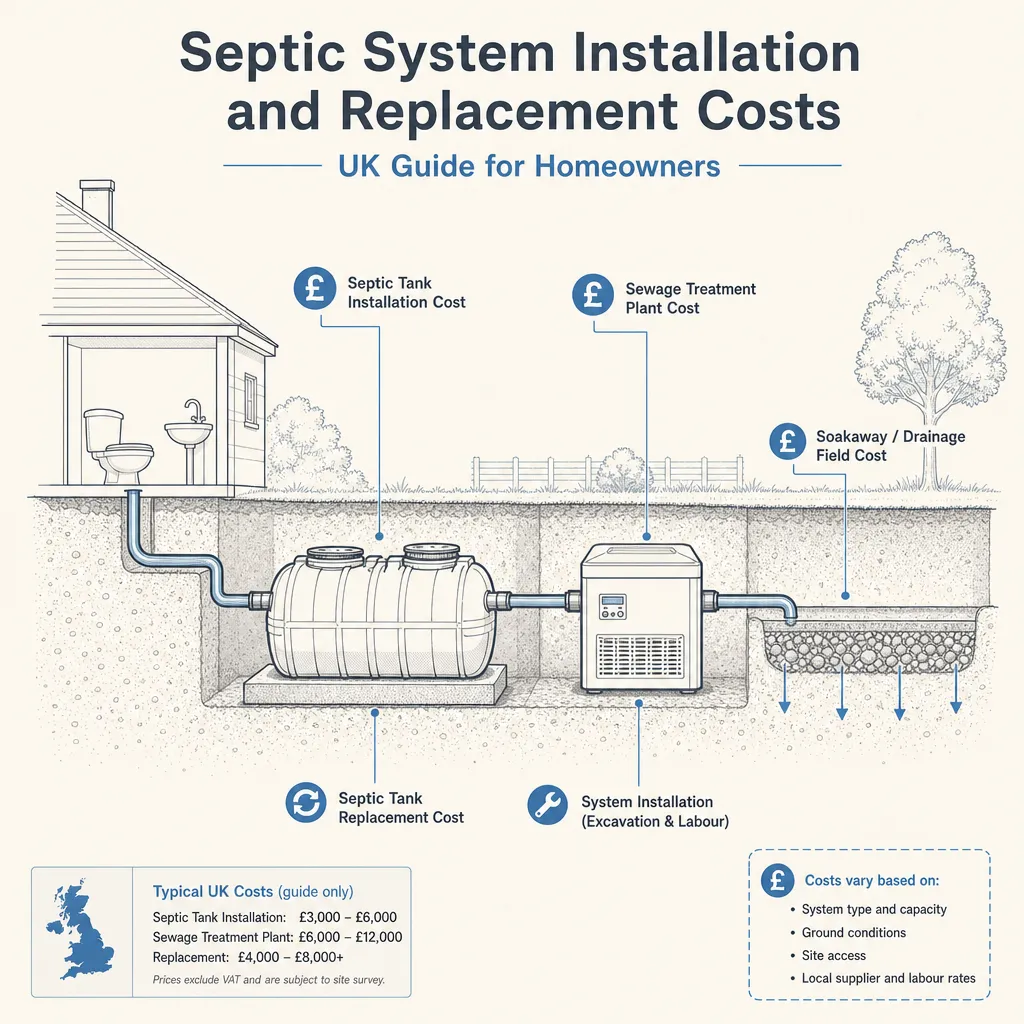
Septic System Installation and Replacement Costs
For the estimated one in five rural properties in England not connected to the mains sewer, a private wastewater treatment system is essential infrastructure. Questions about installation and replacement costs typically arise when buying a rural property, when an ageing tank fails, or when Environment Agency regulations require an upgrade to bring an existing system into compliance.
Key points
- Since January 2020, the Environment Agency's General Binding Rules (England) prohibit most septic tanks from discharging treated effluent directly to surface water such as ditches, streams, and rivers — non-compliant systems must be replaced or upgraded.
- A percolation test carried out to British Standard BS 6297:2007 is required before a drainage field (soakaway) can be designed; clay-heavy soils in many parts of the Midlands and north of England frequently fail.
- Building Regulations Part H (Drainage and Waste Disposal) applies to new and replacement off-mains drainage; Building Control sign-off from a local authority or Approved Inspector is required.
- Sewage treatment plants (small sewage treatment plants, or SSTPs) must meet BS EN 12566-3 and achieve a minimum effluent standard of 20 mg/l BOD5 for lawful discharge to ground or surface water.
- Indicative UK installed costs range from approximately £3,000–£5,000 for a basic plastic septic tank to £8,000–£25,000+ for a sewage treatment plant with drainage field, depending on ground conditions, access, and system specification (Indicative UK costs, last reviewed 2026-05-30).
What types of off-mains drainage are available in the UK?
System type | How it works | Discharge route | Environment Agency permit needed? | Approx. installed cost |
|---|---|---|---|---|
Septic tank | Separates solids; liquid effluent to drainage field | Ground only — not surface water since Jan 2020 | No (if discharges to drainage field and meets GBRs) | £3,000–£8,000 |
Small sewage treatment plant (SSTP) | Biological treatment; higher-quality effluent | Ground or surface water (if permit obtained) | Yes for surface water; no for ground via drainage field under GBRs | £8,000–£20,000+ |
Cesspit (cesspool) | Fully sealed tank — no discharge | None — pumped out regularly | No | £2,500–£5,000 plus £100–£300 per emptying visit |
Package treatment plant | Advanced treatment for constrained sites | Ground or surface water | Yes for surface water; conditions apply | £12,000–£25,000+ |
Indicative UK costs, last reviewed 2026-05-30. All costs exclude VAT and vary significantly by region, access, and ground conditions.
What does UK law require?
The Environment Agency's General Binding Rules (GBRs) for small sewage discharges in England set out what is and is not permitted without a bespoke Environmental Permit.
Key requirements under the current GBRs (England):
- The system must serve a property generating no more than 5,000 litres per day (typically a single dwelling).
- Septic tanks may discharge only to a drainage field, not to surface water — a significant change from the pre-2020 position.
- Sewage treatment plants discharging to surface water must comply with specified effluent quality standards under the permit.
- The drainage field must comply with BS 6297 and must not be within 50 metres of a spring, well, or borehole used for drinking water, or within 10 metres of any watercourse.
In Wales, equivalent rules are administered by Natural Resources Wales. In Scotland, the Water Environment (Controlled Activities) (Scotland) Regulations 2011 and SEPA regulatory position statements apply — the Scottish framework differs from England in several important respects.
Building Regulations Approved Document H also governs drainage and waste disposal for any new or replacement installation in England and Wales.
Percolation testing and site assessment
Before any off-mains drainage system can be designed, the ground's capacity to absorb treated effluent must be established through a percolation test (BS 6297).
What the test involves:
- Excavate two or more test holes (typically 300 mm square, 300 mm deep below the proposed drainage field base).
- Saturate the holes with water for a minimum of 24 hours before testing.
- Measure the time in seconds for water to drop 25 mm — this is the Vp value.
- A Vp between 12 and 100 seconds per 25 mm typically indicates suitable soil for a drainage field.
If the soil fails — often because of heavy clay common across much of the Midlands, north of England, and parts of Wales — a drainage field cannot be used. Options then include a fully sealed cesspit, a package treatment plant with surface-water discharge (requiring a permit), or specialist mound drainage systems. All carry higher cost or operational burden than a straightforward soakaway.
A geotechnical and soil investigation provides a more detailed site assessment where ground conditions are uncertain or where a constrained site makes preliminary testing difficult.
What drives installation cost?
Understanding the cost drivers helps you interpret quotes and budget for contingencies.
Excavation and site access: Rocky ground, restricted access, or high groundwater tables significantly increase plant hire and excavation costs. A rural property with open field access will typically cost substantially less to excavate than one with a paved courtyard.
System size: Systems are sized by population equivalent (PE) — the number of occupants or equivalent users. A four-person household typically requires a 4 PE system; a six-bedroom property may require 6–8 PE. Larger systems cost more and may require a proportionally larger drainage field.
Drainage field size: BS 6297 sets drainage field pipe length based on the Vp value and PE. A slow Vp requires a longer drainage field. For a four- to six-person household, drainage fields typically range from 60 to 120+ metres of perforated pipe in trenches.
Existing system removal: Decommissioning and removing an old tank adds an indicative £500–£2,500 depending on size, location, and specialist waste disposal requirements.
Quote comparison checklist — what to check before accepting:
Which system should you choose?
- Choose a septic tank if soil percolation tests pass, the site is straightforward, and you have no need to discharge to surface water — it is the lower-cost option with minimal running costs.
- Choose a small sewage treatment plant (SSTP) if soil percolation fails, drainage field area is insufficient, or you need to discharge to a watercourse and can obtain an Environmental Permit.
- Choose a cesspit only as a last resort where discharge to ground or surface water is not possible — ongoing emptying costs make it the most expensive option over time.
- Ask a drainage contractor to carry out or arrange the BS 6297 percolation test before committing to a system type.
- Ask a drainage surveyor if you are buying a rural property and want to understand the condition and regulatory compliance of the existing system before exchange.
- Check the Environment Agency's What's in Your Backyard map to identify whether the site falls within a groundwater source protection zone before specifying a system.
Important limitations
This article provides general guidance on UK off-mains drainage system types and indicative costs. Rules, discharge requirements, permit conditions, and distance thresholds vary significantly by location, ground conditions, proximity to watercourses, and whether the property falls in a groundwater source protection zone. The General Binding Rules differ between England, Wales, and Scotland. Nothing in this article constitutes legal, engineering, or regulatory advice. A qualified drainage engineer — and, where relevant, an environmental consultant — should assess your specific site and system before any work begins or any commitment is made.
What to ask a qualified professional
Before instructing a drainage contractor or commissioning a system design, ask:
- Is my site within a groundwater source protection zone, and does this restrict the system type or discharge conditions?
- Do I need an Environmental Permit, or does my proposed system fall within the General Binding Rules without one?
- Will you carry out the BS 6297 percolation test, or do I need to commission this separately?
- What system size (PE) do you recommend for my property, and how is that figure calculated?
- Who will make the Building Control application, and what does Building Control sign-off cover?
- Is the drainage field design based on measured percolation test results, and can you show the calculation?
- What ongoing maintenance does the chosen system require, and do you offer a service contract?
- Are you a registered waste carrier for disposal of the existing tank and its contents?
When to get professional help
Engage a qualified drainage contractor — and where relevant, an Environment Agency-registered waste carrier — immediately if:
- An existing septic tank or treatment plant has stopped functioning, is overflowing, or producing persistent odours — this is both a regulatory breach and a public health matter requiring urgent attention.
- You are buying a rural property and the seller cannot confirm the system's compliance with the January 2020 General Binding Rules.
- Ground investigation suggests the water table is close to the surface — this may preclude a drainage field entirely and require a specialist engineered solution.
- The property is within 50 metres of a drinking water source — discharge rules are stricter in source protection zones and are likely to require a bespoke Environmental Permit.
How Housey can help
Housey connects homeowners with qualified drainage contractors for system installation and replacement, drainage surveyors for condition assessments and pre-purchase compliance checks, and geotechnical specialists for percolation testing and soil assessment on challenging sites. Compare quotes from up to four local specialists in one place.
Frequently asked questions
Do I need planning permission for a new septic tank or sewage treatment plant?
In many cases, installation falls under permitted development rights and does not require a planning application. However, if the property is listed, in a conservation area, or if above-ground elements are proposed, you may need permission. Rules can vary by local authority — always check with your local planning authority before committing to a system design or starting groundworks.
How often does a septic tank need to be emptied?
A conventional septic tank typically requires desludging once a year for a household of four, though this varies with tank size and usage. Sewage treatment plants require less frequent desludging but need annual servicing to maintain the biological treatment process. Neglecting emptying can cause system failure, ground contamination, and regulatory breach.
Can I sell a property with a non-compliant septic tank?
A non-compliant system — particularly one still discharging to surface water contrary to the 2020 General Binding Rules — can complicate a sale. Buyers' solicitors increasingly check compliance, and some mortgage lenders require remediation before completion. The cost of upgrading or replacing a non-compliant system is often negotiated into the sale price.
What is the lifespan of a septic tank or sewage treatment plant?
Concrete septic tanks can last 50 years or more if maintained; plastic and GRP tanks typically 20–40 years. Sewage treatment plants have a mechanical lifespan of 15–25 years for the aeration unit. A drainage survey can help assess the current condition and remaining serviceable life of an existing system before purchase or replacement.
Sources and further reading
- Environment Agency: General binding rules for small sewage discharges — GOV.UK
- GOV.UK: Approved Document H — Drainage and Waste Disposal — MHCLG
- SEPA: Septic tanks and private sewage treatment systems — Scottish Environment Protection Agency
- Natural Resources Wales: Septic tanks and sewage treatment — Natural Resources Wales
- BSI Group: BS 6297:2007 — Design and installation of drainage fields — BSI Group
Useful next reads
 Improvement & Build
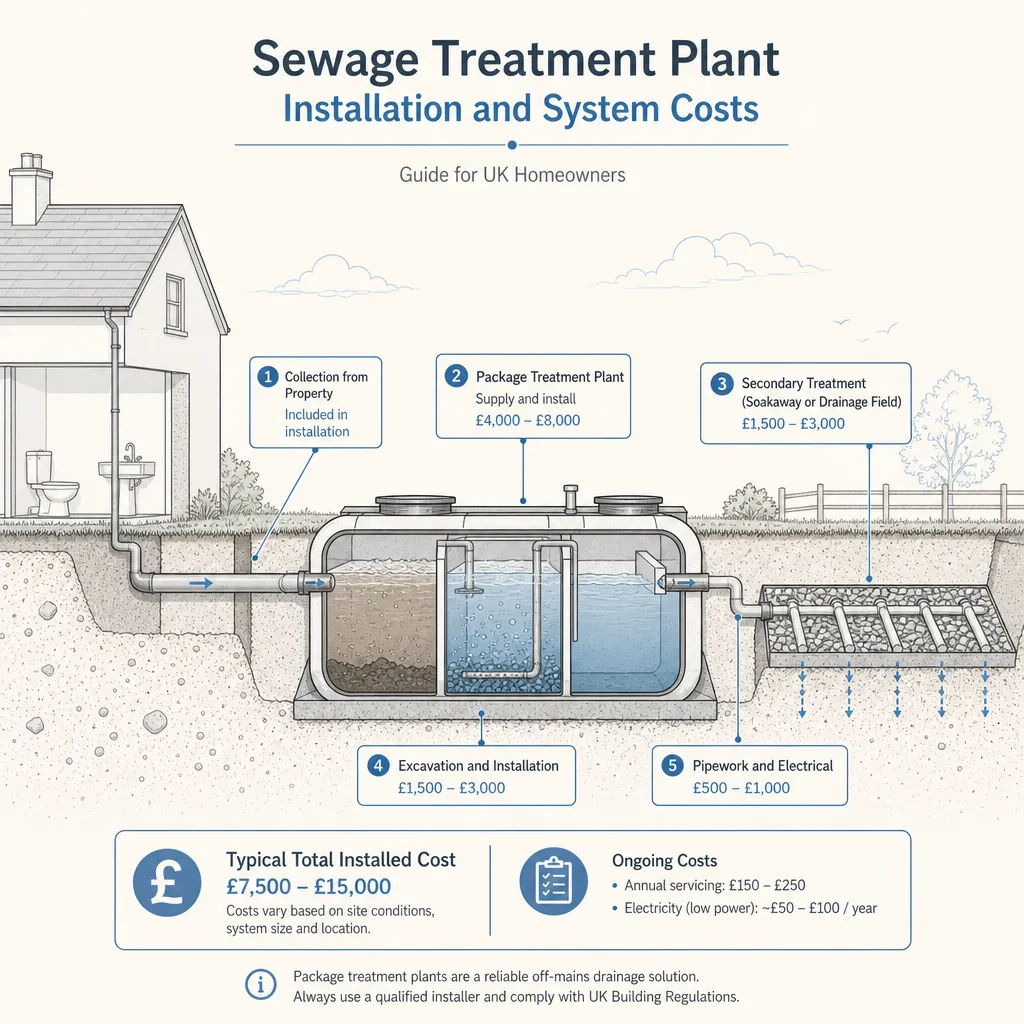
Sewage Treatment Plant Installation and System Costs
A domestic sewage treatment plant typically costs £5,000–£12,000 installed in the UK, depending on capacity, site conditions, and discharge route.
 Improvement & Build
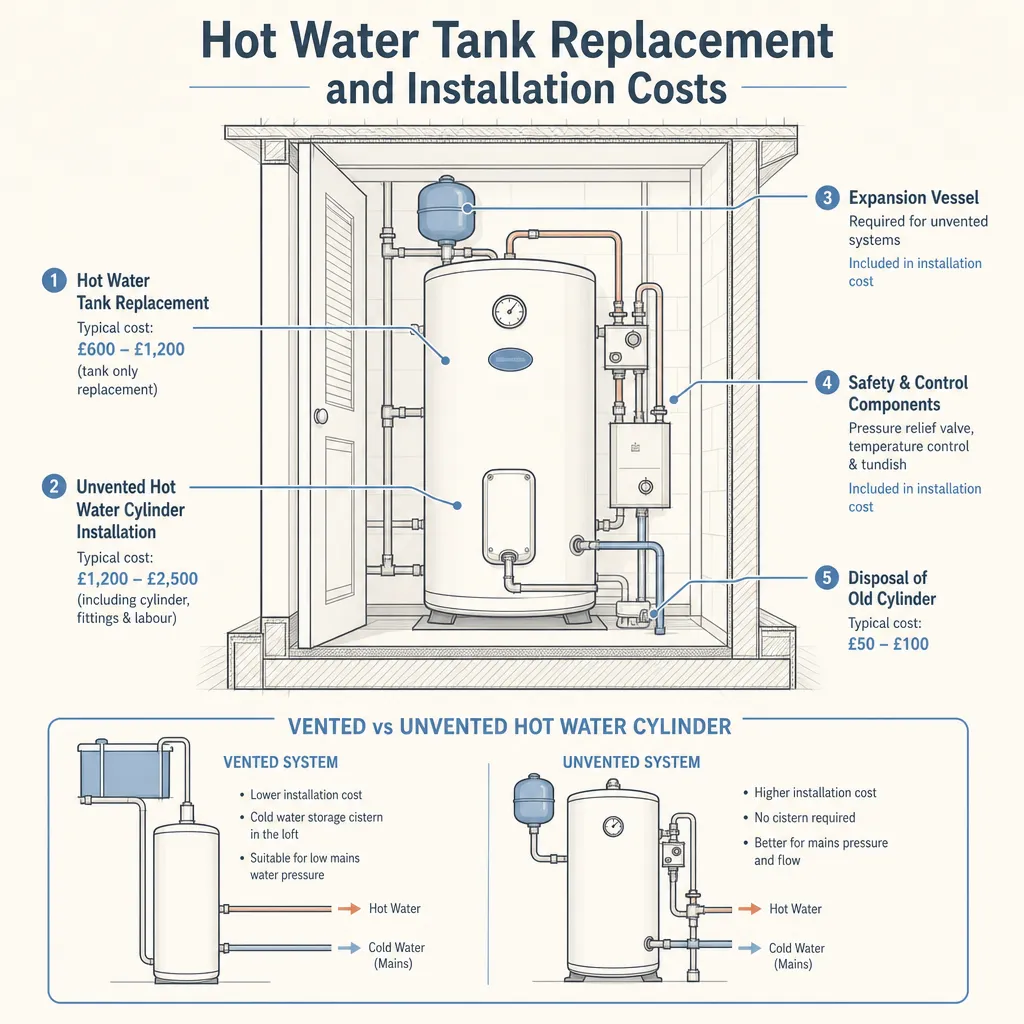
Hot Water Tank Replacement and Installation Costs
Replacing a hot water cylinder in the UK typically costs £450–£1,500 in total, depending on whether you choose a vented or unvented system and the cylinder's capacity.
 Improvement & Build
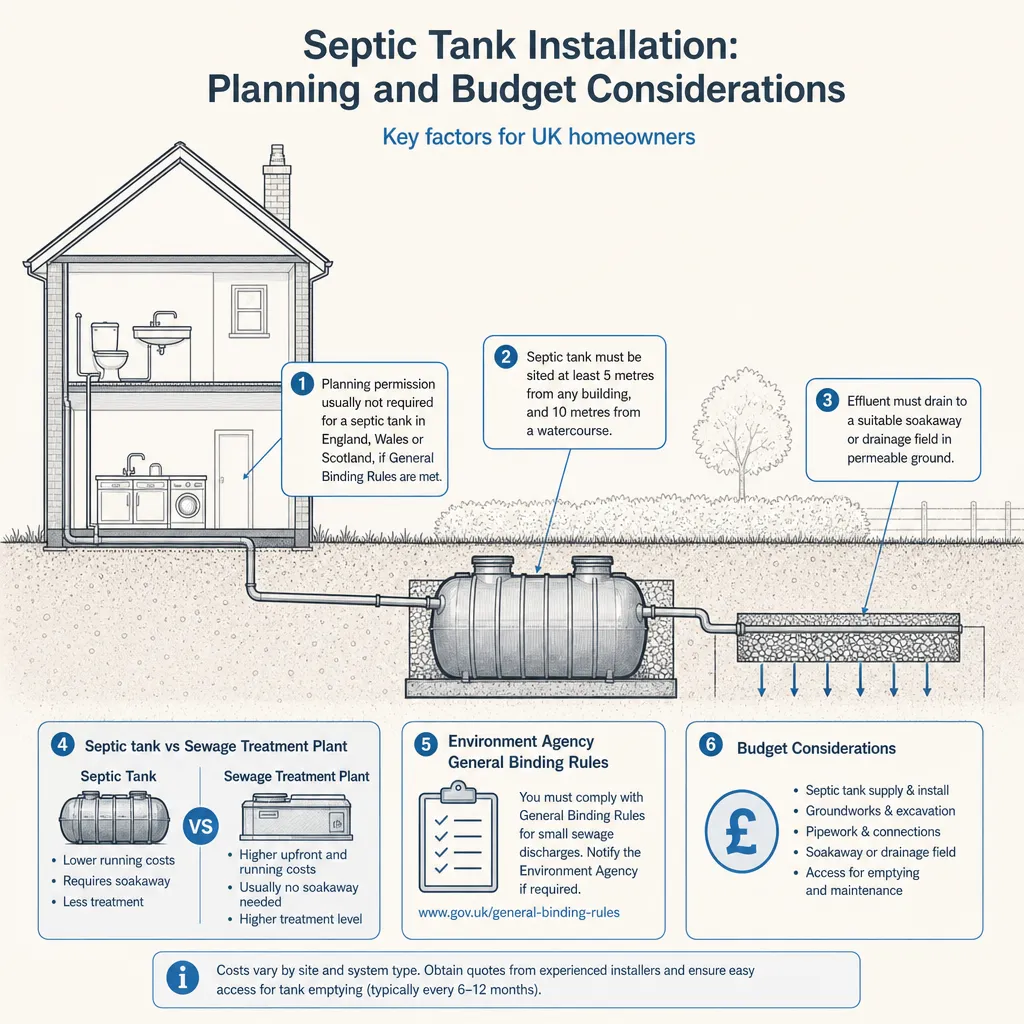
Septic Tank Installation: Planning and Budget Considerations
Installing a septic tank or sewage treatment plant in England requires Environment Agency registration or a permit, plus Building Regulations approval under Approved Document H.
 Improvement & Build
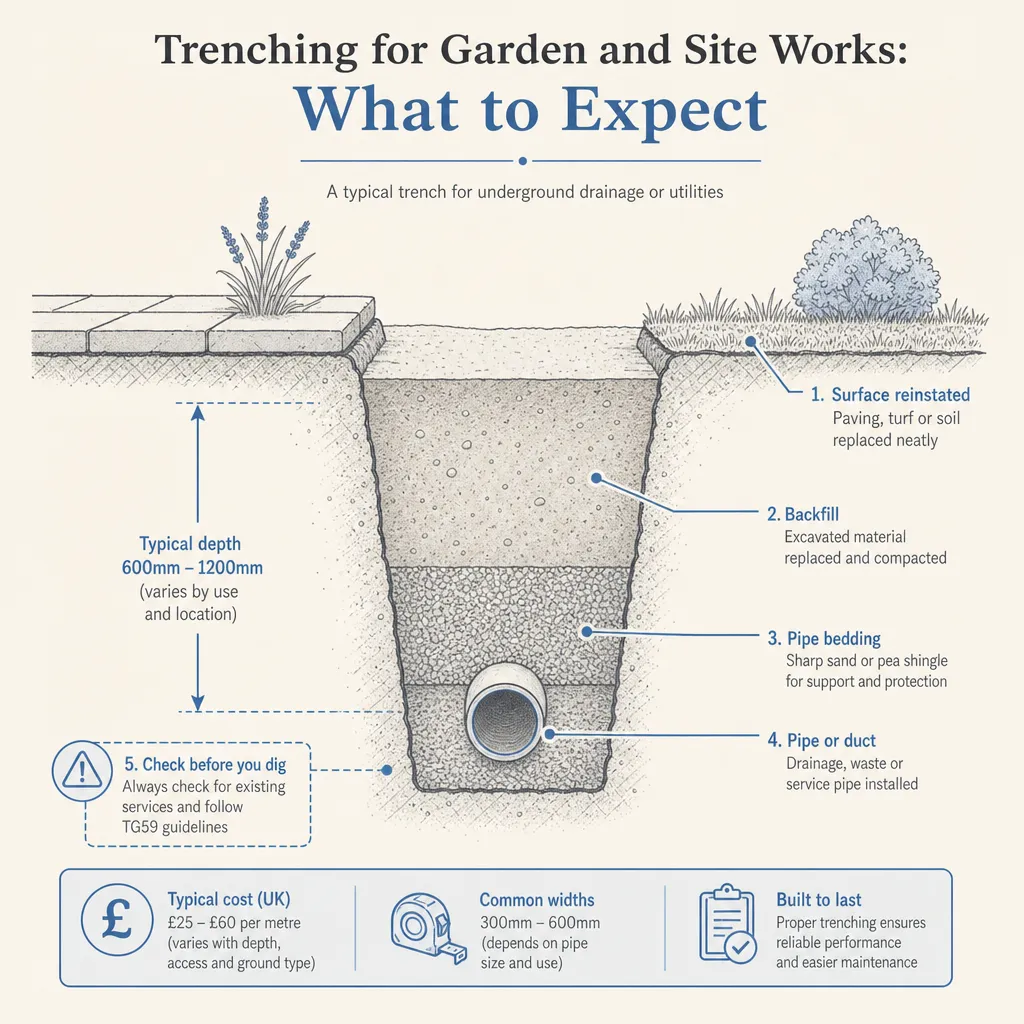
Trenching for Garden and Site Works: What to Expect
Trenching for garden and site works involves excavating channels to lay drainage pipes, electrical cables, water supply lines, or foundation drains.
 Improvement & Build
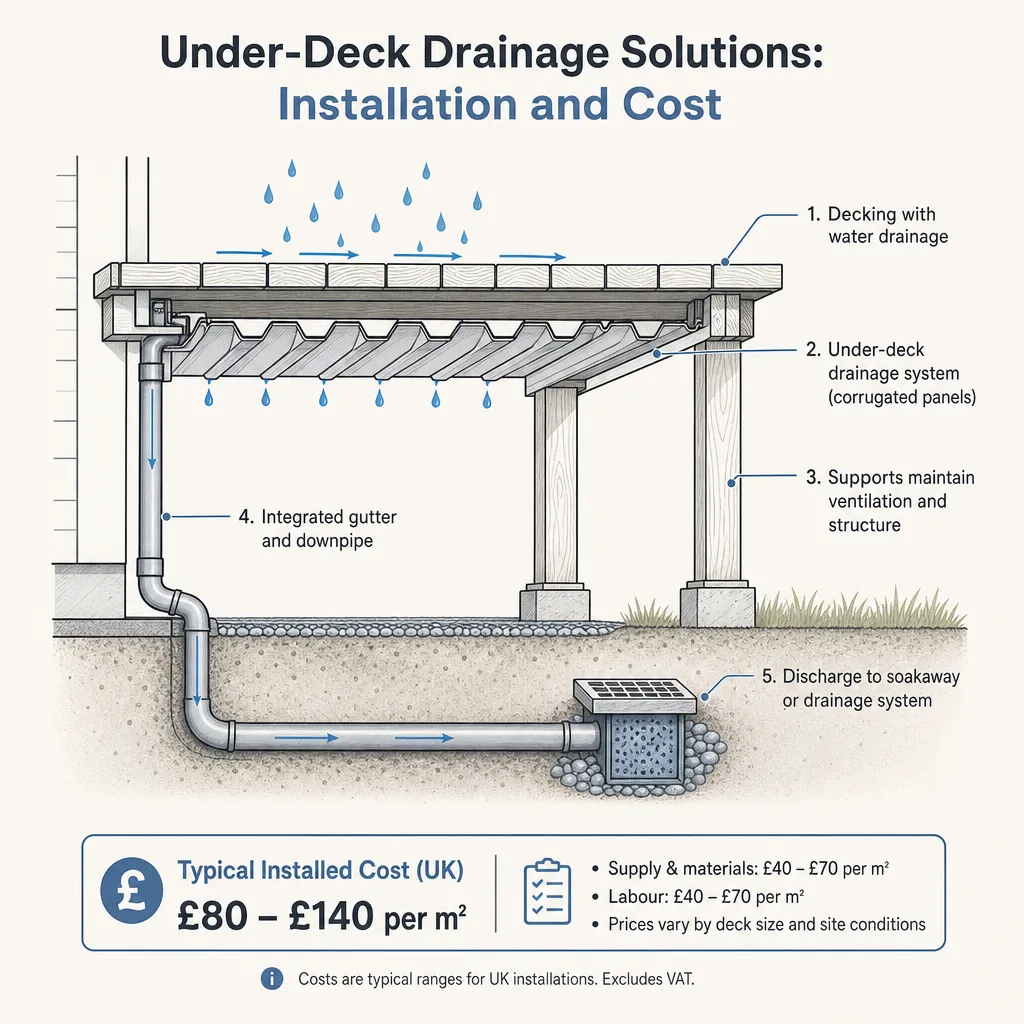
Under-Deck Drainage Solutions: Installation and Cost
Under-deck drainage systems channel rainwater falling through or running off a raised deck away from the space beneath it, keeping the under-deck area dry and usable.