Trenching for Garden and Site Works: What to Expect
By Housey · Last reviewed 25th of May 2026
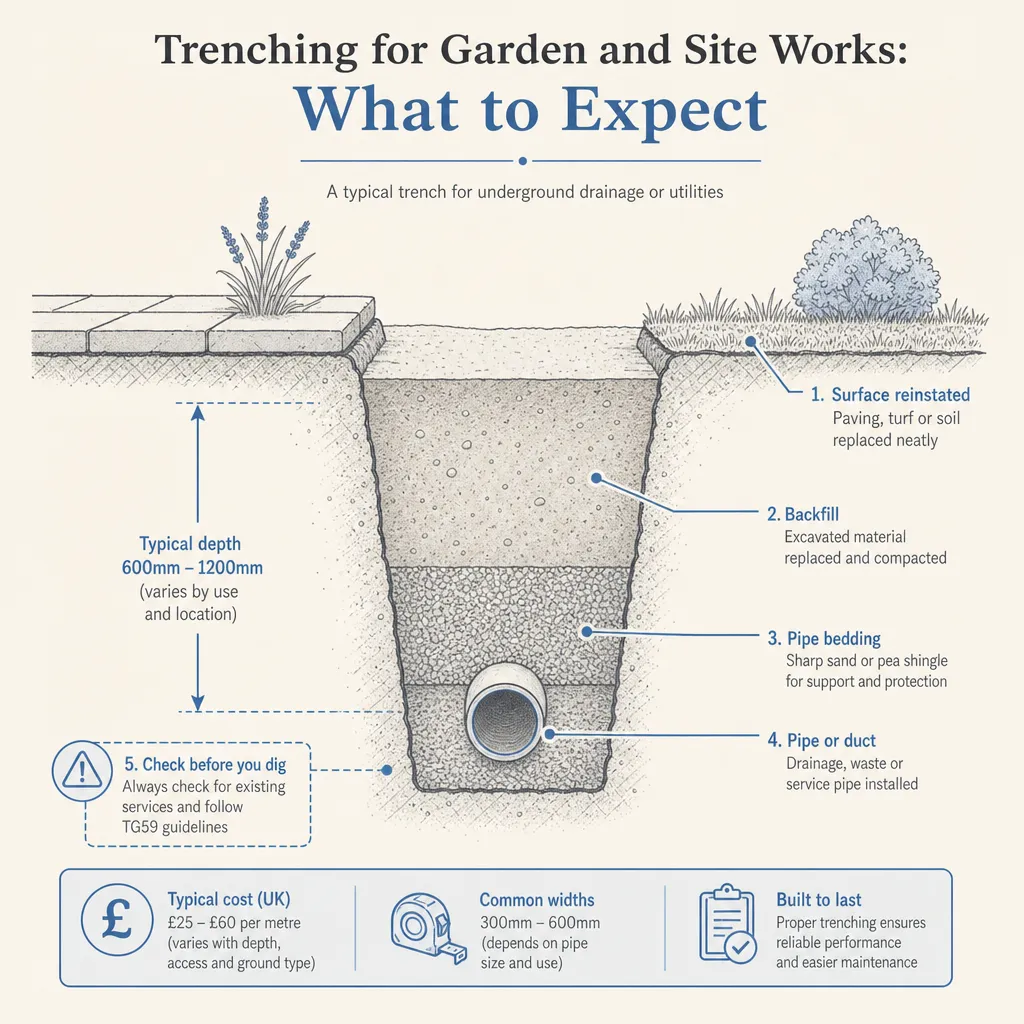
Trenching for Garden and Site Works: What to Expect
Trenching is one of the most common groundwork tasks on UK residential properties, arising whenever drainage, utilities, or substructure drainage need to be laid or extended. Whether you're installing a soakaway at the foot of the garden, running armoured cable to an outbuilding, or laying a new MDPE water supply pipe to an outside tap, the way the trench is dug, bedded, and backfilled has a direct bearing on how the finished installation performs. Getting depths, bedding, and compaction wrong can mean collapsed pipes, cable damage, or future ground settlement under paving.
Key points
- Electricity cable trenches should be a minimum of 450 mm deep under gardens and 600 mm under drives and paths — confirm statutory requirements with your Distribution Network Operator (DNO) before starting.
- Drainage trenches for gravity foul and surface water pipes are typically excavated to 600–900 mm, with depth measured to the invert level (bottom of pipe bore), not the top of the trench.
- Water supply pipes (MDPE) must be buried at least 750 mm deep to protect against frost — shallower burial in the UK climate risks freezing and pipe failure in cold winters.
- Before any excavation, check for buried services using a cable avoidance tool (CAT) and signal generator (genny); the free Linesearch Before U Dig (LSBUD) service maps gas, electricity, and telecoms routes.
- Work within 3 metres of a public sewer requires written consent from your sewerage undertaker under Section 23 of the Water Industry Act 1991 before breaking ground.
What counts as trenching and when do you need it?
Trenching means cutting a narrow channel into the ground to accommodate a pipe, conduit, cable, or drainage run. On a typical UK residential property the most common reasons to trench are:
- New drainage runs — connecting a patio drain, a downpipe extension, or a new WC to the existing drain or a soakaway.
- Outbuilding power supply — burying an armoured cable (SWA) to a garden studio, detached garage, or workshop.
- Water supply extension — running a blue MDPE pipe from the internal stopcock to an outhouse, pool plant room, or garden tap.
- Foundation drainage — installing a French drain or land drain system around a damp-prone wall or the footprint of a new extension.
- Soakaway construction — excavating a perforated plastic chamber or rubble-filled pit to receive surface water where a mains connection is unavailable or impractical.
The required trench depth, width, bedding specification, pipe gradient, and reinstatement method all differ depending on which service is going in the ground.
How deep does a trench need to be?
Depth requirements are set by the type of service being installed and by where on the site the trench runs.
Service type | Min. depth under garden / soft landscaping | Min. depth under drive or path | Bedding required? |
|---|---|---|---|
Armoured electricity cable (SWA) | 450 mm | 600 mm | Yellow warning tape above cable |
Water supply pipe (MDPE) | 750 mm | 750 mm | Sand haunching recommended |
Foul drainage (clay or PVC-u) | 600 mm to invert | 600 mm to invert | 100 mm granular bed |
Surface water drainage | 600 mm to invert | 600 mm to invert | 100 mm granular bed |
Gas service pipe | 375 mm (garden) | 600 mm | Yellow marker tape required |
Indicative UK depths, last reviewed 2026-05-25. Always confirm with your installer, the relevant utility company, and the applicable British Standard or Approved Document. Gas pipework must be installed by a Gas Safe registered engineer throughout.
Do you need planning permission or building control approval?
For most routine residential trenching — drains to a soakaway, cable runs to a garage, a garden tap supply — permitted development rights cover the work without a formal planning application. There are important exceptions:
- Conservation areas or listed buildings: any significant ground alteration may require Listed Building Consent or Conservation Area Consent from your local planning authority (LPA). Check before breaking ground.
- Near a public sewer: under Section 23 of the Water Industry Act 1991, written consent from your sewerage undertaker (Thames Water, Severn Trent, Yorkshire Water, etc.) is legally required before building or excavating within 3 metres of a public sewer.
- Building regulations notifications: new drainage connections and soakaways are notifiable under Approved Document H — you'll need a Building Notice or Full Plans submission to local authority building control or an Approved Inspector. Electrical cable burial to an outbuilding is notifiable under Part P unless carried out by a registered competent-person scheme member (NICEIC or NAPIT).
- Trenching across a boundary: if the trench passes under a neighbouring property, a legal easement or a deed of consent is required before work starts.
What happens on site?
A competent groundworker typically follows this sequence:
- Mark out and service check — Mark the trench line on the surface; carry out a CAT/genny sweep; cross-reference against LSBUD utility plans.
- Excavate — By mini-digger for runs over approximately 10 metres; by hand in confined spaces or within 500 mm of known buried services or structures.
- Grade and bed — Lay granular bedding material (pea gravel or sharp sand) to the correct falls. Approved Document H requires a minimum 1:40 gradient for 100 mm foul drainage pipes.
- Lay the service — Pipe, duct, or armoured cable positioned in the bedded trench.
- Haunch and surround — Backfill around the service with selected fine granular material before the bulk fill is returned.
- Lay warning tape — Coloured marker tape above each service: yellow for gas, blue for water, red for electricity.
- Backfill and compact — Return excavated material in layers of no more than 300 mm, compacting each layer with a whacker plate or heel-and-tamp to prevent future settlement.
- Reinstate surface — Topsoil and turf, re-laid block paving, tarmac, or gravel as agreed with the householder before work began.
Homeowner pre-trench checklist
Before your groundworker arrives, work through this list:
Red flags to watch for
Certain situations on site mean you should pause all work and seek specialist advice before continuing:
- Unexplained pipes or cables not shown on utility records: stop excavation immediately and contact the relevant utility company before proceeding.
- Discoloured, oily, or strong-smelling soil: possible contamination — do not disturb further until a specialist has assessed and, if necessary, tested the material.
- Rapid water flooding into the trench: may indicate a high water table, an undisclosed drainage run, or a nearby burst supply pipe — investigate with a drainage contractor.
- Cracking or movement in adjacent buildings or walls during excavation: stop all work immediately and consult a chartered surveyor or structural engineer before resuming.
- Gas smell at any time: evacuate the area and call the National Gas Emergency Service on 0800 111 999 immediately.
When to get professional help
Most domestic garden trenching is well within the competence of a qualified groundworker. Some situations require a specialist from the outset:
- Gas service trenching: legally requires a Gas Safe registered contractor throughout — it is a criminal offence for an unregistered person to install gas fittings in the UK.
- Electrical cable burial: must comply with BS 7671 (IET Wiring Regulations 18th Edition) and be notified to building control under Part P unless carried out by a registered competent-person scheme member.
- Drainage near a public sewer: requires sewerage undertaker consent and may require a CCTV survey of the existing drain before work can begin.
- Trenching near building foundations: the groundworker should assess structural implications — excavation within the zone of influence of a foundation can undermine it, particularly on clay soils.
How Housey can help
Housey connects you with vetted groundworkers and drainage contractors who operate in your area. Describe your project — trench length, service type, surface reinstatement — and receive comparable quotes from qualified professionals.
Frequently asked questions
Do I need building regulations approval for garden trenching?
It depends on what's going in the trench. Drainage connections to a public sewer or soakaway are notifiable under Approved Document H, so you'll need a Building Notice or Full Plans application. Cable runs to an outbuilding are notifiable under Part P of the Building Regulations unless carried out by a registered competent-person scheme contractor (NICEIC or NAPIT). General landscaping trenches with no services require no building regulations approval.
How long does domestic garden trenching take?
A straightforward run of 20–30 metres — for example, running a drainage pipe from a downpipe to a soakaway — typically takes one day for a groundworker with a mini-digger, plus a further half to full day for bedding, pipe laying, backfilling, and reinstatement. Hand-dug trenches in confined spaces or near existing structures take considerably longer and will be priced accordingly.
What bedding material is required for drainage pipes in a trench?
Clay and PVC-u drainage pipes should be laid on a minimum 100 mm granular bed — 10 mm single-size shingle or pea gravel is most commonly used — then haunched with the same material to the spring line of the pipe before bulk backfilling in compacted layers. Approved Document H and BS EN 1610 set out the full bedding and backfill requirements for UK drainage installations.
Can I dig a garden service trench myself?
For trenches containing buried utilities — electrical cables, gas pipes, water supply mains, or drainage — the work should be carried out or overseen by a qualified contractor to meet building regulations and utility provider standards. Always check for buried services via LSBUD and a CAT scan before any digging. Hand-digging a shallow landscape trench with no services is generally unregulated, but service checks are still advisable.
Sources and further reading
- Approved Document H: Drainage and Waste Disposal — GOV.UK
- Linesearch Before U Dig (LSBUD) — LSBUD
- IET Wiring Regulations BS 7671 — Institution of Engineering and Technology
- Water Industry Act 1991 — Section 23 — legislation.gov.uk
- Gas Safe Register: working on gas fittings — Gas Safe Register
Useful next reads
 Improvement & Build
Expenses for Clearing and Preparing Land
Land clearing and site preparation costs vary widely by scope.
 Improvement & Build
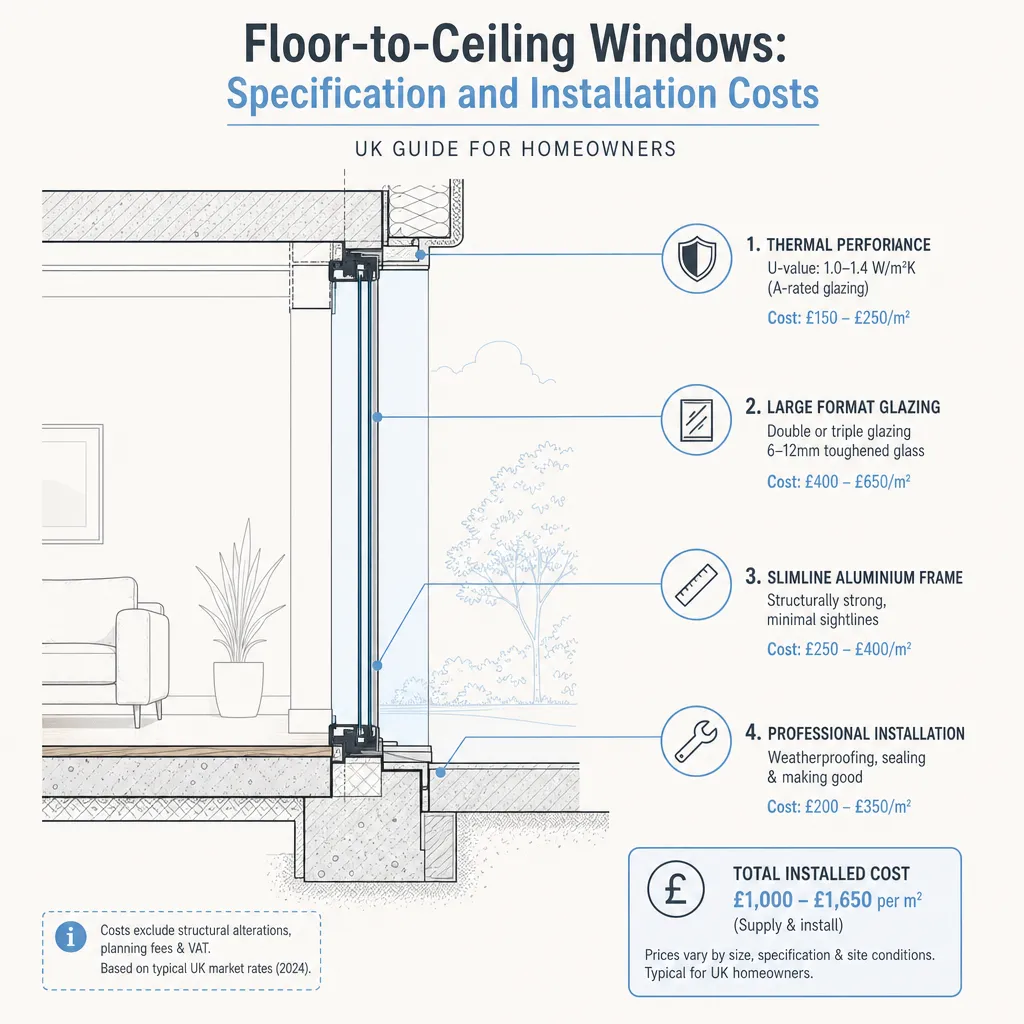
Floor-to-Ceiling Windows: Specification and Installation Costs
Floor-to-ceiling windows in the UK typically cost £1,800–£6,500 per unit installed, depending on glazing type, frame material, and whether structural alterations are needed.
 Improvement & Build
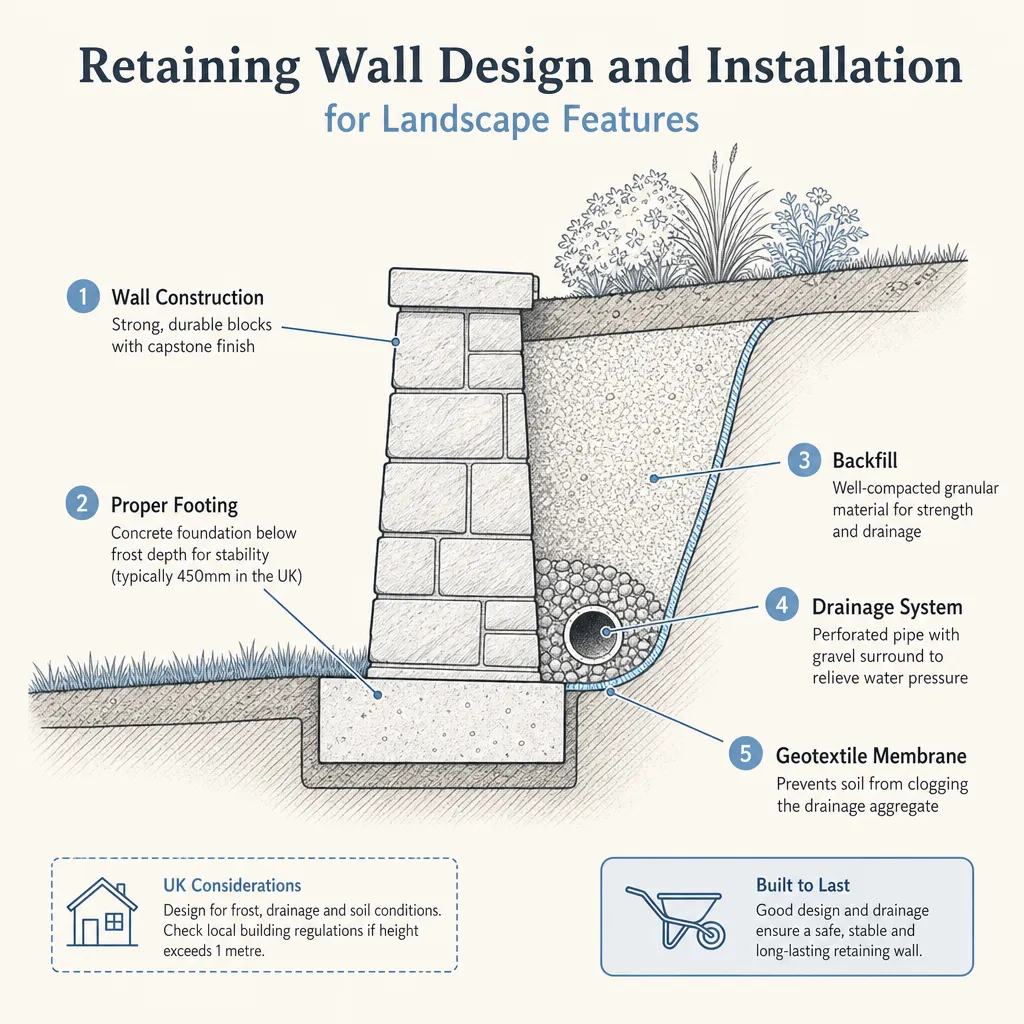
Retaining Wall Design and Installation for Landscape Features
A garden retaining wall holds back soil on a sloped plot using concrete blocks, stone, or timber.
 Improvement & Build
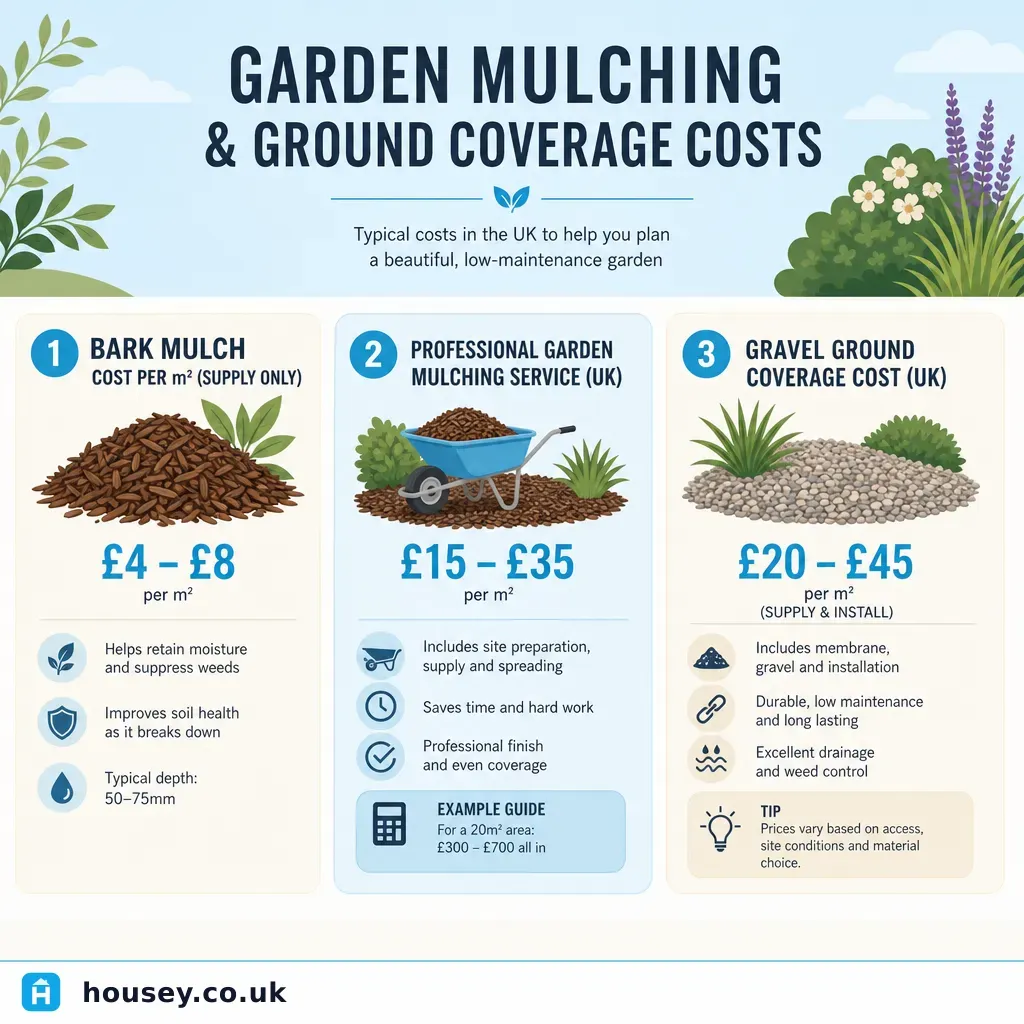
Garden Mulching and Ground Coverage Costs
Professional garden mulching typically costs £150–£600 for an average UK garden, depending on material type, area covered, and whether you hire a landscaper.
 Improvement & Build
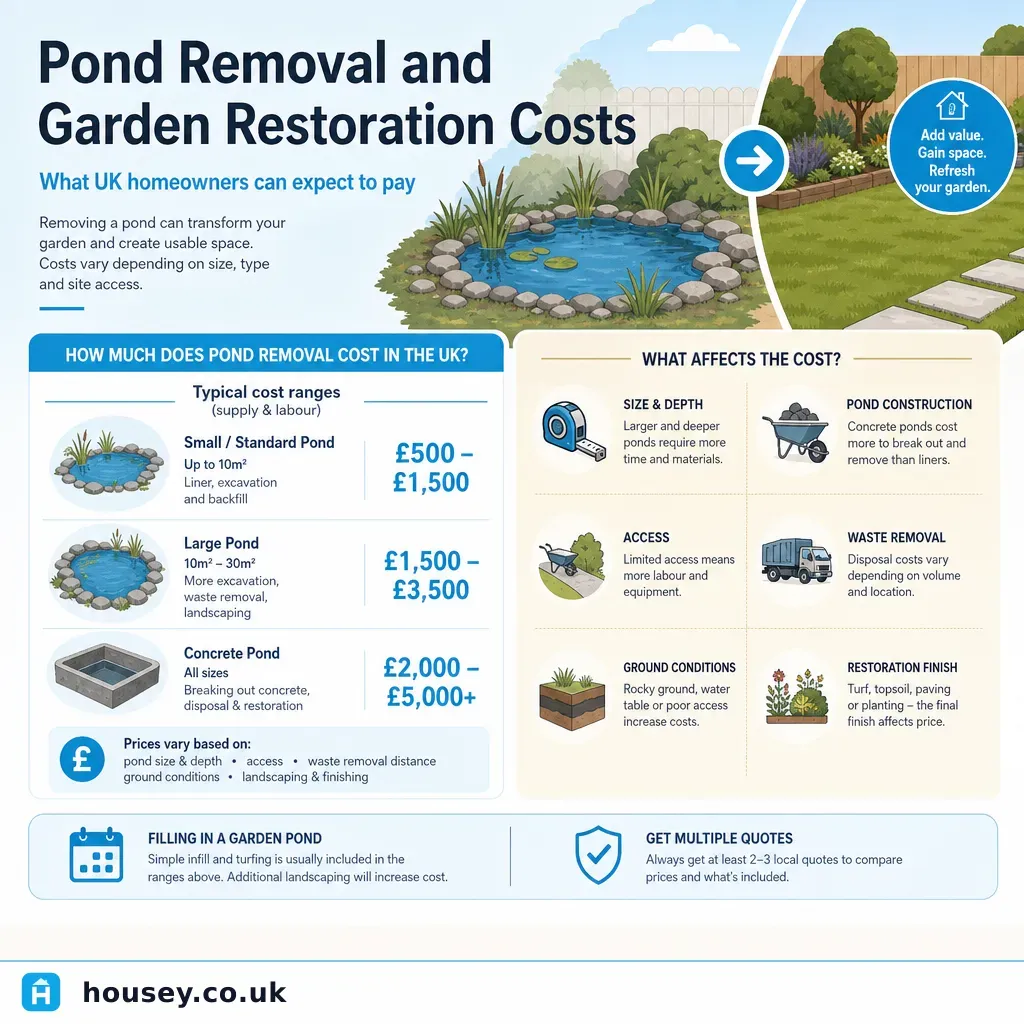
Pond Removal and Garden Restoration Costs
Removing a garden pond in the UK typically costs £300–£700 for a small liner pond, rising to £1,800–£4,000 for a concrete or brick-built structure.