Tree Roots Damaging Sewer Lines: Assessment and Solutions
By Housey · Last reviewed 30th of May 2026
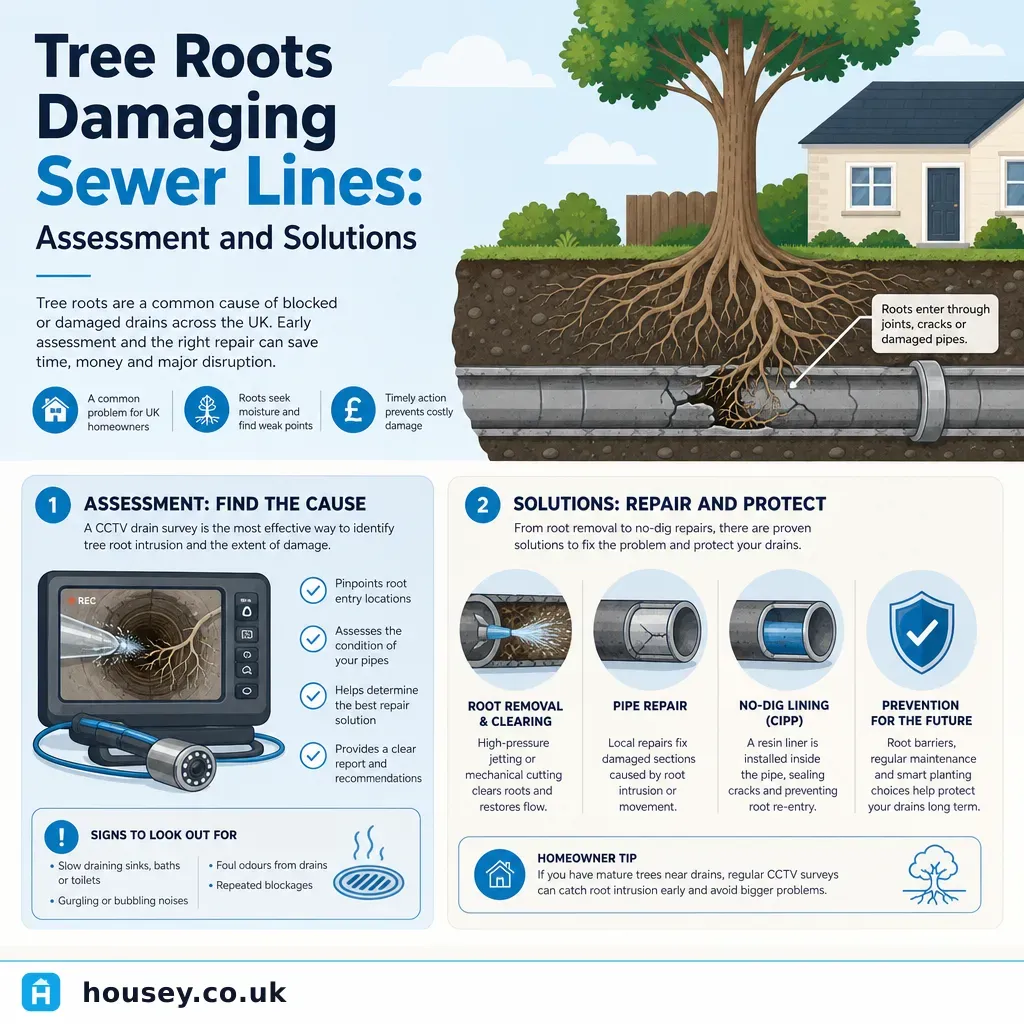
Tree Roots Damaging Sewer Lines: Assessment and Solutions
Tree root ingress into sewer and drain pipes is one of the more disruptive drainage problems a UK homeowner can face, partly because it develops slowly and invisibly underground, and partly because responsibility for repair — whether it falls on the homeowner or the water company — depends on exactly where in the pipe network the problem lies. The question typically arises after a slow drain, a recurring blockage, or a CCTV drain survey identifies root material inside the pipe.
Key points
- Roots in private drains within the property boundary are the homeowner's responsibility; roots in adopted public sewers are the water company's, under the Water Industry Act 1991.
- A CCTV drain survey is the standard diagnostic method for root ingress in UK drains, producing a condition report coded to the Water Research Centre (WRC) Manual of Sewer Condition Classification, 5th edition.
- Tree roots can travel 30–60 m from the base of a mature tree and exploit hairline cracks, compression joints, and clay pipe socket joints.
- Willow, poplar, and silver birch are among the most aggressive species for drain damage in UK gardens.
- Private drain repairs involving root damage typically cost £500–£3,000 or more depending on pipe depth, access, and repair method; confirmed adopted sewer repairs are the water company's responsibility and cost.
How tree roots enter and damage drain pipes
Roots seek water and nutrients. A small crack at a clay pipe joint or a slightly displaced compression joint emits warmth and moisture that fine root tips can detect and follow. Once inside the pipe, a single filament becomes a mat of fibrous root tissue that:
- Catches passing solids, creating a partial or complete blockage.
- Continues to grow, eventually cracking or displacing pipe sections further.
- In clay or vitrified clay (VC) pipes — common in UK properties built before the mid-1980s — accelerates structural collapse under ground pressure.
The rate of damage depends on tree species, pipe material, pipe depth, and ground conditions. Clay and older push-fit PVC pipes are more vulnerable than modern cured-in-place pipe (CIPP) linings.
Which trees cause the most drain damage in UK gardens?
Tree species | Root aggressiveness | Typical root spread | Most vulnerable pipe types |
|---|---|---|---|
Willow (Salix spp.) | Very high | Up to 40 m | Clay, old PVC, pitch-fibre |
Poplar (Populus spp.) | Very high | Up to 40 m | Clay, old PVC |
Silver birch (Betula pendula) | High | 15–25 m | Clay, push-fit PVC |
Oak (Quercus spp.) | Moderate–high | 20–30 m | Clay, older pipes |
Ash (Fraxinus excelsior) | Moderate | 15–20 m | Clay |
Apple and cherry (Malus, Prunus) | Low–moderate | 5–10 m | All types at joints |
Indicative values based on arboricultural guidance. Actual spread depends on soil conditions, water availability, and tree age.
Deciding who is responsible for repair
- Contact your water company if the affected drain is in the highway, serves more than one property, or is shown as an adopted sewer on a drainage map. Drainage maps are available from your water company and were included in any drainage and water search carried out during conveyancing.
- Contact a drainage contractor for private repair if the drain is within your property boundary and serves only your property.
- Seek legal advice if there is a dispute about adoption status, or if a neighbour's tree has caused damage to your private drain — liability may rest with the tree owner under common law nuisance principles.
- Check your buildings insurance policy before commissioning repairs — some policies cover sudden and unforeseen drain damage, and a pre-repair CCTV survey report will support any claim you make.
What a CCTV drain survey will tell you
A CCTV drain survey passes a crawler or push-rod camera through the drain to record the pipe interior. A competent drainage contractor will produce a WRC-coded condition report identifying defects including:
- RB — Root Ball: dense root mass blocking or partially blocking the pipe bore.
- RJ — Root Junction: roots entering at a joint.
- DJO — Displaced Joint Open or DJC — Displaced Joint Closed: joint displacement that has allowed root entry.
- CL — Crack Longitudinal or CC — Crack Circumferential: structural cracking that may be root-related or concurrent with root damage.
The report should include pipe diameter, invert depth, pipe material, flow direction, and a defect schedule with WRC severity grades. This document is necessary for planning repairs, supporting water company claims, and satisfying insurance requirements.
Repair options for root-damaged drains
Method | Best for | Indicative cost (2026) | Disruption level |
|---|---|---|---|
High-pressure water jetting | Temporary clearance; partial root intrusion only | £100–£300 | Minimal |
Mechanical root cutting | Established root mass blocking the bore | £200–£500 | Minimal |
CIPP pipe lining | Cracked or displaced clay or PVC pipes; avoids excavation | £800–£2,500+ per run | Low — access at manholes only |
Excavation and pipe replacement | Collapsed sections; very shallow drains with poor access | £1,500–£5,000+ | Significant; surface reinstatement needed |
Pitch-fibre reaming and lining | Deformed legacy pitch-fibre pipes | £700–£2,000 | Low–moderate |
Indicative UK costs, last reviewed 2026-05-30. Quotes vary significantly by depth, access, location, and pipe length. Obtain at least three quotes before proceeding.
Red flags that indicate serious or urgent drain damage
- Sewage smell inside or outside the property with no obvious surface-level cause.
- Slow drainage on multiple fixtures at the same time — bath, sink, and WC all sluggish suggests a main drain issue rather than a single branch problem.
- Gurgling from inspection chambers or gullies when another fixture is in use.
- Wet patches or unusually lush grass in a line across the garden, which may indicate a leaking drain below ground.
- A blockage that clears temporarily with jetting but recurs within a few weeks.
- A CCTV report showing WRC grade 4 or 5 structural defects, indicating near-collapse or open pipe.
A WRC grade 5 defect — structural failure or open pipe — should be treated as urgent. Raw sewage escaping underground can contaminate soil and undermine adjacent structure.
What to ask a drainage contractor before instructing them
- Are you a member of the National Association of Drainage Contractors (NADC) or hold an equivalent accreditation?
- Will the CCTV survey produce a WRC-coded condition report with footage I can retain?
- Can you confirm whether the affected drain is private or public before quoting for repair?
- Is your lining contractor approved by the relevant water company if the work might affect an adopted sewer?
- What guarantee do you offer on the lining or excavation repair, and is it backed by insurance?
- Does your quote include surface reinstatement after excavation?
- Have you checked for other defects in the line that might undermine the repair before work starts?
When to get professional help
Commission a CCTV drain survey if you notice any of the red flags above. Do not attempt to probe or excavate near a suspected root-damaged drain yourself — if the pipe is fragile or partially collapsed, disturbance can worsen the failure and cause soil subsidence. If tree work near a sewer is planned, consult a drainage contractor before felling: root removal can shift the surrounding soil and stress adjacent pipe joints.
If the damage appears to involve the adopted public sewer, contact your water company's emergency or infrastructure team directly. They have a statutory duty under the Water Industry Act 1991 to investigate and repair adopted sewers.
How Housey can help
Housey connects you with qualified professionals for CCTV drain surveys and drainage contractors across the UK. Receive and compare quotes before committing to investigation or repair work.
Frequently asked questions
How do I know whether a blockage is in a public or private sewer?
Request a drainage map from your water company, which shows the adopted public sewer network. If you purchased the property recently, a drainage and water search carried out during conveyancing will include the same information. A drainage contractor can also trace the pipe during a CCTV survey and help identify adoption status from the pipe's depth, diameter, and whether it serves more than one property.
Can I remove the offending tree to stop further root damage?
Removing the tree will stop further root growth but will not repair existing pipe damage — a CCTV survey and repair are still required. Before felling, check whether the tree is protected by a Tree Preservation Order (TPO) or is in a conservation area, both of which require planning permission for removal in England. Use GOV.UK's guidance on tree preservation orders to check status before instructing an arborist.
Will my buildings insurance cover tree root drain damage?
Most standard buildings insurance policies cover sudden and unforeseen damage rather than gradual deterioration. Root damage is usually treated as gradual unless it caused a sudden structural collapse or pipe burst. Review your policy wording carefully and contact your insurer before commissioning repairs — having a WRC-coded CCTV condition report in hand before repair work starts will support any claim you make.
Does a drain defect need to be disclosed when selling a property in England or Wales?
A known drain defect should be disclosed on the TA6 Property Information Form used in England and Wales conveyancing. Buyers may commission their own CCTV drain survey as part of pre-exchange due diligence. An unresolved defect can prompt renegotiation or a price reduction. Repairing the drain and obtaining a post-repair CCTV inspection report before marketing usually simplifies the sale process.
Sources and further reading
- Water Industry Act 1991 — legislation.gov.uk
- WRC Manual of Sewer Condition Classification, 5th Edition — Water Research Centre
- Tree preservation orders and protected trees — GOV.UK
- Drainage responsibilities for homeowners — Ofwat
- National Association of Drainage Contractors — NADC
Useful next reads
 Surveys & Inspections
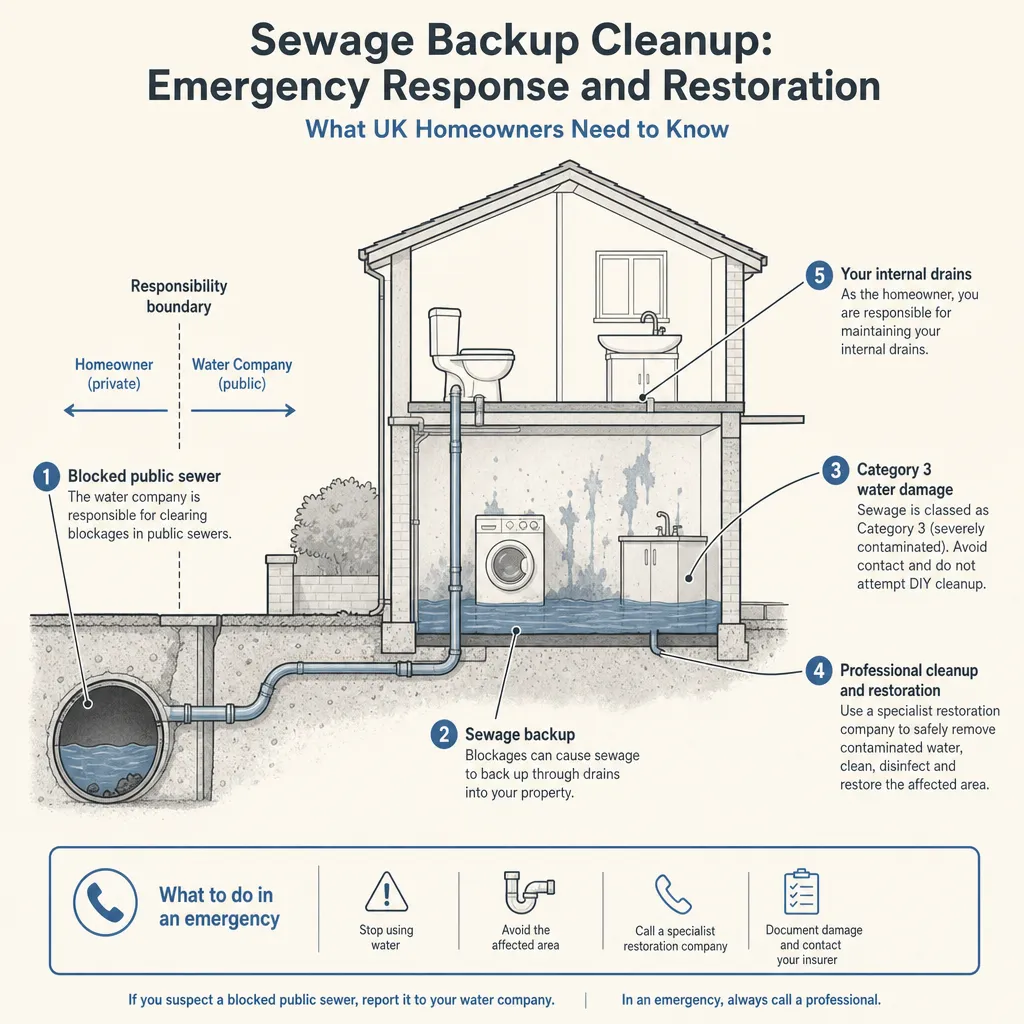
Sewage Backup Cleanup: Emergency Response and Restoration
A sewage backup should be treated as a Category 3 contamination event.
 Surveys & Inspections
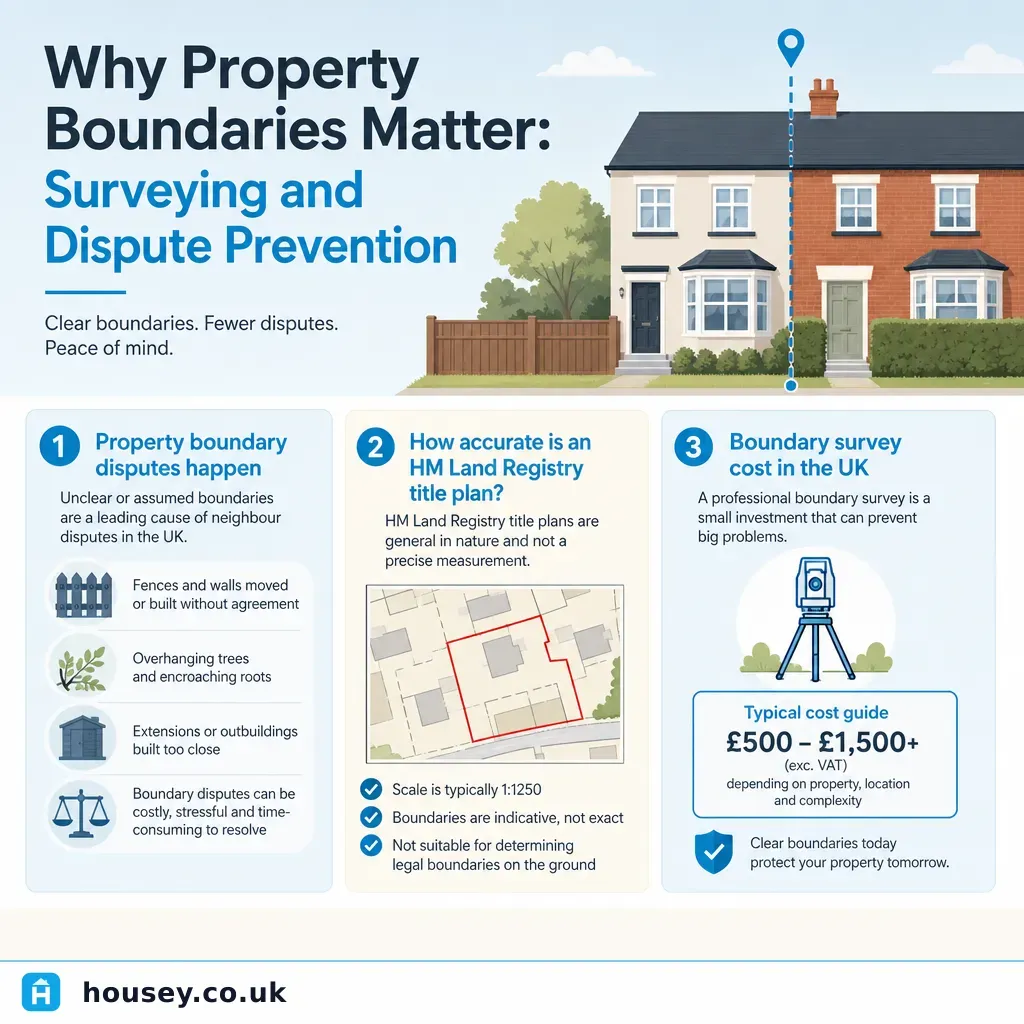
Why Property Boundaries Matter: Surveying and Dispute Prevention
Property boundaries in England and Wales are recorded as general boundaries by HM Land Registry — not precise measurements.
 Surveys & Inspections
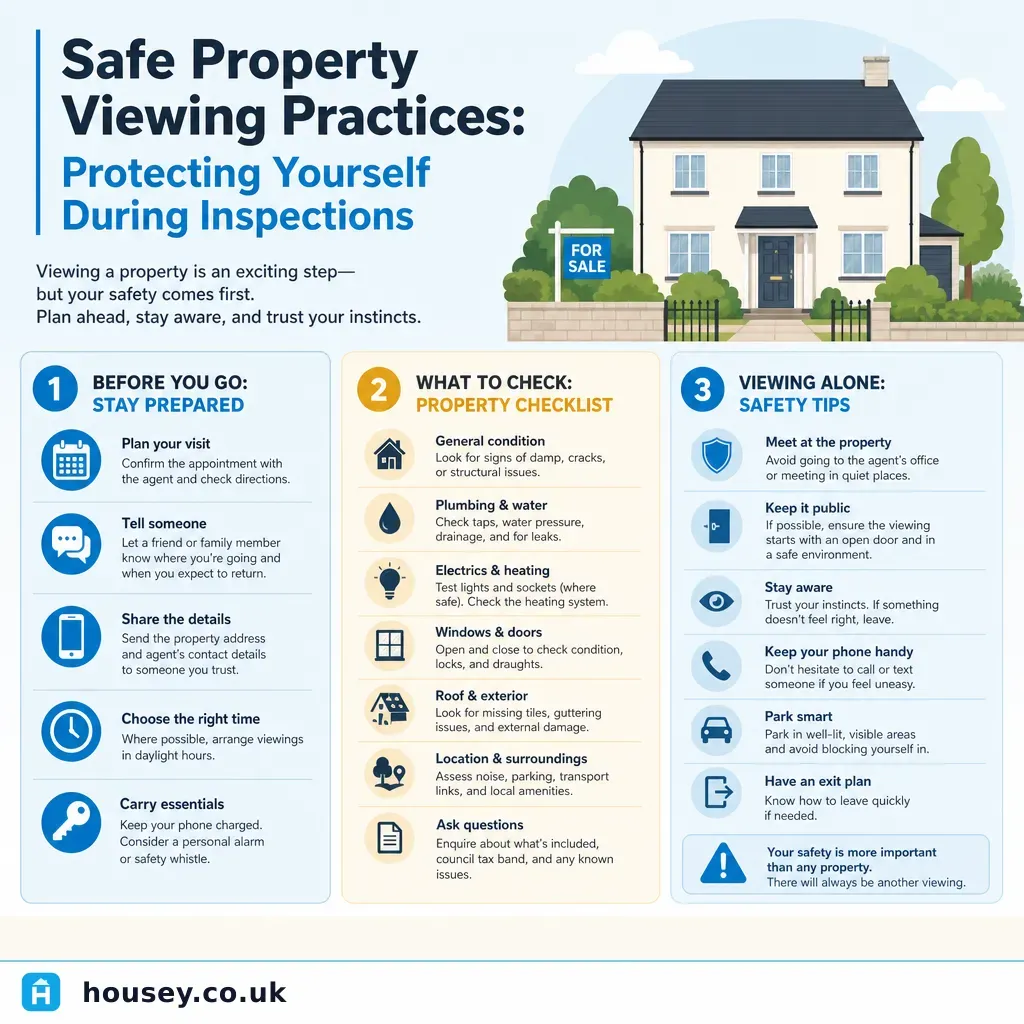
Safe Property Viewing Practices: Protecting Yourself During Inspections
When viewing a property in the UK, always tell someone where you are going and share the full address before you leave.
 Surveys & Inspections
Identifying Asbestos Insulation: What You Need to Know for Your Property
Asbestos insulation was widely used in UK properties built before 2000, commonly found in pipe lagging, ceiling tiles, loose-fill loft insulation, and around boilers.
 Surveys & Inspections
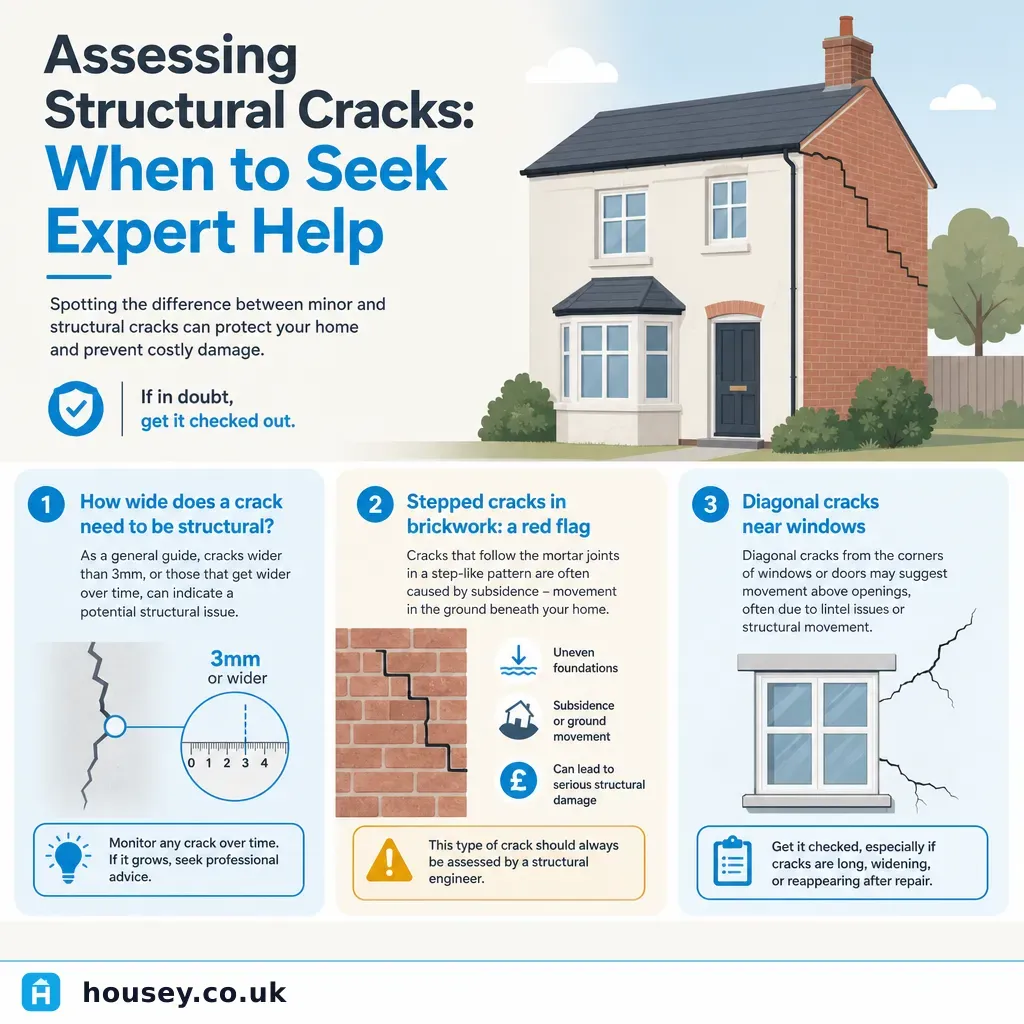
Assessing Structural Cracks: When to Seek Expert Help
Structural cracks range from harmless shrinkage hairlines to signs of subsidence or foundation movement.