Sewer Connection Replacement: Costs and Process
By Housey · Last reviewed 30th of May 2026
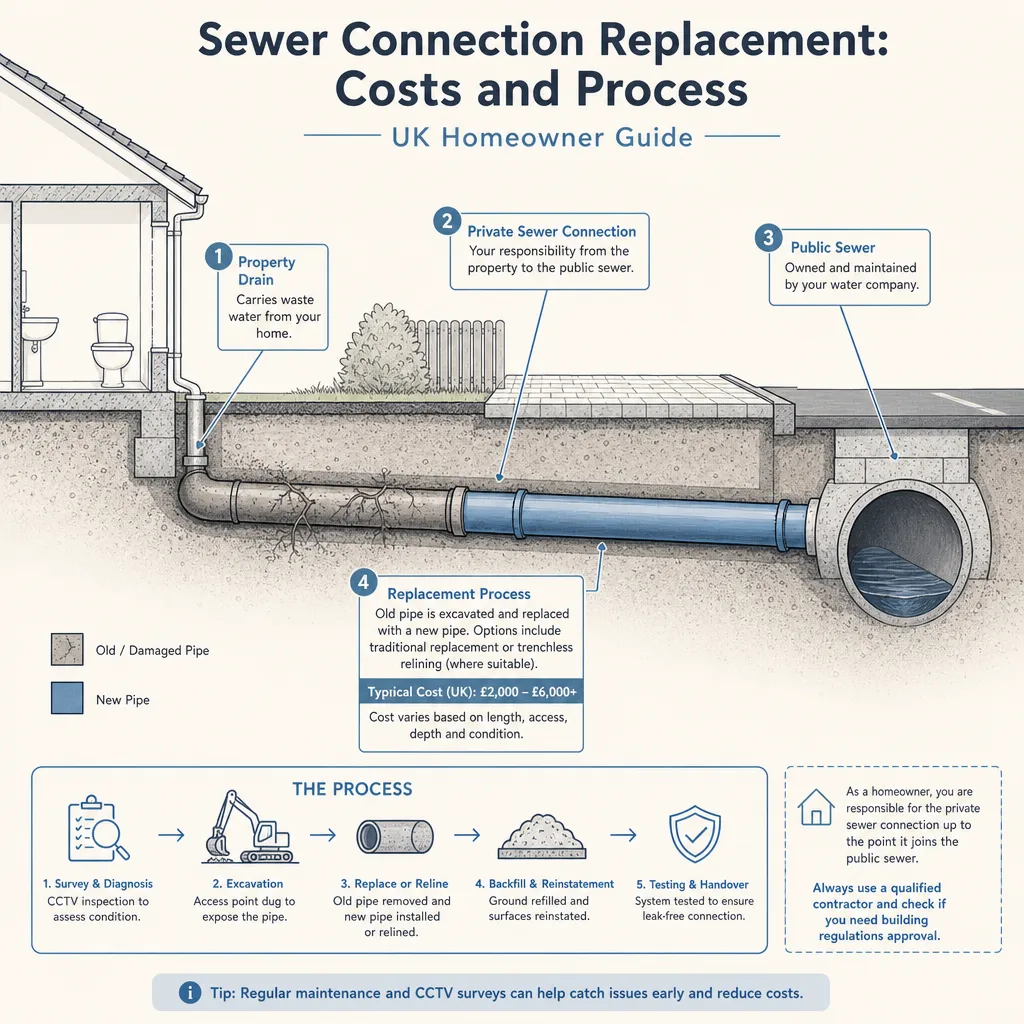
Sewer Connection Replacement: Costs and Process
Sewer connection problems rarely announce themselves gently — slow drainage, recurring blockages, subsidence cracks, or a damp patch in the garden often bring them to light. Whether you have discovered a collapsed clay pipe under a Victorian terrace or a cracked uPVC run beneath a 1990s estate home, the question of whether to repair, reline, or fully replace a sewer connection is one that affects your property's habitability and your legal obligations as a homeowner.
Key points
- Under the Water Industry Act 1991 and the Water Industry (Schemes for Adoption of Private Sewers) Regulations 2011, most shared private sewers were transferred to the relevant water and sewerage company on 1 October 2011 — but private drains serving only your property remain your responsibility to maintain and repair.
- Building Regulations Approved Document H (Drainage and Waste Disposal) applies to new drainage runs and significant replacements; you may need to notify your local building control authority before starting work.
- A CCTV drain survey is the standard diagnostic first step before any replacement or relining work; typical residential costs run from £150 to £400.
- No-dig cured-in-place pipe (CIPP) relining can restore structural integrity without excavating drives, patios, or landscaping, and is often more cost-effective than full replacement for pipes in reasonable structural shape.
- Indicative UK costs for sewer connection replacement range from around £3,000 for a short, shallow, easily accessed run to £20,000 or more for deep excavations, long pipe lengths, or complex ground conditions (Indicative UK costs, last reviewed 2026-05-30).
Who is responsible for sewer replacement in the UK?
Responsibility for drainage in England and Wales was redefined by the Water Industry (Schemes for Adoption of Private Sewers) Regulations 2011, which transferred shared private sewers and lateral drains serving more than one property to the relevant water and sewerage company on 1 October 2011.
As a general guide:
- Your private drain — the run from your property to the public sewer boundary, serving only your home — remains your responsibility to maintain and repair.
- Shared sewers serving more than one property were adopted by the water company in October 2011 and are now their responsibility.
- The public sewer has always been the water company's responsibility.
If you are uncertain where the boundary lies, your water and sewerage company — for example Thames Water, Severn Trent, or Yorkshire Water — can provide a sewer map via their online portal.
Always confirm ownership before commissioning work. If the defective section falls within the water company's responsibility, they may carry out repairs at no cost to you.
Repair, reline, or replace?
Option | Best for | Not ideal for | Indicative cost range | Key consideration |
|---|---|---|---|---|
Patch repair | Localised crack or joint failure where the pipe is otherwise sound | Widespread collapse or extensive root ingress | £500–£2,000 | Short-term fix; CCTV follow-up recommended |
CIPP relining (no-dig) | Cracked, leaking, or slightly misaligned pipes with an intact host pipe shape | Collapsed or severely displaced sections | £2,000–£8,000 | Reduces internal diameter marginally; minimal surface disruption |
Full excavation and replacement | Collapsed pipes, severe root damage, incorrect falls, or pipe too degraded to reline | Where reinstatement cost of disturbed surfaces outweighs benefit | £3,000–£20,000+ | Reinstates correct falls and full bore; most disruptive option |
Pipe bursting (no-dig) | Replacing a pipe in the same alignment where relining is not possible | Pipes with tight bends or complex routing | £3,000–£10,000 | Specialist equipment; not offered by all contractors |
Indicative UK costs, last reviewed 2026-05-30. Obtain at least three quotes from qualified drainage contractors.
The sewer replacement process
- Initial investigation — commission a CCTV drain survey to map the drain run, identify defects, confirm pipe material and diameter, and assess fall and alignment.
- Determine responsibility — confirm which section is your liability using the sewer map from your water company.
- Obtain quotes — invite at least three drainage contractors to quote. Providing the CCTV survey report ensures each contractor prices the same scope.
- Building control notification — if your project involves laying new drains or significantly altering existing routes, notify your local building control authority under Building Regulations Part H before starting work. Minor like-for-like repairs in the same position may be exempt, but check first.
- Water company notification — if works will connect to or temporarily affect a public sewer, give at least 21 days' notice under section 106 of the Water Industry Act 1991.
- Excavation, installation, or relining — the chosen method is carried out. Excavation requires appropriate shoring, traffic management if a road or pavement is affected, and proper compaction of backfill.
- Post-works CCTV inspection — reputable contractors carry out a sign-off survey to confirm the repaired or new run is clear, correctly aligned, and watertight.
- Reinstatement — drives, paths, and landscaping disturbed during excavation are reinstated. Confirm reinstatement is included in your quote and to what specification.
Red flags to watch for
Any of these symptoms warrants a drainage survey before attributing the problem to a simpler cause:
- Recurring blocked drains where clearing is only temporarily effective.
- Slow drainage across multiple outlets simultaneously, suggesting a shared or main section is affected.
- Subsidence or soft ground patches in the garden following prolonged wet weather.
- Foul smells from outside, particularly near drain covers or inspection chambers.
- Tree roots from willows, poplars, or similar species growing close to drain runs — root infiltration is a common cause of failure in older clay-pipe systems.
- Rising damp or efflorescence on a ground-floor wall close to an external drain.
What to ask before accepting a quote
- Is a CCTV survey included before and after the works?
- What drainage qualifications does your team hold?
- Will you handle required notifications to building control and the water company on my behalf?
- Is reinstatement of the surface included, and to what specification?
- What guarantee do you offer on the repair or new pipe, and is it backed by an insured warranty?
- Is VAT included in the quoted price?
- What could change the price — for example, if ground conditions or pipe depth differ from expectations?
- Do you carry adequate public liability insurance?
When to get professional help
Sewer replacement is not a DIY task. Excavating near underground utilities, working in or near confined spaces, and connecting to public sewers each carry risks of serious injury and legal liability. Always engage a qualified drainage contractor. Seek professional assessment without delay if:
- Ground movement or subsidence appears linked to drainage failure.
- Foul water or sewage is surfacing in the garden or within the property.
- Blockages cannot be cleared by jetting or rodding.
- Works will affect a shared sewer or require a new connection to the public sewer network.
How Housey can help
Housey connects you with vetted drainage contractors who can carry out CCTV investigations, drainage surveys, and full sewer replacement or relining across the UK. Use our CCTV drain survey service to find a qualified local contractor for an initial diagnosis before committing to replacement works.
Frequently asked questions
Who pays for sewer replacement in the UK?
If the defective section is a shared sewer adopted by your water and sewerage company in October 2011, they are responsible for repair at no cost to you. If the fault lies in your private drain — the run within your property boundary serving only your home — you bear the cost. Checking the sewer map via your water company is the essential first step before commissioning any work.
Do I need planning permission to replace a sewer?
Like-for-like replacement of an existing drain in the same position usually falls within permitted development and does not require planning permission. However, Building Regulations Approved Document H applies to new drainage runs and significant alterations, and you should notify your local building control authority before starting. Always confirm with your local authority if your specific circumstances are unclear.
How long does sewer connection replacement take?
A short no-dig reline can often be completed within one to two days. Full excavation and replacement of a standard residential drain run, including surface reinstatement, typically takes three to five working days. Complex or deep excavations, difficult access, or waiting for building control inspections can extend this timeline considerably.
What is CIPP relining and is it as durable as full replacement?
Cured-in-place pipe (CIPP) relining inserts a resin-impregnated liner into the existing host pipe, which is inflated and cured to form a smooth, jointless new pipe within the old one. When correctly installed it is generally as durable as a new pipe and carries a 10–50 year guarantee from reputable contractors. The internal diameter is marginally reduced — typically by 3–6 mm — which is rarely significant for residential gravity drainage.
Can I claim on home insurance for sewer replacement?
Some accidental damage policies cover drain collapse caused by a sudden event or linked to subsidence. However, many standard home insurance policies exclude gradual deterioration of underground drains. Check your policy wording carefully and contact your insurer before commissioning work. Separate drain insurance add-ons are available from some providers if your standard policy does not offer cover.
Sources and further reading
- Water Industry Act 1991 — legislation.gov.uk
- Water Industry (Schemes for Adoption of Private Sewers) Regulations 2011 — legislation.gov.uk
- Approved Document H: Drainage and Waste Disposal — GOV.UK
- Sewers and drains explained — Water UK
- Connecting to a public sewer — GOV.UK
Useful next reads
 Improvement & Build
Gutter Replacement: When and What It Costs
Full gutter replacement on a typical UK semi-detached house costs £400–£900 for uPVC, rising to £1,000–£1,800 for seamless aluminium and £2,000–£4,000 or more for cast iron.
 Improvement & Build
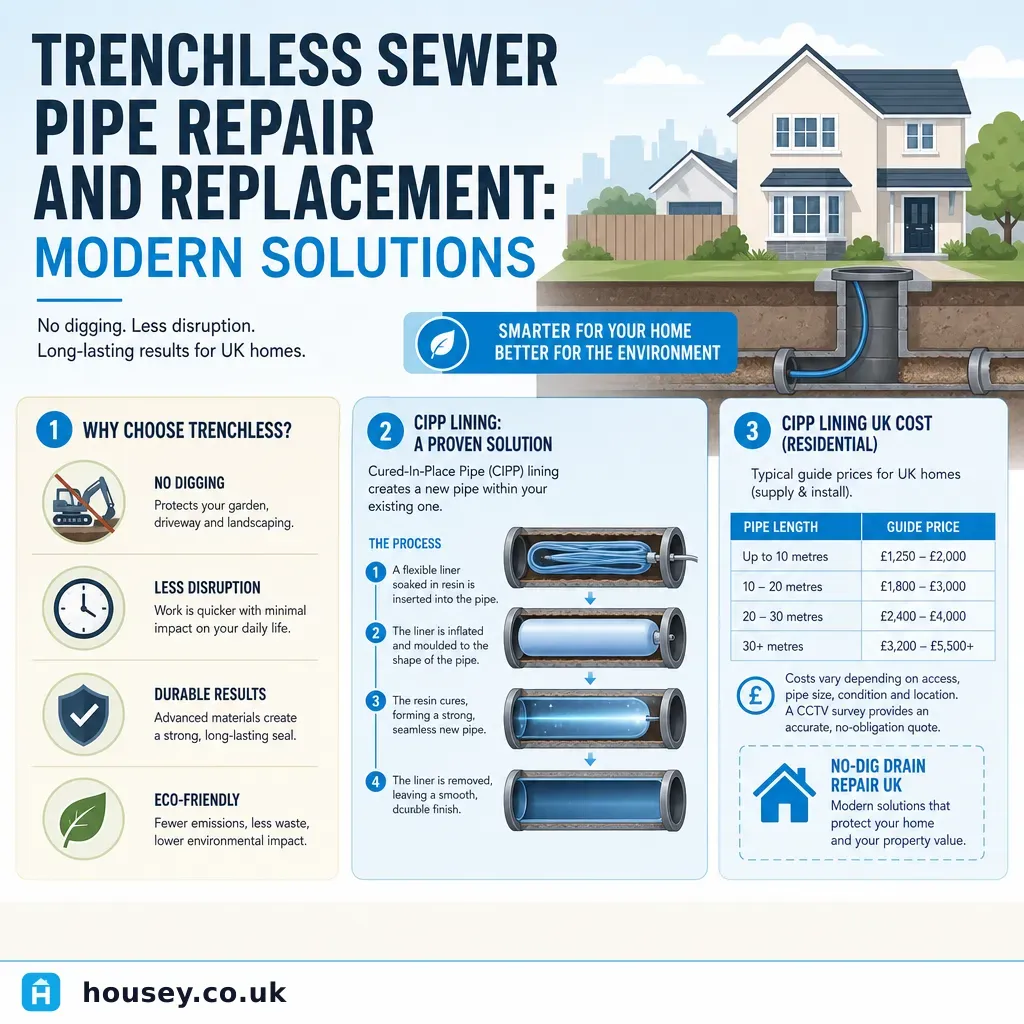
Trenchless Sewer Pipe Repair and Replacement: Modern Solutions
Trenchless sewer pipe repair uses methods such as CIPP (cured-in-place pipe) lining and pipe bursting to rehabilitate or replace underground drain pipes with minimal excavation.
 Improvement & Build
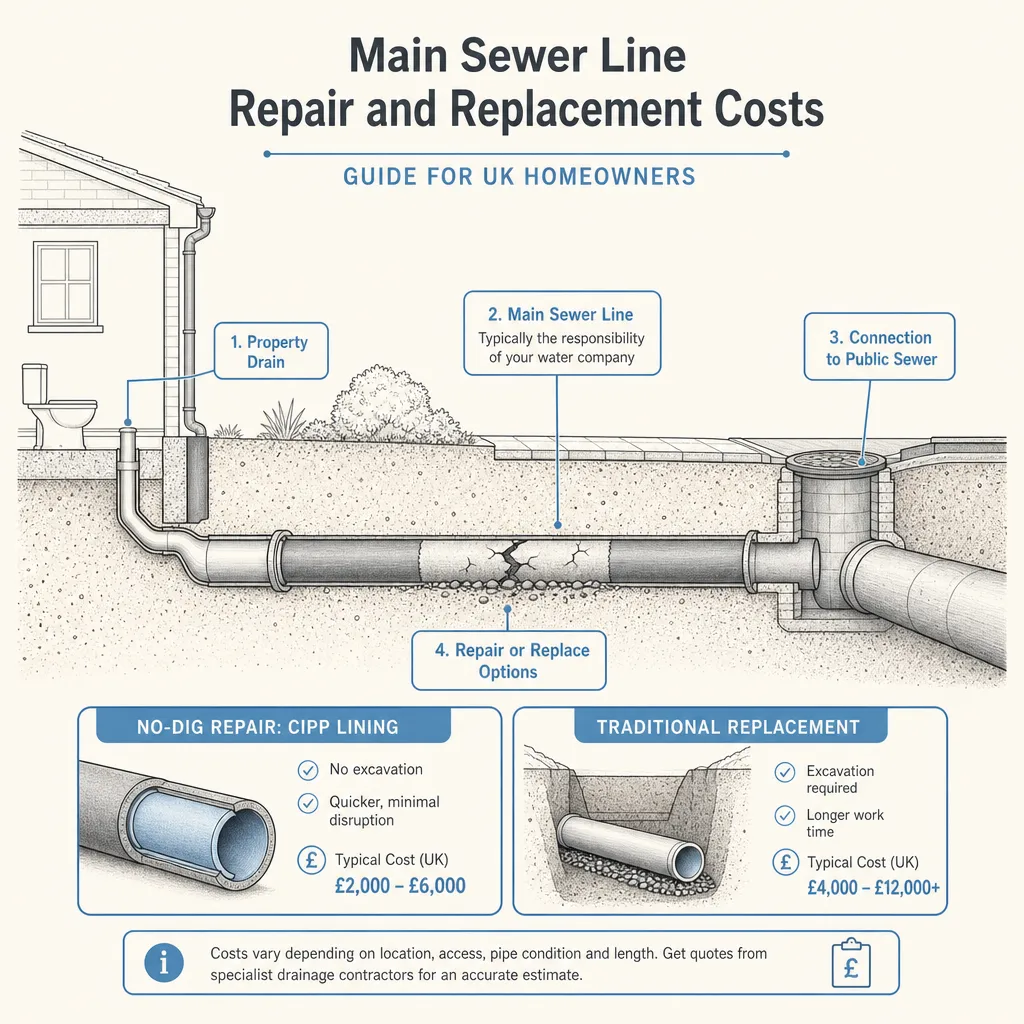
Main Sewer Line Repair and Replacement Costs
Main sewer line repair in the UK costs roughly £500–£2,500 for no-dig methods such as patch lining or full CIPP lining, and £3,000–£10,000 or more for open-cut excavation and pipe replacement.
 Improvement & Build
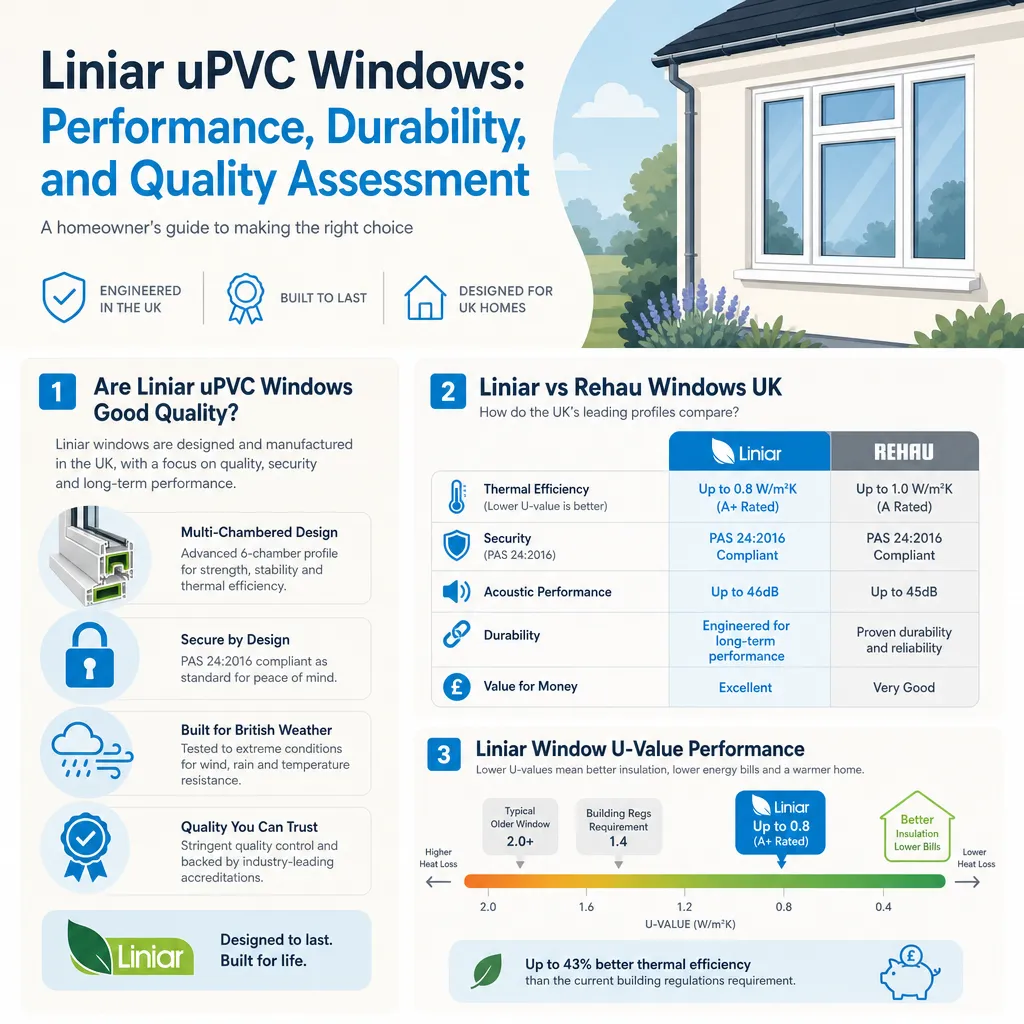
Liniar uPVC Windows: Performance, Durability, and Quality Assessment
Liniar uPVC window profiles are manufactured in the UK using multi-chambered, foamed frames.
 Improvement & Build
Garden Tap Installation with Hot and Cold Water: Plumbing Options
Adding a cold garden tap is a common DIY project, but routing hot water outdoors requires a plumber to connect to your domestic hot water system and comply with the Water Supply (Water Fittings) Regulations 1999.