Sewer Pipe Installation and Underground Drainage Networks
By Housey · Last reviewed 10th of May 2026
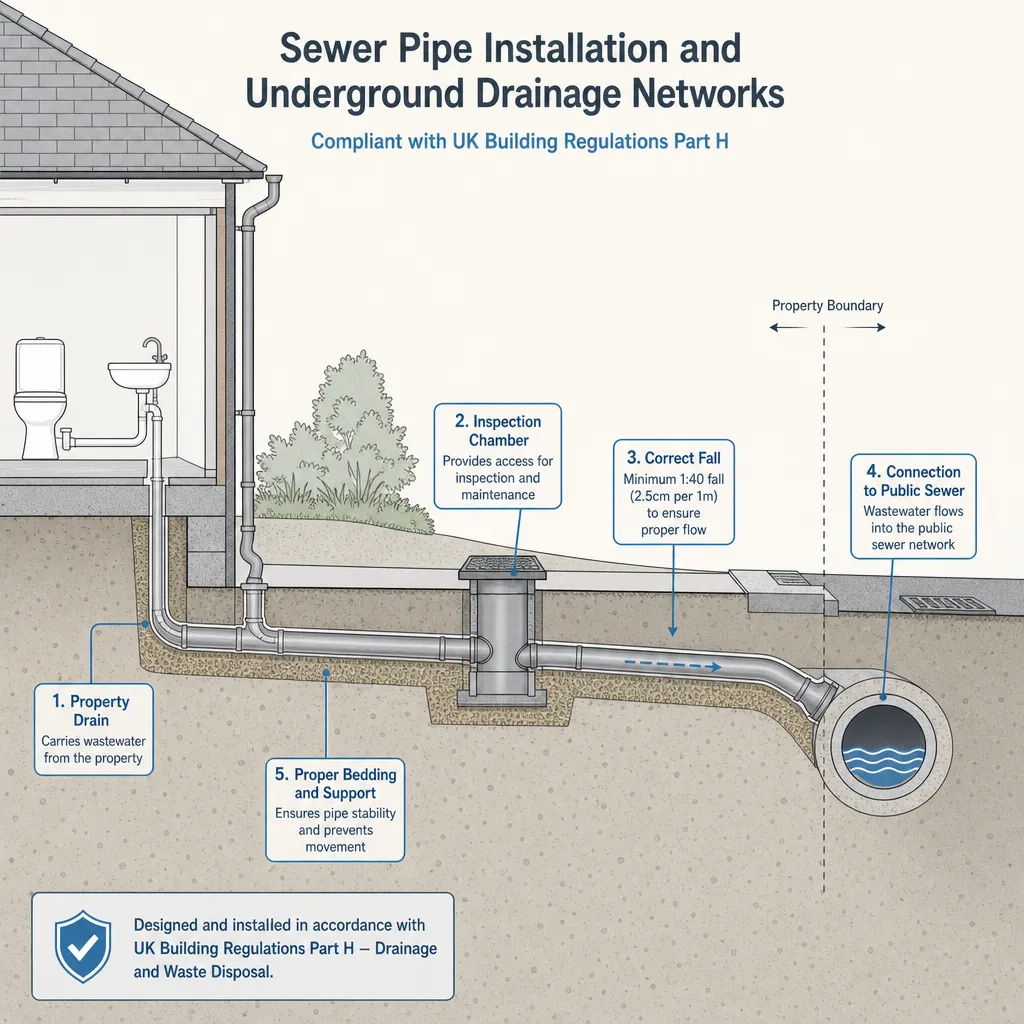
Sewer Pipe Installation and Underground Drainage Networks
Underground drainage is one of the least visible but most consequential elements of a UK property. Whether you are extending a house, adding a new bathroom, connecting a new dwelling to the public sewer, or relaying failed underground pipework, getting the installation right first time avoids costly excavation, enforcement notices, and potential public health consequences. The regulatory framework is more layered than many homeowners expect, spanning Building Regulations, water company consents, and in some cases highway authority approval.
Key points
- Building Regulations Part H (Drainage and Waste Disposal) governs all new foul and surface water drainage installations — you must notify your local building control body before work starts and must not backfill trenches before inspection.
- Connections to a public sewer require formal consent from the water and sewerage company under Section 106 of the Water Industry Act 1991; making an unauthorised connection is a criminal offence.
- Since October 2011, lateral drains and shared private sewers in England and Wales were transferred to water company ownership — check whether your drain is now a public asset before commissioning works on it.
- Approved Document H recommends a minimum gradient of 1:40 for 100mm foul water pipes; too shallow a gradient causes solids to settle and blockages to form.
- A build-over agreement from the water company is required before any structure is built within 3 metres of a public sewer (or 6 metres for sewers over 900mm diameter).
Public sewer, lateral drain, or private drain?
Understanding who owns and is responsible for the drainage network at your property is the essential first step before any works are planned.
Type | Definition | Responsibility |
|---|---|---|
Private drain | Runs from the property to the boundary; serves only that property | Property owner |
Lateral drain | Runs from the property boundary to the public sewer; serves only that property | Water and sewerage company (since October 2011) |
Public sewer | Serves more than one property | Water and sewerage company |
Combined sewer | Carries foul and surface water in a single pipe | Water and sewerage company |
If you are unsure whether a drain is public or private, water companies are required to maintain statutory sewer records, which are often accessible via the company's online mapping portal. A CON29DW drainage and water search, obtained through a conveyancer or solicitor, provides formal confirmation and is standard practice on property purchase.
Which approval route applies to your project?
The consent you need depends on what you are doing and where your drain runs.
- Connecting a new private drain to a public sewer → Section 106 application to the water company, plus building control notification. The company will inspect before and after the connection.
- Building within 3 metres of a public sewer → Build-over agreement (under Section 185 of the Water Industry Act 1991) required before any ground or structural works begin.
- Creating adoptable sewer infrastructure on a new development → Section 104 adoption agreement with the water company; drainage must be built to company standards before adoption.
- Relaying a failed drain entirely within your curtilage with no new public sewer connection → Building control notification required; no water company consent needed.
- Unsure whether the drain is public or private → Check your water company's online sewer records or obtain a CON29DW search before proceeding; do not assume ownership.
Pipe materials: which to choose?
Approved Document H does not mandate a single pipe material, but the material must be appropriate for the ground conditions, loads, and chemical environment.
Material | Standard | Best for | Key considerations |
|---|---|---|---|
Vitrified clay | BS EN 295 | Long runs, corrosive or aggressive soils, connections to public sewers | Heavy; requires careful handling and bedding; very durable and chemical-resistant |
uPVC | BS EN 1401 | Most domestic extension and connection drainage | Lightweight; widely available; easier to cut and join; specify SN8 under driveways or heavily trafficked areas |
HDPE | BS EN 12666 | Ground subject to movement, shrinkable clay soils, or aggressive ground chemistry | Flexible; welded joints eliminate infiltration risk; more expensive than uPVC |
For most domestic new-build or extension drainage, uPVC to BS EN 1401 is the standard choice. Some water companies specify vitrified clay for connections to the public sewer — check with your company before purchasing materials.
Gradient, depth, and access: the design basics
Errors in gradient or depth at design stage cause blockages and structural failures that require full excavation to correct.
Gradient:
- 100mm foul water pipe: 1:40 optimum; 1:80 minimum for branch connections
- 150mm pipe: 1:150 minimum
Depth:
- Foul drains in gardens: typically 0.75m–1.2m
- Drains beneath driveways or trafficked areas: deeper to protect from vehicle loading; use Class D or SN8 rated pipe in concrete surround
Access:
- Inspection chambers at all junctions and changes of direction
- Maximum 45m between access points on straight 100mm runs
- Rodding points at the head of each drain run to allow blockage clearance without excavation
Bedding:
- Pipe bedding and surround material must be specified to match pipe type, ground conditions, and loading.
What to ask before accepting a quote
Before appointing a contractor for underground drainage work:
- What pipe material and standard will be used, and why is it appropriate for my ground conditions?
- Who will notify building control, and which stages require inspection before backfilling?
- Is a Section 106 connection application or build-over agreement needed, and will you manage the submission?
- What gradient and depth will the pipes be laid at, and will this be recorded in as-built drawings?
- Will a CCTV survey be carried out on completion to confirm there are no defects or displaced joints?
- Is VAT included in the price quoted?
- What warranties apply to the installation, and who is responsible if a defect is found within the warranty period?
- Will the work be carried out by your own operatives or a subcontractor?
Important limitations
This article provides general guidance on underground drainage installation in England and Wales. The regulatory framework differs in Scotland (Scottish Water and the building standards system apply) and Northern Ireland (NI Water). Drainage design must account for site-specific factors including invert levels, soil type, existing infrastructure, and flood risk zone. A competent drainage contractor or civil engineer should assess each site individually before design is finalised. Nothing in this article constitutes engineering or legal advice.
What to ask a qualified professional
- Is my proposed drain route clear of public sewers, utilities, and significant tree root zones?
- What is the invert level at the public sewer connection point, and does my scheme have sufficient fall to connect?
- Does the existing drain require CCTV inspection or lining before a new connection is made?
- Are there tree protection obligations that affect the drainage route?
- What as-built drawings and CCTV records will I receive on completion?
When to get professional help
Seek specialist input before proceeding if:
- You are unsure whether a drain is public or private
- Ground conditions include made ground, contaminated land, or high groundwater
- There is evidence of ground movement or subsidence near the drain route
- The proposed route passes through or near a listed building or scheduled monument
- A build-over agreement is required and structural adequacy must be demonstrated to the water company
How Housey can help
Housey connects you with experienced drainage contractors who manage everything from building control notification to Section 106 connection applications. For more complex excavation or infrastructure, groundworkers and civil engineers with underground drainage expertise are also available through the platform.
Frequently asked questions
Do I need building control approval for new drainage?
Yes. All new drainage installations connecting to the foul sewer or a soakaway must be notified to your local building control body under Part H of the Building Regulations. Your contractor can usually handle the notification, but you as the homeowner are ultimately responsible for ensuring approval is obtained and that required inspections take place before backfilling.
Can I connect directly to a public sewer myself?
No. A connection to a public sewer requires Section 106 consent from the water and sewerage company, which will specify how and where the connection is made and will require inspection before and after the work. Unauthorised connections are a criminal offence under the Water Industry Act 1991, and the company can require removal at your cost.
What gradient should a drain be laid at?
Approved Document H recommends 1:40 as the optimum gradient for a 100mm foul water drain, with 1:80 as a practical minimum for branch connections. Too shallow a gradient causes solids to settle and blockages to form; too steep a gradient can cause liquid to run ahead of solids, which also leads to blockages over time.
What is a build-over agreement?
A build-over agreement is formal consent from the water and sewerage company to build a structure within 3 metres of a public sewer — or 6 metres for sewers over 900mm diameter. The company requires this to ensure the sewer remains accessible for maintenance and that the new structure does not impose unacceptable load. It must be obtained before ground or structural works begin.
Sources and further reading
- Approved Document H: Drainage and Waste Disposal — Ministry of Housing, Communities and Local Government
- Water Industry Act 1991 — legislation.gov.uk
- Build over or near a sewer: guidance — GOV.UK
- Drainage and water searches: CON29DW — GOV.UK
Useful next reads
 Improvement & Build
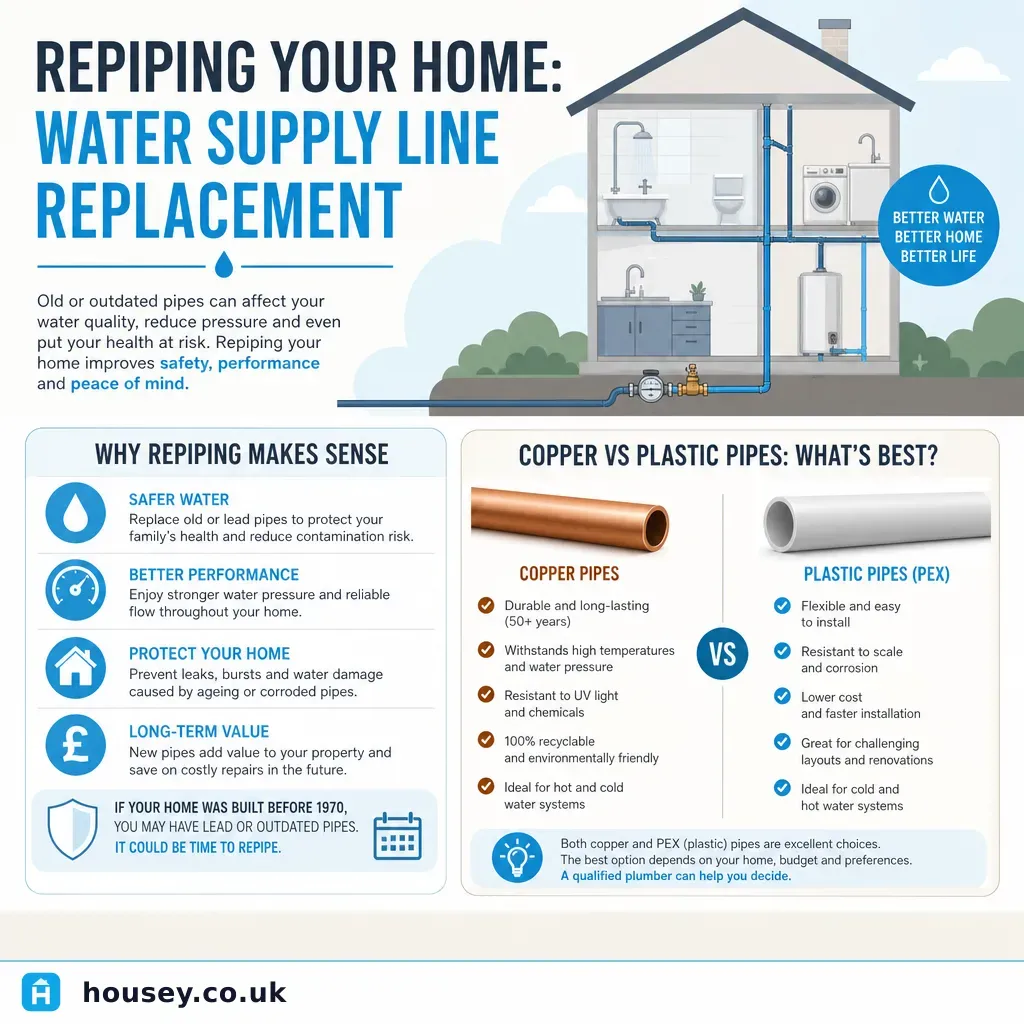
Repiping Your Home: Water Supply Line Replacement
Repiping is typically needed when lead, iron, or early polybutylene pipes corrode, leak, or restrict flow.
 Improvement & Build
UK Construction Sector Outlook: What Industry Confidence Means for Your Build Project
Construction sector confidence data — including PMI readings and CPA output forecasts — signals whether builders are busy and whether lead times are growing.
 Improvement & Build
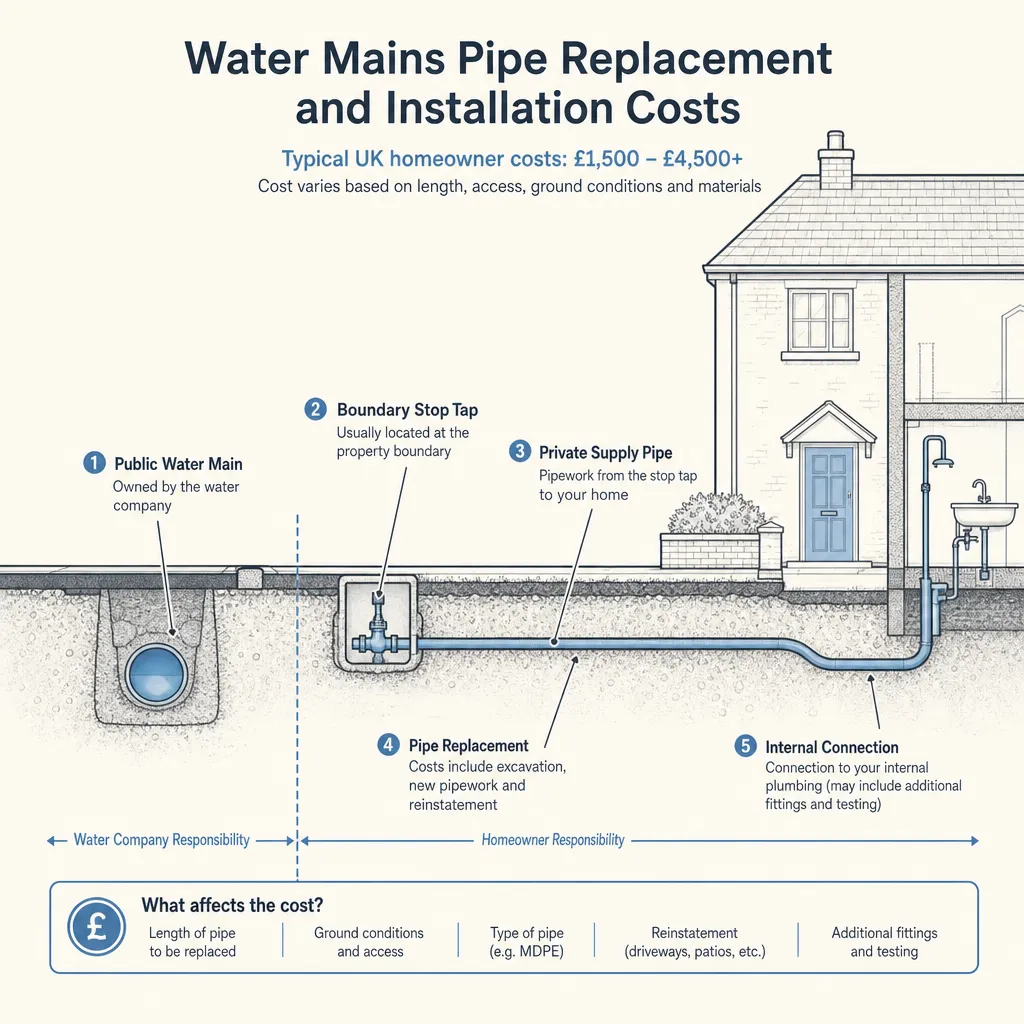
Water Mains Pipe Replacement and Installation Costs
Replacing the supply pipe from the boundary stopcock to your home typically costs £1,500–£3,500 in the UK, depending on pipe length, ground conditions, and whether any hard surfacing must be excavated.
 Improvement & Build
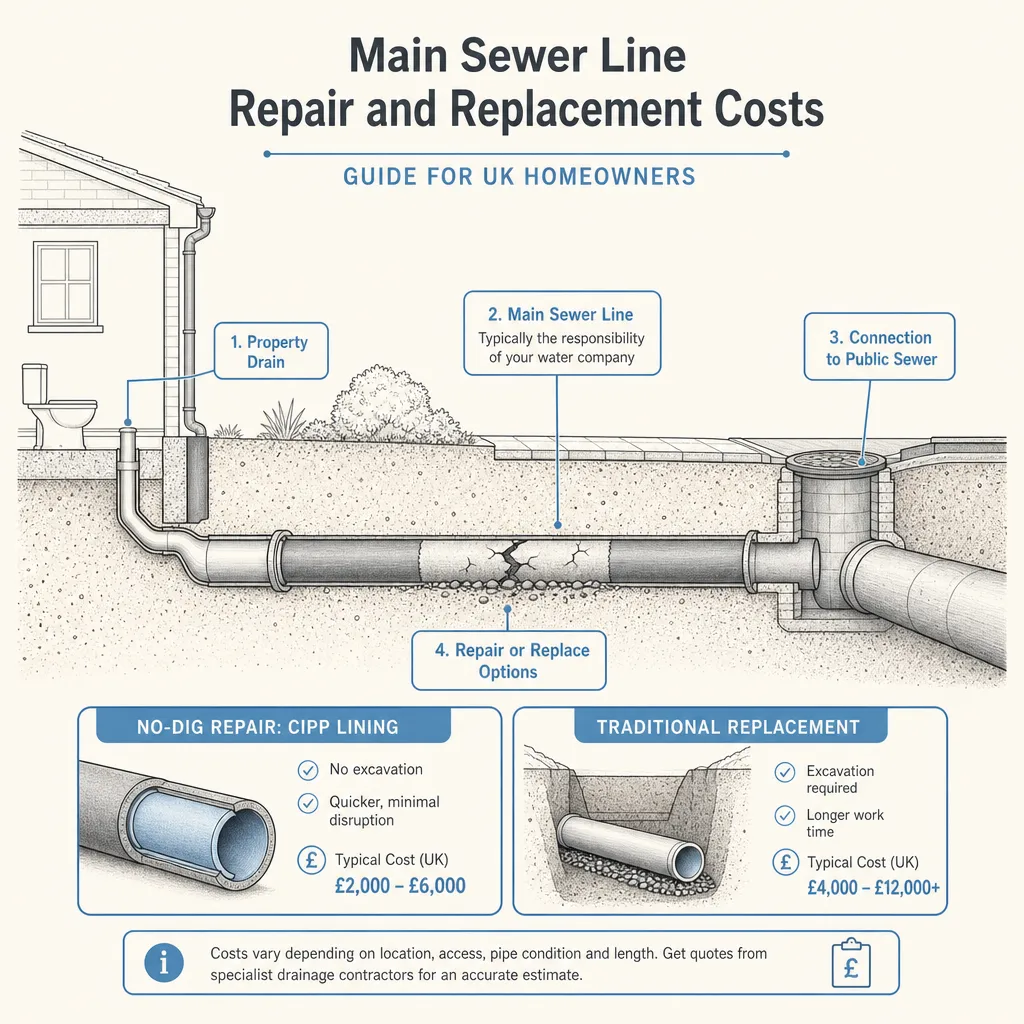
Main Sewer Line Repair and Replacement Costs
Main sewer line repair in the UK costs roughly £500–£2,500 for no-dig methods such as patch lining or full CIPP lining, and £3,000–£10,000 or more for open-cut excavation and pipe replacement.
 Improvement & Build
Liniar uPVC Windows: Performance, Durability, and Quality Assessment
Liniar uPVC window profiles are manufactured in the UK using multi-chambered, foamed frames.