Showcasing Exceptional Extensions: Design Ideas and Execution
By Housey · Last reviewed 9th of May 2026
Showcasing Exceptional Extensions: Design Ideas and Execution
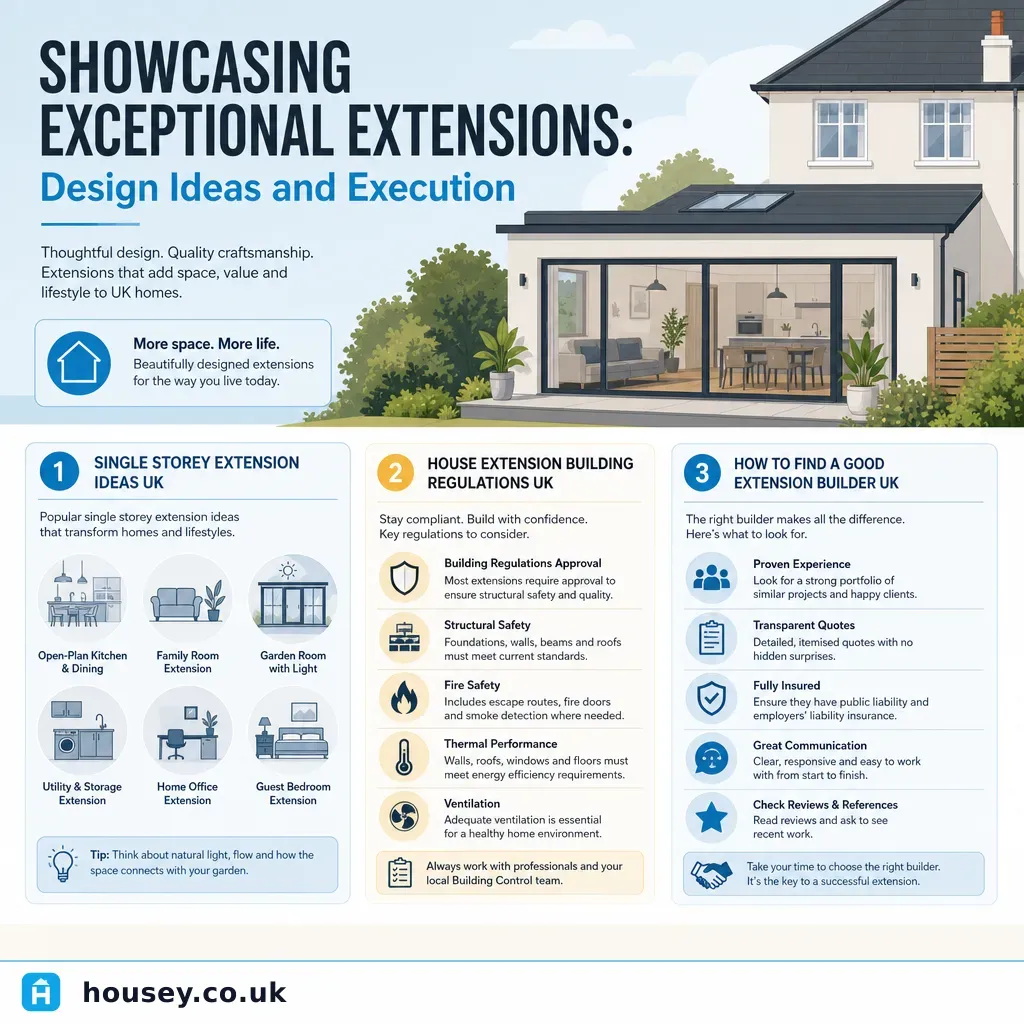
Home extensions are one of the most popular ways UK homeowners create space and add value without moving. Whether you are planning a rear kitchen extension on a Victorian terrace, a side-return infill on an Edwardian semi, or a two-storey addition to a 1930s detached house, the difference between an adequate result and an exceptional one comes down to two things: considered design and disciplined execution.
Key points
- Single-storey rear extensions up to 4 metres deep (detached) or 3 metres (semi-detached and terraced) often qualify as permitted development under Schedule 2, Part 1 of the Town and Country Planning (General Permitted Development) Order 2015, subject to prior approval conditions.
- Building Regulations approval is required for virtually all extensions, covering structural integrity, thermal performance (Part L), fire safety, drainage, and ventilation.
- Under Part L of the Building Regulations 2021, new extension walls must achieve a maximum U-value of 0.28 W/m²K; glazing must not exceed 1.4 W/m²K.
- The Party Wall etc. Act 1996 may require formal notice to adjoining owners before work begins on or near a shared boundary.
- The Federation of Master Builders' 2024 State of Trade Survey identified subcontractor availability and rising material costs as the two most common causes of extension project delays across the UK.
Extension design approaches
Single-storey rear extensions are the most common type. A well-designed example opens the ground floor to garden views through large-format bifold, sliding, or pivot glazing, with rooflights where wall height is constrained. Side-return extensions absorb the narrow passage beside a Victorian or Edwardian terrace into a new kitchen-diner, creating a full-width ground floor with north-to-south daylight. Two-storey extensions add bedroom or bathroom space above new ground-floor rooms and almost always require full planning permission rather than permitted development. Wrap-around extensions combine rear and side-return additions, requiring full planning permission and often a party wall agreement.
Contemporary approaches — flat or mono-pitch roof, powder-coated aluminium glazing — suit modernist or post-war homes and situations where a deliberate contrast between old and new is the design intention. Traditional approaches, using matching brick, stone, or lime render with period window proportions, are more appropriate in conservation areas, for listed buildings, or where visual continuity with the existing house is the priority.
Comparing extension types: a practical overview
Extension type | Typical planning route | Build complexity | Best suited to |
|---|---|---|---|
Single-storey rear | Permitted development (prior approval) | Moderate | Kitchen, dining, living rooms |
Side-return infill | Often permitted development; confirm with LPA | Moderate–high | Victorian/Edwardian terraces |
Two-storey rear | Full planning permission usually required | High | Bedrooms or bathrooms above new ground floor |
Wrap-around (rear + side) | Full planning permission usually required | High | Maximising ground-floor space in a terrace or semi |
Dormer loft | Often permitted development; check LPA policy | High | Additional bedroom with natural light |
Always confirm your planning route with your local planning authority (LPA) before starting works. Permitted development rights can be removed by Article 4 directions, conservation area designations, or prior conditions attached to the property.
What separates exceptional execution from average
Foundations and structural specification. A diligent builder will commission a structural engineer to specify foundations before setting out. Load-bearing steel beams and padstones must be installed to the engineer's specification. Ask to see Building Control inspection sign-off before trenches are backfilled — this stage cannot be retrospectively certified.
Thermal envelope and airtightness. Extensions built to the bare minimum of Part L are noticeably colder in winter. High-quality projects use continuous insulation to minimise thermal bridging at junctions between old and new construction. An airtightness test, required by Building Regulations for most new construction, should be booked before plasterboard is fixed.
Flat-roof waterproofing. Modern warm-roof designs using GRP (glass-reinforced plastic), EPDM rubber, or high-quality built-up felt with 100mm or more of insulation above the deck can last 30 years or more when installed correctly. Require a 10-year installer guarantee and confirm the manufacturer's warranty applies when a registered installer is used.
Glazing performance. Ask for UKCA or CE-marked delivery documentation confirming the stated centre-pane U-value. Thermally broken aluminium frames should be standard on any north- or east-facing elevation. Triple glazing adds cost but may be worthwhile where heat loss is a primary concern.
Finishing and detailing. The markers of a quality build are often invisible by completion: neatly chased cable runs, underfloor heating manifolds installed before screed, door frames built to the tolerances required for the specified ironmongery, and ceiling heights that feel generous rather than pressed. Agree a formal snagging list before releasing the final retention payment.
Homeowner checklist before your extension starts
Use this list to confirm the key bases are covered before construction begins.
Red flags to watch for during the build
- Foundations appearing shallower than the engineer's drawing specifies. Building Control sign-off is required before backfilling; it cannot be retrospected.
- Structural steel or timber not matching approved drawings. Any substitution — smaller section sizes, different connection details — must be agreed in writing with the structural engineer.
- Flat-roof insulation installed below the deck (cold-roof arrangement) without adequate ventilated airspace — associated with condensation failure and generally not acceptable under current Building Regulations without specific design justification.
- Glazing without UKCA or CE markings — this may indicate products not meeting stated thermal or structural specifications.
- Stage payment requests substantially ahead of agreed milestones — a potential indicator of contractor cashflow problems.
- No airtightness test planned — unfamiliarity with this requirement suggests the thermal envelope has not been adequately considered.
When to get professional help
Consider appointing independent professional oversight — an architect acting as contract administrator, or a RICS-accredited project manager — if:
- The build cost is likely to exceed approximately £100,000.
- Structural alterations to the existing house are involved, such as removing load-bearing walls or underpinning.
- The project is in a conservation area, involves a listed building, or is close to a shared boundary or party wall.
- The design includes complex flat roofing, structural glazing, or unusual materials.
- You have concerns about build quality or disputes with your contractor during the works.
How Housey can help
Housey can connect you with vetted extension builders who can provide detailed, comparable quotes for your project. For larger or more technically complex builds, our network of project managers offers independent oversight from design through to practical completion, helping you protect your investment and navigate common pitfalls.
Frequently asked questions
Do I always need planning permission for a house extension?
Not always. Many single-storey rear extensions qualify as permitted development under the Town and Country Planning (General Permitted Development) Order 2015, subject to size limits and prior approval requirements. However, permitted development rights are removed for flats, most listed buildings, and properties in Article 2(3) land such as conservation areas and National Parks. Always confirm with your local planning authority before starting.
How long does a typical single-storey extension take to build?
Most single-storey rear extensions take 10 to 20 weeks from foundations to practical completion. The pre-construction phase — design, planning or prior approval, Building Regulations approval, and tendering — typically adds 3–6 months, sometimes longer if full planning permission is required. Factor in both phases when planning timelines and temporary living arrangements.
What Building Regulations must an extension comply with?
Extensions must comply with the Building Regulations 2010 (as amended), including Part A (structure), Part B (fire safety), Part C (site preparation and moisture), Part F (ventilation), Part L (energy efficiency), and Part P (electrical safety). A Building Control officer inspects at key stages including foundations, structural frames, and the completed thermal envelope.
Should I use full plans approval or a building notice?
Full Plans approval provides pre-approved drawings before work starts, offering greater certainty and legal protection. A Building Notice is faster and cheaper but offers less up-front certainty. For extensions involving structural alterations, complex drainage, or significant glazing, Full Plans approval is generally the more prudent route.
Can I live in my house during an extension?
In most cases, yes — particularly for rear extensions where the existing building envelope remains intact for most of the build. Whether this is practical depends on the scope of work, the season, and personal tolerance for disruption. Agree a site management plan with your builder before works begin, covering dust control, welfare, and site security.
Sources and further reading
- Permitted Development Rights for Householders: Technical Guidance — GOV.UK
- Building Regulations approval — GOV.UK
- Approved Document L: Conservation of Fuel and Power — GOV.UK / DLUHC
- Party Wall etc. Act 1996: preventing and resolving disputes — GOV.UK
- Federation of Master Builders: State of Trade Survey — Federation of Master Builders
Useful next reads
 Improvement & Build
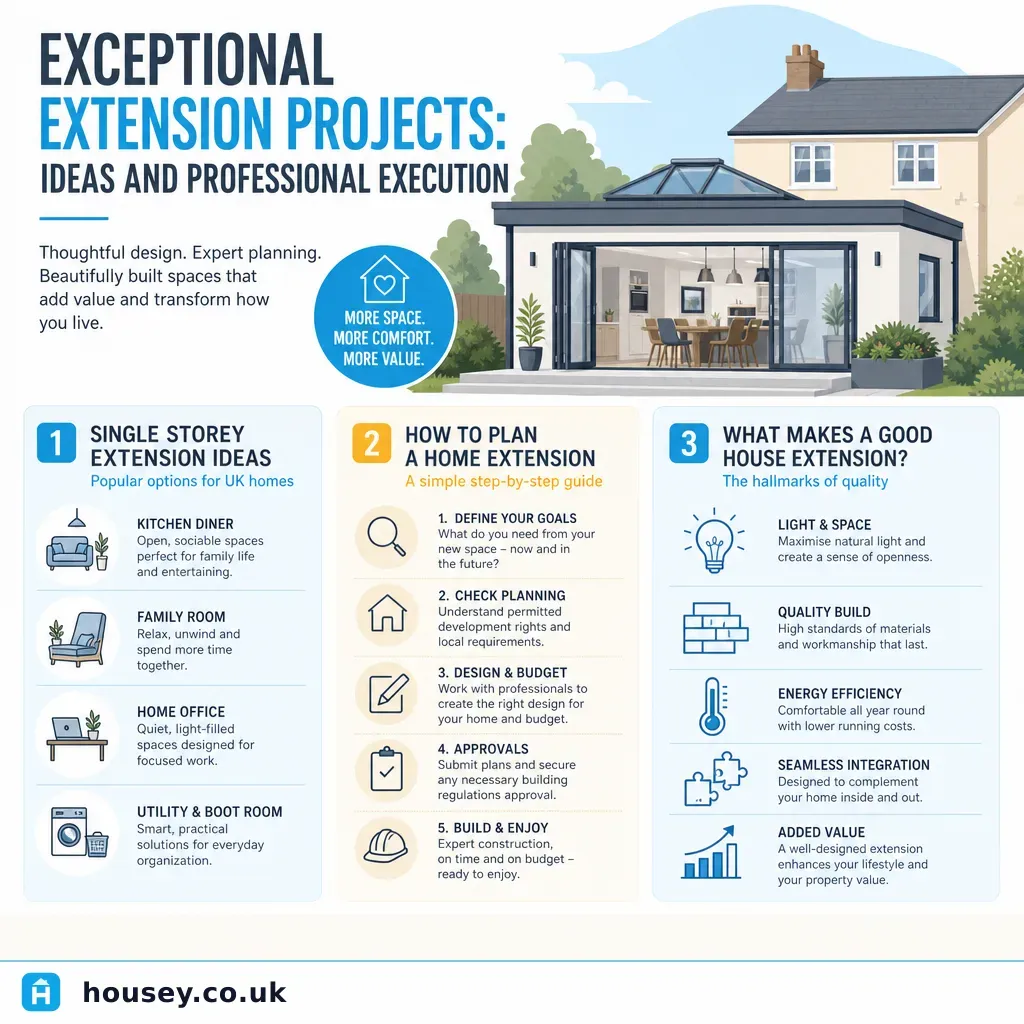
Exceptional Extension Projects: Ideas and Professional Execution
An exceptional home extension combines thoughtful design, correct planning permissions, and skilled professional execution.
 Improvement & Build
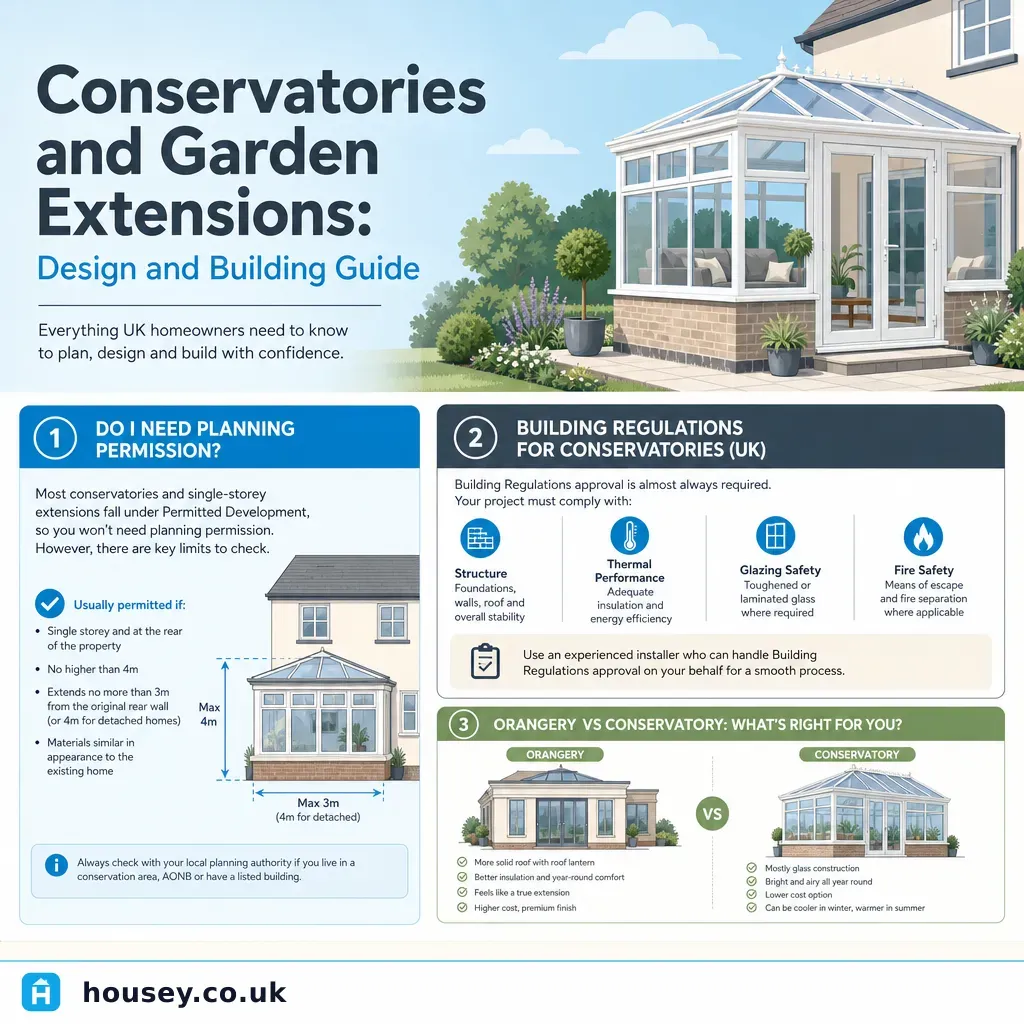
Conservatories and Garden Extensions: Design and Building Guide
Most conservatories qualify as permitted development in England if they are single-storey, within 50% of original curtilage, and meet dimensional limits.
 Improvement & Build
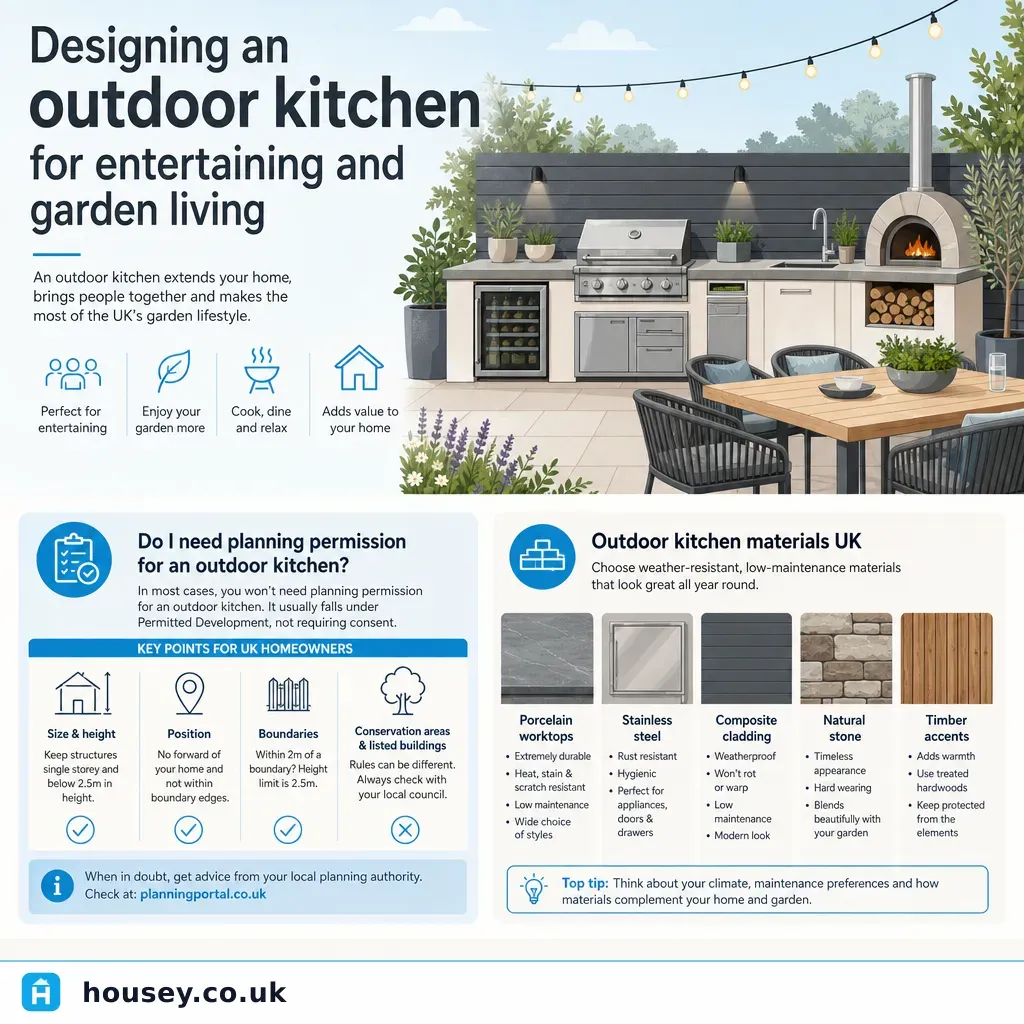
Designing an outdoor kitchen for entertaining and garden living
An outdoor kitchen in a UK garden needs a stable, level base — typically a concrete slab or quality paving — with weather-rated materials such as stainless steel grade 316 or frost-rated porcelain.
 Improvement & Build
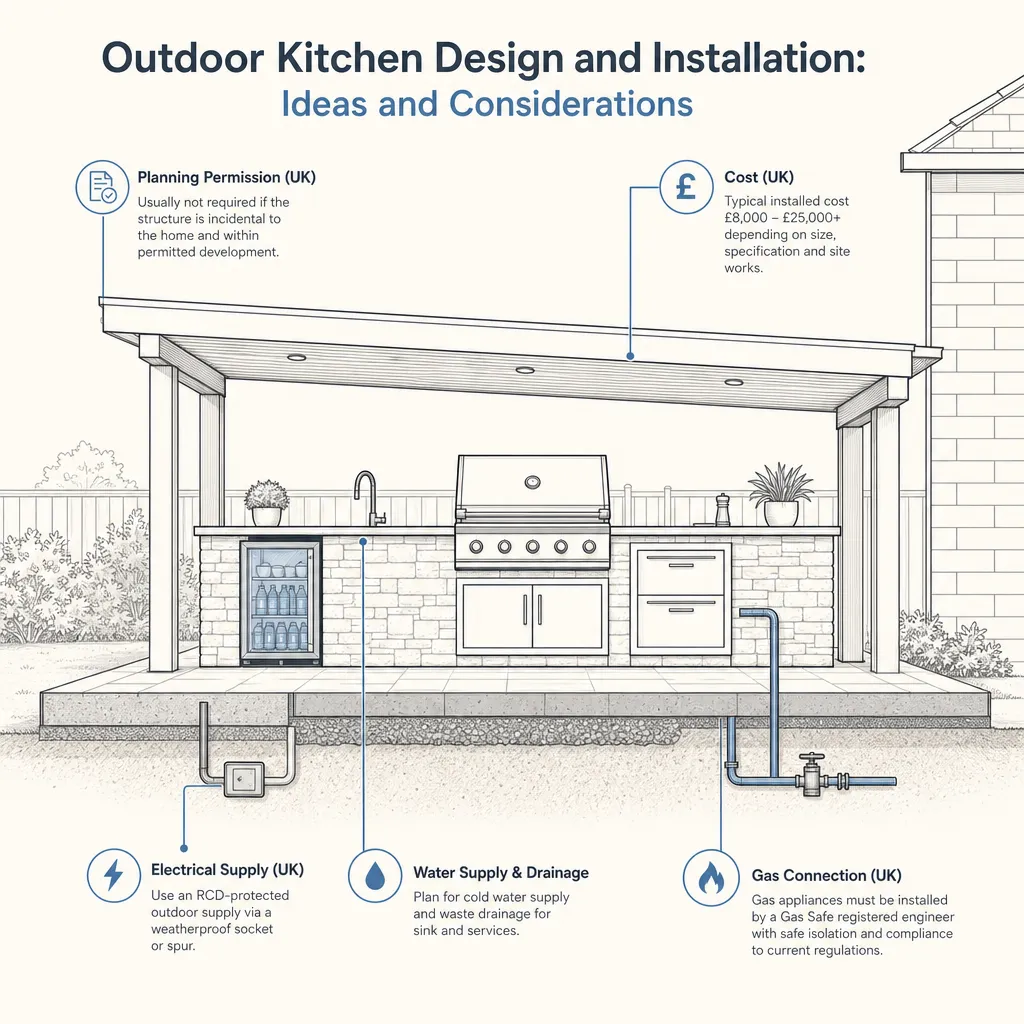
Outdoor Kitchen Design and Installation: Ideas and Considerations
An outdoor kitchen in the UK typically costs £3,000–50,000 depending on size and specification.
 Improvement & Build
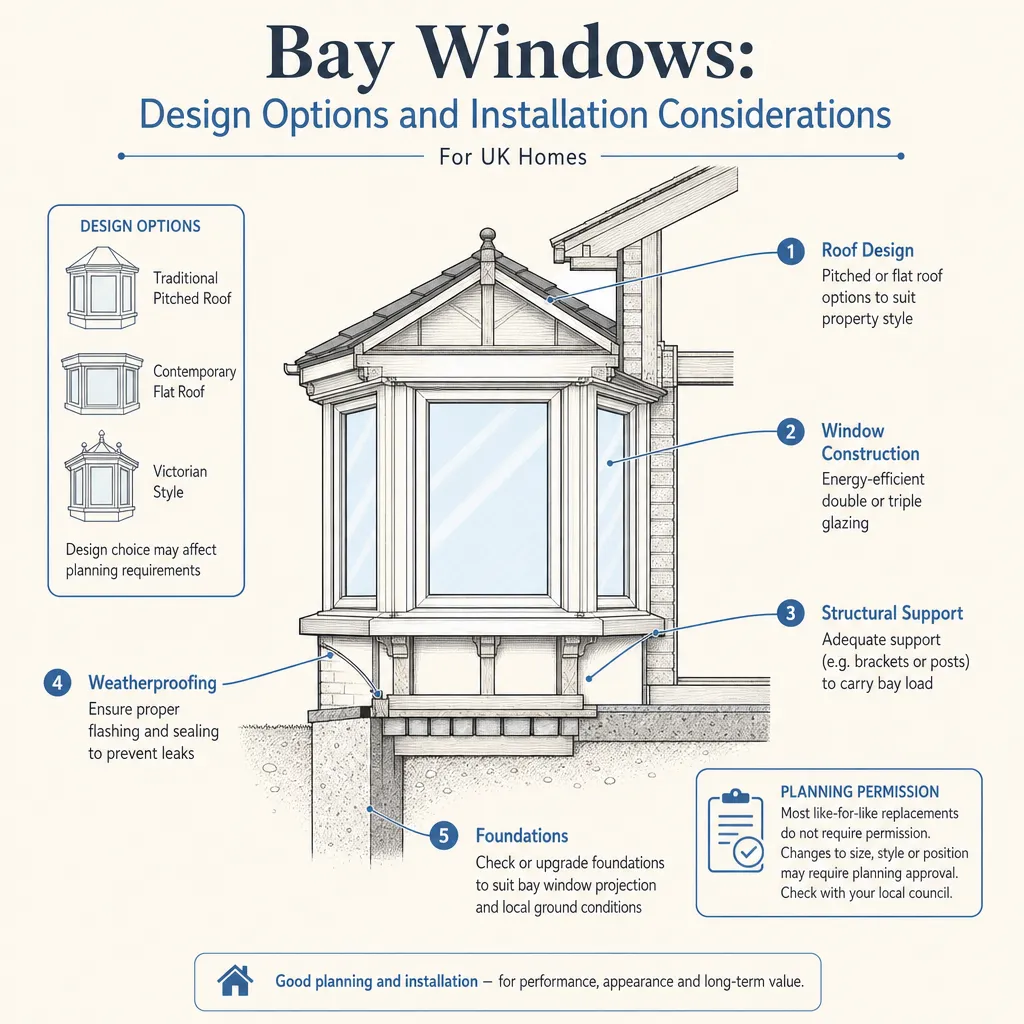
Bay Windows: Design Options and Installation Considerations
Bay windows project beyond the main wall of a house, increasing floor area and natural light.