Signs Your Tree Needs Professional Removal: Safety and Health Considerations
By Housey · Last reviewed 8th of May 2026
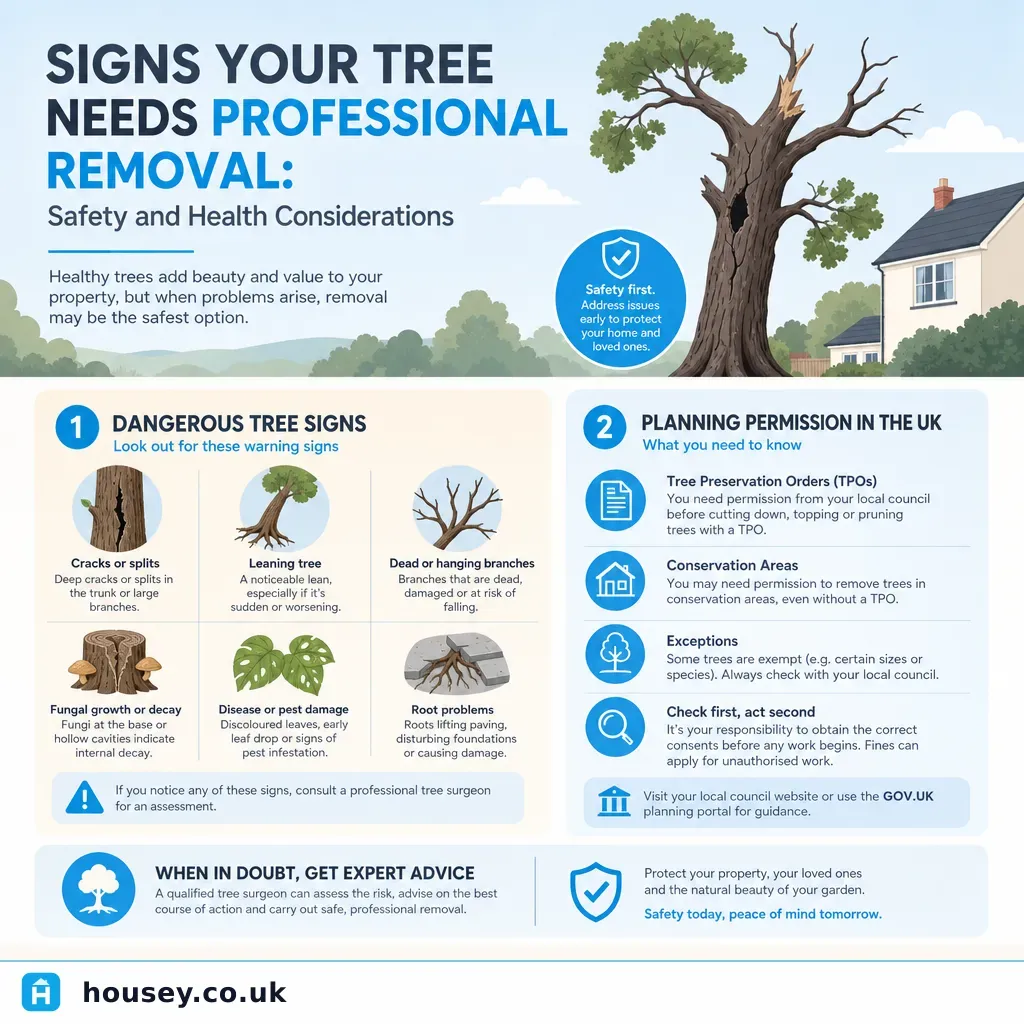
Signs Your Tree Needs Professional Removal: Safety and Health Considerations
Trees add significant value to UK properties — financially, ecologically, and aesthetically — but a tree in structural decline can become a serious hazard to people, buildings, and neighbouring land. The responsibility for managing trees rests with the property owner, and in England, Wales, and Scotland, legal protections mean that removing the wrong tree without permission can result in prosecution and a substantial fine. Knowing when to act, and who to involve, is what this guide addresses.
Key points
- Trees subject to a Tree Preservation Order (TPO) cannot be removed without prior written consent from the local planning authority (LPA), even if the tree appears dead or structurally compromised.
- Trees in conservation areas require at least six weeks' written notice to the LPA (a Section 211 notice under the Town and Country Planning Act 1990) before significant removal or pruning work begins.
- A qualified arborist should hold a recognised qualification such as City & Guilds Level 3 Arboriculture and carry appropriate public liability insurance; membership of the Arboricultural Association is a useful indicator of professional competence.
- The urgency exemption for removing an imminently dangerous tree applies even under TPO protection, but you must notify the LPA as soon as reasonably practicable and retain evidence of the hazard.
- Underground root rot and basal decay can be well-advanced before any above-ground symptoms appear, which is why periodic professional assessments matter for mature trees close to structures — not just routine visual checks.
What makes a tree structurally hazardous?
Trees fail for a range of reasons, and the risk profile varies with species, age, soil conditions, root zone health, and recent weather events. The most common structural failure mechanisms in UK trees include:
- Basal decay: Fungal infection — often Ganoderma, Meripilus, or Armillaria species — breaks down structural wood at the base or roots, leaving the trunk hollow and unable to resist wind loading.
- Crown or branch failure: Dead, weakly attached, or overextended branches are liable to shed, particularly during summer. Summer branch drop is a recognised phenomenon in UK species such as oak, beech, and horse chestnut.
- Root damage: Severed or compacted roots — common after nearby groundworks, drain installation, or new paving — reduce the tree's ability to anchor itself in the ground.
- Recent lean: A significant lean that has developed over weeks or months, particularly where the root plate is partially lifting on one side, indicates progressive structural failure.
- Co-dominant stems: Two or more stems of equal size growing from a low union can split under wind or snow load if no remedial cabling or bracing has been installed.
Signs to look for — a homeowner checklist
You do not need to be an arborist to notice early warning signs. The following checklist identifies observations that warrant a professional inspection.
Structural concerns
Crown and branch health
Root zone and bark
Context and proximity
If you observe any of the structural concerns or root zone issues listed above, instruct a qualified arborist to inspect the tree before attempting any work yourself.
Comparison: situations and appropriate responses
Situation | Likely response | Who to call |
|---|---|---|
Small dead branches in upper crown only | Crown cleaning (deadwood removal) | Arborist |
Large dead or hanging branch over a building | Urgent assessment and likely removal | Arborist — same week |
Fungal brackets at base, no lean | Detailed condition assessment; management plan | Arborist, possibly structural assessment |
Recent lean with root plate lifting | Urgent removal assessment | Arborist immediately |
Dieback in one sector, no structural signs | Crown reduction or sector removal | Arborist |
Healthy tree close to a planned extension | Root protection zone assessment before build | Arborist and structural engineer |
Tree in decline, TPO or conservation area | Professional written report before any work | Arborist and LPA consultation |
Legal considerations before any removal
Before instructing removal work, check the tree's legal status carefully.
1. Check for a TPO
Your local planning authority's online mapping often shows TPO locations, and the LPA tree officer can confirm. Removing a TPO-protected tree without consent is a criminal offence under the Town and Country Planning Act 1990 and can attract an unlimited fine. The urgency exemption applies only where the tree poses an imminent danger; you must notify the LPA as soon as practicable after the work and retain documentation.
2. Check if you are in a conservation area
All trees with a stem diameter of 75mm or more at 1.5m height in a conservation area are subject to automatic notification requirements. Give at least six weeks' written notice to the LPA before undertaking significant work. Exemptions exist for dead, dying, or dangerous trees, but notification must still be made as soon as practicable.
3. Check your title deeds and boundaries
Boundary trees may be jointly owned. Trees that overhang the boundary may allow a neighbour to cut back to the boundary line, but ownership of the main stem determines who may consent to removal.
4. Check for bat roosts and nesting birds
Bats and nesting birds are protected under the Wildlife and Countryside Act 1981 and the Conservation of Habitats and Species Regulations 2017. Trees should not be felled during the active bird nesting season (broadly March to August) without an ecological assessment. If bats are suspected, a licensed bat survey is required before any removal proceeds.
What to ask a qualified arborist
Before instructing any tree work, ask the following:
- What qualifications do you hold, and are you a member of the Arboricultural Association?
- Have you confirmed the tree's TPO or conservation area status with the local planning authority?
- Will you provide a written arboricultural report or risk assessment before work starts?
- What level of public liability insurance do you carry, and may I see the certificate?
- What options short of full removal have been considered — crown reduction, deadwood removal, cabling, or bracing?
- What will happen to the timber and arisings — is clearance and disposal included in the quote?
- Will access to neighbouring land be required, and who is responsible for obtaining permission?
When to get professional help
Instruct a qualified arborist without delay if:
- A large limb has fallen or is visibly hanging and has not yet been professionally assessed
- The tree shows basal fungi in combination with any lean or crown dieback
- The tree is within falling distance of an occupied building and shows any signs of structural weakness
- The tree is in a legally protected location (TPO or conservation area) and you are uncertain of the correct procedure
- Your mortgage lender, insurer, or solicitor has raised a concern about a tree on the property
- You are planning construction works within the root zone of any significant tree
For a formal written condition report — for instance before a house sale, to satisfy an insurer, or to support a planning application — an arboricultural survey documents the tree's condition, risk rating, and recommended management in a format acceptable to lenders and local authorities.
How Housey can help
Housey connects you with qualified tree surgeons who can assess your trees, carry out safe removal or crown work, and handle the procedural requirements for protected trees. If you need a written condition report for insurance, planning, or conveyancing purposes, Housey can also help you request quotes from professionals who carry out arboricultural surveys.
Frequently asked questions
Can I remove a tree in my own garden without permission?
You can remove most trees on your own land without permission — unless the tree is subject to a TPO, is in a conservation area with a stem diameter of 75mm or more at 1.5m height, or is required to be retained under a planning condition. If in doubt, check with your local planning authority's tree officer before instructing any work.
How much does tree removal typically cost in the UK?
Costs vary significantly with tree size, species, accessibility, and disposal of timber and arisings. Indicative UK costs, last reviewed 2026-05-08: small tree removal (up to approximately 5m) may cost £200–£500; medium trees (5–15m) commonly range from £500–£1,500; large or complex removals can be considerably more. Always obtain at least three written quotes. Costs vary widely and this guidance does not constitute a quote.
What is the difference between a tree surgeon and an arborist?
The terms are often used interchangeably in the UK. A tree surgeon typically describes a practical operator who carries out climbing, pruning, and felling work. An arborist can refer to either a practical operator or a consultancy professional who produces condition reports and management plans. For formal planning applications or insurance reports, look for a Chartered Arboriculturalist (MArborA) or fellow of the Arboricultural Association.
What happens if a neighbour's tree is dangerous and they refuse to act?
Write to the tree owner explaining your concern and keep a copy. If they do not act and damage occurs, you may have a civil claim under the law of nuisance, though this is complex. Notify your insurer and, if the tree overhangs a public highway or footpath, contact your local authority. Citizens Advice can provide initial guidance on tree nuisance disputes.
Do I need to replant after removing a protected tree?
A TPO removal consent will usually include replacement planting as a condition. Planning permissions may also specify tree retention or replacement requirements. Even without a legal obligation, local planning authorities often encourage or require replacement planting and may specify the species, size, and location in any consent granted.
Sources and further reading
- Tree Preservation Orders and trees in conservation areas — GOV.UK
- Town and Country Planning Act 1990 — legislation.gov.uk
- Find a qualified arborist — Arboricultural Association
- Wildlife and Countryside Act 1981 — legislation.gov.uk
- Bats: protection, surveys and licences — GOV.UK / Natural England
Useful next reads
 Improvement & Build
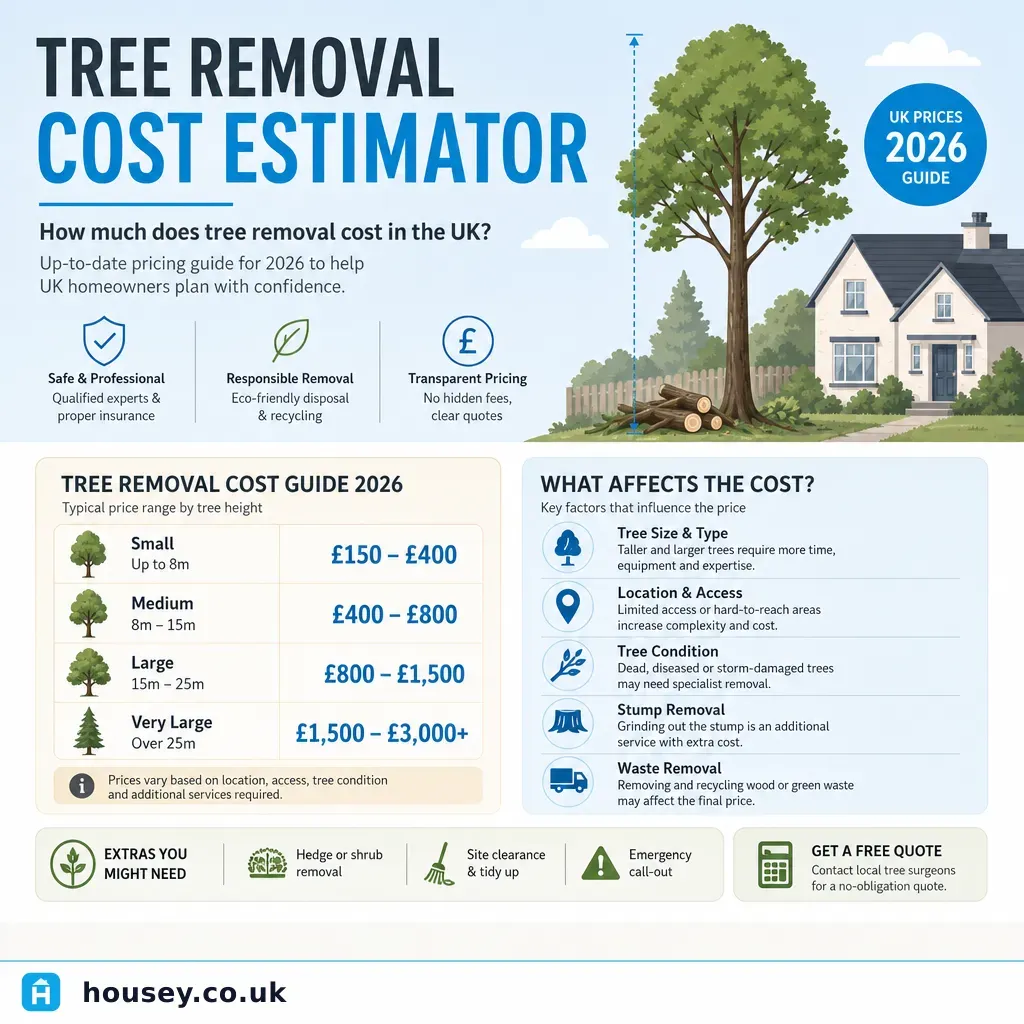
Tree Removal Cost Estimator
Tree removal in the UK costs roughly £150 to £5,000 or more, depending on the tree's height, species, access conditions, and whether stump removal is needed.
 Improvement & Build
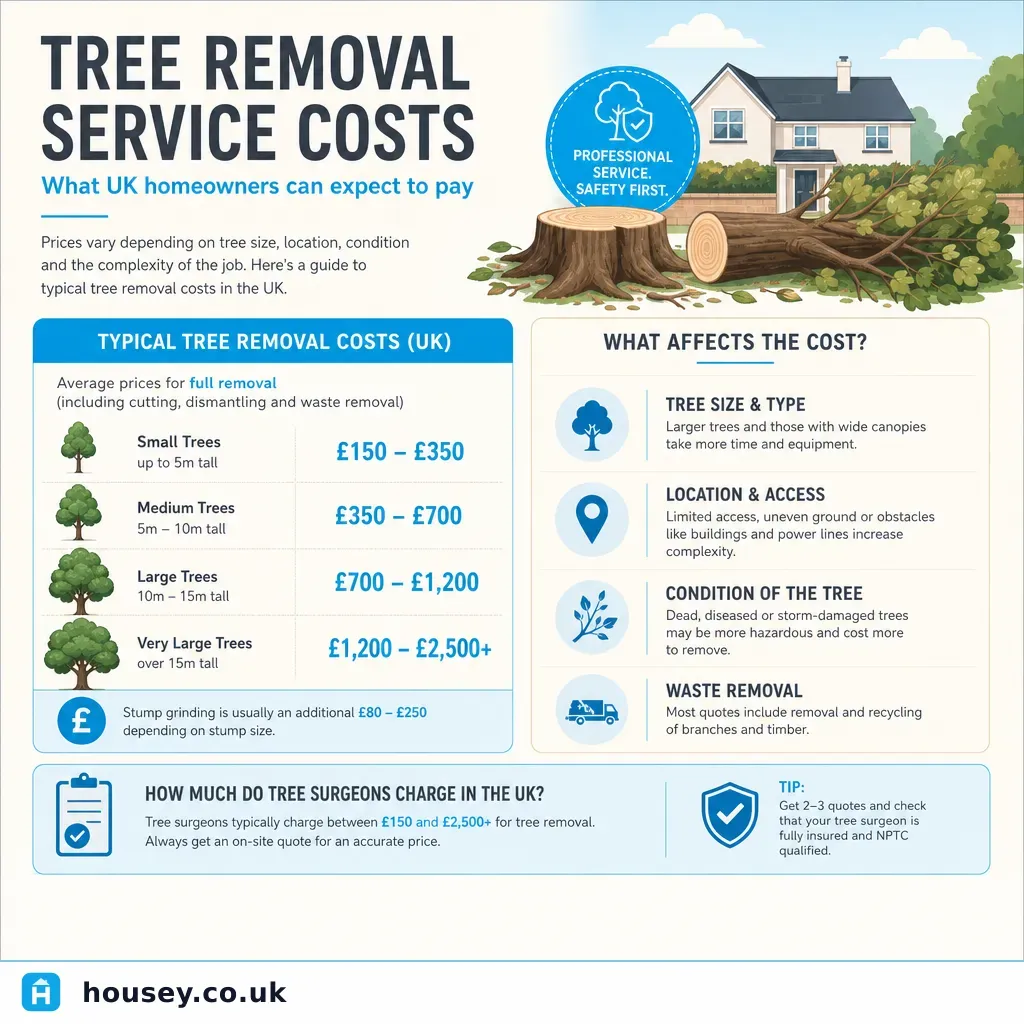
Tree Removal Service Costs
Professional tree removal costs in the UK depend on tree height, access, species, and the scope of work included.
 Improvement & Build
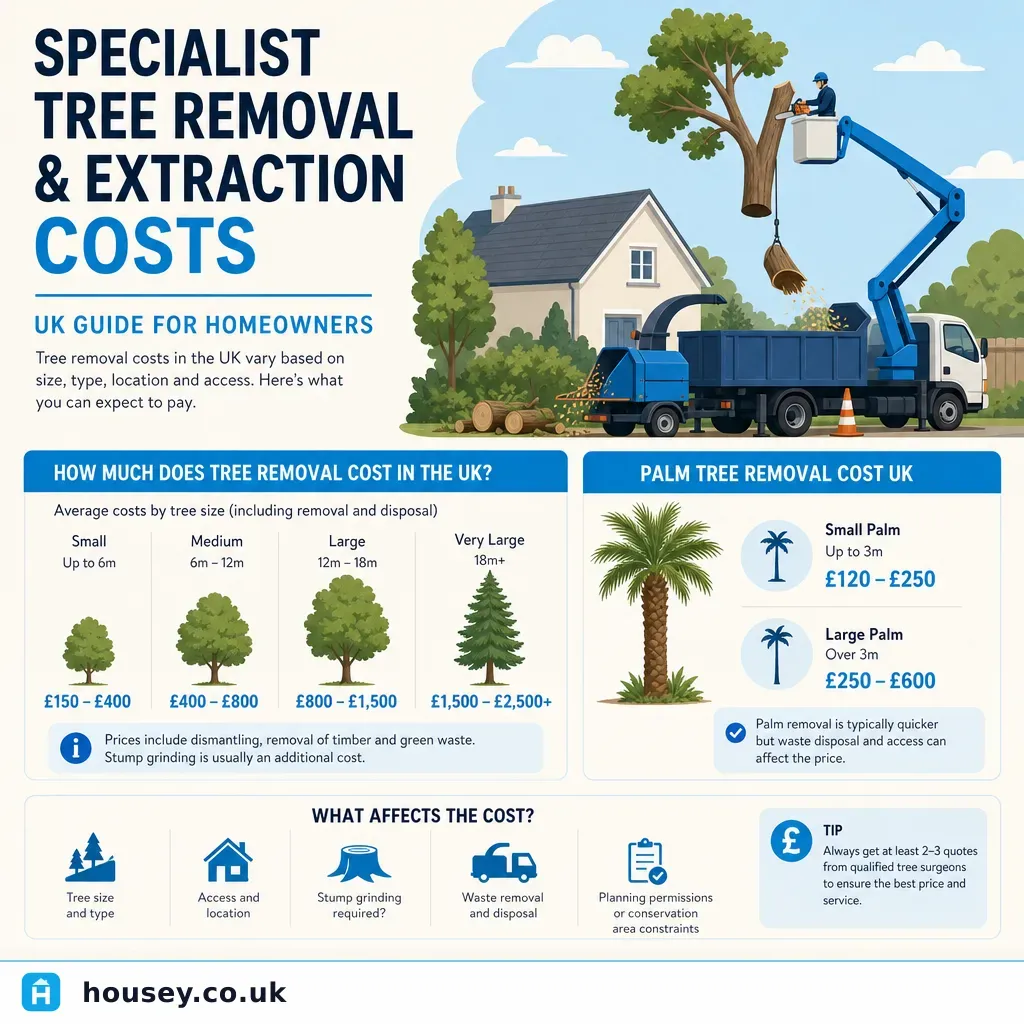
Specialist Tree Removal and Extraction Costs
Specialist tree removal costs in the UK range from around £150 for small trees to £3,000 or more for large mature specimens, with palm trees typically costing more due to specialist technique.
 Improvement & Build
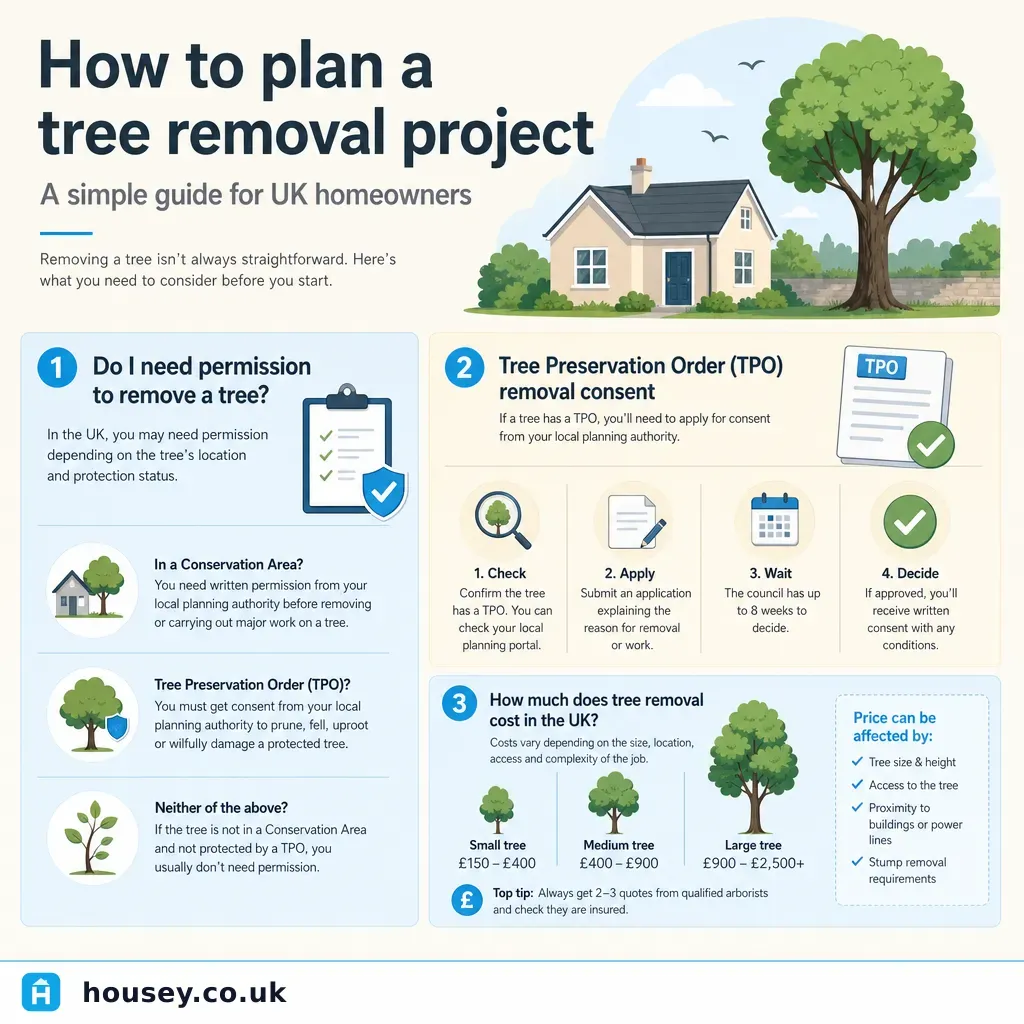
How to plan a tree removal project
Planning a tree removal project starts with checking whether the tree is protected by a Tree Preservation Order or sits in a conservation area, as both require council consent before any work begins.
 Improvement & Build
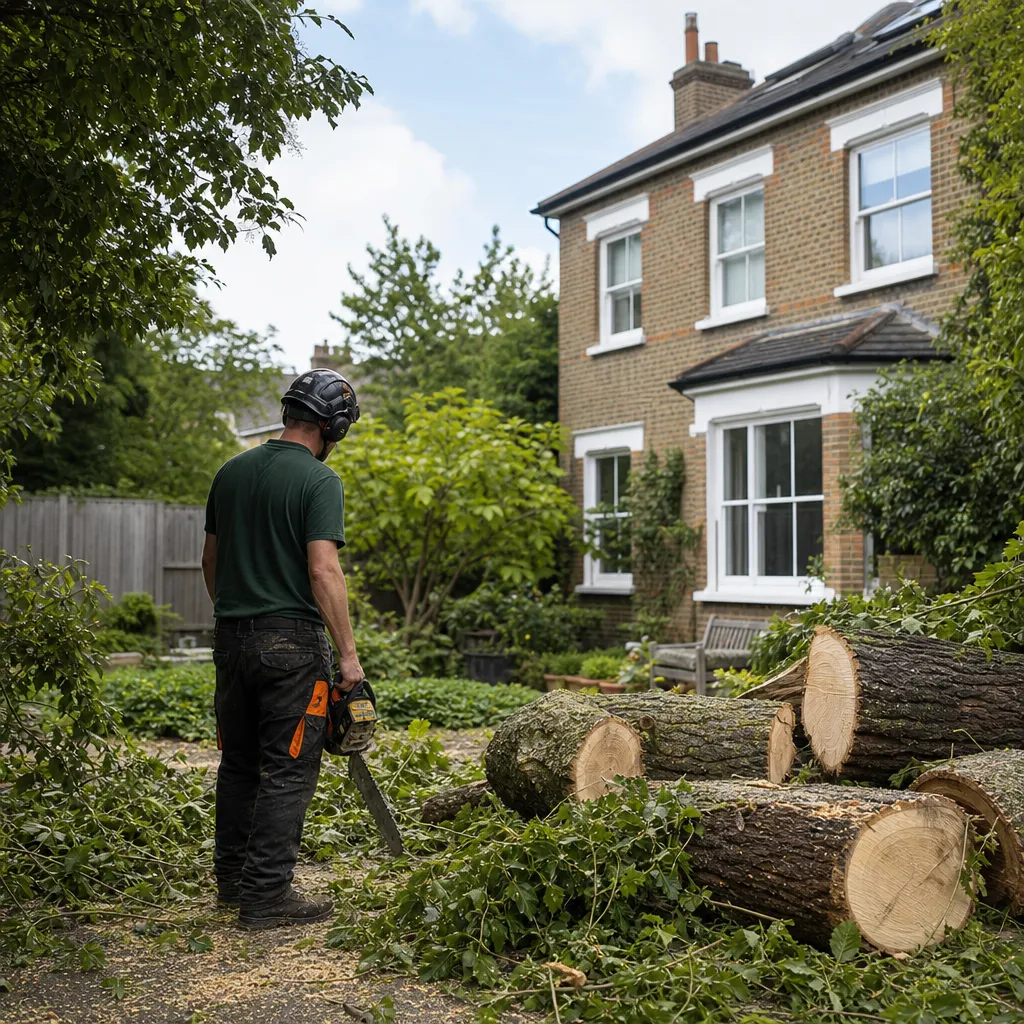
Tree Removal and Sustainable Uses for Timber
When a tree is felled, the timber can be reused as firewood (after 12–24 months' seasoning), woodchip mulch, or sawn planks.