Skip and Grab Hire: Comparing Waste Removal Costs
By Housey · Last reviewed 7th of May 2026
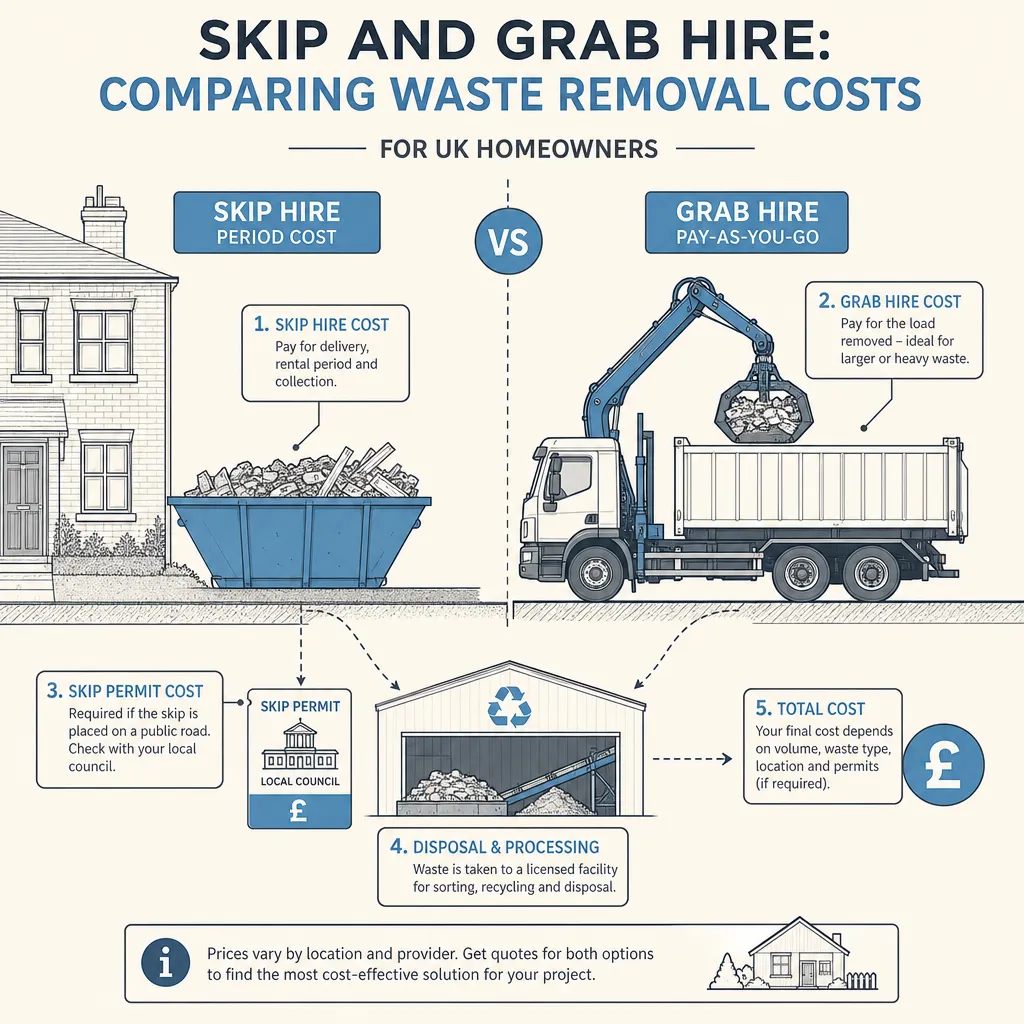
Skip and Grab Hire: Comparing Waste Removal Costs
Construction, renovation, and clearance projects in the UK generate significant volumes of waste that need removing quickly and compliantly. Whether you are clearing a garden, demolishing an outbuilding, or managing a building site, choosing the wrong removal method can mean unnecessary cost, a permit headache, or a lorry that simply cannot reach your site.
Key points
- Skips placed on a public highway require a council permit, which typically costs £50–£150 for a two-week period and requires reflective markings and lights on the skip.
- Grab hire lorries use a hydraulic arm to collect loose materials without entering your site — useful where access is restricted — but cannot take bagged, mixed, or hazardous waste.
- Any contractor collecting, carrying, or disposing of controlled waste must be registered with the Environment Agency as a licensed waste carrier; check the public register at GOV.UK before instructing anyone.
- Skip sizes range from 2-yard mini skips (roughly 15–20 black bags) to 16-yard maxi skips; grab lorries typically carry 8–16 tonnes per load depending on vehicle size.
- Waste containing asbestos, large quantities of plasterboard, contaminated soil, or electrical items requires separate specialist disposal under the Environmental Protection Act 1990.
What is skip hire and when does it suit you?
A skip is a steel open-top container delivered to your property and collected once full or after an agreed hire period. Skip hire suits projects where waste is generated gradually — a kitchen fit-out, loft clearance, or garden landscaping — and where a container on site is practical for several days or weeks.
Most suppliers offer a standard hire period of seven to fourteen days, with extended hire available at a daily surcharge. Skips can take mixed construction waste including timber, bricks, rubble, and general household items, though you should always confirm what is accepted before filling.
Indicative UK skip hire costs (last reviewed 2026-05-07):
Skip size | Approx. capacity | Typical price range (exc. permit) |
|---|---|---|
Mini (2 yd³) | ~15–20 black bags | £80–£150 |
Midi (4 yd³) | ~35–40 black bags | £120–£200 |
Builders (6–8 yd³) | ~60–80 black bags | £200–£350 |
Large (10–12 yd³) | ~100–120 black bags | £300–£500 |
Maxi (14–16 yd³) | ~140–160 black bags | £400–£650+ |
Prices vary by region, supplier, and waste type. Surcharges apply for soil, plasterboard, tyres, or electrical items. Always request an itemised quote and ask whether the council permit fee is included or invoiced separately.
What is grab hire and when does it suit you?
Grab hire uses a lorry fitted with a hydraulic grab arm that reaches over a wall or fence to collect loose material from your site without the vehicle entering. This makes it particularly practical on narrow plots, terraced houses, or sites where a delivery lorry cannot access the driveway.
Grab lorries are most effective for bulk, loose materials: soil, rubble, hardcore, gravel, and clean demolition waste. They are not suitable for mixed or bagged waste, and most operators will refuse hazardous materials.
Indicative UK grab hire costs (last reviewed 2026-05-07):
Lorry type | Typical capacity | Typical price range per load |
|---|---|---|
8-tonne grab | ~5–6 m³ | £180–£280 |
12-tonne grab | ~8–10 m³ | £250–£380 |
16-tonne grab | ~12–14 m³ | £320–£500 |
Prices depend on location, haulage distance to the licensed tip, and material type. Some operators charge by weight rather than by load, so confirm the pricing structure before booking.
Skip vs grab hire: which is right for your project?
Use this decision guide to identify the better option before requesting quotes.
- Choose skip hire if you are generating waste gradually over several days, need on-site storage between collections, have mixed waste types such as timber, rubble, and packaging, or are carrying out a DIY project.
- Choose grab hire if you have a large volume of loose soil, rubble, or hardcore to remove in a single visit, have restricted vehicle access where a skip lorry cannot operate, or are running a demolition or groundworks project.
- Consider both on larger builds where mixed and bulk waste arise at different project stages.
- Ask your contractor whether waste removal is included in the project quote — many demolition and groundworks contractors factor disposal into their overall price.
- Check with your local authority if you are unsure whether a skip permit is needed; requirements and fees vary between councils.
What affects the cost?
Several factors drive variation in quoted prices:
- Location: urban areas with restricted access or higher tip fees typically cost more than rural locations.
- Haulage distance: the further the nearest licensed tip, the higher the transport element of the price.
- Waste type: inert materials such as soil and concrete are usually cheaper to dispose of than mixed or contaminated waste.
- Hire duration: extended skip hire incurs daily surcharges after the standard period.
- Permit fees: council road-placement permits vary by authority — some charge per day, others per permit period.
- Weight overage: skips have weight limits; overloaded skips may incur surcharges or be refused at collection.
Quote comparison checklist
Before accepting any waste removal quote, confirm:
- Is VAT included in the price?
- What waste types are accepted, and what is excluded?
- Is the council permit fee included for road-placed skips?
- What is the standard hire period, and what is the daily rate for extensions?
- Is the contractor registered with the Environment Agency as a licensed waste carrier?
- What happens if the skip is overfilled or overweight at collection?
- Will you receive a waste transfer note confirming legal disposal?
A waste transfer note is a legal requirement under the Environmental Protection Act 1990 duty of care provisions. Always ask for one — it protects you if waste is later found to have been fly-tipped.
When to get professional help
Most skip and grab hire decisions are straightforward, but seek specialist advice or engage a specialist contractor if:
- Your site contains suspected asbestos-containing materials — licensed asbestos removal must be completed before general waste clearance can proceed.
- Soil on site may be contaminated (former industrial land, old petrol station, or chemical storage areas) — contaminated waste must be characterised and disposed of under specialist licences.
- You are managing a complex demolition involving multiple hazardous material streams that require a coordinated removal and disposal plan.
- The volume of waste is large enough that engaging a single contractor for the entire project, waste removal included, may be more cost-effective than arranging skip or grab hire separately.
How Housey can help
If your project involves significant demolition or groundworks, the waste removal strategy is often best decided alongside the contractor carrying out the work. Housey can help you request quotes from demolition contractors and groundworkers who can advise on the most efficient and compliant waste removal approach as part of the wider project.
Frequently asked questions
Do I need a permit to place a skip on the road?
Yes. If the skip is on a public highway — including the pavement — you need a permit from your local council. Your skip hire company will usually apply for this on your behalf, but confirm whether the permit fee is included in your quote. Permits typically cost £50–£150 and are valid for a set period, usually one to two weeks.
Can I put plasterboard in a skip?
Many skip hire companies accept small quantities of plasterboard in a mixed load, but it is often subject to a surcharge or outright ban. Plasterboard (gypsum) must be separated at the tip to avoid contaminating other waste streams. Always check with your supplier before loading plasterboard.
What is a waste transfer note and do I need one?
A waste transfer note confirms that your waste has been handed to a licensed carrier for legal disposal. Under the Environmental Protection Act 1990 duty of care, you are responsible for ensuring your waste is handled correctly. Always request a waste transfer note from your skip or grab hire operator.
How quickly can a skip or grab lorry be delivered?
Many suppliers offer next-day or same-day delivery, depending on availability. Grab hire is often faster to arrange for a single-visit collection. If your project has a tight schedule, book in advance and confirm the lead time when requesting your quote.
Is grab hire cheaper than skip hire for large volumes?
For large volumes of a single loose material — soil or hardcore — grab hire can be more cost-effective because one visit removes a high tonnage quickly. For mixed or ongoing waste generated over several days, skip hire usually offers better value as it provides on-site storage throughout the hire period.
Sources and further reading
- Waste carrier, broker and dealer registration — GOV.UK
- Duty of care: waste transfer notes — GOV.UK
- Skips, scaffolding and other obstructions on public roads — GOV.UK
- Environmental Protection Act 1990 — legislation.gov.uk
Useful next reads
 Improvement & Build
Who Provides House Demolition Services
House demolition in the UK is carried out by specialist demolition contractors, often members of the National Federation of Demolition Contractors (NFDC).
 Improvement & Build
Open Plan Living Space Conversion Costs
Opening up a living space in the UK typically costs £3,000–£15,000+ depending on whether walls are load-bearing, the beam specification required, and the extent of remodelling.
 Improvement & Build
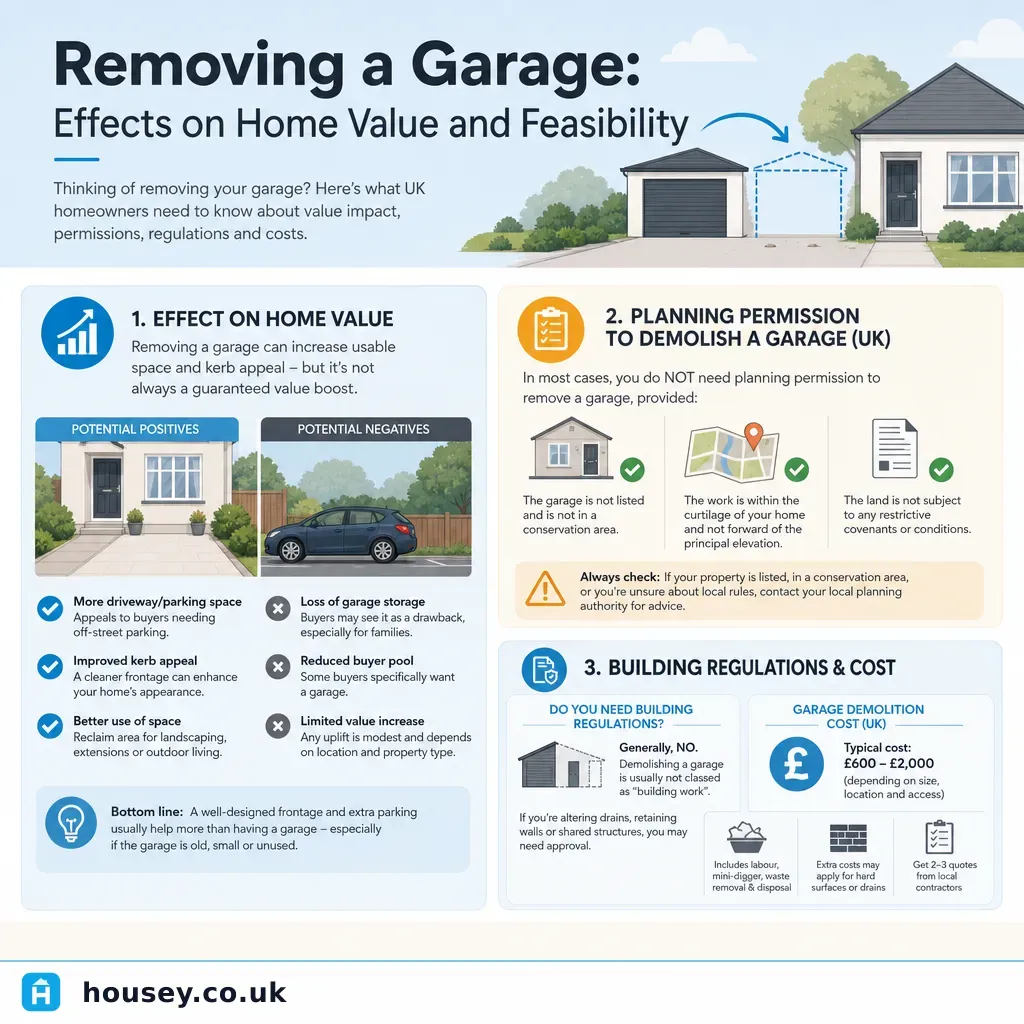
Removing a Garage: Effects on Home Value and Feasibility
Demolishing a garage in England may require prior notification to the local planning authority, and structural or building regulations assessments are often needed if the garage is attached to or integral with the house.
 Improvement & Build
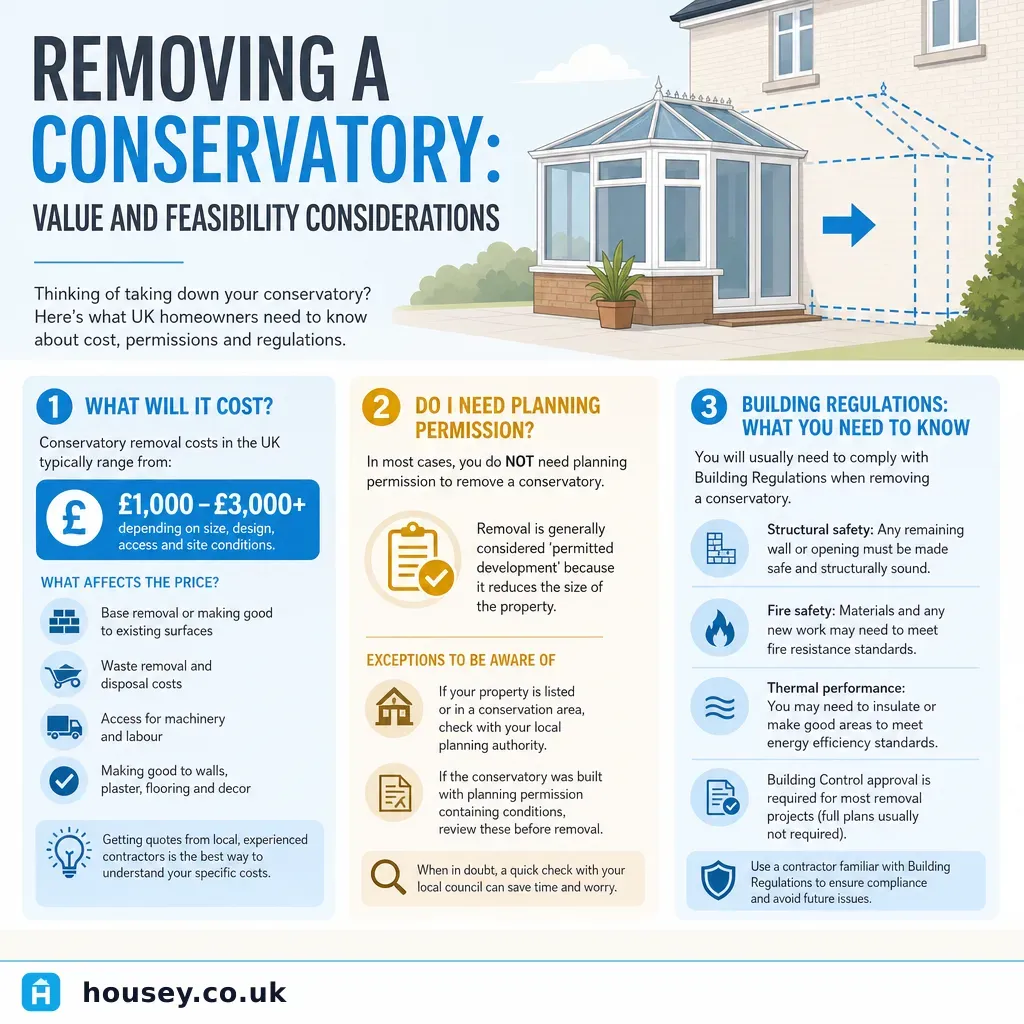
Removing a Conservatory: Value and Feasibility Considerations
Removing a conservatory in England usually does not need planning permission if the original structure was permitted development, but reinstating the original wall almost always requires a building regulations application covering structural, thermal, and moisture elements.
 Improvement & Build
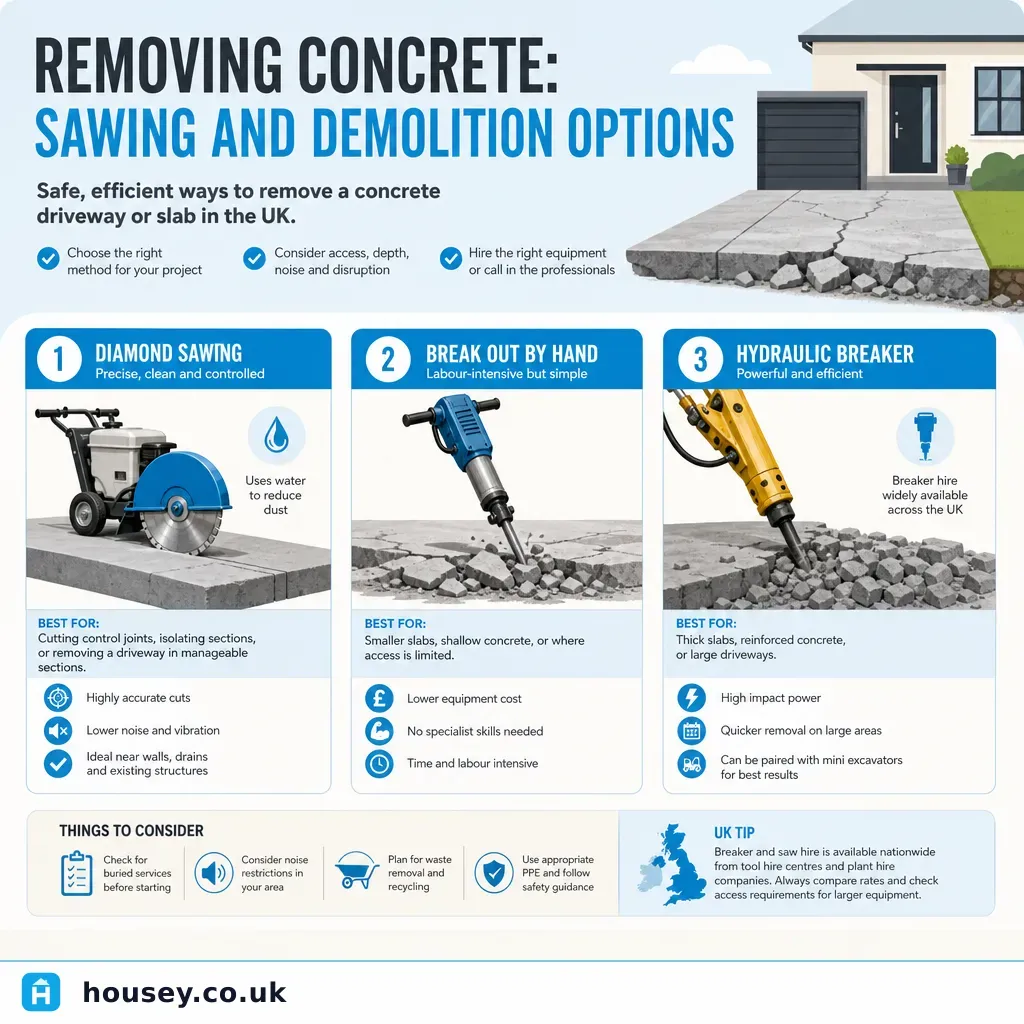
Removing Concrete: Sawing and Demolition Options
Concrete removal methods include hydraulic or electric breakers for bulk demolition, diamond disc or wire sawing for precision cuts, and hand tools for small areas.