Slate Floor Tiles: Installation Costs and Application
By Housey · Last reviewed 31st of May 2026
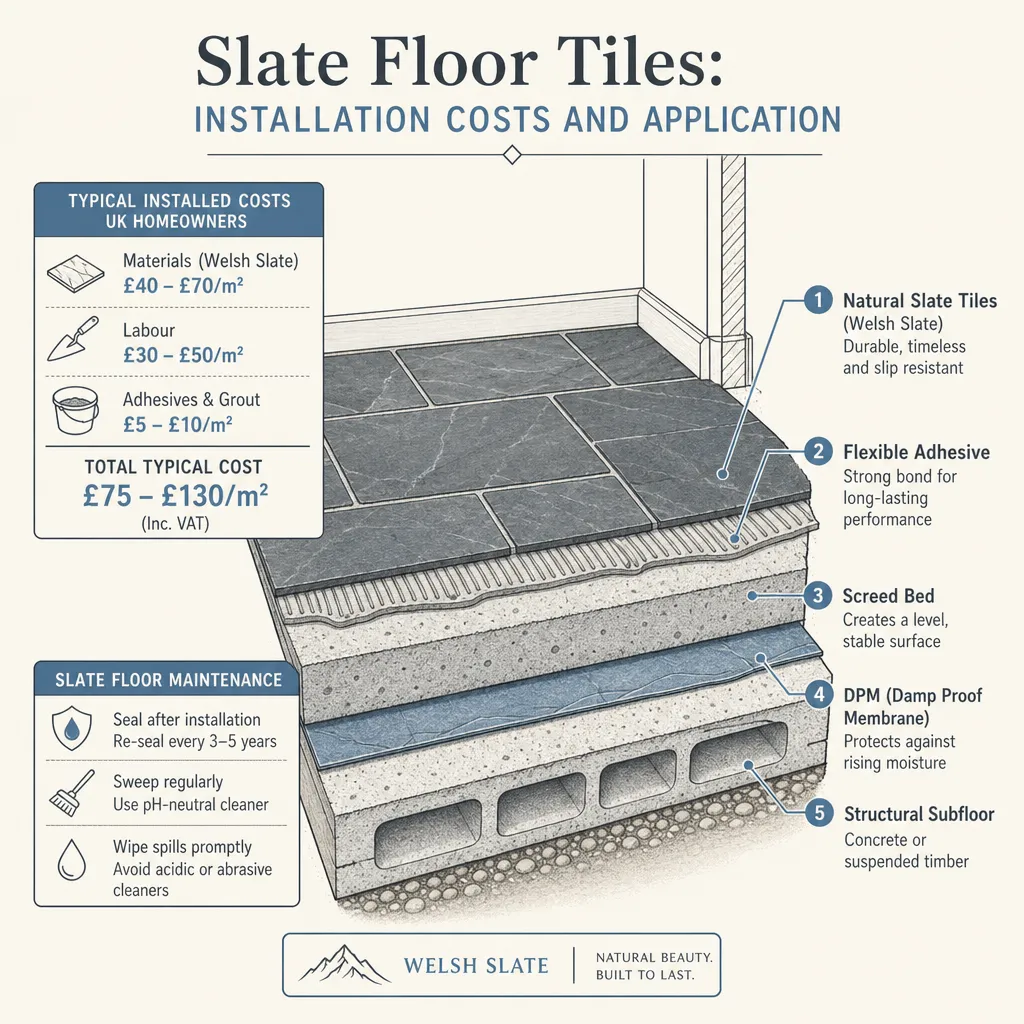
Slate Floor Tiles: Installation Costs and Application
Slate flooring is a long-established choice in UK homes, suited to everything from Victorian hallway restoration to contemporary kitchen extensions. Its durability, thermal mass, and natural variation make it a practical and visually versatile material — but choosing the right origin, thickness, and finish, and preparing the subfloor correctly, determines whether the result lasts decades or causes problems within a few years. Understanding costs and requirements upfront helps homeowners plan their project with realistic expectations.
Key points
- Natural slate floor tiles cost approximately £30–£100 per m² for materials, with installation adding £25–£60 per m², giving a typical supply-and-fit range of £55–£160 per m² (Indicative UK costs, last reviewed 2026-05-31).
- Welsh slate (quarried primarily in Gwynedd, and inscribed as a UNESCO World Heritage landscape) is recognised as a premium domestic product; Indian, Brazilian, and Chinese slates are more affordable but vary significantly in quality and consistency.
- Slate must be sealed with a penetrating impregnating sealant before grouting — unsealed slate is highly porous on many grades and will permanently stain in use.
- BS 8203 recommends a maximum floor flatness deviation of no more than 3 mm under a 2 m straight edge before laying; slate is unforgiving of subfloor movement or irregularity.
- Slate is compatible with underfloor heating (UFH) systems, but a flexible S1 or S2 class adhesive is required to accommodate thermal movement, and the heating should be ramped up gradually during the first season.
Comparing slate origins: which type suits your project?
Slate is quarried across several countries, and origin significantly affects price, quality consistency, and appearance.
Slate origin | Typical material cost | Finish options | Quality consistency | Best for |
|---|---|---|---|---|
Welsh (Penrhyn, Ffestiniog) | £60–£100 per m² | Riven, honed | Very high | Heritage restorations, premium new builds, listed properties |
Spanish | £40–£70 per m² | Riven, honed, brushed | High | Contemporary kitchens, extensions, bathrooms |
Indian (Raj Green, Multicolour) | £15–£35 per m² | Riven, calibrated | Variable | Budget projects, utility areas, outbuildings |
Brazilian (Black, Green) | £25–£55 per m² | Riven, polished | Moderate | Feature areas, modern interiors |
Chinese | £12–£30 per m² | Riven, honed | Variable | Budget applications — check quality carefully before purchasing |
Material prices are indicative only, last reviewed 2026-05-31. Quotes vary by supplier and project size.
Indian slate is widely used in UK homes for its affordability, but quality varies considerably between quarries and production batches. Where budget allows, Spanish or Welsh slate typically delivers more consistent results in domestic applications.
Worked example: slate floor in a Victorian terrace kitchen extension
A homeowner in Bristol fits out a 14 m² rear kitchen extension with Spanish grey slate tiles (600 × 300 mm, honed finish). The extension has a concrete raft slab with an electric underfloor heating mat already installed and the floor is level to BS 8203 tolerances.
Item | Indicative cost |
|---|---|
Spanish slate tiles (14 m² + 10% wastage = 15.4 m² at £50/m²) | £770 |
Flexible S1 adhesive suitable for UFH | £120 |
Installation labour (14 m² at £40/m²) | £560 |
Grout and penetrating sealant | £65 |
Total (indicative) | £1,515 |
The slab was already level; no levelling compound was needed. Had the floor required significant preparation, an additional £150–£350 in self-levelling compound and labour would have applied. All figures are indicative, last reviewed 2026-05-31.
Subfloor preparation: the most important variable
The condition and type of subfloor is often the biggest cost variable in slate flooring installation. Natural stone is heavy and rigid — any movement or irregularity will eventually crack tiles or cause adhesive failure.
- Solid concrete or new screed: a suitable base provided it is dry, flat, and free of contamination. Check moisture content with a hygrometer or carbide bomb test — screed should read below 75% RH before tiling.
- Timber suspended floors: slate is heavy (natural stone tiles typically 20+ kg/m²). Check that the floor structure can carry the additional load. A minimum 18 mm exterior-grade plywood decoupling layer is commonly specified over timber joists to prevent flex.
- Existing ceramic or quarry tiles: can sometimes be tiled over if fully secure and level, reducing removal costs — but adds floor height, which may affect door thresholds and level transitions.
- Existing vinyl or bitumen adhesive residue: most stone tile adhesive manufacturers specify a clean, bare substrate; old black bitumen adhesive (common in pre-2000 UK homes) typically requires mechanical removal.
Sealing and maintenance
Slate's porosity varies by origin and finish — honed slate is typically more porous than riven slate of the same stone. Correct sealing is essential in food preparation areas, hallways, and any high-traffic space.
Sealing process:
- Ensure tiles are clean and fully dry — at least 24–48 hours after grouting
- Apply a penetrating impregnating sealant (not a surface film product); one to two coats is typical depending on porosity
- Allow the manufacturer's specified dwell and cure time before use
- Re-seal as needed — typically every 2–5 years in domestic applications
Avoid acidic cleaning products (limescale removers, vinegar) on slate; these etch the surface and strip sealant. A pH-neutral stone cleaner is recommended for routine maintenance.
When to get professional help
Slate floor installation is within the scope of a competent professional tiler, but seek specialist advice if:
- The floor structure is timber and you are uncertain about load-bearing capacity — a structural engineer's assessment may be needed before specifying heavy stone
- The subfloor requires significant levelling (more than 10 mm variation over 2 m), which may need a self-levelling compound specified for use with natural stone
- You need to confirm adhesive and grout compatibility with a specific UFH system — not all products are rated for use with all heating types
- You are working in a listed building or conservation area where existing floor finishes may be historically significant and should not be disturbed without heritage advice
How Housey can help
Whether you are planning a kitchen extension floor or a full ground floor refurbishment with natural stone, Housey connects you with vetted extension builders and specialist tiling contractors who can advise on subfloor preparation, slate selection, and installation. Submit a quote request to compare prices from local professionals.
Frequently asked questions
Is natural slate flooring suitable for underfloor heating?
Yes — slate is compatible with underfloor heating due to its good thermal conductivity. Use a flexible S1 or S2 class tile adhesive to accommodate thermal movement. Tiles should be acclimated to room temperature for at least 24 hours before laying, and the heating system should run at a low temperature for the first two weeks after installation to minimise stress on the adhesive and grout.
How do I stop slate floor tiles from staining?
Apply a penetrating impregnating sealant before grouting and again after the grout has fully cured. Reseal every 2–5 years in domestic conditions. Wipe spills promptly — slate can stain permanently if liquids are left to soak in — and avoid acidic or bleach-based cleaners, which can damage the surface and strip the sealant.
What thickness of slate tile is best for floors?
For domestic floor applications, 10–12 mm calibrated slate is the most practical choice, giving a consistent thickness that simplifies installation. Thicker gauges add weight and may affect door thresholds. Riven (uncalibrated) slate varies in thickness across the face and requires more skill and adhesive depth to lay level.
Can I lay slate tiles over an existing wooden floor?
It is possible but requires careful assessment of the floor structure's load-bearing capacity and the addition of a rigid decoupling layer, typically 18 mm exterior-grade plywood. A flexible tile adhesive must be used. In older properties with springy timber floors, the risk of cracked tiles over time is significant and a structural assessment is advisable before proceeding.
Sources and further reading
- GOV.UK: Building Regulations Approved Document C — resistance to moisture and subfloor preparation
- BS 8203: Code of practice for installation of resilient floor coverings — British Standards Institution, subfloor flatness tolerances
- The Tile Association: natural stone and slate installation guidance — The Tile Association, professional installation best practice
Useful next reads
 Improvement & Build
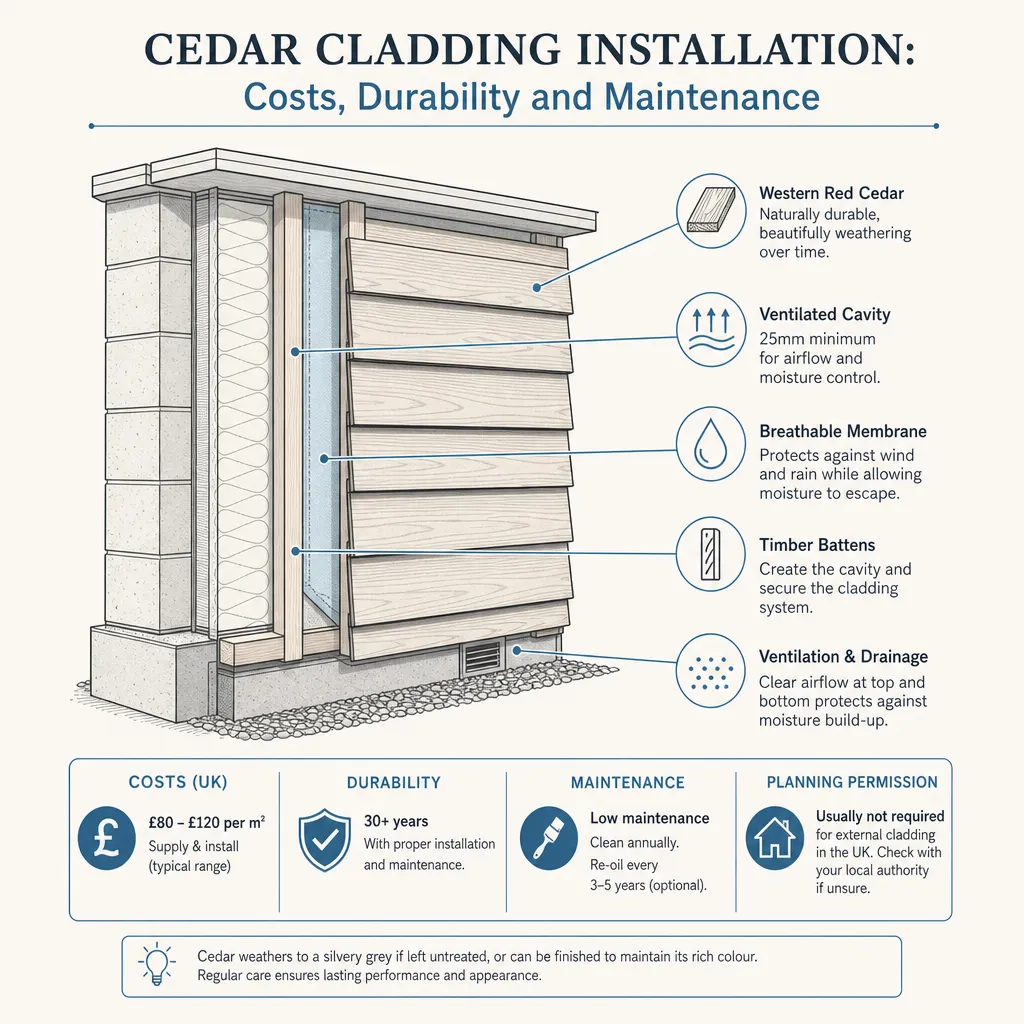
Cedar Cladding Installation: Costs, Durability and Maintenance
Cedar cladding is a natural timber exterior finish popular for UK homes and extensions.
 Improvement & Build
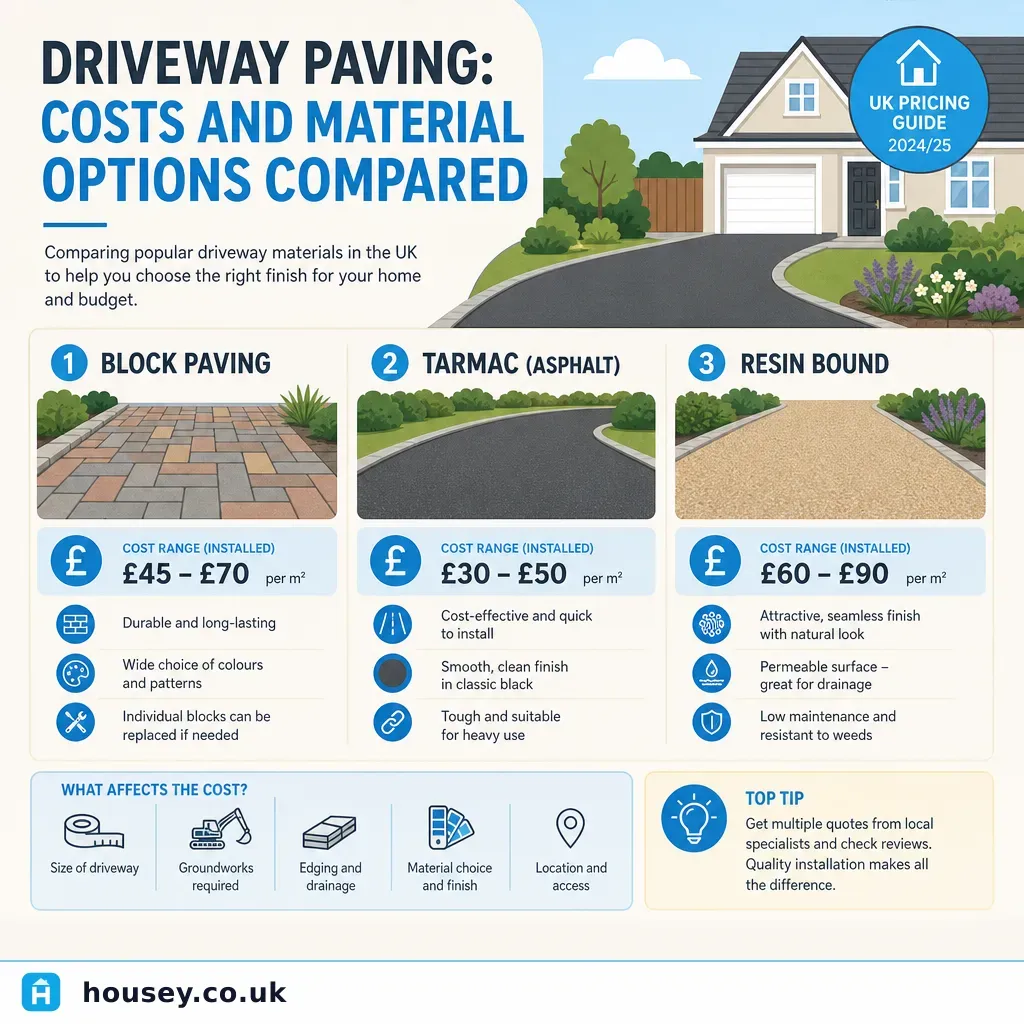
Driveway Paving: Costs and Material Options Compared
Driveway installation costs in the UK typically range from £50–£90 per m² for tarmac to £80–£150 per m² for block paving and £70–£120 per m² for resin-bound surfaces.
 Improvement & Build
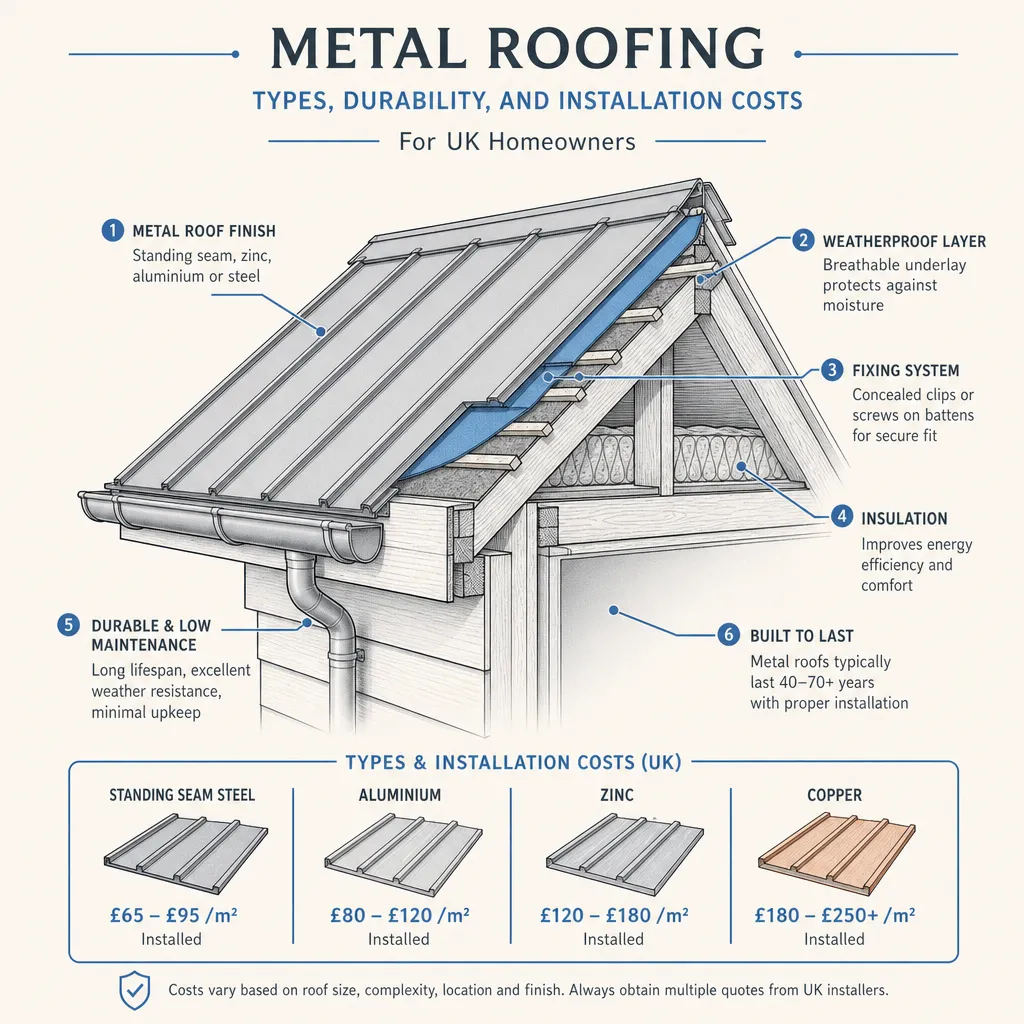
Metal Roofing: Types, Durability, and Installation Costs
Metal roofing in the UK includes standing seam, corrugated sheet, and metal tile systems in steel, aluminium, zinc, or copper.
 Improvement & Build
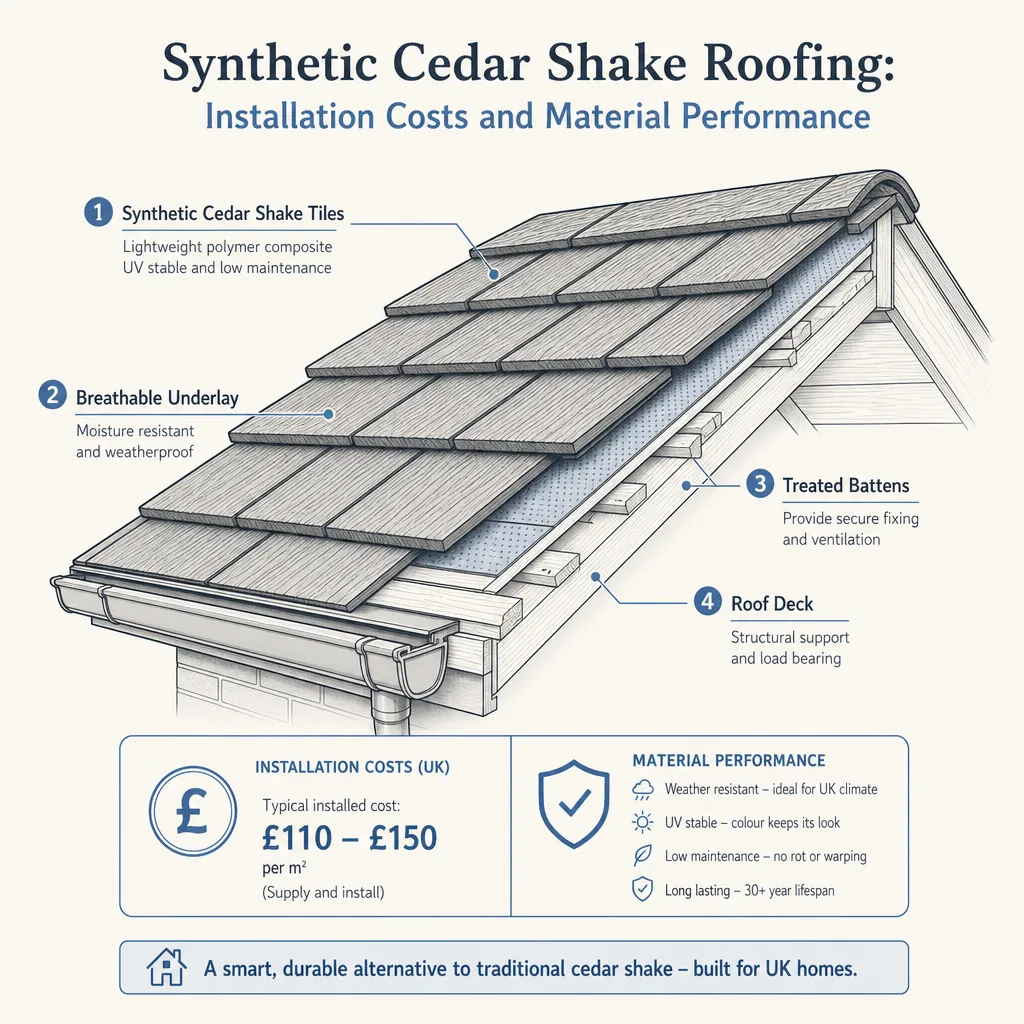
Synthetic Cedar Shake Roofing: Installation Costs and Material Performance
Synthetic cedar shake roofing uses polymer composite, rubber, or fibre-cement tiles to replicate the look of natural cedar wood shingles.
 Improvement & Build
Building an Outdoor Kitchen: Design, Materials, and Investment
Building an outdoor kitchen in the UK costs roughly £3,000–£25,000 depending on size and materials.