Small Retaining Wall Construction Methods for Residential Gardens
By Housey · Last reviewed 25th of May 2026
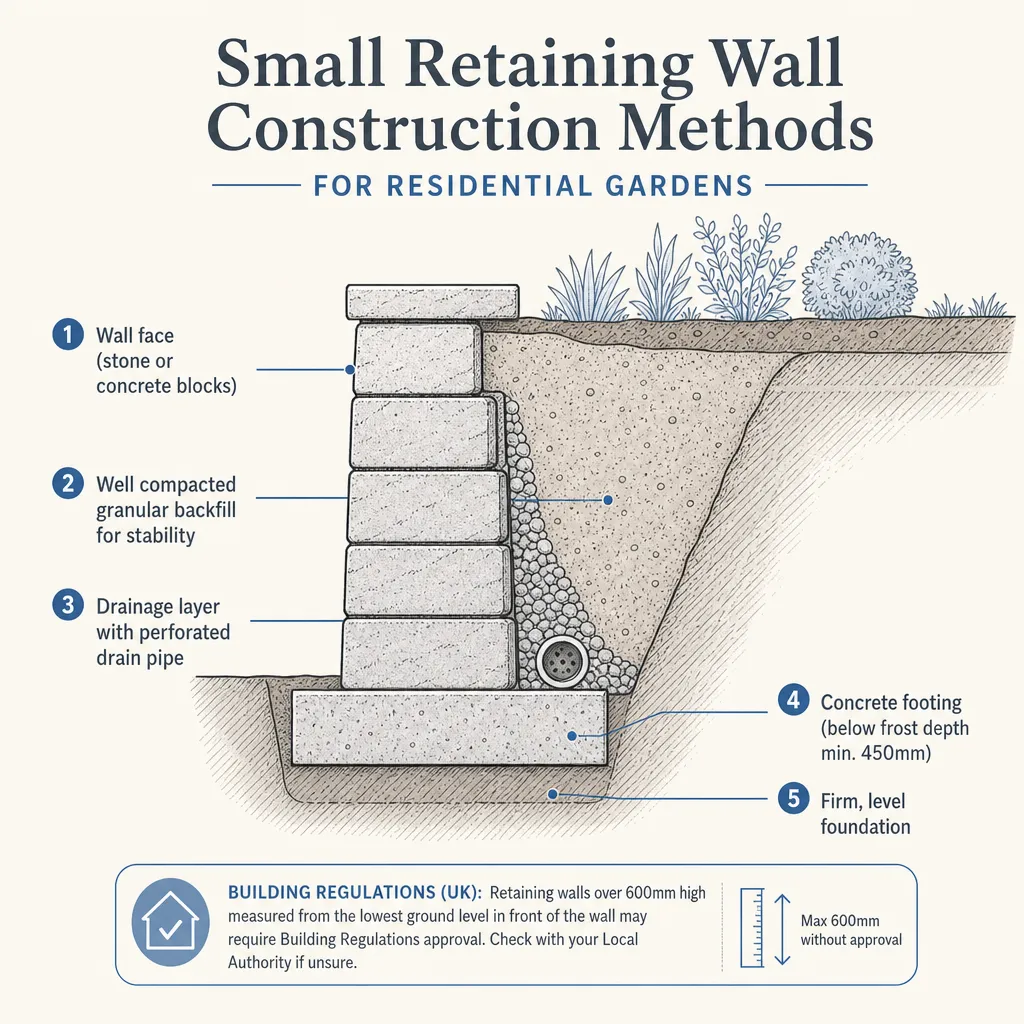
Small Retaining Wall Construction Methods for Residential Gardens
Sloped gardens and level-change terraces are a common feature of UK residential properties — from Victorian terraces built on hillsides to postwar semis with stepped rear gardens. A retaining wall holds back soil at a level change, and the choice of method and material has real consequences for durability, drainage, and safety. An under-designed or poorly drained wall can fail progressively, sometimes years after construction, causing damage to adjacent paving, boundary features, or buildings.
Key points
- Gravity retaining walls — which resist soil pressure through their own mass — are the standard method for garden walls up to approximately 1 m in height; beyond this, an engineered solution specified by a structural engineer is usually required.
- In England and Wales, a retaining wall adjacent to a highway that exceeds 1 m in height, or one exceeding 2 m elsewhere, is likely to require Building Regulations approval under Approved Document A (Structure).
- Drainage failure is the primary cause of retaining wall collapse: hydrostatic pressure from waterlogged soil can exceed a wall's lateral resistance rapidly; weep holes or a free-draining aggregate layer behind the wall are essential design elements, not optional extras.
- The Party Wall etc. Act 1996 may apply where construction involves excavating within 3 m of a neighbouring structure to a depth greater than the existing foundations, even in a residential garden context.
- Timber sleepers pressure-treated to Use Class UC4 can last 15–20 years in ground contact; reclaimed railway sleepers may contain creosote, classified as hazardous under COSHH regulations, and are not recommended near vegetable plots or children's play areas.
Which retaining wall method suits your garden?
Gravity walls (most common for small domestic gardens)
Gravity walls resist earth pressure through their own weight and mass without requiring steel reinforcement or deep engineered foundations. They must be adequately thick relative to their retained height — a commonly cited rule of thumb for dry-stone or block gravity walls is a base width of at least one-third to one-half the exposed height. Common gravity wall materials in UK residential gardens include:
- Natural stone (dry-stone or mortared): A traditional aesthetic particularly suited to rural, cottage, and Arts and Crafts gardens. Dry-stone walls allow drainage through the face, reducing hydrostatic pressure. Mortared stone walls require weep holes. Skilled laying is important for long-term durability.
- Concrete or dense masonry blocks: Economical and durable. Suitable for mortared construction with rendered or faced finishes. Weep holes are essential for drainage.
- Engineering brick: Suitable for formal or urban garden contexts. A half-brick (102 mm) wall is not adequate as a retaining wall — a full brick (215 mm) or cavity construction with piers at intervals is more appropriate.
- Timber sleepers: Horizontal stacked sleepers are popular for raised beds and low terracing. New softwood sleepers pressure-treated to Use Class UC4 are suitable for ground contact. Reclaimed railway sleepers may contain creosote and must be handled with care under COSHH regulations.
- Gabion baskets: Wire mesh cages filled with stone. Provide excellent drainage, a naturalistic aesthetic, and good tolerance of slight ground movement. Require careful tensioning of mesh and selection of suitable stone infill.
Reinforced or cantilevered walls (for heights above approximately 1 m)
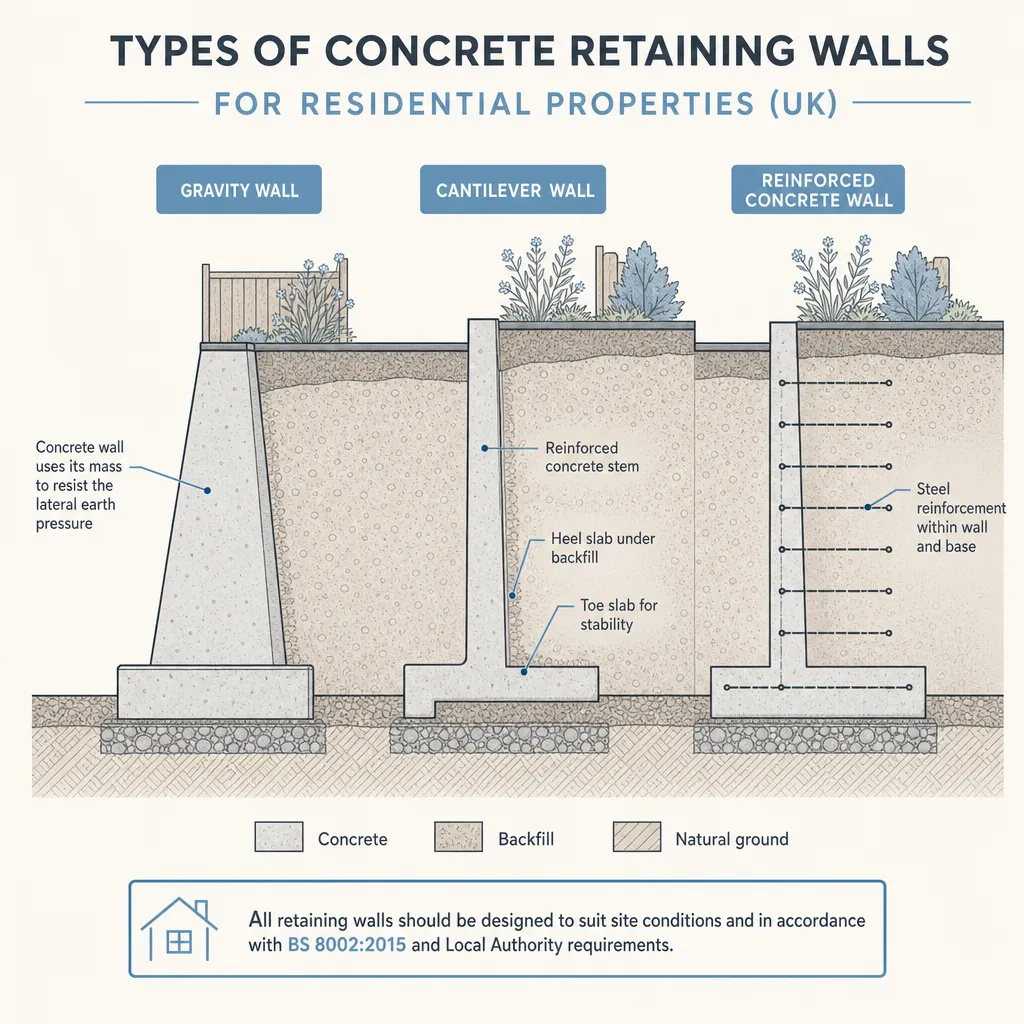
For walls retaining more than approximately 1 m of soil, or where the retained material is particularly heavy or waterlogged clay, gravity methods alone are usually insufficient. Reinforced concrete retaining walls, cantilevered concrete L-walls, or geogrid reinforced-earth systems should be specified by a qualified structural engineer. Construction at this scale is not suitable for DIY.
Comparison: small garden retaining wall methods
Method | Best suited to | Typical height range | Drainage provision | Relative cost | Skill level needed |
|---|---|---|---|---|---|
Dry-stone | Rural, cottage, informal gardens | Up to 1 m | Excellent (drains through face) | Medium | High |
Mortared stone or block | Formal gardens, rendered finish | Up to 1.2 m | Weep holes essential | Medium | Medium–high |
Timber sleepers | Raised beds, informal terracing | Up to 0.6–0.8 m | Good with horizontal gaps | Low–medium | Low–medium |
Engineering brick | Formal, urban, near buildings | Up to 0.9 m | Weep holes essential | Medium | Medium–high |
Gabion baskets | Informal, naturalistic, sloped sites | Up to 1 m | Excellent | Medium | Low–medium |
Reinforced concrete | Steep drops, near buildings or highway | 1 m and above | Engineered drainage required | High | Professional only |
Indicative relative costs only; actual quotes vary by location, access, and specification. Indicative UK costs, last reviewed 2026-05-25.
Decision tree: which wall and who should build it?
- Choose timber sleepers if the wall is under 600 mm, purely decorative or forming a raised bed, the garden has an informal character, and budget is a priority.
- Choose dry-stone or gabion construction if drainage is a priority, the garden has a rural or naturalistic aesthetic, and the retained height is under 1 m.
- Choose mortared stone or dense block if you want a formal or rendered finish and the retained height is up to 1.2 m.
- Instruct a structural engineer if the retained height exceeds 1 m, the wall is near a building foundation, or the ground is poor, waterlogged, or made-up fill.
- Check with your local planning authority if the wall is on or near a highway boundary, in a conservation area, or forms part of a listed building curtilage.
- Consult a party wall surveyor if the wall will be on or near a shared boundary and excavation could affect neighbouring land or structures.
Drainage: the most important design element
Drainage failure is the most frequent cause of retaining wall collapse in domestic gardens. Saturated soil can exert lateral pressure many times higher than dry soil — a wall that performs well in summer may be under significant stress after a prolonged wet winter. For any mortared or block wall, include:
- Weep holes at the base of the wall, approximately 50–100 mm in diameter or formed by unbonded perpendicular joints, at roughly 1 m horizontal centres, allowing water to pass through the face.
- A free-draining aggregate layer (20 mm clean gravel or similar) placed immediately behind the wall to a minimum depth of 150 mm, extending to the base of the wall.
- Optionally, a perforated land drain pipe at the base of the aggregate layer, leading water away to a soakaway or drainage ditch.
Dry-stone and gabion walls drain naturally through their structure, but a drainage aggregate layer behind the wall is still beneficial where significant soil depths are retained.
Building Regulations and planning considerations
Many small garden retaining walls are built without formal consent, but there are circumstances where approval is necessary:
- Building Regulations Part A (Structure): Walls adjacent to a highway exceeding 1 m in height, or walls elsewhere exceeding 2 m, are notifiable under Building Regulations in England and Wales. Seek Building Control advice before proceeding with walls approaching these thresholds.
- Planning permission: In England, freestanding garden walls up to 2 m generally benefit from permitted development rights under the Town and Country Planning (General Permitted Development) (England) Order 2015. This does not apply in conservation areas (limit is 1 m adjacent to a highway) or for listed buildings, where Listed Building Consent may be required. Rules differ in Scotland, Wales, and Northern Ireland.
- Party Wall etc. Act 1996: Where construction involves excavating within 3 m of a neighbouring structure at a depth greater than the neighbouring foundations, the Act may apply. Take legal advice or instruct a party wall surveyor before excavating near the boundary.
Important limitations
This article provides general information about common construction methods for small garden retaining walls and is not a substitute for professional structural, planning, or legal advice. Retaining wall design depends on retained height, soil type, groundwater conditions, proximity to buildings, and local planning constraints — variables that require on-site professional assessment. A wall that appears adequate at the time of construction may fail progressively as drainage conditions or soil behaviour changes. Always have walls over 1 m, or walls near buildings, boundaries, or highways, assessed by a qualified structural engineer or experienced landscape contractor before and during construction.
When this becomes urgent
Stop work and seek professional advice immediately if:
- An existing retaining wall is visibly leaning, cracking at the base, bulging, or has moved from its original position — these are signs of potential imminent failure.
- Excavation uncovers unexpectedly soft, wet, or contaminated ground.
- Digging reveals foundations of neighbouring structures, buried services, or drainage infrastructure.
- Any new or existing wall is within 2 m of a building's foundations.
What to ask a qualified professional
Before instructing a landscaper, groundworker, or structural engineer for a retaining wall project, ask:
- Do you carry professional indemnity and public liability insurance adequate for structural landscaping work?
- Have you designed or built retaining walls of this height and method before, and can you provide references or examples?
- Will the design include drainage provision — what does that involve in terms of materials and specification?
- Do I need Building Regulations approval or planning permission, and will you advise on the application process?
- Will you provide a written specification or drawing I can submit to Building Control if required?
- How will the finished wall be maintained, and does it need periodic inspection of drainage?
- What are the access requirements for construction, and how will excavated spoil be removed from site?
When to get professional help
A professional landscaper, groundworker, or structural engineer should be involved when:
- The wall will retain more than 1 m of soil.
- The ground is waterlogged, clay-heavy, or has poor bearing capacity.
- The wall is near a building foundation, shared boundary, or highway.
- The project may require Building Regulations approval or planning consent.
- You are in a conservation area or working near a listed building.
How Housey can help
Housey connects you with vetted landscapers, groundworkers, and garden designers experienced in garden terracing, retaining wall design, and construction across the UK. Whether you need a structural assessment, a detailed design, or hands-on construction, you can submit a request through Housey to compare quotes from local professionals.
Frequently asked questions
Do I need planning permission for a garden retaining wall?
In most cases in England, garden retaining walls benefit from permitted development rights and do not require a planning application, provided the wall does not exceed 2 m in height (or 1 m adjacent to a highway). Permitted development rights do not apply in conservation areas, Article 4 Direction areas, or to listed buildings. Rules differ in Scotland, Wales, and Northern Ireland. Always confirm with your local planning authority before starting work.
How deep should the foundations be for a small garden retaining wall?
Foundation depth depends on wall height, soil type, and frost penetration. As a general guide, foundations should reach at least one-third of the wall's exposed height below ground, with a minimum of 300–450 mm below finished ground level to sit beneath seasonal frost depth. In clay or made-up ground, deeper or wider strip foundations may be necessary. A structural engineer should specify foundations for walls over 1 m or in poor ground conditions.
Can I use reclaimed railway sleepers for a garden retaining wall?
Reclaimed railway sleepers can be used for low decorative walls and raised beds, but older sleepers are often treated with creosote — classified as hazardous under UK COSHH regulations — which can leach into soil and is not recommended near vegetable plots or areas where children play. New softwood sleepers pressure-treated to Use Class UC4 are a safer and often more durable alternative. Check the treatment specification before purchase.
How long does a timber sleeper retaining wall last?
New softwood sleepers treated to UC4 can last 15–20 years or more in ground contact, depending on drainage, soil conditions, and exposure. Sleepers in persistently wet ground will deteriorate more quickly. Natural hardwood sleepers such as oak or sweet chestnut offer greater durability but at considerably higher cost. Inspect timber walls annually and replace sections showing significant softening or decay before structural integrity is compromised.
Sources and further reading
- Building Regulations Approved Document A: Structure — GOV.UK
- Town and Country Planning (General Permitted Development) (England) Order 2015 — legislation.gov.uk
- Party Wall etc. Act 1996 – explanatory booklet — GOV.UK
- CIRIA guidance on retaining wall design and assessment — CIRIA
- HSE COSHH: creosote and wood preservatives — Health and Safety Executive
Useful next reads
 Improvement & Build
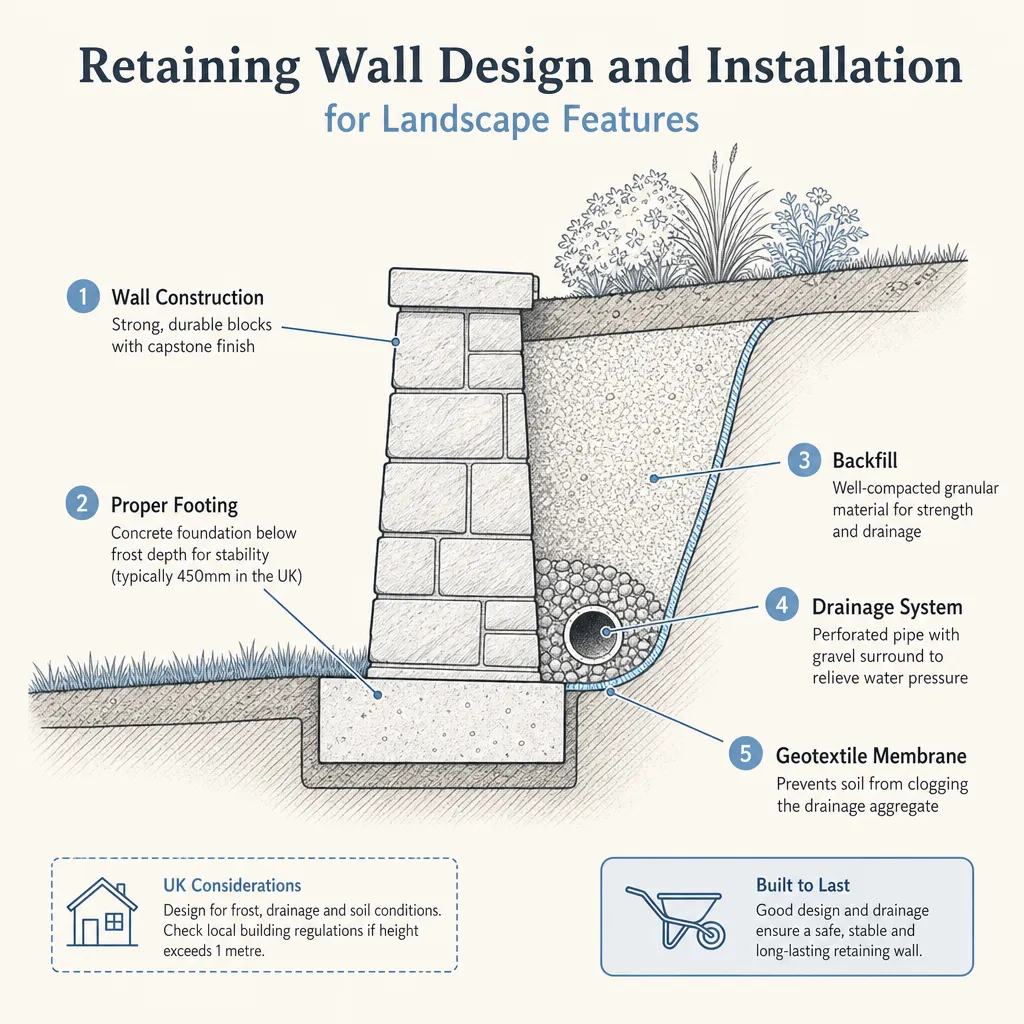
Retaining Wall Design and Installation for Landscape Features
A garden retaining wall holds back soil on a sloped plot using concrete blocks, stone, or timber.
 Improvement & Build
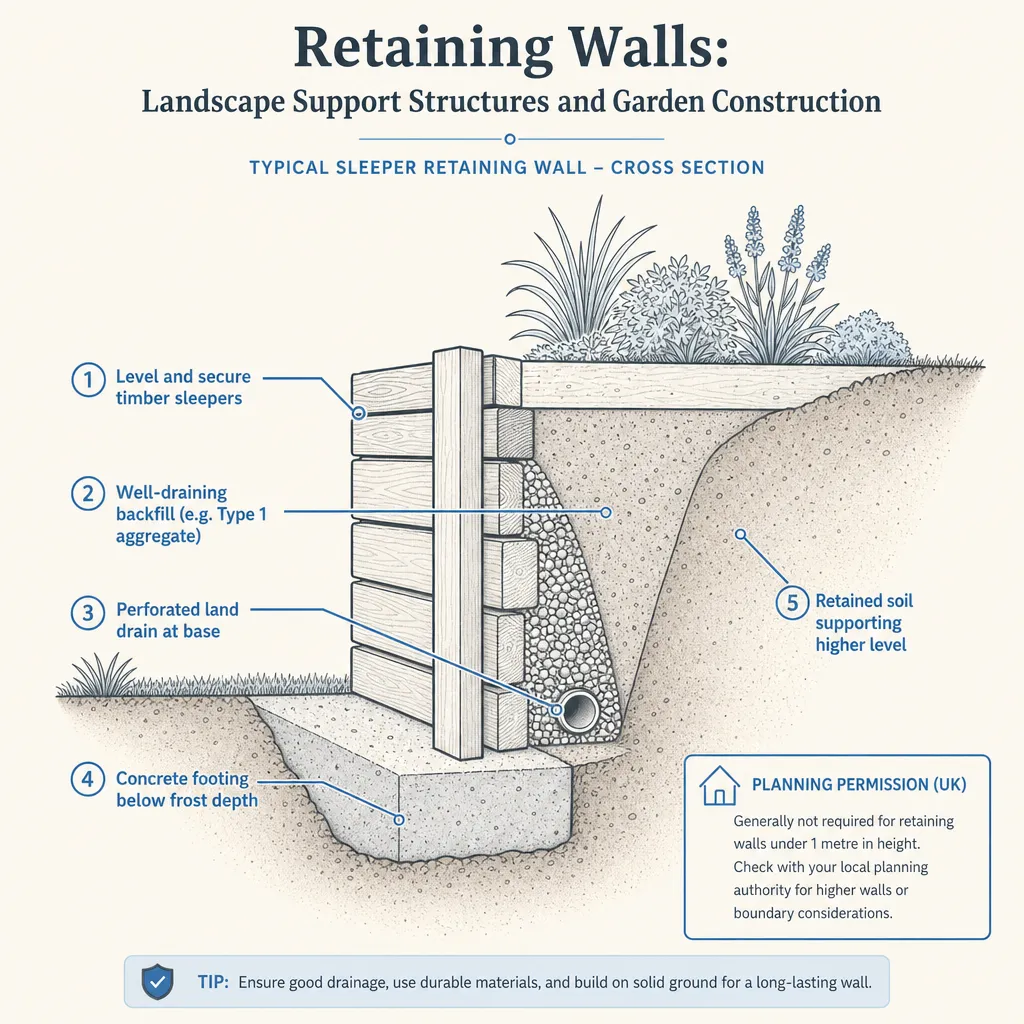
Retaining Walls: Landscape Support Structures and Garden Construction
A domestic retaining wall under 1 metre in height, away from buildings and boundaries, can usually be built by a landscaper or groundworker without structural calculations.
 Improvement & Build
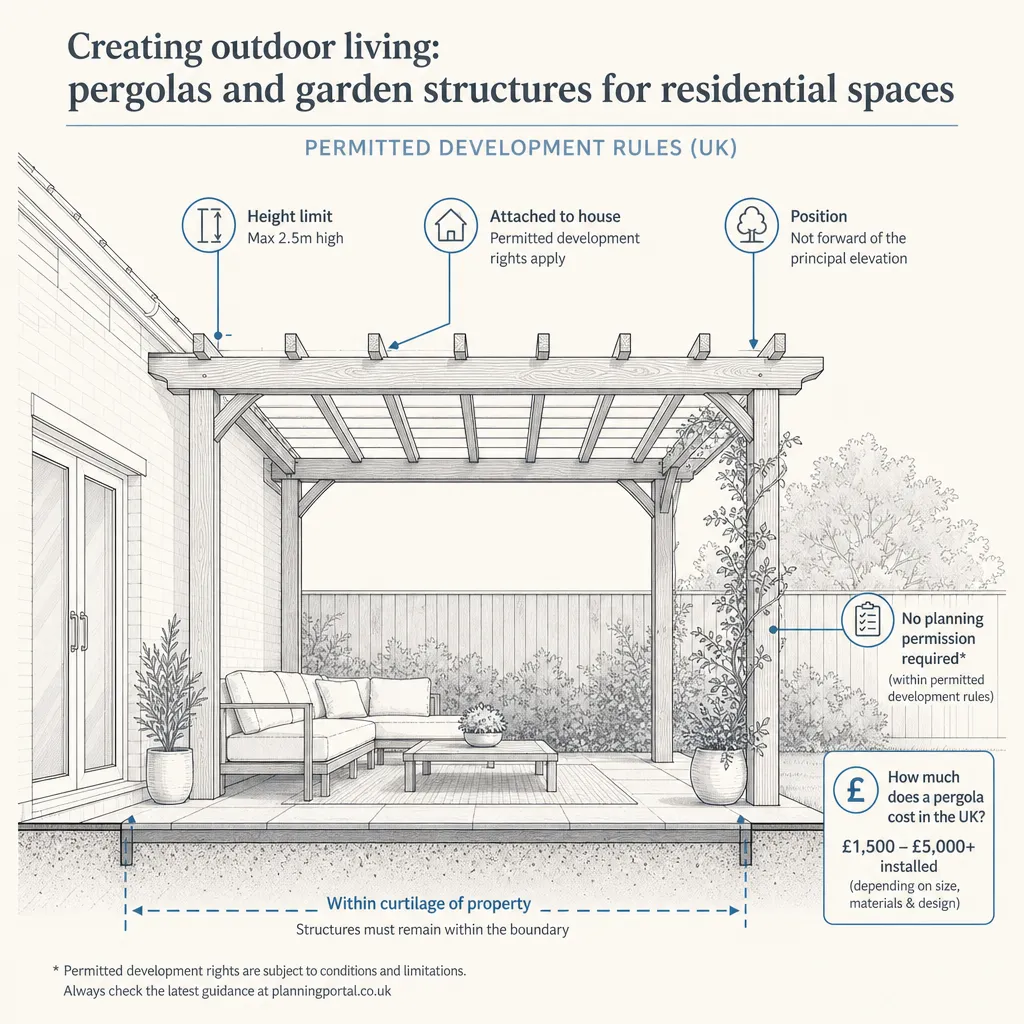
Creating outdoor living: pergolas and garden structures for residential spaces
Most freestanding pergolas in UK rear gardens are permitted development and don't need planning permission, provided they stay within height limits and outbuilding coverage stays below 50% of the original garden.
 Improvement & Build
Types of Concrete Retaining Walls for Residential Properties
The four main concrete retaining wall types for UK residential use are gravity walls, cantilever walls, segmental block (SRW) systems, and sheet-pile walls.
 Improvement & Build
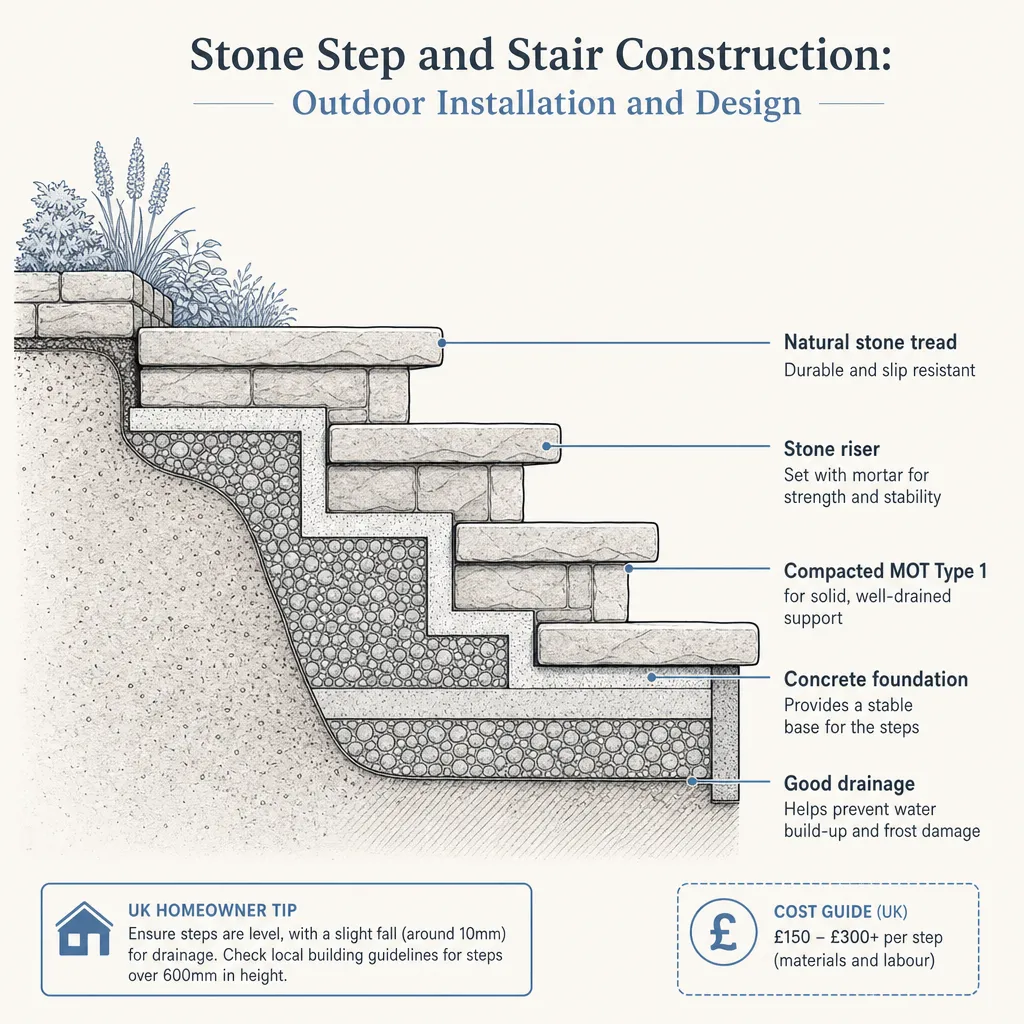
Stone Step and Stair Construction: Outdoor Installation and Design
Outdoor stone steps typically cost £200–£500 per step installed in the UK, depending on stone type, tread depth, riser height, and subbase conditions.