Smart garage door systems: investment and operating efficiency
By Housey · Last reviewed 31st of May 2026
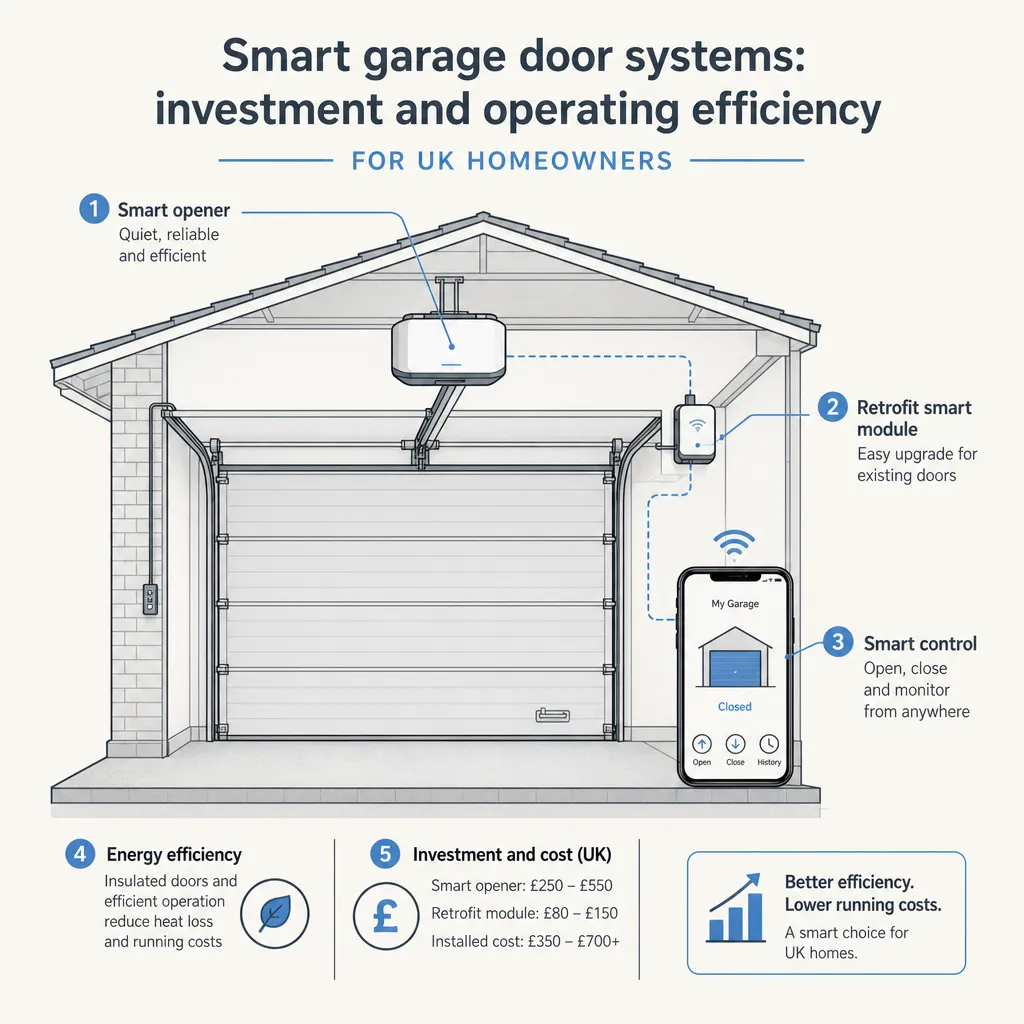
Smart garage door systems: investment and operating efficiency
Smart garage door systems have become an increasingly common home improvement in the UK, driven by the wider availability of affordable retrofit technology and the growing integration of garage control into smart home platforms. The decision to upgrade typically arises when an existing motorised opener fails, when security concerns prompt a review of access control, or when a home automation project makes a connected garage door a logical addition. Understanding what different system tiers actually offer — and what installation genuinely requires — helps homeowners avoid overpaying for features they will not use or choosing a system that creates security gaps.
Key points
- Garage door opener motors operate on the UK 240V mains supply; new circuit connections require a qualified electrician and may need a Part P Building Regulations notification in England and Wales.
- Most UK smart garage door systems use 433MHz or 868MHz rolling-code radio plus Wi-Fi or Z-Wave for app connectivity — verify compatibility with your existing door hardware before purchasing.
- Safety auto-reverse (obstacle detection on closing) is a requirement under BS EN 12453 for all powered garage doors; confirm any system you install includes this functionality.
- Running costs are minimal: standby consumption of 1–5W and brief operating cycles typically amount to under £10 per year at current UK electricity rates.
- Some home insurance policies require notification when physical security features are modified — check your policy schedule before replacing a garage door or opener.
What makes a garage door system smart?
A smart garage door adds one or more of the following capabilities to a standard motorised opener:
- Remote control via smartphone app — open, close, and check door status from any location
- Scheduled automation — set the door to close automatically at a fixed time or after a defined period
- Access logs and alerts — push notifications when the door is opened, closed, or left open
- Voice assistant integration — Alexa, Google Home, or Apple HomeKit compatibility
- Smart home integration — triggers and automations with lights, cameras, or heating systems
- Guest access — time-limited codes or virtual keys for tradespeople or regular visitors
The core hardware is typically a motor unit, an infra-red or pressure-based safety sensor, and a Wi-Fi or hub-based connectivity module. The smart layer is either built into the motor unit or added as a retrofit adapter board connected to the existing motor's trigger terminals.
Types of smart garage door system compared
System type | Best for | Compatibility | Typical installed cost | Main limitation |
|---|---|---|---|---|
Retrofit smart adapter (e.g., Meross, Nexx Garage) | Existing motorised door with dry-contact input | Most motors with external trigger terminals | £50–£200 | Depends on existing motor condition; limited features |
Integrated smart opener (e.g., Chamberlain myQ, Somfy io) | Replacing a failed motor or upgrading spec | Manufacturer-specific; most support Alexa/Google | £300–£700 supplied and fitted | Platform lock-in; some require paid subscription |
Full smart door and opener (e.g., Hormann with ProMatic module) | New door with integrated smart technology | Best — single-supplier warranty and support | £1,200–£3,500+ | Higher upfront cost |
Smart home hub integration (Zigbee/Z-Wave) | Existing hub users (Home Assistant, Vera) | Compatible controller and gateway required | £200–£800 (variable) | Configuration complexity; technical knowledge needed |
Indicative UK installed costs, last reviewed 2026-05-31. Prices vary by door type, region, and supplier.
Upfront costs and ongoing running costs
The upfront investment varies significantly by system tier (see comparison table above). Ongoing running costs are typically modest:
- Standby power: 1–5W depending on model — at approximately 24p/kWh (indicative UK rate, last reviewed 2026-05-31), annual standby cost is roughly £1–£10.
- Operating energy: 200–500W during door movement for approximately 15–30 seconds per cycle — for typical use of 4–6 cycles per day, annual operating energy cost is usually under £5.
- Subscription fees: some platforms, notably Chamberlain myQ, have introduced paid subscriptions for full smart features — check current terms before purchasing, as these can change.
- Consumable parts: springs and cables on sectional and roller doors are wear items regardless of smart or standard operation; budget for replacement every 7–10 years.
Compatibility: doors, openers, and smart home platforms
Before purchasing any smart garage door system, verify:
- Door type — sectional, roller, up-and-over (one-piece or canopy), side-hinged, and tilt doors each have different motor configurations and track requirements.
- Existing motor — check whether your current opener has a dry-contact (external trigger) terminal; most motors manufactured since 2000 do. Older units may require full motor replacement before a retrofit adapter will work.
- Smart home platform — confirm native support for Apple HomeKit, Google Home, or Amazon Alexa as appropriate. Not all systems support all platforms without a third-party bridge.
- Wi-Fi band — many smart openers use 2.4GHz Wi-Fi only; verify your router broadcasts a 2.4GHz network if you have a 5GHz-primary or merged-SSID setup.
Security considerations
Smart technology introduces both improvements and potential new considerations for garage door security:
- Rolling-code technology (standard on most UK systems since the early 2000s) prevents the code-grabbing attacks that affected older fixed-code systems.
- Door-open alerts significantly reduce the risk of leaving the garage unsecured — among the most consistently valued features by smart door users.
- Cloud dependency — systems that require a live connection to a third-party cloud server may not operate during server outages or if the manufacturer's service is discontinued. Prefer systems with documented local control fallback.
- Physical security first — smart connectivity does not compensate for a weak door leaf, failing frame, or inadequate locking. The door hardware remains the primary physical security layer.
If the garage has an internal door connecting to the house, that door should be fire-rated (minimum FD30, self-closing) under Part B of the Building Regulations — this requirement is unchanged by adding smart technology to the outer garage door.
Which system should you choose?
- Choose a retrofit smart adapter if your existing motor is in good working order, has a dry-contact input, and your budget is under £200.
- Choose an integrated smart opener if you are replacing a failed or ageing motor and want reliable app control, scheduling, and voice assistant integration without the cost of a new door.
- Choose a full smart door and opener if your door leaf is old or failing, you want a single-supplier warranty covering door and drive, or you want the highest level of integration and security.
- Choose smart home hub integration if you already run Home Assistant, Vera, or a comparable local hub and want the garage door in the same ecosystem without cloud dependency.
- Consult a garage door specialist if your door is a non-standard or vintage type, a timber up-and-over with suspect spring gear, or sited in a listed building or conservation area setting.
What to ask before accepting a quote
- What connectivity protocol does the system use (Wi-Fi, Z-Wave, proprietary RF), and does it operate locally without an internet connection?
- Will a qualified electrician make the mains connections, and will a Part P Building Regulations notification be issued if required?
- Does the system include safety auto-reverse compliant with BS EN 12453?
- What are the warranty periods for the motor unit, the smart module, and the door hardware — stated separately?
- Are there ongoing subscription fees for app or cloud features, and what functionality is restricted without a subscription?
- What happens to remote access if the manufacturer's cloud service changes pricing or is discontinued?
When to get professional help
Motor installation and mains electrical connections should be carried out by a qualified garage door engineer or a Part P-registered electrician. If the work involves a new dedicated circuit from the consumer unit, a Building Regulations notification is required under Part P in England and Wales. Do not attempt to fit any motorised opener to a door with suspect spring or cable condition — worn torsion or extension springs under tension are a significant safety risk and should be assessed and replaced by a specialist before motorisation.
How Housey can help
If you are considering a smart garage door as part of a wider garage improvement or conversion project, Housey connects you with experienced local specialists. Speak with garage conversion specialists who can assess your current setup and recommend the most appropriate smart door solution for your door type, home automation platform, and budget.
Frequently asked questions
Do smart garage door systems work during a power cut?
Most smart garage door openers stop functioning during a power cut unless a battery backup unit is fitted. Some systems include a built-in backup battery; others offer it as an optional accessory, typically adding £30–£80 to the system cost. A manual release cord allows the door to be operated by hand during any outage, regardless of whether a battery backup is installed.
Will a smart garage door affect my home insurance?
It may, depending on your policy. Some insurers require notification when physical security features are changed, and a few specify minimum-standard door products. Check your policy schedule before replacing the door or opener, and notify your insurer if in doubt. In most cases, upgrading from a standard to a smart motorised opener has no adverse effect on premiums, and may be viewed favourably.
Is it worth adding smart technology to an old garage door?
It depends on the condition of the existing door and motor. If both are in good working order and the motor has a dry-contact input, a retrofit adapter (£50–£200) is a cost-effective upgrade. If the door is more than 15 years old or the spring mechanism is showing wear, a complete smart door and opener replacement typically gives better long-term value and avoids the safety risks of motorising an ageing mechanism.
What is the difference between a smart opener and a connected opener?
A connected opener adds remote app control of an existing motor; a smart opener adds scheduling, smart home integration, access logs, multi-user management, and automation triggers. For most homeowners, the additional features of a smart opener — particularly open/close alerts and scheduled automatic closing — offer noticeably more practical value than basic remote control alone.
Sources and further reading
- Approved Document P: electrical safety in dwellings — GOV.UK
- IET Wiring Regulations (BS 7671, 18th Edition) — Institution of Engineering and Technology
- BS EN 12453: safety in use of power-operated doors — BSI Group
- Energy Saving Trust: household electricity costs — Energy Saving Trust
- Which? smart home security guidance — Which?
Useful next reads
 Improvement & Build
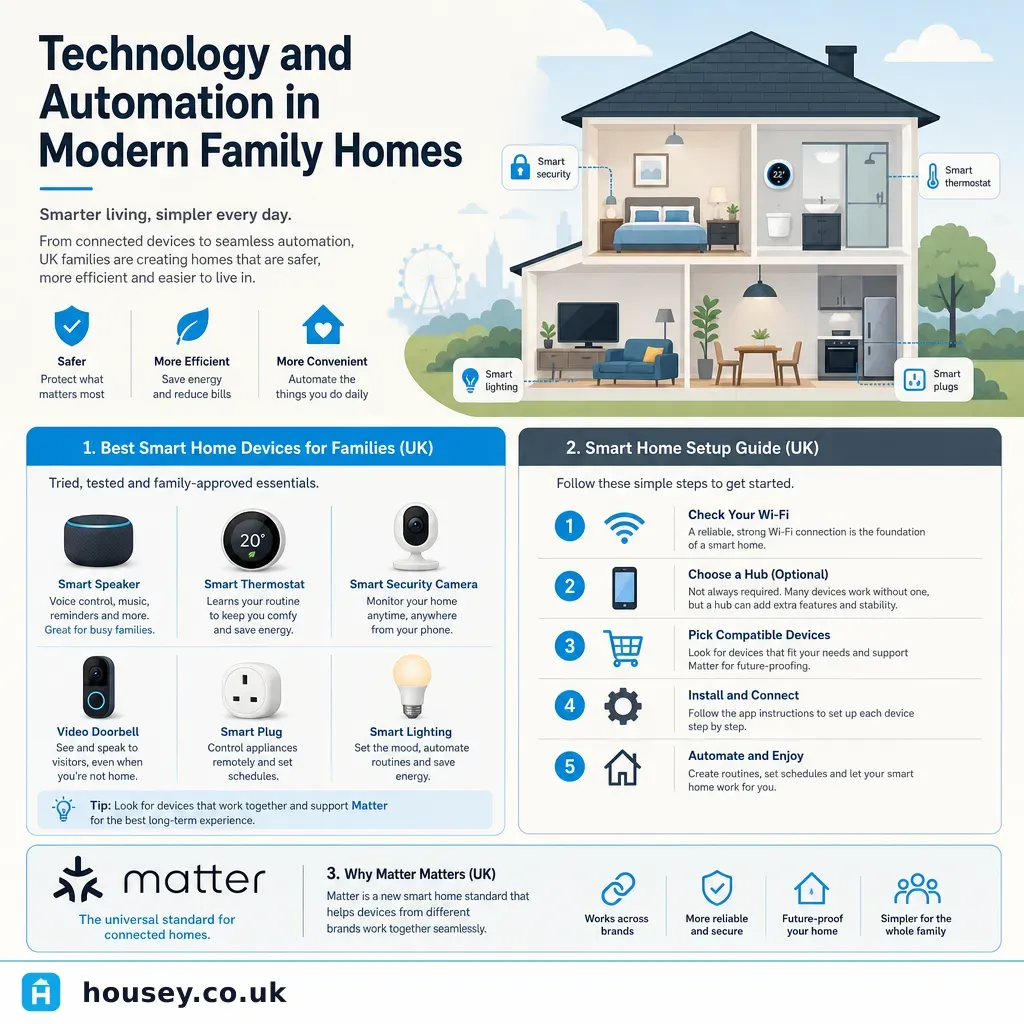
Technology and Automation in Modern Family Homes
Smart home technology lets UK families automate lighting, heating, security, and entertainment from a single app or voice command.
 Improvement & Build
Smart Home Technology and Mobile Device Integration
Most smart home devices in the UK are controlled via dedicated smartphone apps or platforms such as Amazon Alexa, Google Home, or Apple Home.
 Improvement & Build
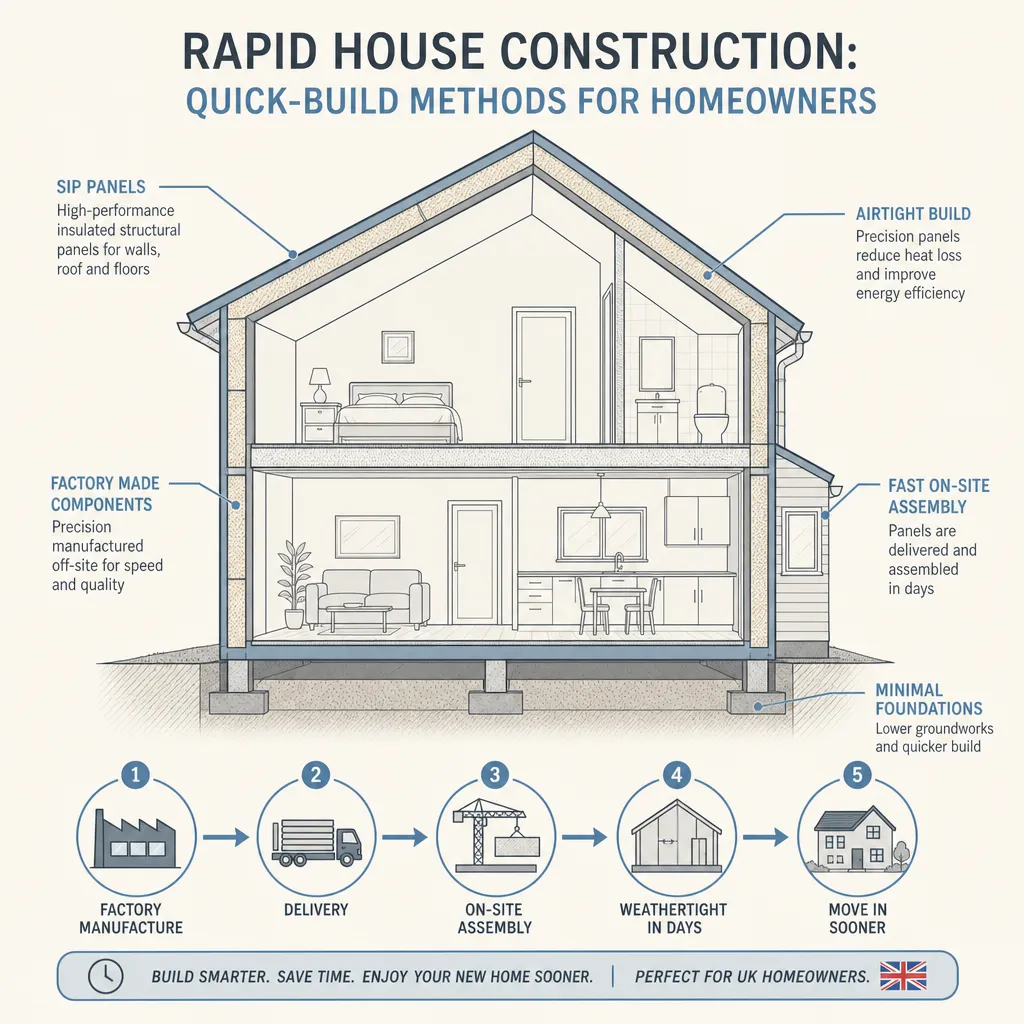
Rapid House Construction: Quick-Build Methods for Homeowners
Rapid house construction in the UK typically uses Modern Methods of Construction such as timber frame, structural insulated panels (SIPs), or volumetric modular systems.
 Improvement & Build
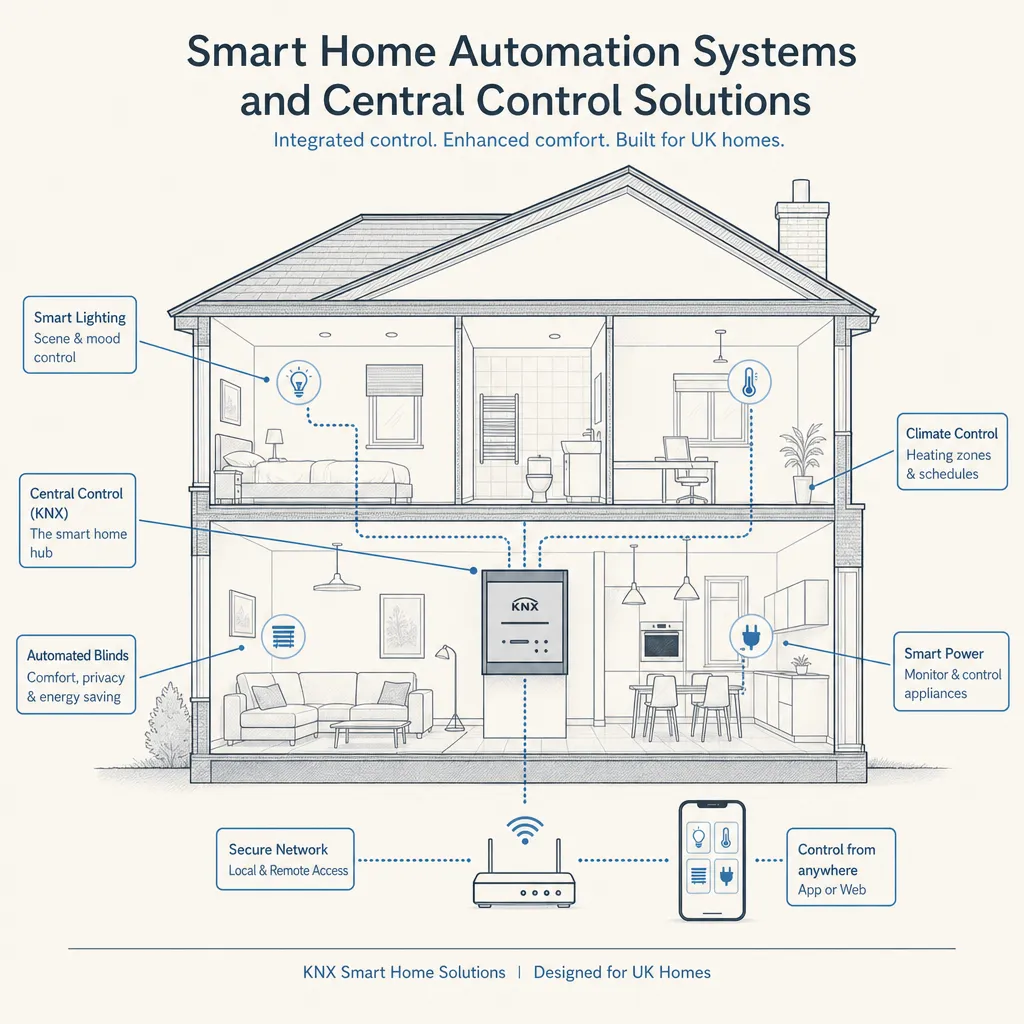
Smart Home Automation Systems and Central Control Solutions
Smart home automation connects lighting, heating, security, audio, and window coverings through a single controller.
 Improvement & Build
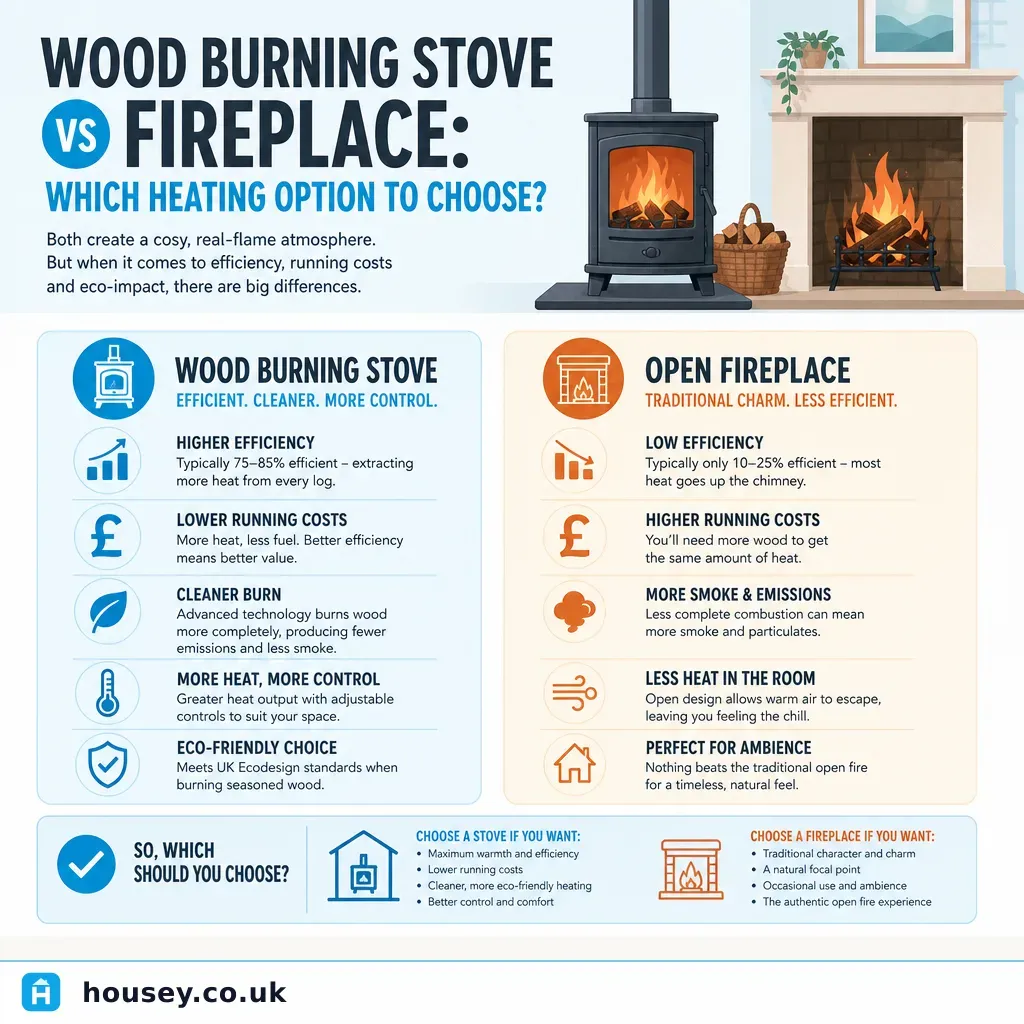
Wood burning stove versus fireplace: which heating option to choose
A wood burning stove is significantly more efficient than an open fireplace — typically 70–80% efficient compared with 15–30% for an open fire — and produces fewer emissions.