Smart Home Technology Comparison for Home Automation
By Housey · Last reviewed 10th of May 2026
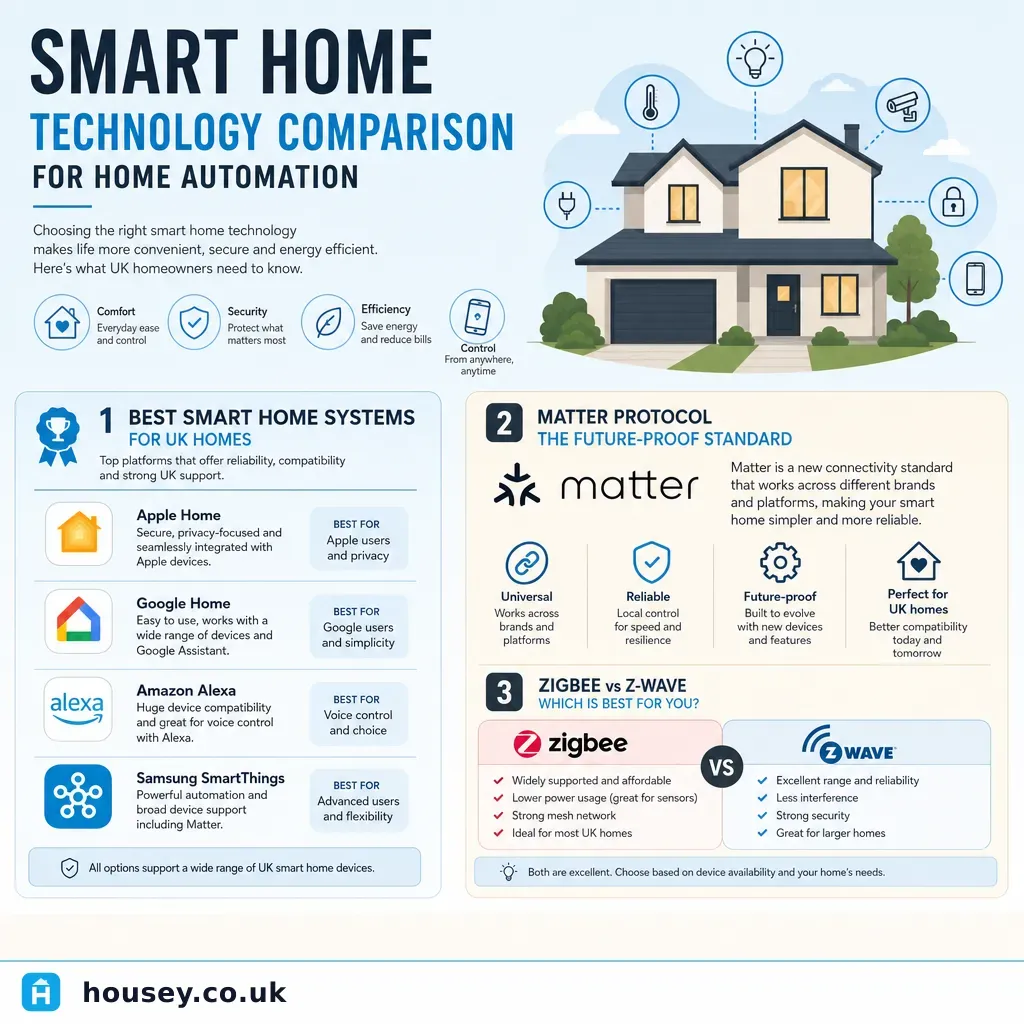
Smart Home Technology Comparison for Home Automation
Choosing a home automation system is increasingly common during renovation planning, new-build specification, or when making significant upgrades to an existing property. The market has grown substantially in the UK, with dozens of competing protocols, platforms, and devices — each with different levels of compatibility, installation complexity, and long-term support. Getting the choice wrong early can mean expensive rewiring, devices that stop talking to each other, or a system that becomes obsolete within a few years.
Key points
- The three dominant smart home protocols in the UK market are Matter (a cross-industry open standard launched in 2022), Zigbee, and Z-Wave — all operate on mesh networking and do not depend on a cloud connection to function locally.
- Apple HomeKit, Amazon Alexa, and Google Home are platform ecosystems, not protocols — a single device may support multiple platforms simultaneously if it is Matter-certified.
- KNX is the professional-grade bus protocol widely used in high-specification commercial and residential installations; it requires specialist programming and is typically installed by KNX-certified integrators.
- Retrofitting wireless smart devices is generally possible in any UK property; wired systems (KNX, Crestron, Control4) are most cost-effective to plan during a significant renovation or new build.
- The British Standards Institution publishes BS 8557 as guidance on the design and installation of home networks in dwellings; some local authorities may reference this in building control submissions.
What smart home systems are available in the UK?
Smart home systems fall into three broad categories: DIY consumer systems, professional semi-open systems, and full-specification AV and building-management systems.
DIY consumer systems include devices from Philips Hue, IKEA Dirigera, Amazon Echo, and Google Nest. These use Wi-Fi, Zigbee, or Thread/Matter protocols and can be self-installed without specialist knowledge. They are well-suited to adding individual smart functions — lighting scenes, smart thermostats, video doorbells — to an existing home.
Professional semi-open systems such as Lutron Caseta, Somfy, and Rako lighting control are designed for installer-led projects. They offer more robust performance and greater integration but typically require a trained integrator to commission.
Full-specification systems — Control4, Crestron, Savant, and KNX — are engineered for whole-home automation. They require professional design, structured cabling, and ongoing maintenance relationships. These are most cost-effective when planned at the construction or major-renovation stage.
Which smart home protocol should you choose?
The protocol determines how devices communicate — and whether devices from different manufacturers will work together.
Protocol | Connection type | Requires hub? | Best for | Main limitation |
|---|---|---|---|---|
Matter | Thread / Wi-Fi / Ethernet | No (local) | Future-proof multi-brand setups | Still maturing; not all features supported across brands |
Zigbee | Mesh radio (2.4 GHz) | Yes | Affordable multi-device setups (IKEA, Aldi, Philips Hue) | Hub required; 2.4 GHz can clash with Wi-Fi |
Z-Wave | Mesh radio (868 MHz UK) | Yes | Reliable low-interference mesh | Fewer devices than Zigbee; hub required |
KNX | Wired bus or IP | No (local) | High-spec whole-home control | Requires specialist installer and upfront cabling |
Wi-Fi | Home router | No | Simple plug-and-play devices | Cloud-dependent; adds router congestion |
Matter, ratified by the Connectivity Standards Alliance in 2022, is the nearest thing the industry has agreed on as a common language — major platforms including Apple Home, Amazon Alexa, Google Home, and Samsung SmartThings now support it, though the range of Matter-certified devices is still expanding.
Comparing major UK smart home platforms
Your platform choice determines your voice assistant, the app you manage everything from, and how devices from different brands interact.
Platform | Voice assistant | Works well with | Not ideal for | UK availability |
|---|---|---|---|---|
Apple Home | Siri | iPhone/iPad households; high privacy priority | Android users; non-Apple devices | Wide; Matter support strong |
Amazon Alexa | Alexa | Broad device support; easy setup | Local-only operation without internet | Extensive UK range |
Google Home | Google Assistant | Android households; Nest devices | Complex automations | Good UK support |
Samsung SmartThings | Bixby / Alexa | Mixed brands; Samsung appliances | Apple-only households | Available in UK |
Home Assistant | Various (local) | Full local control; privacy-conscious users | Non-technical users | Open-source; self-hosted |
Home Assistant deserves particular mention for UK homeowners wanting local control without cloud dependency — it runs on a Raspberry Pi or similar device and supports hundreds of integrations, including most Zigbee and Z-Wave hardware. It requires more technical confidence to set up than consumer platforms.
Which system should you choose?
- Choose a Matter-compatible platform (Apple Home, Google Home, Amazon Alexa) if you want straightforward, multi-brand flexibility and are starting fresh in 2025 or later.
- Choose Zigbee with a hub (e.g., Philips Hue Bridge or IKEA Dirigera) if you want reliable, affordable smart lighting and sensors without relying on Wi-Fi congestion.
- Choose Z-Wave if reliable mesh networking with minimal radio interference is a priority, particularly for security or lock applications.
- Choose KNX or Control4/Crestron if you are planning a new build or full renovation and want whole-home automation with professional-grade reliability and scene control.
- Choose Home Assistant if you want maximum local control, strong data privacy, and are comfortable with a technical setup process.
- Speak to a CEDIA-registered integrator if your project involves a combination of AV, lighting, HVAC, security, and access control — the system interactions are complex enough to warrant professional design.
Compatibility: what to check before buying
Buying devices before checking compatibility is the most common mistake in DIY smart home projects. Key checks before purchasing:
- Protocol match — does the device use the same protocol as your hub or platform? A Zigbee device will not communicate directly with a Z-Wave hub.
- Matter certification — if buying in 2025 or later, look for the Matter logo to maximise future interoperability.
- UK voltage compliance — all devices sold in the UK must comply with the Electrical Equipment (Safety) Regulations 2016. Grey-import US devices (120 V) are not suitable for UK mains.
- UKCA or CE marking — products placed on the UK market must carry the UKCA mark (or CE mark under current transitional provisions).
- Hub range — Zigbee and Z-Wave mesh networks extend range through devices, but check coverage for large or multi-storey properties.
When to get professional help
Home automation installation for consumer devices is generally low-risk and can be self-managed. Professional help is advisable when:
- Your project involves wiring new circuits, installing consumer-unit components, or running structured cabling — this work must be carried out or certified by a Part P-registered electrician in England and Wales.
- You are specifying a whole-home system for a new build or significant renovation and want to integrate lighting, HVAC, AV, and security into a single platform.
- You are having persistent difficulty getting devices from different manufacturers to reliably communicate.
- The system is for a listed building or conservation area property where invasive cable routes may require Listed Building Consent.
- You want ongoing support, software updates, and maintenance — professional system integrators (CEDIA members) offer managed service contracts.
How Housey can help
If your smart home plans form part of a larger renovation or new build, the electrical and structural elements will need to comply with Building Regulations. Our building regulations drawings service helps ensure your installations satisfy Part P and Part L requirements from the outset, reducing the risk of costly changes during construction.
Frequently asked questions
Does a smart home system add value to a UK property?
Evidence is mixed. A professionally installed whole-home system with open standards and good documentation may attract some buyers in the mid-to-upper market. Proprietary or poorly documented systems can deter buyers who face ongoing subscription costs or technical dependencies. If resale is a priority, focus on open-standard systems (Matter, Zigbee, KNX) with full documentation and avoid cloud-only platforms that may be discontinued.
Do smart home devices work without the internet?
It depends on the protocol. Zigbee, Z-Wave, and KNX operate locally and do not require an internet connection for basic functions. Most Wi-Fi consumer devices — Ring, Nest, Hive — rely on cloud servers and will lose functionality during an outage. Matter-certified devices are designed to support local operation, though some cloud-dependent features may still require connectivity.
Is smart home installation covered by building regulations?
New electrical circuits, consumer-unit work, and mains connections may fall under Building Regulations Part P in England and Wales. Low-voltage data and AV cabling does not itself require notification. Planning permission is rarely needed for internal smart home works, but adding external equipment to listed buildings or conservation area properties may require consent. Always check with your local planning authority if the property has designations.
What is CEDIA and should I use a CEDIA-registered installer?
CEDIA (Custom Electronic Design and Installation Association) is the UK professional trade body for home technology integrators. A CEDIA-registered installer is trained in system design, installation standards, and aftercare, and operates within a recognised complaints and professional indemnity framework. For complex whole-home systems combining AV, lighting, HVAC, and security, using a CEDIA member is advisable.
Sources and further reading
- Matter specification — Connectivity Standards Alliance
- Electrical Equipment (Safety) Regulations 2016 — legislation.gov.uk
- Building Regulations Approved Document P — Electrical safety in dwellings — GOV.UK
- CEDIA — find a certified home technology integrator — CEDIA
- BS 8557 — Code of practice for the design and installation of home networks — BSI
Useful next reads
 Planning & Pre-Build
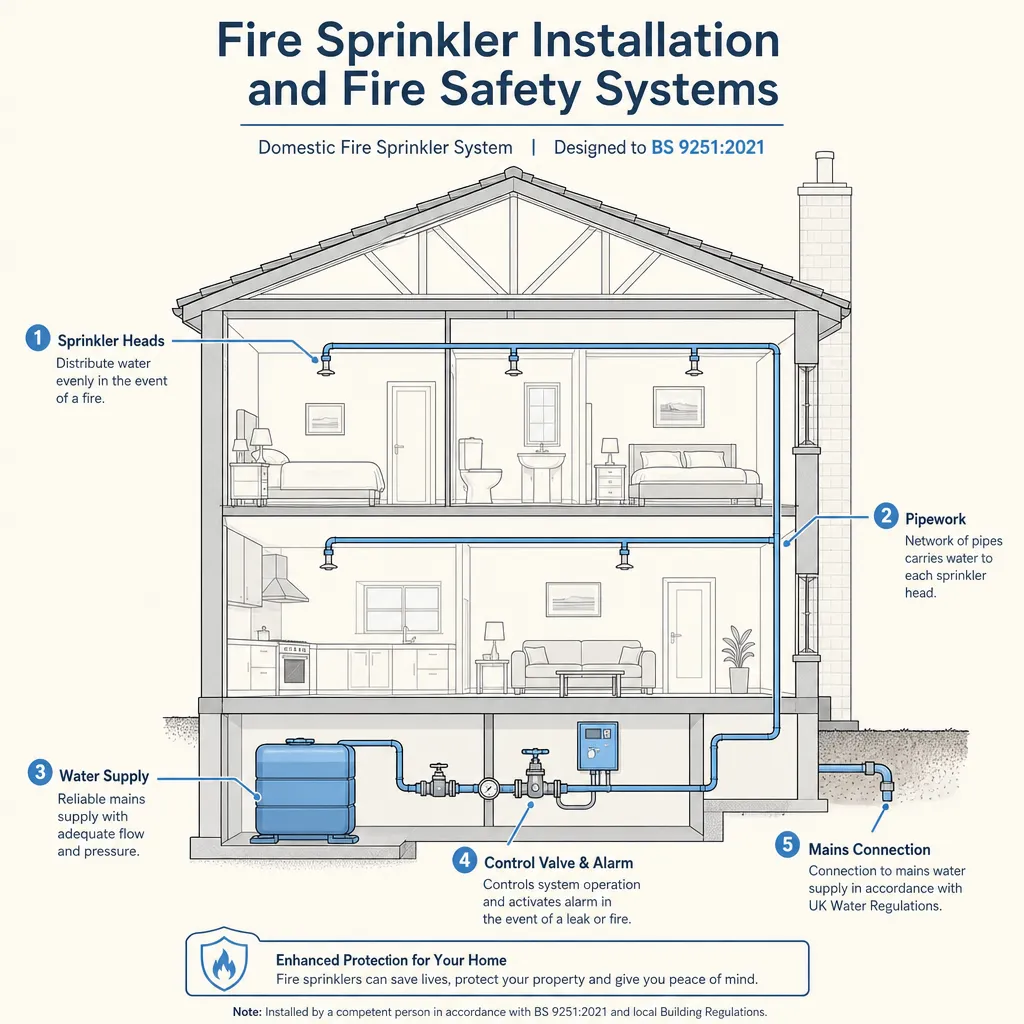
Fire Sprinkler Installation and Fire Safety Systems
Residential fire sprinkler systems in the UK must comply with BS 9251:2021.
 Planning & Pre-Build
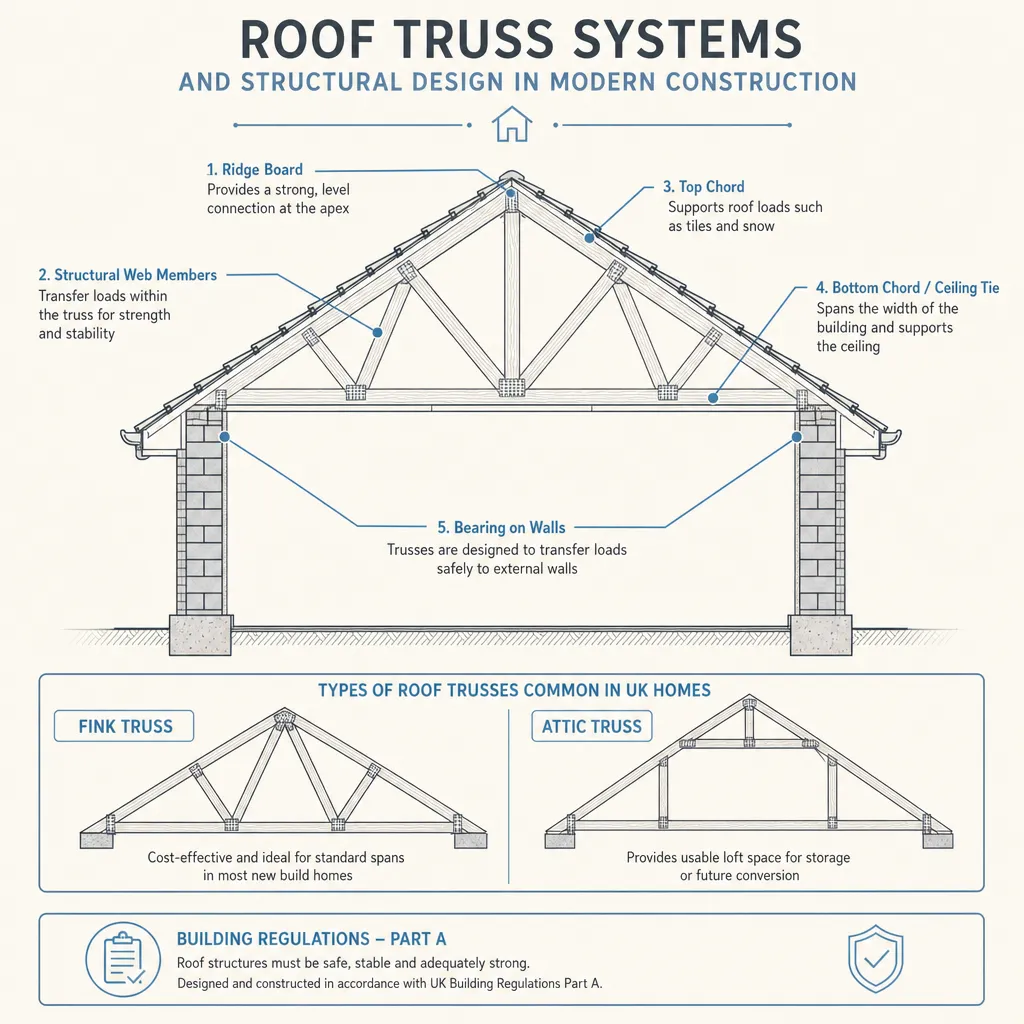
Roof Truss Systems and Structural Design in Modern Construction
Roof trusses are factory-engineered frames that carry roof loads to load-bearing walls.
 Planning & Pre-Build
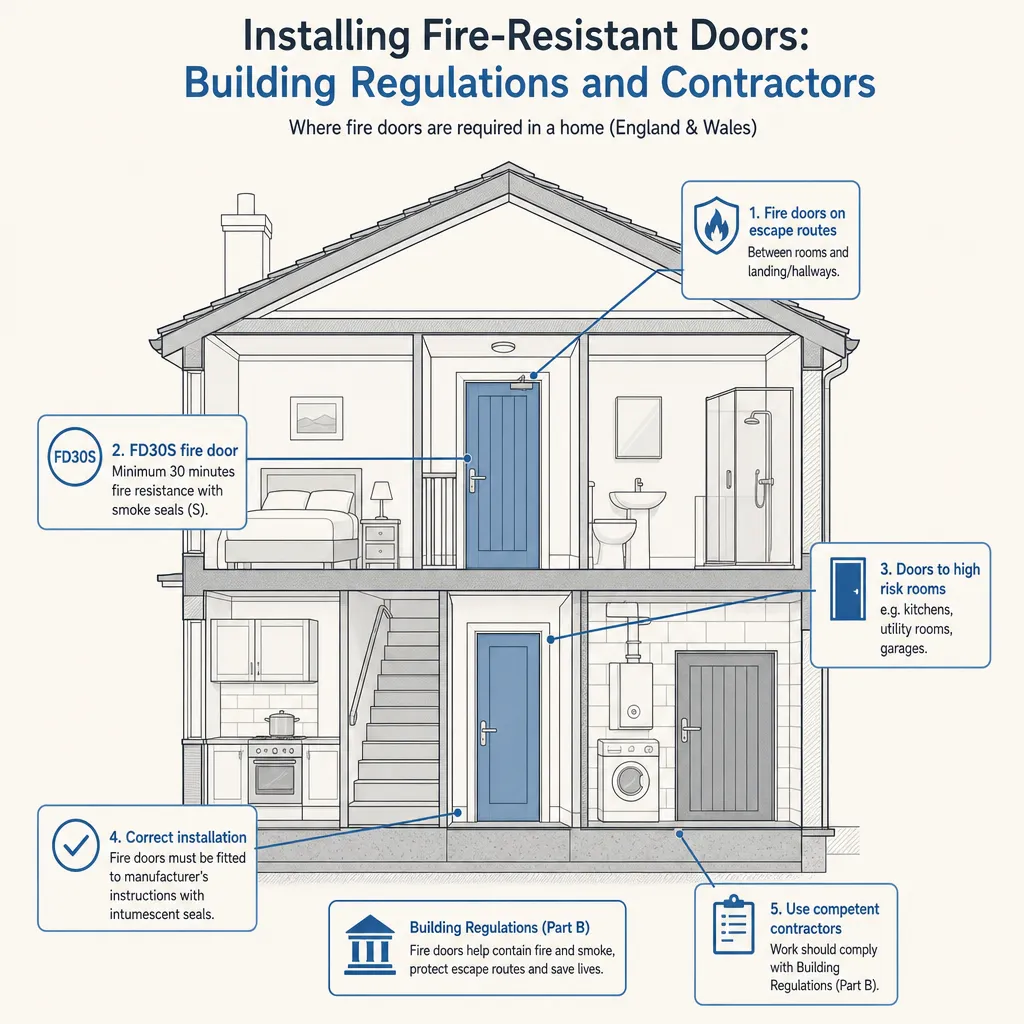
Installing Fire-Resistant Doors: Building Regulations and Contractors
Fire doors are required by Building Regulations in specific locations — including integral garages, properties of three or more storeys, loft conversions, and HMOs.
 Planning & Pre-Build
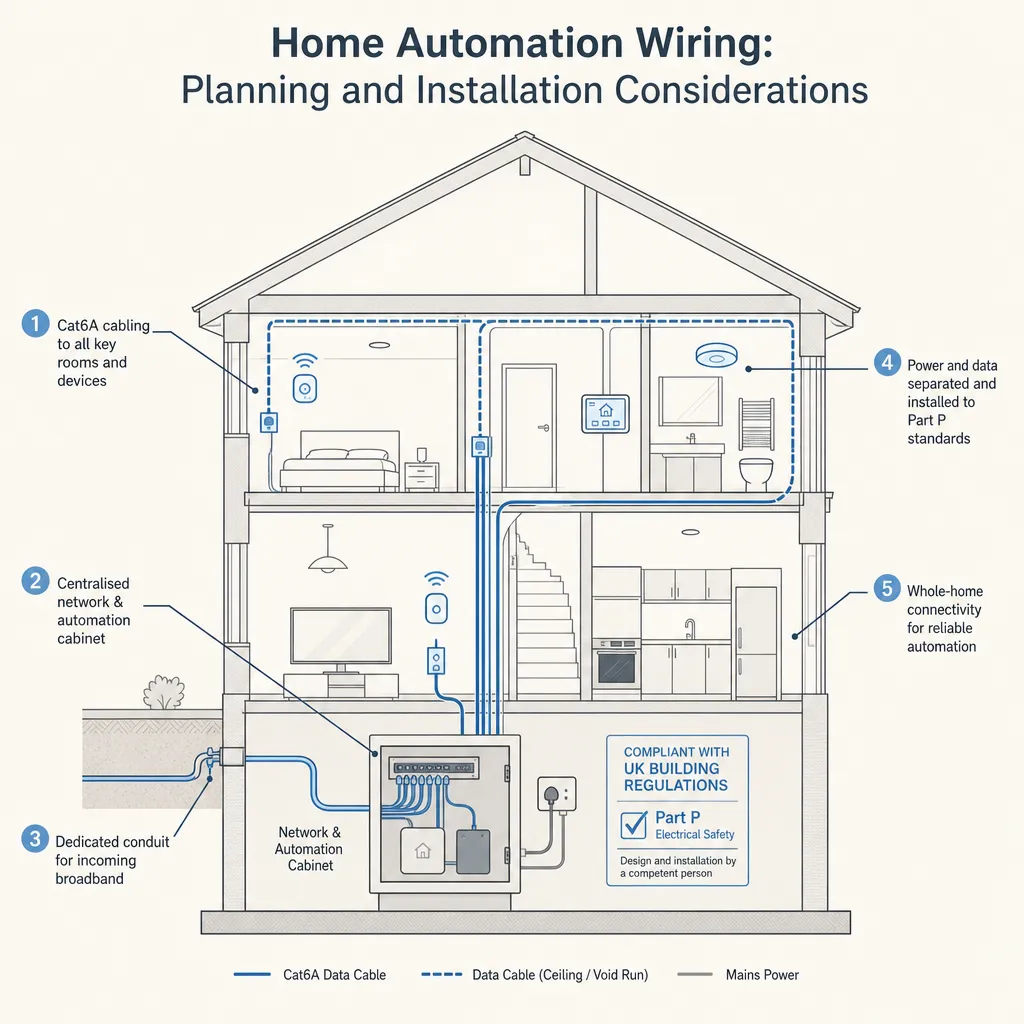
Home Automation Wiring: Planning and Installation Considerations
Home automation wiring decisions — data cabling, power circuits, control wiring — are most cost-effectively made during first-fix, before walls are closed.
 Planning & Pre-Build
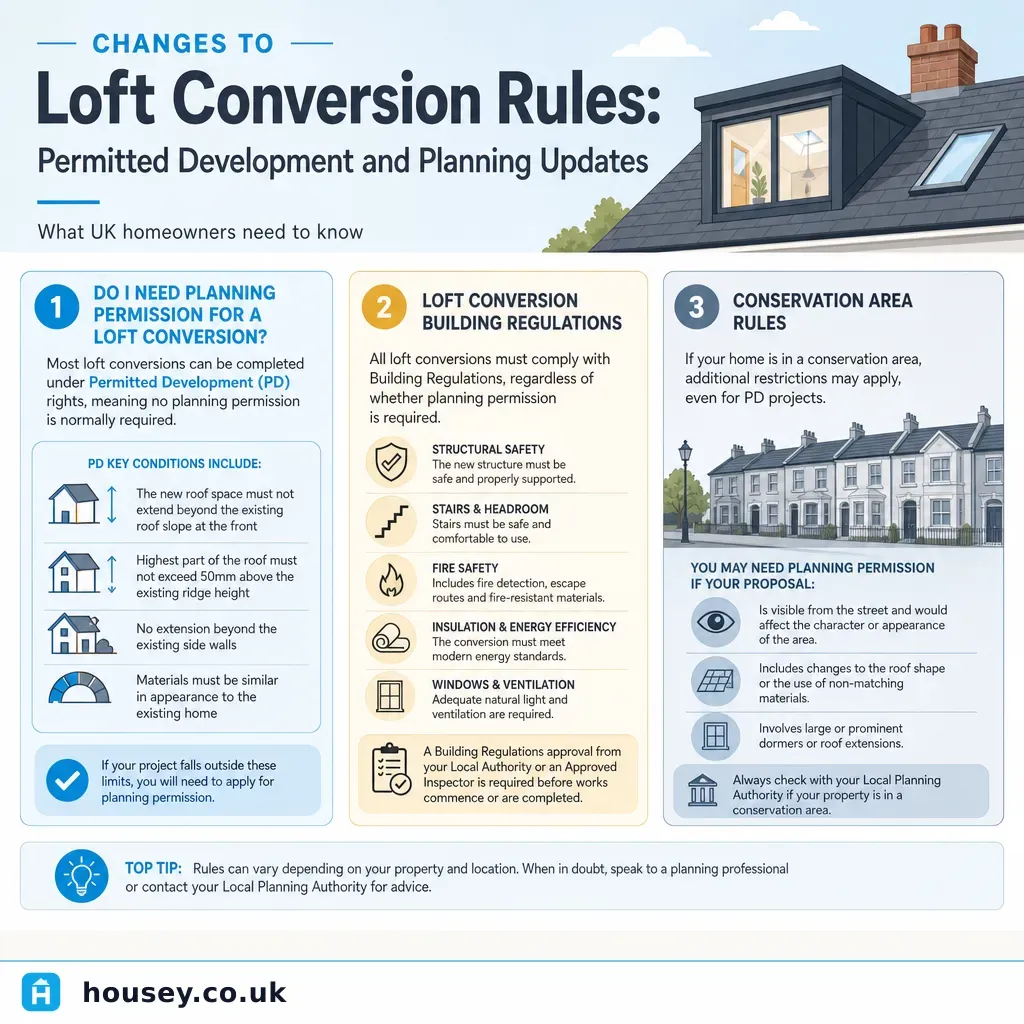
Changes to Loft Conversion Rules: Permitted Development and Planning Updates
In England, most loft conversions on standard houses qualify as Permitted Development under Class B of the GPDO 2015, allowing up to 40 cubic metres (terraced) or 50 cubic metres (detached or semi-detached) without a planning application — if conditions are met.