Solar Energy for UK Homes: Benefits and Key Considerations
By Housey · Last reviewed 11th of May 2026
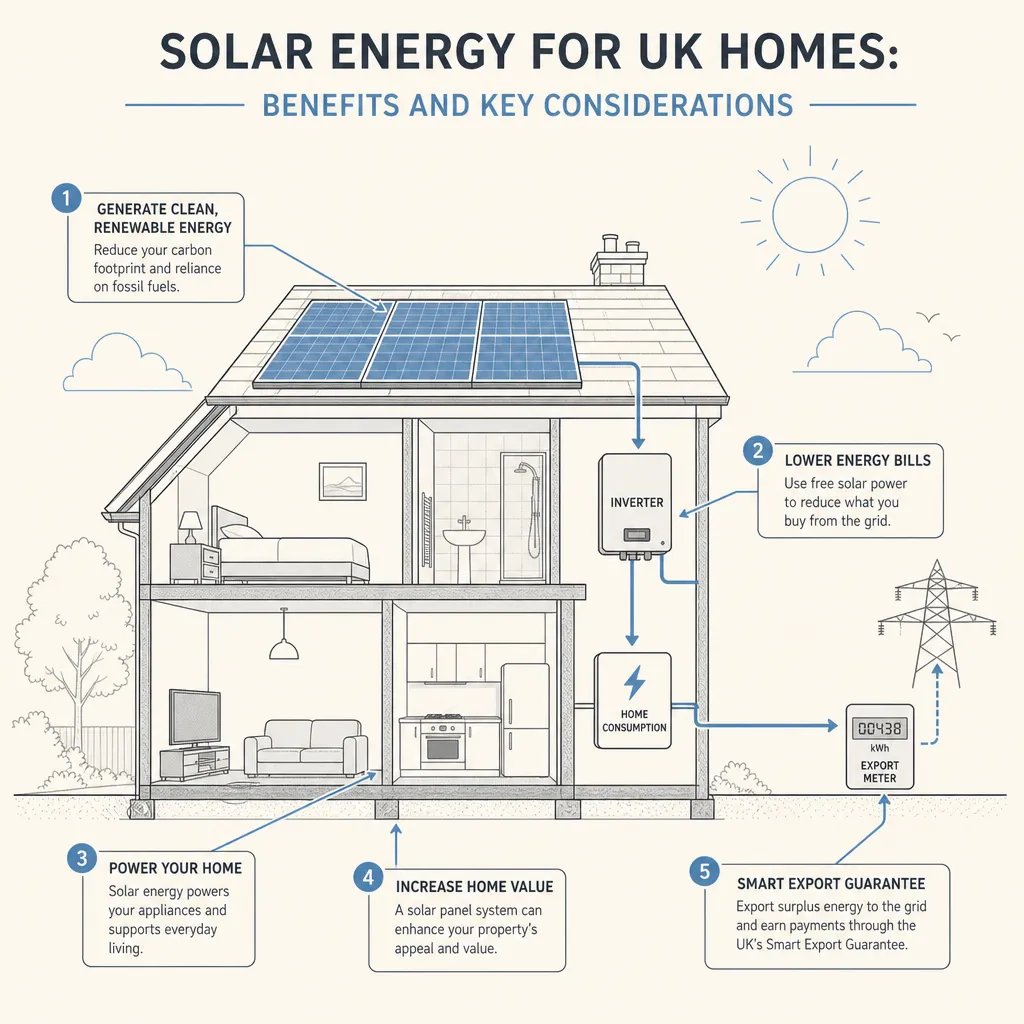
Solar Energy for UK Homes: Benefits and Key Considerations
Interest in solar energy among UK homeowners has grown substantially since the cost of solar photovoltaic (PV) panels fell sharply through the 2010s and the Smart Export Guarantee (SEG) created a formal route for households to receive payment for surplus electricity sent back to the grid. Whether you are motivated by reducing energy bills, cutting carbon, or improving your home's Energy Performance Certificate (EPC) rating, there are several practical factors worth assessing before committing to an installation.
Key points
- Solar PV panels installed by a Microgeneration Certification Scheme (MCS)-certified installer qualify for the Smart Export Guarantee (SEG), which requires licensed electricity suppliers with more than 150,000 customers to offer an export tariff for surplus generation.
- Most domestic solar panel installations in England are permitted development under Schedule 2, Part 4, Class A of the Town and Country Planning (General Permitted Development) (England) Order 2015, but listed buildings require listed building consent and installations visible from a highway in conservation areas require full planning permission.
- A south-facing roof pitched at 30–40° gives optimal output; east- or west-facing roofs typically generate around 80–85% of the output of a due-south installation.
- Solar PV installations are notifiable electrical work under Building Regulations Part P and must be carried out by a competent person registered under a government-approved scheme or notified to building control.
- Battery storage can increase a household's self-consumption of solar generation from approximately 30–50% without storage to 60–80% with an appropriately sized battery, depending on consumption patterns.
How solar PV works and what you can generate
Solar photovoltaic panels convert daylight (not heat) into direct current (DC) electricity. An inverter converts this to alternating current (AC) for use in the home or for export. Generation depends on several factors:
- Panel orientation and tilt — south-facing at 30–40° is optimal; east and west faces generate roughly 80–85% of the output of due south.
- Shading — a shadow on even one cell in a series-connected string can reduce output across the whole string. Micro-inverters or DC power optimisers reduce this effect where shading is unavoidable.
- Panel efficiency — monocrystalline panels typically achieve 18–22% cell efficiency per m²; polycrystalline panels achieve 15–17%.
- Location — solar irradiation is measurably higher in the south of England than in Scotland. The Energy Saving Trust's solar energy calculator provides location-specific yield estimates.
A typical domestic installation of 3–4 kWp on a 3–4 bedroom home in England may generate 2,500–3,500 kWh per year. Actual yield depends on all the above factors. Indicative UK costs, last reviewed 2026-05-11.
Solar PV vs solar thermal: a comparison
Feature | Solar PV | Solar thermal |
|---|---|---|
What it produces | Electricity | Domestic hot water |
Typical system size | 3–6 kWp for most homes | 2–4 m² collector for average household |
MCS-certified for incentives | Yes — SEG applies | MCS certification available; no equivalent export scheme |
Pairing with heat pumps | Effective — reduces running costs | Less direct synergy |
Planning rules | Permitted development in most cases | Same permitted development rules apply |
Maintenance requirement | Low (annual visual check recommended) | Moderate — heat transfer fluid needs periodic replacement |
Best for | Reducing electricity bills, EPC improvement, export income | Homes with high hot water demand, supplementing a boiler |
Less suitable for | Heavily shaded or north-facing roofs | Small households with low hot water use |
Financial benefits and the Smart Export Guarantee
The Smart Export Guarantee (SEG) launched in January 2020, replacing the Feed-in Tariff (FiT) scheme, which closed to new applications in March 2019. Under the SEG:
- Suppliers with more than 150,000 domestic customers must offer at least one SEG tariff.
- Export tariff rates vary between suppliers and change over time; time-of-use tariffs that pay more during peak grid demand periods are increasingly available.
- Your installation must be MCS-certified to qualify for any SEG payment.
Beyond export income, the primary financial benefit is bill reduction through self-consumption of generated electricity. The Energy Saving Trust indicates that potential annual savings vary considerably depending on your tariff, household consumption, and whether battery storage is fitted. A pre-installation solar survey will produce a more accurate site-specific generation and savings estimate.
Solar installations also typically improve an EPC rating, which can be relevant for mortgage lending, rental compliance (as minimum EPC standards for landlords are expected to rise), and future resale value.
Planning rules for solar panels in the UK
Under the Town and Country Planning (General Permitted Development) (England) Order 2015, most domestic solar PV installations qualify as permitted development (PD), provided they:
- Are installed on a dwelling house or a block of flats.
- Do not protrude more than 200 mm beyond the plane of the roof.
- Do not extend above the highest part of the roof.
- Are removed when no longer needed.
Exceptions where permitted development does not apply:
- Listed buildings — require listed building consent; consult Historic England guidance before proceeding.
- Conservation areas — roof-mounted panels visible from a highway are not permitted development and require planning permission.
- Article 4 direction areas — some local planning authorities restrict permitted development rights more broadly.
Rules differ in Scotland, Wales, and Northern Ireland. Always check with your local planning authority before installing if you are uncertain about designations affecting your property.
Is solar right for my home?
- Commission a solar survey if your main roof face is south, south-east, or south-west; is largely unshaded between 9am and 3pm; and the property is not listed or subject to conservation area restrictions.
- Seek planning advice first if the property is listed, in a conservation area, or in an Article 4 direction area.
- Consider battery storage if your household is largely absent during daylight hours when generation peaks, and you want to maximise self-consumption.
- Consult a PAS 2035-qualified Retrofit Coordinator if solar forms part of a broader retrofit programme — particularly where you are also improving insulation or installing a heat pump — to ensure moisture and ventilation interactions are properly managed.
- Delay until after a reroof if the existing roof covering needs replacing within the next five years — removing and reinstalling panels adds material cost.
- Check grant eligibility if the property has a low EPC rating or if you are on qualifying benefits — the Great British Insulation Scheme (GBIS) and ECO4 may include solar as part of a funded package.
Homeowner checklist before accepting an installation quote
When to get professional help
A qualified MCS-certified installer must carry out grid-connected solar PV work — this is notifiable electrical work under Building Regulations Part P. For listed buildings or conservation area properties, seek planning advice and an installer experienced with heritage property constraints before proceeding.
Consult a structural engineer if:
- The roof covering is in poor condition or the structure appears weakened.
- You are installing a ground-mounted or flat-roof frame system where loadings differ from a standard pitched roof.
- Solar installation is being combined with other significant roof alterations.
How Housey can help
Housey can connect you with qualified professionals for a solar survey to assess your roof's suitability, shading profile, and likely generation before you commit to any installation — giving you an independent view rather than relying solely on an installer's own estimate.
Frequently asked questions
Do solar panels work in the UK's cloudy climate?
Yes. Solar PV panels generate electricity from daylight rather than direct sunshine, though output is higher on bright days. The UK receives sufficient solar irradiation to make residential solar PV financially viable across most of England, Wales, and Scotland. The Energy Saving Trust's solar energy calculator provides location-specific generation estimates to help you assess viability before appointing an installer.
How much do solar panels cost in the UK?
Indicative UK costs, last reviewed 2026-05-11: a 3–4 kWp system (approximately 8–10 panels) typically costs £5,000–£8,000 installed, including 0% VAT for eligible residential installations. Battery storage adds approximately £2,500–£5,000 depending on capacity and brand. Prices vary by installer, region, roof complexity, and panel specification — obtain at least three detailed written quotes.
What is the Smart Export Guarantee and how do I sign up?
The Smart Export Guarantee requires licensed electricity suppliers with over 150,000 customers to pay you for every unit of surplus electricity exported to the grid. Your system must be MCS-certified to qualify. Once installed and commissioned, you apply directly to an SEG-licensed supplier of your choice — you are not required to use the same supplier as for your electricity import tariff.
Will solar panels increase my home's value?
A higher EPC rating from solar installation can improve marketability, particularly as minimum energy efficiency standards for the private rented sector are expected to tighten. The effect on sale price varies by market, buyer profile, and location. Document the installation clearly — MCS certificate, warranties, and DNO approval — for the benefit of future buyers and mortgage lenders.
Sources and further reading
- Smart Export Guarantee — Ofgem — Ofgem
- Solar panels — Energy Saving Trust — Energy Saving Trust
- MCS certified installer database — MCS
- Approved Document P — Electrical safety in dwellings — GOV.UK
- Town and Country Planning (General Permitted Development) (England) Order 2015 — legislation.gov.uk
Useful next reads
 Energy & Retrofit
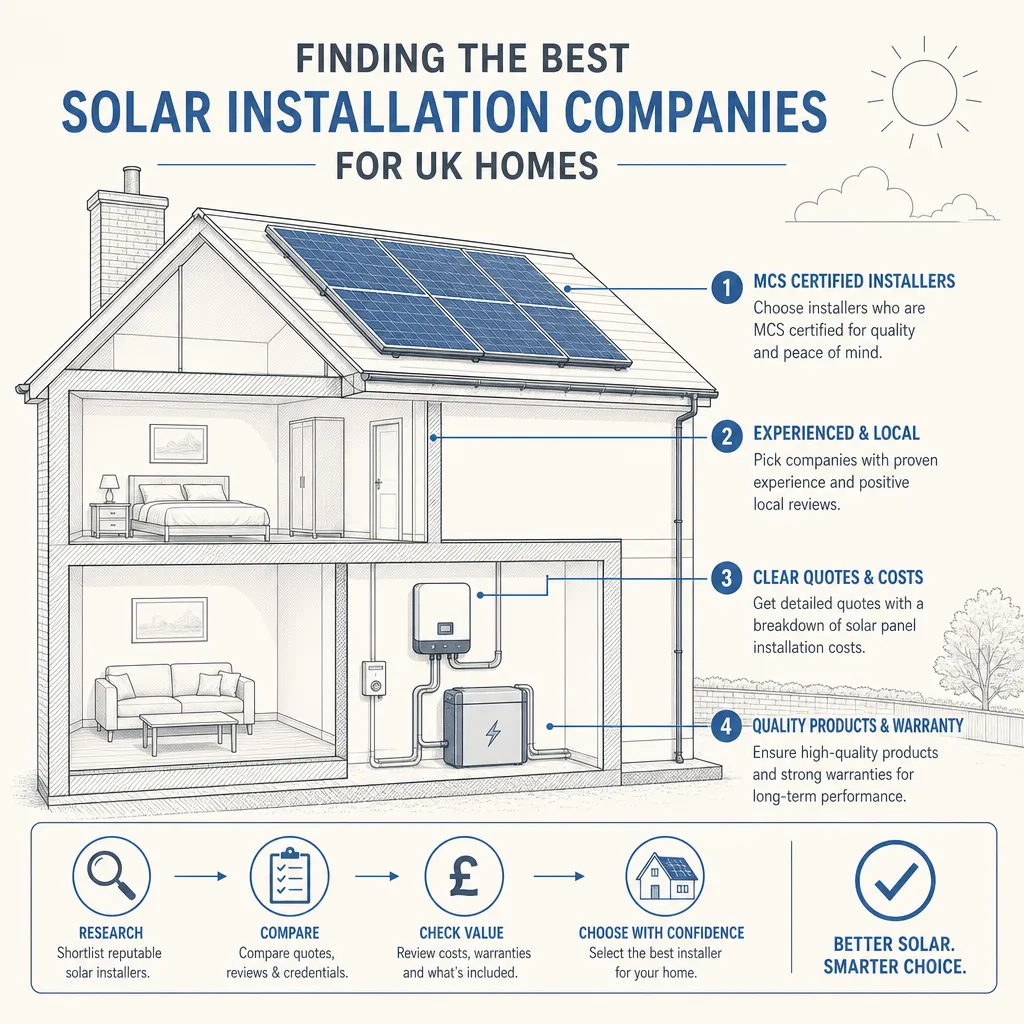
Finding the Best Solar Installation Companies for UK Homes
To find a reliable solar installation company in the UK, look for MCS (Microgeneration Certification Scheme) certification — required for Smart Export Guarantee eligibility — plus NICEIC or NAPIT electrical registration.
 Energy & Retrofit
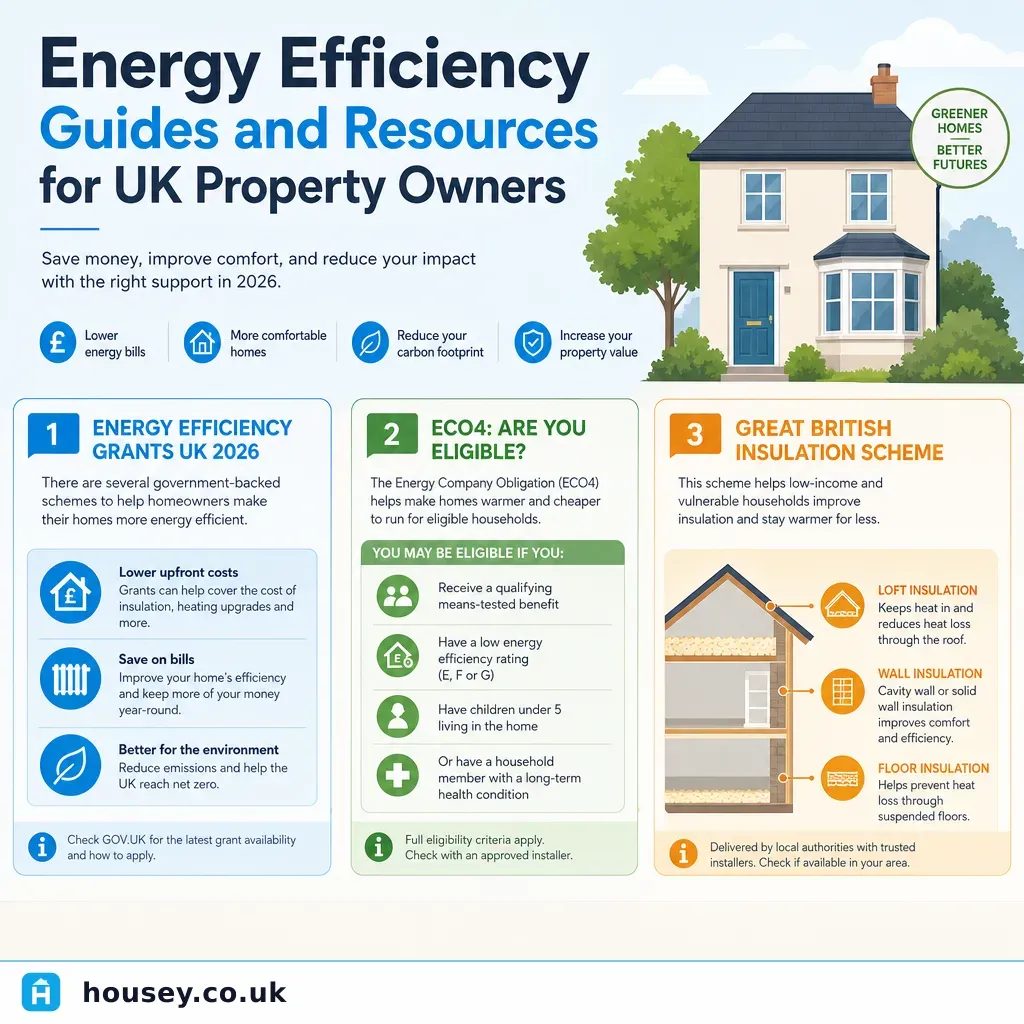
Energy Efficiency Guides and Resources for UK Property Owners
UK homeowners can improve energy efficiency through a range of measures — from loft and cavity wall insulation to heat pumps, solar panels, and improved heating controls.
 Energy & Retrofit
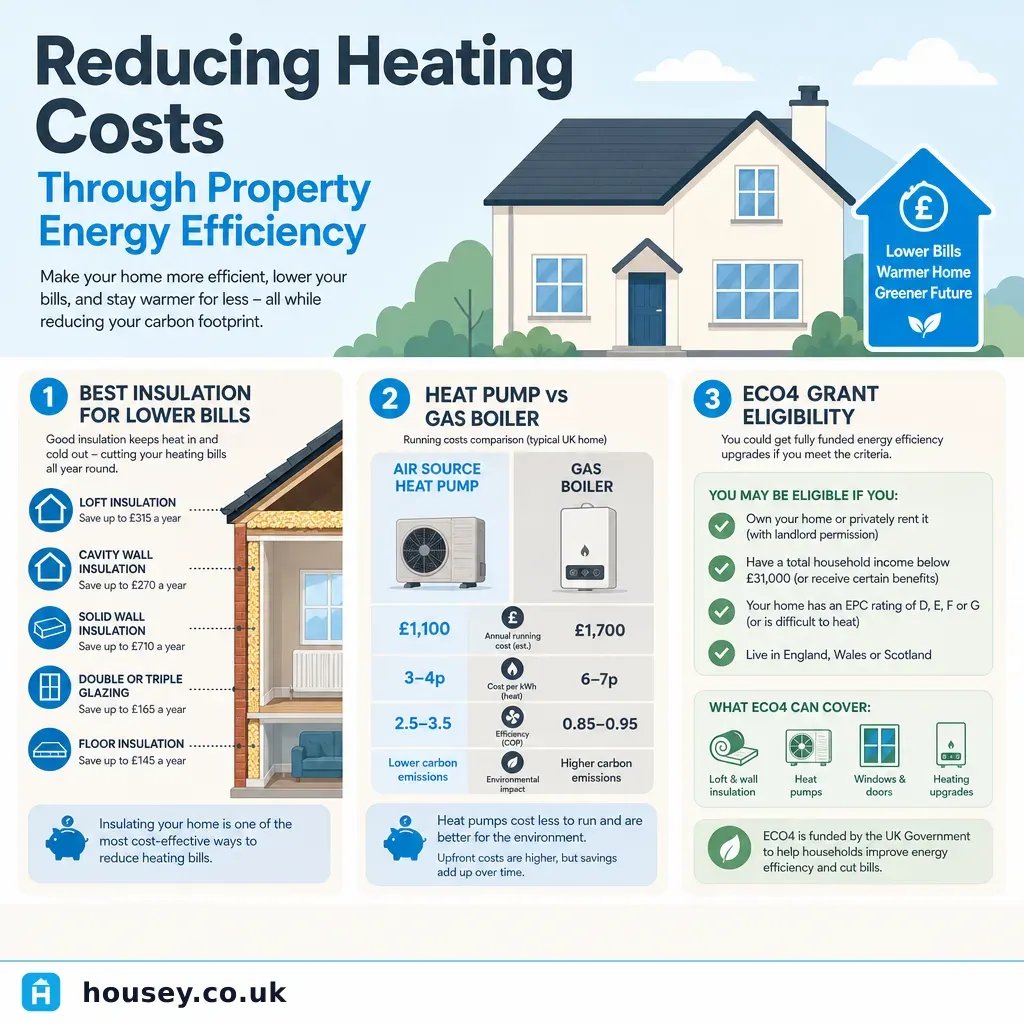
Reducing Heating Costs Through Property Energy Efficiency
Reducing heating costs starts with identifying where heat is lost — typically walls (30–35%), roof (20–25%), and windows.
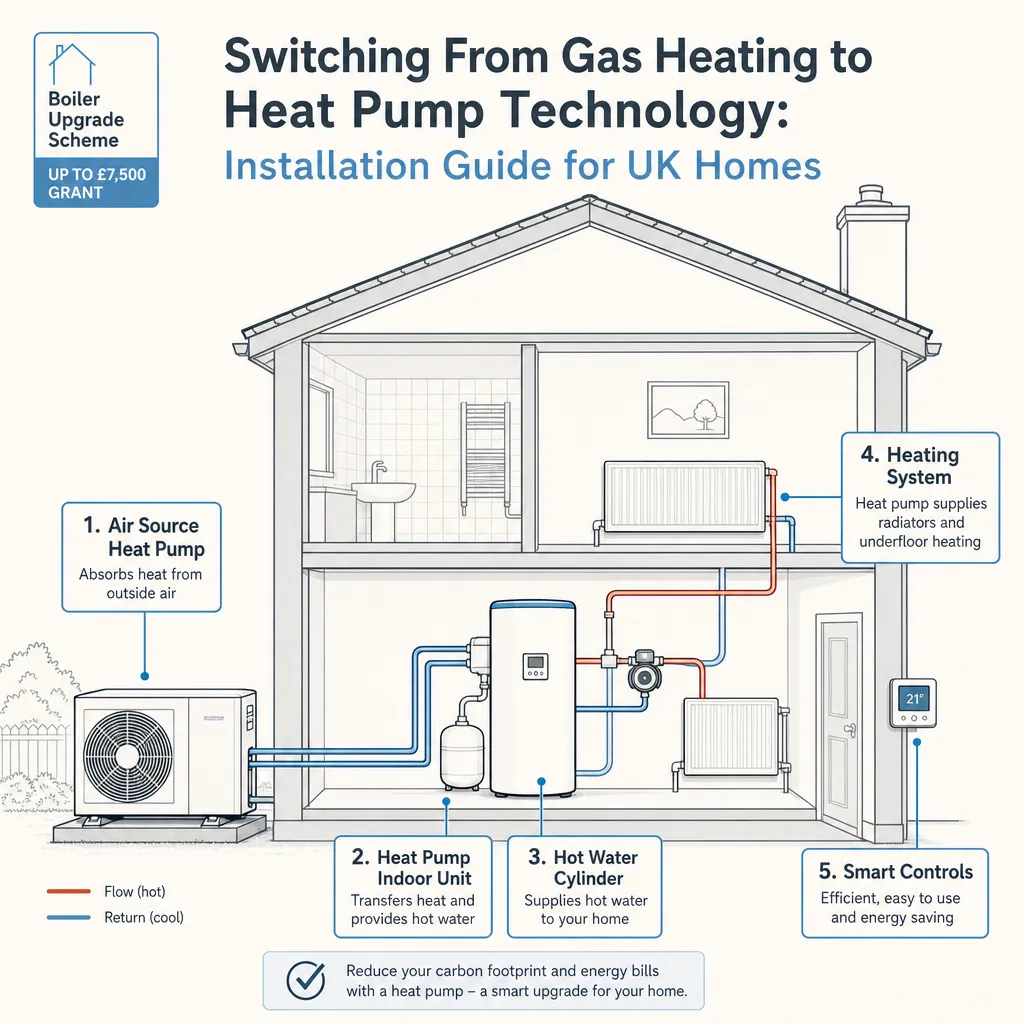 Energy & Retrofit
Switching From Gas Heating to Heat Pump Technology: Installation Guide
Switching from gas to a heat pump requires a heat loss calculation, correctly sized equipment, and often radiator upgrades before installation.
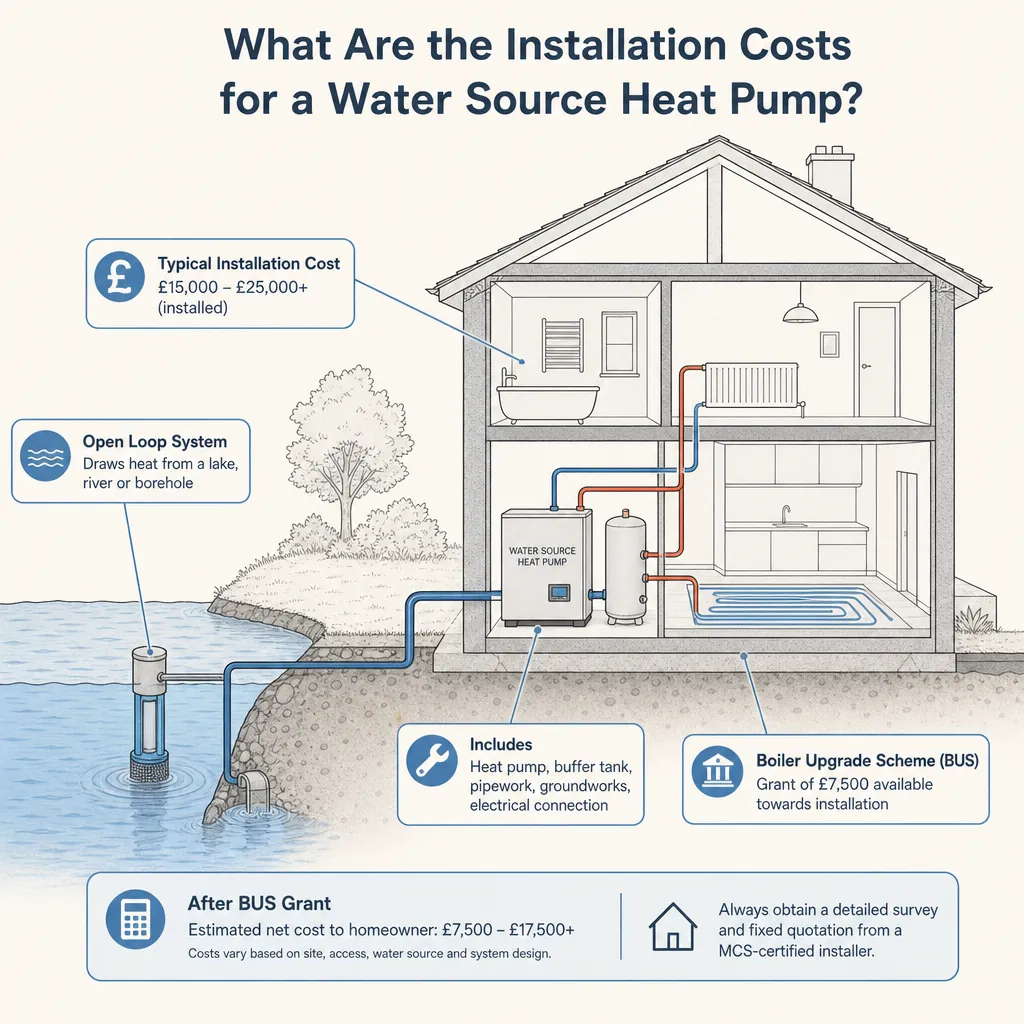 Energy & Retrofit
What Are the Installation Costs for a Water Source Heat Pump?
Water source heat pump installation in the UK typically costs £15,000–£45,000, depending on system type (open-loop or closed-loop), required heat output, and site complexity.