Understanding Solar Inverters: How They Work in Solar Installations
By Housey · Last reviewed 31st of May 2026
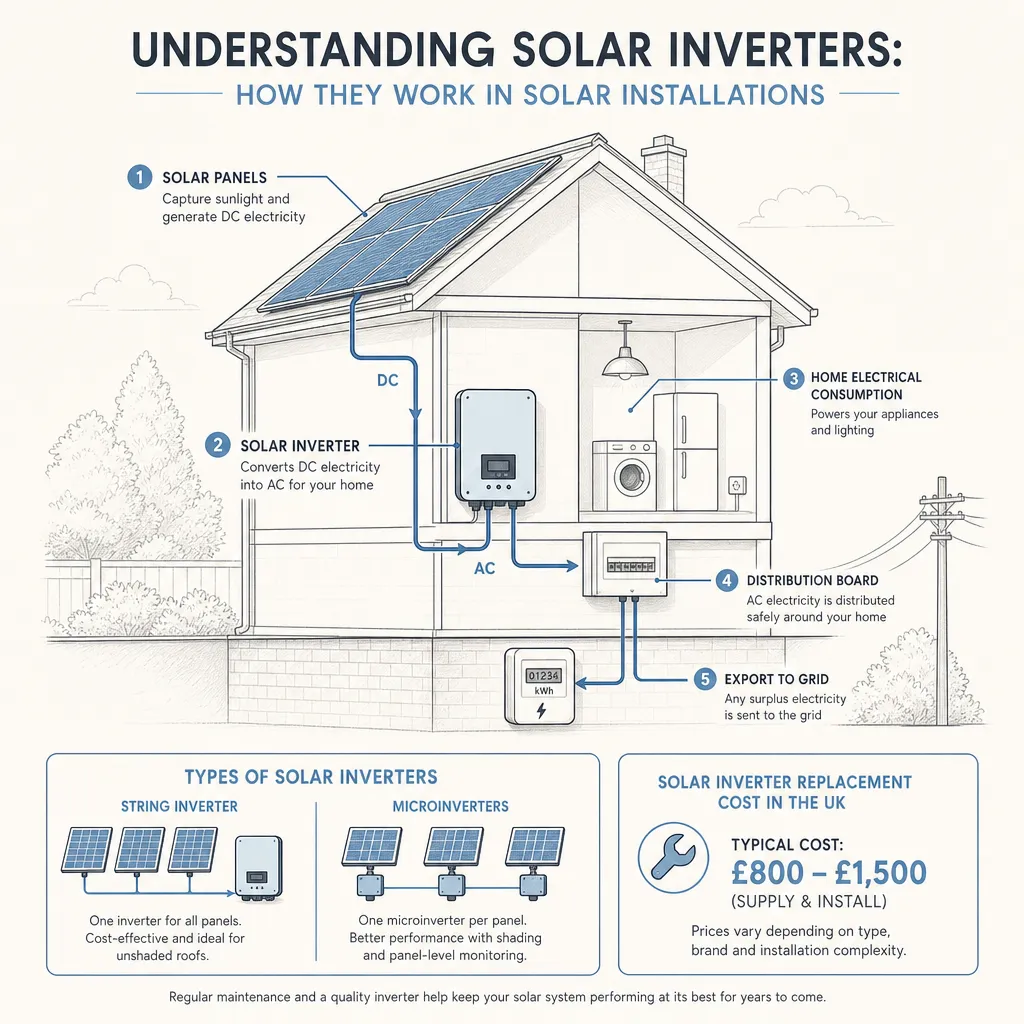
Understanding Solar Inverters: How They Work in Solar Installations
When a solar PV system is installed on a UK home, the panels themselves often get all the attention — but the inverter is where electricity generation actually becomes useful. Without it, the power produced by panels cannot run a kettle, charge a phone, or be exported to the grid under the Smart Export Guarantee. Whether you are planning a new installation, comparing installer quotes, or troubleshooting a system that appears to be underperforming, understanding how inverters work will help you ask better questions and make a more informed decision.
Key points
- Solar inverters convert DC electricity from panels into 230V AC electricity for use in UK homes and for export to the distribution grid.
- All grid-connected inverters in the UK must comply with Engineering Recommendation G98 (systems ≤16A per phase) or G99 (larger systems), published by the Energy Networks Association (ENA).
- MCS (Microgeneration Certification Scheme) certification of both the inverter product and the installer is required for Smart Export Guarantee (SEG) eligibility.
- String inverters are the most common type in UK residential systems; microinverters and DC optimisers offer performance advantages on partially shaded or multi-orientation roofs.
- Residential solar inverters typically last 10–15 years — considerably shorter than the 25-year performance warranties on most panels — making replacement a foreseeable cost over a system's lifetime.
What a solar inverter does
Solar panels produce direct current (DC) electricity: current that flows in one direction, at a voltage that varies with sunlight intensity. The UK grid, and all standard domestic appliances, run on 230V alternating current (AC): current that reverses direction 50 times per second.
The inverter performs three core functions:
- DC–AC conversion. Power electronics inside the inverter switch the DC on and off at high speed to synthesise a 50 Hz AC waveform synchronised to the grid frequency.
- Maximum power point tracking (MPPT). The inverter continuously adjusts the operating voltage of the panels to extract maximum power as cloud cover, temperature, and shading change throughout the day.
- Grid synchronisation and safety isolation. The inverter monitors grid frequency and voltage, adjusting output to match. If the grid fails, the inverter must disconnect automatically — a function called anti-islanding — to protect line workers and prevent unauthorised energisation of the network.
A modern inverter also monitors and logs generation data, typically accessible via a smartphone app or web portal, allowing you to track daily and cumulative output.
Types of solar inverter compared
Inverter type | How it works | Best for | Limitations |
|---|---|---|---|
String (central) inverter | All panels connect in series strings to a single inverter unit | South-facing, unshaded roofs; most cost-effective option | One shaded or faulty panel reduces output across the whole string |
Microinverter | An individual inverter attaches to each panel on the roof | Complex roofs, multiple orientations, partial shading | Higher upfront cost; more components in an exposed roof environment |
DC optimiser + string inverter | Optimiser on each panel maximises individual output, feeds into a central inverter | Partial shading; per-panel monitoring required | Mid-range cost; requires an optimiser-compatible inverter |
Hybrid inverter | Combines solar inverter with battery management controller in one unit | Homes adding battery storage now or planning to in future | Higher cost; battery compatibility varies by manufacturer and chemistry |
Off-grid inverter | Operates independently of the distribution network | Isolated properties, cabins, backup generation | Cannot export to grid; no SEG income |
Which inverter type should you choose?
- Choose a string inverter if your roof faces broadly south, has minimal shading between 9am and 4pm, and you want the most cost-effective system.
- Choose microinverters or DC optimisers if your roof faces multiple directions, has dormers, chimneys, or nearby trees creating partial shade across panels.
- Choose a hybrid inverter if you are installing battery storage at the same time, or want to add it later without significant additional works.
- Ask your MCS-certified installer for a shade analysis if you are unsure about shading impact — many use simulation tools such as PVsyst to model likely output across the year.
- Consult your Distribution Network Operator (DNO) before installation if your system will exceed 3.68 kW per phase, as G99 pre-approval is required.
Grid connection: G98 and G99
All inverters connected to the UK low-voltage distribution network must comply with Engineering Recommendations published by the Energy Networks Association (ENA):
- G98 applies to micro-generation systems of ≤16A per phase (most domestic solar PV up to approximately 3.68 kW per phase). Installers must notify the relevant Distribution Network Operator (DNO) within 28 days of commissioning; prior approval is not required.
- G99 applies to larger systems (>16A per phase). Prior DNO approval is required before installation begins, and a more detailed technical assessment is needed.
Your MCS-certified installer is responsible for ensuring the correct notification or approval is obtained. If you are expanding an existing system, the cumulative capacity of all generation on the property determines which recommendation applies.
Smart Export Guarantee and inverter requirements
The Smart Export Guarantee (SEG), regulated by Ofgem, requires larger energy suppliers to offer export tariffs to eligible generators. To qualify:
- The installation must be certified under MCS (or a recognised equivalent scheme).
- The inverter must appear on the MCS product certification database.
- A smart export meter or compatible smart meter must be installed at the property.
An inverter that is not MCS-listed will disqualify the system from SEG export income, even if the panels and installation work are otherwise compliant. Always confirm inverter MCS listing before purchase.
Red flags: when your inverter may need attention
- Generation data showing a flat line or zero output during daylight hours — possible inverter fault or grid disconnection event.
- Persistent error codes on the inverter display; check the manufacturer's documentation to identify the fault type before calling an engineer.
- Output consistently 20–30% below modelled predictions on clear days, with no obvious cause such as seasonal shading.
- The inverter running continuously hot, tripping its own thermal protection, or making unusual sounds.
- An inverter more than 10–12 years old that is producing noticeably less than in previous years of operation.
Inverter faults do not always require full replacement — some are caused by grid events, firmware issues, or components a qualified engineer can repair. Ask a solar PV specialist to diagnose the fault before assuming replacement is the only option.
When to get professional help
Inverter installation, replacement, and grid connection must be carried out by a qualified electrician — typically an MCS-certified solar PV installer registered with a Competent Person Scheme such as NAPIT or NICEIC. Do not work on inverter wiring yourself.
Seek professional advice if:
- Your system is underperforming and you cannot identify an obvious cause via monitoring data.
- Your inverter is more than 10 years old and you are planning to expand the system or add battery storage.
- You are purchasing a property with an existing solar PV system and want to verify the inverter is compliant and functioning correctly.
- Your DNO has contacted you about grid connection compliance or export limiting requirements.
How Housey can help
Housey connects you with MCS-certified local solar specialists who can assess your existing system, advise on inverter upgrades, or design a new solar PV installation suited to your property. Start with a solar survey to understand your roof's generation potential and get clear recommendations on inverter type before committing to any equipment.
Frequently asked questions
How long does a solar inverter last?
Most residential string inverters are rated for 10–15 years by manufacturers, though many last longer with good installation and adequate ventilation. Microinverters and DC optimisers often carry longer warranties — some manufacturers offer 25-year product warranties to match the panel warranty. When planning a solar PV system, budget for at least one inverter replacement during the panels' 25-year lifespan.
Can I replace just the inverter, or do I need to replace the whole system?
In most cases, the inverter can be replaced independently of the panels. The replacement must be compatible with the existing panel string configuration, comply with current G98/G99 requirements, and be MCS-listed if you wish to maintain Smart Export Guarantee eligibility. An MCS-certified installer should check full system compatibility before any replacement work is carried out.
Does my inverter affect how much I earn from the Smart Export Guarantee?
The inverter itself does not set the SEG tariff — that is determined by your energy supplier. However, the inverter must be MCS-listed for the installation to qualify for SEG in the first place. Monitoring data from the inverter helps you track export, though SEG payments are typically based on smart meter readings rather than inverter logs.
What is a hybrid inverter and do I need one?
A hybrid inverter combines a solar inverter and a battery management system in one unit. If you plan to install a home battery — now or within the next few years — a hybrid inverter can simplify integration and may reduce future costs compared with retrofitting a separate battery inverter. If battery storage is not in your plans, a standard string inverter is usually the more cost-effective choice.
Sources and further reading
- Engineering Recommendation G98 — connection of micro-generation to the low voltage distribution network — Energy Networks Association
- Smart Export Guarantee: guidance for generators — Ofgem
- MCS product certification database — Microgeneration Certification Scheme
- Solar panels: what you need to know — Energy Saving Trust
- NAPIT Competent Person Scheme — solar PV — NAPIT
Useful next reads
 Energy & Retrofit
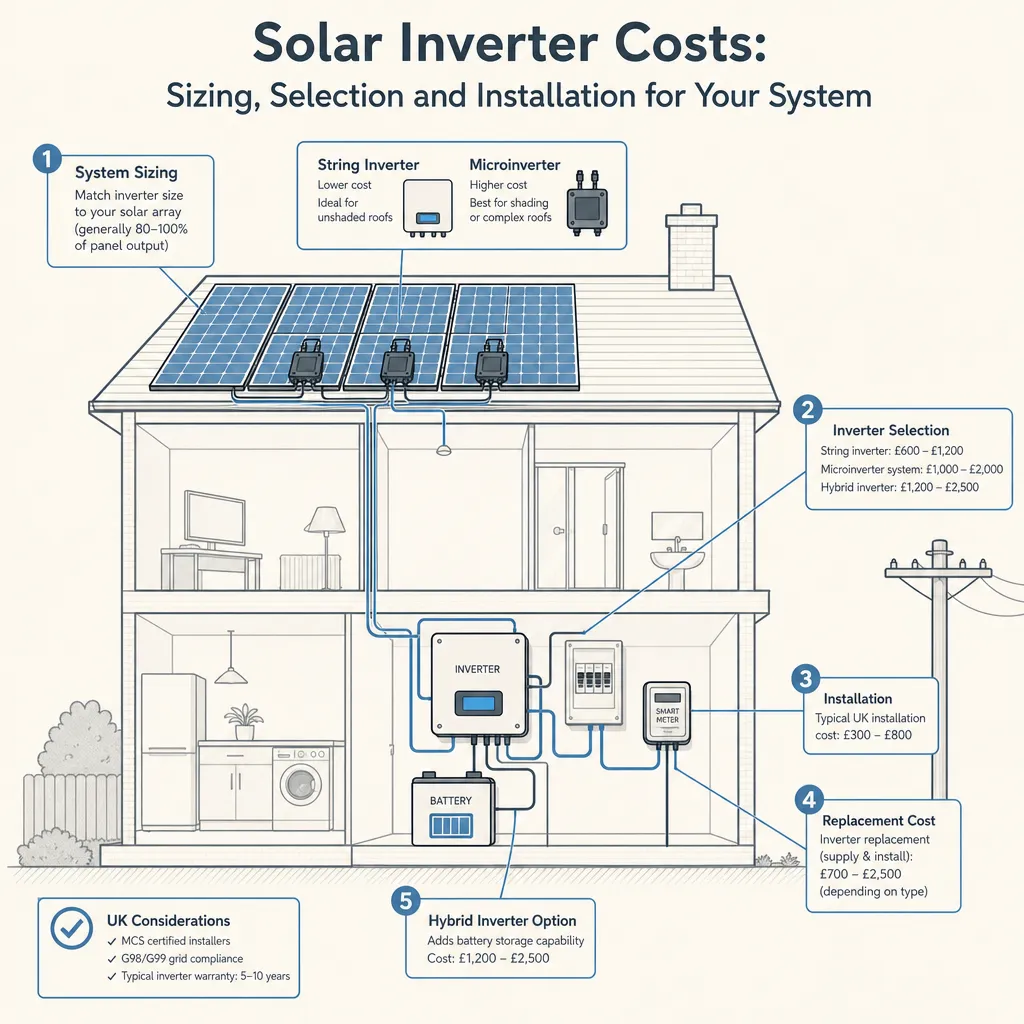
Solar Inverter Costs: Sizing, Selection and Installation for Your System
A solar inverter converts DC electricity from panels into AC power for home use.
 Energy & Retrofit
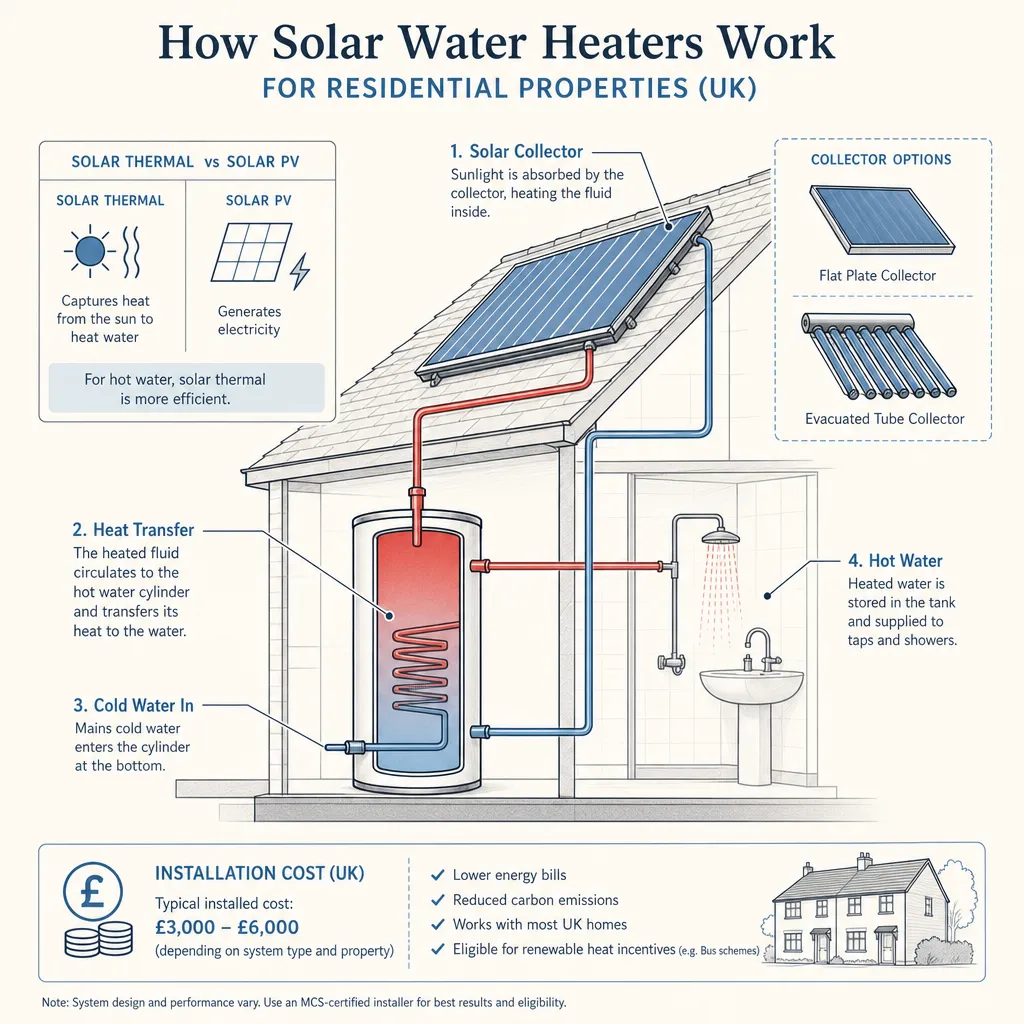
How Solar Water Heaters Work for Residential Properties
Solar water heaters use roof-mounted collectors to capture heat from sunlight and transfer it to a hot water cylinder via a fluid circuit.
 Energy & Retrofit
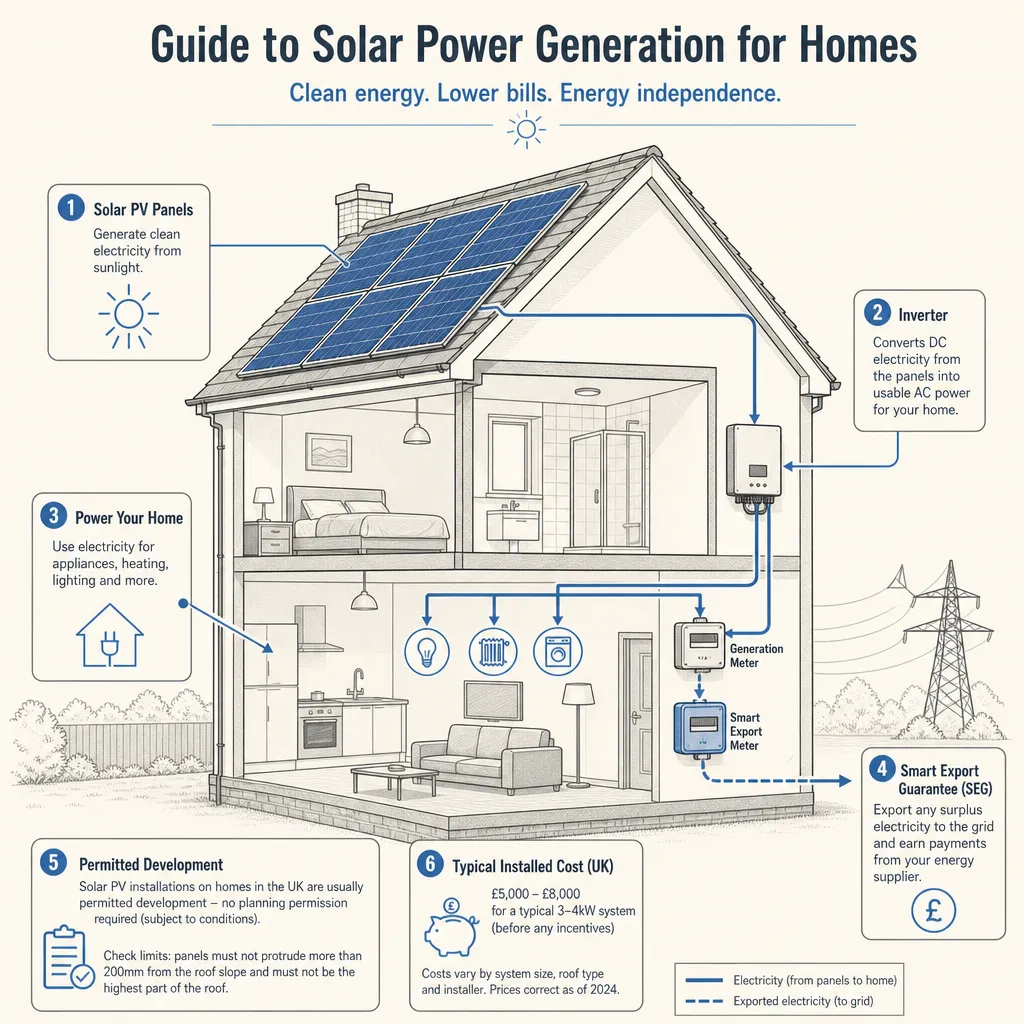
Guide to Solar Power Generation for Homes
Solar photovoltaic (PV) panels convert daylight into electricity and export surplus to the grid via the Smart Export Guarantee (SEG).
 Energy & Retrofit
How Solar Power Technology Works: Technical Fundamentals
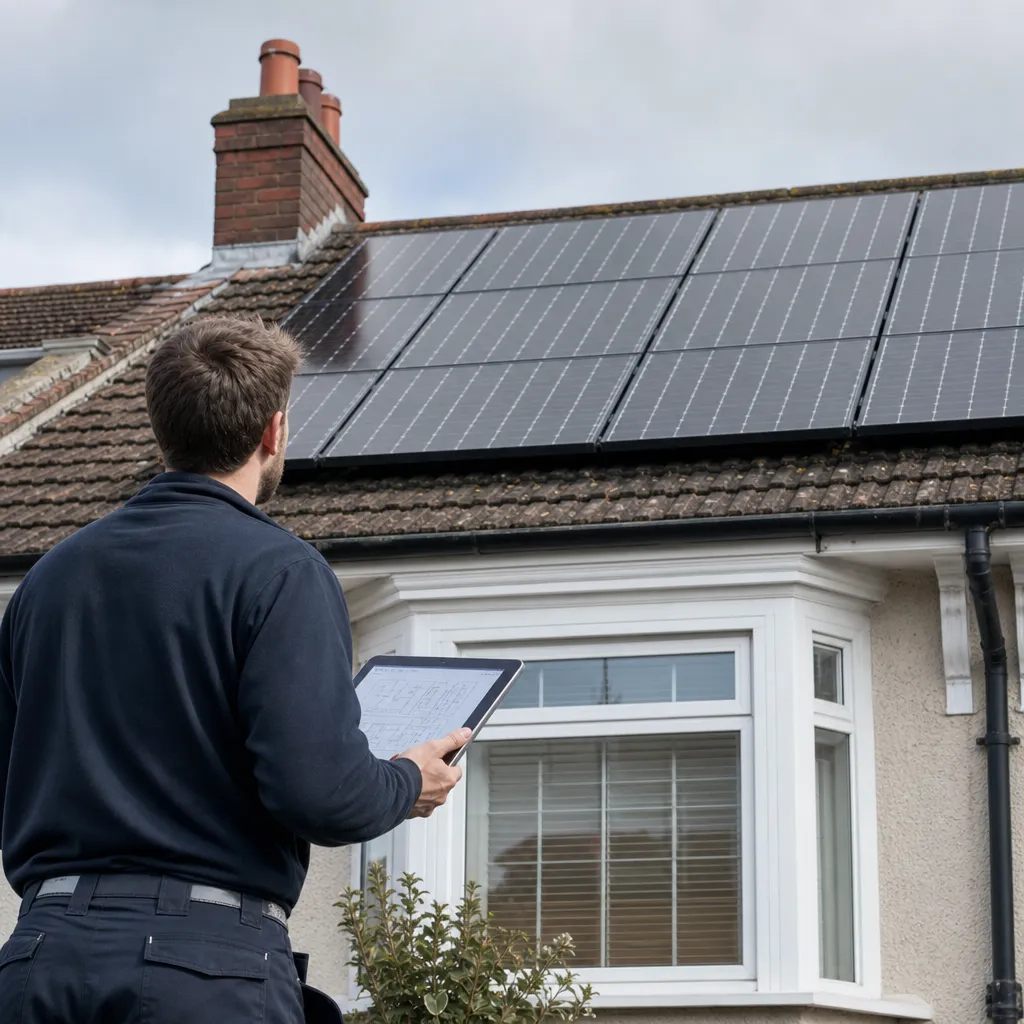
Solar panels use photovoltaic cells to convert sunlight directly into DC electricity, which an inverter then converts to 230V AC for household use.
 Energy & Retrofit
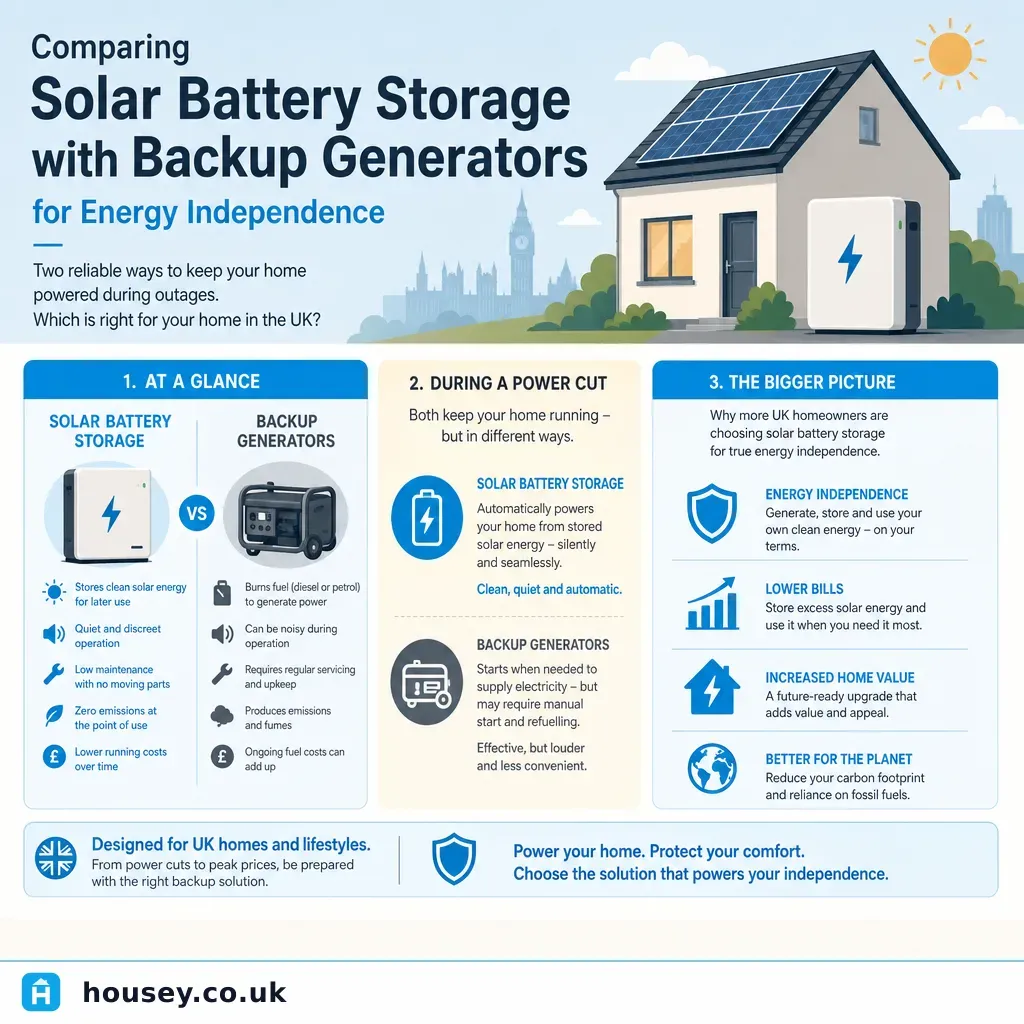
Comparing Solar Battery Storage with Backup Generators for Energy Independence
Solar battery storage and backup generators both offer energy resilience but work very differently.