Solar Panel Composition: Materials and Manufacturing Processes
By Housey · Last reviewed 11th of May 2026
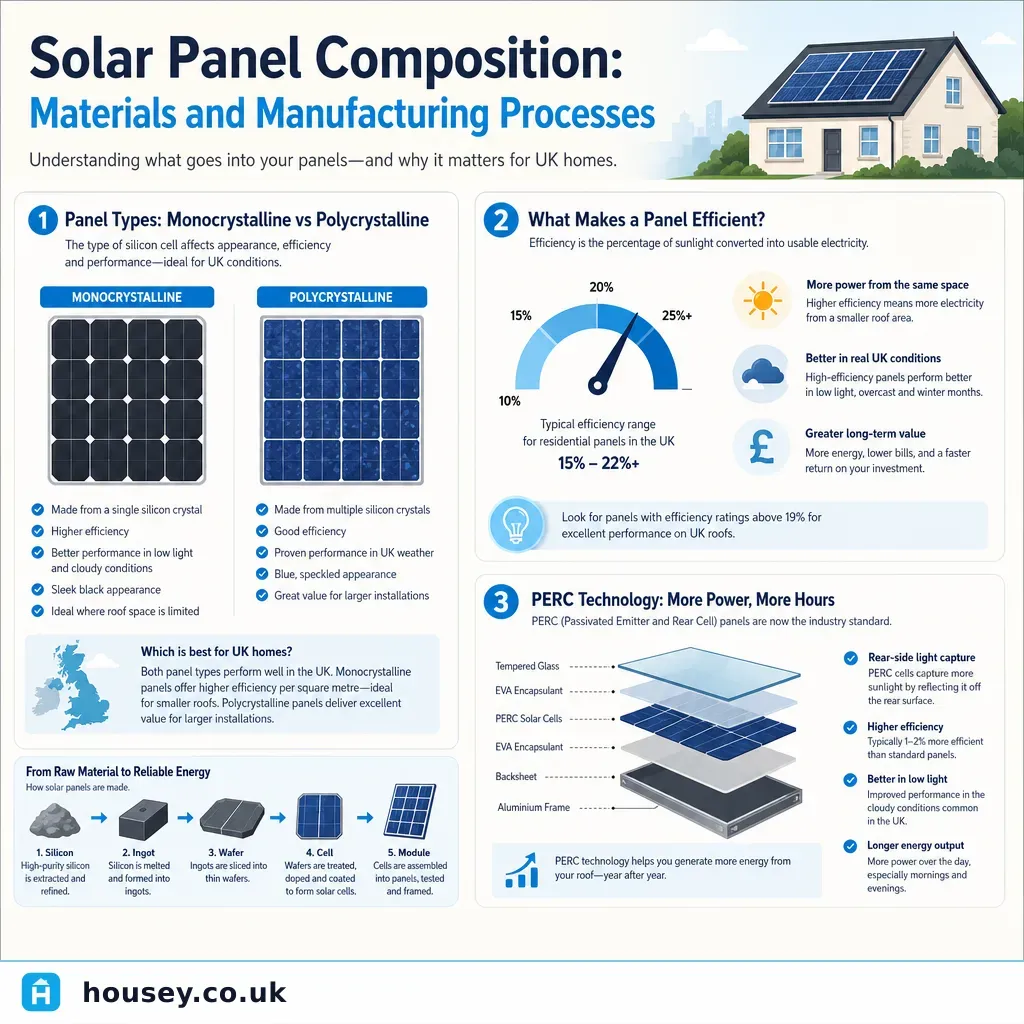
Solar Panel Composition: Materials and Manufacturing Processes
Understanding what solar panels are made of helps UK homeowners evaluate product specifications, compare installer quotes, and ask better questions before committing to an installation that will remain on the roof for 25–30 years. With MCS certification and the Smart Export Guarantee (SEG) tying financial returns directly to the quality and certification of the equipment installed, the materials inside a panel are more than a technical footnote — they affect long-term output, warranty validity, and end-of-life obligations.
Key points
- Standard monocrystalline silicon panels achieve efficiencies of 20–24%, making them the most common choice for UK domestic installations.
- A crystalline silicon panel has five main layers: tempered glass, EVA (ethylene-vinyl acetate) encapsulant, silicon cells, a second EVA layer, and a polymer backsheet, all bonded in an aluminium frame.
- Thin-film technologies — cadmium telluride (CdTe), CIGS, and amorphous silicon — use far less semiconductor material but typically achieve efficiencies of 10–18%.
- An installation must carry MCS (Microgeneration Certification Scheme) certification to qualify for the Smart Export Guarantee (SEG) in Great Britain.
- Perovskite–silicon tandem cells have exceeded 33% efficiency in laboratory conditions; commercial UK residential availability remains limited as of 2026.
The anatomy of a crystalline silicon panel
The vast majority of panels installed on UK homes use crystalline silicon as the active semiconductor. A finished module is a laminated stack of distinct layers, each with a specific function.
Tempered glass (front cover)
The outermost layer is low-iron tempered glass, typically 3–4 mm thick. Low-iron glass improves light transmission relative to standard float glass and resists surface degradation from UV exposure, rain, and hail. Most panels are tested to IEC 61215, which includes a hail-impact test simulating 25 mm hailstones at 23 m/s.
Encapsulant
Silicon cells are embedded in ethylene-vinyl acetate (EVA) on both sides. EVA is transparent, bonds all layers together under heat and pressure during lamination, and provides electrical isolation. Some premium panels use polyolefin (POE) encapsulant, which is more moisture-resistant and reduces the risk of potential-induced degradation (PID) over time.
Silicon photovoltaic cells
The cells are the active element converting photons into direct current (DC) electricity via the photovoltaic effect. The main cell types used in UK residential panels are:
Cell type | Efficiency range | Key characteristic | Best suited to |
|---|---|---|---|
Monocrystalline (Mono-Si) | 20–24% | Cut from a single silicon ingot (Czochralski process) | Maximum output in limited roof space |
Polycrystalline (Poly-Si) | 15–17% | Cast from multiple silicon crystals; lower manufacturing energy | Lower upfront cost; larger roof area available |
PERC (Passivated Emitter Rear Cell) | 21–24% | Rear-surface passivation layer | Better low-light performance in diffuse UK conditions |
HJT (Heterojunction) | 22–25% | Amorphous silicon layers on crystalline substrate | Strong diffuse-light output; lower temperature coefficient |
TOPCon (Tunnel Oxide Passivated Contact) | 22–25% | High bifacial gain; longer product warranties | East–west roof layouts; bifacial mounting |
Backsheet and frame
The rear layer is typically a multi-layer polymer (commonly TPT — tedlar-polyester-tedlar) or, in bifacial panels, a second sheet of glass. An anodised aluminium frame provides rigidity, mounting points, and grounding connections. Frameless glass-glass panels are also used in some building-integrated photovoltaic (BIPV) applications.
Thin-film solar panels
Thin-film panels deposit a microscopically thin photovoltaic layer onto a substrate — glass, metal, or flexible polymer. The three main technologies are:
- Cadmium Telluride (CdTe): The most widely deployed thin-film technology globally. Module efficiencies are typically 18–20%. Low manufacturing energy, but cadmium is a toxic element requiring managed end-of-life recycling.
- CIGS (Copper Indium Gallium Selenide): Efficiencies of 17–20%; flexible versions are available for curved surfaces and some building-integrated applications.
- Amorphous Silicon (a-Si): The lowest efficiency (6–9%) but performs relatively well under diffuse light. More common in portable devices than residential roofing.
Thin-film panels are less common on UK homes than crystalline silicon products but appear in commercial, agricultural, and BIPV projects.
Emerging materials: perovskite cells
Perovskite solar cells use a crystalline compound that can be deposited cheaply via printing or vapour deposition. Laboratory efficiencies for perovskite–silicon tandem cells have exceeded 33% in research settings. Commercial challenges — including durability under prolonged UV exposure and lead-content regulation under the UK REACH framework — mean widespread residential availability remains anticipated rather than established as of 2026.
Certifications that matter for UK homeowners
Certification | What it covers | Practical importance |
|---|---|---|
MCS (Microgeneration Certification Scheme) | Product and installer certification | Required for Smart Export Guarantee (SEG) eligibility |
IEC 61215 | Performance and durability for crystalline silicon modules | Confirms testing against degradation, mechanical load, and hail |
IEC 61730 | Electrical and fire safety standard | Required for grid-connected UK installations |
PAS 5203 | UK standard for solar PV system design | Used alongside MCS for installer competence |
For the SEG, both the product and the installer must carry MCS certification. An MCS-certified installer will use MCS-certified equipment and provide the relevant documentation to the homeowner.
What to ask when comparing panel specifications
- What cell technology is used — monocrystalline, PERC, HJT, or TOPCon?
- What is the stated efficiency at Standard Test Conditions (STC)?
- What are the product warranty terms and the performance warranty (degradation rate per year — typically no more than 0.5%/year, guaranteeing at least 80% output after 25 years)?
- Is the panel MCS-certified and does it carry IEC 61215 and IEC 61730 certification?
- How is the encapsulant rated for moisture resistance, and does the manufacturer specify PID resistance?
- What end-of-life recycling provisions does the manufacturer offer under the UK WEEE Regulations?
When to get professional help
Understanding panel specifications usefully informs a conversation with a qualified installer — it should not replace one. Consult an MCS-certified installer if:
- You are comparing quotes and the panel technologies differ significantly between proposals.
- The installer cannot provide a panel datasheet or IEC certification documentation.
- The roof has shading issues from chimneys or neighbouring buildings that may warrant power optimisers or microinverters.
- You are considering a bifacial, building-integrated, or thin-film product less commonly installed in the UK domestic market.
How Housey can help
Housey connects you with MCS-certified local solar specialists through our solar surveys service. A solar survey will assess your roof's orientation, pitch, shading, and structural load before producing a site-specific specification — without any upfront purchase commitment.
Frequently asked questions
What percentage of solar panels installed in the UK are monocrystalline?
The large majority of panels installed on UK homes are monocrystalline silicon — including PERC, HJT, and TOPCon variants. Polycrystalline panels are less common in new installations due to the falling cost of monocrystalline manufacturing. Thin-film panels represent a small share of the UK residential market, primarily in building-integrated applications.
Do solar panels degrade over time?
Yes. Crystalline silicon panels typically degrade at approximately 0.3–0.7% per year. Most manufacturers guarantee at least 80% of rated output at 25 years. Light-induced degradation (LID) causes a small initial output drop of 1–3% in the first hours of exposure. PERC, HJT, and TOPCon panels generally show lower initial degradation and slower long-term decline rates.
Are solar panels recyclable in the UK?
Most panels can be partially recycled: the aluminium frame, glass, and copper wiring are commercially recyclable. The silicon cells and encapsulant layers are harder to separate and recover at scale. Under the UK WEEE Regulations 2013, manufacturers and importers must fund end-of-life collection and recycling for photovoltaic panels.
Sources and further reading
- Smart Export Guarantee (SEG) guidance — GOV.UK
- MCS: Standards and certification — Microgeneration Certification Scheme
- IEC 61215 and IEC 61730 — International Electrotechnical Commission
- UK WEEE Regulations 2013 — GOV.UK
- Solar panels — Energy Saving Trust
Useful next reads
 Energy & Retrofit
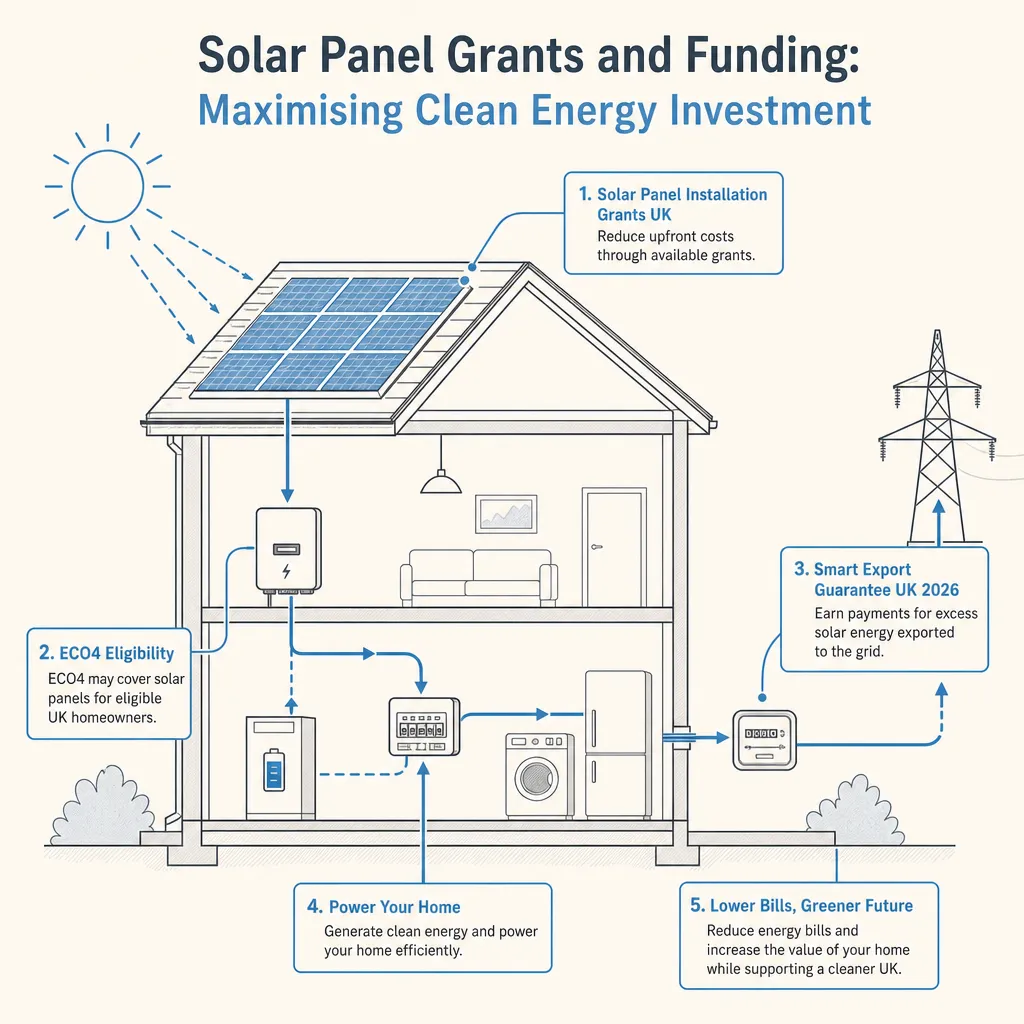
Solar Panel Grants and Funding: Maximising Clean Energy Investment
Several UK solar funding schemes are currently open: the Smart Export Guarantee pays homeowners for surplus electricity exported to the grid, ECO4 can fund free or subsidised panels for eligible low-income households, and 0% VAT on installation applies until at least March 2027.
 Energy & Retrofit
Renewable Energy Systems and Property Value: Solar Panels and Heat Pumps
Solar panels can add a modest 1–4% to UK property values in the right conditions, particularly when they improve the EPC rating.
 Energy & Retrofit
Do Solar Panels Increase Property Value?
Solar panels generally add value to UK properties, with research suggesting an uplift of 0.
 Energy & Retrofit
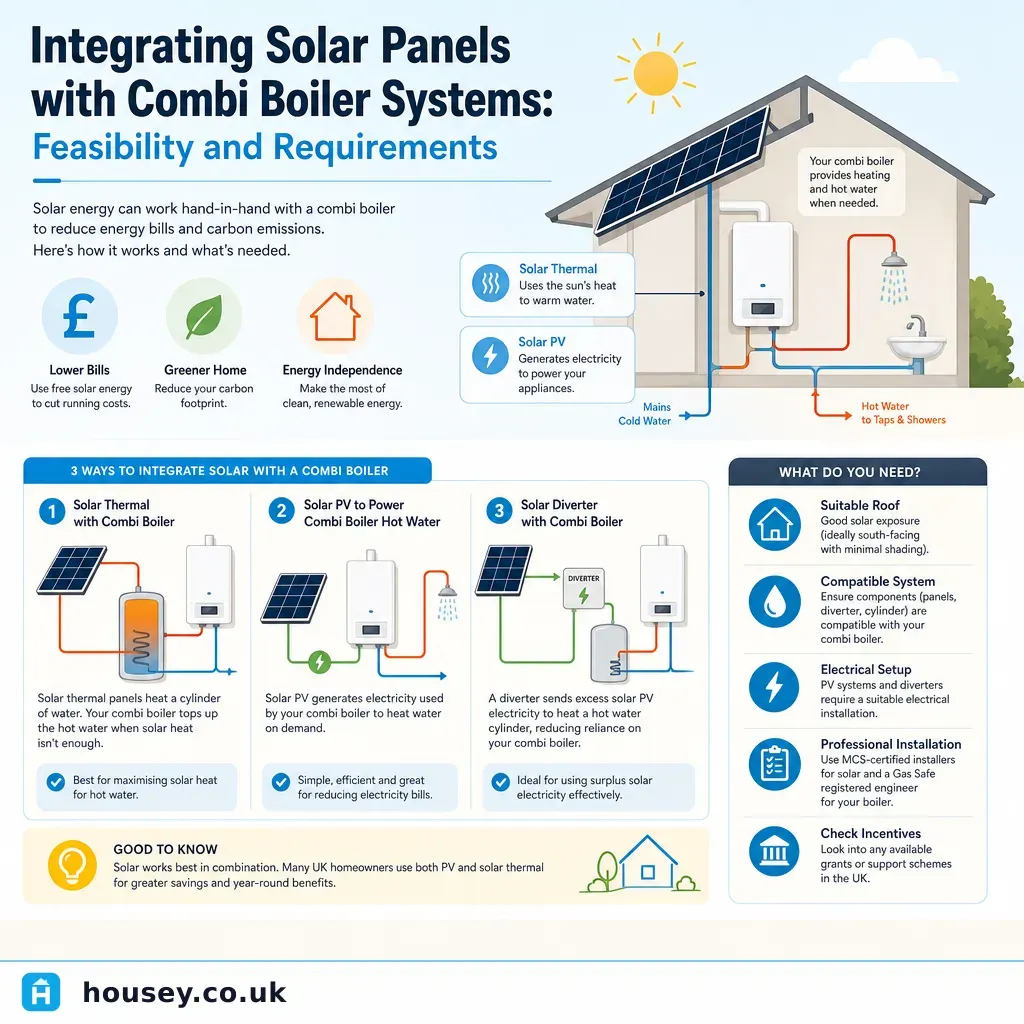
Integrating Solar Panels with Combi Boiler Systems: Feasibility and Requirements
Combi boilers heat water on demand without a hot water storage cylinder, making direct solar thermal integration impractical.
 Energy & Retrofit
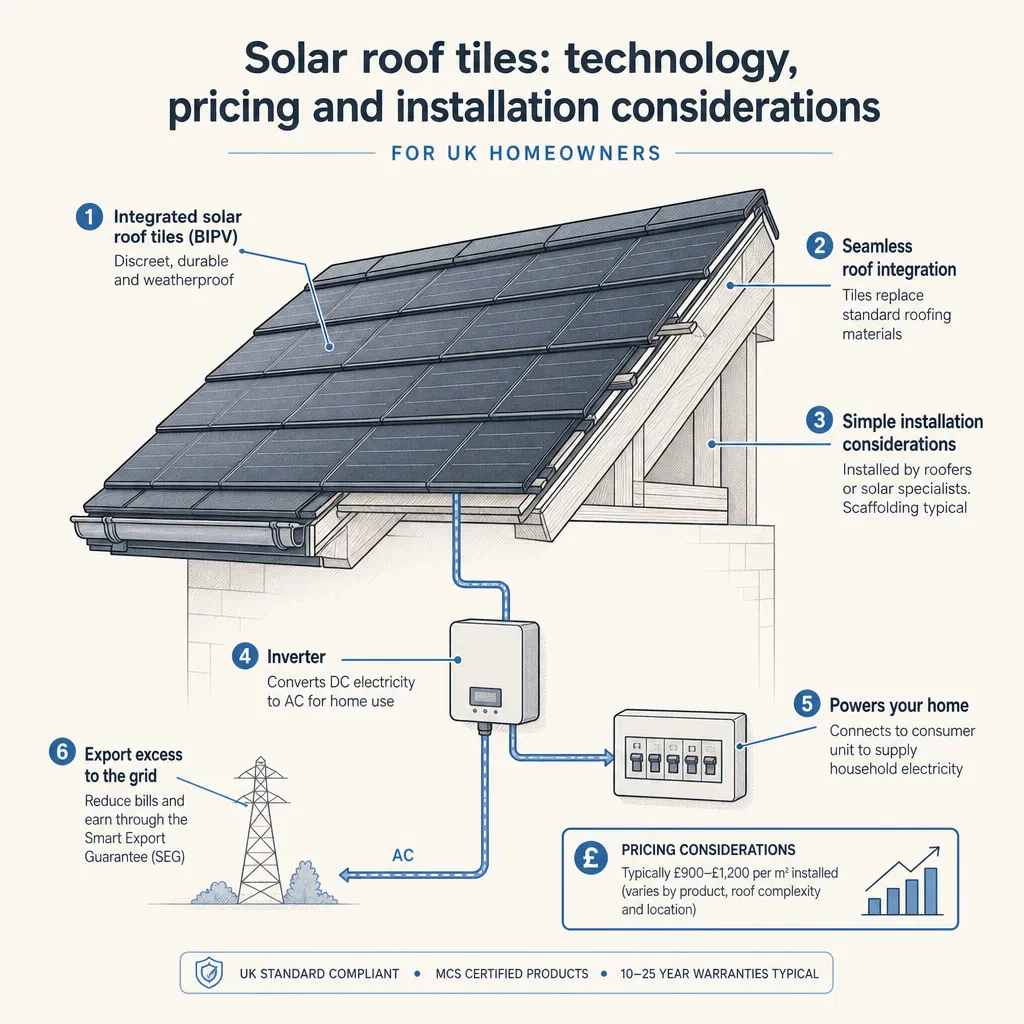
Solar roof tiles: technology, pricing and installation considerations
Solar roof tiles (BIPV tiles) replace your conventional roof covering while generating electricity.