Solar roof tiles: technology, pricing and installation considerations
By Housey · Last reviewed 12th of May 2026
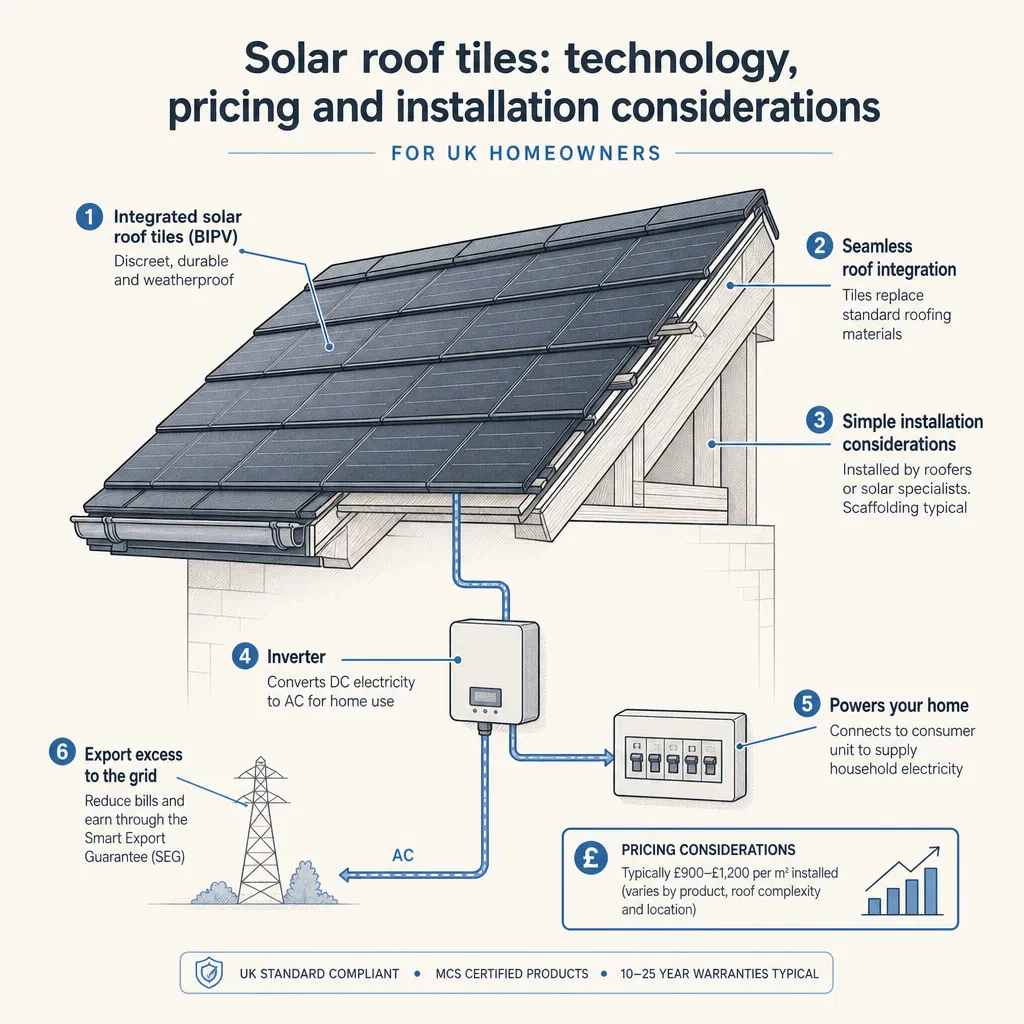
Solar roof tiles: technology, pricing and installation considerations
Solar roof tiles have attracted growing interest from UK homeowners looking to generate renewable electricity without the visual impact of rack-mounted panels. The technology has matured considerably since its early iterations, and the decision sits at the intersection of roofing, renewable energy, and planning compliance — making it important to understand what you are buying before committing to a significant installation.
Key points
- Solar roof tiles are a form of Building Integrated Photovoltaics (BIPV), replacing conventional roof covering rather than mounting on top of it.
- Indicative UK installation costs range from £15,000 to £35,000+ for a fully integrated roof, compared with £5,000–£10,000 for a conventional rack-mounted solar panel array of similar output (indicative costs, last reviewed 2026-05-12).
- To receive Smart Export Guarantee (SEG) payments for exported electricity, your installer must hold MCS (Microgeneration Certification Scheme) accreditation.
- Most domestic solar tile installations fall under permitted development rights in England under Schedule 2, Part 14 of the Town and Country Planning (General Permitted Development) (England) Order 2015, but listed buildings, conservation areas, and some flats are excluded.
- Individual tile output typically ranges from 70W to 200W per tile; a substantial south-facing roof section is usually needed to match a conventional panel array's generating capacity.
What are solar roof tiles and how do they differ from standard panels?
Solar roof tiles — sometimes called solar shingles or BIPV tiles — are photovoltaic cells embedded within a roofing material that replaces, rather than sits on top of, your existing roof covering. Unlike rack-mounted solar panels, solar tiles integrate flush with the roof plane and perform two functions simultaneously: weatherproofing the roof and generating electricity.
Standard solar panels are fixed to a mounting frame above an existing roof. They are generally more efficient per pound spent and faster to install, but they sit visibly above the roofline. Solar tiles are significantly more expensive for an equivalent generating capacity, but may suit situations where aesthetics are a priority, on roofs approaching end-of-life replacement, or on new builds where integrated design can be planned from the outset.
Most BIPV tile products currently available in the UK market use monocrystalline silicon cells, with individual tile efficiency typically running 15–22%. Products are available in slate-effect, terracotta, and plain formats to complement different property styles, including Victorian terraces and 1930s semis where conventional panels can look incongruous.
How much do solar roof tiles cost in the UK?
Indicative UK costs, last reviewed 2026-05-12.
Solar roof tiles are materially more expensive than conventional solar panels because they include the roofing substrate itself. You are, in effect, paying for a re-roof and a solar installation simultaneously.
Option | Indicative installed cost | Typical output | Includes re-roof? |
|---|---|---|---|
Solar roof tiles (full roof) | £15,000–£35,000+ | 3–6 kWp | Yes |
Solar roof tiles (south-facing slopes only) | £8,000–£18,000 | 2–4 kWp | Partial |
Rack-mounted solar panels (6–10 panels) | £5,000–£10,000 | 3–5 kWp | No |
Costs vary considerably depending on roof area, pitch, existing roof condition, tile product chosen, scaffolding requirements, and installer location. Always obtain at least three itemised quotes. Your roof's orientation, shading, and local installer pricing will all affect the final figure significantly.
Key cost drivers:
- Roof size and complexity: Multiple slopes, dormers, or valleys increase the cost of both the roofing work and tile integration.
- Roof deck condition: A deck requiring replacement before tiling adds to overall cost.
- Inverter type: String inverters are lower cost; microinverters or optimisers perform better on partially shaded roofs but add expense.
- Battery storage: Adding a home battery system — typically £2,000–£6,000 extra — is worth planning alongside any solar installation.
- Scaffolding: Usually required and typically costs £600–£1,500 depending on roof height and access complexity.
As of 2026, there is no capital grant specifically targeting solar tiles, but 0% VAT applies to most residential solar installations. The Smart Export Guarantee pays for surplus electricity exported to the grid, provided your installer is MCS-accredited.
Solar roof tiles vs conventional solar panels
Feature | Solar roof tiles | Rack-mounted panels |
|---|---|---|
Aesthetic impact | Minimal — flush with roofline | Visible above roof |
Cost per kWp | Higher | Lower |
Suited to roof nearing end of life | Yes — combines re-roof and solar | No |
Installation disruption | Higher — full or partial re-roof | Low — typically 1–2 days |
Conservation area / planning risk | Check LPA | Check LPA |
MCS installer required for SEG | Yes | Yes |
Best for | Aesthetic priority; roof replacement due | Maximum generation per £ spent |
Which option should you choose?
- Choose solar roof tiles if your roof is approaching end of life and needs replacing regardless, you have planning or aesthetic constraints that make rack-mounted panels unsuitable, or the property is a new build where integrated design can be incorporated from the start.
- Choose rack-mounted solar panels if your roof is in good condition, your primary goal is return on investment from electricity generation, or your budget is limited.
- Commission a solar survey first if you are unsure about roof suitability, shading from trees or neighbouring buildings, or the structural loading implications of BIPV tiles.
- Check with your local planning authority (LPA) before proceeding if the property is listed, in a conservation area, or a flat — permitted development rights may not apply.
Planning permission and building regulations
Most domestic solar installations fall under permitted development rights under Schedule 2, Part 14 of the Town and Country Planning (General Permitted Development) (England) Order 2015, so planning permission is not normally required.
Exceptions include:
- Listed buildings: Permitted development does not apply. Full planning consent is required before installation.
- Conservation areas and World Heritage Sites: Additional restrictions apply; check with your local planning authority before proceeding.
- Article 4 directions: Some areas carry additional local restrictions; your LPA can confirm whether one applies to your property.
- Flats: Permitted development rights for solar are typically limited to building owners; individual flat owners should check both their lease and the LPA position.
Building regulations approval is not generally required for like-for-like solar installations, but if structural work on the roof deck is involved, building control may need to be notified. Your installer should clarify this during the survey and quotation process.
What to ask before accepting a quote
- Is the installer MCS-accredited, and will the installation be eligible for the Smart Export Guarantee?
- What is the tile product brand and its efficiency rating per tile?
- What inverter technology is proposed, and why is it suited to this particular roof and its shading profile?
- How does the quote break down between roofing work and the solar installation itself?
- What warranties are offered on tiles, inverter, and workmanship separately?
- Has the roof structure been assessed to confirm it can carry the additional loading of BIPV tiles?
- What assumptions has the quote made regarding scaffold, roof deck condition, and access?
- Is 0% VAT applied to the installation, and on what basis?
- What is the estimated annual generation in kWh for this roof, its pitch, and its orientation?
When to get professional help
A professional solar survey is strongly advisable before committing to solar tiles. Specialist input is particularly important if:
- The roof has complex geometry, significant shading, or a pitch outside the 20–50° optimal range for solar yield.
- The property is listed or in a conservation area.
- You are uncertain whether the roof structure can support the additional loading of BIPV tiles versus conventional slates or tiles.
- You want an independent assessment of projected generation and payback period, rather than relying solely on the installing contractor's estimate.
How Housey can help
Housey connects you with qualified professionals for both solar surveys and roofing work. A solar survey before you commit can clarify whether your roof is well-suited to BIPV tiles, what output you can realistically expect, and whether conventional panels might deliver better value for your specific circumstances and budget.
Frequently asked questions
Do solar roof tiles qualify for the Smart Export Guarantee?
Yes, provided the installer holds MCS accreditation. The Smart Export Guarantee requires all solar installations to be certified under the MCS scheme before you can access tariff payments from an energy supplier. Always confirm MCS accreditation before signing a contract.
How long do solar roof tiles last?
Most manufacturers quote 25–30 years for the photovoltaic cells, with some tile products warranted as a roofing material for a similar period. Inverters typically have shorter lifespans — usually 10–15 years — and should be factored into your long-term cost planning.
Do I need planning permission for solar roof tiles?
In most cases, no — residential solar installations fall under permitted development rights in England. However, listed buildings, conservation areas, and some flats are excluded. Always check with your local planning authority if you are uncertain about your property's planning status.
Are solar roof tiles available across Scotland, Wales, and Northern Ireland?
Yes, but permitted development rules differ by nation. Check with Planning Scotland, the Welsh Government's planning guidance, or the Northern Ireland Planning Portal for the rules that apply to your specific property and location.
Sources and further reading
- GOV.UK: Permitted development rights for solar panels — planning permission guidance for domestic solar installations
- MCS: Microgeneration Certification Scheme — accreditation requirements for Smart Export Guarantee eligibility
- Ofgem: Smart Export Guarantee — tariff and eligibility information
- Energy Saving Trust: Solar panels — general guidance on solar energy for UK homes
- Planning Portal: Solar panels — interactive planning guidance for solar installations
Useful next reads
 Energy & Retrofit
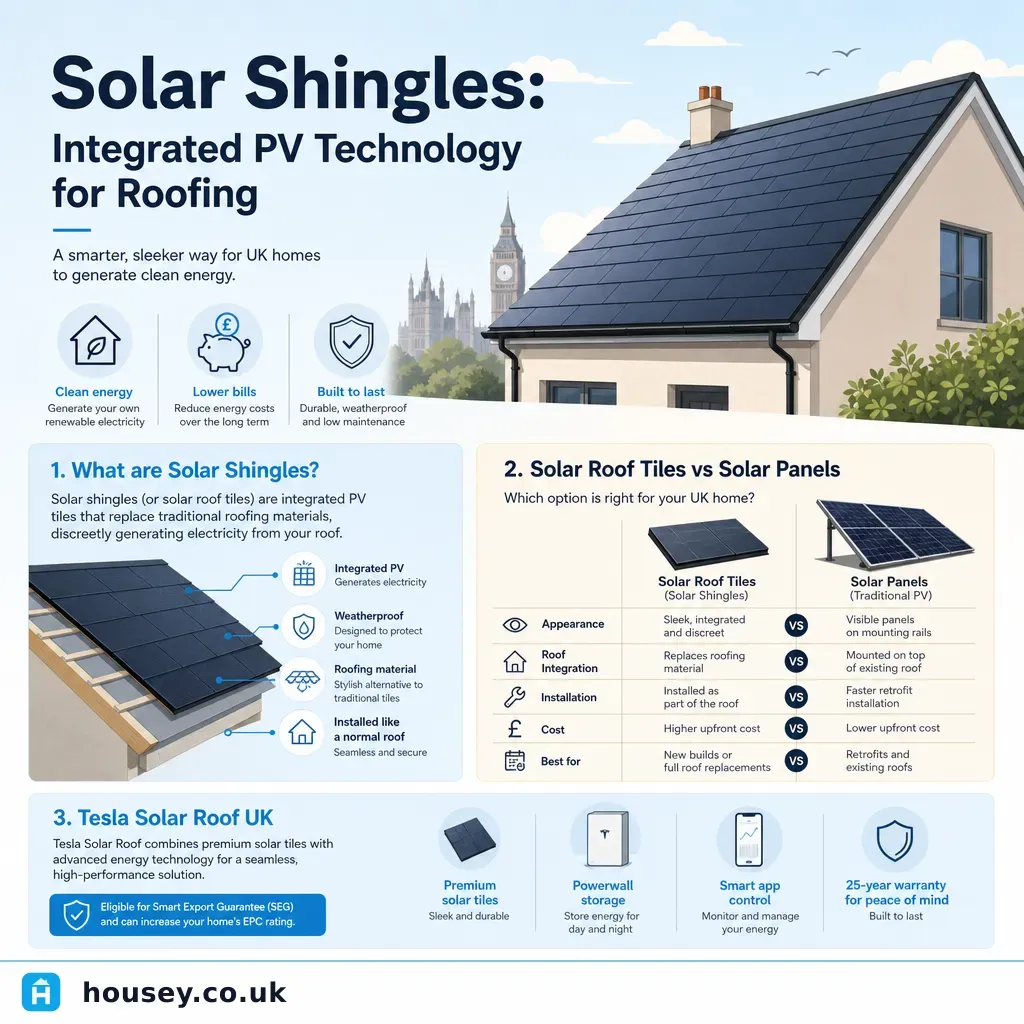
Solar Shingles: Integrated PV Technology for Roofing
Solar shingles are photovoltaic cells built into individual roofing tiles, generating electricity while serving as the weatherproof roof covering.
 Energy & Retrofit
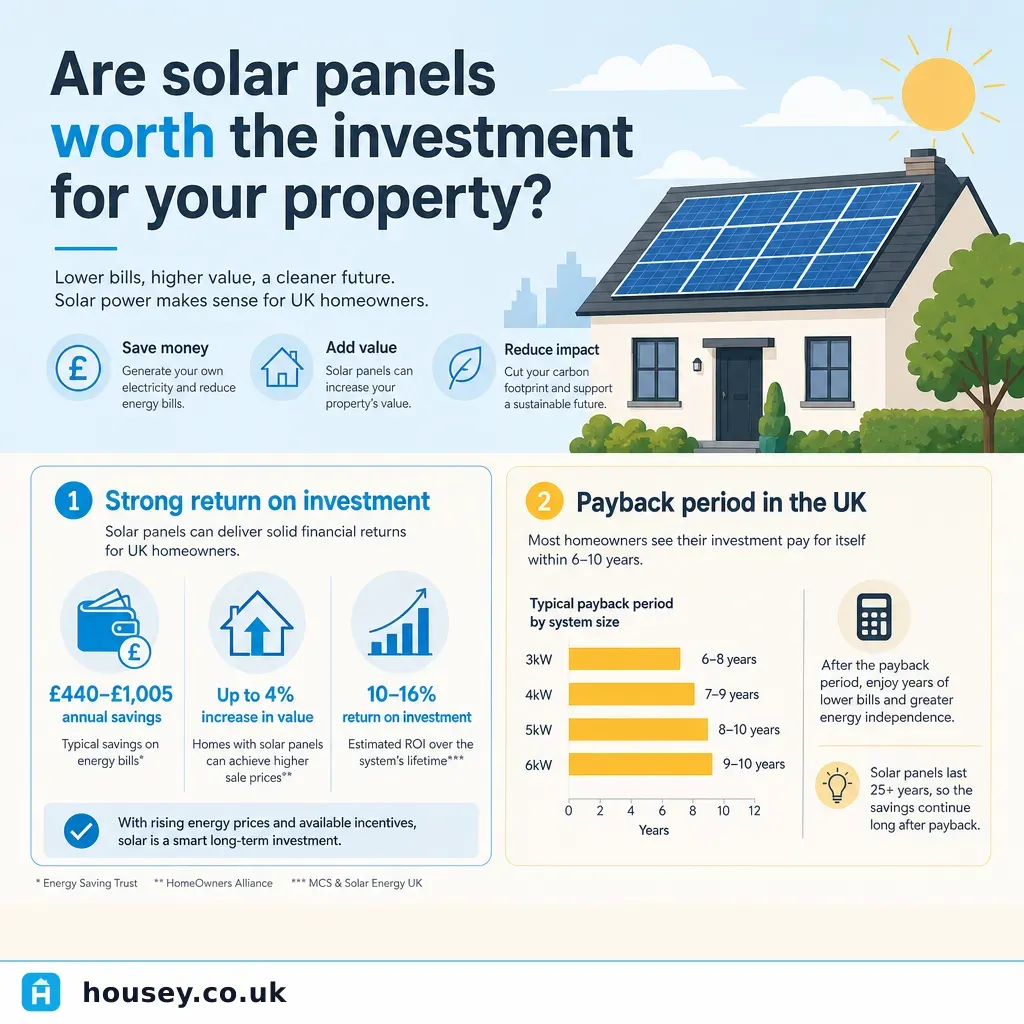
Are solar panels worth the investment for your property?
Solar panels can be a worthwhile investment for many UK homeowners, with typical payback periods of 10–15 years and ongoing income from the Smart Export Guarantee.
 Energy & Retrofit
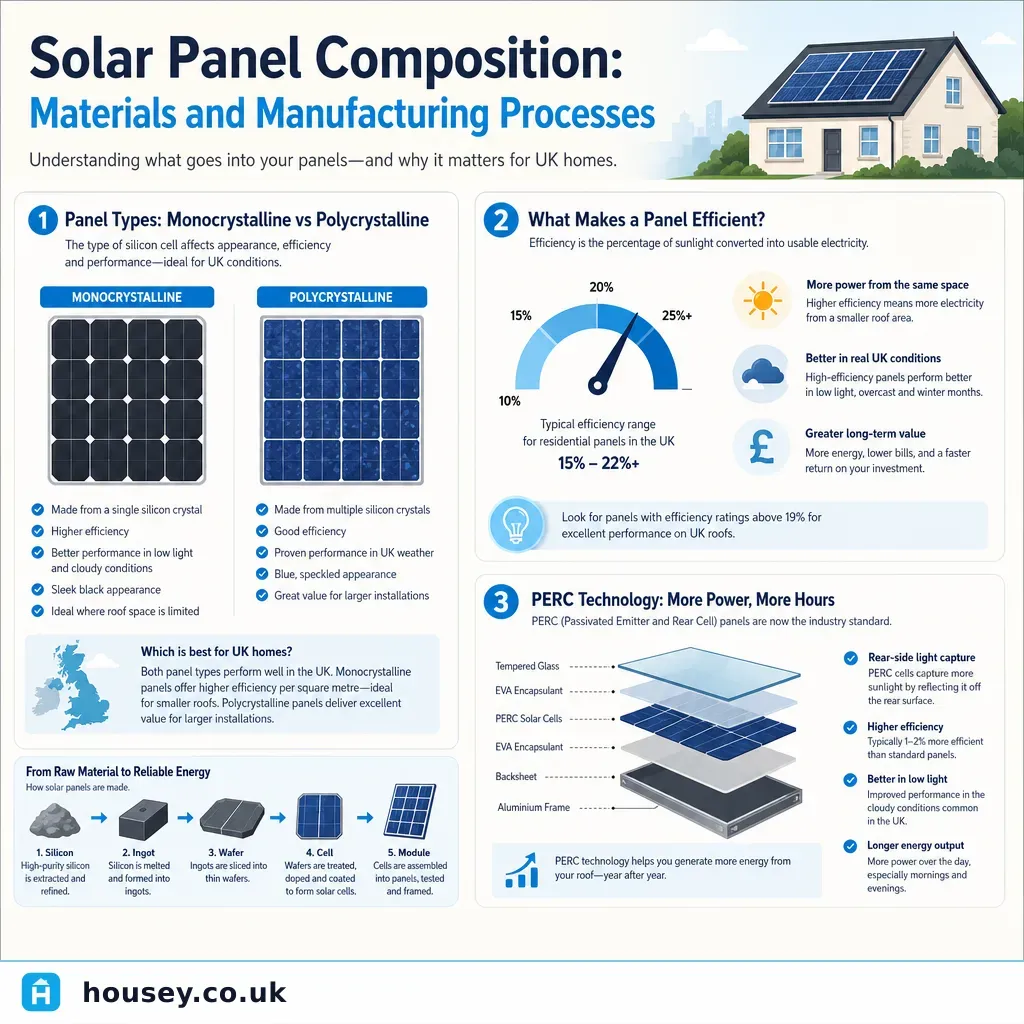
Solar Panel Composition: Materials and Manufacturing Processes
Solar panels are made primarily of silicon photovoltaic cells sandwiched between layers of tempered glass, an EVA (ethylene-vinyl acetate) encapsulant, a protective backsheet, and an aluminium frame.
 Energy & Retrofit
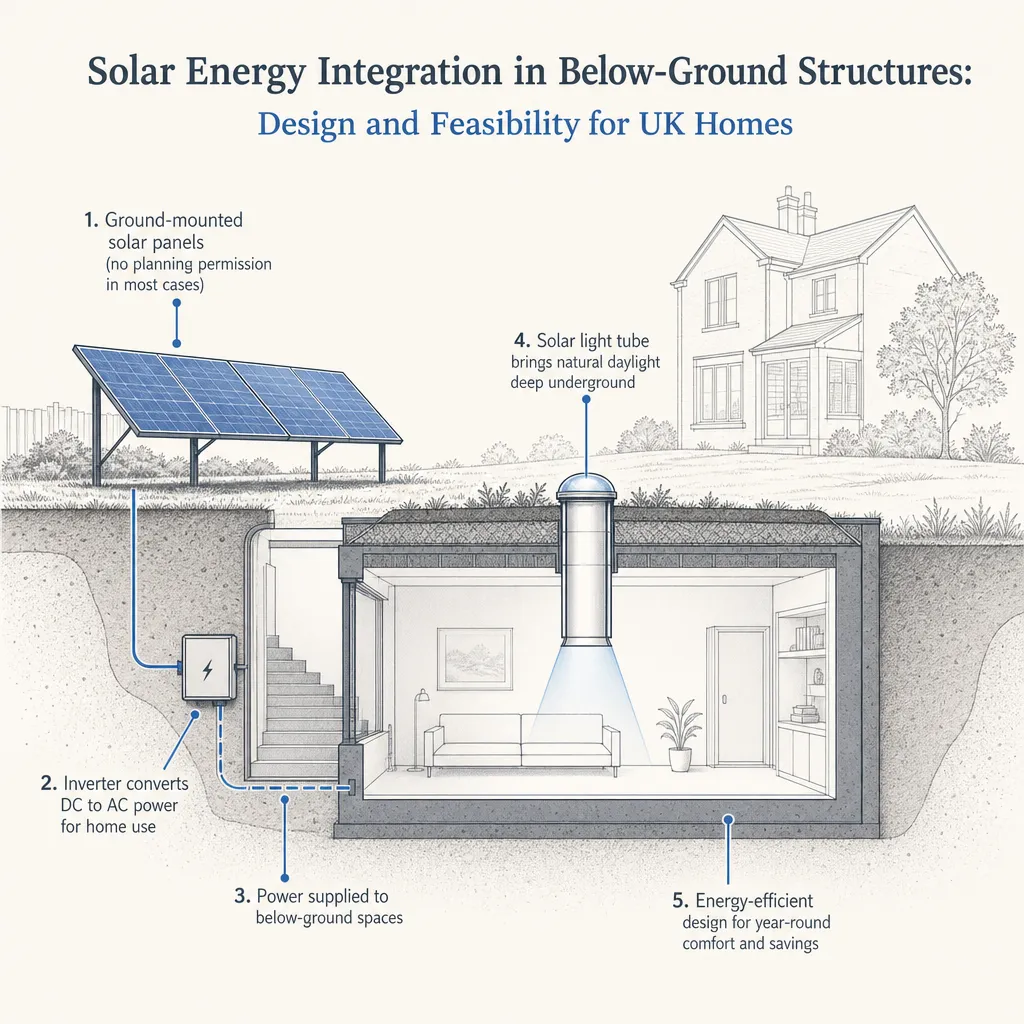
Solar Energy Integration in Below-Ground Structures: Design and Feasibility
Below-ground structures cannot host solar panels on their own roofs but can use surface-mounted panels connected via cable runs, solar light tubes for daylighting, and battery storage.
 Energy & Retrofit
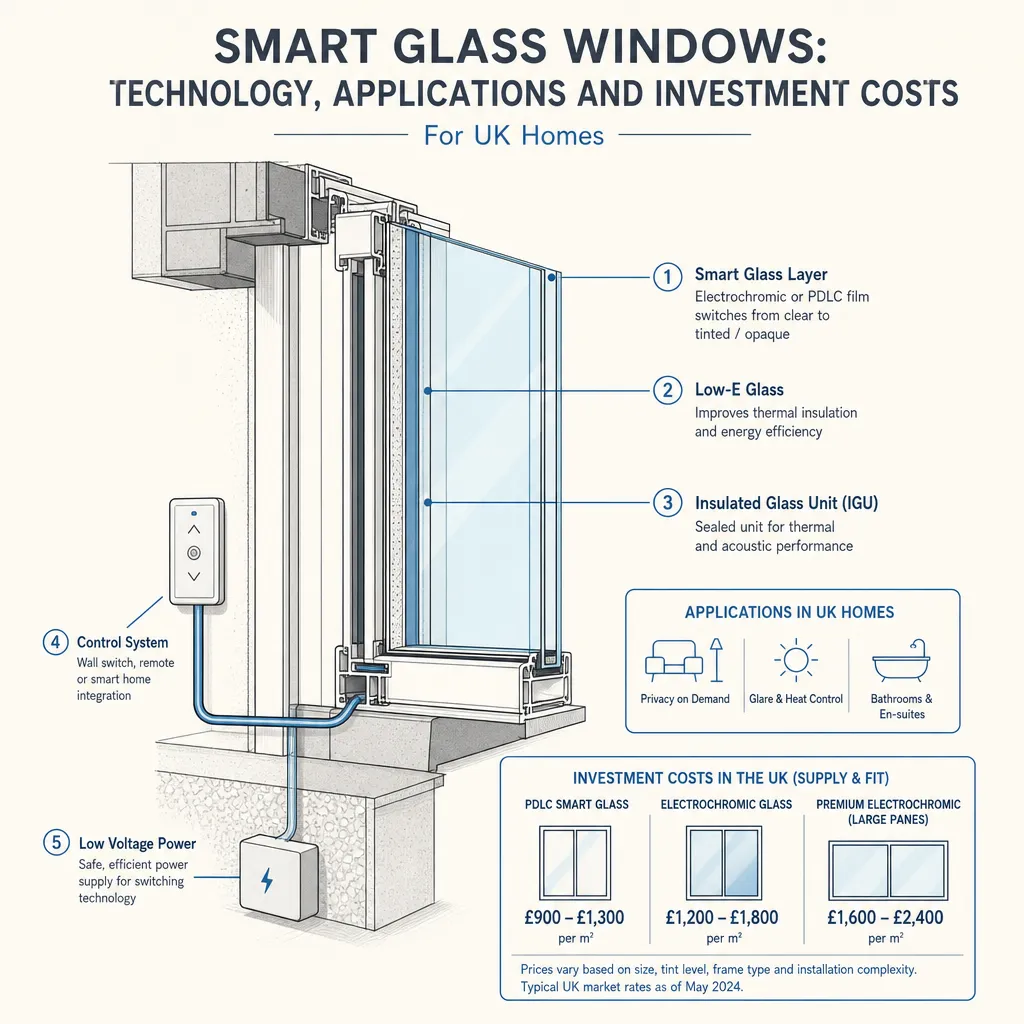
Smart Glass Windows: Technology, Applications and Investment Costs
Smart glass windows switch between transparent, tinted, or opaque states using electrical signals or heat.