Solar Panel Dimensions and Specification Guide for Residential Installation
By Housey · Last reviewed 1st of June 2026
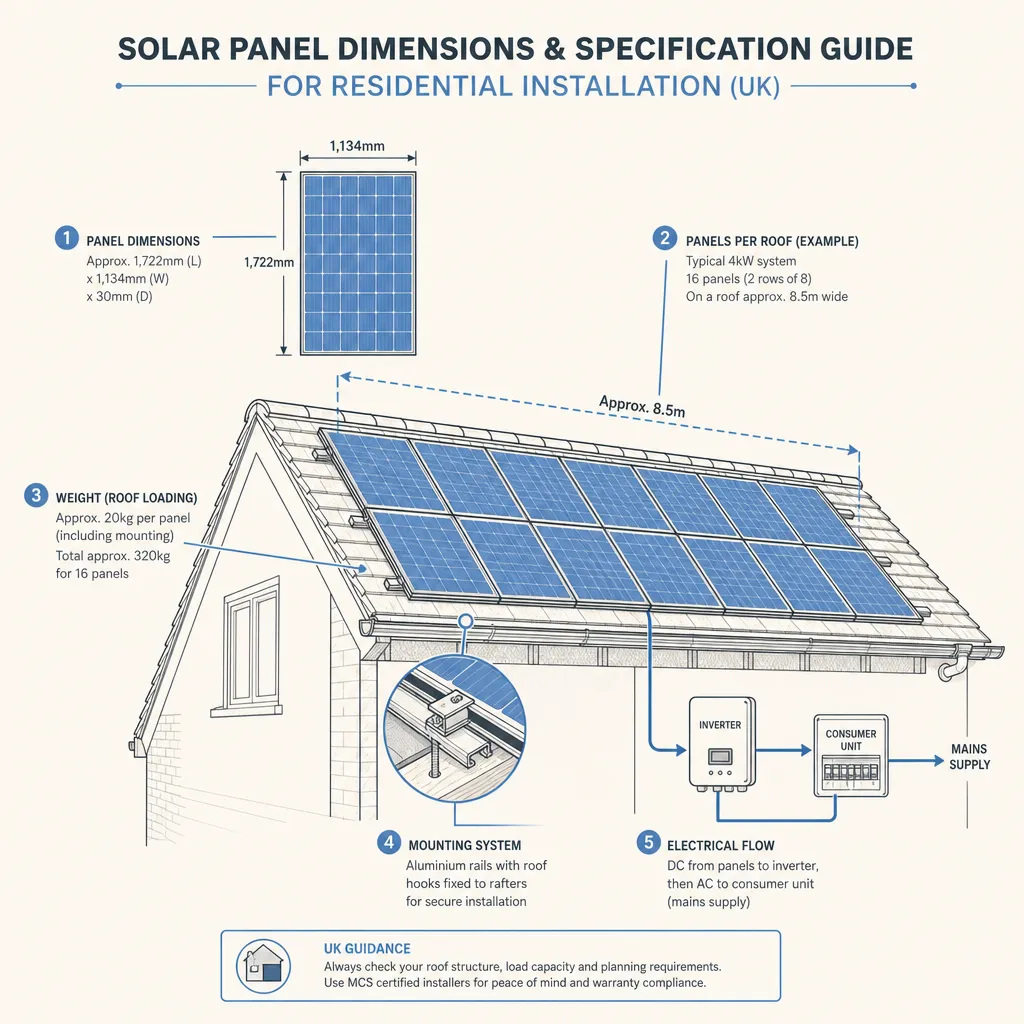
Solar Panel Dimensions and Specification Guide for Residential Installation
Understanding solar panel dimensions matters from the very first site assessment. A roof that appears large enough may have shading constraints, structural limitations, or hip and valley sections that significantly reduce the effective installation area. Getting the specification right before committing to a system avoids undersized arrays, disappointing yields, and potential issues with permitted development compliance or grid connection approval.
Key points
- A standard residential solar panel measures approximately 1700–1800mm × 1000–1050mm, weighs 18–22 kg, and produces 380–450 W; a single 400 W panel covers roughly 1.72 m² of roof area.
- A 4 kWp system (a common starting size for a 3–4 bedroom home) requires approximately 10 × 400 W panels and around 17–18 m² of unshaded, structurally suitable roof space.
- Under permitted development in England, solar panels must not protrude more than 200mm from the roof slope; front-elevation panels that face a highway are excluded from permitted development in conservation areas and on listed buildings.
- MCS (Microgeneration Certification Scheme) accreditation is required for both the installer and the equipment to qualify for the Smart Export Guarantee (SEG) and most publicly funded grant schemes.
- Arrays above 3.68 kW per phase require a G99 application to the Distribution Network Operator (DNO) before the system can be energised; confirm this is included in your installer's quote.
Standard solar panel dimensions and specifications
Most residential panels sold in the UK in 2025–2026 are monocrystalline silicon units in the 380–450 W range. Manufacturers achieve higher output primarily through improved cell efficiency rather than by increasing panel size, so physical dimensions are broadly consistent across this wattage range.
Panel type | Typical size (mm) | Typical weight | Typical wattage | Efficiency range |
|---|---|---|---|---|
Standard residential monocrystalline | 1700–1800 × 1000–1050 | 18–22 kg | 380–450 W | 20–23% |
Large-format residential | 2000–2100 × 1000–1100 | 22–28 kg | 500–600 W | 21–23% |
Half-cut cell (common from 2024) | 1700–1800 × 1000–1050 | 20–23 kg | 400–440 W | 21–22% |
Bifacial (selected installs) | 1700–1900 × 1000–1100 | 21–25 kg | 400–500 W | 21–23% |
All-black aesthetic panel | 1700–1800 × 1000–1050 | 19–22 kg | 375–420 W | 20–22% |
Specifications vary by manufacturer. Always check the product datasheet for the specific panel you intend to install.
How many panels will fit on a UK roof?
The number of panels a roof can practically accommodate depends on usable area after discounting hips, valleys, rooflights, chimneys, and any shading zones from neighbouring buildings or trees. As a general guide:
- Each standard 400 W panel requires approximately 1.7–1.8 m² of roof space, plus small inter-panel gaps for mounting hardware.
- A 4 kWp system (10 × 400 W) suits a 2–3 bedroom property and needs around 17–18 m² of clear roof space.
- A 5–6 kWp system (13–15 panels) is more typical for a 3–4 bedroom house and requires approximately 22–27 m² of usable area.
- A south-facing pitch at 30–40 degrees gives the best annual yield in the UK; east- or west-facing roofs are workable but typically produce around 15–20% less energy annually.
- Roofs with fewer than 10 m² of unshaded, structurally suitable area are generally not viable for a grid-connected system.
System size decision guide
- Choose a 4 kWp system (10 × 400 W) if roof space is limited or the property has 1–2 occupants.
- Choose a 5–6 kWp system for a 3–4 bedroom property with average daytime electricity consumption.
- Choose a 6.5–10 kWp system if you have an electric vehicle, heat pump, or high daytime electricity use — subject to DNO approval for arrays above 3.68 kW per phase.
- Ask a MCS-accredited solar assessor to model the panel layout if shading, hip sections, or mixed orientations complicate the roof geometry.
- Check with your local planning authority before proceeding if the property is listed, in a conservation area, or a purpose-built flat.
Permitted development rules for solar panels
Solar panel installation on a dwelling house generally qualifies as permitted development under Schedule 2, Part 14 of the Town and Country Planning (General Permitted Development) (England) Order 2015, provided:
- Panels do not protrude more than 200mm from the roof or wall surface.
- On a pitched roof, panels are not installed above the highest point of the roof (excluding the chimney).
- On a listed building, panels do not face a highway (listed building consent is also likely required regardless).
- In a conservation area, panels on a principal elevation facing a highway are excluded from permitted development.
- The installation is removed when it is no longer needed.
Scotland, Wales, and Northern Ireland operate under separate permitted development rules — check with the relevant national planning authority before proceeding.
Structural considerations and roof loading
Solar panels add a sustained imposed load to the roof structure, typically 15–20 kg/m² for panels plus mounting hardware. For most post-1945 construction with factory-made trussed rafters, this falls within normal safe limits. However:
- Pre-war properties with traditional cut-rafter roofs may need a structural engineer to confirm adequacy before installation proceeds.
- Flat roofs require ballasted or penetrating mounting systems; the roof membrane, deck, drainage capacity, and existing imposed loads must all be assessed.
- Older roofs with degraded felt and battens should be inspected before panels are fitted — panel warranties typically run 25 years, and the underlying roof needs to be in a condition to match.
- Individual panel weight (18–22 kg) is distributed across 2–4 mounting brackets; overall loading on ageing purlins and rafters is the key structural consideration.
What to check in a solar installation quote
When to get professional help
Solar installation always requires a qualified, MCS-accredited installer — this is not optional if you wish to access the Smart Export Guarantee or any publicly funded scheme. Additionally:
- A structural engineer should assess the roof if the property predates 1945, has a flat roof, or shows any signs of deflection or movement in the roof structure.
- An independent energy assessor or PAS 2035 retrofit coordinator can advise whether improving the building fabric first would improve the overall return from the solar system.
- DNO approval for larger arrays must be received before the system is energised — confirm the installer is managing this process and that approval is in hand before the scheduled installation date.
How Housey can help
Before committing to an installation, a solar survey provides an independent assessment of your roof's structural suitability, shading risks, orientation, and expected yield — giving you credible data to compare against the proposals you receive from installers.
Frequently asked questions
How much roof space do I need for solar panels?
A 4 kWp system using standard 400 W panels requires approximately 10 panels and around 17–18 m² of unshaded, structurally suitable roof space. The usable area depends on your roof's shape, orientation, pitch, and any obstructions such as chimneys, rooflights, hips, or neighbouring shading. A site survey will give a more accurate figure for your specific property.
Do solar panels need planning permission in the UK?
Most residential solar installations qualify as permitted development and do not require a planning application. Listed buildings, conservation areas, and installations on walls facing a highway have specific restrictions. Always verify with your local planning authority if uncertain, particularly in Scotland, Wales, or Northern Ireland where separate permitted development rules apply.
What is the weight of a solar panel, and will my roof support it?
A standard residential panel weighs 18–22 kg. A 10-panel system adds roughly 200–240 kg distributed across the roof area — typically 15–20 kg/m². Most post-1945 roofs with standard trussed rafters handle this comfortably, but pre-war properties or flat roofs should be assessed by a structural engineer before installation is confirmed.
What does MCS accreditation mean for solar panels?
MCS (Microgeneration Certification Scheme) is the UK quality standard for small-scale renewable energy. Using an MCS-accredited installer with MCS-certified equipment is a condition of eligibility for the Smart Export Guarantee (SEG) — the scheme through which energy suppliers pay for surplus solar electricity exported to the grid. Without MCS certification the installation is ineligible for SEG and most grant funding.
Sources and further reading
- Smart Export Guarantee — Ofgem guidance — Ofgem
- Permitted development for householders — solar panels — Planning Portal
- MCS standards and installer certification — Microgeneration Certification Scheme
- Solar panels — costs, savings, and eligibility — Energy Saving Trust
- G99 connection requirements for generators — Energy Networks Association
Useful next reads
 Energy & Retrofit
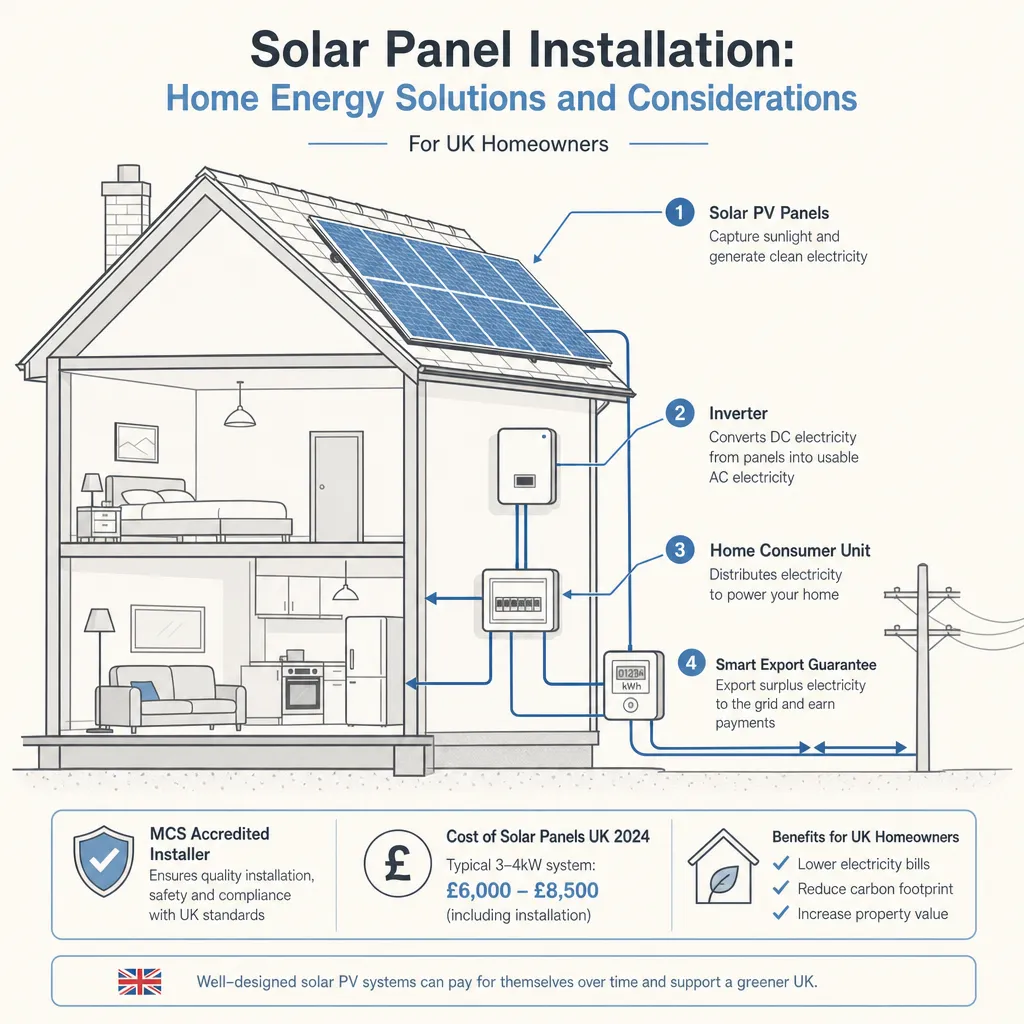
Solar Panel Installation: Home Energy Solutions and Considerations
A typical 4 kWp solar PV system costs £6,000–£9,000 installed and generates around 3,400–3,800 kWh per year on a south-facing roof in southern England.
 Energy & Retrofit
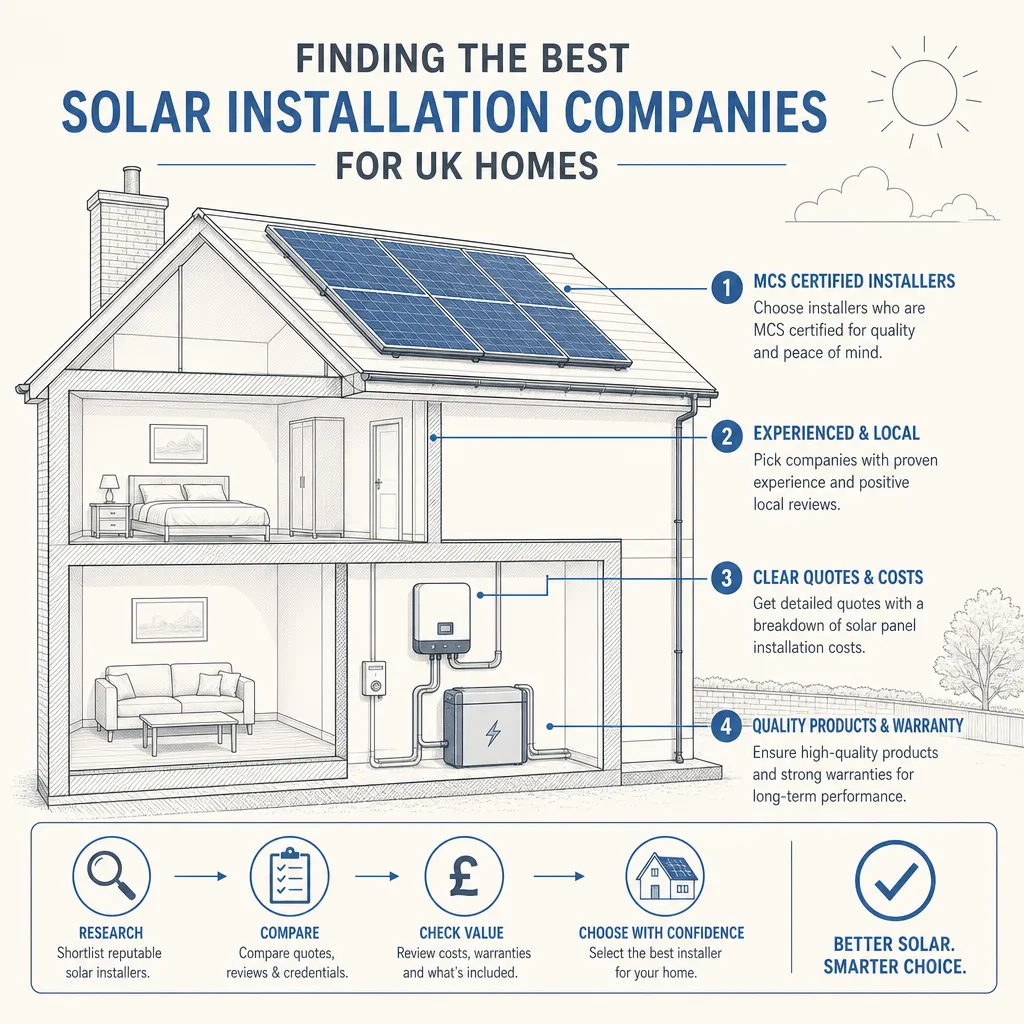
Finding the Best Solar Installation Companies for UK Homes
To find a reliable solar installation company in the UK, look for MCS (Microgeneration Certification Scheme) certification — required for Smart Export Guarantee eligibility — plus NICEIC or NAPIT electrical registration.
 Energy & Retrofit
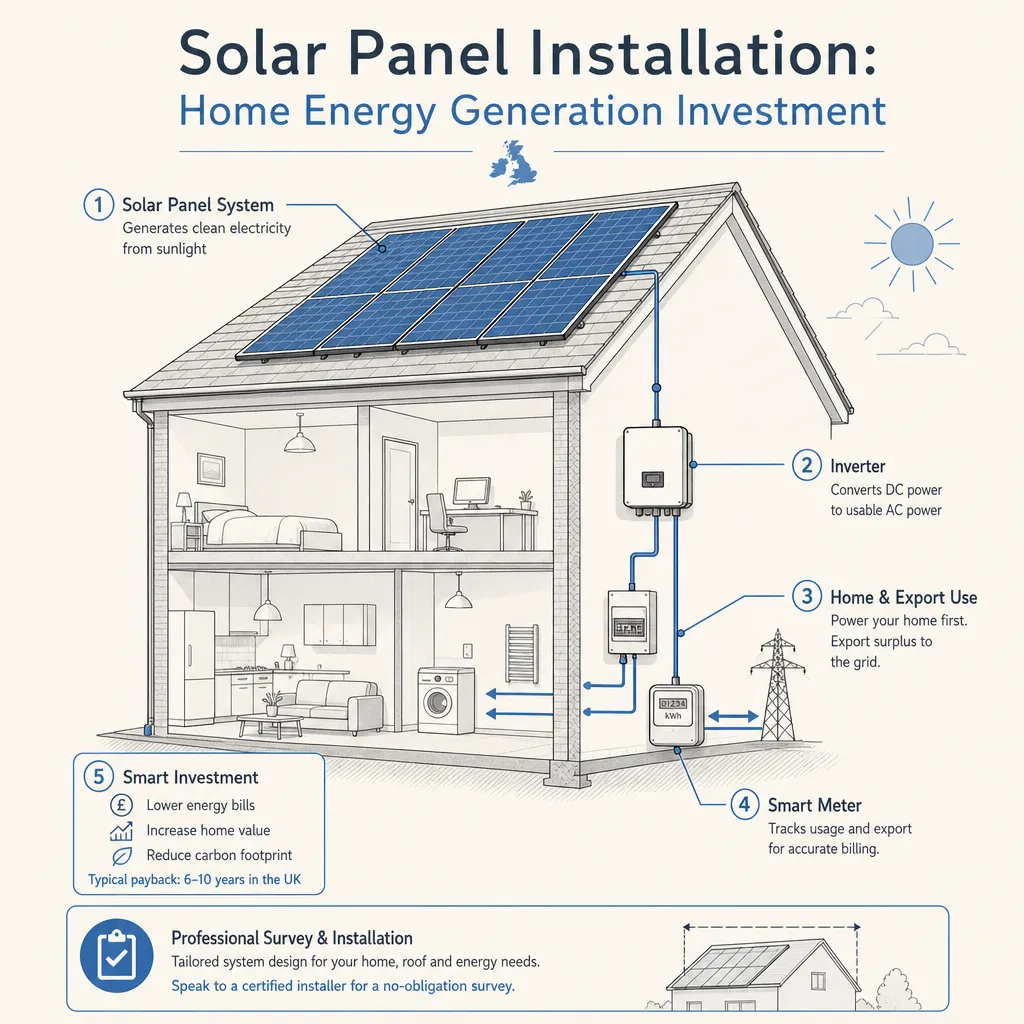
Solar Panel Installation: Home Energy Generation Investment
Solar panel installation in the UK typically costs £5,000–£9,000 for a 3–4 kWp system.
 Energy & Retrofit
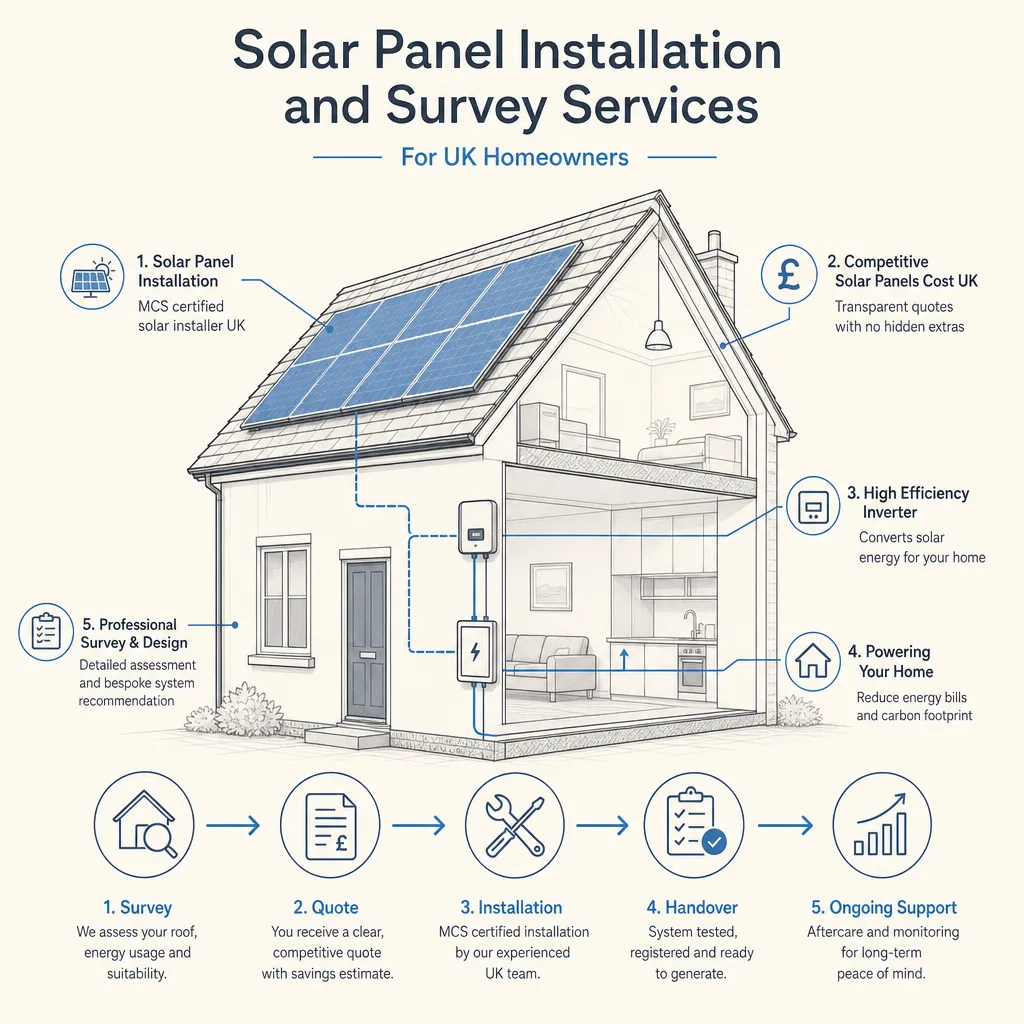
Solar Panel Installation and Survey Services
Solar panel installation in the UK involves a pre-installation roof survey, system design, MCS-accredited fitting, and notification to your Distribution Network Operator (DNO).
 Energy & Retrofit
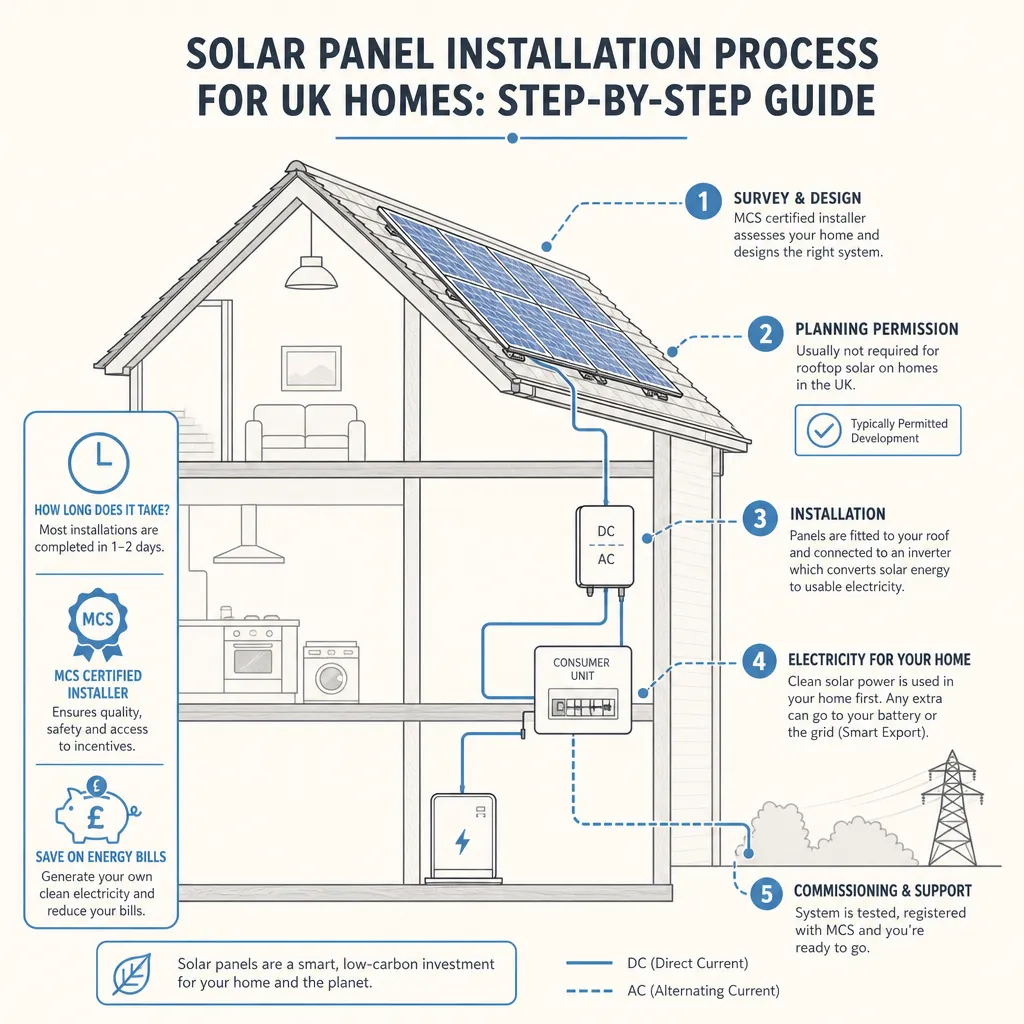
Solar Panel Installation Process for UK Homes: Step-by-Step Guide
Solar panel installation for a UK home usually takes 1–2 working days on-site, with the full process from initial survey to MCS certificate taking 2–6 weeks.