Solar Panel Installation Costs and Financial Breakdown for UK Properties
By Housey · Last reviewed 30th of May 2026
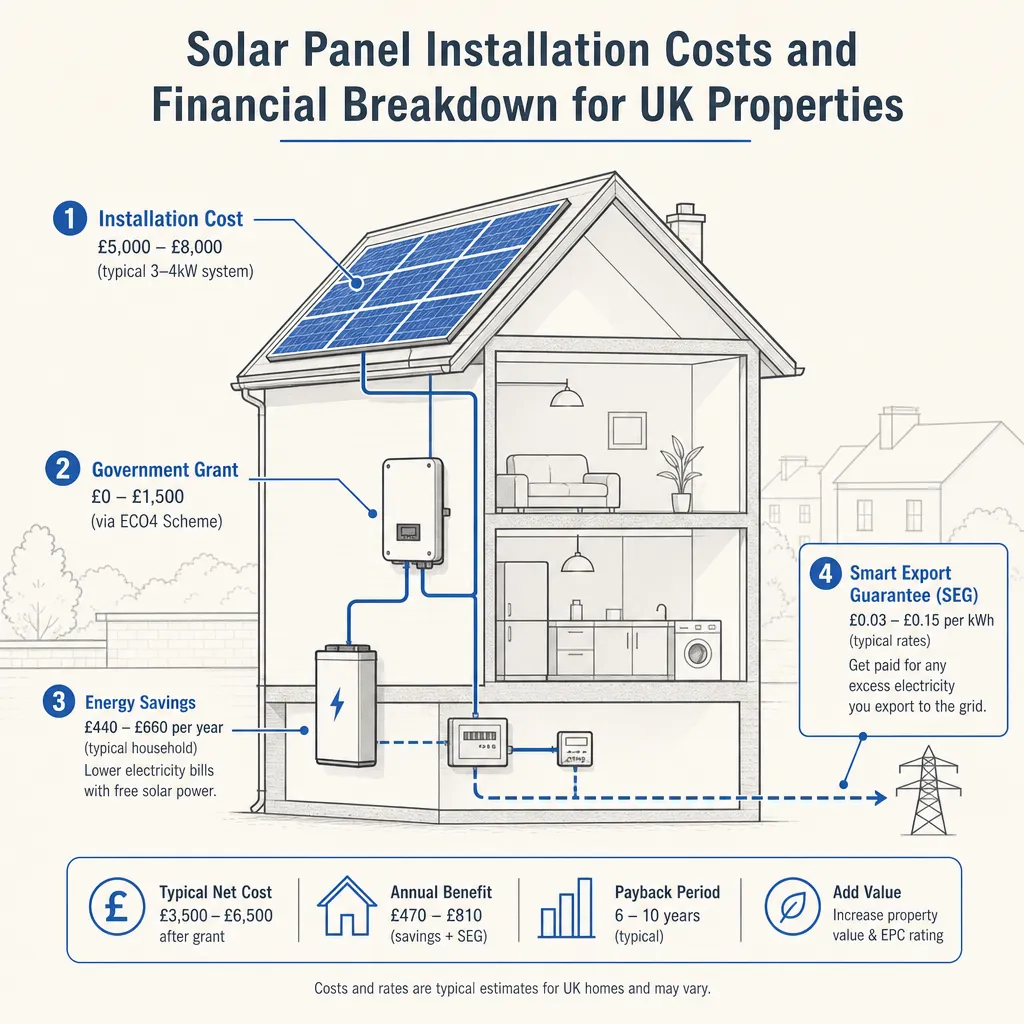
Solar Panel Installation Costs and Financial Breakdown for UK Properties
Solar panels have become one of the most common home energy investments in the UK, yet the total cost — and what drives it — often surprises homeowners at the quote stage. Whether you're weighing up the upfront outlay against long-term savings or trying to understand how the Smart Export Guarantee changes the picture, knowing the real numbers before you approach installers puts you in a much stronger position.
Key points
- VAT on residential solar panel installations is currently zero-rated in Great Britain, reducing upfront costs compared to most other home improvements.
- All installers must hold Microgeneration Certification Scheme (MCS) accreditation for your system to qualify for the Smart Export Guarantee (SEG).
- The Smart Export Guarantee requires licensed electricity suppliers with 150,000 or more customers to pay you for surplus electricity exported to the grid — rates and terms vary by supplier.
- A typical 3.5–4.5 kWp system on a 3-bed semi generates roughly 3,000–4,000 kWh per year in southern England, falling to around 2,600–3,400 kWh further north.
- Battery storage typically adds £3,500–£7,000 to system cost but can increase self-consumption from around 30% to 50–70%, improving the financial case where SEG export rates are low.
What does a solar panel installation include?
A standard domestic solar installation in the UK covers:
- Panels — typically monocrystalline, polycrystalline, or premium half-cell modules
- Inverter — converts DC electricity from panels to AC for household use; string inverters are most common, microinverters offer per-panel monitoring at higher cost
- Mounting system — in-roof or on-roof rail systems; roof penetrations should be flashed and waterproofed
- Generation meter — records total production for warranty and SEG purposes
- Electrical connection to the consumer unit, which must comply with BS 7671 and be notified to building control via a competent person scheme
- DNO notification — your installer notifies your local Distribution Network Operator for systems above 3.68 kW single-phase
- MCS certificate — required for SEG eligibility
Battery storage, EV charger integration, and smart energy monitoring are optional extras that affect both cost and complexity.
How much does solar panel installation cost in the UK?
Indicative UK costs, last reviewed 2026-05-30. Prices vary significantly by region, roof complexity, panel brand, and installer. Always obtain at least three quotes.
System size | Typical annual output | Suitable for | Indicative installed cost (VAT at 0%) |
|---|---|---|---|
2 kWp (6–7 panels) | 1,600–2,000 kWh | Small or low-demand home | £3,500–£5,500 |
3.5 kWp (10–11 panels) | 2,800–3,500 kWh | 3-bed semi, average consumption | £5,000–£7,500 |
4.5 kWp (13–14 panels) | 3,600–4,500 kWh | 4-bed detached, higher demand | £6,500–£9,000 |
4.5 kWp + battery storage | As above plus stored surplus | Higher self-consumption targets | £10,000–£16,000 |
Key cost drivers:
- Roof pitch, aspect (south-facing maximises output), and scaffolding requirements
- Roof condition — reroofing or structural reinforcement adds significant cost
- Number of storeys and complexity of cable routing
- Inverter type: microinverters cost more than string inverters but offer panel-level monitoring
- Panel brand, efficiency rating, and warranty terms
Worked example: a 3-bed semi in Nottingham
A homeowner installs a 3.5 kWp system with 10 monocrystalline panels — south-facing at a 30-degree pitch — for £6,200 all-in.
- Annual generation estimate: approximately 3,100 kWh
- Self-consumed (approx. 35%): 1,085 kWh at 24p/kWh saves around £260 per year on bills
- Exported to grid (approx. 65%): 2,015 kWh at a 5p/kWh fixed SEG rate earns approximately £101 per year
- Total annual financial benefit: approximately £361
- Simple payback period: £6,200 ÷ £361 = approximately 17 years
Increasing self-consumption — through different usage patterns or battery storage — or securing a higher SEG tariff shortens payback considerably. Rising electricity unit rates also improve the return over time. This is a simplified illustrative calculation; your actual results depend on your consumption pattern, roof orientation, shading, and the SEG rate you negotiate.
Financial support and incentives
Smart Export Guarantee (SEG)
Since January 2020, the SEG replaced the Feed-in Tariff for new applicants. Under the SEG, licensed suppliers must pay you for electricity you export, but they set their own rates. Typical fixed rates range from 3p to 15p per kWh depending on supplier and tariff. Your installer must be MCS-accredited for you to be eligible to apply. Check Ofgem's published list of SEG licensees for current rates before signing up.
Grants and funding schemes
- ECO4 — primarily covers insulation, heating, and low-carbon heat. Solar panels are not a standard ECO4 measure, though some local authority flex routes may include them in specific circumstances.
- Great British Insulation Scheme — covers insulation only; not applicable to solar.
- Home Upgrade Grant (HUG2) — may fund solar for off-gas-grid low-income households via local authorities; check with your local council.
- Wales: Warm Homes Programme — solar may be included for eligible households.
- Scotland: Home Energy Scotland — offers interest-free loans for solar installations from the Scottish Government.
Always verify current eligibility directly with the relevant authority or Energy Saving Trust, as schemes open and close.
VAT
Residential solar panel systems in Great Britain are currently zero-rated for VAT, following HMRC guidance effective from April 2022.
Homeowner checklist before instructing a solar installer
When to get professional help
A solar survey is worth arranging before committing to a full installation quote if your roof is older, has previously been repaired, or you have any uncertainty about its structural condition. A professional assessment confirms whether your roof can safely support the additional load — typically 15–20 kg/m² for a panel array — and whether your electrical system is compatible.
Seek specialist advice if:
- Your property is listed or in a conservation area (planning consent may be required)
- Your roof shows signs of movement, rot in timbers, or cracked tiles
- Your consumer unit is older than 25 years and may need upgrading before connection
How Housey can help
Housey connects homeowners with accredited solar professionals who can assess your roof and provide itemised quotes. Start with a solar survey to get an independent assessment of your roof's suitability, shading analysis, and realistic generation estimates before committing to any system.
Frequently asked questions
Do I need planning permission for solar panels in the UK?
Most residential solar panel installations in England, Scotland, and Wales fall within permitted development rights, so planning permission is not usually required. Exceptions include listed buildings and, in some cases, properties within conservation areas. Always check with your local planning authority if your property has any restrictions, or if panels would face a public highway.
How long do solar panels last?
Most manufacturers provide a 25-year linear performance guarantee, typically warranting that panels will produce at least 80% of rated output after 25 years. Inverters have a shorter lifespan of roughly 10–15 years, so budget for at least one replacement over the full panel lifetime. Quality mounting and installation workmanship also affect longevity.
Will solar panels generate electricity on cloudy days or in winter?
Solar panels generate electricity from daylight, not direct sunshine, so they produce in overcast conditions and in winter, at reduced output. December and January typically account for around 3–5% of annual generation, while June and July account for 18–25%. Overall annual generation remains meaningful even in the north of England or Scotland.
What is the Smart Export Guarantee and how much will I earn?
The Smart Export Guarantee requires licensed electricity suppliers with 150,000 or more customers to pay you for surplus electricity exported to the grid. Rates vary by supplier and tariff — typical fixed rates range from approximately 3p to 15p per kWh. Your installer must hold current MCS accreditation for you to be eligible to apply for a SEG tariff.
Sources and further reading
- Smart Export Guarantee guidance — Ofgem
- VAT on energy-saving materials and heating equipment — HMRC
- Find an MCS-certified installer — Microgeneration Certification Scheme
- Solar panels — homeowner advice — Energy Saving Trust
- Home Energy Scotland — loans and cashback — Energy Saving Trust / Scottish Government
Useful next reads
 Energy & Retrofit
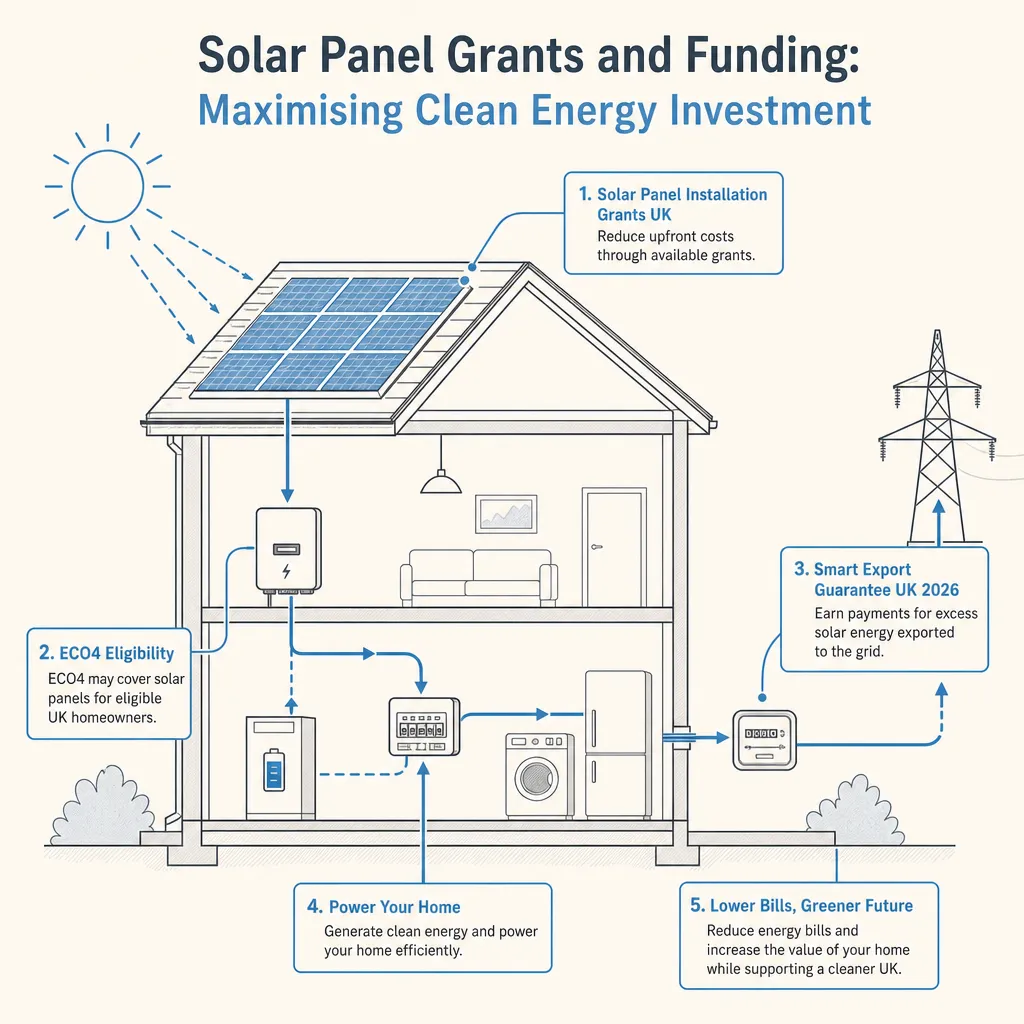
Solar Panel Grants and Funding: Maximising Clean Energy Investment
Several UK solar funding schemes are currently open: the Smart Export Guarantee pays homeowners for surplus electricity exported to the grid, ECO4 can fund free or subsidised panels for eligible low-income households, and 0% VAT on installation applies until at least March 2027.
 Energy & Retrofit
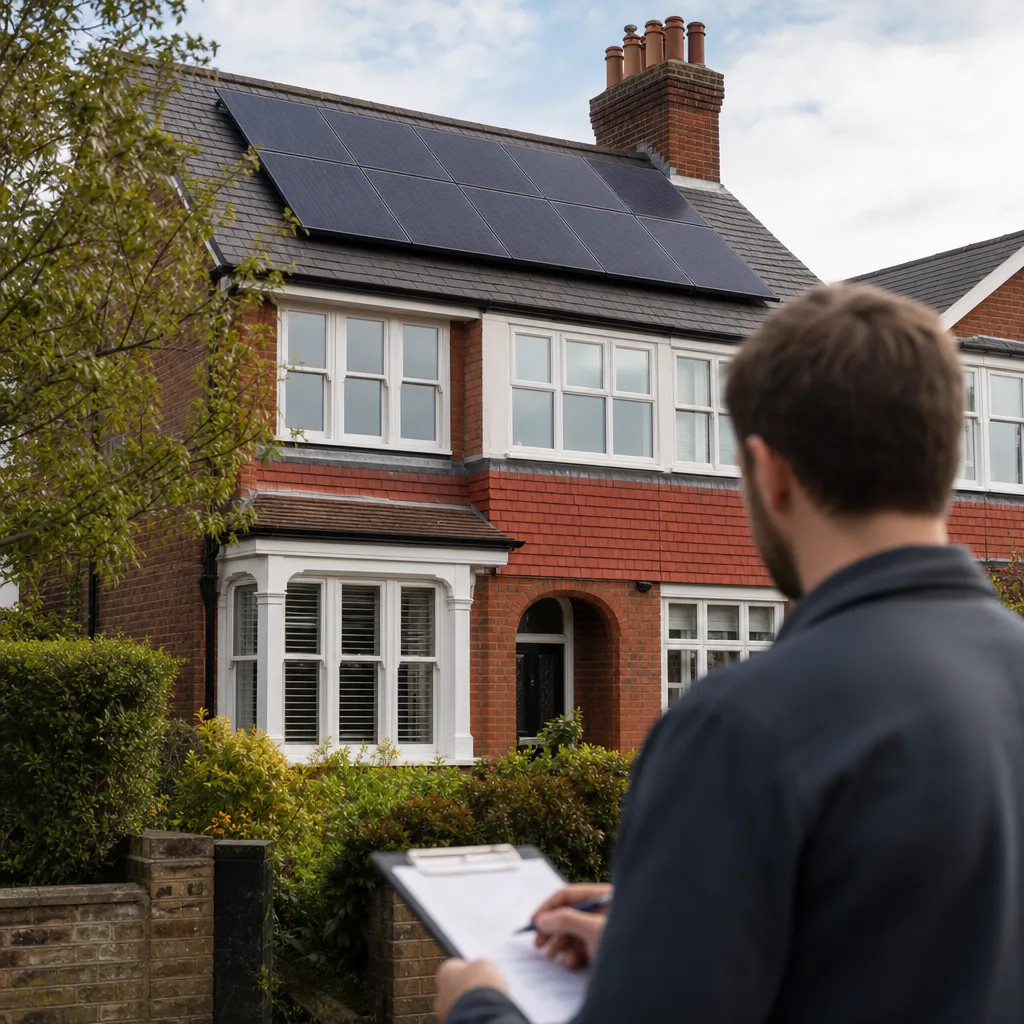
Do Solar Panels Increase Property Value?
Solar panels generally add value to UK properties, with research suggesting an uplift of 0.
 Energy & Retrofit
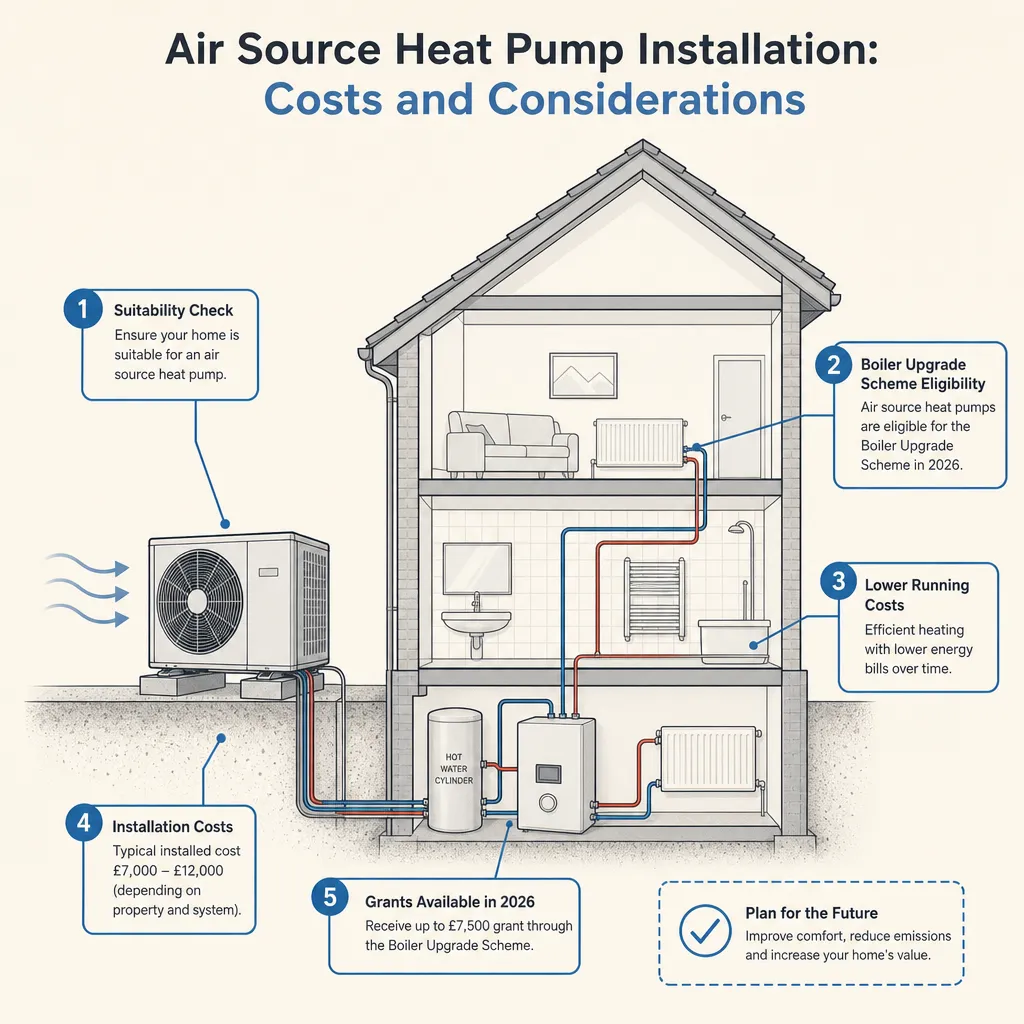
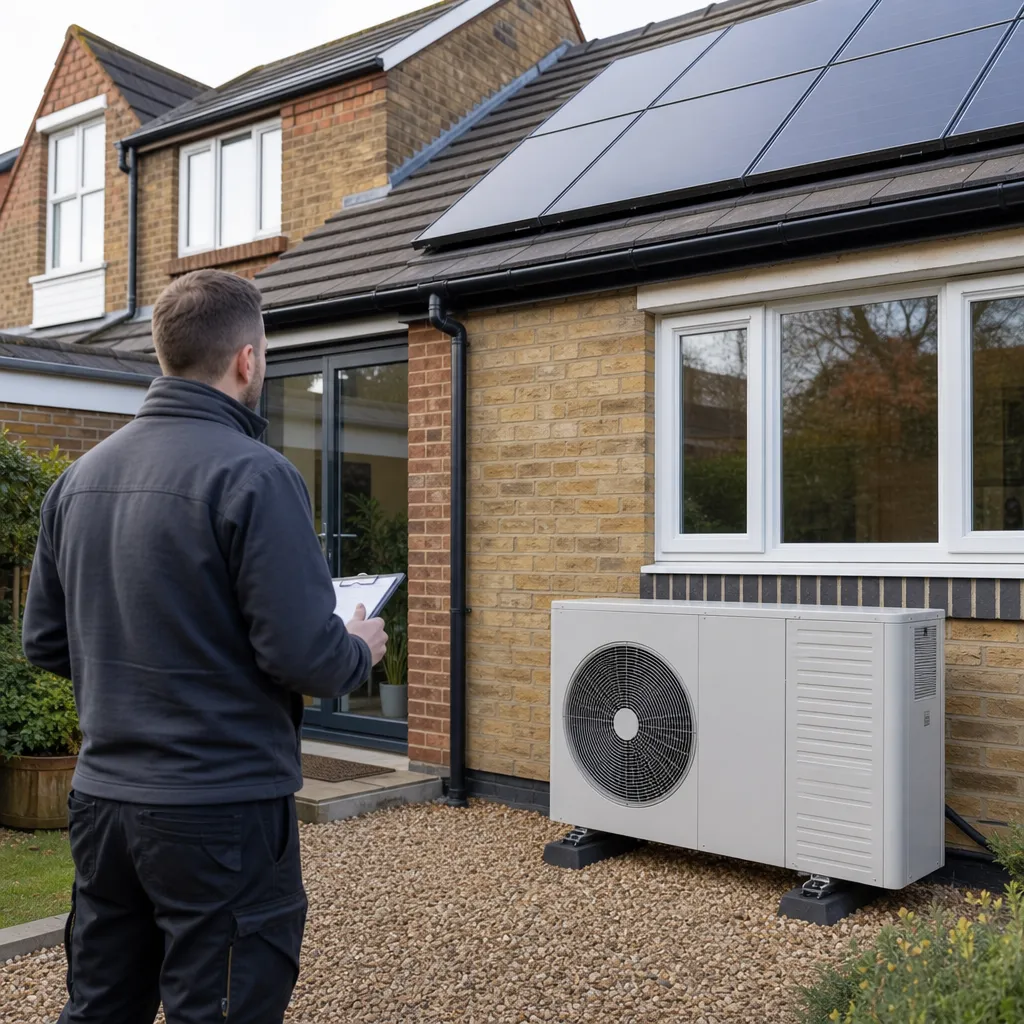
Air Source Heat Pump Installation: Costs and Considerations
Air source heat pump installation in the UK typically costs £8,000–£15,000 before the £7,500 Boiler Upgrade Scheme grant, available through MCS-certified installers in England and Wales.
 Energy & Retrofit
Renewable Energy Systems and Property Value: Solar Panels and Heat Pumps
Solar panels can add a modest 1–4% to UK property values in the right conditions, particularly when they improve the EPC rating.
 Energy & Retrofit
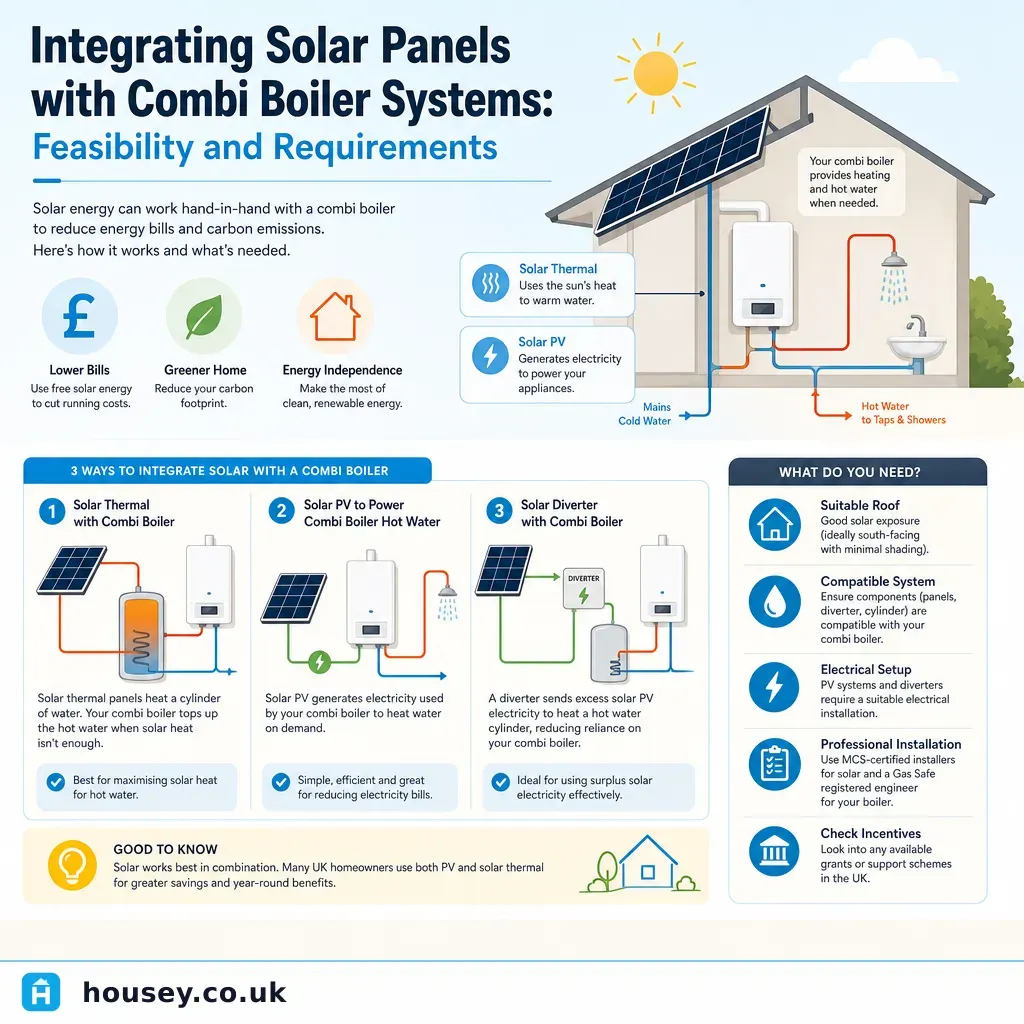
Integrating Solar Panels with Combi Boiler Systems: Feasibility and Requirements
Combi boilers heat water on demand without a hot water storage cylinder, making direct solar thermal integration impractical.