Solar panel inspections: costs and assessment requirements
By Housey · Last reviewed 31st of May 2026
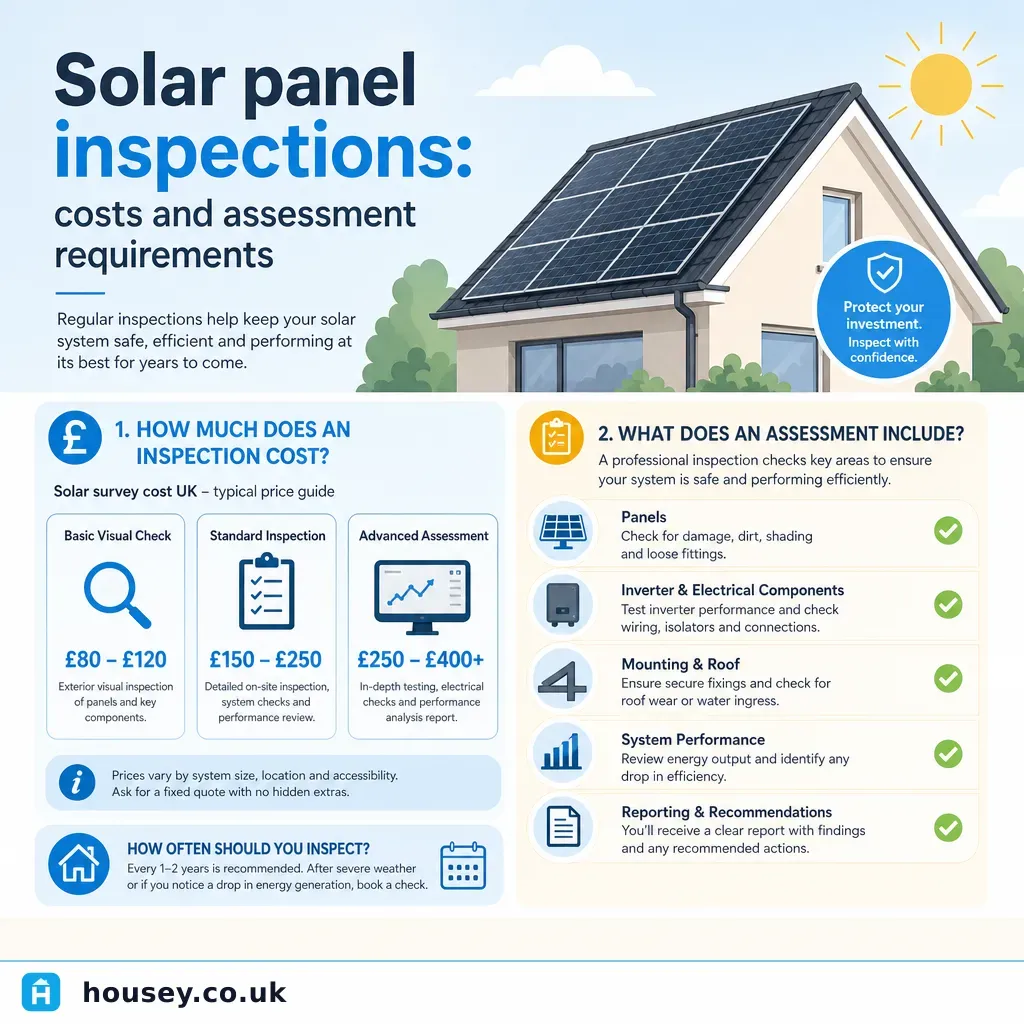
Solar panel inspections: costs and assessment requirements
A solar PV system represents a significant financial investment — typically £6,000–£10,000 for a domestic installation — and yet many UK homeowners go years without a formal assessment. Inspection costs are often lower than expected, and identifying a developing fault early can prevent a much larger repair bill. Whether you are buying a property with panels already fitted, preparing to sell, or simply due a check on a system that is several years old, understanding what inspections cost and what they cover helps you ask the right questions.
Key points
- A basic professional solar panel inspection for a typical domestic system costs approximately £150–£300 in the UK; full assessments including thermal imaging and electrical testing can reach £350–£600 or more. (Indicative UK costs, last reviewed 2026-05-31.)
- MCS-accredited installers are required to carry out a commissioning inspection on completion; subsequent periodic inspections are not legally mandated for domestic systems but are recommended every 3–5 years.
- IEC 62446-1 is the international standard for PV system documentation and testing — a commissioning-level test includes insulation resistance, continuity, and polarity checks on each string.
- Most manufacturers' product warranties (typically 25 years on power output) require evidence of reasonable maintenance; an inspection report provides that documentation.
- If a property changes hands with an existing solar installation, the buyer's conveyancer should request the MCS certificate, any Distribution Network Operator (DNO) notification, and details of any Smart Export Guarantee (SEG) or legacy Feed-in Tariff agreement.
What does a solar panel inspection include?
The scope of an inspection varies significantly between providers. A standard inspection report should cover:
- Visual check of all panels for cracks, delamination, discolouration, soiling, or physical damage
- Frame and mounting hardware examination for corrosion, loose fixings, or structural concerns
- Inverter status check, including error history and performance data review
- Wiring inspection for cable condition, UV degradation, and termination quality
- Roof penetration check for signs of water ingress
- Shading analysis — identifying new or seasonal shading sources affecting output
- Generation data review against expected output for the system size and UK location
Enhanced inspections may also include:
- Thermal (infrared) imaging: identifies hotspots on panel cells invisible to the naked eye — indicators of cell degradation, bypass diode failure, or partial shading effects
- IV curve tracing: tests each panel's current-voltage response to diagnose underperforming modules
- Electrical testing to IEC 62446-1: insulation resistance, string continuity, and earth bonding checks
Inspection types and typical costs
Inspection type | Typical cost (domestic) | Best for | Limitations |
|---|---|---|---|
Basic visual inspection | £100–£200 | Annual health check, post-storm assessment | Does not detect hidden cell faults or electrical issues |
Visual + inverter analysis | £150–£300 | Routine 3–5 year check, pre-sale assessment | Misses subsurface cell degradation |
Full assessment with thermal imaging | £250–£500 | Older systems, fault diagnosis, property purchase | Thermal imaging needs adequate sunlight |
Electrical testing to IEC 62446-1 | £200–£400 | Post-installation verification, fault investigation | Requires safe system isolation |
Combined (thermal + electrical + visual) | £350–£600+ | Pre-purchase survey, insurance requirement, systems over 10 years old | Higher cost; requires good daylight conditions |
(Indicative UK costs, last reviewed 2026-05-31. Prices vary by region, system size, roof access, and provider.)
When is an inspection required or strongly advisable?
No UK regulation currently requires domestic solar owners to carry out periodic inspections after the initial commissioning check. However, an inspection is strongly advisable in the following situations.
Before or during a property sale: A buyer's solicitor will typically ask about the solar installation, and many buyers request independent evidence of condition. An inspection report provides that documentation and can prevent last-minute renegotiations.
After severe weather: Hail, storms, or falling branches can cause damage not always visible from ground level. Insurance claims may require a professional condition report.
When output has dropped unexpectedly: If inverter data shows generation significantly below historical levels — and there is no obvious panel fouling or shading change — an inspection can identify whether a panel, string, or inverter fault is responsible.
For systems over 5–10 years old: Early UK domestic installations (pre-2015) are now reaching an age where inverter replacement and panel degradation become realistic concerns. A baseline inspection provides useful evidence for warranty and insurance purposes.
Before a battery storage retrofit: Adding a battery system requires understanding the current performance and wiring configuration of the existing PV array. An inspection ahead of a retrofit avoids surprises during installation.
What drives inspection costs?
Several factors push inspection costs up or down:
- System size: More panels take more time to inspect. A 4kWp system (12–16 panels) costs less to assess than a 10kWp array.
- Roof access: Steep pitches, complex geometries, or the need for scaffolding add cost. Ground-mounted systems are generally cheaper to inspect.
- Scope of testing: Thermal imaging requires specialist equipment and is often priced separately or bundled in premium packages. Electrical testing to IEC 62446-1 is time-intensive.
- Location: Urban areas with competitive markets tend to have lower rates; rural locations with significant travel costs are often higher.
- Report format: A brief checklist costs less than a full written report with annotated photographs suitable for conveyancing or insurance purposes.
What to ask before accepting a quote
- What does the inspection cover, and what is explicitly excluded?
- Will thermal imaging be included, and what conditions are required for an accurate result?
- What qualifications and accreditations does the inspector hold — MCS, NICEIC Solar PV, NAPIT, or equivalent?
- Will I receive a written report with photographs, or verbal feedback only?
- How will the system be safely isolated for any electrical testing?
- Is VAT included in the quoted price?
- How long will the inspection take, and what access is needed (loft space, consumer unit, external equipment)?
- If a significant fault is found, do you offer repair services or refer independently?
When to get professional help
Inspection costs are modest relative to the cost of a missed fault. Consider booking a professional assessment if:
- Your system is showing unexpected output reductions that cleaning has not resolved
- The system was installed by a company that has since ceased trading and no commissioning records are available
- You are a landlord with a solar installation on a rented property — tenant safety and electrical installation duties apply
- The original MCS certificate cannot be located and you need to re-register for the Smart Export Guarantee
- Your home insurer has asked for a condition report as part of a renewal or claim
How Housey can help
Housey can connect you with qualified professionals offering solar surveys tailored to your system type and situation — whether you need a straightforward annual check or a full thermal imaging assessment ahead of a sale or retrofit. Compare quotes from vetted local providers before you commit.
Frequently asked questions
Is a solar panel inspection a legal requirement in the UK?
There is no current legal requirement for domestic solar PV owners to carry out periodic formal inspections after the initial commissioning check. However, manufacturer warranty conditions, home insurance policies, and the EICR regime for rented properties may each create a practical requirement to have the system assessed periodically.
How long does a solar panel inspection take?
A visual inspection of a typical domestic system takes around 1–2 hours on site. A full assessment including thermal imaging and electrical testing may take 2–4 hours. Allow extra time if the inspector needs loft access for wiring checks or if scaffolding is required for a difficult roof.
Can I use a general electrician for a solar panel inspection?
A general electrician can assess the AC-side electrical installation, but solar PV systems have DC-side characteristics — high voltage that remains present even when isolated from the grid — requiring solar-specific competence. Look for inspectors with MCS competence, NICEIC Solar PV registration, or NAPIT Solar PV accreditation.
Does a solar inspection affect my Smart Export Guarantee payments?
Arranging an inspection does not affect your SEG payments. However, if an inspection reveals a fault requiring the system to be taken offline, output during that period will be lower. Any system changes following an inspection should be carried out by an MCS-accredited installer to preserve SEG eligibility.
Sources and further reading
- MCS — Microgeneration Certification Scheme — MCS
- NICEIC — find a registered contractor — NICEIC
- Energy Saving Trust — solar panels — Energy Saving Trust
- Smart Export Guarantee guidance — GOV.UK
- Solar Trade Association — Solar Trade Association
Useful next reads
 Energy & Retrofit
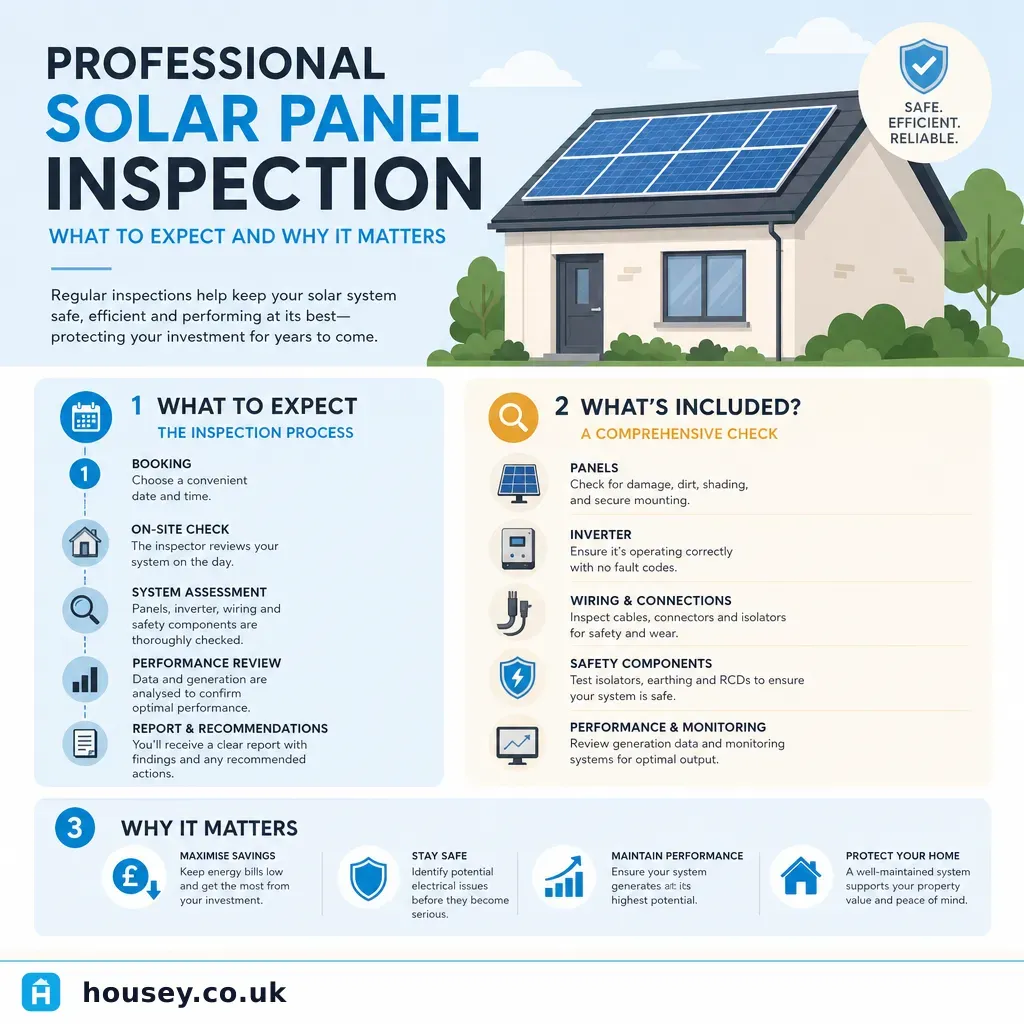
Professional solar panel inspection: what to expect and why it matters
A professional solar panel inspection typically takes 1–3 hours and covers visual panel condition, mounting hardware, inverter performance, wiring integrity, and often thermal imaging to detect hidden faults.
 Energy & Retrofit
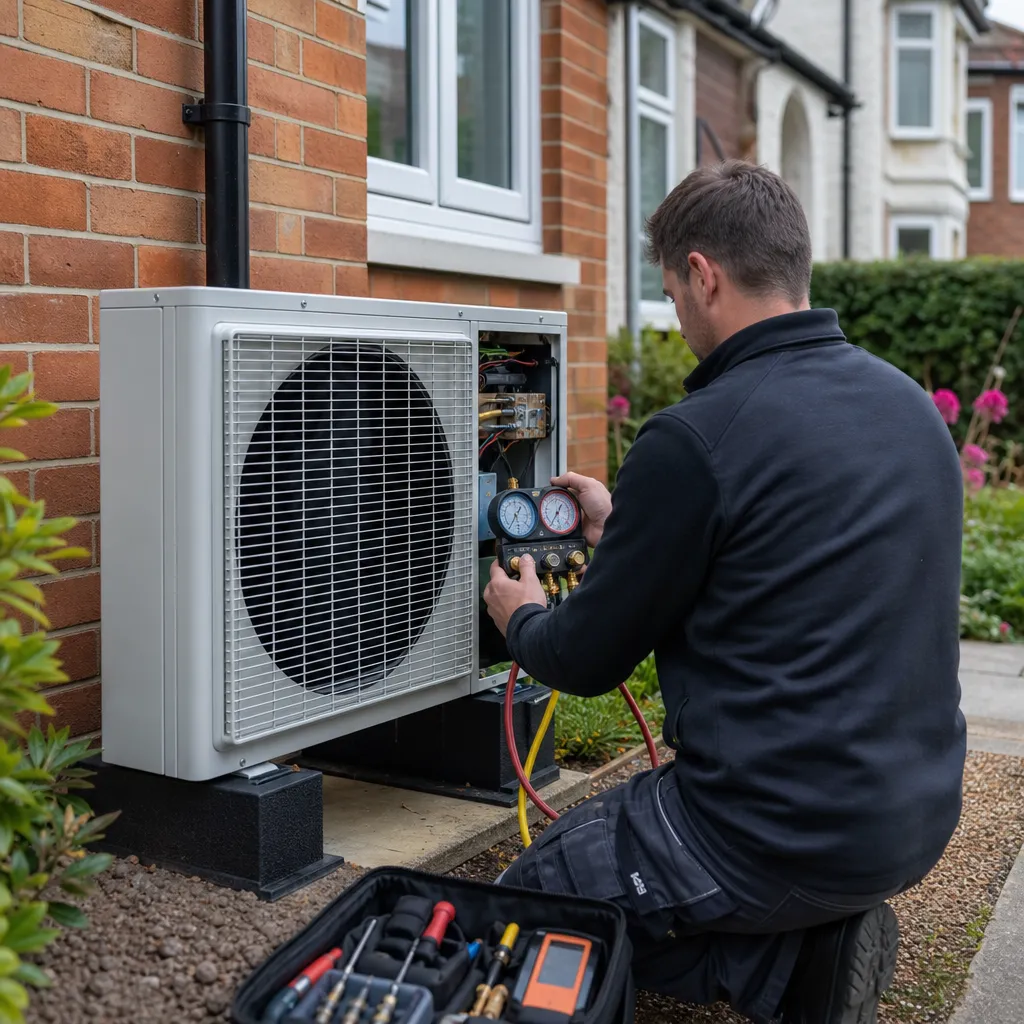
Diagnosing Heat Pump Performance Issues: Why Cooling Fails
Heat pump cooling failure is usually caused by refrigerant loss, a dirty air filter, a blocked outdoor unit, incorrect controller settings, or an undersized system.
 Energy & Retrofit
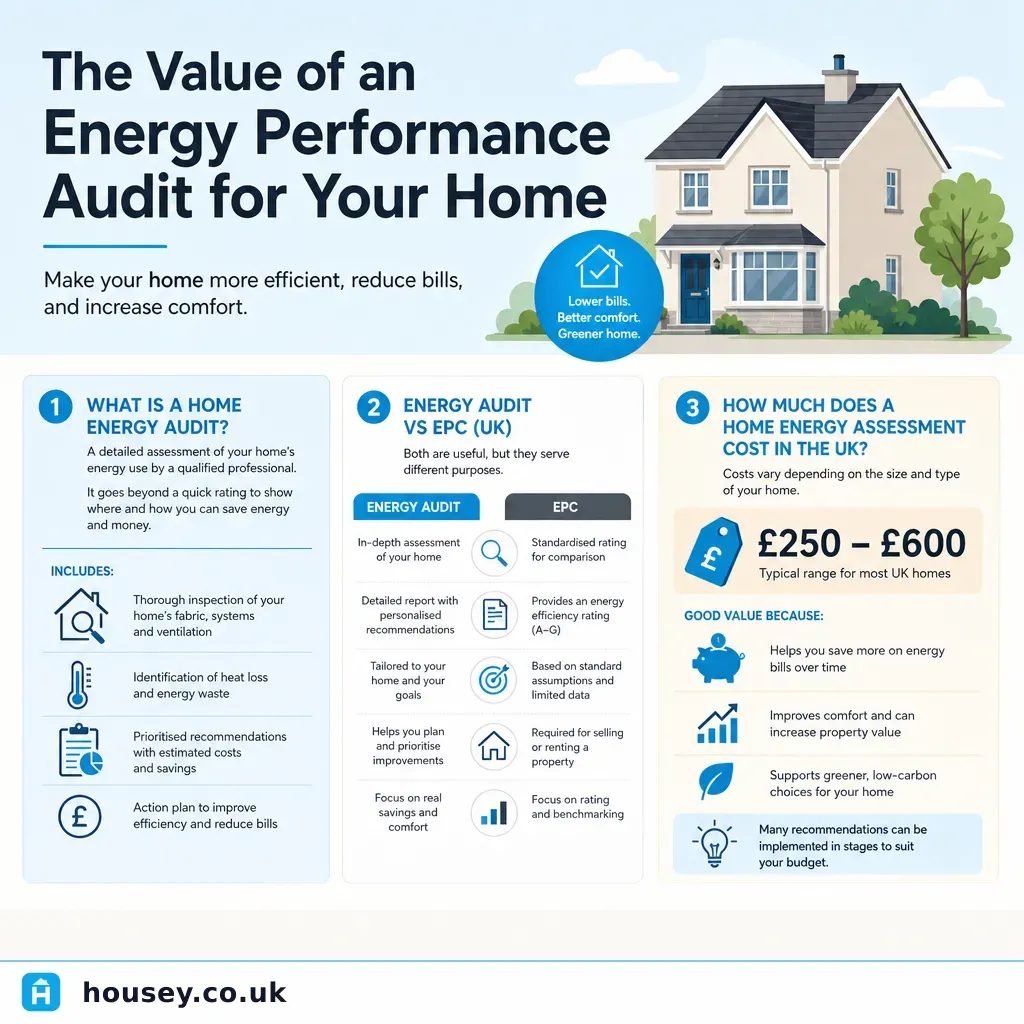
The Value of an Energy Performance Audit for Your Home
A home energy performance audit is a detailed, site-specific assessment of a property's fabric, heating, ventilation, and controls.
 Energy & Retrofit
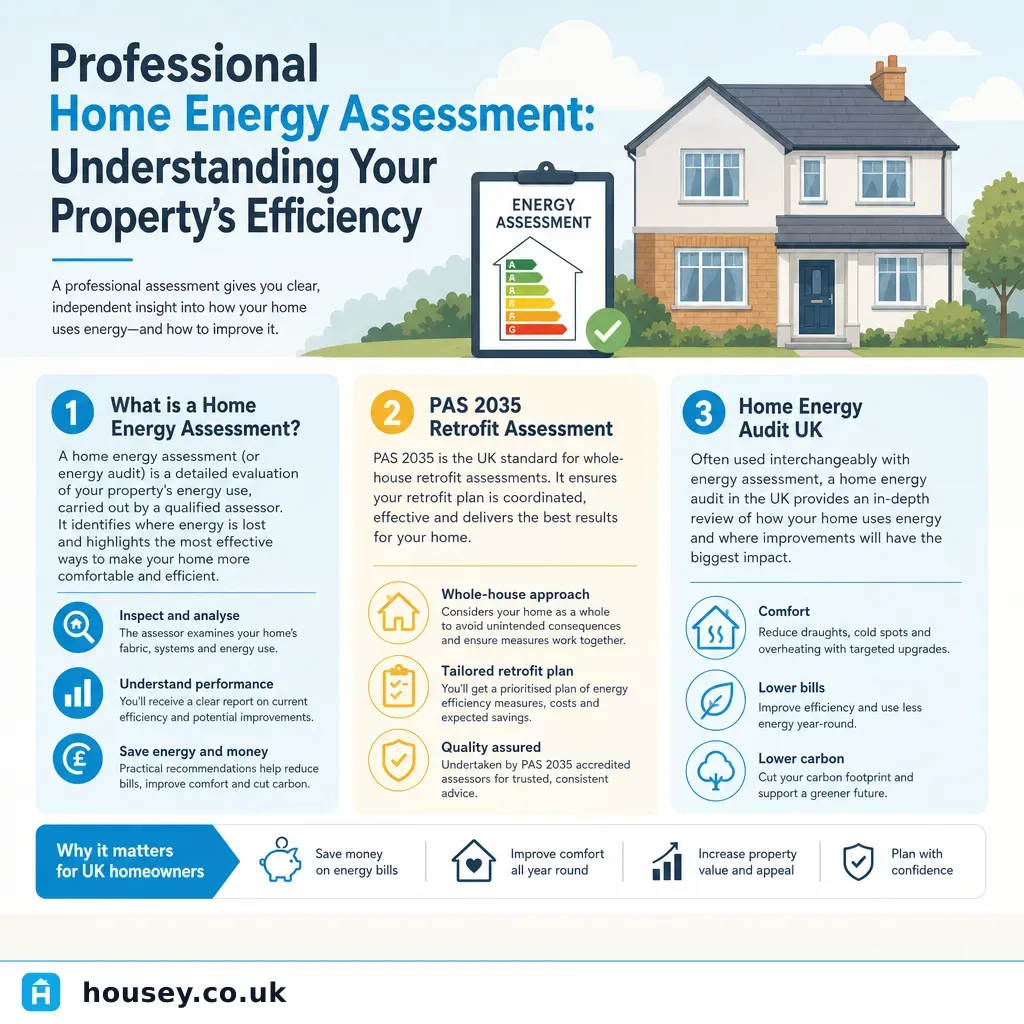
Professional Home Energy Assessment: Understanding Your Property's Efficiency
A professional home energy assessment goes beyond an EPC to evaluate how your property loses heat, where insulation is inadequate, and what improvements should be made in what order.
 Energy & Retrofit
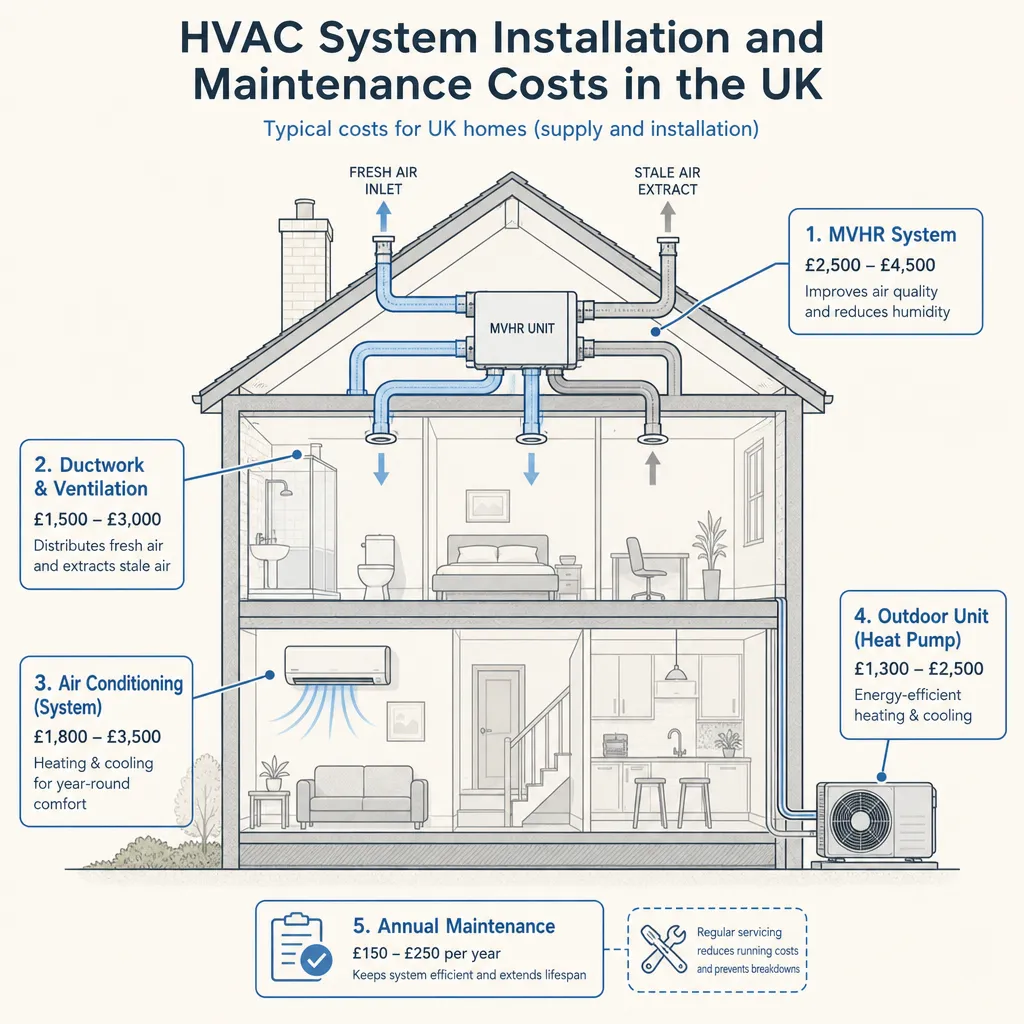
HVAC System Installation and Maintenance Costs in the UK
HVAC costs in UK homes vary by system type.