Solar Panel Leasing vs. Ownership: Comparing Your Options
By Housey · Last reviewed 17th of May 2026
Solar Panel Leasing vs. Ownership: Comparing Your Options
The way you finance solar panels determines who captures the financial benefit over the system's 25–30-year lifespan — and whether the panels complicate the eventual sale or remortgage of your home. UK homeowners now have several routes to solar: outright purchase, loan-financed ownership, and various rent-a-roof or lease arrangements. Understanding the distinction between these models before signing anything matters considerably more than most people realise at the point of first contact with an installer.
Key points
- Under the Smart Export Guarantee (SEG), owners of MCS-certified solar PV systems receive payment for electricity exported to the grid — this right belongs to the system owner, not necessarily the property owner, which is the central financial difference in lease arrangements.
- The Feed-in Tariff closed to new applicants in April 2019; the SEG replaced it, paying a market-determined export rate rather than a government-set tariff.
- Solar PV supply and installation for residential properties in Great Britain is eligible for 0% VAT, a rate confirmed through to 2027 under GOV.UK guidance.
- Under a typical rent-a-roof scheme, the solar company owns the panels and claims all SEG export payments — you receive only the value of electricity consumed during daylight hours.
- Leased solar panels can complicate property sales and remortgages — mortgage lenders vary significantly in how they treat a solar lease registered on title deeds.
Leasing vs. ownership: the full comparison
Feature | Owned system (purchase or loan) | Lease / rent-a-roof |
|---|---|---|
Upfront cost | Typically £5,000–£11,000 for a 3–4 kWp system (indicative, last reviewed 2026-05-17; see Energy Saving Trust for current guidance) | Usually £0 |
SEG export payments | Yours to keep | Typically retained by the solar company |
Ongoing maintenance | Your responsibility or via product warranty | Usually covered by the solar company |
Panel removal at end of life | Your cost to arrange | Usually the solar company's responsibility |
Impact on property sale | Generally adds value | Can complicate sale; buyer's solicitor must review the lease |
Mortgage lender acceptance | Generally straightforward | Varies — some lenders decline; others require specific lease conditions |
Contract term | Permanent — panels are a fixed asset | Typically 20–25 years |
Early exit | Not applicable | May require a buyout payment or panel transfer |
VAT on installation | 0% (residential Great Britain) | Verify in contract — may vary |
25-year financial benefit | Higher — you own all output and SEG income | Lower — only daytime self-consumption savings |
Understanding the Smart Export Guarantee
The SEG replaced the Feed-in Tariff in January 2020. Under the scheme:
- The installed system must be 5 MW or smaller — all domestic solar qualifies comfortably.
- Both the system and the installer must be MCS-certified — check the MCS installer database before appointing any contractor.
- Mandatory SEG licensees (energy suppliers with 150,000 or more domestic customers) must offer at least one SEG tariff; smaller suppliers may participate voluntarily.
- Export rates are market-determined — rates vary from approximately 4p to 24p per kWh depending on the tariff chosen. Ofgem publishes current guidance and comparison information.
- A smart meter is required to register for most SEG tariffs.
In a lease arrangement, the solar company typically holds MCS registration and collects SEG income. You consume electricity generated during daylight hours at no direct cost, but any export income flows to the company rather than to you.
Decision tree: which financing model suits you?
- Choose outright purchase if you have accessible savings or can obtain a loan below your expected system return rate, plan to stay in the property for at least 10 years, and want the full financial benefit including SEG income.
- Choose a solar loan (personal loan or a specialist green finance product) if you want full ownership benefits without a large upfront payment — you own the system from day one and receive all export income from registration onwards.
- Consider a lease or rent-a-roof only if you cannot access purchase funding, fully understand you will not receive SEG payments, and have first confirmed your mortgage lender will accept the arrangement.
- Do not proceed with any arrangement without first checking:
- Whether your roof structure, orientation, and pitch are suitable and the remaining covering lifespan justifies the investment.
- Whether your mortgage lender requires written notification or explicit consent before installation.
- Whether the lease will be registered on your title deeds and how a future buyer's lender will treat it.
- Whether planning permission is required for your specific property type or location.
What happens when you sell a property with leased panels?
A solar lease typically runs with the land — meaning it transfers automatically to a buyer on completion. The buyer's solicitor must review the lease terms, and the buyer's mortgage lender must be willing to lend against a property encumbered by it.
Mortgage lenders have varying policies on this point. UK Finance, the lender trade association, has published guidance for members on assessing solar leases; requirements often include a minimum remaining lease term relative to the mortgage, clearly defined landlord obligations, and explicit provisions for panel access and removal.
If you are considering signing a lease: Request a specimen lease document from the solar company and have your own solicitor review it before committing. Inform your existing mortgage lender and obtain written consent.
If you are buying a property with existing leased panels: Ensure your solicitor reports fully on the lease terms and that your mortgage lender confirms it will proceed. Do not assume the arrangement is straightforward or that the panels are an unqualified asset.
Homeowner checklist: before committing to any solar arrangement
When to get professional help
- Always use an MCS-certified installer — non-MCS installations cannot access SEG payments and may not qualify for building regulations self-certification.
- If your roof covering is approaching the end of its useful life, address it before panels are installed — removing and reinstalling panels to carry out subsequent roof repairs is avoidably expensive.
- A solar survey provides an independent suitability assessment and an objective basis for evaluating competing installer quotes.
- For lease arrangements, independent legal advice on the lease document before signing is strongly advisable — this is not a standard consumer purchase contract.
How Housey can help
Before committing to any solar arrangement, a solar survey gives you an independent view of your roof's suitability, estimated annual yield, and any issues worth addressing first. Housey connects you with qualified surveyors who assess your property with no sales agenda attached to their findings.
Frequently asked questions
Can I still get the Feed-in Tariff for new solar panels?
No. The Feed-in Tariff closed to new applicants in April 2019. New solar PV systems can instead register for the Smart Export Guarantee (SEG), which pays a market-rate tariff for electricity exported to the grid. SEG rates are set by energy suppliers and vary — use Ofgem's guidance to compare currently available tariffs before registering your system.
Do solar panels need planning permission?
In most cases, no. Solar panels on a dwelling house are Permitted Development provided they protrude no more than 200mm from the roof slope and do not exceed the highest point of the roof. Exceptions apply to listed buildings, which require listed building consent, and some conservation areas. Confirm with your local planning authority if you have any doubt about your property.
What happens to leased solar panels at the end of the lease term?
This depends on your lease contract. Most rent-a-roof agreements state that the solar company removes the panels at their cost at the end of the term, returning the roof to its original condition. Always confirm this in writing before signing, and check what the contract says if the solar company is acquired, restructured, or ceases trading during the term.
Will solar panels affect my home insurance?
Owned solar panels should be declared to your home insurer, as they form part of the building structure. Most standard buildings insurance policies can accommodate them, though cover levels and premiums may vary. Under a lease, the solar company typically insures the panels themselves — confirm this in your lease agreement, and notify your buildings insurer of the installation regardless.
Sources and further reading
- Smart Export Guarantee: Ofgem guidance — Ofgem
- MCS: find a certified installer — Microgeneration Certification Scheme
- VAT on energy-saving materials: Notice 708/6 — GOV.UK
- Planning permission for solar panels — Planning Portal
- Solar panels: consumer guidance — Energy Saving Trust
Useful next reads
 Energy & Retrofit
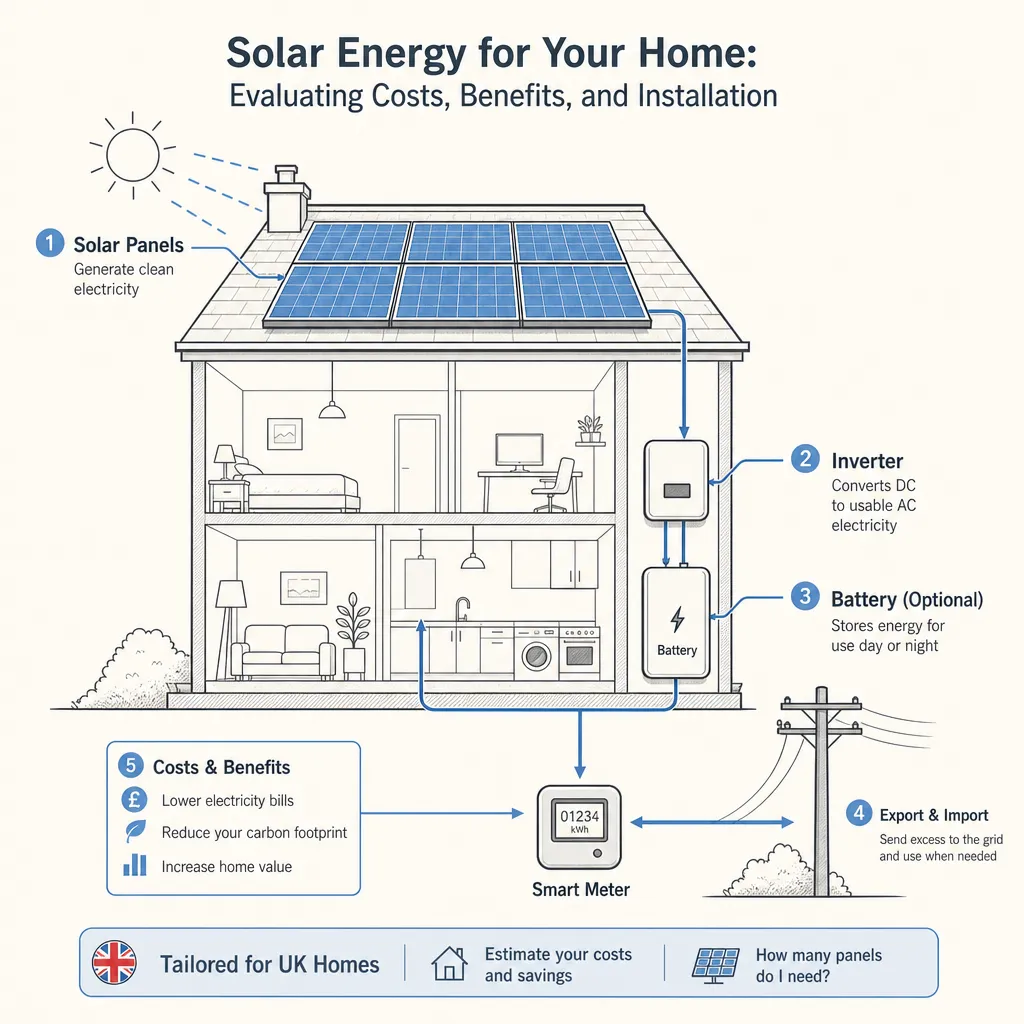
Solar Energy for Your Home: Evaluating Costs, Benefits, and Installation
A typical UK home solar PV system of 3–4 kWp costs approximately £5,000–£8,000 fully installed and can generate 2,600–3,800 kWh per year, covering 40–60% of average household electricity use.
 Energy & Retrofit
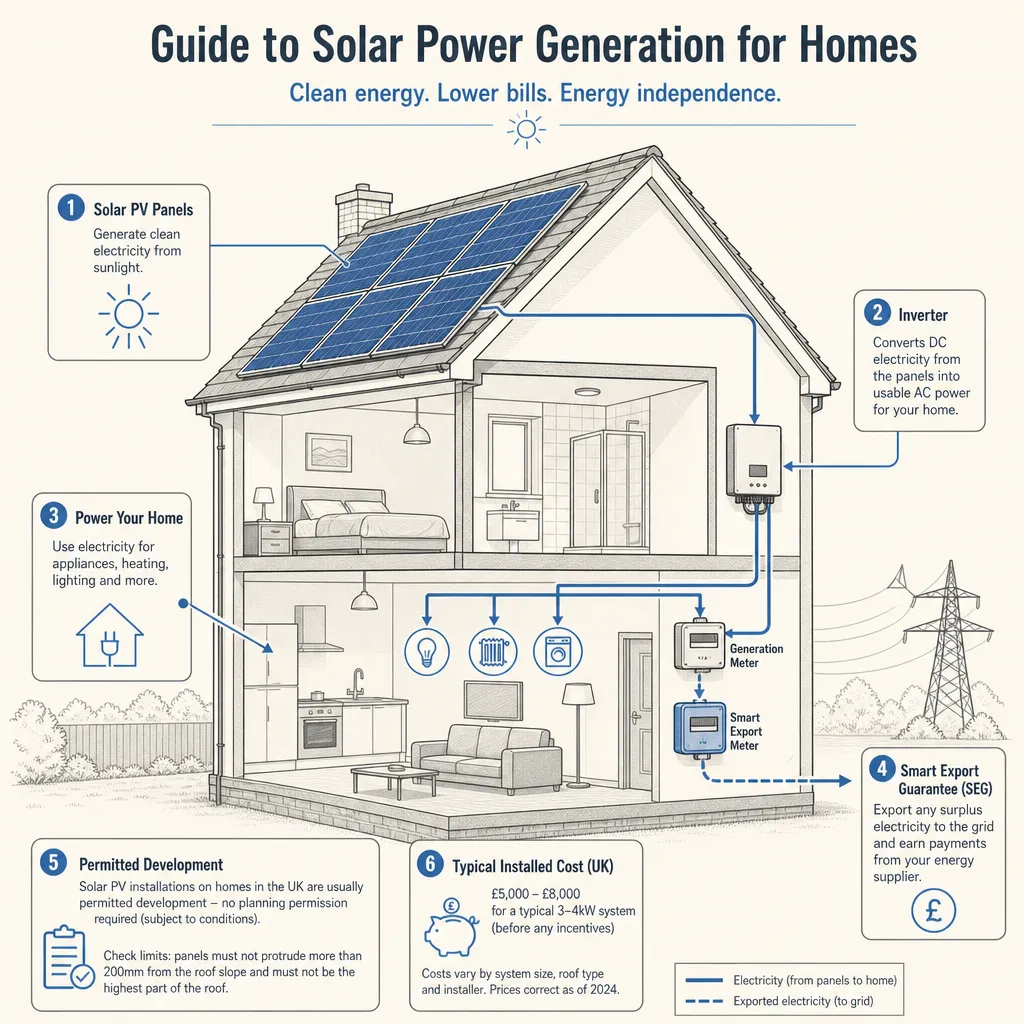
Guide to Solar Power Generation for Homes
Solar photovoltaic (PV) panels convert daylight into electricity and export surplus to the grid via the Smart Export Guarantee (SEG).
 Energy & Retrofit
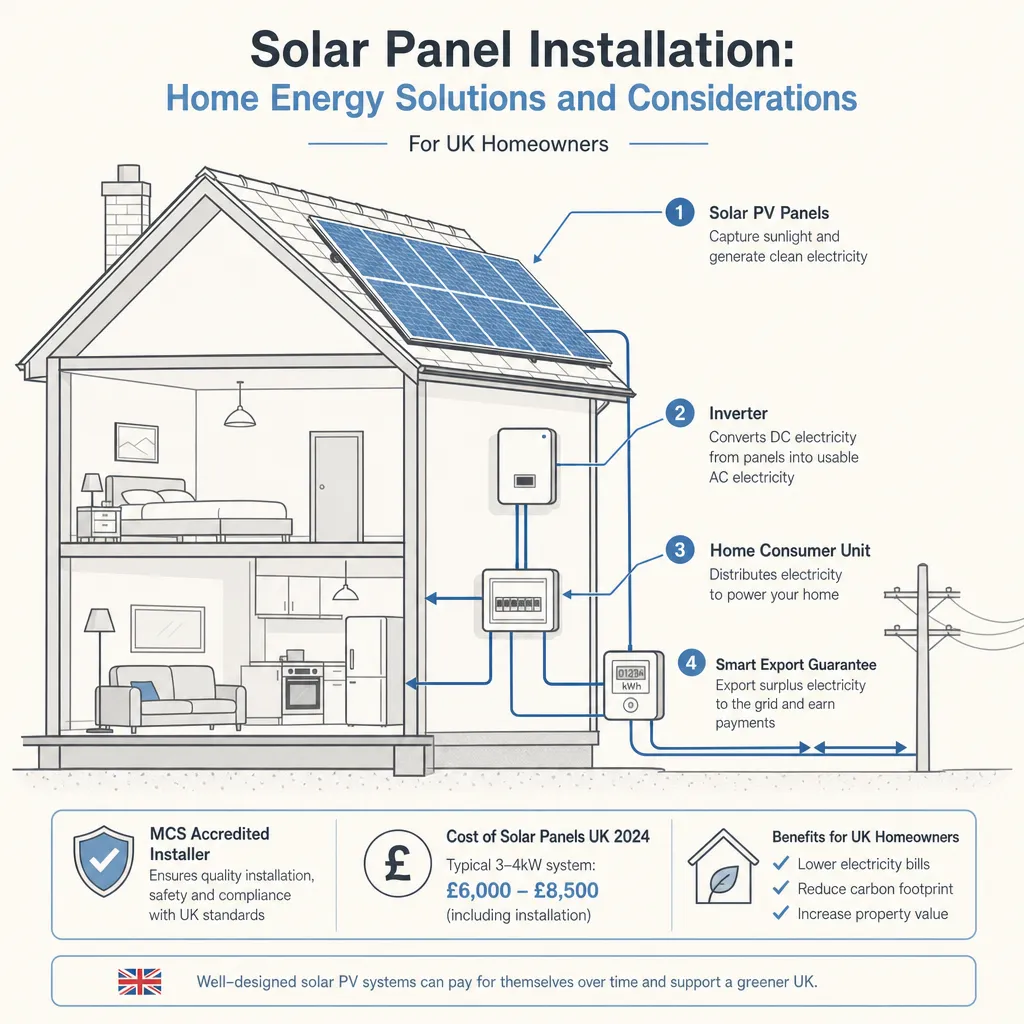
Solar Panel Installation: Home Energy Solutions and Considerations
A typical 4 kWp solar PV system costs £6,000–£9,000 installed and generates around 3,400–3,800 kWh per year on a south-facing roof in southern England.
 Energy & Retrofit
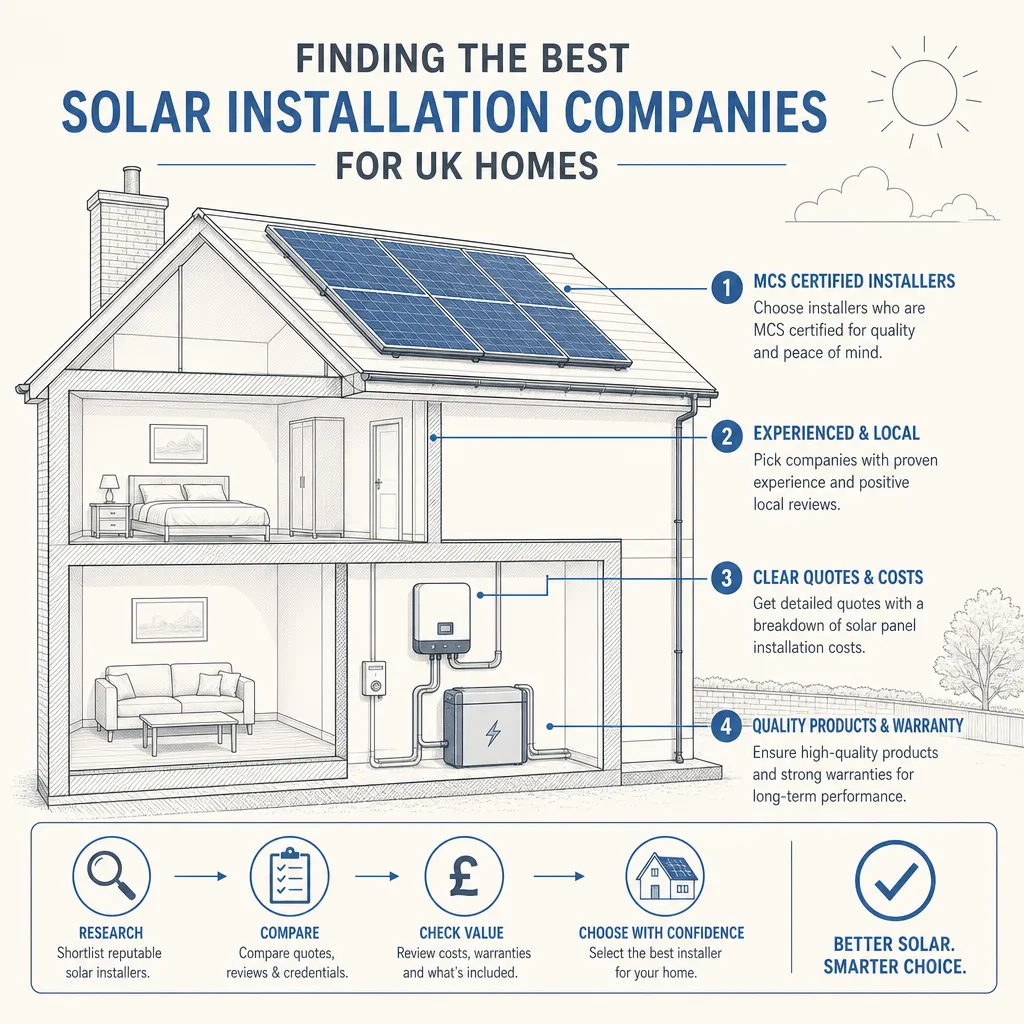
Finding the Best Solar Installation Companies for UK Homes
To find a reliable solar installation company in the UK, look for MCS (Microgeneration Certification Scheme) certification — required for Smart Export Guarantee eligibility — plus NICEIC or NAPIT electrical registration.
 Energy & Retrofit
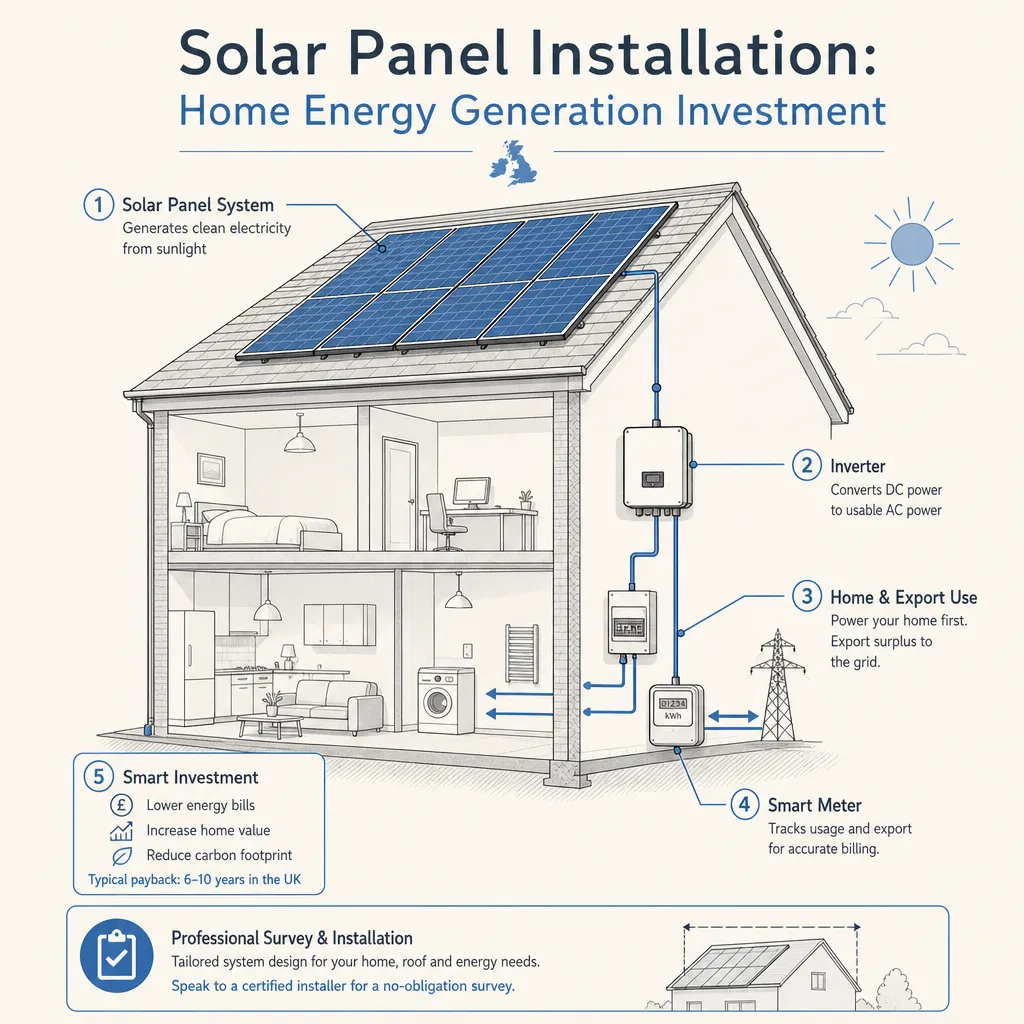
Solar Panel Installation: Home Energy Generation Investment
Solar panel installation in the UK typically costs £5,000–£9,000 for a 3–4 kWp system.