Solar Panel Orientation: Optimising Direction and Placement for UK Properties
By Housey · Last reviewed 31st of May 2026
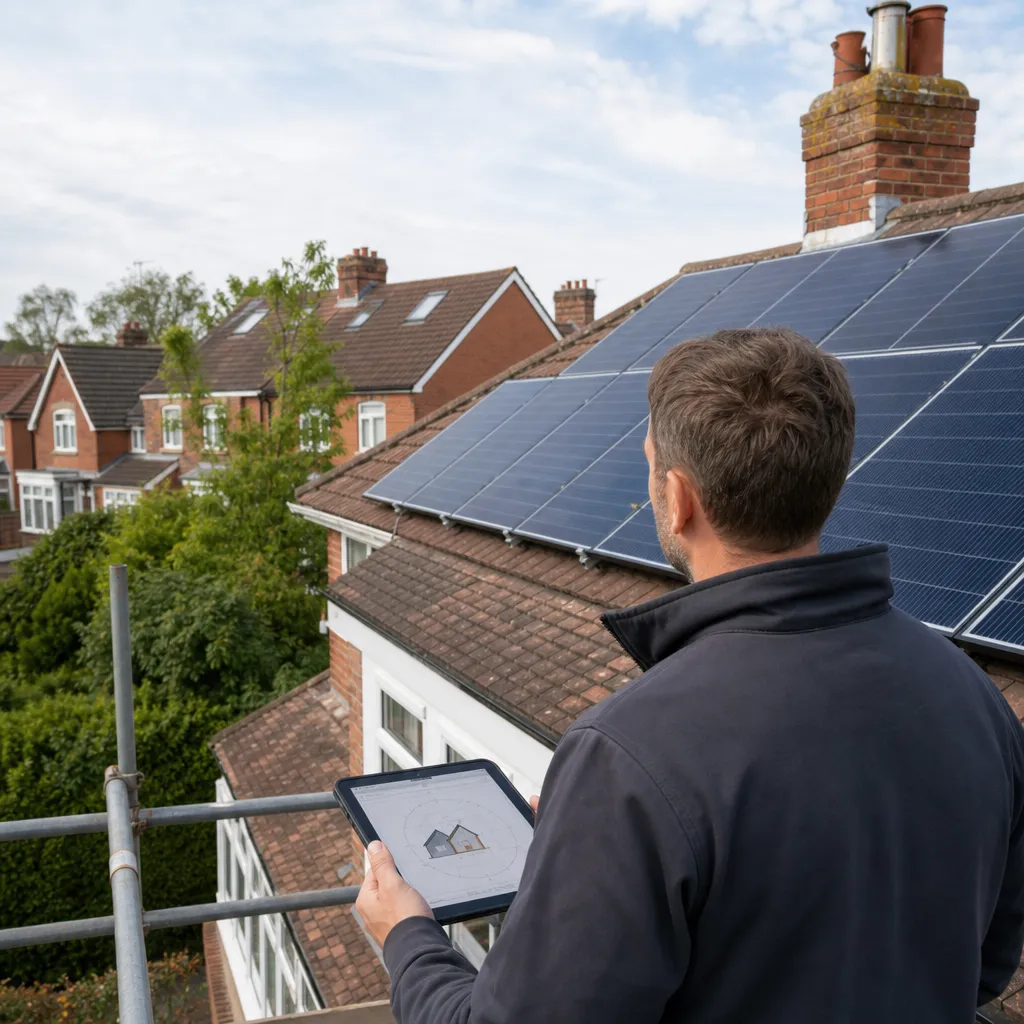
Solar Panel Orientation: Optimising Direction and Placement for UK Properties
For most UK homeowners, the decision to install solar panels quickly leads to practical questions about whether the roof faces the right way, at what angle, and whether shading from a chimney stack or neighbouring tree will undermine the investment. These questions matter financially: a poorly oriented or shaded array can take significantly longer to pay back than an optimised one, and the site assessment is also a prerequisite for Microgeneration Certification Scheme (MCS) certification — which is required to access the Smart Export Guarantee (SEG).
Key points
- South-facing panels at a 30–40 degree pitch generate the highest annual output in the UK, typically 10–15% more than east- or west-facing equivalents at the same tilt (Energy Saving Trust guidance).
- East- and west-facing roofs produce roughly 15–20% less output than south-facing arrays but remain financially viable, particularly for households with high daytime consumption, battery storage, or an electric vehicle.
- MCS requires installers to carry out a documented shading and orientation assessment before specifying an array; MCS certification is a prerequisite for Smart Export Guarantee eligibility.
- Panels installed at less than 10 degrees from horizontal accumulate dirt and bird fouling faster, reducing output and increasing the frequency of manual cleaning.
- North-facing roofs in the UK produce approximately 55–60% of the south-facing baseline and are rarely recommended as a primary array location; alternative mounting options should be explored.
How orientation affects solar output in the UK
The UK sits between approximately 50° and 59° north latitude. At this latitude, the sun's path is predominantly to the south throughout the year, which is why south-facing roofs capture the most solar radiation over a 12-month period.
The table below shows estimated annual output relative to an optimally south-facing, 35-degree roof. Figures are illustrative for a 4 kWp system based on Energy Saving Trust guidance and MCS methodology.
Roof orientation | Estimated relative output | Typical payback impact |
|---|---|---|
South (true south, 35° pitch) | 100% — baseline | Optimal; typically 8–12 year payback |
South-east or south-west (up to 45° from south) | ~95–98% | Minimal impact on payback |
East or west | ~80–85% | Adds roughly 1–2 years to payback; still viable |
North-east or north-west | ~65–70% | Substantially reduced; usually not recommended |
North | ~55–60% | Not recommended as primary location |
Flat roof (south-tilted frames at 15–30°) | ~90–95% | Close to optimal if frames are angled correctly |
Actual output depends on shading, local climate, panel efficiency, inverter specification, and system losses. An MCS-certified installer calculates site-specific estimates using irradiance data — commonly via the European Commission's PVGIS tool or SAP 10.2 calculation methods.
Pitch angle: why 30–40 degrees is the UK optimum
The widely accepted optimal tilt for solar panels in the UK is 30–40 degrees from horizontal, with 35 degrees commonly cited for central England. At this angle, panels intercept sunlight most efficiently across the full year — capturing low winter sun as well as summer generation peaks.
Most residential installations are mounted flush with the existing roof pitch. Common UK roof pitches fall between 30 and 45 degrees, meaning most properties naturally sit within or close to the optimal range. If your roof pitch falls significantly outside this window — for example, a 15-degree lean-to roof or a steep 50-degree Victorian terrace — your installer should note the expected output impact in their system design report.
For flat roofs, panels are typically mounted on angled frames at 10–30 degrees. Frames angled too steeply cause mutual shading between rows; frames too shallow reduce self-cleaning by rainfall and increase fouling over time.
Shading: the factor homeowners most often underestimate
Even partial shading from a chimney, a neighbouring tree, a dormer, a TV aerial, or a satellite dish can disproportionately reduce output. In a standard string-inverter system, the performance of the weakest panel in a string limits the output of every panel connected to it.
Modern microinverters and DC power optimisers — from manufacturers including Enphase and SolarEdge — address this by optimising each panel independently. If your roof has any shading source, even at limited times of year, ask your installer whether microinverters or optimisers are specified in their design, and why.
A professional shading assessment considers obstructions from all compass points at multiple points during the year. This is a standard part of the MCS design process and should be documented in your pre-installation system design report.
Decision tree: finding the best placement for your panels
- Choose the main south-facing roof slope if your roof faces within 90 degrees of true south and is largely unshaded — this is the default optimal position.
- Consider an east–west split array if your property has well-matched east and west roof slopes: this spreads generation across more of the day and suits households with morning and evening consumption peaks.
- Explore flat-roof frame mounting if you have a flat or very low-pitch roof section — south-tilted frames at 15–30 degrees can achieve close to optimal annual output.
- Consider a ground-mounted array if roof space is insufficient, heavily shaded, or structurally unsuitable — ground-mount systems require land and may need a permitted development check or planning application.
- Always engage an MCS-certified solar surveyor if: the property is in a conservation area or is listed; the roof has multiple slopes or significant shading sources; battery storage or EV-charger integration is planned; or quotes from different installers show substantially different output estimates.
What an MCS solar survey covers
Before installation, an MCS-certified installer is required to assess and document:
- Roof orientation, pitch angle, and available panel area
- Shading analysis at representative times of year
- Structural suitability of the roof for the proposed panel loading
- DNO (Distribution Network Operator) notification requirements — required for most systems above 3.68 kW per phase under the G98 process
- Electrical connection point and export meter configuration for SEG eligibility
The output is a system design report including an estimated annual generation figure, self-consumption analysis, and proposed equipment specification. You should receive this report before signing any installation contract.
When to get professional help
A basic orientation check is useful for initial planning, but a site survey is essential before committing to installation. Seek a professional assessment if:
- The property is in a conservation area or is listed — permitted development rights may not apply and a planning application may be required.
- The roof is more than 20 years old, shows visible deterioration, or is an unusual construction type such as thatch, standing seam metal, or EPDM flat.
- The proposed system exceeds 3.68 kW per phase, requiring formal DNO notification under the G98 or G99 process.
- You want to combine solar with battery storage, a heat pump, or an EV charger — integrated system design is more complex and errors are costly.
- Quotes from different installers show significantly different annual generation estimates — ask each to explain their irradiance source and calculation methodology.
How Housey can help
Housey connects homeowners with qualified MCS-certified solar surveyors who can carry out a full site assessment, produce a compliant system design, and advise on orientation, shading mitigation, and Smart Export Guarantee eligibility. Request a solar survey through Housey to compare certified professionals in your area.
Frequently asked questions
Can solar panels work on an east- or west-facing roof in the UK?
Yes. East- or west-facing roofs typically generate around 80–85% of the output of an equivalent south-facing installation. For many households — particularly those with higher daytime consumption, battery storage, or an electric vehicle — this reduction is acceptable and the investment can remain financially sound over the system's 25-year-plus lifespan.
Do I need planning permission for solar panels in the UK?
Most residential solar installations in England are permitted development and do not require planning permission, provided panels do not protrude more than 20cm from the roof surface and other standard conditions are met. Conservation areas, listed buildings, and some flat-roof installations may require a planning application. Check GOV.UK guidance or contact your local planning authority before proceeding.
What is the Smart Export Guarantee (SEG)?
The Smart Export Guarantee is a government-backed scheme requiring licensed energy suppliers to offer a tariff for surplus electricity exported to the grid from small-scale renewable installations. To access SEG payments, the system must be designed and installed by an MCS-certified installer and meet relevant technical standards, including the orientation and shading assessment.
How much does a solar survey cost?
Many MCS-certified installers include a site survey within the quote process at no additional charge. Standalone independent assessments typically cost £150–£400 depending on complexity and location. Indicative UK costs, last reviewed 2026-05-31. Always confirm what the survey report includes — shading analysis, irradiance data, and a system design report should be standard deliverables.
Sources and further reading
- Energy Saving Trust: solar panels — output guidance and financial analysis for UK households
- MCS: find a certified installer — MCS certification, SEG eligibility, and installer search
- GOV.UK: planning permission guidance — permitted development rules for solar panels in England
- PVGIS solar irradiance tool — European Commission tool for site-specific solar irradiance data
Useful next reads
 Energy & Retrofit
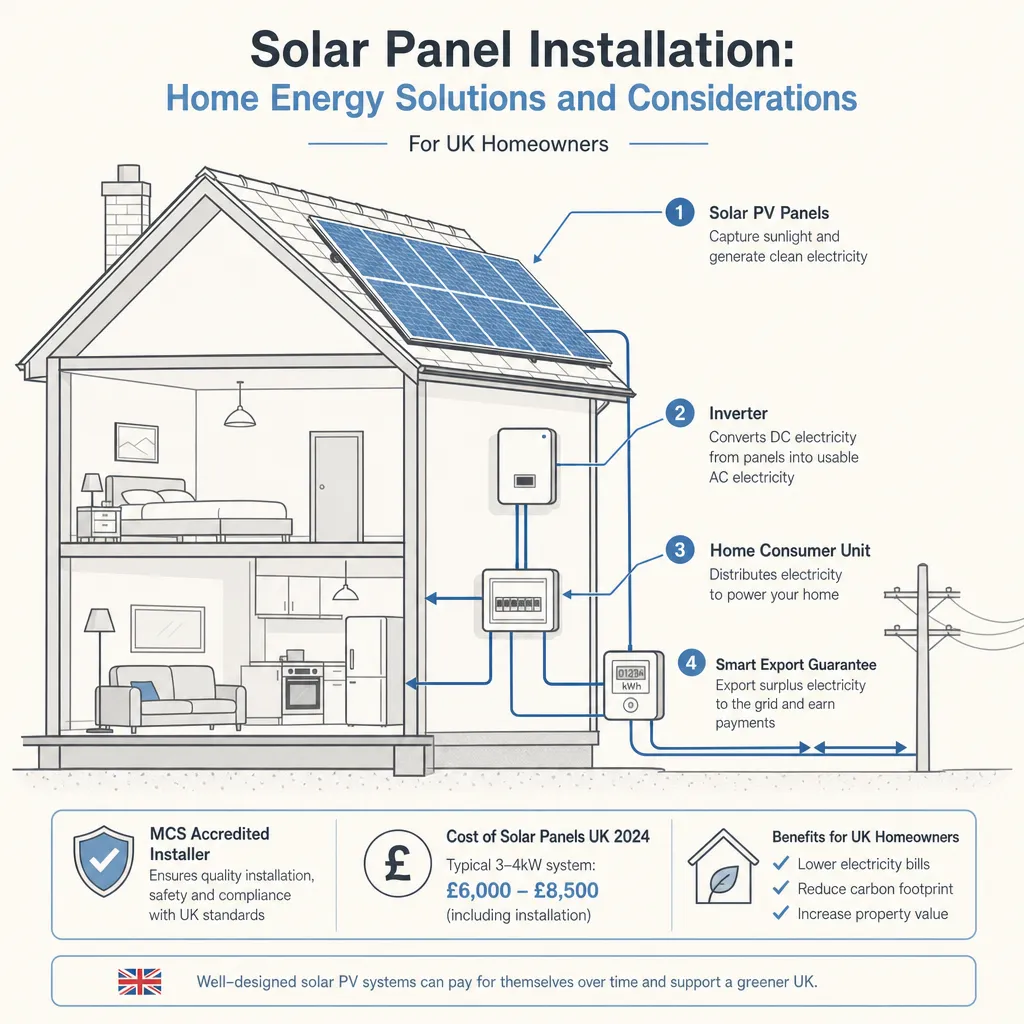
Solar Panel Installation: Home Energy Solutions and Considerations
A typical 4 kWp solar PV system costs £6,000–£9,000 installed and generates around 3,400–3,800 kWh per year on a south-facing roof in southern England.
 Energy & Retrofit
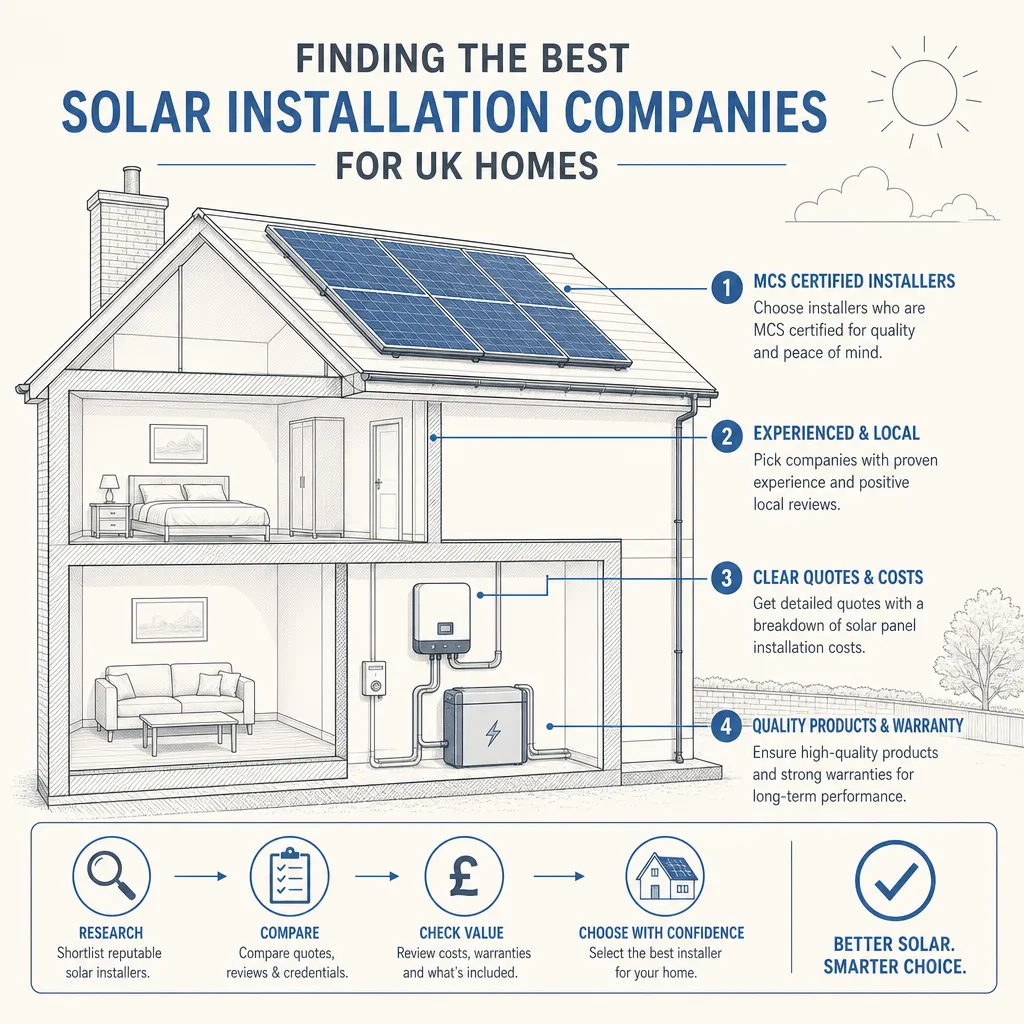
Finding the Best Solar Installation Companies for UK Homes
To find a reliable solar installation company in the UK, look for MCS (Microgeneration Certification Scheme) certification — required for Smart Export Guarantee eligibility — plus NICEIC or NAPIT electrical registration.
 Energy & Retrofit
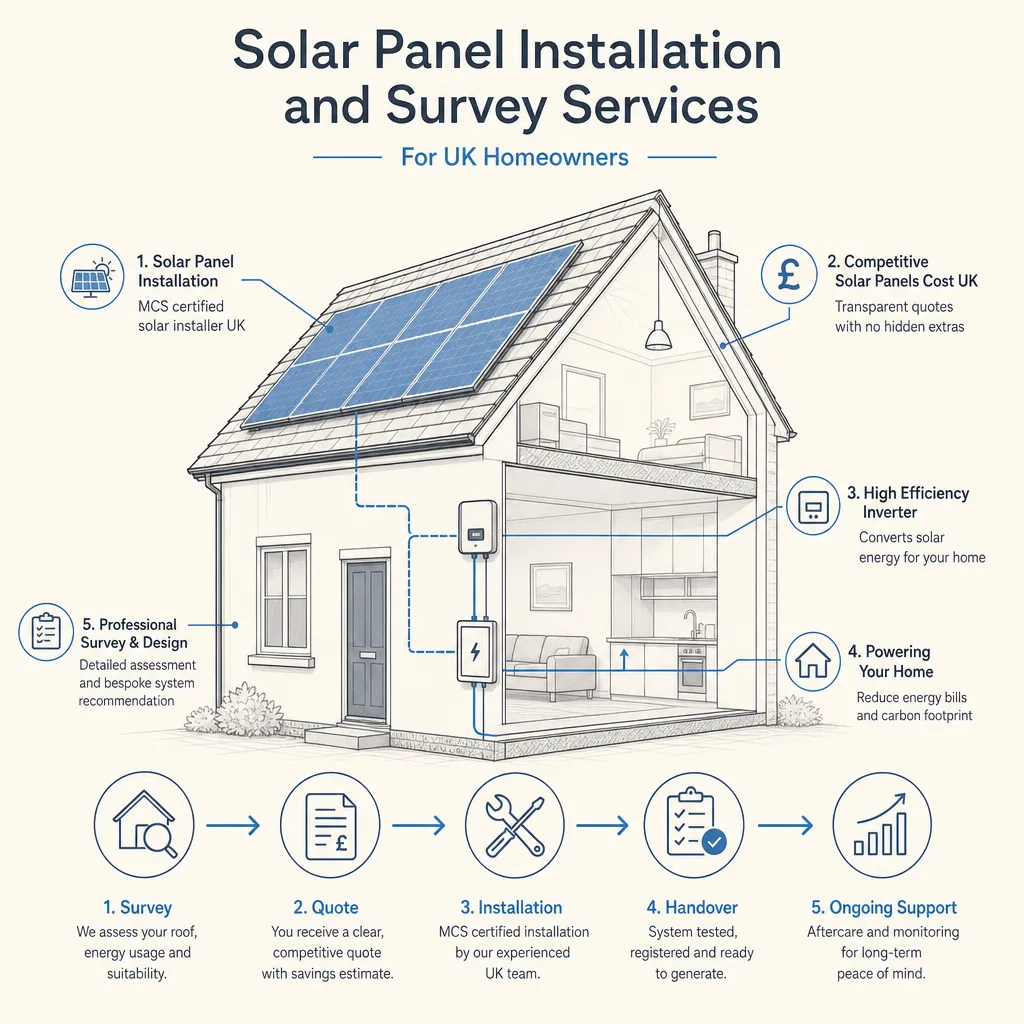
Solar Panel Installation and Survey Services
Solar panel installation in the UK involves a pre-installation roof survey, system design, MCS-accredited fitting, and notification to your Distribution Network Operator (DNO).
 Energy & Retrofit
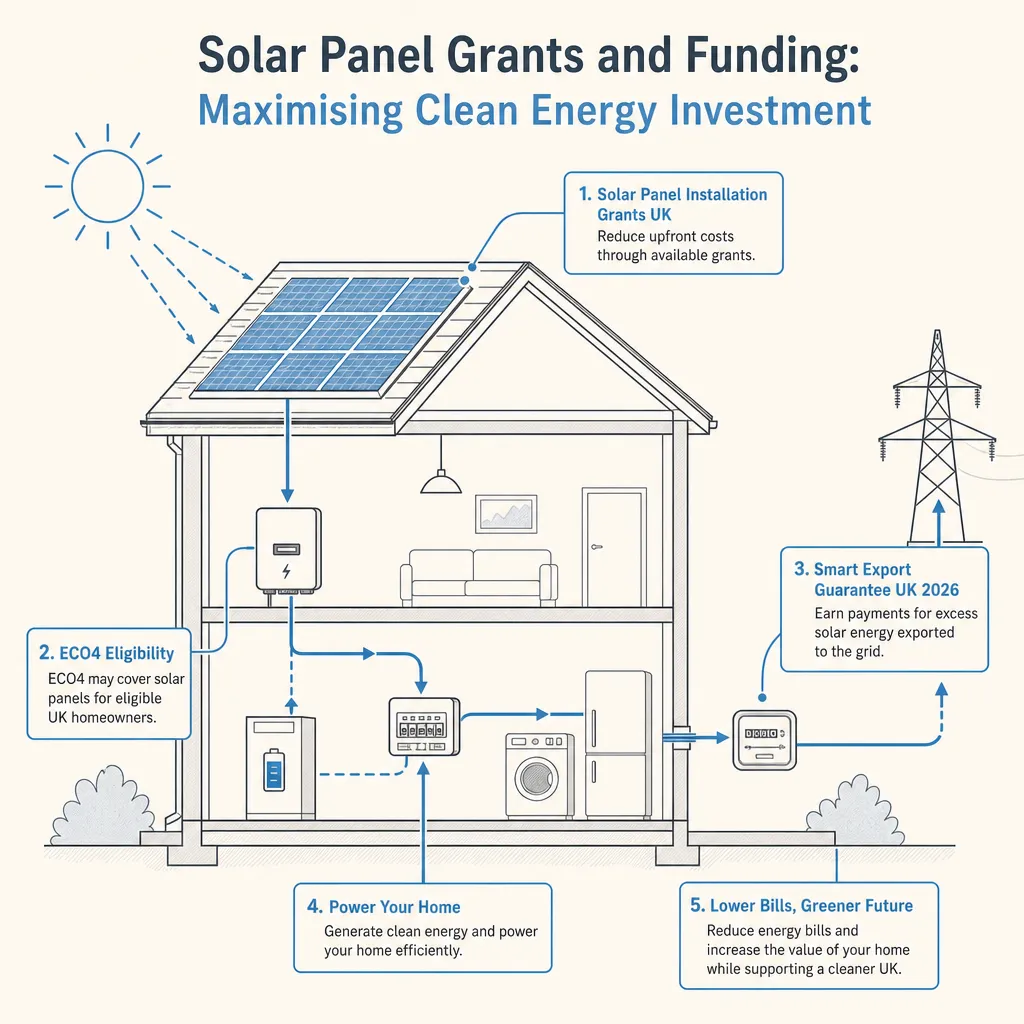
Solar Panel Grants and Funding: Maximising Clean Energy Investment
Several UK solar funding schemes are currently open: the Smart Export Guarantee pays homeowners for surplus electricity exported to the grid, ECO4 can fund free or subsidised panels for eligible low-income households, and 0% VAT on installation applies until at least March 2027.
 Energy & Retrofit
Renewable Energy Systems and Property Value: Solar Panels and Heat Pumps
Solar panels can add a modest 1–4% to UK property values in the right conditions, particularly when they improve the EPC rating.