Solar Panel Repairs and Maintenance Services
By Housey · Last reviewed 11th of May 2026
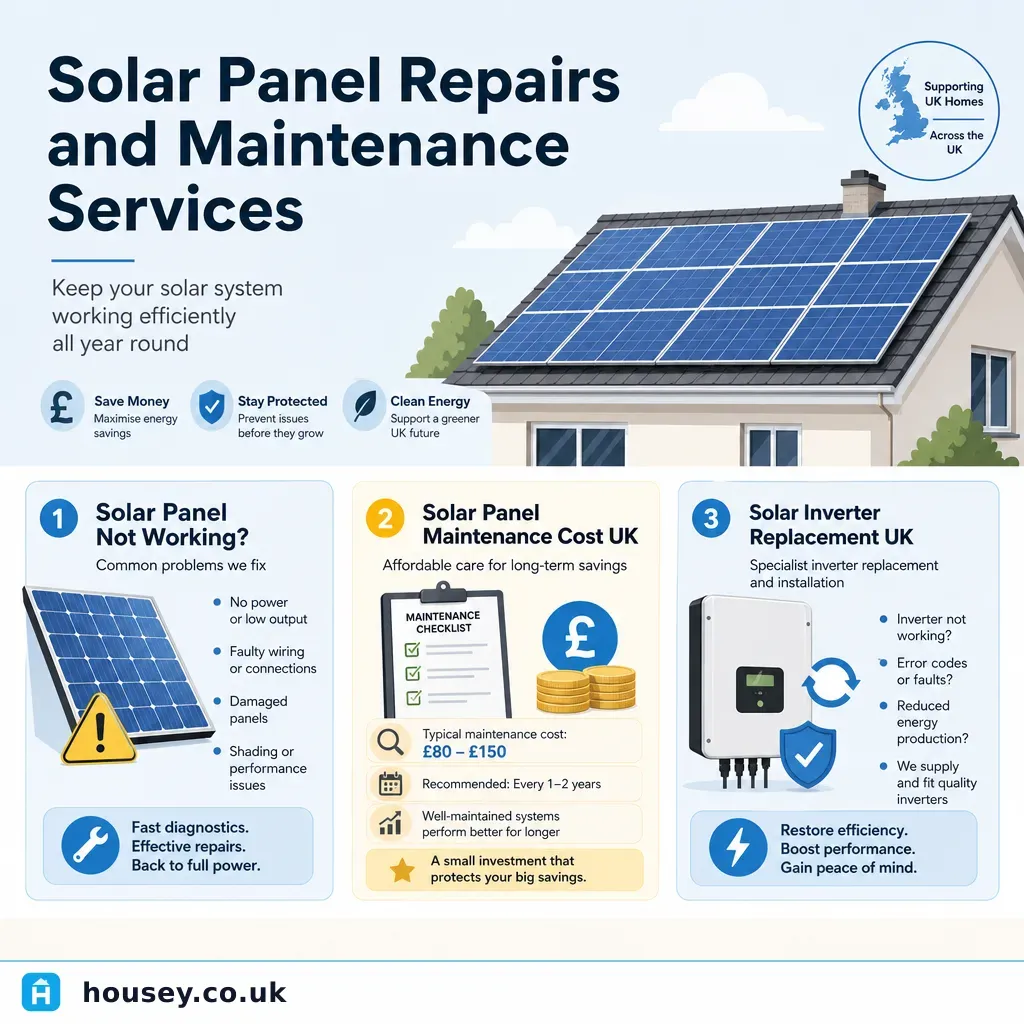
Solar Panel Repairs and Maintenance Services
Solar panels are low-maintenance by design, but they are not maintenance-free — and when something does go wrong, the financial impact can be significant given the energy generation you are losing. Most UK homeowners first notice a problem when electricity bills start creeping upwards or their monitoring app reports unexpectedly low output. Catching and addressing faults early protects both your system's performance and any remaining manufacturer or installer warranty.
Key points
- Solar panels in the UK typically produce 265–330 watts per panel under standard test conditions (STC), but real-world output can drop 10–25% due to dirt, shading, or fault conditions.
- Inverter failure is the most common cause of complete system shutdown; string inverters have an average lifespan of 10–15 years compared to 20–25 years for the panels themselves.
- Under the Microgeneration Certification Scheme (MCS), electrical work on a grid-connected solar PV system must be carried out by a suitably qualified electrician — in most cases an MCS-accredited installer.
- The Smart Export Guarantee (SEG), which replaced the Feed-in Tariff, requires your system to remain in working order for you to receive export payments — a persistent fault can disrupt that income.
- Panels should be cleaned when soiling causes a visible layer of debris, typically once or twice a year in most UK locations, although urban or coastal properties may need more frequent attention.
Common solar panel faults and what causes them
Solar PV systems can develop a range of faults, some visible and some detectable only through monitoring data or professional testing.
Fault | Likely cause | Typical fix | Who to call |
|---|---|---|---|
Zero output across the whole system | Inverter failure, tripped isolator, grid fault | Replace inverter or reset isolator; check DNO supply | MCS-accredited electrician |
Low output from part of the array | Failed microinverter, shading, dirty panels, cracked cell | Clean panels; replace microinverter or optimiser | Solar contractor |
Visible panel damage | Storm, foot traffic on roof, thermal stress | Replace individual panels | MCS-accredited installer |
Monitoring system offline | Wi-Fi dropout, firmware issue, data logger fault | Reboot router or logger; update firmware | Installer support or electrician |
Discolouration or browning on panels | Hot-spot effect from cell mismatch or partial shading | Panel replacement; add power optimisers | Solar contractor |
Loose or corroded wiring | Poor original installation, weather exposure | Inspect and re-terminate connections | Part P registered electrician |
How often should solar panels be serviced?
There is no mandatory maintenance schedule for domestic solar PV in the UK, but manufacturers and MCS guidance generally recommend:
- Annual visual inspection — check for cracked cells, damaged frames, loose mountings, and correct inverter display readings.
- Professional system check every 1–2 years — includes electrical safety checks, inverter performance review, and data download from the monitoring system.
- Panel cleaning as needed — typically once or twice a year. Panels at a low tilt angle (below 10°) accumulate dirt faster and rarely self-clean in rainfall.
Some installer warranties require documented servicing to remain valid. Check your original installation documentation for any service intervals specified by your installer or panel manufacturer.
What does solar panel maintenance cost?
Indicative UK costs, last reviewed 2026-05-11.
- Annual maintenance visit: £80–£200 depending on system size and location, including electrical checks and a written report.
- Panel cleaning (professional): £50–£150 for a typical 4 kWp domestic system; higher for two-storey or complex roofs requiring access equipment.
- Inverter replacement: £500–£1,500 for a string inverter (parts and labour); individual microinverter replacement costs less per unit but labour accumulates on larger arrays.
- Individual panel replacement: £200–£500 per panel including labour, depending on specification and roof access.
- Power optimiser addition: £80–£180 per panel fitted.
Quotes vary significantly with location, roof pitch, access requirements, and system age. Always request a written quotation and confirm whether VAT is included.
Choosing a qualified solar contractor
Not all solar installers carry out repairs on systems they did not install. When hiring a contractor for maintenance or repairs, look for:
- MCS accreditation: The Microgeneration Certification Scheme sets installation and product standards. Verify any contractor via the MCS installer database at mcsgroup.org.
- RECC membership: The Renewable Energy Consumer Code provides consumer protections for domestic customers and covers dispute resolution.
- Part P competency: Any electrical work — including wiring, inverter replacement, and isolator work — must be carried out by or overseen by a Part P registered electrician. Verify via the NICEIC or NAPIT registers.
- Manufacturer authorisation: For inverter warranty replacements, check whether your brand (SolarEdge, SMA, Enphase, Growatt) requires an authorised service partner.
What to ask before accepting a quote
- What is included and excluded from the service visit?
- Are you MCS-accredited, and can you provide your accreditation number for verification?
- Is the person carrying out electrical work Part P registered?
- What report or certificate will I receive after the work is complete?
- What assumptions is the quote based on (roof access, scaffolding, system age)?
- What could increase the price once work has started?
- Is VAT included, and at what rate?
- Will any panel or inverter warranty be affected by the work?
Red flags when hiring a solar repair contractor
- Offering a firm repair price before inspecting the system or reviewing monitoring data.
- Unable to confirm MCS accreditation or Part P electrical competency when asked.
- Recommending full system replacement when the fault may be limited to one component.
- No written quotation or contract provided before work begins.
- Requesting full payment upfront before any work is carried out.
- Not mentioning a completion certificate or updated installation documentation.
When to get professional help
Contact a qualified solar contractor promptly if:
- Your monitoring system shows zero output with no obvious cause and the inverter display is dark.
- Output has dropped more than 20% compared to the same period last year and cleaning has not resolved it.
- You notice burning smells, discolouration on the inverter casing, or signs of melted wiring.
- A panel is visibly cracked, delaminating, or has suffered physical damage.
- Your SEG export meter readings have stopped or significantly declined without explanation.
- Your system was installed more than 10 years ago and has never been professionally checked.
Do not attempt to access roof-mounted panels yourself, and do not open the inverter or DC isolators. Solar PV systems remain live during daylight hours even when the AC isolator is switched off.
How Housey can help
If you are unsure whether your system needs a routine maintenance visit or something more involved, an independent solar survey can assess your system's condition, output performance, and any remedial works required — without being tied to a contractor's repair estimate.
Frequently asked questions
Can I clean solar panels myself?
You can rinse panels using clean water and a soft brush on an extension pole, provided you can do so safely without going on the roof. Avoid abrasive cleaners or pressure washers, which can damage the anti-reflective coating. For panels on a steep or high roof, use a professional cleaning service with appropriate access equipment.
Will my warranty cover solar panel repair costs?
Most panel manufacturers offer a 10–25 year performance warranty covering significant output degradation and a shorter product warranty (typically 5–12 years) for manufacturing defects. Inverter warranties are usually 5–12 years. Whether labour costs for warranty repairs are included varies by installer — check your original installation documentation before instructing a contractor.
Do I need to notify my DNO if I have a solar fault repaired?
Routine maintenance and like-for-like component replacement generally do not require a new G98/G99 notification to your Distribution Network Operator. However, if the system is substantially altered or upgraded, you may need to re-notify your DNO. Your contractor should advise on this requirement before work starts.
How do I know if my solar panels are underperforming?
Compare your actual generation in kWh against the predicted annual yield from your installer's commissioning report, or use the PVGIS tool from the European Commission. Year-on-year variation of 10–15% due to weather is normal; consistent underperformance beyond that, with no obvious cause such as shading or soiling, warrants professional investigation.
Sources and further reading
- MCS — Installer standards and accreditation database — Microgeneration Certification Scheme
- GOV.UK — Smart Export Guarantee — GOV.UK
- Renewable Energy Consumer Code — RECC
- NICEIC — Find a Part P registered contractor — NICEIC
- PVGIS Solar Radiation Database — European Commission
Useful next reads
 Energy & Retrofit
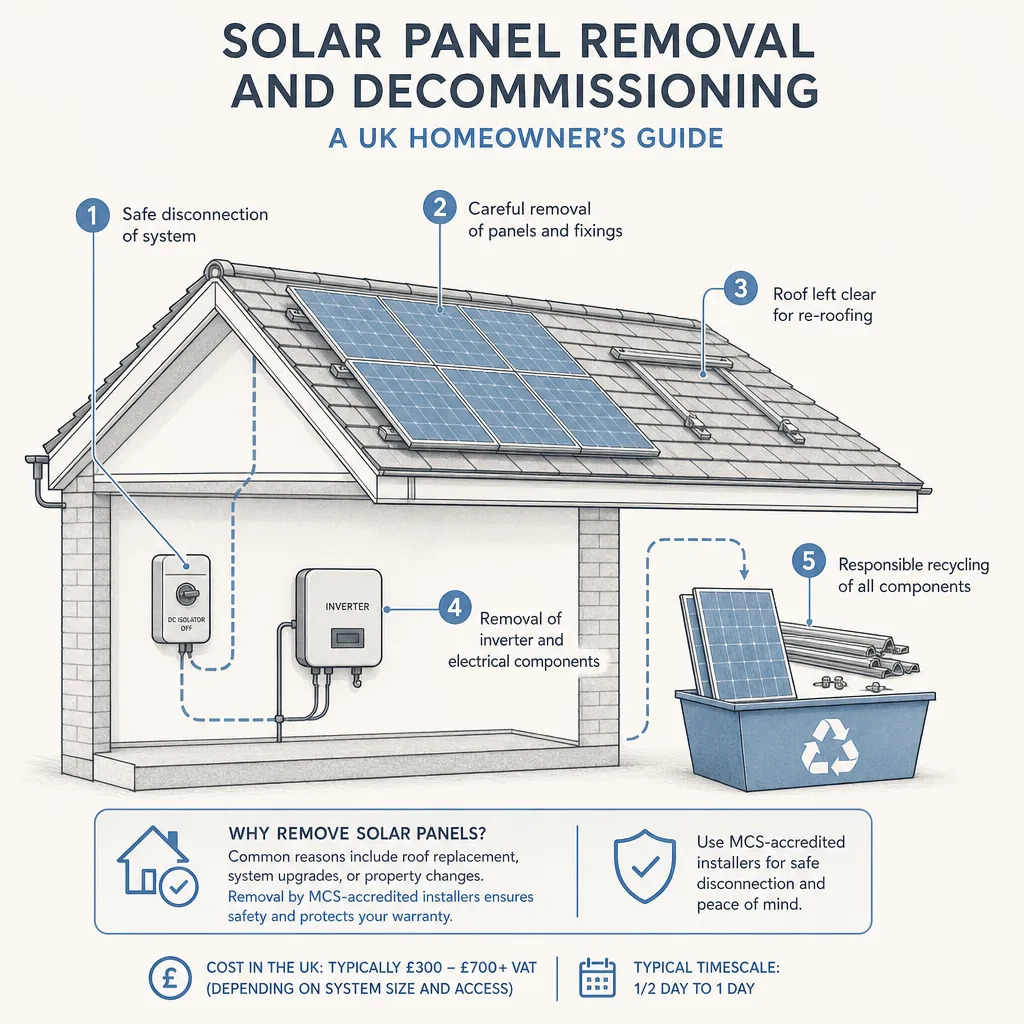
Solar Panel Removal and Decommissioning
Solar panel removal requires a qualified electrician or MCS-accredited installer to isolate and disconnect live DC cabling before any physical work begins — the cables carry voltage whenever daylight hits the panels, even with the inverter off.
 Energy & Retrofit
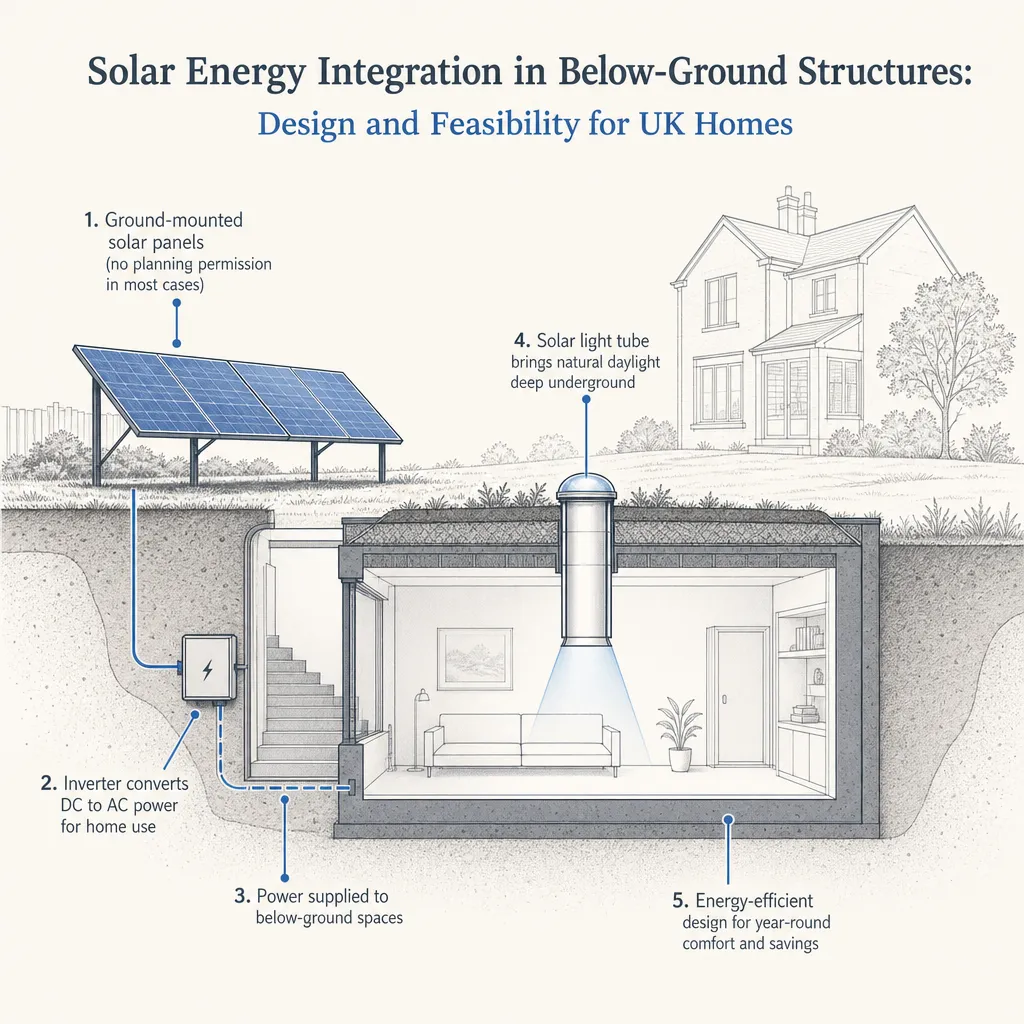
Solar Energy Integration in Below-Ground Structures: Design and Feasibility
Below-ground structures cannot host solar panels on their own roofs but can use surface-mounted panels connected via cable runs, solar light tubes for daylighting, and battery storage.
 Energy & Retrofit
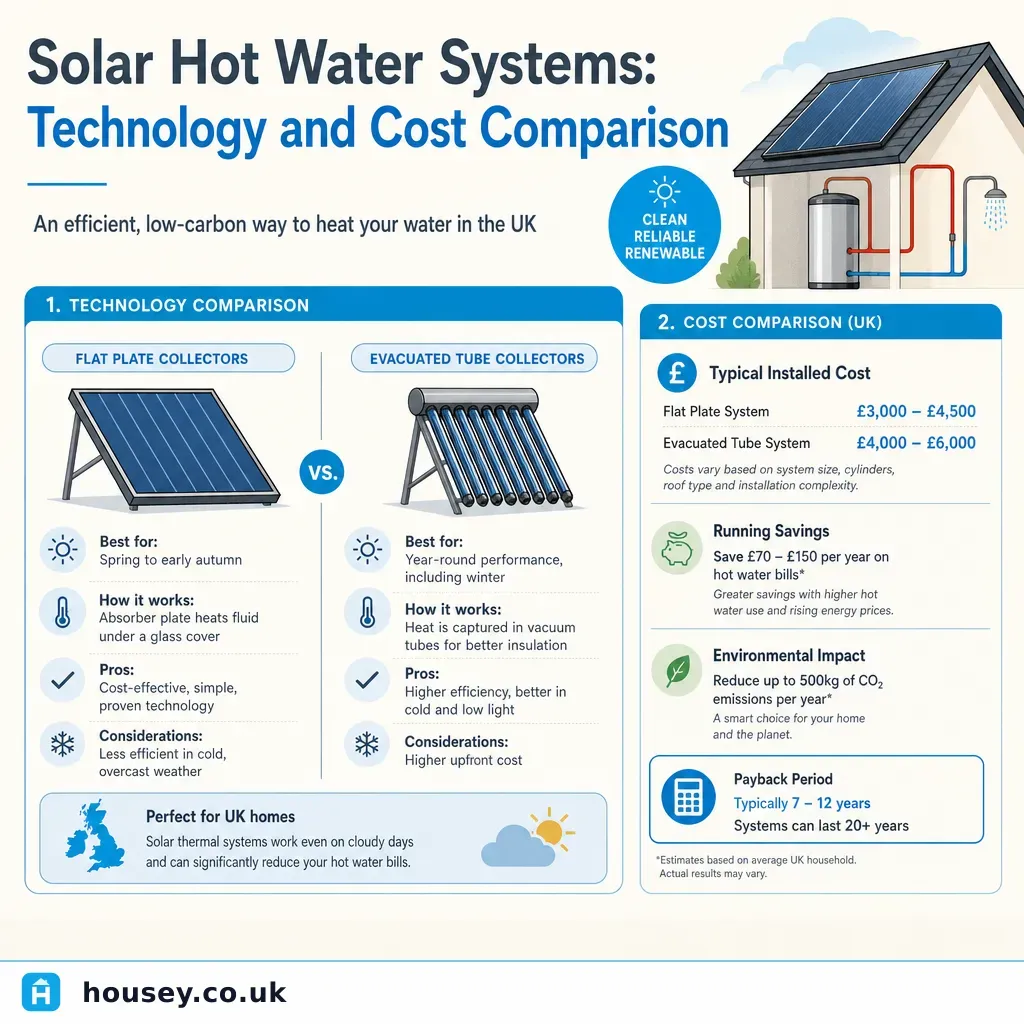
Solar Hot Water Systems: Technology and Cost Comparison
Solar thermal systems use roof-mounted collectors to heat domestic hot water via a glycol circuit and twin-coil cylinder.
 Energy & Retrofit
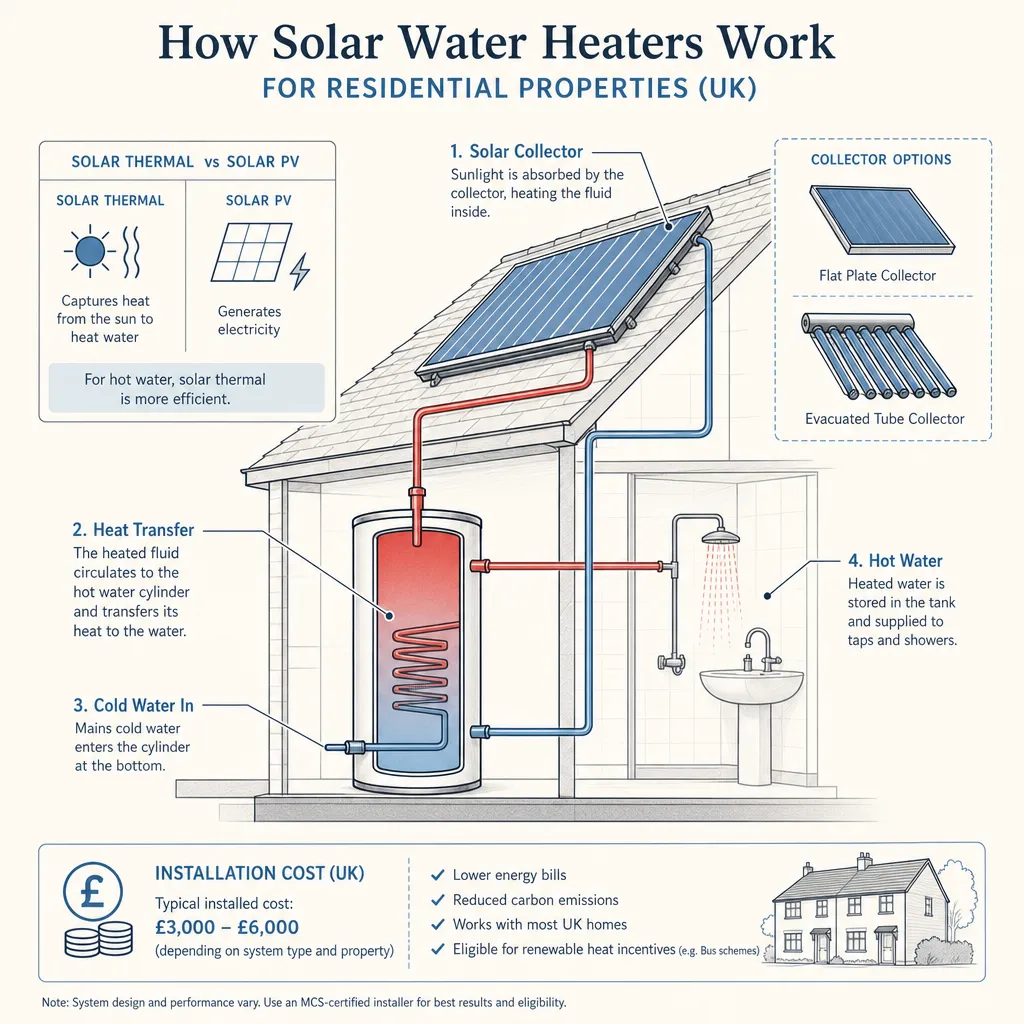
How Solar Water Heaters Work for Residential Properties
Solar water heaters use roof-mounted collectors to capture heat from sunlight and transfer it to a hot water cylinder via a fluid circuit.
 Energy & Retrofit
Renewable Energy Technologies for Homes
UK homes can choose from solar photovoltaic panels, air source heat pumps, ground source heat pumps, and battery storage as the main residential renewable technologies.