Solar Panels: A Comprehensive Buying and Installation Guide
By Housey · Last reviewed 11th of May 2026
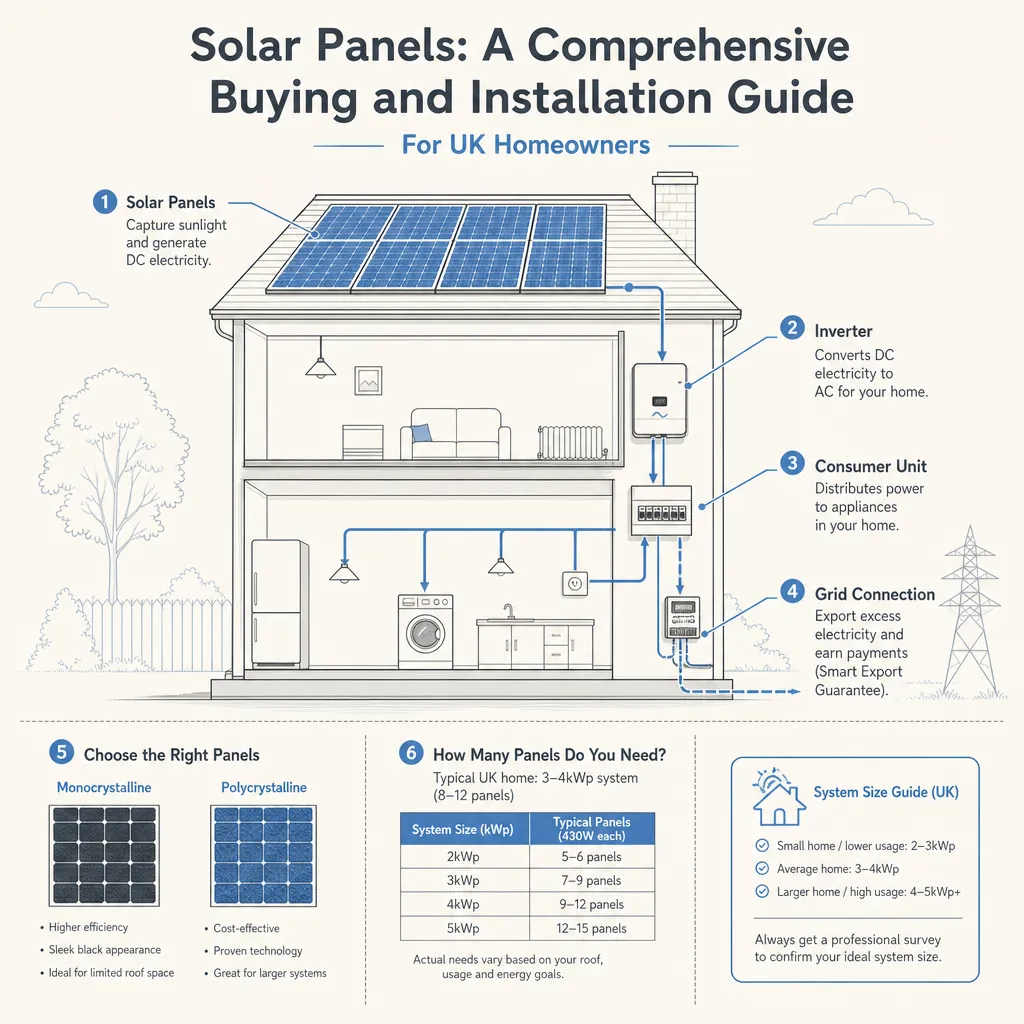
Solar Panels: A Comprehensive Buying and Installation Guide
For many UK homeowners, solar panels represent a long-term financial and environmental commitment rather than a straightforward product purchase — the right system for a 1970s semi in the East Midlands may differ considerably from what suits a new-build in Surrey. Getting the specification right before signing a contract matters: undersized systems leave money on the table, oversized ones add unnecessary upfront cost, and the wrong inverter or panel type can reduce generation significantly if your roof has shading or an awkward orientation.
Key points
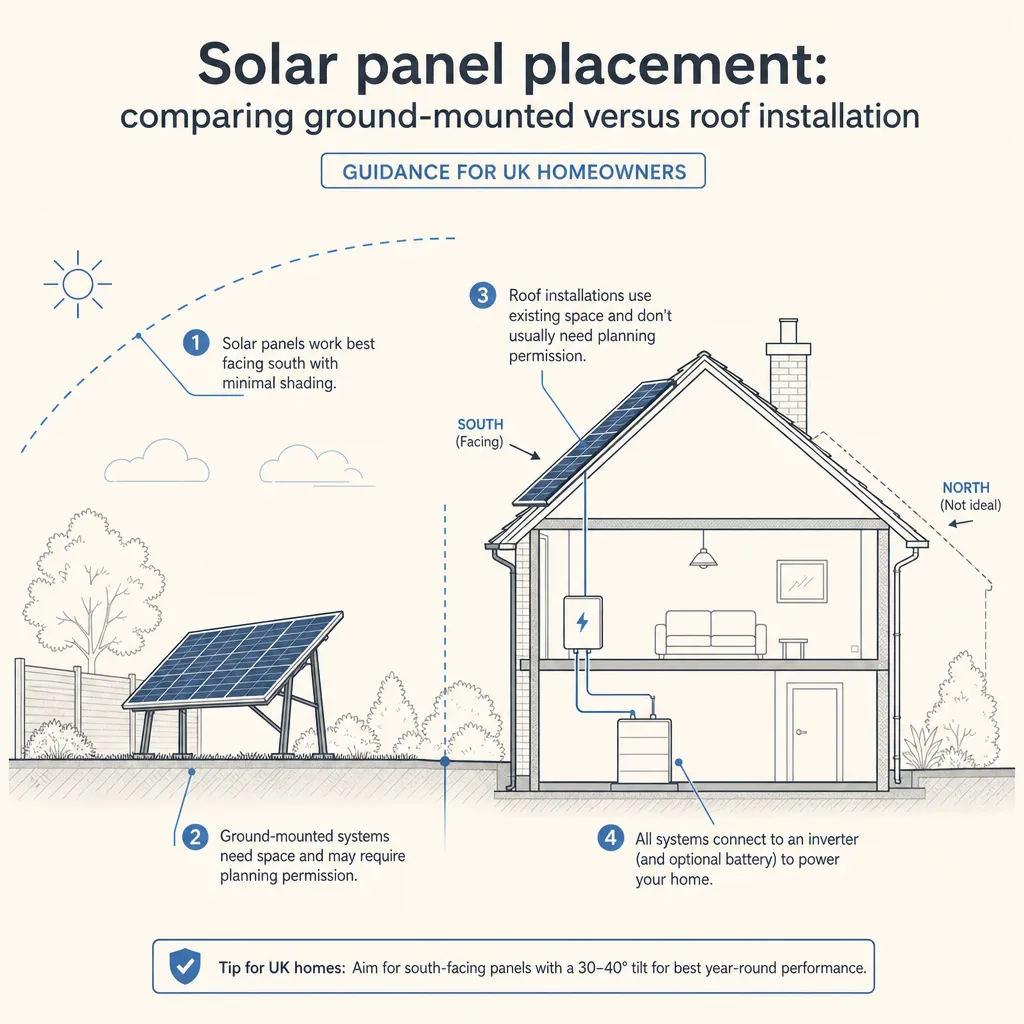
- A south-facing roof pitched at 30–40° gives the best UK generation; east- or west-facing roofs typically produce 15–20% less annually.
- The Microgeneration Certification Scheme (MCS) accredits both solar products and installers; only MCS-certified installations qualify for the Smart Export Guarantee and most capital grant schemes.
- Monocrystalline panels typically achieve 20–23% efficiency, compared to 15–17% for polycrystalline, making them better suited to smaller or partially shaded UK roofs.
- A standard 3–4 kWp system using 8–12 panels suits most three-bedroom UK homes; actual sizing should be based on annual kWh consumption, not bedroom count.
- Adding battery storage can increase self-consumption from around 25–35% (without storage) to 50–70% for a typical UK household, according to Energy Saving Trust guidance.
What system size do you need?
The starting point for sizing a solar system is your annual electricity consumption in kWh, not the number of bedrooms. A typical UK household uses around 3,500 kWh per year (Ofgem figures), but homes with electric vehicles, heat pumps, or regular home-working patterns often use significantly more.
- Choose a 3 kWp system (7–9 panels) if your annual consumption is below 3,000 kWh or roof space is limited.
- Choose a 4 kWp system (10–12 panels) if annual consumption is 3,000–5,000 kWh and roof space allows.
- Choose a 5–6 kWp system if consumption exceeds 5,000 kWh, you plan to add a heat pump or EV charger, or you have a large south-facing roof available.
- Ask your installer to model generation against your actual energy bills if your usage is atypical.
- Consult a retrofit coordinator if you are planning multiple measures — solar, heat pump, battery — simultaneously, as system interactions affect the correct sizing of each component.
A solar survey will assess actual roof area, structural suitability, shading from trees or chimneys, orientation, pitch, and existing electrical infrastructure — all of which affect the recommended system size more reliably than any general rule of thumb.
Panel types compared
Three panel technologies dominate the residential UK market. For most homes, monocrystalline is the practical default; the choice between types mainly affects space efficiency and cost.
Panel type | Typical efficiency | Best for | Not ideal for | Typical warranty |
|---|---|---|---|---|
Monocrystalline | 20–23% | Limited roof space; partial shading with optimisers | Budget installs where roof space is plentiful | 25 yrs product; 25–30 yrs performance |
Polycrystalline | 15–17% | Large unshaded roofs where space is not a constraint | Small roofs or east/west orientations | 10–25 yrs product; 25 yrs performance |
Thin-film (e.g. CIGS) | 10–13% | Flat roofs; irregular shapes; building-integrated use | Standard pitched domestic roofs | Varies by manufacturer |
For a typical UK semi-detached with 20–30 m² of usable roof area, monocrystalline panels are usually the most practical choice. Polycrystalline may suit a large bungalow with an unshaded south-facing roof where fitting enough panels is not a constraint.
Inverter options
The inverter converts direct current (DC) electricity from the panels to alternating current (AC) for use in your home. Three main types are common in UK residential installations.
String inverter: one central unit for the whole system. Lower upfront cost; simpler maintenance. Performance is reduced if any single panel is shaded, as the weakest panel constrains the output of the whole string.
Microinverters: individual units on each panel. Each panel performs independently, so shading on one panel does not drag down the others. Higher upfront cost; well suited to roofs with partial shading or panels on multiple orientations.
DC optimisers with string inverter: panel-level optimisation combined with a single central inverter. Often a cost-effective middle ground for roofs with mild or intermittent shading.
For a straightforward south-facing unshaded roof, a string inverter from an established manufacturer is usually adequate. If your roof has chimneys, dormers, or nearby trees causing shading, microinverters or optimisers are worth the additional cost.
Battery storage: is it worth adding?
Domestic battery storage is increasingly common as import electricity prices have risen. A typical residential battery stores 5–10 kWh, which in summer can cover much of a household's evening consumption from daytime solar generation.
The Energy Saving Trust estimates that adding a 5 kWh battery to a 3.5 kWp system can increase self-consumption from around 30% to around 55%, though actual figures vary with household usage patterns.
Key considerations:
- Battery storage currently attracts 0% VAT when installed alongside solar panels; check current HMRC guidance for the position on retrofitted storage.
- Most batteries carry a warranty of 10 years or a specified cycle count (typically 4,000–6,000 cycles).
- Confirm your inverter is battery-compatible if you plan to retrofit storage later — some string inverters require a separate hybrid inverter or an AC-coupled battery unit.
MCS accreditation: why it matters
The Microgeneration Certification Scheme (MCS) certifies both solar products and the installers who fit them. Using an MCS-accredited installer with MCS-certified products is required to:
- Receive Smart Export Guarantee (SEG) payments for surplus exported generation
- Access ECO, Home Upgrade Grant, and other capital grant schemes
- Ensure building regulations notification under Part P is handled by the installer as a registered competent person
MCS accreditation also provides access to the scheme's consumer protection framework, including workmanship warranties. Always verify a proposed installer's current MCS status at mcscertified.com before signing a contract.
Pre-installation checklist
Before accepting a quote or signing a contract, confirm the following:
Planning permission and building regulations
Most domestic solar panel installations in England, Wales, and Scotland are permitted development and do not require planning permission, provided they meet the relevant size limits and the property is not a listed building or in a conservation area subject to additional restrictions.
In England, key permitted development constraints include: panels must not protrude more than 200mm from the roof surface, and must not be installed on a wall or roof slope facing a highway if they would project beyond the roof plane.
Listed buildings typically require listed building consent; flats and maisonettes may have leasehold constraints. Always check your specific situation with your local planning authority or via the Planning Portal before proceeding.
Building regulations notification under Part P (electrical installations in dwellings) must be handled by your installer. MCS-accredited installers are registered to self-certify this work.
When to get professional help
Commission a solar survey before accepting any quote if your roof is older than 20 years, has visible defects, carries a complex layout, or your property has had previous alterations. Red flags that warrant a survey before proceeding include:
- Cracked, missing, or slipped tiles visible from ground level
- A previous loft conversion, dormer, or other roof alteration
- Evidence of damp or condensation in the loft space
- Significant shading from trees, extensions, or neighbouring buildings
- Uncertainty about whether the roof structure can carry the additional weight of panels and mounting hardware
How Housey can help
Housey connects you with MCS-accredited solar installers and independent surveyors. Book a solar survey to get a property-specific assessment of your roof's suitability, an accurate generation model, and a clear picture of which system size and configuration suits your home before committing to any equipment purchase.
Frequently asked questions
How many solar panels do I need for a three-bedroom house in the UK?
Most three-bedroom UK homes are suited to a 3–4 kWp system using 8–12 panels, based on typical annual consumption of around 3,500 kWh. Actual requirements depend on your electricity usage, roof area, orientation, and whether you plan to add an EV charger or heat pump. A solar survey will give a more accurate recommendation than bedroom count alone.
Do solar panels work on a north-facing roof in the UK?
North-facing panels generate significantly less than south-facing equivalents — typically 30–40% less annually — making them economically marginal for most households. East- or west-facing roofs perform considerably better, losing around 15–20% compared to south. If the only usable roof slope faces north, an independent survey assessment is recommended before committing to a purchase.
How long does solar panel installation take?
Most residential installations take 1–2 days for the physical work once scaffolding is in place. Including scaffolding erection and removal, most projects complete within a week. Waiting times for MCS certificate issuance and Smart Export Guarantee application processing can extend the overall process by several additional weeks.
Can I install solar panels myself in the UK?
Solar panel installation involves electrical work at the consumer unit and grid connection, which must be carried out by a competent person under Part P of the Building Regulations. DIY installation also disqualifies you from SEG payments, MCS workmanship warranties, and most grant schemes. Instructing an MCS-accredited installer is required for both financial and regulatory compliance.
Sources and further reading
- Solar panels: are they worth it? — Energy Saving Trust
- Smart Export Guarantee — Ofgem
- MCS installer database — Microgeneration Certification Scheme
- Solar panels permitted development — Planning Portal
- VAT relief on energy-saving materials — GOV.UK
- Typical domestic electricity consumption — Ofgem
Useful next reads
 Energy & Retrofit
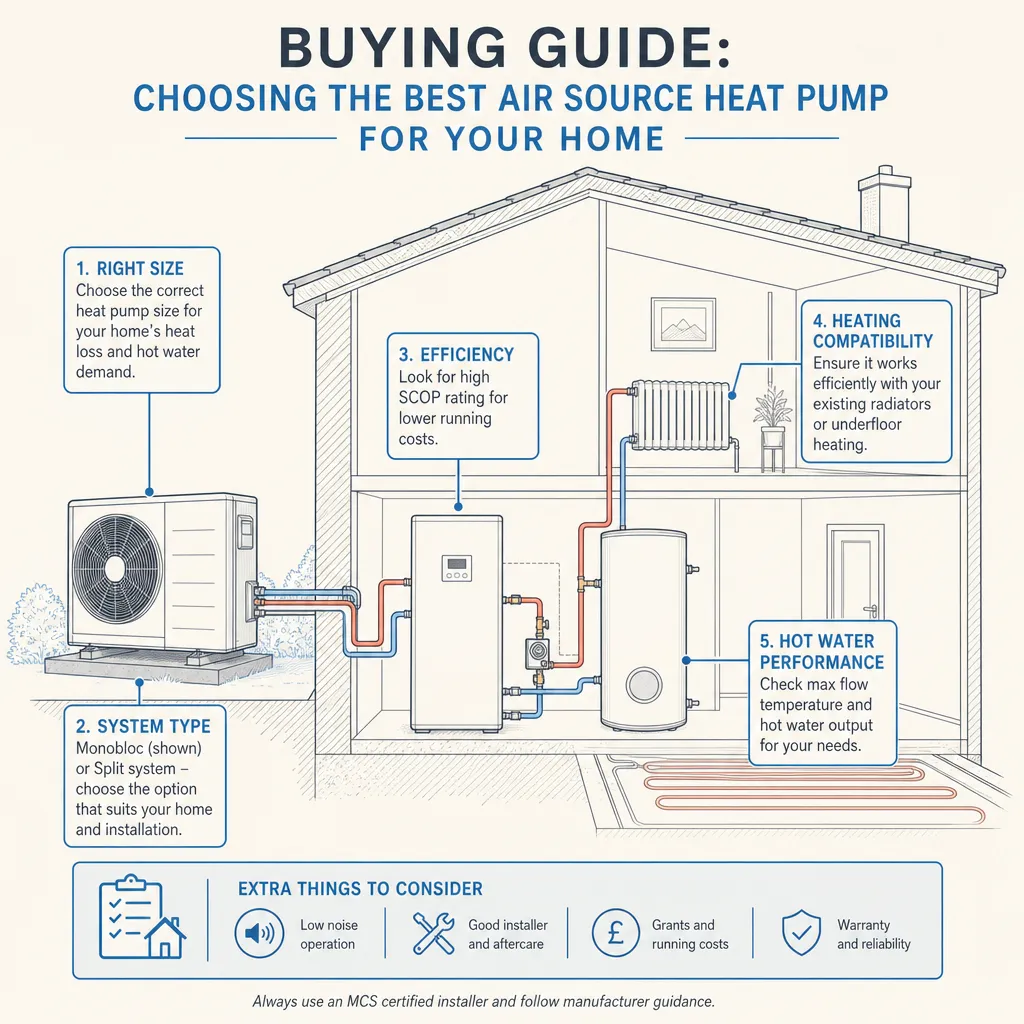
Buying guide: choosing the best air source heat pump for your home
Choose an air source heat pump by matching output to your home's BS EN 12831 heat loss calculation — not floor area alone.
 Energy & Retrofit
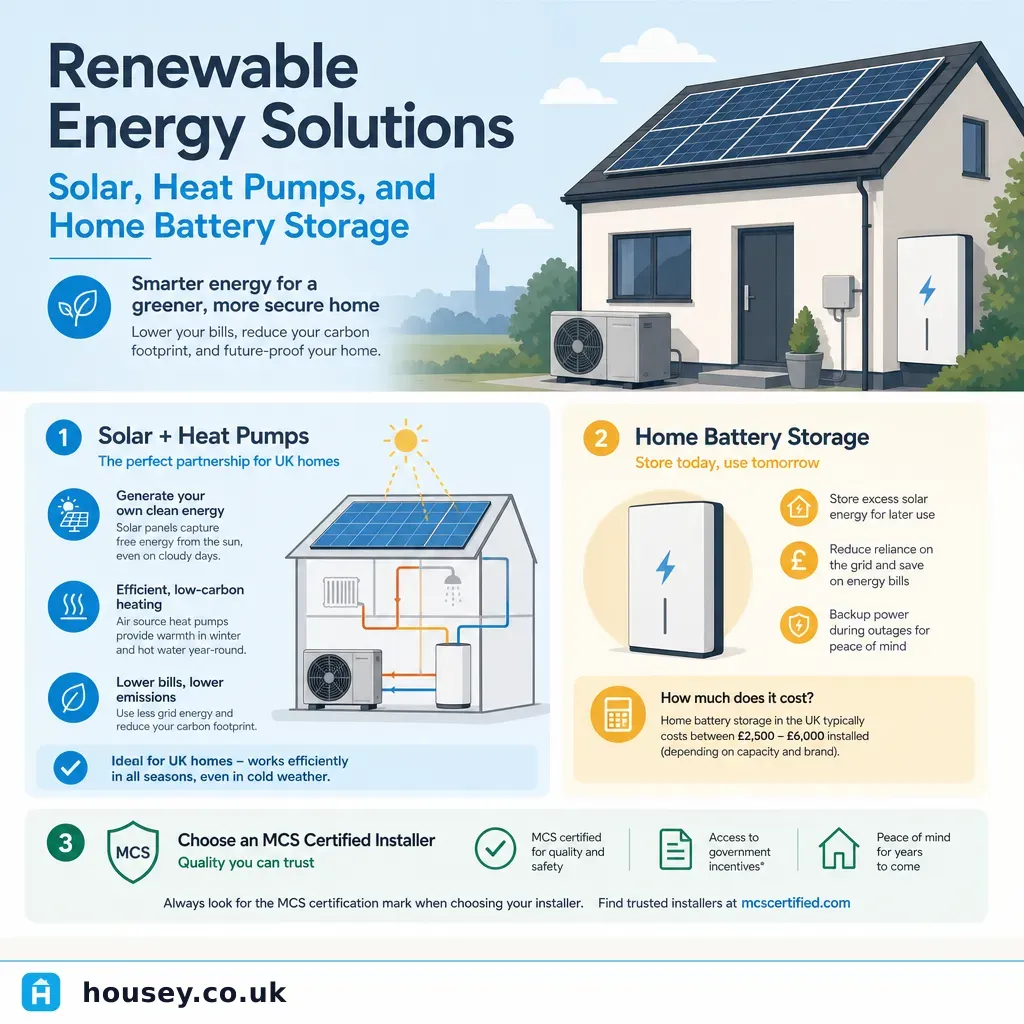
Renewable Energy Solutions: Solar, Heat Pumps, and Home Battery Storage
UK homeowners can reduce energy bills and carbon emissions by combining solar PV panels, air source heat pumps, and home battery storage.
 Energy & Retrofit
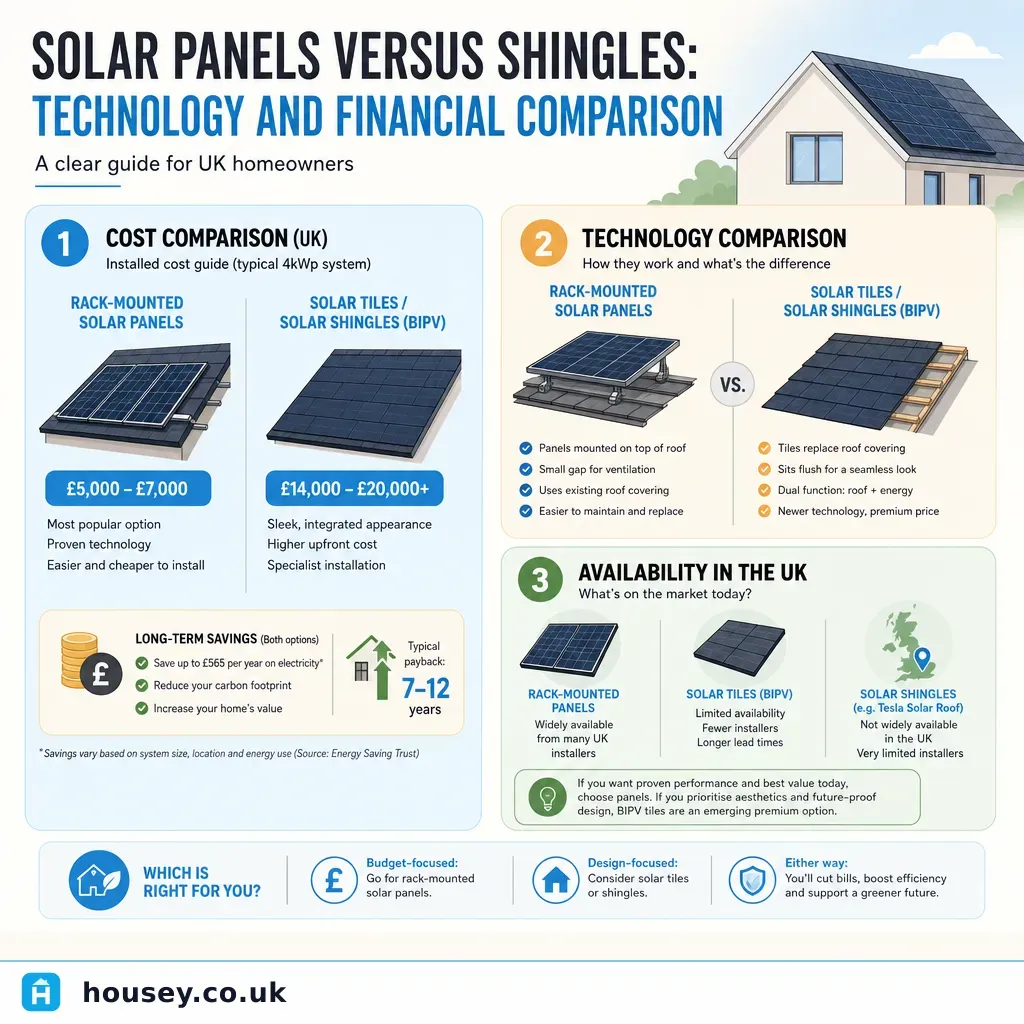
Solar Panels Versus Shingles: Technology and Financial Comparison
Rack-mounted solar panels cost less and generate more electricity per square metre than solar shingles, making them the practical choice for most UK homes where the existing roof is in good condition.
 Energy & Retrofit
Solar panel placement: comparing ground-mounted versus roof installation
Roof-mounted solar panels suit most UK homes and cost less to install, but ground-mounted arrays offer more flexibility over angle and orientation.
 Energy & Retrofit
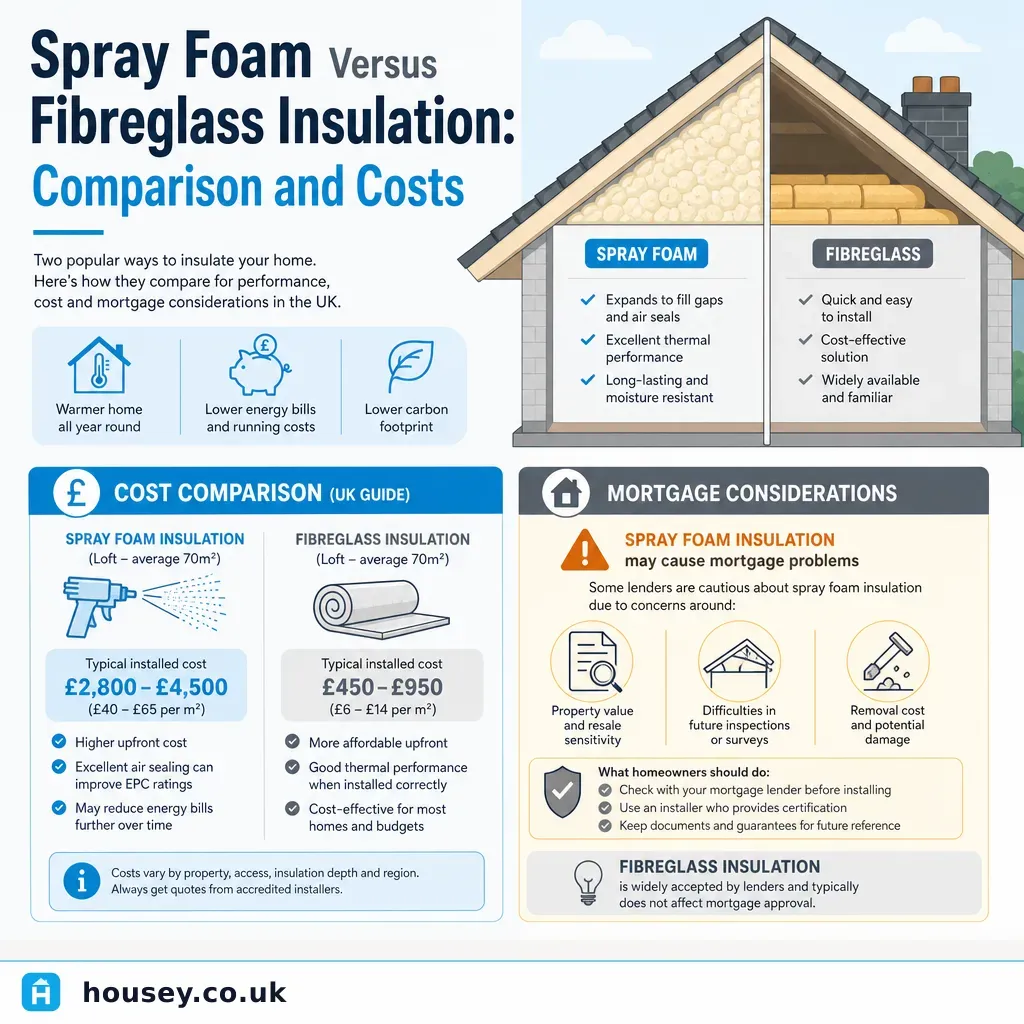
Spray Foam Versus Fibreglass Insulation: Comparison and Costs
Fibreglass (glass wool) insulation is the most widely used and mortgage-friendly choice for UK lofts and cavities, typically costing £300–£600 for a standard semi-detached loft.