Solar Panels Versus Shingles: Technology and Financial Comparison
By Housey · Last reviewed 10th of May 2026
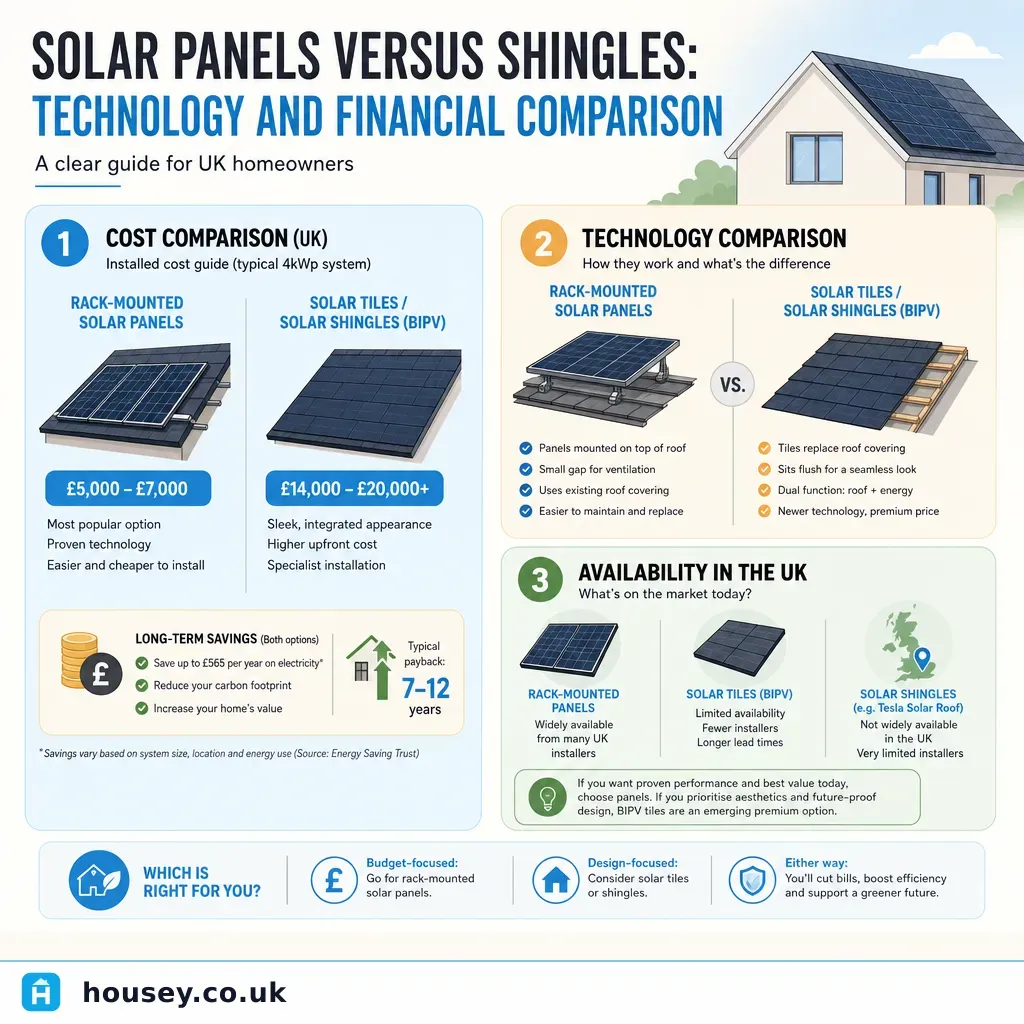
Solar Panels Versus Shingles: Technology and Financial Comparison
Homeowners exploring solar energy increasingly face a choice that did not widely exist a decade ago: rack-mounted solar panels fitted on top of an existing roof, or solar shingles — also known as solar tiles or BIPV tiles — that replace the roof covering entirely. The decision matters because the two technologies differ substantially in upfront cost, aesthetics, energy output, and installation requirements. The right answer depends heavily on your roof's condition, your budget, your planning context, and whether you have works already planned that make integration more cost-effective.
Key points
- Rack-mounted solar panels have a lower upfront cost and higher cell efficiency (20–22%) than solar shingles (10–20%), making them the more cost-effective choice for most homes where aesthetics are not the primary concern.
- Solar shingles replace the roof covering itself and are most economical when a full roof replacement is already planned or required.
- Both technologies qualify for the Smart Export Guarantee (SEG) when installed by an MCS-certified installer using MCS-certified products.
- Rack-mounted panels typically cost £5,000–£8,000 installed for a 4 kWp system; solar shingle systems for equivalent output typically cost £15,000–£25,000 or more.
- In conservation areas or on prominently visible roofs, integrated solar tiles may receive more favourable planning consideration than rack-mounted panels — though both require consent on listed buildings.
How each technology works
Both technologies use photovoltaic (PV) cells to convert sunlight into direct current (DC) electricity, which an inverter converts to alternating current (AC) for household use. The fundamental physics is identical; the differences are in how the cells are packaged, mounted, and integrated with the building.
Rack-mounted solar panels use rigid modules — typically mono-crystalline silicon in 2026 — fixed to a metal frame secured to the existing roof structure. The roof covering beneath remains intact; panels sit above it on standoffs, and the roof continues to function independently.
Solar shingles (BIPV tiles) replace the conventional tile or slate roof covering. PV cells are embedded within or behind the tile itself. Some systems mix active generating tiles with passive matching tiles to cover areas unsuitable for generation, maintaining a consistent roof appearance.
Side-by-side comparison
Feature | Rack-mounted panels | Solar shingles |
|---|---|---|
Typical cell efficiency (2026) | 20–22% (mono-crystalline) | 10–20% |
Indicative installed cost (4 kWp) | £5,000–£8,000 | £15,000–£25,000+ |
Roof covering replaced? | No | Yes |
Best timing for installation | Any time roof is in sound condition | During a full planned roof replacement |
Planning permission (England) | Usually permitted development; 200 mm protrusion rule applies | Same PD rules apply; may be viewed more favourably in sensitive areas |
Aesthetics | Visible modules on roof | Low-profile, integrated appearance |
Typical power output warranty | 25–30 years | 20–30 years; check weatherproofing warranty separately |
MCS eligibility for SEG | Yes | Yes |
Battery storage compatible | Yes, with hybrid inverter | Yes, with hybrid inverter |
Suitable for listed buildings? | Requires planning consent | Requires planning consent |
Indicative UK costs, last reviewed 2026-05-10. Costs vary by roof size, complexity, location, and specification. Obtain at least three written quotes.
Financial comparison: a worked UK property scenario
Property: 1930s semi-detached in the East Midlands. South-facing rear roof slope. Roof is 12 years old and in good condition. Annual household electricity consumption: 3,500 kWh. No immediate plans to re-roof.
Option A: 4 kWp rack-mounted panels
- Estimated installed cost: £6,500
- Estimated annual generation: approximately 3,400 kWh (based on Energy Saving Trust regional estimates for the East Midlands)
- Estimated annual bill savings: £680–£850 (at 20–25p/kWh; rate-dependent)
- SEG export income (estimated 15% exported at ~5p/kWh): approximately £25/year
- Indicative simple payback: 7–9 years
Option B: Solar shingles (equivalent 4 kWp output)
- Estimated installed cost: £20,000 (roof in good condition; no re-roofing cost saving applicable)
- Estimated annual generation and bill savings: similar to Option A
- Indicative simple payback: approximately 22–28 years
Scenario variation — roof due for replacement: If the same property needed a full re-roof costing £9,000–£12,000, that spend could be redirected towards a BIPV tile system, reducing the effective premium for the integrated system and bringing the payback period significantly closer to that of the panel option.
These figures are illustrative only. Your actual costs, generation, and savings will vary. Obtain a site-specific assessment from an MCS-certified installer.
Which should you choose?
- Choose rack-mounted panels if your roof is in sound condition and you do not plan to re-roof within the next five years, you want the lowest upfront cost per kWp, you want maximum generation from a given roof area, or payback period is your primary metric.
- Choose solar shingles if you are already planning a full roof replacement and can offset roofing costs against the BIPV system, aesthetics are a priority and panels would be prominently visible, your property is in a conservation area where rack-mounted panels might be viewed less favourably, or you are undertaking a new build or major renovation where design integration is possible from the outset.
- Ask an independent specialist if your roof has mixed orientations, complex geometry, or significant shading — either technology may underperform and the trade-offs need careful assessment.
- Check with your local planning authority if your property is listed, in a conservation area, or subject to an Article 4 direction.
Installation and roof implications
Rack-mounted panels require a Part P registered electrician (such as an NICEIC or NAPIT member) for the electrical connection. A structural check is advisable to confirm the roof can carry the additional load — typically 10–15 kg/m² for panels and mounting frame. The roof covering beneath must be in good condition; panels fitted over failing tiles can trap moisture and accelerate deterioration.
Solar shingles involve a full or partial roof strip and relay, meaning a qualified roofer with solar experience with BIPV experience must be involved alongside the electrical installer. This also creates an opportunity to improve roof insulation at rafter level, subject to Building Regulations Part L requirements.
A professional solar survey is advisable before committing to either technology — it will assess orientation, shading, pitch, structural suitability, and generate an output estimate specific to your property.
When to get professional help
Both technologies require installation by MCS-certified operatives to qualify for the Smart Export Guarantee. Seek specialist advice if:
- You want an independent assessment of the two technologies for your specific property, rather than relying solely on an installer's recommendation.
- Your roof has signs of defects, movement, or moisture ingress that need addressing before any PV system is fitted.
- Your property is listed or in a conservation area and you are uncertain whether planning consent is needed.
- You want to integrate battery storage and need help specifying a compatible hybrid inverter from the outset.
How Housey can help
Housey connects you with MCS-certified solar specialists and experienced roofers with solar installation experience in your area who can survey your property and provide comparable quotes for both rack-mounted and BIPV tile options. Start with a solar survey to get an independent site assessment before you decide which technology best suits your roof and budget.
Frequently asked questions
Are solar panels or solar shingles better for a Victorian terrace?
It depends on the roof condition and planning context. Victorian terraces often have front-elevation roofs visible from the street; in a conservation area, panels on the front slope may require planning consent, while integrated tiles may be considered more sympathetic — though both require planning approval for listed buildings. On an unrestricted rear slope, rack-mounted panels typically offer a shorter payback period.
Do both solar panels and solar shingles qualify for SEG payments?
Yes, as long as the installation uses an MCS-certified product and is carried out by an MCS-certified installer. Smart Export Guarantee payments are technology-neutral. You need to register with an SEG-licensed energy supplier to receive export payments — your installer can advise on which suppliers currently offer competitive export rates in your area.
Can I add battery storage to either system?
Yes. Both rack-mounted panels and solar shingles are compatible with battery storage, subject to inverter specification. A hybrid inverter must be specified at installation — retrofitting battery capability to an incompatible inverter is possible but adds cost. Discuss storage requirements with your installer before the system is specified so the right inverter is selected from the outset.
Which system has a longer lifespan?
Both technologies carry power output warranties of 25–30 years based on current manufacturer standards. Solar shingles also fulfil a weatherproofing function; check that the product warranty covers both power output degradation and weatherproofing performance separately, as some manufacturers differentiate the two. Rack-mounted panels leave the roof covering intact, so its independent lifespan is not tied to the panels.
Sources and further reading
- Smart Export Guarantee guidance — GOV.UK
- Solar energy guidance for homeowners — Energy Saving Trust
- Solar panels: permitted development rules — Planning Portal
- MCS certification — Microgeneration Certification Scheme
- Building Regulations Approved Document L — GOV.UK
Useful next reads
 Energy & Retrofit
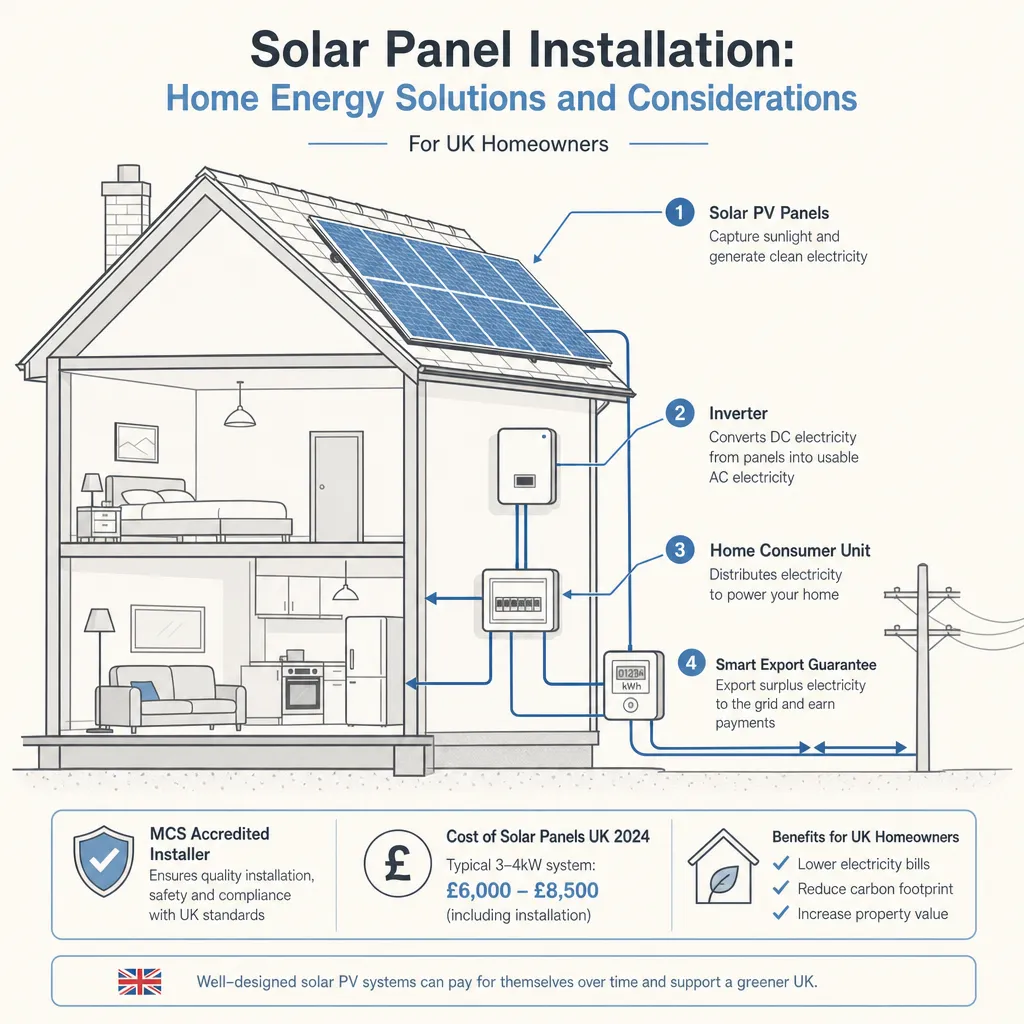
Solar Panel Installation: Home Energy Solutions and Considerations
A typical 4 kWp solar PV system costs £6,000–£9,000 installed and generates around 3,400–3,800 kWh per year on a south-facing roof in southern England.
 Energy & Retrofit
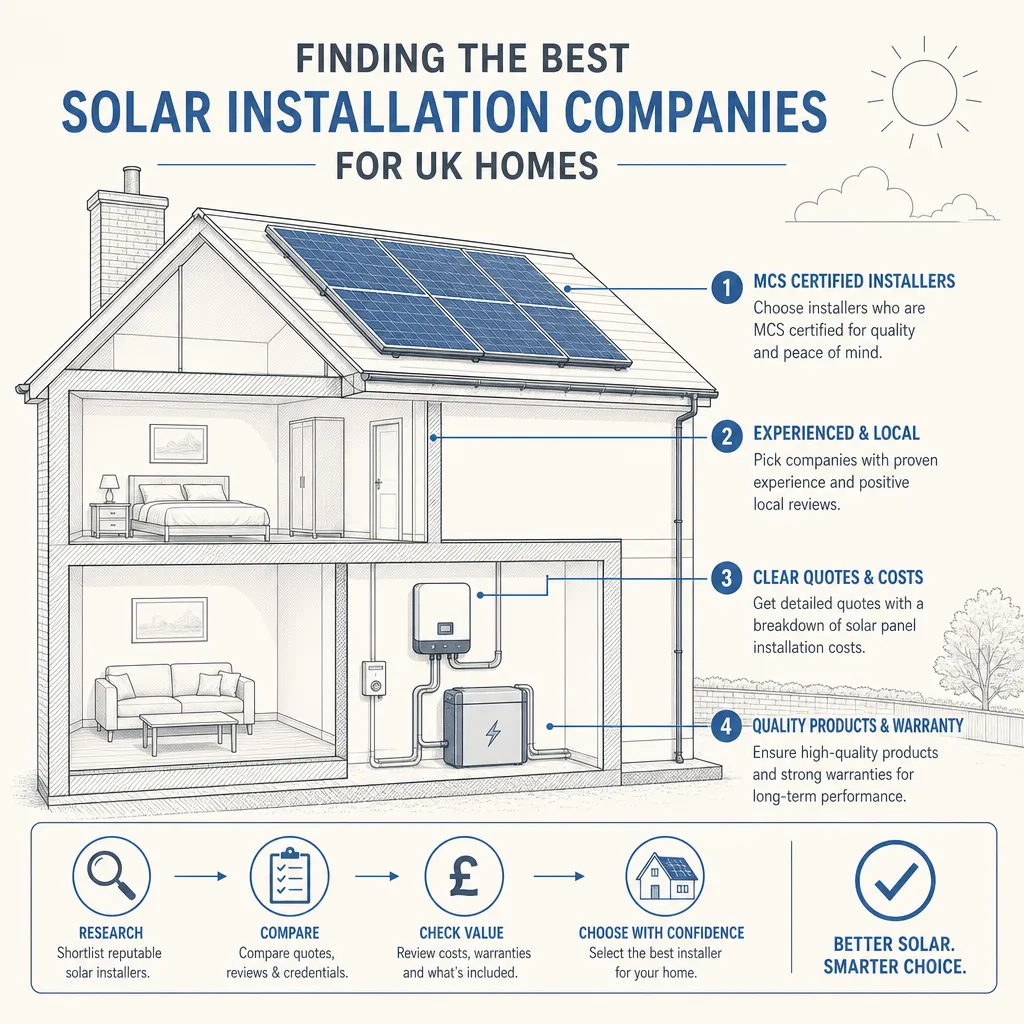
Finding the Best Solar Installation Companies for UK Homes
To find a reliable solar installation company in the UK, look for MCS (Microgeneration Certification Scheme) certification — required for Smart Export Guarantee eligibility — plus NICEIC or NAPIT electrical registration.
 Energy & Retrofit
How Solar Power Technology Works: Technical Fundamentals
Solar panels use photovoltaic cells to convert sunlight directly into DC electricity, which an inverter then converts to 230V AC for household use.
 Energy & Retrofit
Solar Panel Orientation: Optimising Direction and Placement for UK Properties
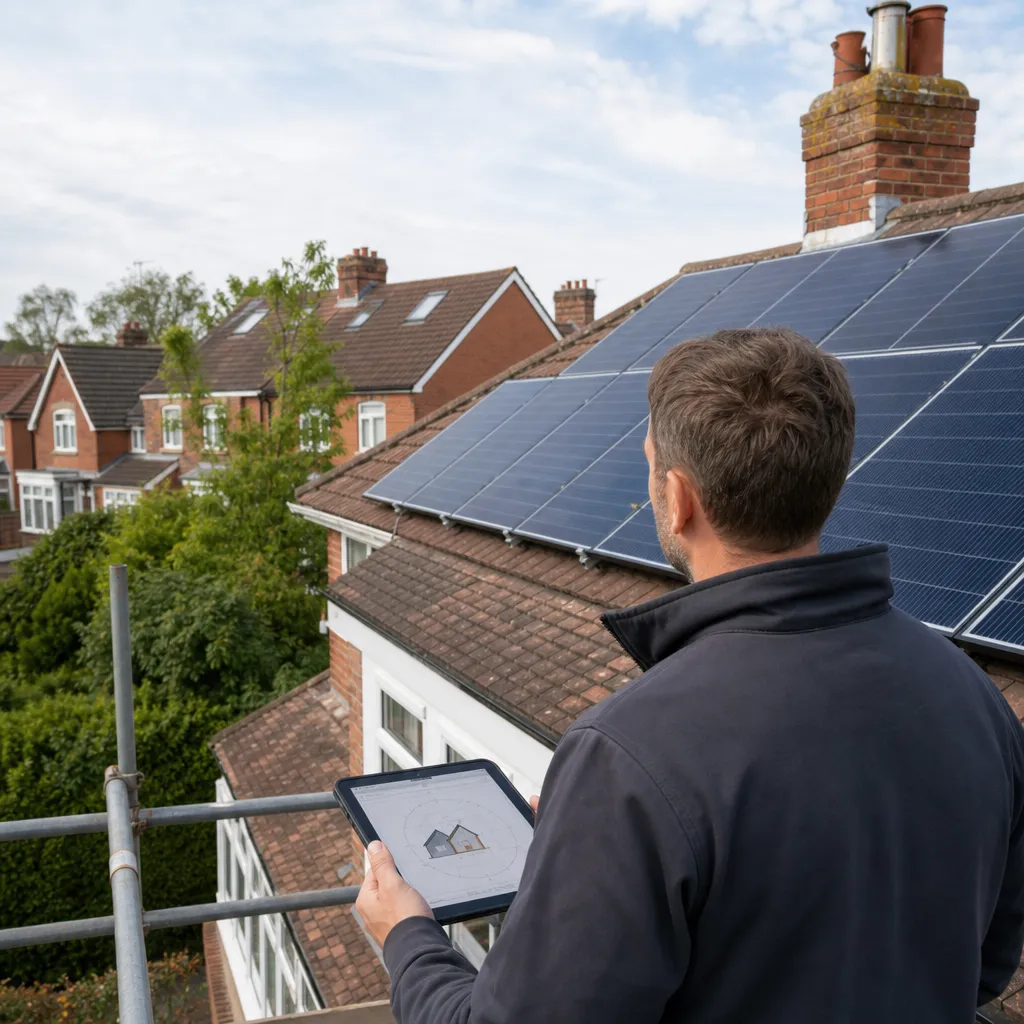
In the UK, solar panels generate the most electricity when facing true south at a pitch of 30–40 degrees.
 Energy & Retrofit
Renewable Energy Solutions: Solar, Heat Pumps, and Home Battery Storage
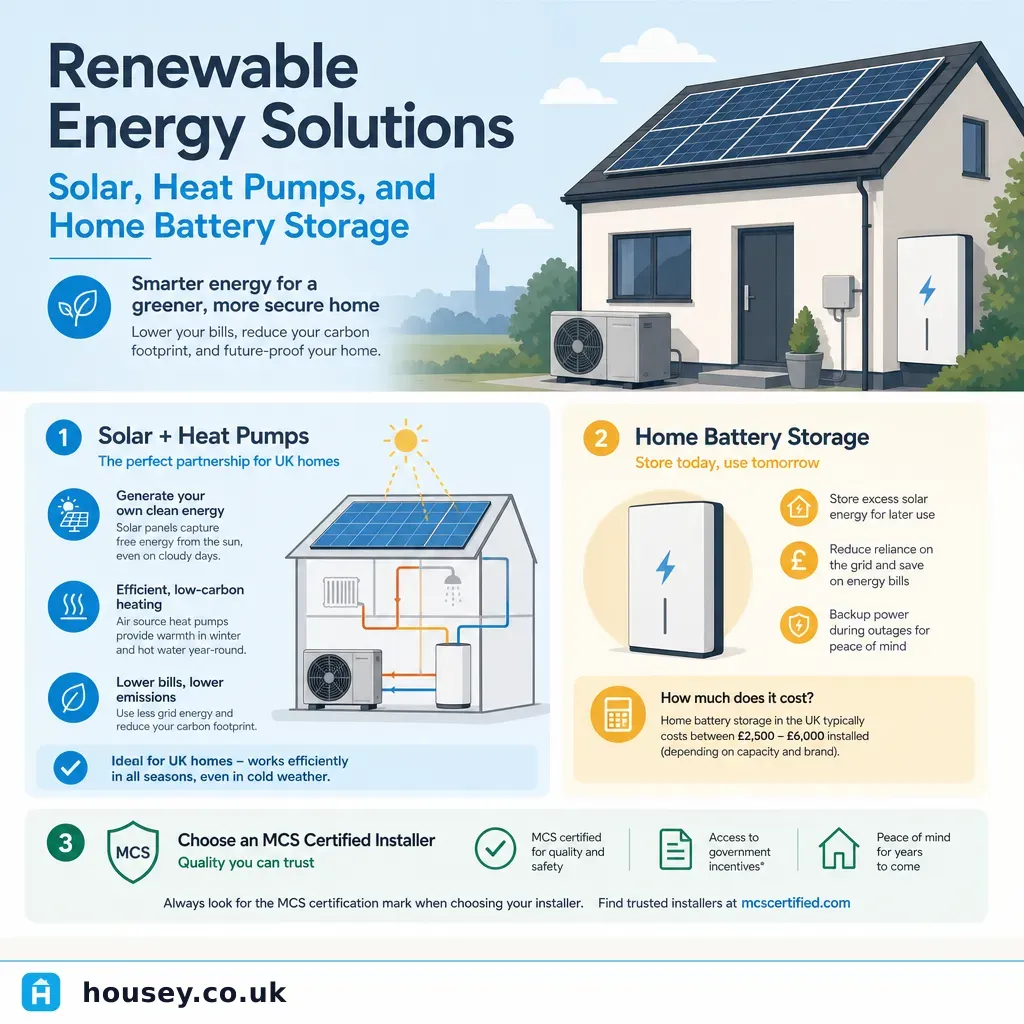
UK homeowners can reduce energy bills and carbon emissions by combining solar PV panels, air source heat pumps, and home battery storage.