Solar Roof Tiles: Technology, Cost, and Integration Options
By Housey · Last reviewed 10th of May 2026
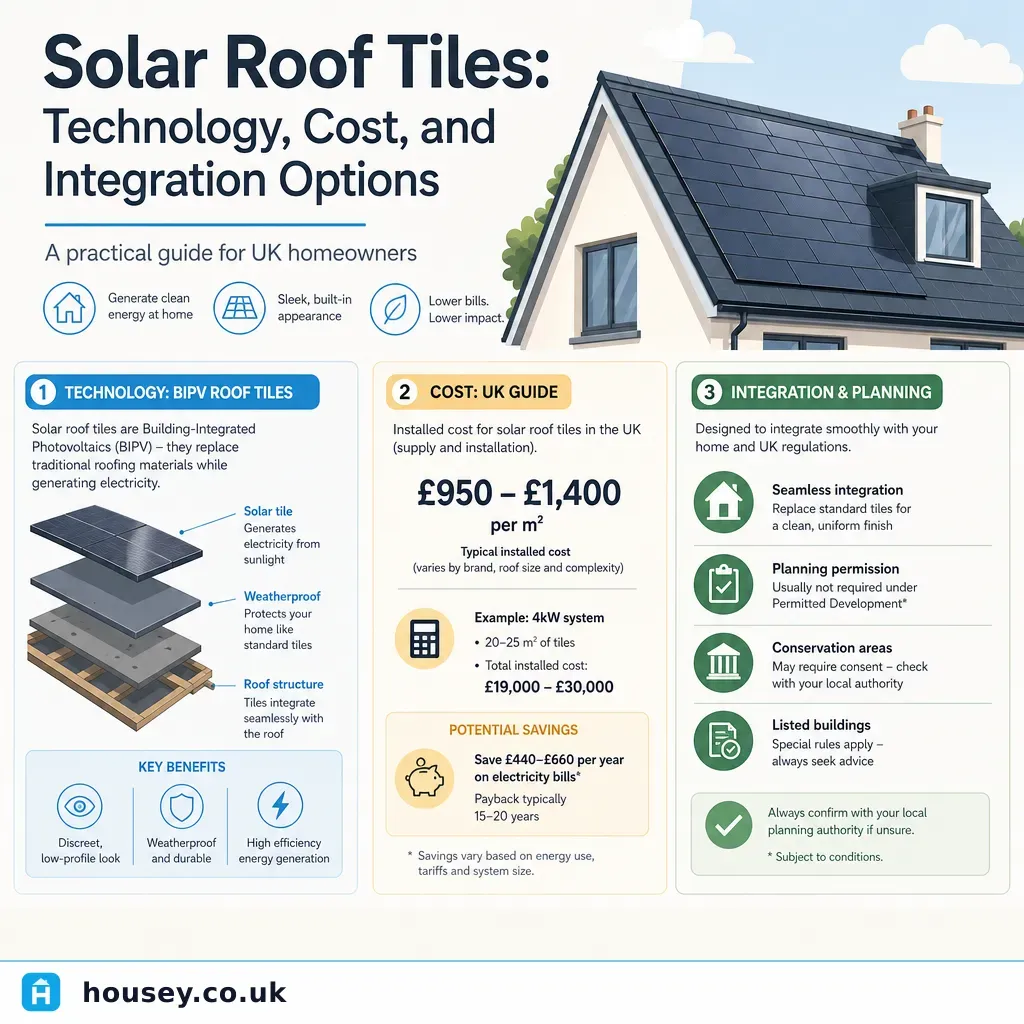
Solar Roof Tiles: Technology, Cost, and Integration Options
Solar roof tiles are increasingly being considered by UK homeowners who want to generate renewable electricity without the visual impact of traditional bolt-on panels. The question of whether they are the right fit typically arises during a roof replacement, new build, or whole-house retrofit — moments when the cost of integration is easier to justify alongside existing works. Understanding the technology, realistic performance, and installation requirements helps you weigh up whether building-integrated photovoltaics (BIPV) make financial and practical sense for your property.
Key points
- Building-integrated photovoltaic (BIPV) tiles replace the roof covering itself and generate electricity; they are distinct from rack-mounted panels, which are mounted on top of an existing roof without replacing it.
- MCS (Microgeneration Certification Scheme) certification is required for both the installer and the product to qualify for Smart Export Guarantee (SEG) export payments.
- Indicative installed costs in 2026 range from approximately £10,000 to £30,000 or more, depending on roof area, tile type, and whether scaffolding and battening works are included.
- Permitted development rights usually allow solar roof tiles on most homes in England, but listed buildings, properties in conservation areas, and Article 4 direction areas require a planning application.
- Current BIPV tile efficiency typically ranges from 10 to 20%, compared with 20–22% for conventional mono-crystalline panels — meaning a larger roof area is needed to achieve equivalent output.
What are solar roof tiles?
Solar roof tiles — also called solar shingles or BIPV tiles — are photovoltaic cells embedded within or made to resemble standard roof tiles. Unlike rack-mounted solar panels, they form part of the weatherproof roof covering itself. When correctly specified and installed, they serve the dual function of protecting the building envelope and generating electricity.
Products available in the UK in 2026 include both fully integrated systems (where every tile on part of the roof generates power) and mixed systems (where active solar tiles are interspersed with matching non-active tiles for aesthetic continuity). Brands such as Tesla Solar Roof, GB-Sol, and Bristile Solar supply products compatible with UK grid connection requirements, though availability and regional installer networks vary.
How the electricity system works
Solar tiles generate direct current (DC), which is converted to alternating current (AC) by an inverter — the same arrangement as with conventional panels. Most modern systems are compatible with battery storage, allowing surplus energy to be stored for use at night or during low-generation periods. Grid export is metered separately, and homeowners on an MCS-certified installation can register for Smart Export Guarantee (SEG) payments from a licensed energy supplier.
Planning permission and building regulations
Under the Town and Country Planning (General Permitted Development) (England) Order 2015 (as amended), solar tiles on a dwelling are generally permitted development — meaning no planning application is required — provided they meet specific conditions:
- The installation does not protrude more than 200 mm from the roof slope or wall surface.
- On a listed building or within its curtilage, permitted development rights do not apply — a full planning application is required.
- In a conservation area or World Heritage Site, permitted development conditions are more restrictive for roof-facing elevations visible from a highway.
Scotland, Wales, and Northern Ireland have separate permitted development regimes; check with your local planning authority before proceeding.
Building Regulations approval under Part L (conservation of fuel and power) and Part P (electrical safety) will also be required. An MCS-certified installer will typically manage building control notification as part of the installation process.
Costs and financial considerations
Indicative UK costs, last reviewed 2026-05-10.
Solar roof tile systems are consistently more expensive per kWp than conventional rack-mounted panels because they incorporate the roofing material itself. The following ranges are illustrative; actual costs depend heavily on roof size, pitch, complexity, and product specification.
System type | Indicative installed cost (2026) | Notes |
|---|---|---|
BIPV tiles (partial coverage, 3–4 kWp) | £10,000–£18,000 | Suits modest roofs; mixed active/non-active tiles |
BIPV tiles (full coverage, 5–7 kWp) | £18,000–£30,000+ | Larger homes; full roof replacement included |
Conventional rack-mounted panels (4 kWp) | £5,000–£8,000 | Mounted on existing roof; lower upfront cost |
Sources: Energy Saving Trust indicative figures; installer market data. Obtain at least three written quotes before committing.
Key cost drivers include:
- Roof area and pitch
- Whether scaffolding is already required (e.g., during a planned re-roof)
- Inverter and battery storage specifications
- Local labour rates
- Complexity of roof shape — hips, dormers, and valleys increase cost
Smart Export Guarantee (SEG)
Homeowners with MCS-certified installations can apply to an SEG-licensed energy supplier to receive payment for surplus electricity exported to the grid. SEG rates are set by individual suppliers and are not fixed by government — check current rates before relying on export income projections. The scheme is technology-neutral and applies equally to BIPV tiles and conventional panels.
Is your roof suitable?
Not every roof is well suited to solar tile integration. Before commissioning a survey, consider:
- Roof orientation: South-facing slopes generate the most energy. East- or west-facing orientations can still be viable but with reduced output. North-facing slopes are generally unsuitable.
- Roof pitch: Most solar tiles are designed for pitches between 20° and 50°. Very low or very steep roofs may not be compatible with all products.
- Shading: Nearby trees, chimney stacks, or adjacent buildings that cast shadows during peak generation hours significantly reduce output.
- Roof condition and age: Solar tiles are most cost-effective when the existing roof covering is already due for replacement; adding them to a sound roof is rarely economical.
- Structural load: Your roofer or structural engineer should confirm the existing roof structure can carry the tile weight before specification.
A professional solar survey will assess orientation, shading, pitch, and structural suitability before you commit to a specification.
Homeowner checklist: before you instruct an installer
When to get professional help
Solar tile installation involves roofing, electrical work, and building control compliance simultaneously — it is not a DIY project. Seek qualified professional help if:
- You are unsure whether your property is subject to planning restrictions (listed building, conservation area, Article 4 direction).
- You want an independent assessment of whether BIPV tiles represent value for money versus conventional panels for your specific roof.
- Your roof has complex geometry, signs of structural weakness, or existing defects that need addressing before installation.
- You want battery storage integrated into the system — inverter and battery compatibility requires careful specification.
An energy-efficiency consultant can provide independent advice on whether solar tiles are the most cost-effective retrofit choice for your home, while a qualified roofer with BIPV experience can assess the structural and weatherproofing implications.
How Housey can help
Housey connects you with MCS-certified solar specialists, experienced roofers with integrated photovoltaic experience, and independent energy-efficiency consultants who can help you weigh up costs and benefits before you commit. Start with a solar survey to get a site assessment and comparable quotes from vetted local professionals.
Frequently asked questions
Do solar roof tiles need planning permission in the UK?
In most cases, no. Under permitted development rights in England, solar tiles on a dwelling are generally allowed without a planning application, provided they do not protrude more than 200 mm beyond the roof slope. Listed buildings, properties in conservation areas, and some Article 4 areas are exceptions — always check with your local planning authority before installation.
How long do solar roof tiles last?
Most manufacturers offer product warranties of 20–30 years for power output, though some mechanical and weathering warranties are shorter. Because the tiles form part of the roof covering, longevity is tied to both photovoltaic performance and weatherproofing integrity. Ask your installer for the power output warranty and the product weatherproofing warranty separately, as they may differ.
Can I add battery storage to a solar tile system?
Yes, provided the inverter specified is battery-compatible — sometimes called a hybrid inverter. Battery storage allows surplus energy generated during the day to be used at night or during cloudy periods. Discuss battery compatibility with your installer before the system is specified, as retrofitting a battery to an incompatible inverter can add significant cost.
Are solar roof tiles eligible for the Smart Export Guarantee?
Yes, as long as the installation uses an MCS-certified product and is carried out by an MCS-certified installer. The Smart Export Guarantee is technology-neutral. You then need to apply to an SEG-licensed energy supplier for an export tariff — your installer can usually advise on which suppliers are currently offering competitive rates.
Are solar tiles more efficient than solar panels?
Currently, no. Most BIPV tiles achieve 10–20% cell efficiency versus 20–22% for high-quality mono-crystalline panels. To generate the same amount of electricity, a solar tile system generally requires a larger roof area. Efficiency is improving as the technology matures, but rack-mounted panels remain the higher-output option per square metre in 2026.
Sources and further reading
- Smart Export Guarantee guidance — GOV.UK
- MCS product certification — Microgeneration Certification Scheme
- Solar panels: permitted development rules — Planning Portal
- Solar energy guidance for homeowners — Energy Saving Trust
- Building Regulations Approved Document L — GOV.UK
Useful next reads
 Energy & Retrofit
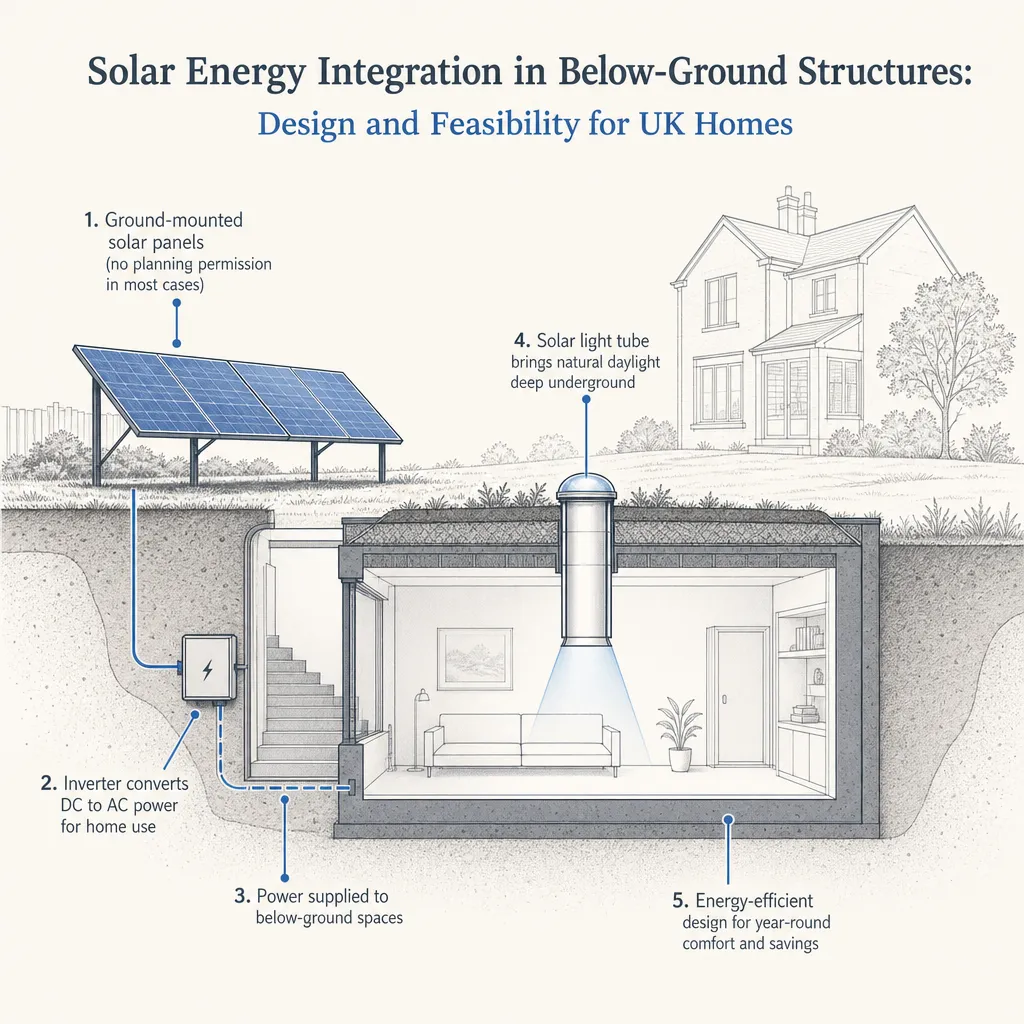
Solar Energy Integration in Below-Ground Structures: Design and Feasibility
Below-ground structures cannot host solar panels on their own roofs but can use surface-mounted panels connected via cable runs, solar light tubes for daylighting, and battery storage.
 Energy & Retrofit
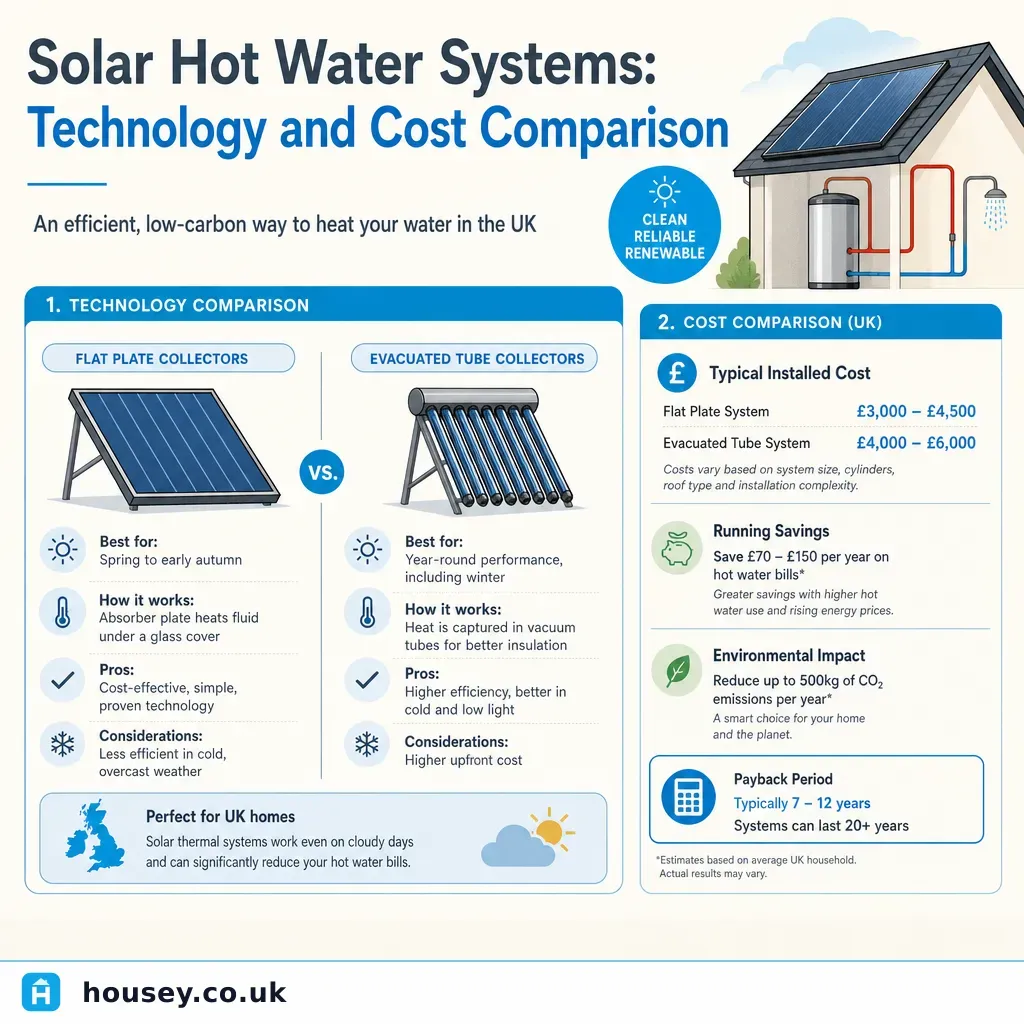
Solar Hot Water Systems: Technology and Cost Comparison
Solar thermal systems use roof-mounted collectors to heat domestic hot water via a glycol circuit and twin-coil cylinder.
 Energy & Retrofit
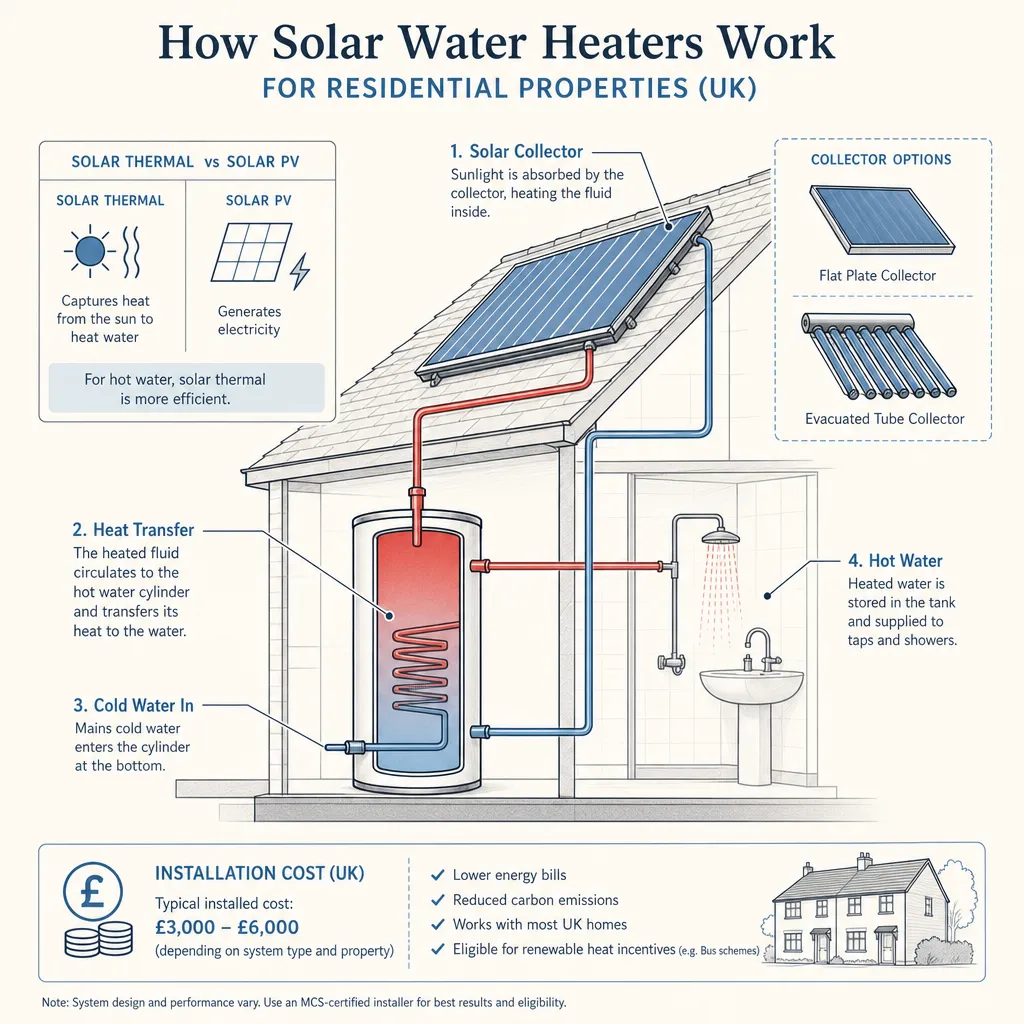
How Solar Water Heaters Work for Residential Properties
Solar water heaters use roof-mounted collectors to capture heat from sunlight and transfer it to a hot water cylinder via a fluid circuit.
 Energy & Retrofit
Renewable Energy Technologies for Homes
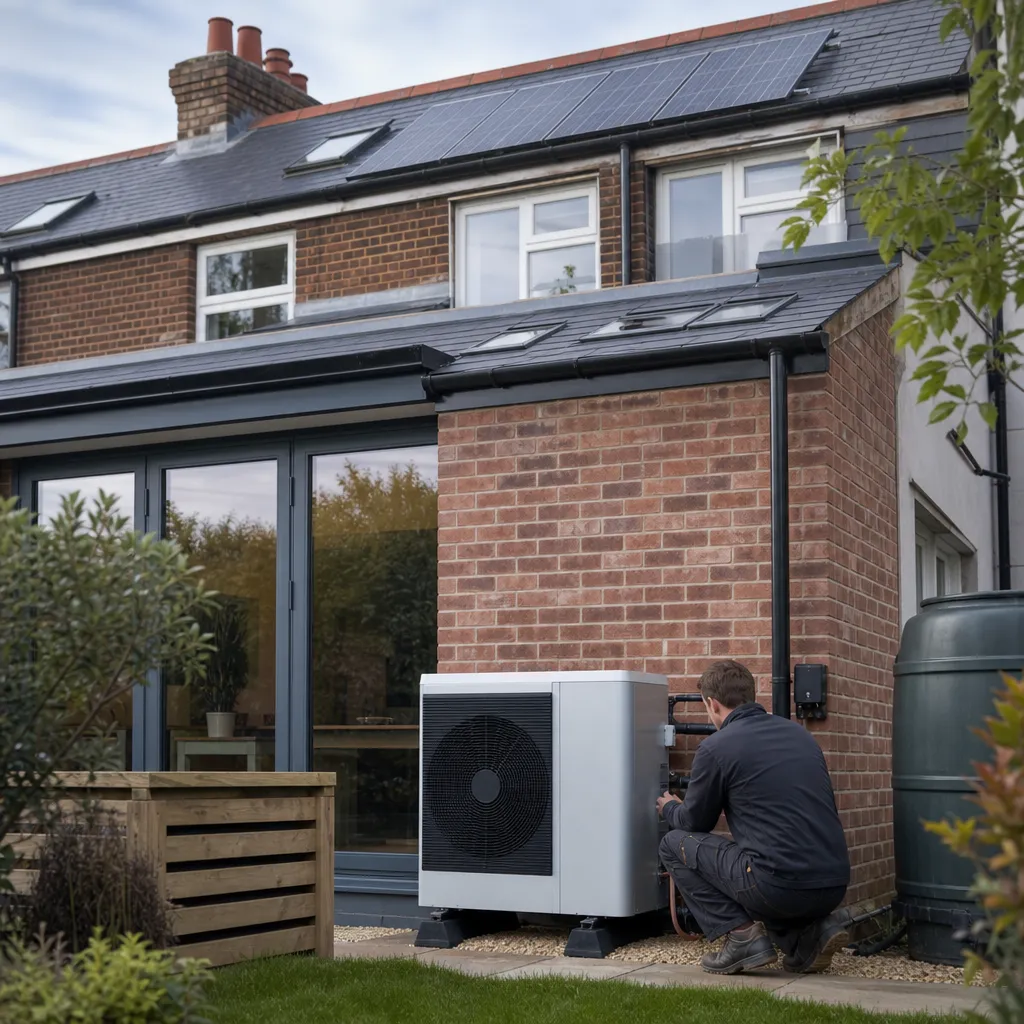
UK homes can choose from solar photovoltaic panels, air source heat pumps, ground source heat pumps, and battery storage as the main residential renewable technologies.
 Energy & Retrofit
Making your home more sustainable
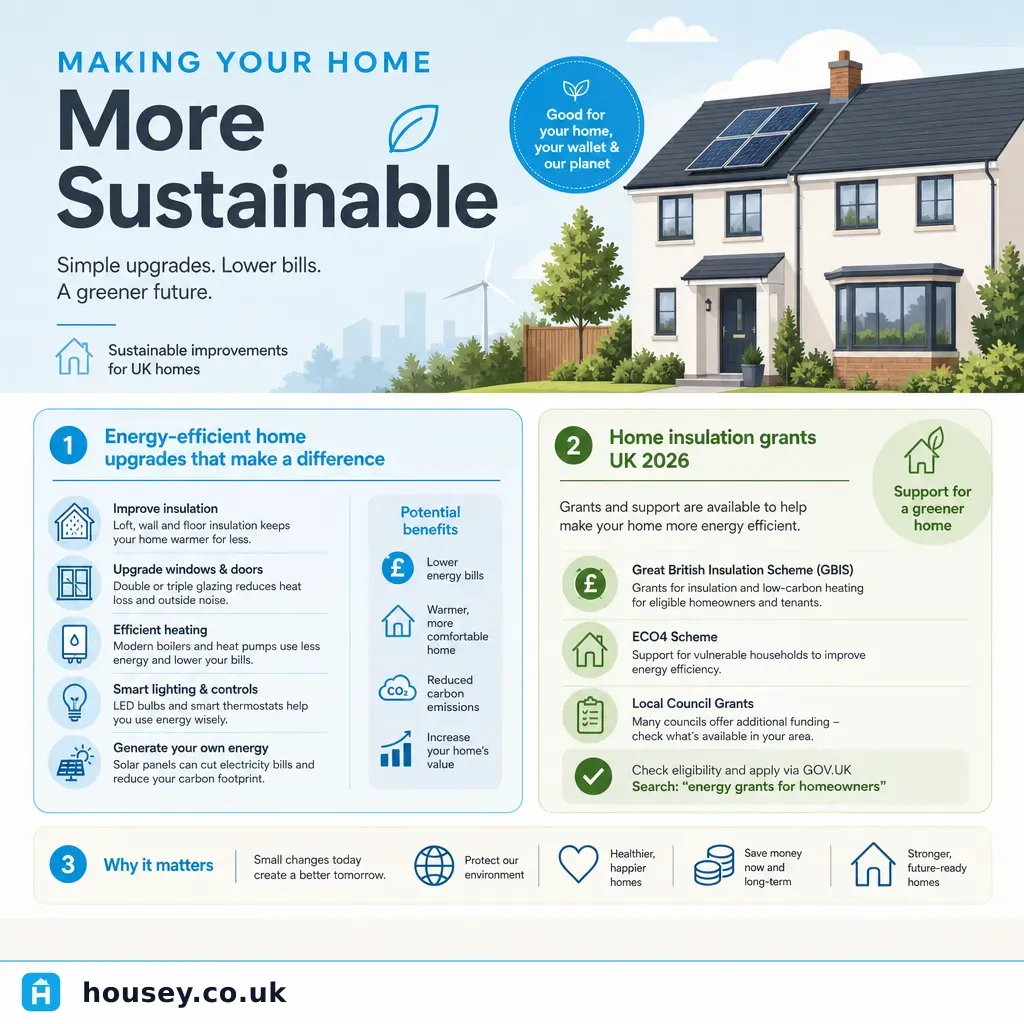
Making a UK home more sustainable usually starts with fabric-first improvements such as insulation, draught-proofing, and efficient glazing before adding renewable energy systems like solar panels or a heat pump.