Solar Shingles: Integrated PV Technology for Roofing
By Housey · Last reviewed 11th of May 2026
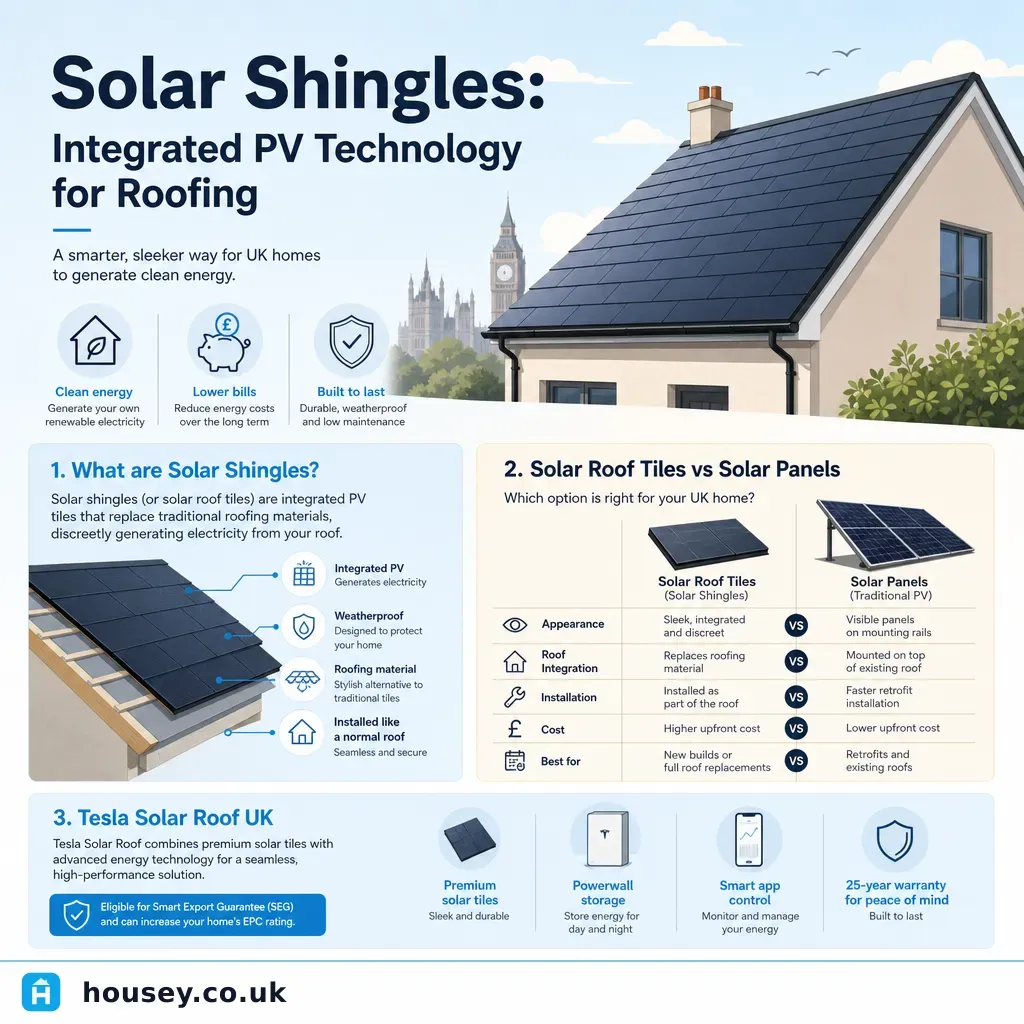
Solar Shingles: Integrated PV Technology for Roofing
Solar shingles sit at the intersection of roofing and renewable energy — products that replace a conventional roof covering while simultaneously generating electricity. In the UK, interest has grown alongside Building Regulations Part L requirements for low-carbon generation in new and renovated dwellings, and high-profile product launches from manufacturers including Tesla, Marley, and SunRoof. The decision to specify solar shingles rather than conventional panels requires careful examination of cost, efficiency, MCS certification status, and structural suitability before any commitment is made.
Key points
- Solar shingles integrate photovoltaic cells into individual roofing tiles, replacing both the roof covering and the panel array in a single installation.
- UK solar shingles typically achieve cell efficiencies of 14–22%, generally lower than premium standalone monocrystalline panels (up to 24–25%).
- A full solar shingle roof in the UK typically costs £15,000–£30,000+, compared to £4,000–£10,000 for a conventional solar panel array on an existing sound roof — Indicative UK costs, last reviewed 2026-05-11.
- To qualify for the Smart Export Guarantee (SEG), the installation must carry MCS (Microgeneration Certification Scheme) certification; not all solar shingle products available in the UK are currently MCS-certified.
- Solar shingles on domestic roofs are generally permitted development in England, but planning permission is required in conservation areas, AONBs, or on listed buildings.
How solar shingles work
Each solar shingle — also called an integrated solar tile or BIPV (building-integrated photovoltaic) tile — contains one or more photovoltaic cells embedded within a tile body, typically made from tempered glass, composite polymer, or a glass-glass laminate. Electrical connections run beneath the battens and into a standard inverter. The tiles are installed in overlapping courses like conventional roofing products, so the weatherproofing function is performed by the shingle itself rather than by a separate tile beneath a mounted panel rack.
Two broad approaches exist in the UK market:
Approach | Description | Examples | Typical application |
|---|---|---|---|
Full-roof integrated | The entire roof area is replaced with solar shingles and non-active infill tiles | Tesla Solar Roof | New builds; full roof replacement at end of covering life |
Partial integration | A section of a conventional tile roof is replaced with solar tiles; surrounding tiles remain | Marley SolarTile, Tractile | Reroofing sections; phased upgrade alongside existing covering |
Efficiency and output in UK conditions
Solar shingle efficiency is constrained by the tile format. Conventional panels are installed at an optimised tilt angle; solar shingles follow the exact roof pitch and orientation, and the tile body imposes thermal and cell-layout constraints.
Typical performance in UK conditions:
- Full-roof integrated products (e.g. Tesla Solar Roof): approximately 21.85 W per tile at standard test conditions; whole-roof power density is generally lower than a conventional panel array of equivalent footprint
- Partial-integration products (e.g. Marley SolarTile): uses SunPower Maxeon cells at approximately 17–19% cell efficiency
Annual generation depends on roof pitch (25–35° is typically optimal in the UK), orientation (south-facing best; southeast and southwest acceptable), shading from chimneys or dormers, and latitude. A property in Aberdeen generates approximately 25–30% less solar energy per year than one in Exeter.
Cost comparison
Solar shingles cost significantly more than conventional solar panels on a cost-per-watt basis. Key drivers include more complex tile-body manufacturing, the frequent need to strip and replace the existing roof covering entirely, and inverter or optimiser requirements that vary by system.
Option | Typical upfront cost (3-bed semi) | Typical annual generation (south-facing, Midlands) | SEG eligibility |
|---|---|---|---|
Conventional panels (6–8 panels) | £4,000–£7,000 | 2,500–4,000 kWh | Eligible (MCS) |
Partial solar tile replacement | £8,000–£15,000 | 2,000–3,500 kWh | Eligible if MCS-certified |
Full solar shingle roof | £15,000–£30,000+ | 3,000–6,000 kWh (larger area) | Eligible if MCS-certified |
Indicative UK costs, last reviewed 2026-05-11. Costs vary widely by property size, roof complexity, and installer. Always obtain at least three quotes from MCS-certified installers.
Planning permission and building regulations
Permitted development
In England, solar equipment on domestic roofs is generally permitted development under the Town and Country Planning (General Permitted Development) (England) Order 2015, Class A. Key conditions include:
- The installation must not protrude more than 200 mm from the roof slope when measured perpendicularly.
- Equipment must be removed when no longer needed.
- Permitted development does not apply to listed buildings — listed building consent is required.
In conservation areas and AONBs, permitted development rights for equipment visible from a highway may be restricted or removed. Always confirm with your local planning authority (LPA) before installing. Rules differ in Wales, Scotland, and Northern Ireland.
Building regulations
A solar shingle installation engages both roofing and electrical regulations:
- Part L (Conservation of Fuel and Power): Solar shingles can contribute to on-site low-carbon generation and may form part of a Part L compliance strategy for new builds and extensions.
- Part P (Electrical Safety): The PV electrical installation must be carried out by a competent person. An MCS-certified installer self-certifies the electrical work; otherwise, notification to the local building control body is required.
- Structural loading: A roofer or structural engineer should confirm the existing roof structure can carry the weight of the specified shingle product before installation begins.
MCS certification and the Smart Export Guarantee
To export surplus electricity under the SEG and receive payment from an energy supplier, the installation must be MCS-certified. As of 2026:
- MCS certification requires both the product and the installer to be listed on the MCS register.
- Not all solar shingle products on the UK market carry current MCS product certification — ask any installer to provide the specific MCS product number before signing a contract.
- SEG tariffs paid by energy suppliers typically range from 3p to 15p per kWh exported, providing income that can partially offset the higher upfront cost of solar shingles over the system lifetime.
When does a solar shingle make sense?
- Choose conventional solar panels if the existing roof is in sound condition and you want the best output per pound of investment.
- Consider partial solar tile replacement if the roof needs retiling within the next five years and you want an integrated appearance without a full roof replacement cost.
- Consider a full solar shingle roof if the existing covering is at or near end of life, conventional panels are ruled out by planning restrictions or aesthetics, and the property has sufficient roof area to justify the cost premium.
- Consult your LPA before specifying any solar product if the property is listed, in a conservation area, or in an AONB.
- Ask a structural engineer if there is any doubt about whether the roof structure can carry the specified product's weight.
What to ask a solar shingle installer
- Is this specific product MCS-certified? Provide the MCS product number.
- Does the installation include full roof-stripping, or is it a partial tile replacement?
- What weatherproofing warranty covers the roof as a water barrier — not just the PV output?
- What inverter or optimiser system is specified, and why is it suited to this product?
- What are the performance warranty (annual output degradation) and the tile-body product warranty terms?
- Does the quote include scaffolding, electrical sign-off, and building control notification?
When to get professional help
Solar shingle installation combines specialist roofing and electrical competencies. Always instruct an MCS-certified installer for the photovoltaic element and an NFRC-member roofer (or a specialist with proven solar roofing experience) for the structural and weatherproofing element. Seek professional assessment before proceeding if:
- The existing roof structure shows signs of sagging, rafter damage, or rot.
- The property is listed or in a conservation area and permitted development status has not been confirmed with the LPA.
- The installer cannot provide an MCS product certificate for the specific tile product.
- Quotes do not separately itemise roofing works, electrical works, and scaffolding.
How Housey can help
Housey connects you with MCS-certified solar specialists via our solar surveys service, and with qualified roofers who can assess your existing roof, confirm structural suitability, and provide an honest view on whether integrated solar tiles or a conventional panel system better suits your property and budget.
Frequently asked questions
Are solar shingles available in the UK?
Yes, though the market is smaller than for conventional solar panels. Products installed in the UK as of 2026 include Tesla Solar Roof, Marley SolarTile, SunRoof, and Tractile, among others. MCS certification status varies by product and may change; always ask an installer to confirm the current MCS product number before signing a contract.
Do solar shingles work as well as solar panels?
Solar shingles typically produce less electricity per unit area than a conventional panel array of the same footprint, because the tile format constrains cell orientation and can increase operating temperatures. However, a whole-roof product covers a larger area, so total system output can be comparable. The most useful metric is cost per kilowatt-hour generated over the system lifetime, not peak power rating alone.
Can solar shingles be installed on any roof?
Solar shingles are best suited to roofs with a pitch of approximately 20–45°, a predominantly south, southeast, or southwest orientation, and minimal shading. Most products require a sound roof structure capable of carrying the additional weight of integrated tiles. A pre-installation survey from an MCS-certified installer and a competent roofer should confirm suitability before any work begins.
Sources and further reading
- Smart Export Guarantee (SEG) guidance — GOV.UK
- MCS: Find a certified installer — Microgeneration Certification Scheme
- Planning Portal: Solar panels and permitted development — Planning Portal
- Building Regulations Part L — GOV.UK
- Solar panels — Energy Saving Trust
Useful next reads
 Energy & Retrofit
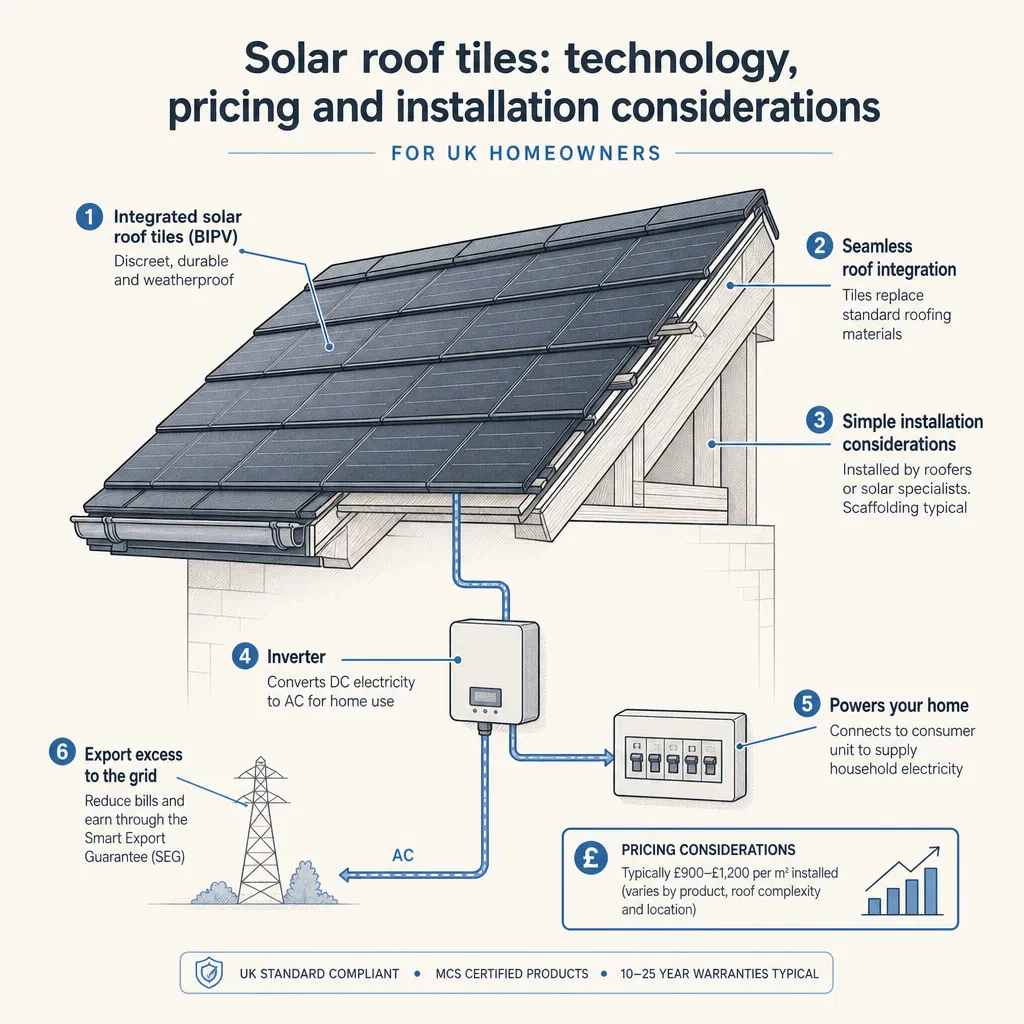
Solar roof tiles: technology, pricing and installation considerations
Solar roof tiles (BIPV tiles) replace your conventional roof covering while generating electricity.
 Energy & Retrofit
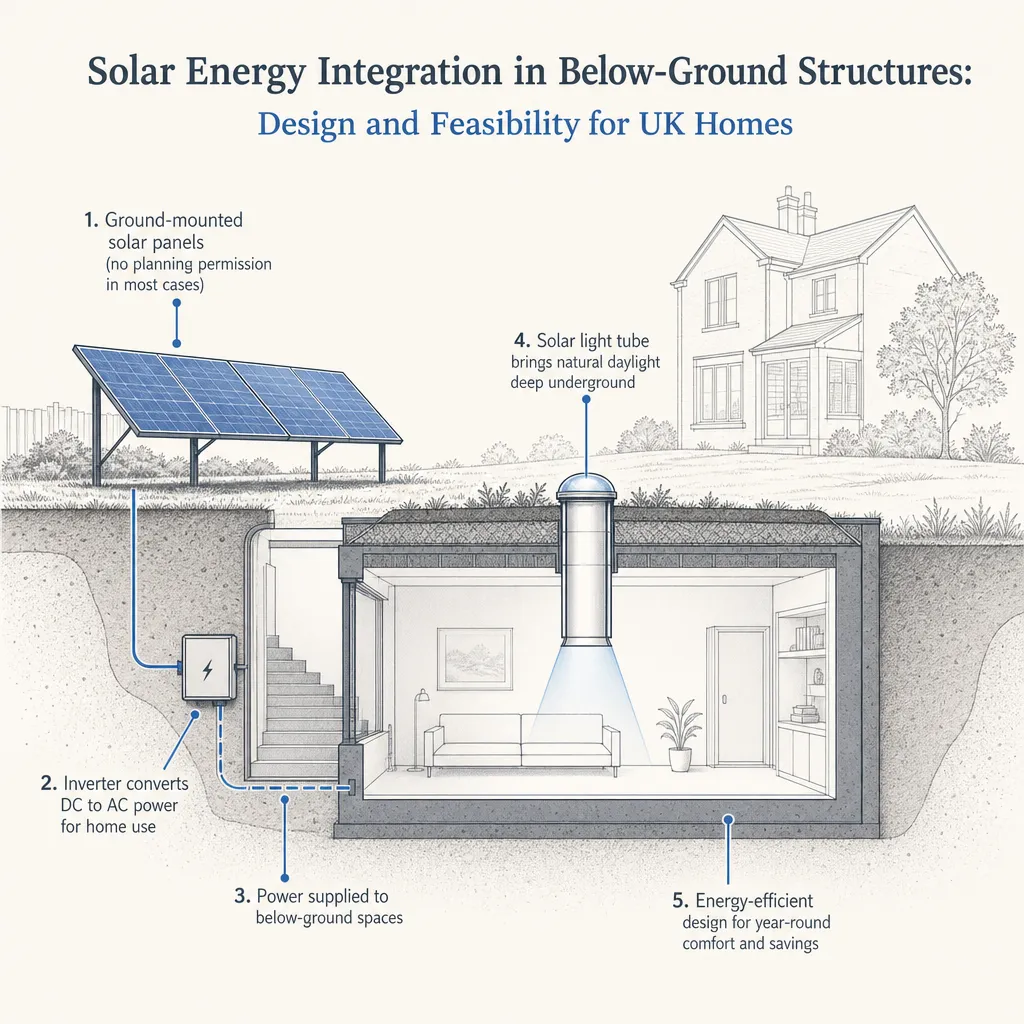
Solar Energy Integration in Below-Ground Structures: Design and Feasibility
Below-ground structures cannot host solar panels on their own roofs but can use surface-mounted panels connected via cable runs, solar light tubes for daylighting, and battery storage.
 Energy & Retrofit
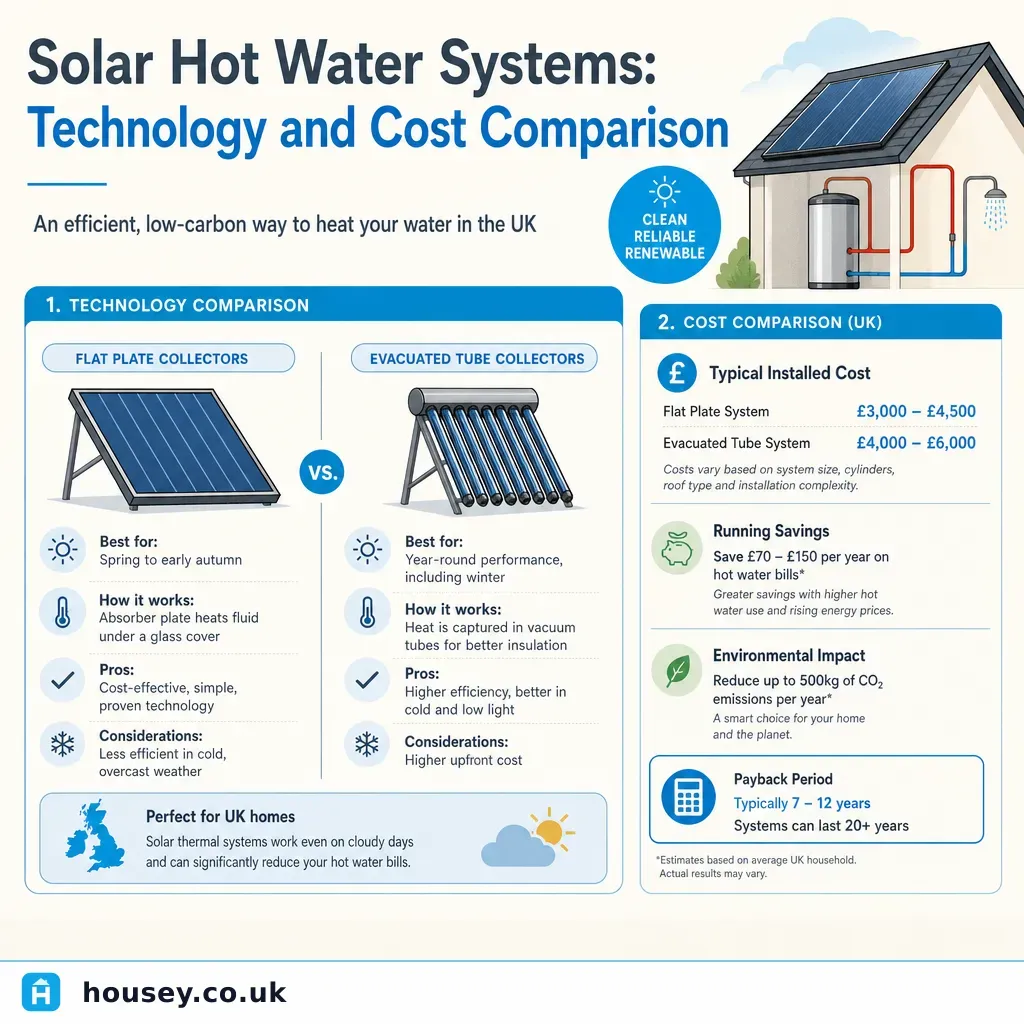
Solar Hot Water Systems: Technology and Cost Comparison
Solar thermal systems use roof-mounted collectors to heat domestic hot water via a glycol circuit and twin-coil cylinder.
 Energy & Retrofit
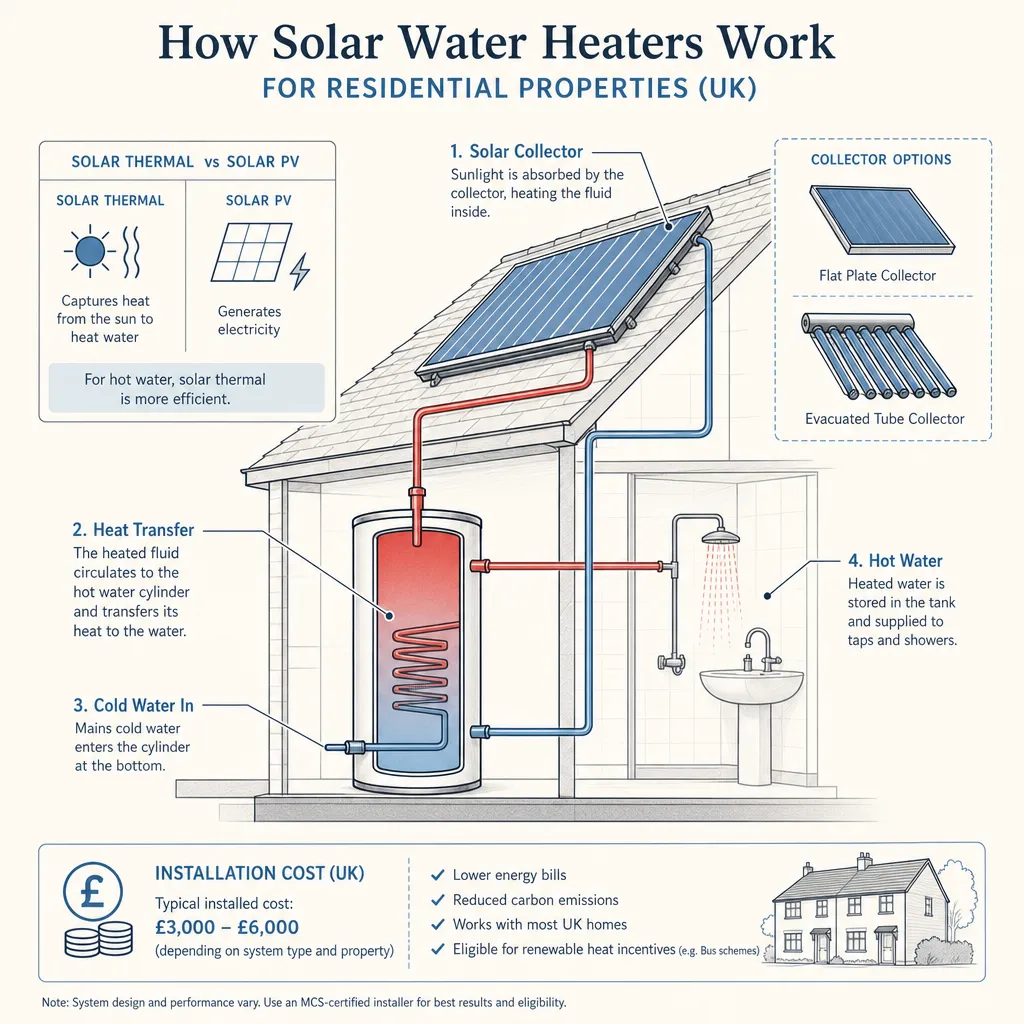
How Solar Water Heaters Work for Residential Properties
Solar water heaters use roof-mounted collectors to capture heat from sunlight and transfer it to a hot water cylinder via a fluid circuit.
 Energy & Retrofit
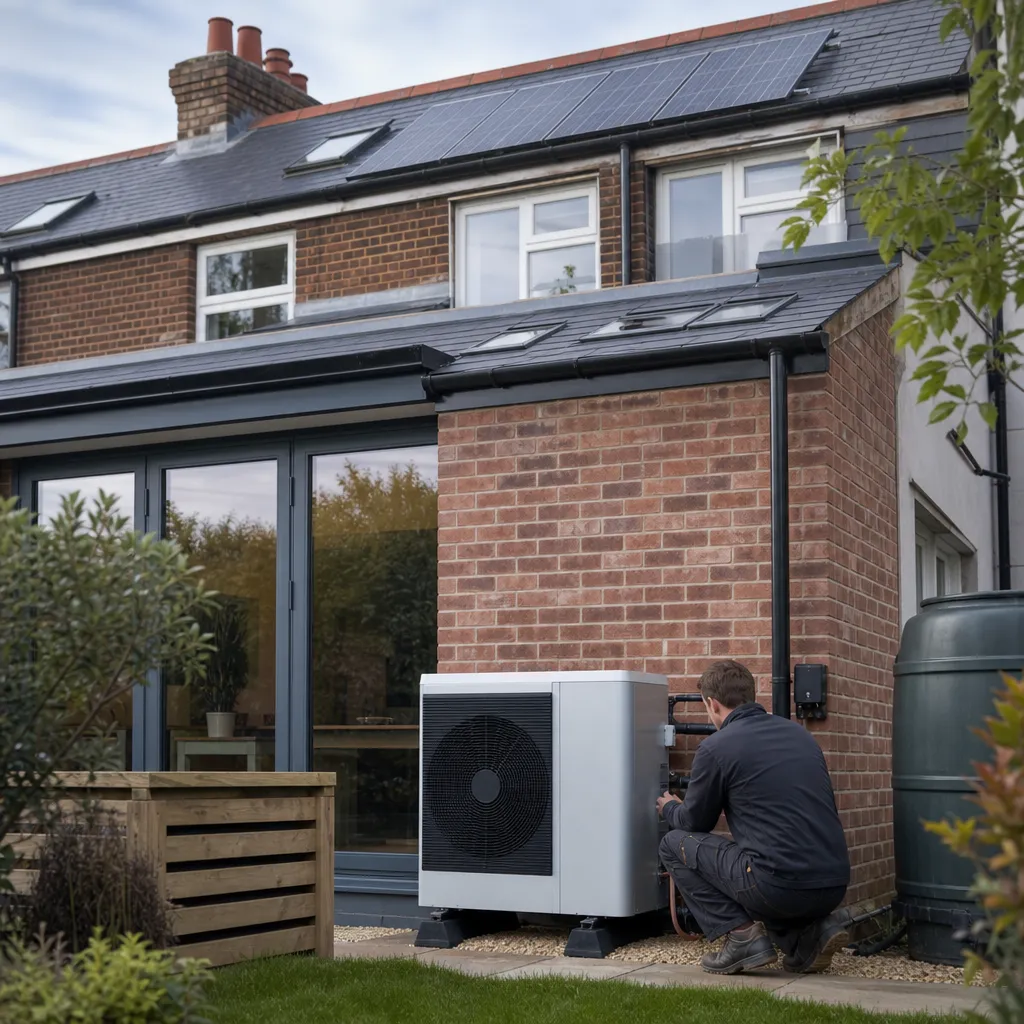
Renewable Energy Technologies for Homes
UK homes can choose from solar photovoltaic panels, air source heat pumps, ground source heat pumps, and battery storage as the main residential renewable technologies.