Specifying Architectural Concrete: Quality Standards and Finishes
By Housey · Last reviewed 11th of May 2026
Specifying Architectural Concrete: Quality Standards and Finishes
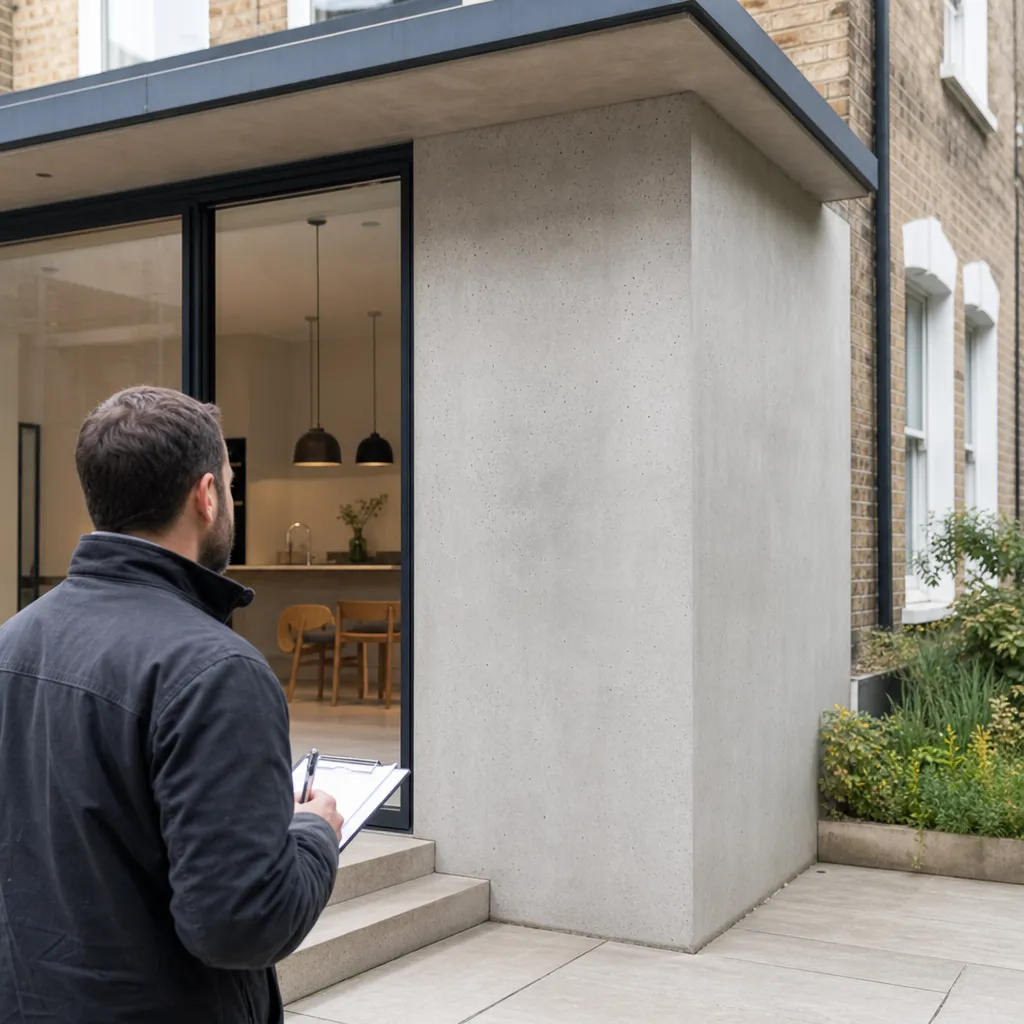
Architectural concrete — sometimes called fair-faced concrete or béton brut — is among the most demanding materials in construction to specify correctly. Unlike concrete hidden behind cladding or plaster, architectural concrete is the finished surface: exposed to view and scrutiny for the life of the building. UK architects and architectural technologists working on contemporary homes, extensions, basement conversions, and commercial projects increasingly specify it for walls, floors, stairs, and feature elements. Getting the specification right before work begins is essential — once concrete is poured and formwork is struck, defects are difficult and expensive to put right.
Key points
- BS EN 206 (with UK complement BS 8500-1 and BS 8500-2) governs concrete mix specification in the UK, covering exposure class, cement content, water/cement ratio, and minimum cover to reinforcement.
- A complete architectural concrete specification must address: mix design, cement type and source, formwork material, release agent, pour sequence, compaction method, curing regime, and defect tolerance — omitting any one of these commonly leads to disputes after striking.
- A visual reference panel of minimum 1 m², agreed between client, contractor, and designer before main pours commence, is established best practice and is referenced in NBS (National Building Specification) clause F30.
- NBS clause F30 (In-Situ Concrete) is the standard UK specification vehicle for architectural concrete work on architect- and technologist-led projects.
- Colour uniformity in architectural concrete is affected by cement batch variation, water content changes, pour temperature, curing rate, and release agent application — all must be controlled and documented in the specification.
What makes concrete "architectural"?
The term has no single technical definition in UK standards, but it is understood to mean concrete where the as-struck surface is the intended finish — not a substrate for render, tiles, or paint. This places extraordinary demands on consistency: every pour seam, tie hole, bug hole (small surface void), form joint, and colour variation will be visible and permanent.
British architects and specifiers commonly use a tiered classification of finish quality, drawing on Continental European practice — particularly the German DAfStb guideline on fair-faced concrete, which defines Sichtbetonklassen SB1 to SB4. In the UK, NBS clause F30 allows specifiers to define their own criteria or reference a visual mock-up panel as the contractual benchmark.
Finish class | Typical application | Acceptable blemish level |
|---|---|---|
General (broadly SB1) | Below-ground structures, plant rooms, utilitarian exposed concrete | High tolerance — surface honesty, no structural defects |
Standard (broadly SB2) | Commercial interiors, external walls not viewed at close range | Moderate tolerance — no major voids, reasonable colour consistency |
Quality (broadly SB3) | Feature walls, residential interiors, external facades viewed closely | Low tolerance — consistent colour, minimal bug holes, clean tie-hole pattern |
Premium (broadly SB4) | High-specification residential, cultural buildings, museum-quality work | Very low tolerance — near-uniform colour, very small bug holes, precision formwork alignment |
Agreeing which class applies — and documenting it in the contract — prevents the most common dispute on architectural concrete projects, which is that the client and contractor hold different expectations of what "good" looks like.
Formwork and its effect on finish
Formwork choice is the single biggest determinant of the finished surface. Specifying "standard shuttering" is not adequate for a quality or premium finish. The specifier must define the exact formwork system and its condition.
Formwork type | Typical finish character | Best for | Watch out for |
|---|---|---|---|
Smooth birch-faced plywood (Finnish or Baltic birch) | Smooth with subtle grain imprint | Standard to quality residential and commercial | Ply absorbs water unevenly — seal edges; define maximum reuse count |
GRP (glass-reinforced plastic) liner | Very smooth, highly consistent, non-absorbent | Premium and repetitive architectural elements | High cost; any damage shows directly in the finish; must be repaired before reuse |
Rough-sawn timber boards | Pronounced grain and board texture (board-marked) | Textured contemporary or rustic aesthetic | Grain pattern varies between boards; difficult to achieve consistent result |
EPS (expanded polystyrene) inserts | Geometric patterns, coffers, chamfers, reveals | Feature panels and bespoke textured elements | Can fail under pour pressure if inadequately braced; joints must be sealed |
Absorptive or HDPE-faced ply | Reduced bug holes, improved surface paste quality | Quality and premium specifications | Shorter reuse life; higher material cost |
The number of permitted formwork reuses must be stated — plywood degrades visibly with each use, and striking beyond the permitted number produces a noticeably different surface. On premium specifications, first-use ply only is often required.
Mix design and consistency
Architectural concrete is sensitive to mix variation in ways that structural concrete is not. Small changes in water content shift colour perceptibly; different cement batches from the same supplier can produce visible tone differences between sequential pours.
Key controls to specify and enforce:
- Cement type and source: CEMI (Portland cement) is standard; blended cements with GGBS (ground granulated blast-furnace slag) or PFA (pulverised fuel ash) tend to produce a lighter, cooler colour but can be less consistent batch to batch. Specify a single named cement source and, for long programmes, arrange agreed batched supply to maintain consistency.
- Water/cement ratio: Fix the w/c ratio tightly — for example, 0.40–0.45. On-site water additions are the most common cause of colour variation and surface weakness; specify that no additions are permitted without engineer's agreement.
- Admixtures: Superplasticisers (high-range water reducers) improve workability without adding water and are appropriate for most architectural concrete. Air-entraining agents are generally avoided as they increase surface voids. Document all admixtures, dosage rates, and the approved supplier.
- Aggregate size and colour: Fine aggregate contributes to the overall surface tone. Where bug holes expose aggregate at the surface, a well-chosen aggregate can improve rather than detract from the appearance.
All mix design parameters should be documented in a pre-pour report signed off by the designer and contractor before any production pour commences. Concrete should be tested on delivery (slump or flow, cube samples) at a frequency defined in the specification.
Release agents and curing
Two final stages are frequently underspecified in less rigorous projects.
Release agents prevent the formwork bonding to hardened concrete. Chemical release agents react with cement alkalis to form a soap-like layer and are generally preferred for smooth finishes. Barrier (film-forming) agents are used for textured or heavily patterned work. The wrong agent can cause surface staining, delayed surface set resulting in a friable skin when the form is struck, or patchy areas where the agent was unevenly applied. Specify the product by name, application rate, and method.
Curing is the process of maintaining moisture in the concrete surface while it hydrates and gains strength. Rapid drying — particularly in warm weather, in heated interiors, or in windy exposed locations — causes surface crazing, colour variation, and a weaker, more porous surface. Specify the curing method (polythene sheeting, spray-applied curing compound, or continuous water mist), the minimum duration (typically 7 days for standard-class work; up to 14 days or more for premium specifications), and the trigger conditions for extended curing (ambient temperature, wind speed, direct sun).
Document-preparation list for an architectural concrete specification
Before any production pour, the project team should have agreed and documented the following:
When to get professional help
Architectural concrete is specialist work, and the specification process is not straightforward. Involve qualified professionals from the specification stage if:
- The element is structural as well as architectural — walls, columns, and cores must simultaneously satisfy structural requirements (cover, mix, exposure class per BS 8500) and aesthetic requirements, which can pull in different directions.
- The project is in an exposed environment — coastal, upland, or frost-exposed locations tighten durability requirements and may restrict mix options available for aesthetic reasons.
- The building is listed or in a conservation area — the weight, thermal mass, and appearance of concrete may require heritage officer input before specification is finalised.
- Previous pours on the same project have produced defects — a specialist concrete technologist review before proceeding with further pours is advisable.
How Housey can help
Housey connects clients with experienced architectural technologists, architects, and structural engineers who can develop complete architectural concrete specifications, prepare NBS clause F30 documentation, manage visual mock-up panel sign-off, and oversee specialist subcontractor procurement. Request and compare quotes from qualified professionals in your area.
Frequently asked questions
Do I need a specialist subcontractor for architectural concrete?
For standard-class utility exposed concrete, a general concrete subcontractor experienced in shuttered work is usually adequate. For quality or premium architectural finishes, a specialist subcontractor with a portfolio of comparable completed projects is strongly recommended. Ask to see examples, discuss their defect rates, and agree the repair procedure in writing before appointing. The quality of the result depends heavily on the subcontractor's experience.
What is a visual reference panel and is it a contractual requirement?
A visual reference panel is a sample area of concrete cast using the specified mix, formwork, release agent, and curing regime, then agreed between client, contractor, and designer as the acceptable standard of finish. It is not a statutory requirement but is widely recognised as best practice and is referenced in NBS clause F30. Without one, disputes about finish acceptability are very difficult to resolve objectively once main pours are complete.
Can architectural concrete be repaired if defects appear after striking?
Minor defects such as isolated bug holes or small chips can be repaired with proprietary cementitious fillers colour-matched to the base. Achieving a genuinely invisible repair on high-quality architectural concrete is difficult and repairs often remain visible in raking light. Major defects — large voids, honeycombing, severe discolouration — may require breaking out and recasting. The permissible repair method and extent should be defined in the specification before work begins.
Is architectural concrete suitable for residential extensions in the UK?
Yes — architectural concrete is increasingly used in contemporary residential extensions, basement conversions, open-plan ground floors, and feature staircases across the UK. The principal constraint is skill: result quality depends on the subcontractor's experience and the specification's rigour. Budget accordingly — architectural concrete typically costs more per square metre than blockwork, but savings on finishes (no render, tiles, or cladding required) can partially offset the premium.
Sources and further reading
- BS EN 206: Concrete — specification, performance, production and conformity — BSI Group
- BS 8500-1/-2: Concrete — complementary British Standard to BS EN 206 — BSI Group
- NBS: clause F30 in-situ concrete specification guidance — NBS (RIBA Enterprises)
- The Concrete Centre: specifying and designing with concrete — The Concrete Centre (MPA)
- Historic England: use of concrete in heritage contexts — Historic England
Useful next reads
 Planning & Pre-Build
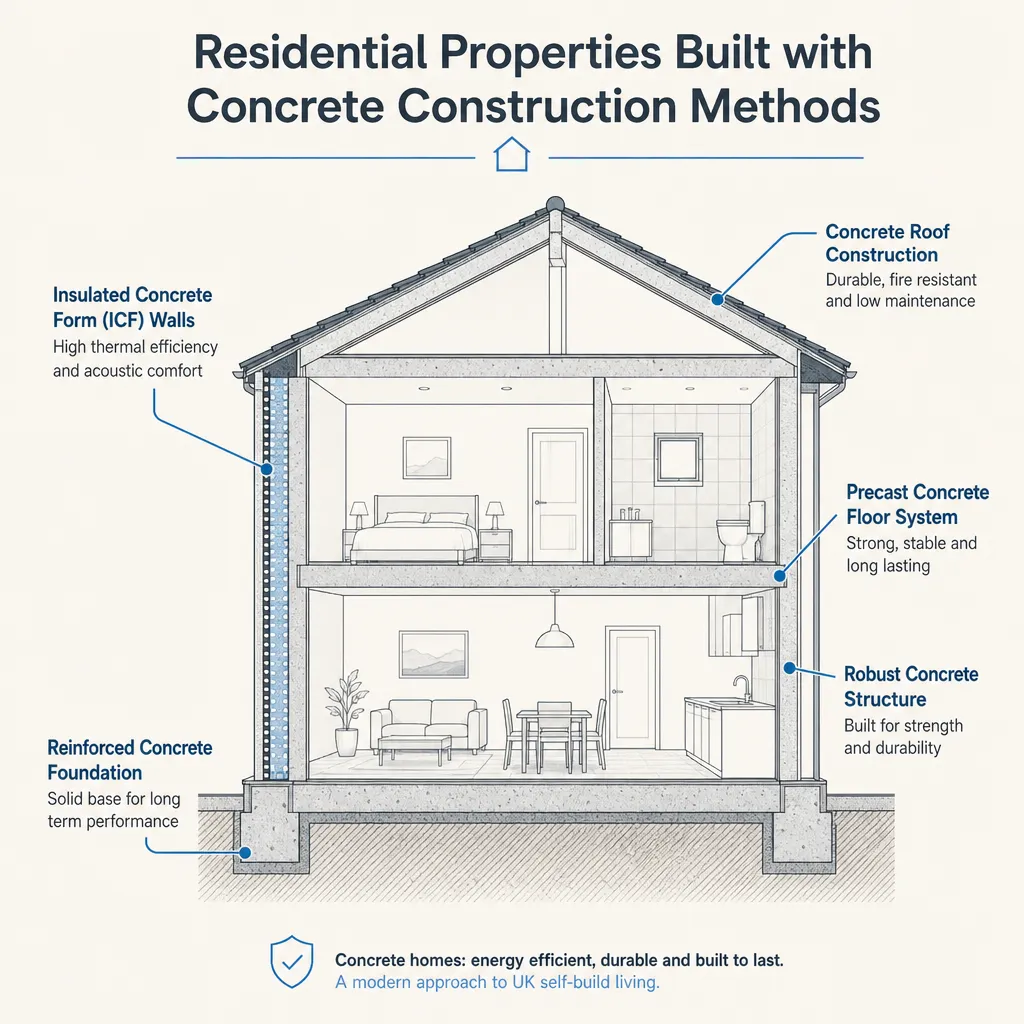
Residential Properties Built with Concrete Construction Methods
UK homes are built using several concrete methods: in-situ cast concrete, precast panel systems, insulating concrete formwork (ICF), and older non-traditional types such as Wimpey No-Fines and Laing Easiform.
 Planning & Pre-Build
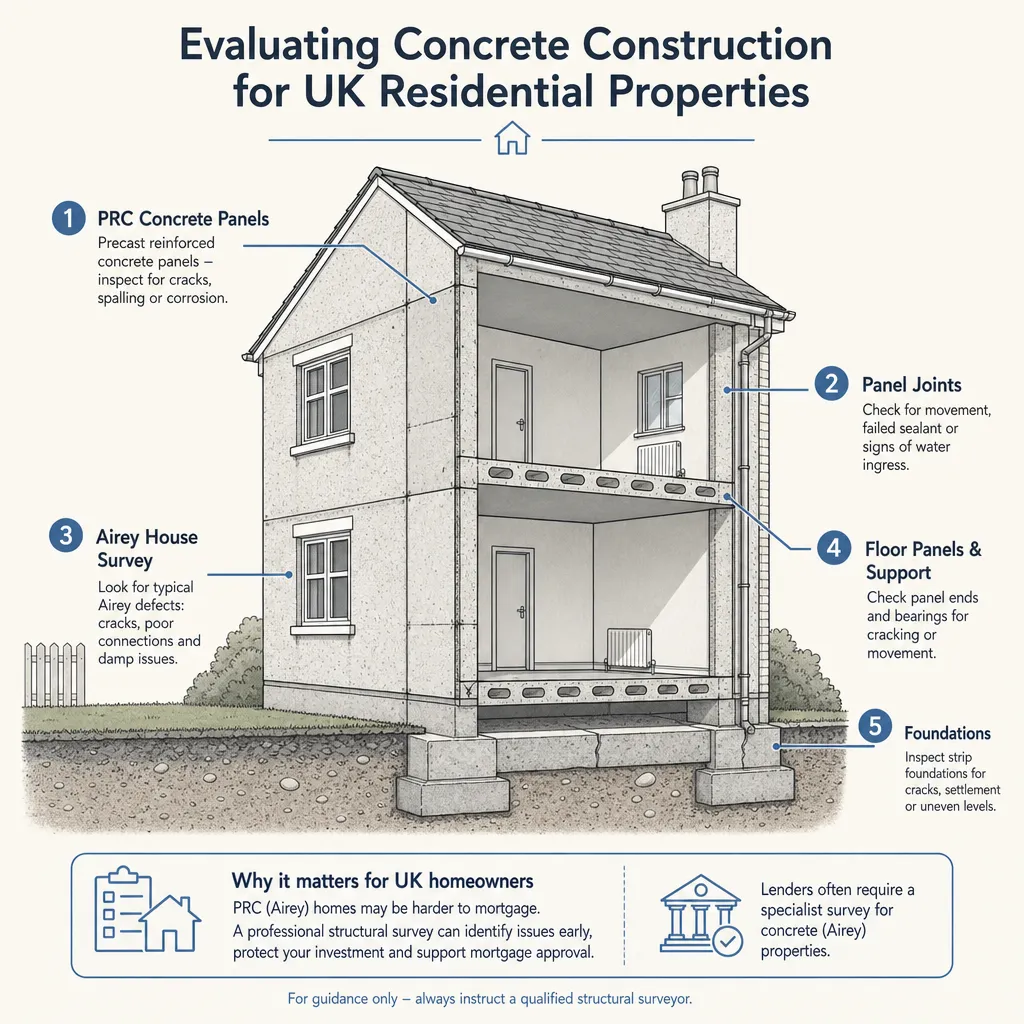
Evaluating Concrete Construction for UK Residential Properties
Concrete construction in UK homes covers post-war non-traditional housing — such as Airey and Wimpey No-Fines properties — typically classified as non-standard by mortgage lenders, and modern systems including ICF and block cavity wall, which are generally standard.
 Planning & Pre-Build
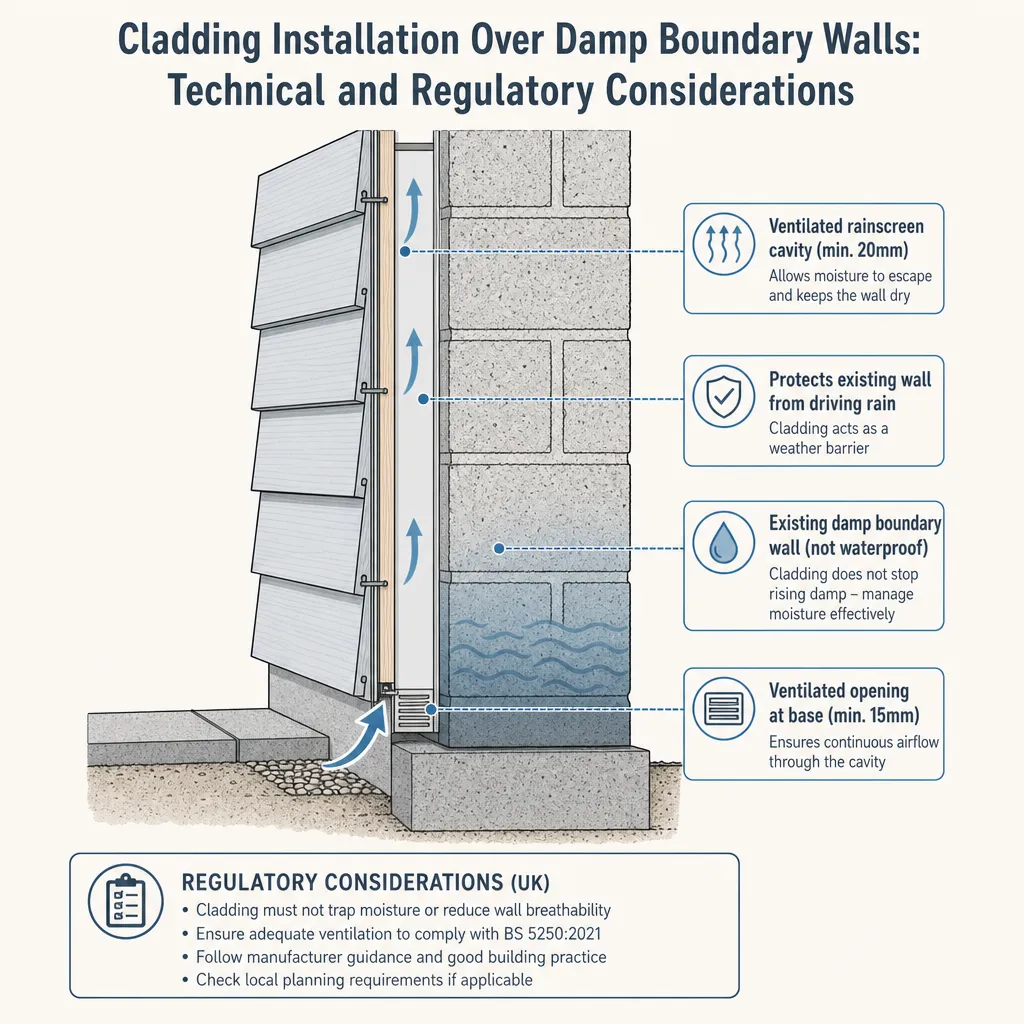
Cladding Installation Over Damp Boundary Walls: Technical and Regulatory Considerations
Installing cladding over a damp boundary wall requires a damp survey to identify the moisture source before any cladding system is specified.
 Planning & Pre-Build
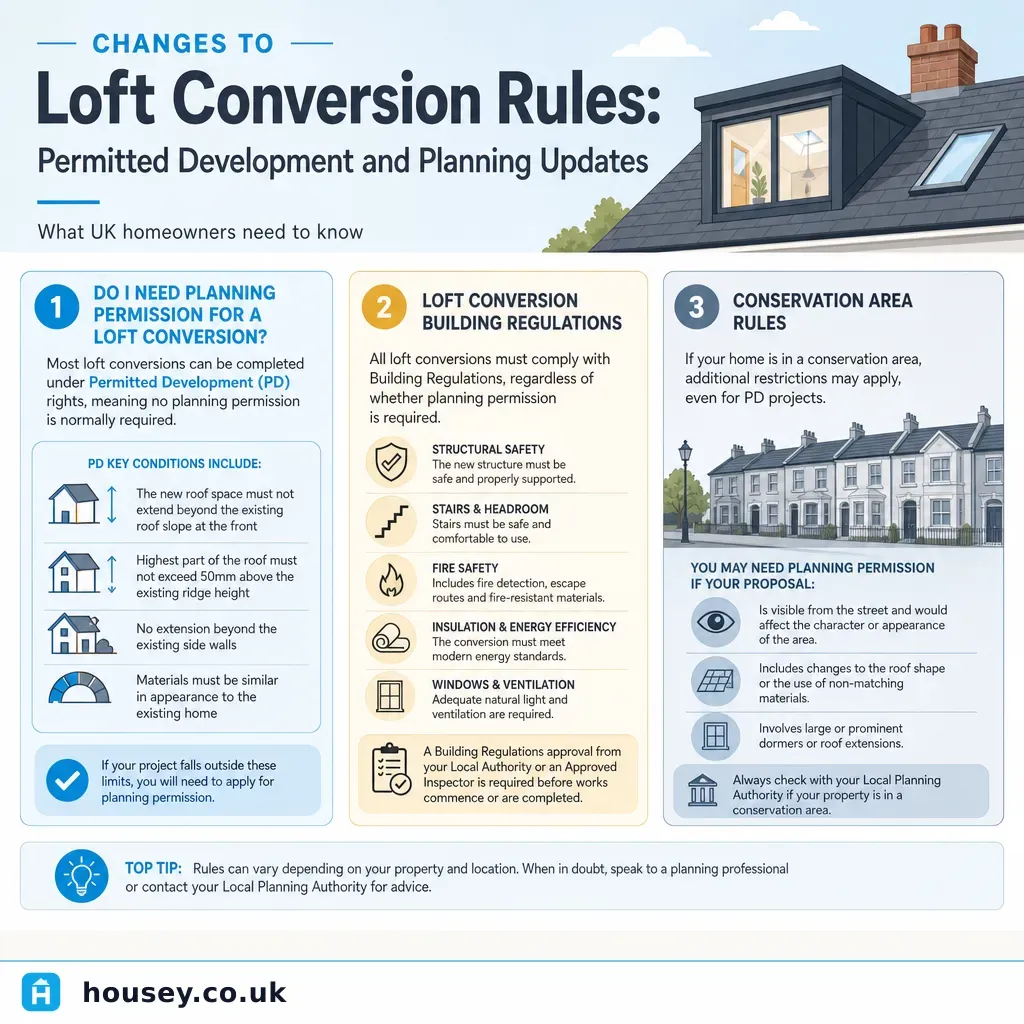
Changes to Loft Conversion Rules: Permitted Development and Planning Updates
In England, most loft conversions on standard houses qualify as Permitted Development under Class B of the GPDO 2015, allowing up to 40 cubic metres (terraced) or 50 cubic metres (detached or semi-detached) without a planning application — if conditions are met.
 Planning & Pre-Build
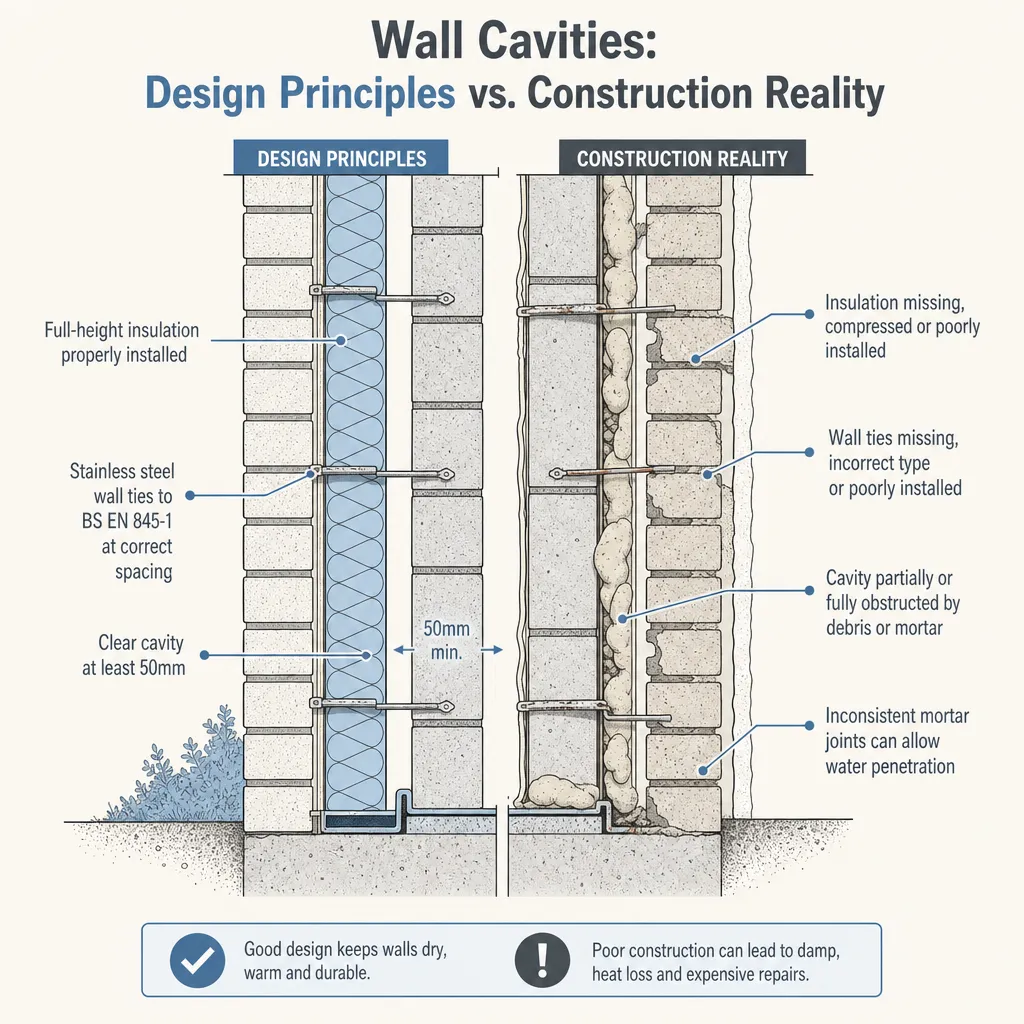
Wall Cavities: Design Principles vs. Construction Reality
A UK cavity wall is designed to resist weather, control heat loss, and structurally link two masonry leaves.