Timber Fence Installation: Options and Costs
By Housey · Last reviewed 9th of May 2026
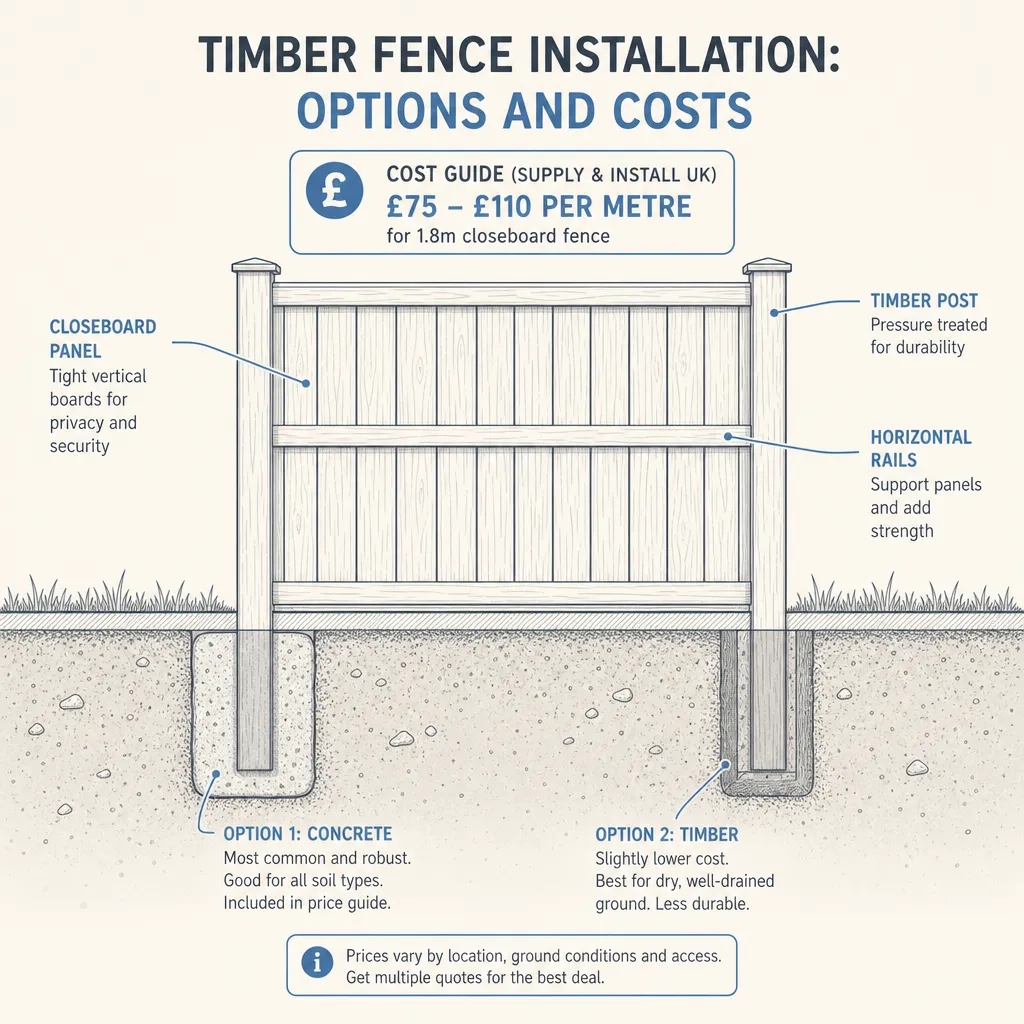
Timber Fence Installation: Options and Costs
A fence replacement or new boundary installation is one of the most common exterior projects UK homeowners undertake — but the range of panel styles, post materials, and heights can make it genuinely difficult to compare quotes or know what to specify. Getting the combination wrong often means a shorter lifespan, extra repair costs within a few years, or a dispute with a neighbour over where the boundary actually sits.
Key points
- Closeboard fencing typically costs £80–£150 per metre installed, including posts and gravel boards (Indicative UK costs, last reviewed 2026-05-09).
- Fences over 2 metres in height generally require planning permission; fences over 1 metre adjacent to a highway also require permission under the Town and Country Planning (General Permitted Development) (England) Order 2015, Schedule 2, Part 2.
- Concrete posts and concrete gravel boards significantly outlast timber equivalents — often by 10–15 years — and represent strong value over a 20-year horizon.
- Before any installation, confirm which boundary you own by checking your title deeds or Land Registry title plan; you are normally only entitled to fence your own boundary.
- Pressure-treated softwood panels carry a typical lifespan of 10–15 years; UC4-rated hardwood components and concrete posts can last 20–25 years or more with proper maintenance.
Timber fence types compared
Fence type | Best for | Not ideal for | Typical lifespan (treated timber) | Approx. installed cost per metre |
|---|---|---|---|---|
Closeboard (featherboard) | Privacy, exposed or high-wind sites | Front garden aesthetics | 15–20 years | £80–£150 |
Lap panel | Cost-sensitive projects, sheltered gardens | High-wind sites, longevity | 10–15 years | £60–£100 |
Picket | Front gardens, low decorative boundaries | Full privacy | 15–20 years | £70–£120 |
Post-and-rail | Field boundaries, rural settings | Privacy or security | 20–30 years | £30–£60 |
Trellis | Climbing plants, screening above a wall | Security or full privacy | 10–15 years | £40–£80 |
Indicative UK costs, last reviewed 2026-05-09. Prices vary by region, ground conditions, supplier, and whether the existing fence requires removal.
Do you need planning permission for a fence?
Most standard garden fencing falls within permitted development rights, so no formal planning application is needed. The exceptions are defined under Schedule 2, Part 2 of the Town and Country Planning (General Permitted Development) (England) Order 2015:
- Fences over 2 metres in height anywhere on your property.
- Fences over 1 metre if adjacent to a highway (including a public footpath or bridleway).
- Properties in a conservation area or subject to an Article 4 Direction may face additional restrictions.
- Listed buildings and land within their curtilage require Listed Building Consent for any external boundary structures.
If your property is leasehold, check your lease — many require freeholder consent before erecting a new fence. In Wales, Scotland, and Northern Ireland, permitted development rules differ from those in England; always verify with your local planning authority.
Which post material should you choose?
The post carries the structural load of the entire fence run. Three materials are commonly used in UK residential fencing:
Pressure-treated softwood posts (UC4 rated): The most common and economical choice. UC4 treatment certifies suitability for ground contact and should provide around 15 years of service when correctly installed in concrete. Posts are susceptible to rot at the base if the concrete is set too shallow or drainage is poor.
Concrete posts: Typically £15–£30 more per post than timber, but commonly lasting 25 years or more. Concrete posts accept standard arris rails and closeboard panels directly and are a cost-effective upgrade for any long-term installation.
Steel or metal posts: Less common in residential settings; used where concrete or timber is impractical. Generally the most expensive option and rarely necessary for domestic fencing.
For most residential projects, concrete posts with pressure-treated closeboard panels and concrete gravel boards offer the best balance of upfront cost and service life.
What affects the cost of fence installation?
Several factors move the final price beyond the headline panel-and-post cost:
- Ground conditions: Rocky, heavily rooted, or waterlogged ground requires more labour and may need alternative post-fixing methods.
- Site access: Narrow side passages or restricted rear access increase installation time and cost.
- Existing fence removal: Disposal of old fencing typically adds £10–£20 per metre or a separate day-rate charge including skip hire.
- Gravel boards: Concrete gravel boards at the base protect panel bottoms from soil moisture and add approximately £10–£20 per linear metre, but extend overall fence life noticeably.
- Corners, slopes, and returns: Each change of direction or gradient adds labour time and may require custom-cut panels.
- Regional labour rates: Labour in London and the South East typically runs 20–30% above the national average.
Homeowner checklist before installation
What to ask before accepting a quote
- What species and treatment class of timber is being used for posts and panels?
- Are posts being concreted in, and to what depth?
- Are gravel boards included — and if so, timber or concrete?
- Is removal and disposal of the existing fence included in the price?
- Is VAT included in the quoted figure?
- What guarantee, if any, applies to the installation and materials?
- Is access to the neighbouring garden required, and who arranges that with the neighbour?
- Will the fence be constructed as individual arris-rail runs or pre-made panels slotted into post slots?
When to get professional help
A straightforward fence replacement along a level, accessible boundary is within the capability of most competent tradespeople. Seek specific professional input when:
- The fence line runs across a steeply sloped site requiring stepped or raked panels — this affects drainage, stability, and the finished appearance.
- A tree with a Tree Preservation Order is close to the fence line. Root disturbance during post-hole digging can trigger enforcement action from the local planning authority.
- The boundary position is unclear or disputed — a solicitor's advice or a Land Registry-compliant boundary determination may be needed before you install anything.
- The fence needs to support a vehicular access gate, which has different structural requirements and may have separate planning implications.
How Housey can help
If your fence installation involves difficult ground, drainage management near the boundary, or site clearance before work can start, Housey can help you request quotes from vetted local tradespeople. Find a groundworker through Housey to compare costs and get the job specified correctly from the outset.
Frequently asked questions
Do I need my neighbour's permission to put up a fence on my boundary?
You do not legally need your neighbour's permission to erect a fence on your own boundary, provided it meets permitted development height limits. However, notifying them in writing beforehand is courteous and practically useful — particularly if contractors need access to their garden to install posts or remove the old fence.
How long does a timber fence last?
Treated softwood lap panels typically last 10–15 years; closeboard panels in treated softwood last 15–20 years. Hardwood components and concrete posts can last 25 years or more. Lifespan depends on ground conditions, drainage, and whether concrete gravel boards are used at the base to keep panel edges clear of soil.
Who owns the fence between two properties?
Boundary ownership is determined by your title deeds or Land Registry title plan, not by which side the posts face. A "T" mark on the title plan indicates the party responsible for that boundary. When no T mark exists, ownership may be ambiguous — seek legal advice before installing a fence if a dispute is possible.
Is there VAT on fence installation?
Yes. Standard-rate VAT at 20% applies to both materials and labour for new fencing installation. There is no reduced rate for residential fencing work. Always confirm whether a quote is inclusive or exclusive of VAT before you agree to it.
Sources and further reading
- Town and Country Planning (General Permitted Development) (England) Order 2015 — legislation.gov.uk
- Fences, gates and garden walls: do you need planning permission? — Planning Portal
- Search for land and property information — HM Land Registry, GOV.UK
- Tree Preservation Orders and trees in conservation areas — GOV.UK
Useful next reads
 Improvement & Build
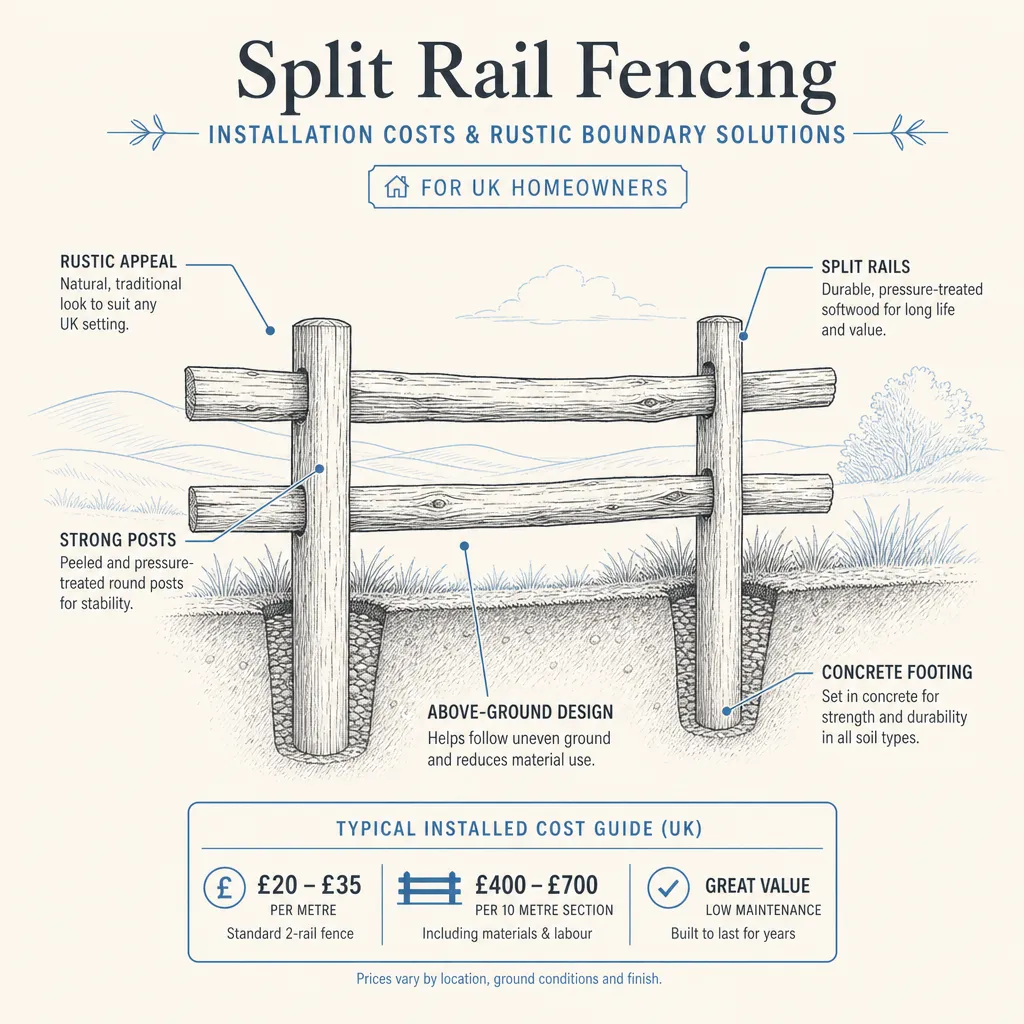
Split rail fencing: installation costs and rustic boundary solutions
Split rail fencing typically costs between £30 and £60 per linear metre installed in the UK, depending on timber species, number of rails, and local labour rates.
 Improvement & Build
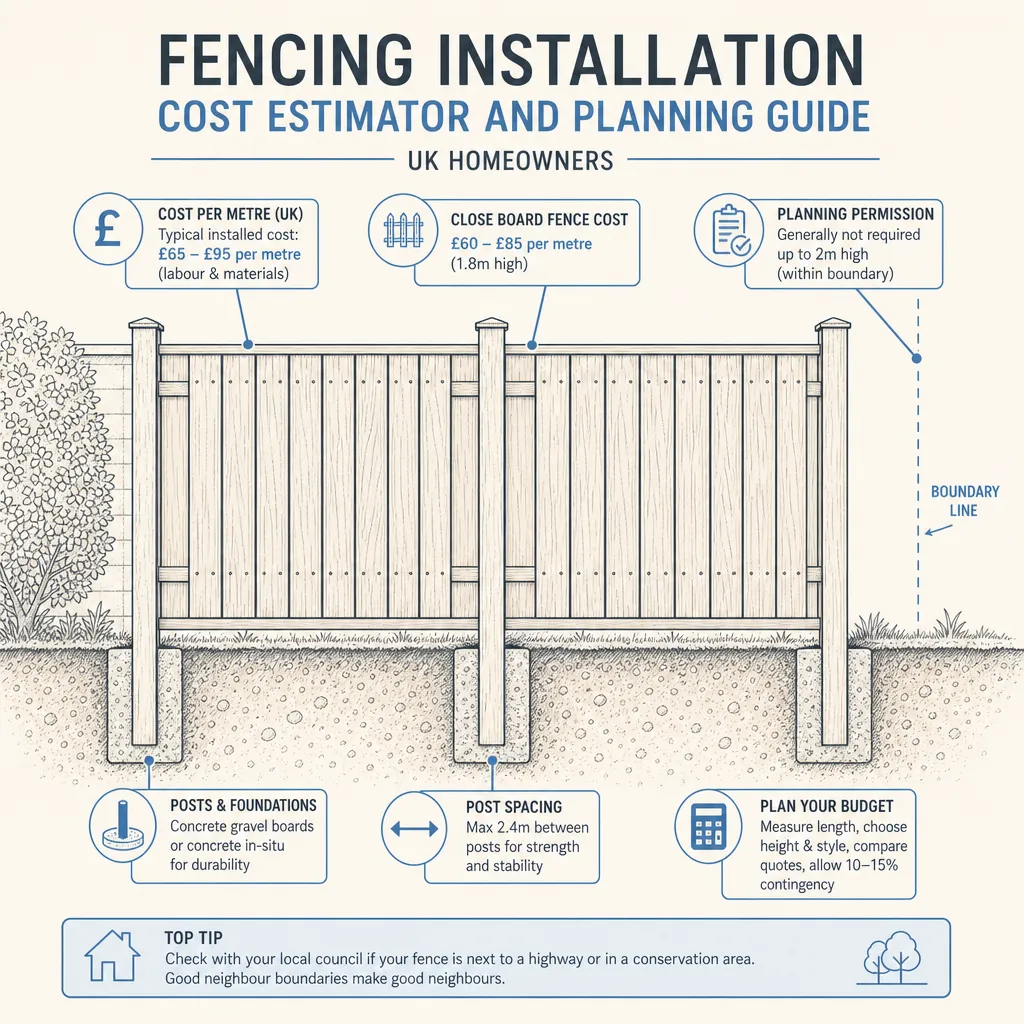
Fencing Installation Cost Estimator and Planning Guide
Fencing installation in the UK typically costs £50–£160 per metre installed, depending on fence type and ground conditions.
 Improvement & Build
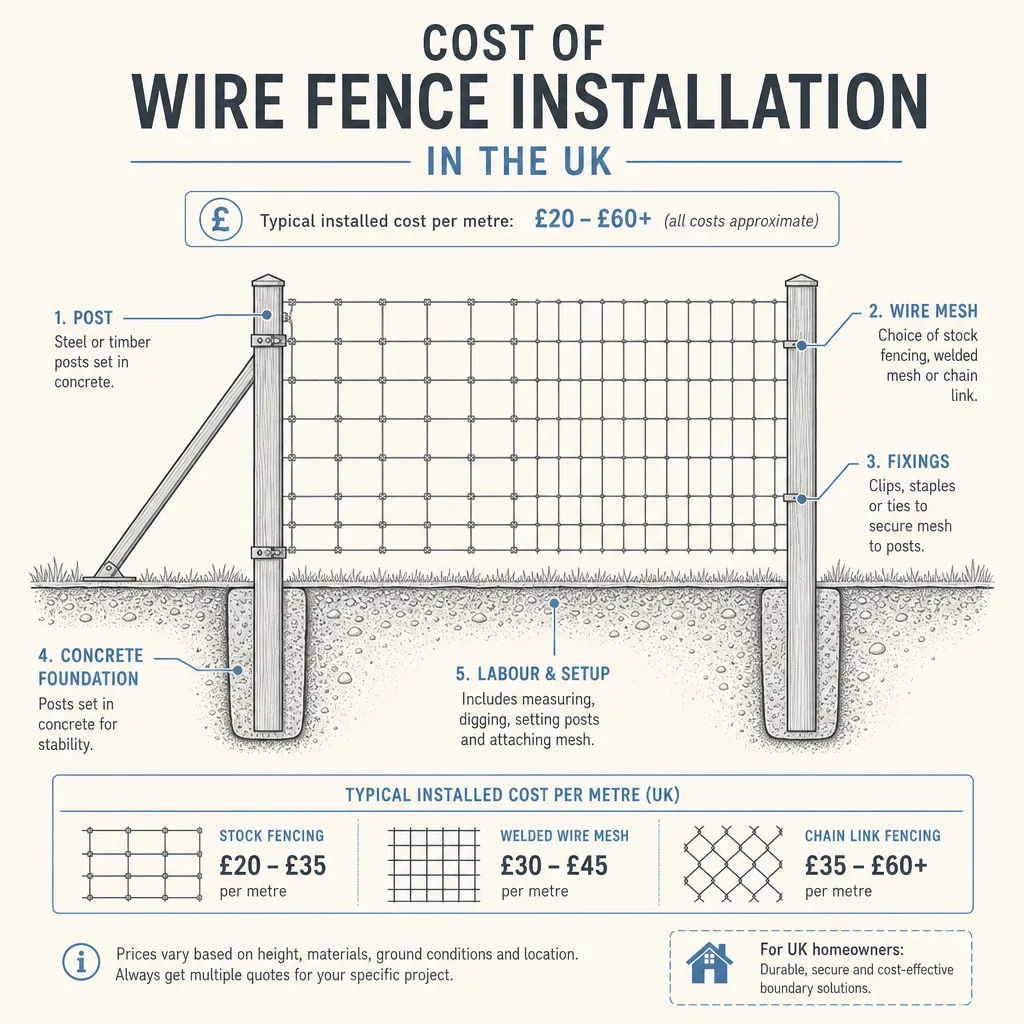
Cost of Wire Fence Installation in the UK
Wire fence installation in the UK typically costs £8–18 per metre for stock fencing, £15–35 per metre for chain-link, and £20–45 per metre for welded wire mesh panels, all installed.
 Improvement & Build
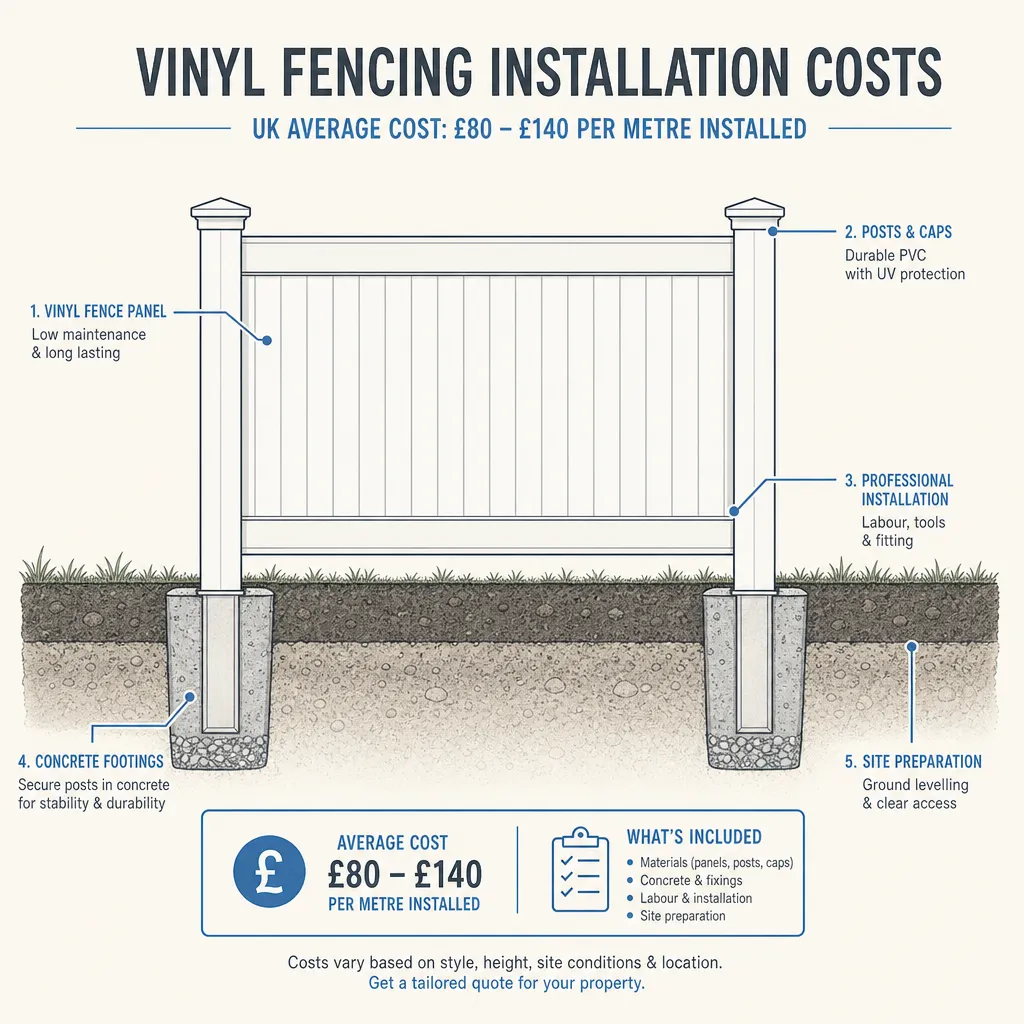
Vinyl Fencing Installation Costs
Vinyl fencing in the UK costs roughly £60–£200 per metre for supply and installation, depending on fence style, height, and ground conditions.
 Improvement & Build
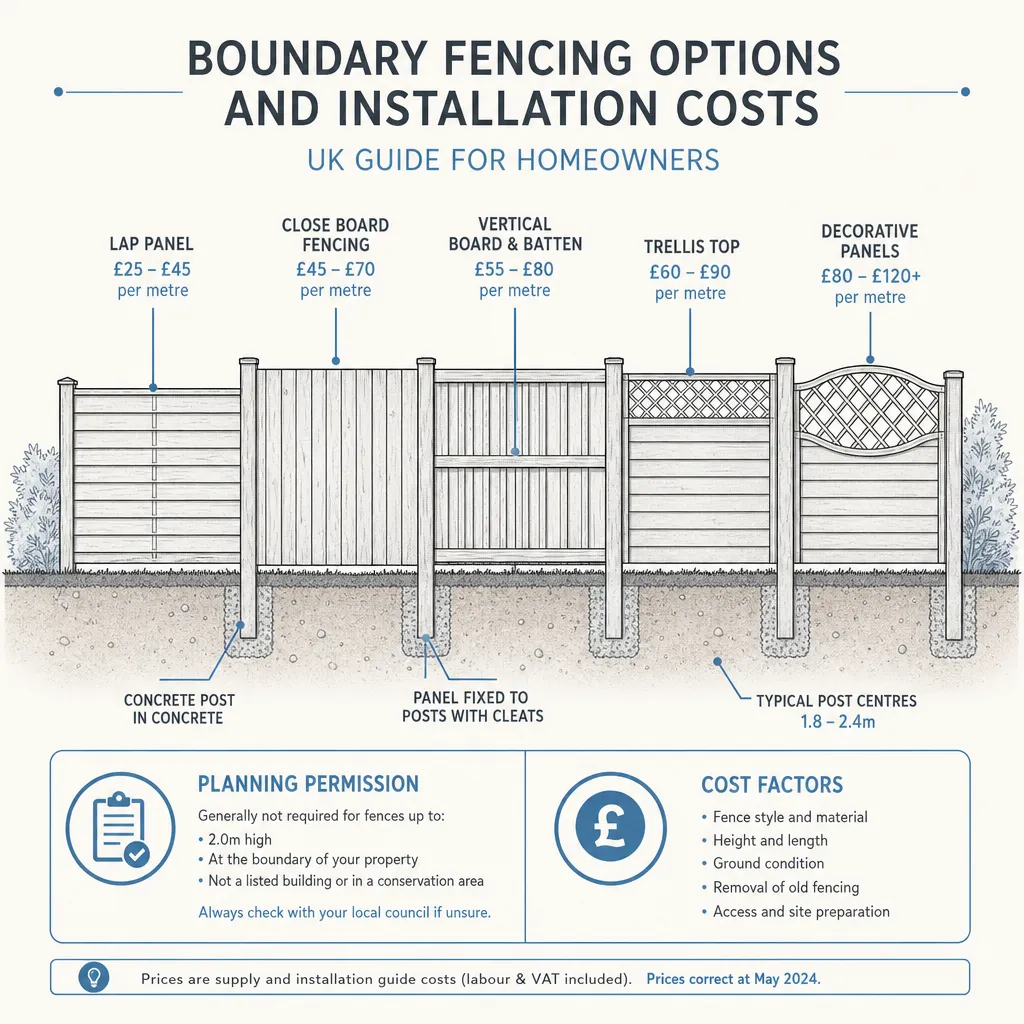
Boundary Fencing Options and Installation Costs
Boundary fencing in the UK ranges from around £50 to £250 per linear metre installed, depending on material, height, and ground conditions.