Seasonal Home Maintenance: Spring Property Care Guide
By Housey · Last reviewed 9th of May 2026
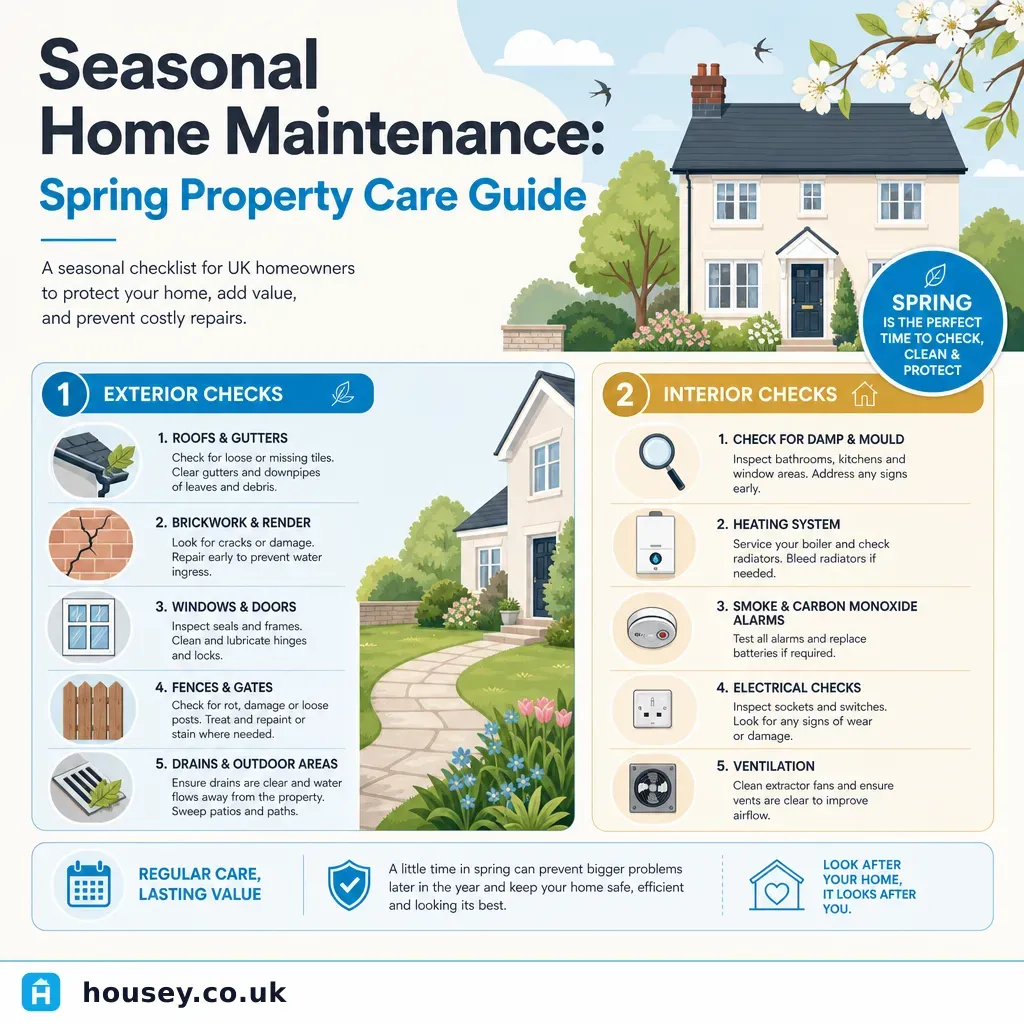
Seasonal Home Maintenance: Spring Property Care Guide
Winter in the UK takes a toll on homes in ways that often go unnoticed until they become expensive repairs. The period between late March and early May — once temperatures have stabilised and before the main renovation season begins — is the ideal window to assess what winter has left behind. Whether you own a Victorian terrace, a 1970s semi-detached, or a newer build, the same principles apply: catch small defects early, know which tasks you can safely tackle yourself, and recognise when a professional should take over.
Key points
- Working at height above 2m is a significant cause of serious falls in the UK — the Health and Safety Executive (HSE) advises that ladder use on domestic property should be limited to short-duration tasks with three points of contact maintained at all times.
- RICS guidance recommends seeking a professional assessment for cracks wider than 5mm, those running diagonally through brickwork, or any crack accompanied by symptoms such as sticking doors or sloping floors.
- Gutters and downpipes should be checked and cleared at least once a year; blocked gutters are a leading cause of damp penetration in UK homes.
- External pointing on older masonry — particularly pre-1919 solid-wall properties — should be lime-based, not ordinary Portland cement (OPC); OPC repointing can trap moisture and accelerate frost damage to brickwork.
- An Electrical Installation Condition Report (EICR) is recommended every 10 years for owner-occupied homes and every 5 years for rented properties under the Electrical Safety Standards in the Private Rented Sector (England) Regulations 2020.
What spring maintenance covers — and what it doesn't
Spring maintenance is a visual inspection and minor-task routine, not a structural assessment. Its purpose is to catch deterioration before it escalates: a loose roof tile found in April costs a fraction of the water damage bill if left until October. It does not replace a formal survey, and for older or more complex properties a professional condition check may be worth commissioning alongside your own walk-round.
This guide covers tasks a reasonably competent adult can carry out safely from ground level or an accessible ladder. It does not cover gas appliances, consumer-unit electrical work, structural elements, or any task requiring extended work above approximately 2m — all of which require a qualified professional.
Exterior: roof and chimneys
From a safe position on the ground, use binoculars to inspect the roof covering. Look for:
- Missing, slipped, or cracked tiles or slates.
- Ridge tiles that appear displaced or have open mortar joints.
- Chimney stacks with cracks in the pointing or flashings that appear lifted, split, or missing.
- Lead or felt flashings around dormer windows, rooflights, or roof-to-wall abutments that have split or pulled away.
If tiles have slipped or flashings appear compromised, arrange a qualified roofing contractor to inspect. Do not attempt to access a pitched roof without appropriate equipment and training.
Exterior: gutters, downpipes, and drainage
Blocked gutters are one of the most common and preventable causes of damp in UK homes. After winter they often contain compacted leaf debris, moss, and silt.
- Check gutters are securely fixed at the correct fall — water should drain toward the downpipe, not pool in the centre of the run.
- Inspect joints for leaks by running a garden hose through; look for water escaping at brackets or unions.
- Clear debris from downpipe tops and check gully grids at ground level.
- Look for staining on the external wall below gutter runs, which often indicates a persistent leak.
Gutter clearing from a ladder is manageable for most homeowners. Work above approximately 2m warrants extra caution and ideally a helper to steady the ladder.
Exterior: walls, pointing, and windows
Walk the perimeter on a dry day and look for:
- Cracks in external render or masonry — note width, direction, and location.
- Gaps in pointing at window and door lintels and below sills.
- Paint or render that is bubbling, spalling, or has detached from the wall.
- Timber window frames that have cracked, lost their paint film, or show gaps at the masonry junction.
- Weep holes in cavity wall construction (open perpend joints at regular intervals in the outer leaf) — confirm they are not blocked by paint or debris.
Hairline cracks below 1mm are generally cosmetic. Cracks wider than 5mm, diagonal cracks through brickwork, or any crack that has visibly grown warrant a structural surveyor's assessment.
Interior: damp, condensation, and ventilation
Spring is the right time to check for damp that may have developed or worsened over winter. Look for:
- Tide marks on walls or skirting boards at ground level or where external walls meet floors.
- Mould growth in corners of external walls or on window reveals in bathrooms and kitchens.
- Musty smell in underfloor void access points, loft spaces, or basement areas.
- Blistering or blown plaster on ground-floor external walls.
Distinguish between penetrating damp (localised, linked to a specific defect) and rising damp (associated with a failed or absent damp-proof course). Persistent damp should be investigated by a specialist before cosmetic treatment is applied.
Spring homeowner maintenance checklist
Use this checklist to structure your annual spring inspection. Note anything requiring follow-up and set a date for action.
Exterior — roof and chimneys
Exterior — gutters and drainage
Exterior — walls and openings
Interior — damp and structure
Services — annual sense-check
Red flags: when to stop and call a professional
Certain findings should prompt you to stop, document what you see, and arrange a professional assessment before any remediation is attempted.
Structural red flags
- Cracks wider than 5mm, particularly diagonal cracks through brickwork at corners or above and below windows.
- Doors or windows that were previously free-moving but now stick or bind — this can indicate foundation movement.
- Visible sagging or deflection in a roof slope, ceiling, or floor.
- A chimney stack that appears to lean when viewed from distance.
Damp and water ingress red flags
- Fresh water staining on ceilings or walls not present at the previous inspection.
- Mould that returns despite ventilation improvements — this may indicate a fabric or structural cause.
- Water at floor level following rainfall in a property with a suspended timber floor.
Services red flags
- Gas smell anywhere in the property — evacuate and call the National Gas Emergency line on 0800 111 999 immediately.
- Discoloured lights, tripping circuits, or burn marks near sockets or the consumer unit — contact a registered electrician (NICEIC or NAPIT registered).
When to get professional help
If your spring inspection surfaces anything beyond minor cosmetic issues, consider a professional assessment before planning repair work. A RICS Level 2 or Level 3 Home Survey provides a professionally documented condition report, which is particularly valuable if you are planning to sell, remortgage, or undertake major works in the near term.
Consider commissioning a professional when:
- Any crack has visibly grown since a previous observation.
- Damp is present in multiple locations or returns after previous treatment.
- The roof covering is over 20 years old and has not been recently assessed.
- You are preparing for an extension or loft conversion and need a clear picture of the existing structure.
How Housey can help
If your spring inspection raises concerns you cannot resolve yourself, Housey can connect you with qualified professionals. Request quotes from RICS-registered surveyors for a home condition survey or from structural survey specialists if you have identified movement or cracking. Compare quotes from local providers before committing to any work.
Frequently asked questions
When is the best time to do a spring home maintenance check?
Late March to early May is usually ideal in the UK — temperatures are stable enough to assess external materials after winter, but before the main renovation season when contractors are harder to book. Choose a dry day for the external walk-round so you can see wall surfaces clearly and spot staining or surface defects without rain interfering.
Can I check my own roof without climbing onto it?
Yes — a ground-level inspection using binoculars is recommended as a safe starting point. Look for displaced tiles, open ridge joints, or split flashings. If you spot potential defects, arrange a qualified roofer or surveyor to inspect at closer range. HSE guidance is clear that working at height on domestic property carries a significant injury risk without appropriate equipment.
How often should gutters be cleaned in the UK?
Most gutters benefit from at least one clear-out per year, typically in late autumn after leaf fall. In areas with overhanging trees, a spring check after winter is also sensible to clear debris washed in during storms. Cast-iron gutters on older properties may additionally need repainting or joint resealing every few years to prevent corrosion and leaks.
What are the signs of damp I should look for in spring?
Key indicators include tide marks on lower walls, salt crystallisation on internal masonry surfaces, mould in corners of external walls, musty odours in loft or underfloor voids, and blistering or blown plaster. Identifying the type of damp — penetrating, rising, or condensation-related — matters before starting any treatment, as remediation differs significantly for each cause.
Sources and further reading
- Working at height: a brief guide (INDG401) — Health and Safety Executive
- Electrical safety standards in the private rented sector — GOV.UK
- Damp and old buildings — Historic England
- RICS Home Survey Standard — RICS
Useful next reads
 Surveys & Inspections
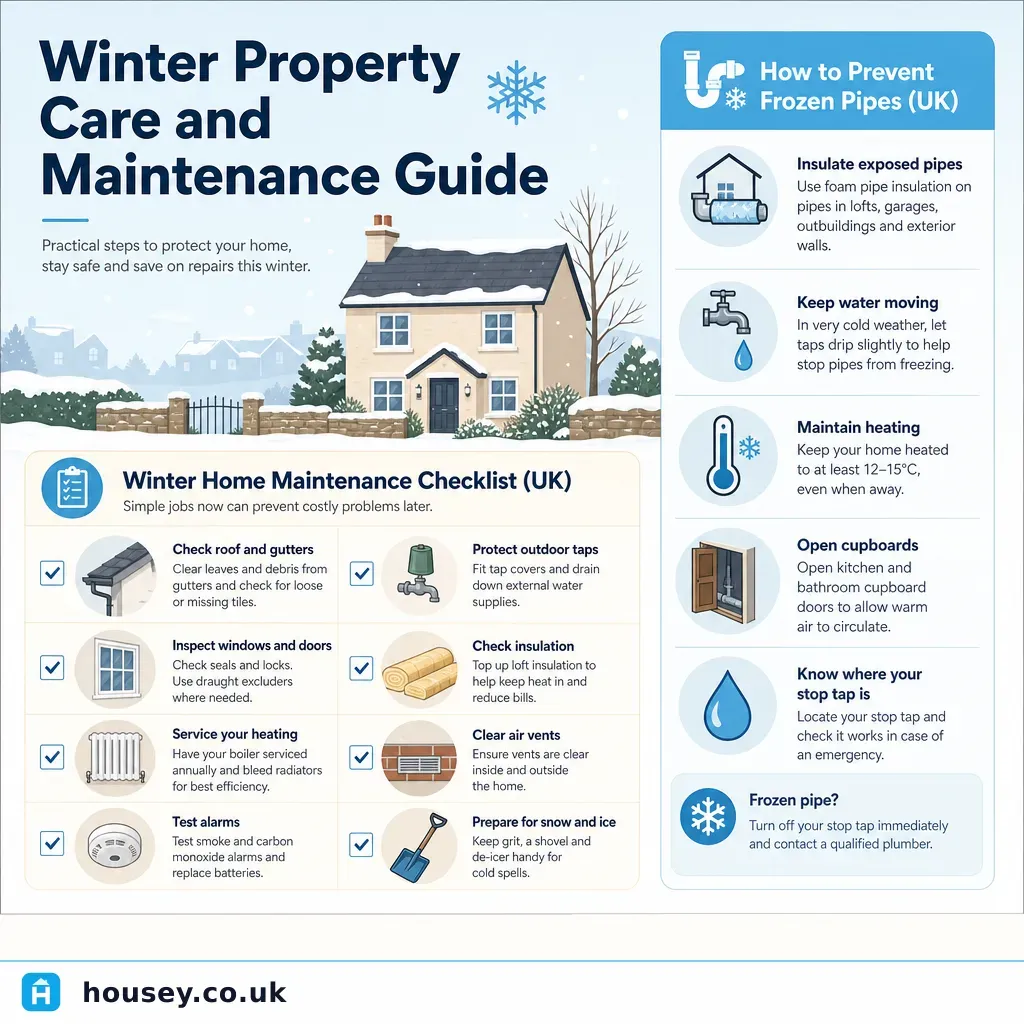
Winter Property Care and Maintenance Guide
Winter property maintenance in the UK means checking your roof, gutters, and drainage before the first frosts; insulating exposed pipework; booking a Gas Safe registered engineer for your annual boiler service; and clearing leaves from downpipes and outlets.
 Surveys & Inspections
Rental Property Inspection Checklist: What Landlords Should Assess
A landlord inspection should cover statutory safety checks (gas, electrical, smoke alarms), structural condition, services, and interior fabric.
 Surveys & Inspections
Why Property Boundaries Matter: Surveying and Dispute Prevention
Property boundaries in England and Wales are recorded as general boundaries by HM Land Registry — not precise measurements.
 Surveys & Inspections
Safe Property Viewing Practices: Protecting Yourself During Inspections
When viewing a property in the UK, always tell someone where you are going and share the full address before you leave.
 Surveys & Inspections
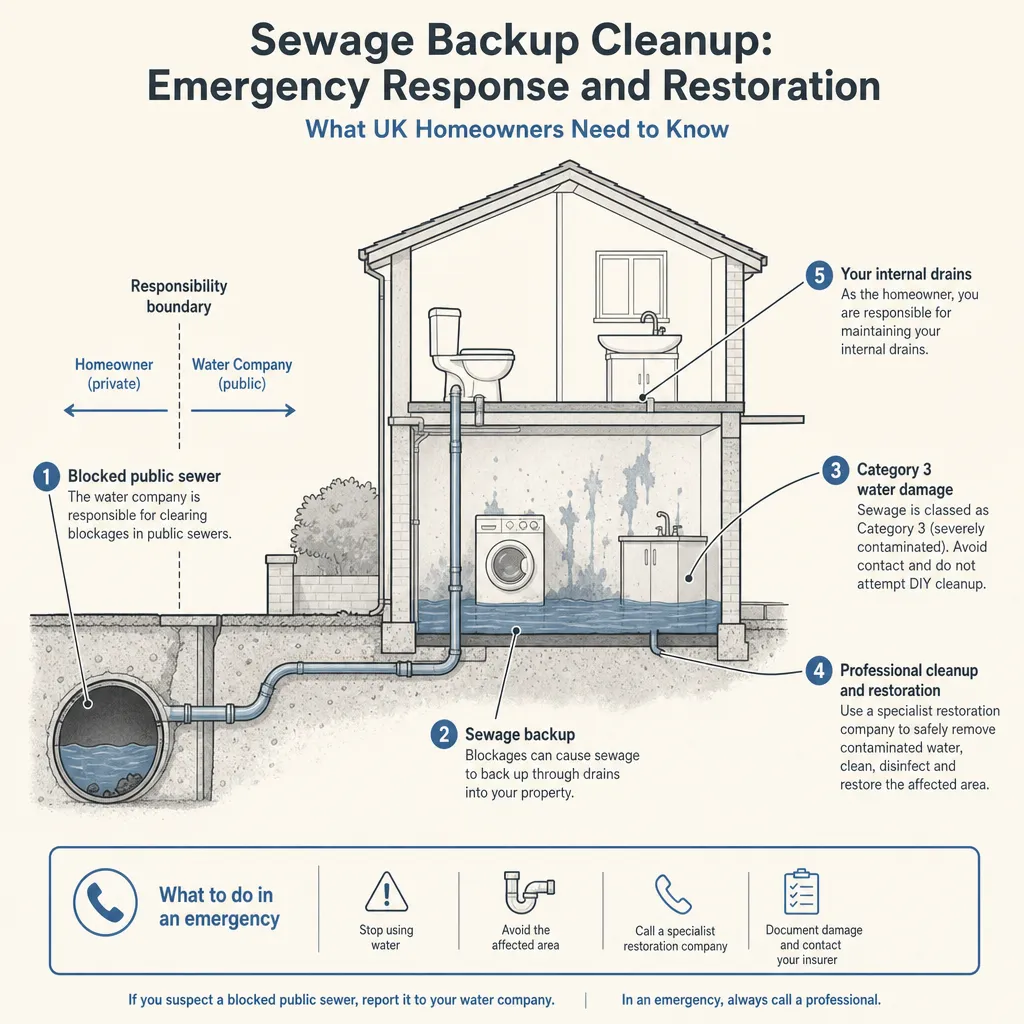
Sewage Backup Cleanup: Emergency Response and Restoration
A sewage backup should be treated as a Category 3 contamination event.