Winter Property Care and Maintenance Guide
By Housey · Last reviewed 30th of May 2026
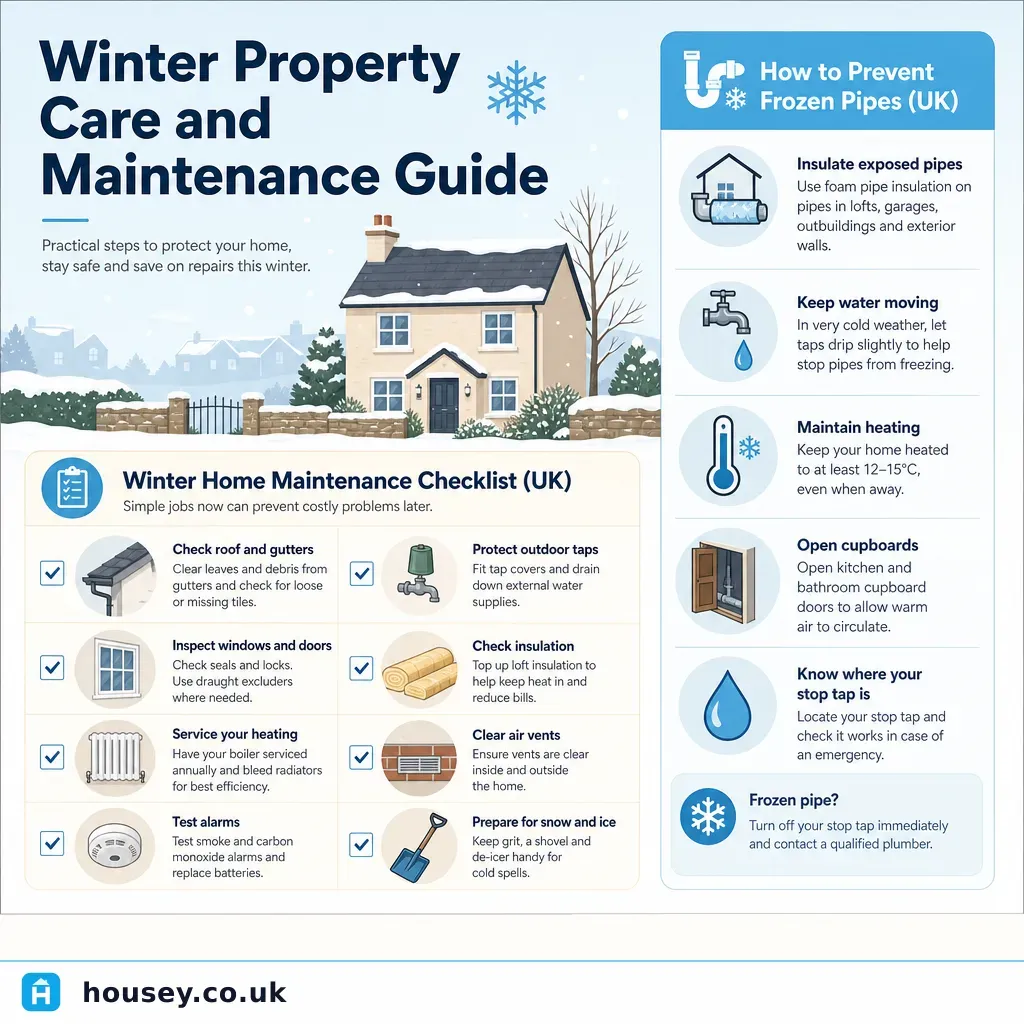
Winter Property Care and Maintenance Guide
For UK homeowners, the autumn-to-winter transition is when small maintenance oversights — a blocked gutter, a cracked ridge tile, a pipework void that was never insulated — turn into emergency repair calls in January. The UK's combination of freeze-thaw cycles, sustained rain, and older housing stock (over a third of homes were built before 1945) means seasonal preparation is genuinely useful rather than merely precautionary.
Key points
- Frozen and burst pipes are among the most common and costly winter home insurance claims in the UK; the Association of British Insurers (ABI) notes that cold-snap water damage claims can run into thousands of pounds per incident.
- Boiler servicing must be carried out by a Gas Safe registered engineer — this is required under the Gas Safety (Installation and Use) Regulations 1998, and most boiler warranties and home insurance policies require annual servicing to remain valid.
- Flat and low-pitch roof outlets and valley gutters are particularly prone to leaf and debris accumulation that causes ponding and eventual water ingress if left through autumn.
- CCTV drain surveys can identify root ingress, cracking, and partial blockages before the ground hardens in late autumn, when excavation becomes harder and more expensive.
- Building Regulations Approved Document J governs combustion appliances in new builds, but older boilers running outside their original service schedule present a higher risk of failure during peak winter demand.
Your autumn and winter property maintenance checklist
Work through these checks in October and November, before temperatures drop significantly.
Exterior checks
Heating and plumbing checks
Interior checks
DIY vs professional: which checks can you handle yourself?
Check | DIY-appropriate? | When to call a professional |
|---|---|---|
Clearing gutters at single-storey level | Yes, if safely accessible from a stable ladder | Work above 2m — use a professional with appropriate access equipment |
Visual roof inspection from ground | Yes, using binoculars | Missing or slipping tiles, sagging, visible damage — roofer or roof survey |
Bleeding radiators | Yes | Repeated pressure loss or persistent airlock — heating engineer |
Lagging accessible pipes | Yes | Pipes in difficult voids, or suspected prior freeze-damage |
Boiler service | No — Gas Safe registered engineer only | Annual service; any fault codes, unusual smells, or abnormal flame colour |
Drain inspection | No — specialist CCTV equipment required | Slow-clearing or recurring blockages, suspected structural pipe damage |
Checking chimney condition | Ground-level visual only | Any doubt — HETAS-registered sweep or qualified surveyor |
Loft inspection for leaks or movement | Yes, from boarded walkways only | Staining, cracking, sagging rafters — chartered surveyor |
Red flags that need immediate attention
Do not defer these findings to spring:
- Active water ingress through a ceiling or internal wall after rain, even if intermittent — trace and address before winter proper.
- Gutters or downpipes visibly pulling away from the wall or leaking at joints — can lead to water tracking into the cavity or wall structure.
- Boiler fault codes, unusual noises, or abnormal flame colour — call a Gas Safe registered engineer; do not attempt to investigate the appliance yourself.
- Stopcock that will not close fully — a plumber should replace it before the heating season begins.
- Cracked or bowed external render — can allow significant water penetration during freeze-thaw cycles, especially on solid-wall older properties.
- Staining or mould on a loft rafter or ceiling joist — indicates an existing leak or persistent condensation that warrants professional investigation.
- Slow-clearing or gurgling drains — a partial blockage may overflow or back up during heavy winter rain.
Maintenance responsibilities for landlords
Landlords in England and Wales have statutory obligations under the Landlord and Tenant Act 1985 to keep the structure, exterior, and heating and plumbing installations in repair. Winter defects that affect habitability — a failed boiler, a leaking roof, or sustained water ingress — must be addressed promptly. The Homes (Fitness for Human Habitation) Act 2018 extended tenant rights to challenge properties with serious defects. Check the GOV.UK guidance on landlord repair responsibilities.
When to get professional help
Many autumn checks are self-manageable, but professional advice is needed when:
- Your roof inspection reveals missing or slipped tiles, open ridge joints, or any sign of water ingress — commission a roof survey before the first prolonged heavy rain.
- You have recurring or slow-clearing drain blockages — a CCTV drain survey identifies root ingress, pipe cracking, or partial collapse without excavation.
- You notice worsening cracks in external or internal walls, particularly stepped cracking through brickwork, or cracks that reopen after filling — a structural survey by a chartered surveyor is the appropriate next step.
How Housey can help
Housey connects homeowners with trusted local specialists for seasonal property care. If your autumn inspection raises concerns, compare quotes for a professional roof survey to assess the extent of any defects. For drainage worries, a CCTV drain survey provides a clear picture without digging. And if structural concerns arise, a structural survey gives you the detailed professional assessment you need to plan repairs safely.
Frequently asked questions
When is the best time to carry out winter property maintenance?
October is the best window for most exterior checks — after the main leaf-fall but before the first hard frosts. Boiler servicing is best booked in September when engineers are less stretched than during the October–November peak. Interior checks such as loft inspection and draught-proofing can be done at any time before temperatures drop significantly.
How do I prevent frozen pipes?
Keep your heating on a low setting — a minimum of 12–15°C is commonly recommended — during cold snaps, even when the property is unoccupied. Insulate exposed pipes in unheated spaces using pipe lagging. Locate and test your stopcock so it operates correctly. If a pipe does freeze, never apply a naked flame — a warm cloth or warm-water bottle applied to the frozen section is the safe approach; call a plumber if in any doubt.
Does a boiler service cover the whole heating system?
A standard annual boiler service by a Gas Safe registered engineer covers the boiler unit — combustion analysis, heat exchanger, seals, flue, and controls. It does not routinely include flushing the system, balancing radiators, or inspecting the hot water cylinder. Ask your engineer what is included and whether a power flush or inhibitor top-up is advisable for your system.
What does a CCTV drain survey involve?
A CCTV drain survey involves a specialist camera fed through your drainage system from an access point such as a manhole or inspection chamber. It identifies blockages, root ingress, cracked or displaced joints, and collapsed pipe sections. A written report with footage is usually provided. Most surveys on a standard residential property take between one and three hours.
Sources and further reading
- Gas Safety (Installation and Use) Regulations 1998 — legislation.gov.uk
- Gas Safe Register: find a registered engineer — Gas Safe Register
- GOV.UK: Landlord responsibilities for repairs — GOV.UK
- Energy Saving Trust: pipe and tank insulation — Energy Saving Trust
- Association of British Insurers: home insurance guidance — ABI
Useful next reads
 Surveys & Inspections
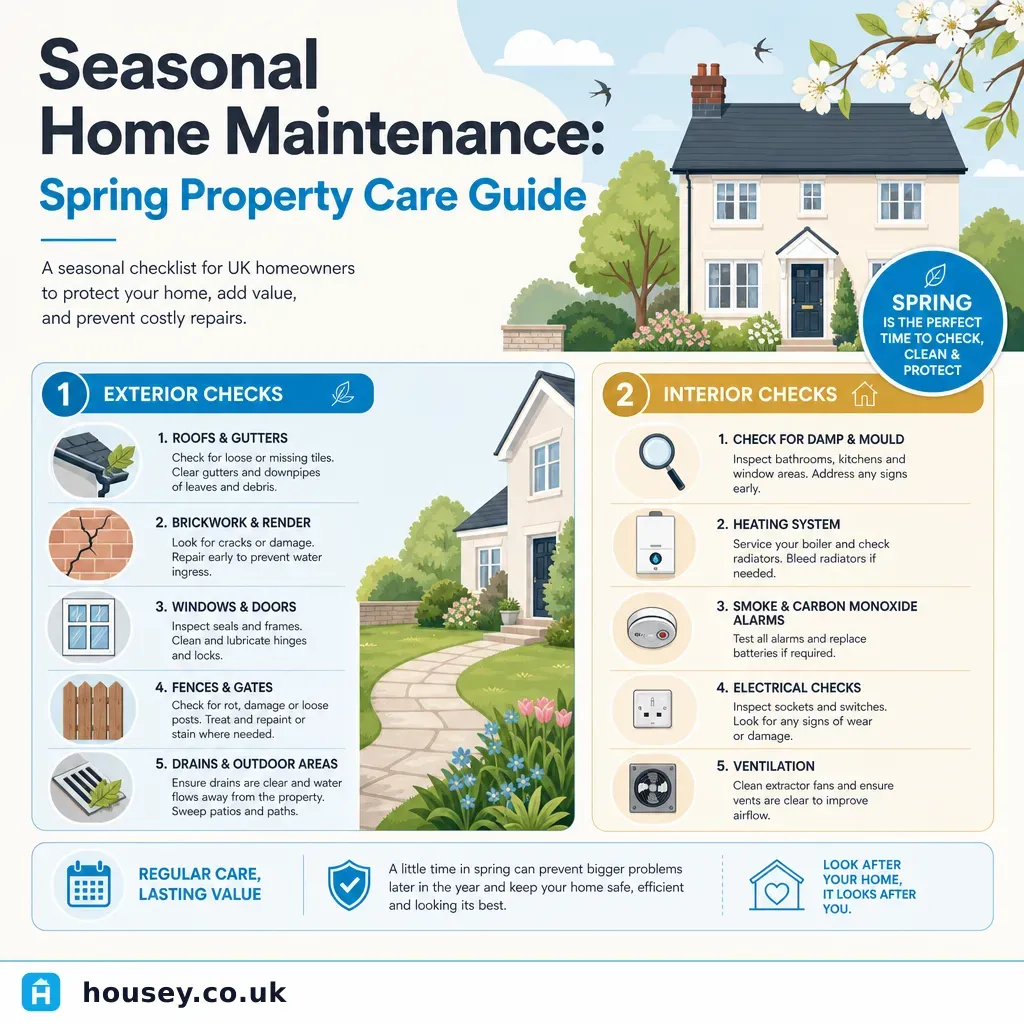
Seasonal Home Maintenance: Spring Property Care Guide
Spring is the best time to inspect your home after winter.
 Surveys & Inspections
How Professional Home Surveys Deliver Real Value For Buyers
A professional home survey by a RICS-registered surveyor can identify defects, legal compliance gaps, and cost liabilities before exchange of contracts, giving buyers an evidence base for negotiation or withdrawal.
 Surveys & Inspections
The First-Time Homeowner's Essential Guide to Property Surveys and Inspections
First-time buyers in the UK need more than the mortgage valuation — that report protects the lender, not you.
 Surveys & Inspections
Understanding Property Surveys: Types and Services Available
UK property surveys follow three RICS-defined levels: Level 1 (Condition Report), Level 2 (Home Survey), and Level 3 (Building Survey).
 Surveys & Inspections
Getting a Valuation Survey Before Selling Your Property
Before selling, a free estate agent appraisal gives a market price guide, but only a RICS Red Book valuation carries formal professional standards and legal weight.