Staircase Baluster and Railing Replacement Costs in the UK
By Housey · Last reviewed 6th of May 2026
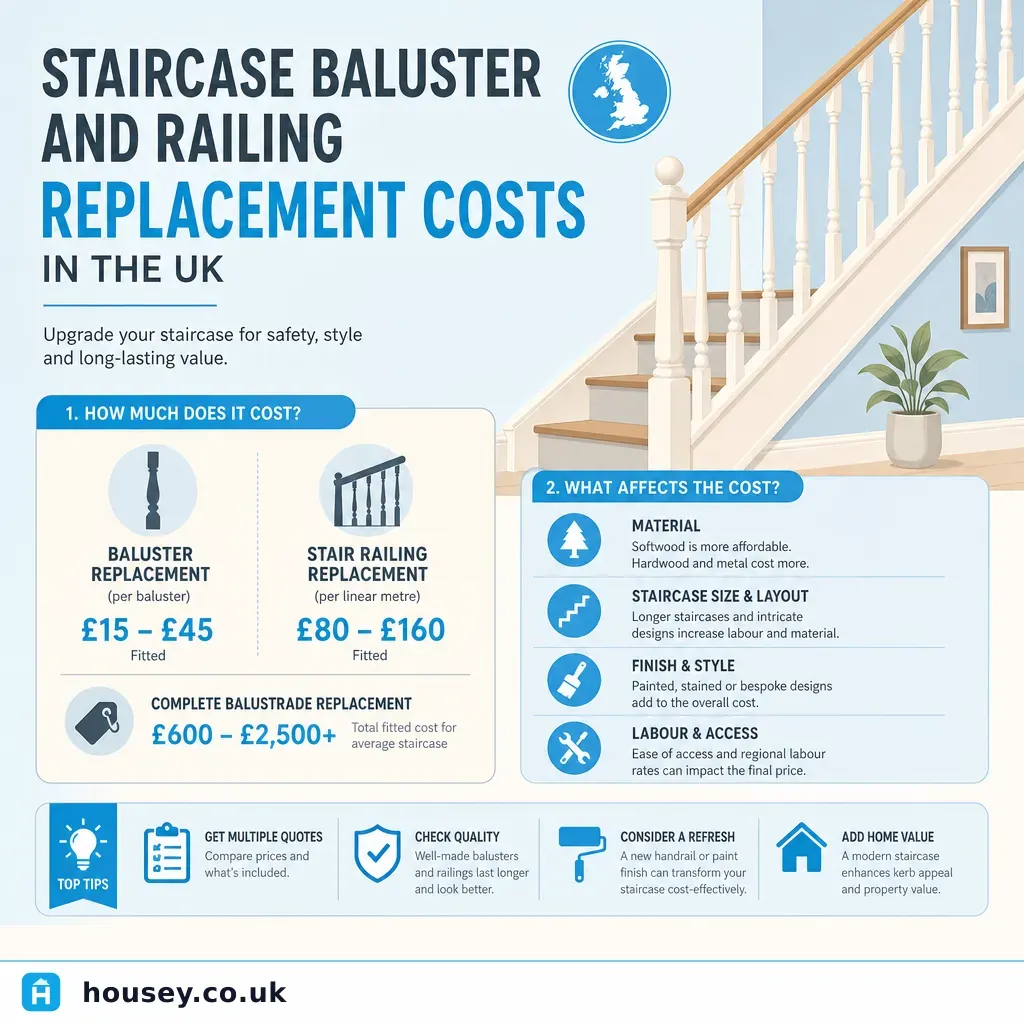
Staircase Baluster and Railing Replacement Costs in the UK
Staircase balusters — sometimes called spindles — and handrails deteriorate through everyday use, accidental impact, and in older properties, wood rot or metal corrosion. Whether you have noticed a loose spindle, a cracked handrail, or want to update the look of a tired staircase before listing a property for sale, understanding the realistic cost of replacement and when Building Regulations apply will help you plan and budget the job properly.
Key points
- Building Regulations Approved Document K requires no gap in a domestic balustrade to allow a 100mm sphere to pass through, and sets handrail height at 900mm–1,000mm above the stair pitch line
- Replacing timber balusters on a standard flight typically costs £500–£1,500 for supply and fit; glass balustrade systems can reach £2,000–£6,000+ (indicative UK costs, last reviewed 2026-05-06)
- In a listed building, replacing balusters or railings — even internally — may require listed building consent; check with your local planning authority before ordering materials
- Like-for-like baluster replacement without altering the staircase structure may not require a formal Building Regulations application, but the completed installation must still comply with Part K
- Any replacement handrail must be continuous, graspable, and safely terminated — a defect type commonly flagged in RICS HomeBuyer Surveys, Building Surveys, and Housing Health and Safety Rating System (HHSRS) assessments
What does baluster and railing replacement cost in the UK?
Cost depends primarily on material, the number of spindles, staircase configuration, and whether the handrail or newel posts also need replacing. The table below gives indicative ranges by material type (indicative UK costs, last reviewed 2026-05-06):
Material | Approx. supply cost per baluster | Typical full staircase supply and fit | Notes |
|---|---|---|---|
Timber — softwood, painted | £3–£10 | £500–£1,200 | Most common; easiest to match existing joinery |
Timber — hardwood (e.g. oak) | £8–£25 | £800–£2,000 | More durable; popular in period and Victorian properties |
Wrought iron or mild steel | £15–£60 | £1,000–£3,000 | Period or industrial style; professional fitting essential |
Powder-coated steel | £20–£80 | £1,200–£3,500 | Durable and low-maintenance; wide design range |
Structural glass panels | £150–£500 per panel | £2,000–£6,000+ | Modern look; specialist glazier and possible structural sign-off required |
Stainless steel wire or cable | £80–£200 per metre | £1,500–£4,000 | Contemporary; gap compliance must be independently verified |
Indicative UK costs, last reviewed 2026-05-06. Prices vary by region, supplier, and staircase complexity. Obtain at least three quotes before instructing any work.
Handrail-only replacement typically costs £200–£600 for a standard flight. Replacing a newel post adds £150–£500 per post depending on material, height, and fixing method.
What affects the cost of replacement?
Number of spindles A typical UK staircase of 13 treads has approximately 26–40 balusters. Open-plan layouts or staircases with a full landing balustrade add considerably to the spindle count and therefore to both material and labour costs.
Fixing method and base rail condition Balusters are typically fixed by dowelling into a base rail and handrail, or by a pin-and-shoe system. If the existing base rail is damaged or rotten, it may need repair or replacement before new balusters can be fitted.
Age and complexity of the staircase Pre-1919 staircases often have non-standard profiles. Balusters may need to be custom-turned or sourced from architectural salvage, increasing both lead times and cost. Winding, open-string, or spiral staircases are more labour-intensive than straight closed-string flights.
Regional labour rates Joinery labour varies significantly across the UK. London and the South East typically carry a 20–40% premium over equivalent rates in the Midlands, North of England, and Wales.
Building Regulations and compliance
Replacing staircase components falls within the scope of Approved Document K: Protection from falling, collision and impact (Building Regulations 2010 as amended). Key domestic staircase requirements:
- Balustrade gaps: no opening should allow a 100mm sphere to pass through — a child-safety requirement applying to both the stair flight and any landing balustrade
- Handrail height: between 900mm and 1,000mm measured vertically above the pitch line of the stair
- Handrail continuity: must extend the full length of the stair flight without interruption
- Handrail profile: must be graspable — round or oval profiles are preferred over flat or thin square sections
Do you need a formal Building Regulations application?
Where you are replacing balusters on a like-for-like basis — same material, same dimensions, same fixing method — this is generally treated as repair and maintenance rather than notifiable building work under the Building Regulations 2010. Formal approval may not be required, but the completed installation must still comply with Part K.
Where you are changing the design, material type, spindle spacing, or height — or installing glass, cable, or structural metalwork — the works are more likely to constitute notifiable building work. Contact your local building control body before starting if you are uncertain.
Worked example: Victorian terrace, South London
A homeowner in a Victorian mid-terrace noticed the original turned softwood spindles were becoming loose and several had split along the grain. The main flight had 34 spindles; the landing balustrade had 16 — 50 in total.
- Like-for-like softwood replacement: approximately £1,100 supply and fit
- Upgrade to oak spindles for a longer-lasting finish: approximately £1,900 supply and fit
- Existing handrail: structurally sound but needed sanding and repainting — additional £150 labour
Total: approximately £2,050. No Building Regulations application was required (like-for-like structural replacement, compliant with Part K spindle spacing and handrail height). The joiner confirmed compliance in writing, which the homeowner retained for their property records. The work was completed in a single day.
Red flags: when baluster replacement becomes urgent or complex
- Balusters are absent, loose, or have gaps that allow a 100mm sphere to pass through — a direct safety hazard particularly for young children or elderly occupants
- The handrail pulls away from wall fixings, is cracked, or feels unstable under load — replacement is urgent
- A RICS HomeBuyer Survey or Building Survey has flagged the staircase as requiring attention
- The property is listed or in a conservation area — check consent requirements before ordering materials or removing any existing components
- Visible rot or corrosion at fixing points — the structural integrity of newel posts may also be compromised and should be checked before new balusters are fitted
- An HHSRS assessment has classified the staircase as a Category 1 hazard (relevant for rental properties where landlord remedial action is mandatory)
What to ask a joiner or staircase specialist
Before accepting a quote, ask:
- Is the quoted price inclusive of materials, labour, fixings, and disposal of the old components?
- Will the replacement balusters comply with Building Regulations Part K spindle spacing and handrail height requirements?
- Will you confirm compliance in writing once the work is complete?
- Are custom or non-standard sizes required, and will these affect lead times or cost?
- What is included if damage to the base rail, string, or newel post is discovered once work has started?
- Do I need to notify my local building control body?
- Is VAT included in the quoted price?
- What warranty do you offer on workmanship, and do you carry public liability insurance?
When to get professional help
For straightforward like-for-like timber replacement on a conventional staircase, a competent joiner is usually sufficient. Seek additional professional input if:
- Glass balustrade panels are involved — these require a specialist glazier and may need a structural assessment of fixing points
- The property is listed — a heritage architect or your local conservation officer should be consulted before any component is removed or ordered
- Structural movement or damage to the staircase itself is suspected — a structural engineer should assess before cosmetic replacement begins
- The property is let and an HHSRS hazard assessment has flagged the staircase — document all remedial works to demonstrate compliance with the Landlord and Tenant Act 1985
How Housey can help
Housey helps homeowners across the UK find and compare quotes from vetted local joiners, staircase specialists, and other tradespeople. Use the Housey marketplace to request quotes, review professional credentials, and compare itemised prices before instructing anyone to begin work on your staircase.
Frequently asked questions
Do I need planning permission to replace stair balusters?
In most cases, no. Replacing balusters inside your home is not development and does not require planning permission. However, if your property is listed, you may need listed building consent even for internal works — the threshold is lower than many owners expect. Check with your local planning authority before removing any existing components, particularly in pre-1919 properties where original joinery may be considered significant.
How long does it take to replace stair balusters?
A standard staircase of 30–40 spindles can usually be completed in one day by an experienced joiner. Glass balustrade installations or staircases requiring custom-made components may take two to three days. Factor in lead times for bespoke or specially ordered materials, which can add one to four weeks to the overall programme before on-site work even begins.
Can I replace stair balusters myself?
Homeowners can technically carry out like-for-like baluster replacement themselves, provided the result complies with Building Regulations Approved Document K. In practice, achieving correct spacing, secure fixing, and a clean finish requires solid joinery skills. Glass, metal cable, and structural balustrade systems should always be professionally installed given the safety and technical requirements involved.
What is the difference between a baluster, spindle, and balustrade?
These terms are widely used interchangeably. A baluster or spindle is the individual vertical post between the handrail and the base rail. A balustrade is the complete assembly: handrail, balusters, base rail, and newel posts. A railing usually refers to the handrail itself, though it is often used informally to mean the full balustrade on a staircase or landing.
Will replacing balusters add value to my home?
Replacing damaged or dated balusters can improve first impressions during a sale, particularly in older homes where the staircase is prominent from the entrance hall. More practically, it reduces the risk of staircase defects being flagged in a RICS survey report at the pre-exchange stage, which could delay a sale or give a buyer grounds to renegotiate the agreed price.
Sources and further reading
- Approved Document K: Protection from falling, collision and impact — GOV.UK, Building Regulations
- Listed buildings — works requiring consent — Planning Portal
- Technical advice for historic buildings — Historic England
- Repairs in rented housing — Citizens Advice, HHSRS and landlord repair obligations
Useful next reads
 General property advice
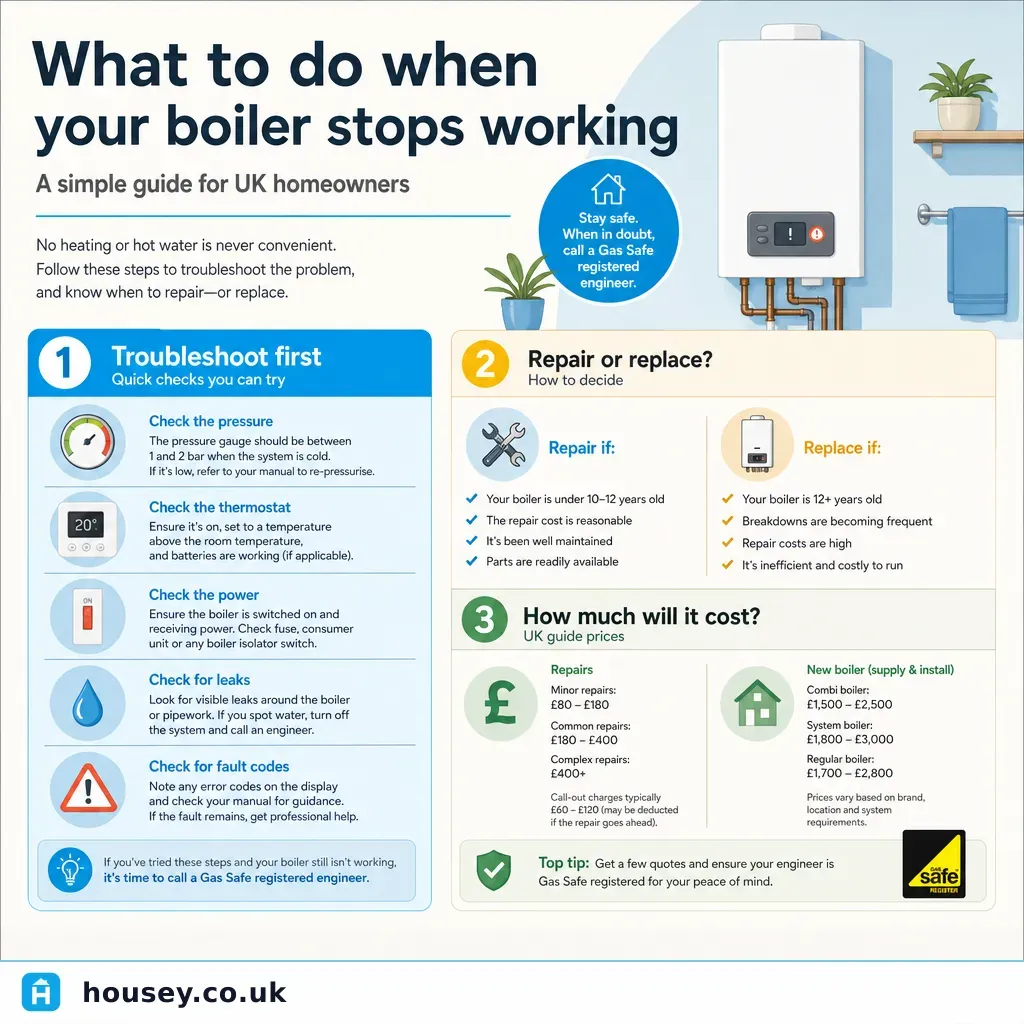
What to do when your boiler stops working
When your boiler stops working, check the pressure gauge (should read 1–1.
 General property advice
Property Market Trends: Activity Growth and Price Movements
UK property market activity is measured through completed sale registrations (HM Land Registry), lender mortgage data, and transaction volumes from HMRC.
 General property advice
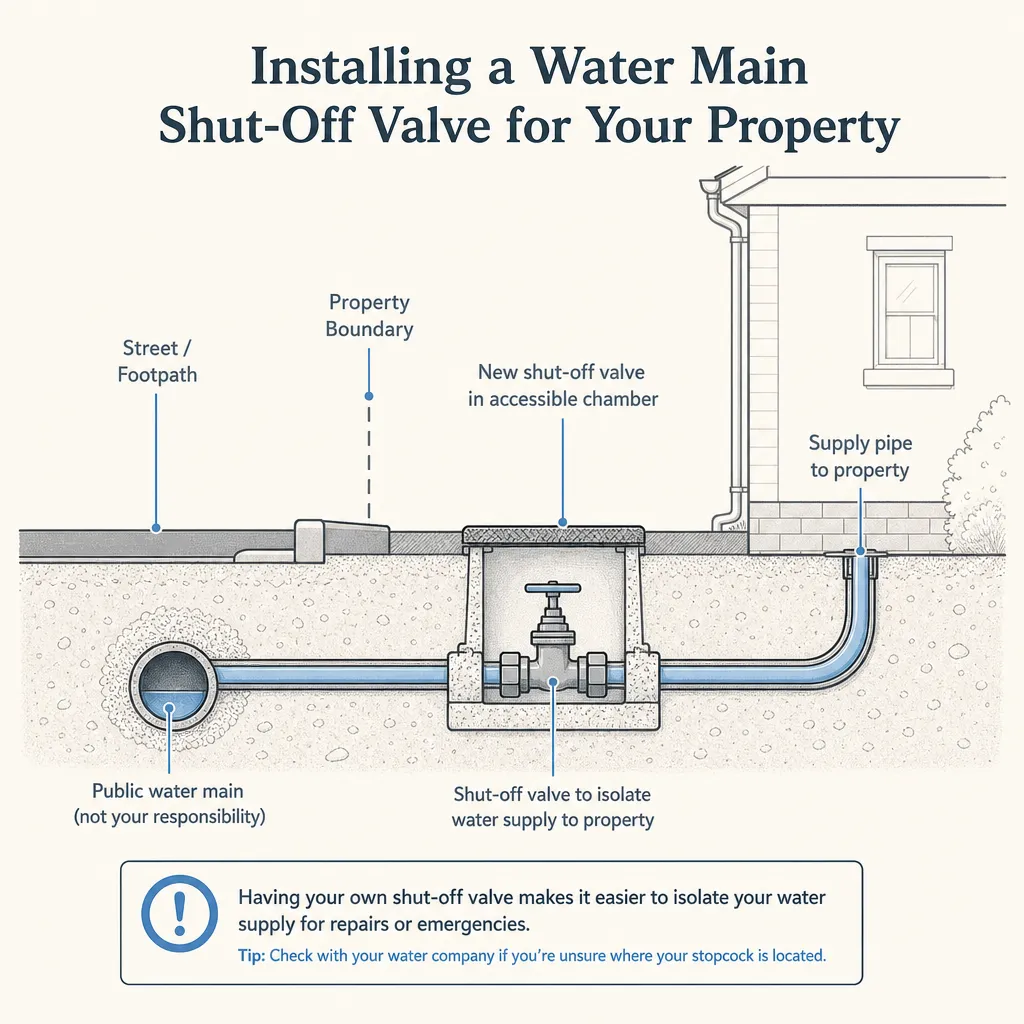
Installing a water main shut-off valve for your property
A water main shut-off valve — commonly called a stopcock — controls all water entering your home from the mains.
 General property advice
Monthly House Price Index: August Market Report and Analysis
The UK House Price Index is published monthly using completed Land Registry transaction data, meaning August figures typically reflect sales agreed months earlier.
 General property advice
Scottish Property Market: Activity and Regional Trends
Scotland's property market operates under distinct legal rules: sellers must provide a Home Report before marketing, transactions become legally binding at conclusion of missives rather than exchange of contracts, and Land and Buildings Transaction Tax replaces Stamp Duty.